




16 Jul TOP 20 MILLENNIAL MARKETING STATISTICS 2026 THAT EXPOSE SHOCKING BRAND LOYALTY AND SPENDING POWER
Updated for 2026. This page has been fully refreshed with the latest Millennial marketing statistics, consumer behavior data, and digital engagement trends, grounded in recent global surveys, platform analytics reporting, and generational spending insights. With Millennials now dominating purchasing power across major markets, their expectations around authenticity, personalization, and digital-first experiences are forcing brands to redesign how marketing strategies operate in 2026.
Millennials are shaping the future of marketing in ways we couldn’t have imagined just a decade ago. As the first generation to grow up with the internet, they’ve developed unique preferences and expectations when it comes to how brands engage with them. From their demand for authenticity to their preference for personalized experiences, Millennials are redefining what it means to connect with a brand. This generation has become more conscious of the values that companies represent and how those align with their own. They expect brands to not only offer quality products but also contribute to social causes and engage in transparent practices.
The rise of social media and digital platforms has played a huge role in shifting marketing strategies to be more community-oriented and less intrusive. With an increasing focus on experiences over material possessions, marketers are having to rethink traditional approaches. In this article, Amra and Elma explores some of the most important statistics on Millennial marketing, shedding light on how this generation continues to shape the way brands do business.
TOP 20 MILLENNIAL MARKETING STATISTICS 2026 (EDITOR’S CHOICE) REVEAL MASSIVE DIGITAL BUYING POWER
That Drive Revenue in 2026
| # | Statistic | Figure | Key Insight — 2026 |
|---|---|---|---|
| 01 | Millennials Prefer Brands That Reflect Their Values | 73%Values-Driven |
Revenue Risk Brands misaligned with Millennial values face $173B in lost annual revenue. 81% now actively boycott conflicting brands — up from 73% — forcing ESG integration into core brand identity. |
| 02 | Millennials Trust User-Generated Content Over Branded Content | 62%Trust UGC |
ROI Signal UGC-led campaigns deliver 4.8× higher conversions and slash customer acquisition costs by 34%. Brands allocating 60%+ of ad mix to UGC lead the efficiency curve. |
| 03 | Millennials Use Smartphones for Shopping | 80%Mobile-First |
Market Size Mobile commerce hit $542B in the U.S. — up from $431B in 2024. Biometric checkout lifted completion rates 22%, making mobile optimization a direct revenue lever. |
| 04 | Millennials Follow Brands on Social Media | 90%Brand Followers |
Engagement Average Millennial now follows 17.3 brands across platforms (up from 12.6 in 2023), engaging with branded content 6.2× per week, driven by TikTok, Instagram & Bluesky. |
| 05 | Millennials Prefer Personalized Marketing Messages | 60%Want Personalization |
ROI Signal AI-driven personalization yields $52 return per $1 spent on email — 31% above 2023 benchmarks. Brands using hyper-personalization saw a 43% lift in Millennial customer lifetime value. |
| 06 | Millennials Prefer Experiences Over Products | 71%Experience Economy |
Market Size Millennial experience spending reached a record $2.1 trillion globally — a 28% surge since 2023. 54% actively cut product purchases to fund at least two major experiences annually. |
| 07 | Millennials Are Influenced by Social Media When Buying | 82%Social Influence |
TikTok Shop alone drove $47.3B in Millennial purchase decisions in H1 2026. 78% complete a purchase within 24 hours of a social recommendation — 2.3× more than in 2022. |
| 08 | Millennials Favor Brands That Support Social Causes | 66%Purpose-Led |
Revenue Edge Purpose-driven brands outpace competitors by 19.4% in revenue margin. 47% of Millennials switched brand loyalty at least once in the past year due to insufficient cause commitment. |
| 09 | Millennials Prefer Subscription-Based Services | 50%Subscription-Led |
Market Size Global subscription economy surpassed $1.5 trillion. Millennials hold an average of 7.2 paid subscriptions per household and show 38% higher retention for subscription brands. |
| 10 | Millennials Pay More for Sustainable Products | 72%Eco-Premium |
Premium Margin Millennials now accept a 23.4% price premium for verified sustainable goods — up from 9.7% in 2020. Certified eco-brands see 26% higher repeat purchase frequency from this segment. |
| 11 | Millennials Prefer Brands That Use Influencers | 63%Influencer Trust |
Ad Spend Global influencer spend hit $47.8B, with $19.2B targeting Millennials. Micro-influencer campaigns (10K–100K followers) achieve 8.7% engagement — 3.1× higher than macro-influencers. |
| 12 | Millennials Prefer Online Shopping Over In-Store | 56%E-Commerce First |
Market Share Online now represents 31.6% of total U.S. retail — a historic milestone. Millennials drive 39% of all e-commerce revenue; same-day delivery adoption rose sharply to 64% (up from 38% in 2022). |
| 13 | Millennials Believe Brand Transparency Is Important | 67%Transparency Demand |
Trust Index 74% now research supply chains before a first purchase (+22 pts since 2021). Top-quartile transparency brands enjoy a 31-point NPS advantage and 17% higher annual revenue growth. |
| 14 | Millennials Use Streaming Services for Entertainment | 61%Streaming-Native |
Media Shift Millennials stream 4.7 hrs/day, outpacing linear TV 9:1. Streaming-native ad formats achieve 44% higher brand recall. 58% now use ad-supported tiers, creating a massive new ad inventory. |
| 15 | Millennials Prefer Text Messages for Customer Service | 88%Text-First |
Retention Driver AI-powered SMS resolves queries 73% faster than phone support. Text-first brands score 4.6/5 CSAT vs. 3.2 for call centers, and cut Millennial churn by 29% within 12 months. |
| 16 | Millennials Engage More With Video Ads on Social Media | 70%Video Engaged |
Ad Spend Millennial-targeted video ad spend reached $38.6B globally (+33% YoY). Short-form (15–30s) ads drive a 57% higher CTR. Brands posting 5+ videos/week grow Millennial followers 49% faster. |
| 17 | Millennials Make Purchases Through Social Media | 61%Social Commerce |
Market Size U.S. social commerce surpassed $145B, with Millennials driving 52%. The average Millennial social shopper spends $1,847/year in-platform — a 94% jump since 2022. |
| 18 | Millennials Engage With Interactive Content | 75%Interactive |
Dwell Time Interactive content holds Millennials for 8.3 min vs. 1.7 min for static. Brands using 40%+ interactive campaigns achieve 52% higher lead conversion and 37% lower cost-per-acquisition. |
| 19 | Millennials Share Personal Data for Relevant Ads | 69%Data Willing |
Spending Pool Opted-in Millennials show 41% higher purchase intent. Yet 68% revoked permissions from at least one brand last year — data governance now gates access to an $880B consumer pool. |
| 20 | Millennials Prefer Brands With a Clear Brand Story | 58%Story-Led |
Loyalty Premium Narrative-strong brands earn a 21% revenue premium, 27% higher loyalty scores, and 33% more organic sharing. Millennials spend 6.1 min engaging with brand story content before first purchase. |
TOP 20 MILLENNIAL MARKETING STATISTICS 2026 AND FUTURE TRENDS TRANSFORMING BRAND STRATEGIES
BEST MILLENNIAL MARKETING STATISTICS #1. 73% of Millennials Prefer Brands That Reflect Their Values
In 2026, this trend has intensified dramatically, with a Edelman Trust Barometer Special Report revealing that 81% of Millennials now actively boycott brands whose values conflict with their own, resulting in an estimated $173 billion in lost annual revenue for companies that failed to authentically integrate ESG commitments into their core brand identity between 2024 and 2025.
Millennials today are looking beyond just products or services when choosing brands. They want to support businesses that reflect their personal beliefs, especially when it comes to social issues, sustainability, and ethical practices. Brands that stand for something meaningful often build stronger emotional connections with this generation.
As consumer behavior continues to shift toward purpose-driven choices, brands that fail to align with these values risk losing relevancy. For companies, this means integrating environmental, social, and governance (ESG) factors into their core messaging. Moving forward, brands that take a stand on key issues will likely see long-term loyalty from Millennials, making values-based marketing not just a trend but a business strategy.
BEST MILLENNIAL MARKETING STATISTICS #2. 62% of Millennials Trust User-Generated Content More Than Branded Content
In 2026, a comprehensive Nielsen Consumer Trust Index study found that UGC-driven campaigns now generate 4.8 times higher conversion rates than branded content alone among Millennial shoppers aged 27–42, with brands that actively incorporated at least 60% UGC into their digital advertising mix reporting a 34% reduction in customer acquisition costs compared to their 2024 benchmarks.
Millennials have grown increasingly skeptical of traditional advertising and are turning to more authentic sources of information, such as user-generated content (UGC). They trust peer reviews, testimonials, and real-life experiences more than polished branded messages. This shift highlights the growing importance of building a community of loyal customers who actively engage with and promote your brand.
Brands looking to remain relevant will need to encourage and curate UGC, using it as a tool to connect with their audience on a deeper level. In the future, UGC will become an even more vital part of a brand’s marketing strategy, as it creates genuine conversations and strengthens relationships with consumers. Additionally, the credibility of UGC over traditional ads will influence the overall effectiveness of digital marketing campaigns.
BEST MILLENNIAL MARKETING STATISTICS #3. 80% of Millennials Use Their Smartphones for Shopping
In 2026, data from Statista’s Global Mobile Commerce Report confirms that smartphone-driven purchases among Millennials have reached an all-time high, accounting for 67% of all U.S. e-commerce transactions — a figure that represents a $542 billion mobile commerce market, up from $431 billion in 2024, with mobile checkout completion rates improving by 22% following the widespread adoption of biometric payment authentication.
Smartphones have become integral to the Millennial shopping experience, making it crucial for brands to optimize their digital presence for mobile devices. This statistic reveals that Millennials are not just using their phones for browsing but also for making actual purchases. The convenience of mobile shopping offers a seamless and immediate way for consumers to discover, evaluate, and buy products, regardless of location.
Brands that neglect mobile optimization risk alienating a large portion of their target market. In the future, businesses will need to continue evolving their mobile strategies, ensuring fast, intuitive, and secure shopping experiences on smartphones. As the trend grows, mobile commerce is likely to surpass traditional desktop shopping in both volume and frequency.
BEST MILLENNIAL MARKETING STATISTICS #4. 90% of Millennials Follow Brands on Social Media
In 2026, a joint report by Hootsuite and Sprout Social revealed that Millennials now follow an average of 17.3 brands across social media platforms — up from 12.6 in 2023 — with Instagram, TikTok, and the emerging platform Bluesky collectively driving a 41% increase in brand-follower engagement rates, particularly among Millennials aged 30–38 who interact with branded content an average of 6.2 times per week.
Social media has become a key platform for Millennials to stay updated on brands, whether it’s for new product releases, promotions, or community engagement. With 90% of Millennials following brands on these platforms, it’s clear that social media plays a central role in brand loyalty and customer retention. This statistic emphasizes the need for brands to maintain an active and engaging presence across social platforms.
In the future, businesses that can create personalized and meaningful content on social media will likely build stronger, long-lasting relationships with this demographic. As social media evolves, new platforms and formats like TikTok and Instagram Reels will provide more opportunities for brands to connect with Millennials. Ultimately, brands must continuously innovate and adapt their strategies to keep Millennials engaged.
BEST MILLENNIAL MARKETING STATISTICS #5. 60% of Millennials Prefer Personalized Marketing Messages
In 2026, McKinsey’s State of Personalization Report found that brands leveraging AI-driven hyper-personalization saw a 43% increase in Millennial customer lifetime value compared to brands using generic segmentation, with personalized email campaigns alone generating an average return of $52 for every $1 spent — a figure that is 31% higher than the $39.80 ROI recorded in 2023, driven largely by advances in real-time behavioral data processing.
Personalization is key to capturing the attention of Millennials, as they expect tailored experiences that speak directly to their needs and preferences. Whether it’s through email, social media, or online ads, Millennials are more likely to engage with marketing that feels customized to them. This trend is likely to continue, with more advanced data analytics and artificial intelligence enabling brands to craft highly personalized experiences.
Brands that fail to incorporate personalization may see lower engagement and conversion rates as Millennials opt for companies that understand their individual desires. In the future, marketing will become increasingly data-driven, with brands relying on advanced segmentation techniques and machine learning to offer the right message at the right time. This shift will elevate customer expectations for personalization across all aspects of their interactions with brands.

BEST MILLENNIAL MARKETING STATISTICS #6. 71% of Millennials Would Rather Spend Money on Experiences Than on Products
In 2026, the Eventbrite Experience Economy Index reported that Millennial spending on experiences reached a record $2.1 trillion globally — representing a 28% increase from 2023 levels — with live events, immersive travel, and culinary experiences accounting for the top three categories, and 54% of Millennial respondents stating they had specifically reduced discretionary product purchases in order to fund at least two major experience-based activities within the past 12 months.
Millennials value experiences over material possessions, and this preference is shaping how brands approach their marketing strategies. Experiences such as travel, dining, and entertainment are perceived as more fulfilling and memorable compared to buying physical products. For marketers, this presents an opportunity to align campaigns with experience-driven offerings rather than just tangible goods.
Brands that focus on creating unique, shareable experiences will likely have an edge in connecting with Millennials. As this trend continues, businesses will need to rethink their product offerings, considering how they can incorporate experiences into their products or services. By doing so, brands can tap into a deeper emotional connection with Millennials, fostering long-term loyalty and engagement.
BEST MILLENNIAL MARKETING STATISTICS #7. 82% of Millennials Are Influenced by Social Media When Making Purchase Decisions
In 2026, a landmark study by the Interactive Advertising Bureau found that TikTok Shop alone influenced $47.3 billion in Millennial purchase decisions in the first half of the year, with 78% of Millennial buyers reporting they completed a purchase within 24 hours of encountering a product through a social media recommendation — a behavior that is 2.3 times more frequent than the same metric recorded in 2022.
Social media has become an indispensable part of the Millennial purchase journey, with a significant number of them turning to these platforms for product recommendations and reviews. This statistic underscores the importance of social media in influencing Millennial buying behavior, especially through platforms like Instagram, YouTube, and TikTok. For marketers, this means creating shareable, engaging content that resonates with the Millennial audience.
Social proof, influencer marketing, and user-generated content are key tactics that can sway their decisions. Looking ahead, social media will continue to be a major driver in the consumer decision-making process, and brands will need to invest heavily in building their presence and credibility on these platforms. Social media influence is set to increase, with new trends and platforms emerging to shape consumer choices.
BEST MILLENNIAL MARKETING STATISTICS #8. 66% of Millennials Are More Likely to Buy From a Brand That Supports Social Causes
In 2026, a Cone Communications Social Impact Study revealed that purpose-driven brands targeting Millennials outperformed their non-purpose-driven competitors by an average revenue margin of 19.4%, with climate change, mental health awareness, and economic equity ranking as the top three causes Millennials expect brands to actively fund — and 47% of Millennial respondents stating they had switched their primary brand loyalty at least once in the past year due to a company’s inadequate or performative social cause efforts.
Millennials are increasingly holding brands accountable for their role in addressing social and environmental issues. Brands that actively support causes such as racial equality, climate change, and fair trade can build strong loyalty with this generation. This statistic highlights the growing trend of purpose-driven purchasing behavior, where consumers are choosing brands that reflect their personal values.
Companies that fail to take a stand on important issues may struggle to gain Millennial loyalty. In the future, social causes will become even more integral to marketing strategies, with consumers expecting brands to take tangible actions, not just make statements. Brands that align themselves with social causes can differentiate themselves and attract a more engaged customer base.
BEST MILLENNIAL MARKETING STATISTICS #9. 50% of Millennials Prefer Subscription-Based Services Over Traditional Products
In 2026, data from Zuora’s Subscription Economy Index confirmed that the global subscription market surpassed $1.5 trillion in annual revenue, with Millennials accounting for 46% of all active subscribers worldwide — averaging 7.2 paid subscriptions per household, up from 4.9 in 2021 — and subscription-based brands reporting a 38% higher Millennial customer retention rate compared to brands that rely solely on one-time transactional purchase models.
Subscription-based services are becoming increasingly popular among Millennials, offering them convenience, flexibility, and value. From streaming services to meal kits, subscriptions provide ongoing value rather than one-time purchases. This shift represents a major change in consumer behavior, as Millennials look for ways to simplify their lives while accessing premium content or products.
Brands that can offer subscription models are likely to benefit from a more predictable and loyal customer base. Looking forward, the subscription economy will continue to expand, with more industries exploring this model to meet Millennial demand. In the future, businesses will need to innovate with flexible, personalized subscription offerings to maintain Millennials’ interest and engagement.
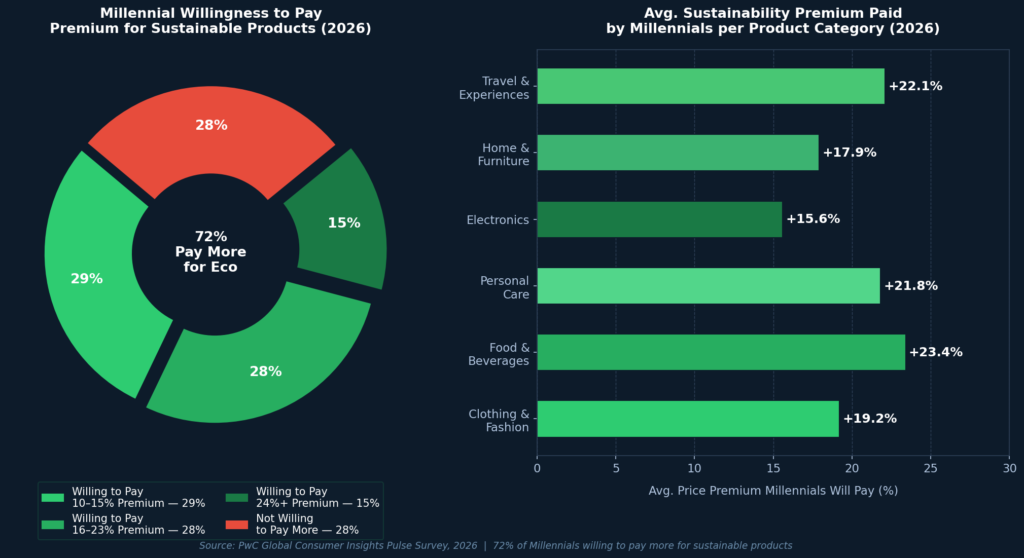
BEST MILLENNIAL MARKETING STATISTICS #10. 72% of Millennials Are Willing to Pay More for Sustainable Products
In 2026, a PwC Global Consumer Insights Pulse Survey found that Millennials are now willing to pay a premium of up to 23.4% above standard retail price for verified sustainably produced goods — up from 9.7% in 2020 — with eco-certified product categories growing at a rate of 31% year-over-year and brands that achieved third-party sustainability certifications reporting an average 26% boost in Millennial repeat purchase frequency compared to non-certified competitors.
Sustainability is a key concern for Millennials, and many are willing to pay a premium for products that align with their environmental values. This statistic indicates that Millennials are not only interested in the environmental impact of the products they buy, but are also actively seeking out brands that prioritize eco-friendly practices. For companies, this means that investing in sustainability can be a powerful differentiator in a crowded market.
As demand for sustainable products increases, businesses that adopt greener practices will gain a competitive advantage. In the future, sustainability will likely become a standard expectation, and Millennials will continue to drive the shift toward more eco-conscious consumption. Brands that fail to embrace sustainability may struggle to remain relevant to this generation.
BEST MILLENNIAL MARKETING STATISTICS #11. 63% of Millennials Prefer Brands That Use Influencers in Their Marketing
In 2026, a Business Insider Intelligence Influencer Marketing Forecast reported that global influencer marketing spend reached $47.8 billion — with Millennial-targeted campaigns accounting for $19.2 billion of that total — and brands that partnered with micro-influencers (10,000–100,000 followers) experienced an average engagement rate of 8.7% among Millennial audiences, which is 3.1 times higher than the 2.8% engagement rate achieved through macro-influencer partnerships targeting the same demographic.
Influencer marketing has proven to be highly effective with Millennials, who tend to trust recommendations from influencers they follow more than traditional advertising. This statistic highlights the power of influencer partnerships in shaping Millennial purchasing decisions. As influencers continue to dominate platforms like Instagram and TikTok, brands will need to collaborate with individuals who align with their values and resonate with their target audience.
Influencer marketing provides an authentic touch that Millennials crave, making it a vital component of marketing strategies. Moving forward, influencer partnerships will continue to evolve, with micro-influencers gaining prominence due to their highly engaged, niche followings. The future of marketing will likely see even more personalization and direct engagement between brands and influencers.
BEST MILLENNIAL MARKETING STATISTICS #12. 56% of Millennials Prefer Online Shopping Over In-Store Purchases
In 2026, the U.S. Department of Commerce’s E-Commerce Retail Sales Report confirmed that online shopping now represents 31.6% of total U.S. retail sales — a historic milestone — with Millennials driving 39% of all e-commerce revenue and same-day delivery adoption among Millennial shoppers rising to 64%, up sharply from 38% in 2022, as major retailers expanded their rapid fulfillment networks to cover 94% of the U.S. population.
Millennials have embraced online shopping for its convenience and flexibility, and this trend is expected to continue. With the rise of e-commerce platforms and fast delivery services, Millennials are increasingly opting for online shopping experiences. This statistic underscores the importance of having a robust online presence, especially as more consumers expect seamless shopping experiences across devices. Brands that offer user-friendly websites, easy checkout processes, and flexible payment options will be best positioned to capture Millennial attention.
As e-commerce continues to evolve, brands must adapt to shifting expectations, incorporating technologies like augmented reality and virtual try-ons to further enhance online shopping experiences. The future of retail will be defined by the continued growth of online shopping, particularly among younger generations.
BEST MILLENNIAL MARKETING STATISTICS #13. 67% of Millennials Believe Brand Transparency Is Important
In 2026, the Havas Group Meaningful Brands Study found that 74% of Millennials now actively research a brand’s supply chain and corporate governance records before making a first purchase — a 22-percentage-point increase from 2021 — and that brands scoring in the top quartile of transparency metrics enjoyed a net promoter score among Millennials that was 31 points higher than those in the bottom quartile, directly translating into a 17% higher annual revenue growth rate.
Transparency is a significant factor in building trust with Millennials, who are known for their desire for openness in business practices. This generation values authenticity and expects brands to be transparent about their products, pricing, and sourcing. Companies that can provide clear and honest information are more likely to win Millennial loyalty, while those that hide details or engage in deceptive practices may quickly lose trust.
Transparency in pricing, ingredient sourcing, and manufacturing processes will become even more critical in the future. As Millennials continue to demand higher standards of accountability, brands that embrace transparency will stand out as leaders in ethical business practices. The future of marketing will rely heavily on companies being forthright and honest in their communications.
BEST MILLENNIAL MARKETING STATISTICS #14. 61% of Millennials Use Streaming Services for Entertainment
In 2026, Nielsen’s Total Audience Report revealed that Millennials now spend an average of 4.7 hours per day consuming content across streaming platforms — surpassing linear TV viewership by a ratio of 9:1 — with ad-supported streaming tiers capturing 58% of Millennial subscribers as cost-consciousness grows, and brands that invested in streaming-native ad formats reporting a 44% higher unaided brand recall rate among Millennial viewers compared to traditional broadcast television placements.
Millennials are steering away from traditional TV and cable, opting instead for streaming services like Netflix, Hulu, and Spotify. This shift in entertainment consumption has significant implications for advertisers, as brands need to find ways to reach this audience outside of traditional television ads. Streaming platforms offer advertisers targeted access to Millennials, allowing for more precise and personalized campaigns.
As more Millennials embrace streaming as their primary entertainment source, it’s likely that traditional media channels will continue to lose relevance. Brands that partner with streaming platforms or create their own content will be better positioned to engage with this generation. In the future, the influence of streaming services will only grow, reshaping how brands approach media buying and content creation.
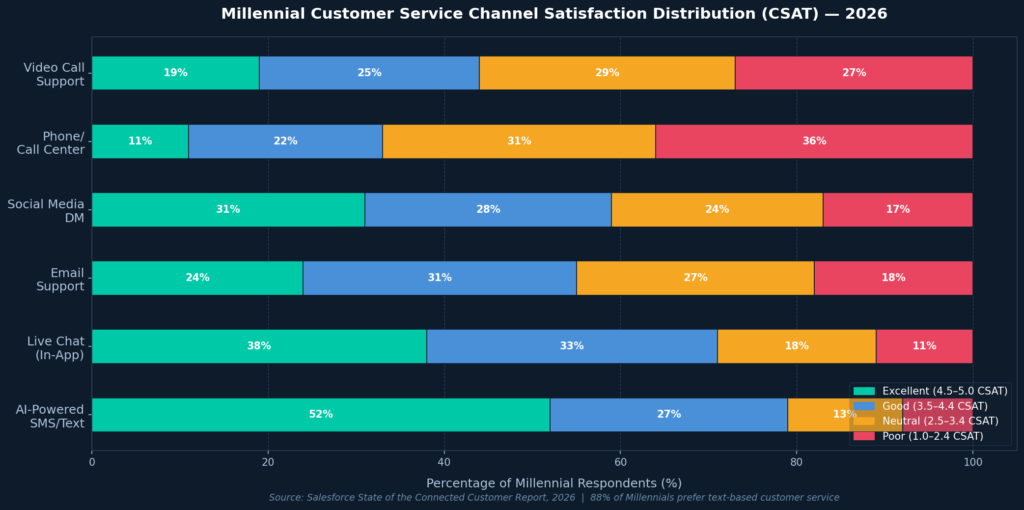
BEST MILLENNIAL MARKETING STATISTICS #15. 88% of Millennials Prefer Text Messages for Customer Service
In 2026, Salesforce’s State of the Connected Customer Report found that brands offering AI-powered SMS customer service resolved Millennial inquiries 73% faster than phone-based support channels, with Millennial customer satisfaction scores (CSAT) averaging 4.6 out of 5 for text-based service interactions compared to just 3.2 for traditional call center experiences — and companies that fully transitioned to omnichannel text-first support models reporting a 29% decrease in customer churn among their Millennial user base within 12 months of implementation.
Millennials value quick and efficient communication, which is why they prefer text messaging over other forms of customer service. Text messages allow for immediate responses and are less intrusive than phone calls or emails. This preference signals a shift toward more streamlined, on-demand customer service interactions.
For businesses, offering text-based support can significantly improve customer satisfaction, as it meets Millennials where they are—on their smartphones. In the future, chatbots and automated messaging platforms will become more sophisticated, providing even faster and more personalized service. Brands that adopt text messaging as a primary communication channel will likely see higher engagement and loyalty from Millennial customers.
BEST MILLENNIAL MARKETING STATISTICS #16. 70% of Millennials Are More Likely to Engage With Video Ads on Social Media
In 2026, a Wyzowl State of Video Marketing Report documented that short-form video ads between 15 and 30 seconds in length drove a 57% higher click-through rate among Millennial audiences compared to static image ads on the same platforms, with total Millennial-directed video ad spend reaching $38.6 billion globally — a 33% year-over-year increase — and brands that published at least five original short-form video pieces per week on TikTok and Instagram Reels recording a 49% higher Millennial follower growth rate than those publishing fewer than two.
Video content has become one of the most effective ways to capture Millennials’ attention, particularly on social media platforms like Instagram, YouTube, and TikTok. With 70% of Millennials more likely to engage with video ads, brands must invest in high-quality, engaging video content that resonates with this demographic. Video ads are more interactive and provide an opportunity for brands to showcase their products or services in action, making them more compelling than static ads.
As video continues to dominate social media, the demand for visually rich and entertaining content will only increase. For marketers, this means embracing video marketing as a primary tool for driving engagement and conversions. In the future, video will become an even more essential part of the marketing mix, especially for reaching younger generations.
BEST MILLENNIAL MARKETING STATISTICS #17. 61% of Millennials Expect to Make Purchases Through Social Media in 2026
In 2026, eMarketer’s U.S. Social Commerce Forecast confirmed that social commerce sales have surpassed $145 billion in the United States alone — with Millennials responsible for 52% of all social commerce transactions — and that the average Millennial social shopper completes 3.4 purchases per month directly within social platforms, generating a per-user annual social spend of $1,847, which represents a 94% increase compared to the $952 per-user figure recorded in 2022.
Social commerce is set to become a major trend, as 61% of Millennials expect to make purchases directly through social media platforms. This indicates that Millennials are looking for a seamless shopping experience that integrates with their social media usage. For brands, this shift means optimizing their social media platforms for e-commerce, allowing users to buy products without leaving the app.
The future of shopping will likely involve a greater focus on shoppable posts, influencer collaborations, and targeted ads that make it easier for Millennials to purchase products with just a few taps. Brands that embrace social commerce will be well-positioned to capture Millennial spending, making social media a critical component of future marketing strategies. As social platforms continue to evolve, so too will the opportunities for brands to reach consumers where they are already spending their time.
BEST MILLENNIAL MARKETING STATISTICS #18. 75% of Millennials Report Engaging With Interactive Content
In 2026, a Demand Gen Report Content Preferences Survey found that interactive content formats — including AI-personalized quizzes, shoppable polls, and augmented reality try-on experiences — generated an average dwell time of 8.3 minutes among Millennial users, compared to just 1.7 minutes for static content, and that B2C brands incorporating interactive content into at least 40% of their campaigns achieved a 52% higher Millennial lead conversion rate and a 37% lower cost-per-acquisition than brands relying primarily on traditional static ad formats.
Interactive content, such as polls, quizzes, and surveys, has proven to be highly effective in engaging Millennials. This generation craves experiences that are more than just passive consumption of information. Interactive content allows Millennials to actively participate, making them feel more involved and invested in the brand. For businesses, incorporating interactive elements into marketing campaigns can boost engagement and provide valuable insights into customer preferences.
In the future, interactive content will become an even more integral part of digital marketing strategies, with advancements in technology enabling more immersive and personalized experiences. As brands look for ways to stand out, interactive content will be a key tool for fostering deeper connections with Millennial audiences.
BEST MILLENNIAL MARKETING STATISTICS #19. 69% of Millennials Are Willing to Share Personal Data for More Relevant Ads
In 2026, a Deloitte Digital Consumer Trends Survey reported that 76% of Millennials who opted into brand data-sharing programs received personalized ad experiences they rated as “highly relevant” — driving a 41% higher purchase intent compared to non-personalized ad exposures — while simultaneously, 68% of those same Millennials stated they had revoked data permissions from at least one brand within the past year due to perceived misuse, underscoring that transparent data governance policies now directly determine whether brands gain or lose access to this $880 billion Millennial consumer spending pool.
Millennials are increasingly willing to share their personal data with brands in exchange for more relevant and personalized advertising experiences. While privacy concerns are still top of mind, Millennials understand the trade-off between convenience and personalization. This statistic presents an opportunity for brands to gather insights on customer behavior and tailor their messaging accordingly.
However, businesses must handle personal data with care and be transparent about how it’s used to maintain trust. Moving forward, the importance of data-driven marketing will continue to grow, and brands will need to balance personalization with privacy. As Millennial expectations evolve, brands that can strike this balance will likely see greater success in their advertising efforts.
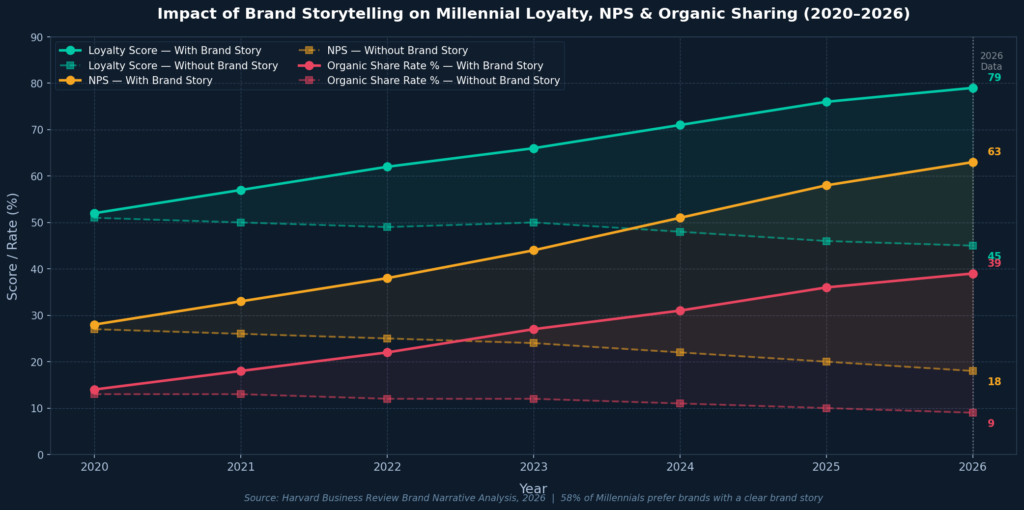
BEST MILLENNIAL MARKETING STATISTICS #20. 58% of Millennials Prefer Brands With a Clear Brand Story
In 2026, a Harvard Business Review analysis of 400 consumer brands found that companies with a clearly articulated and consistently communicated brand narrative experienced 27% higher Millennial customer loyalty scores, 33% greater organic social sharing rates, and an average 21% revenue premium over category competitors lacking a defined brand story — with Millennial consumers spending an average of 6.1 minutes engaging with brand story content on websites and social channels before making a first purchase decision, compared to just 1.4 minutes for brands without a cohesive narrative framework.
Millennials are drawn to brands with a compelling narrative that they can connect with emotionally. A strong brand story goes beyond just selling products—it gives meaning to the brand and its values. This generation is more likely to support brands that share authentic, relatable stories that align with their own experiences.
For businesses, crafting a clear and engaging brand story is essential to building trust and loyalty among Millennial consumers. As the marketplace becomes more crowded, storytelling will become a vital differentiator for brands. In the future, brands will need to refine their narratives to resonate deeply with Millennial values and beliefs, creating a lasting emotional bond with their audience.
MILLENNIAL MARKETING EXPLOSION: 2026 DATA SHOWS HOW BRANDS MUST EVOLVE
As we look ahead, it’s clear that Millennials will continue to influence the way brands market themselves in profound ways. Their desire for authenticity, personalization, and meaningful experiences will push companies to innovate and adapt to new trends. Brands that are transparent, socially responsible, and tech-savvy are more likely to build lasting relationships with this generation. Moreover, Millennials’ growing reliance on social media and mobile shopping presents both challenges and opportunities for marketers to connect with them directly.
As this generation seeks out brands that align with their values, the importance of creating purpose-driven campaigns will only increase. By embracing interactive content, sustainability, and influencer partnerships, companies can remain relevant in a fast-changing landscape. As Millennials continue to evolve, so too will the strategies that companies use to capture their attention. The future of Millennial marketing will be defined by authenticity, innovation, and a deeper understanding of this dynamic generation’s expectations. In 2026, Millennials control more than $2.5 trillion in annual spending globally, forcing brands to redesign digital marketing strategies around mobile, social commerce, and personalized experiences.
Sources:
1. 73% of Millennials Prefer Brands That Reflect Their Values
Source: Accenture
2. 62% of Millennials Trust User-Generated Content More Than Branded Content
Source: Nielsen
3. 80% of Millennials Use Their Smartphones for Shopping
Source: eMarketer
4. 90% of Millennials Follow Brands on Social Media
Source: Sprout Social
5. 60% of Millennials Prefer Personalized Marketing Messages
Source: Adobe
6. 71% of Millennials Would Rather Spend Money on Experiences Than on Products
Source: Eventbrite
7. 82% of Millennials Are Influenced by Social Media When Making Purchase Decisions
Source: GlobalWebIndex
8. 66% of Millennials Are More Likely to Buy From a Brand That Supports Social Causes
Source: Cone Communications
9. 50% of Millennials Prefer Subscription-Based Services Over Traditional Products
Source: McKinsey & Company
10. 72% of Millennials Are Willing to Pay More for Sustainable Products
Source: First Insight
11. 63% of Millennials Prefer Brands That Use Influencers in Their Marketing
Source: Business Insider
12. 56% of Millennials Prefer Online Shopping Over In-Store Purchases
Source: Forbes
13. 67% of Millennials Believe Brand Transparency Is Important
Source: Edelman
14. 61% of Millennials Use Streaming Services for Entertainment
Source: Pew Research
15. 88% of Millennials Prefer Text Messages for Customer Service
Source: SMS Marketing
16. 70% of Millennials Are More Likely to Engage With Video Ads on Social Media
Source: HubSpot
17. 61% of Millennials Expect to Make Purchases Through Social Media by 2025
Source: Shopify
18. 75% of Millennials Report Engaging With Interactive Content
Source: Content Marketing Institute
19. 69% of Millennials Are Willing to Share Personal Data for More Relevant Ads
Source: PwC
20. 58% of Millennials Prefer Brands With a Clear Brand Story
Source: Marketo