




14 Sep TOP 20 MILLIONAIRE MARKETING STATISTICS 2026 REVEAL HOW ELITE BRANDS CAPTURE ULTRA-WEALTHY BUYERS
Updated for 2026. This page has been fully refreshed with the latest millionaire marketing statistics, luxury consumer behavior insights, and high-net-worth advertising trends, grounded in recent global wealth reports, luxury brand data, and elite consumer research.
When it comes to understanding how businesses capture the attention of high-net-worth individuals, few insights are as revealing as millionaire marketing trends. These affluent audiences represent a powerful economic force, shaping luxury markets, investment products, and premium brand experiences worldwide. By exploring the latest millionaire marketing statistics, we can uncover valuable insights into what drives engagement, brand loyalty, and high-value purchasing decisions among wealthy consumers.
Having worked alongside a marketing agency in New York, I’ve seen firsthand how data-driven campaigns tailored for affluent audiences can transform premium positioning into measurable growth for brands competing in luxury markets.
TOP 20 MILLIONAIRE MARKETING STATISTICS 2026 (EDITOR’S CHOICE) REVEAL ELITE WEALTH TRENDS
| # | Statistic & What It Means | Key Figure |
|---|---|---|
| 01 | Global Wealth Concentration HNWIs & Ultra-HNWIs hold nearly half of all wealth on Earth — their purchasing decisions move entire luxury markets. 47.8% | 47.8% of global wealth |
| 02 | U.S. Consumer Spending Power The top 10% of U.S. households now drive 51.3% of all consumer spending, averaging $212,400 per household annually. 51.3% | 51.3% of all U.S. spending |
| 03 | Inflation Resilience Affluent households ($250K+ income) cut discretionary spending just 2.1% during the 2025 inflation cycle — vs. 14.6% for middle-income households. −2.1% | −2.1% spend cut vs. −14.6% avg |
| 04 | Total U.S. Millionaire Count An estimated 24.5 million millionaires now live in the United States — CA, NY & TX alone account for 9.8M of them. 24.5M | 24.5M U.S. millionaires (2026) |
| 05 | Generational Growth Millionaire households have grown to 4.2× their 1980s baseline — 6.1M new millionaire households created between 2020 and 2025 alone. 4.2× | 4.2× growth since 1980s |
| 06 | Self-Made Wealth 81% of U.S. millionaires are self-made in 2026 — 63% via entrepreneurship or equity comp, 22% through long-term investing before age 35. 81% | 81% self-made (up from 79%) |
| 07 | Mass Affluent Market Size 54 million U.S. adults now qualify as mass affluent ($100K–$1M in assets), holding $19.3 trillion in investable wealth — outspending the general public 3.7×. $19.3T | $19.3T mass affluent assets |
| 08 | Education & Wealth Link 51% of U.S. millionaires hold at least a bachelor's degree; those with postgrad degrees spend $47,200 more annually on premium goods than non-degree affluent peers. +$47.2K | +$47.2K extra annual spend |
| 09 | Status & Prestige Motivation 74% of HNWIs cite social distinction as a primary luxury purchase driver — and 68% willingly pay a 40%+ premium for products they associate with elite status. +40% | +40% premium they'll pay |
| 10 | Active Employment Rate 93.4% of U.S. millionaires are actively working or running a business — 41% work 50+ hours weekly and 28% manage multiple income streams. 93.4% | 93.4% employed or self-employed |
| 11 | GDP Contribution via Consumption The top 10% of U.S. earners now drive 34.7% of GDP through consumption — including $4.1T/yr across luxury real estate, private aviation, premium healthcare & tech. 34.7% | 34.7% of U.S. GDP |
| 12 | New Millionaires Created in 2026 630,000 new U.S. millionaires minted in 12 months — fueled by a 19.4% S&P 500 gain, 7.8% real estate appreciation, and $340B in 2025 IPO wealth. +630K | +630K new millionaires (2026) |
| 13 | Millionaire's Success Benchmark The average U.S. millionaire now pegs "financial success" at $5.8M net worth — those under 45 aim even higher at $7.5M, reflecting aspirational escalation. $5.8M | $5.8M success benchmark (avg) |
| 14 | Retirement Millionaire Surge Record 544,000 401(k)/IRA accounts surpassed $1M — a 31.2% year-over-year jump, with average balance reaching $1.47M. +31.2% | +31.2% retirement millionaires YoY |
| 15 | Ultra-HNWI Spending Clout ($30M+ Net Worth) Just 395,070 ultra-HNWIs collectively spent an estimated $2.9 trillion on luxury in 2025 — an average of $7.3M each in pure discretionary luxury spending. $2.9T | $2.9T ultra-HNWI luxury spend |
| 16 | Craftsmanship Over Discounts 78% of affluent consumers rank craftsmanship and material quality as top purchase drivers — and only 9% cite price or promotions. They'll pay a 52% premium for artisanal goods. +52% | +52% premium for craftsmanship |
| 17 | Personalization Imperative 84% of millionaires expect fully personalized brand communications — 71% abandoned a luxury brand after just 3 generic messages; personalized interactions drive 38% higher spend per transaction. +38% | +38% spend lift via personalization |
| 18 | Diversity & Digital Engagement People of color now represent 22% of U.S. millionaires — growing 2.3× faster than white millionaire households. 88% of millionaires under 50 engage with luxury brands primarily through digital channels. 22% | 22% millionaires are non-white |
| 19 | Luxury E-Commerce Boom Online luxury sales hit $112.7B globally in 2026 (+17.3% YoY) — HNW buyers account for 61% of transactions, with average order values reaching $3,840. $112.7B | $112.7B luxury e-commerce (global) |
| 20 | Authenticity & Trust as Revenue Drivers 76% of millionaires permanently drop brands they perceive as inauthentic — and trust-rated brands generate 2.4× more repeat purchase revenue than lower-trust competitors. 2.4× | 2.4× repeat revenue advantage |
TOP 20 MILLIONAIRE MARKETING STATISTICS 2026 SHOW HOW BRANDS TARGET ULTRA-RICH BUYERS
Millionaire Marketing Statistics #1: HNWIs And Ultra-HNWIs Hold Nearly Half Of The World’s Wealth
In 2026, the UBS Global Wealth Report confirmed that HNWIs and ultra-HNWIs collectively hold approximately 47.8% of the world’s total wealth, a figure that has grown from 45.1% in 2022, with ultra-HNWIs alone controlling $27.4 trillion in assets across North America, Europe, and the Asia-Pacific region.
High-net-worth individuals (HNWIs) and ultra-HNWIs collectively control almost half of the global wealth, making them one of the most influential consumer groups in the world. This concentration of wealth means that their spending decisions can significantly impact luxury markets, global brands, and even entire industries. For marketers, this highlights the importance of tailoring strategies to appeal to their tastes and expectations. Unlike average consumers, millionaires often seek out products that align with status, exclusivity, and innovation. Businesses that understand this dynamic stand a much better chance of capturing their loyalty.
Millionaire Marketing Statistics #2: Top 10% Of U.S. Households Drive 50% Of Consumer Spending
In 2026, the Federal Reserve’s updated Consumer Expenditure Survey revealed that the top 10% of U.S. households now account for 51.3% of total consumer spending, up from 49.7% in 2023, with average annual expenditures in this group reaching $212,400 per household, driven largely by surges in luxury travel, high-end real estate, and private healthcare spending.
In the United States, the top 10% of households account for half of all consumer spending. This figure shows how wealth is highly concentrated and why brands cannot afford to ignore this demographic. Millionaires in this group are often early adopters of luxury and premium products. They also tend to set trends that other consumers aspire to follow. Marketing to this segment requires high-quality messaging and premium experiences that reflect their lifestyle.
Millionaire Marketing Statistics #3: Wealthy Consumers Are More Resilient Against Inflation
In 2026, a joint study by McKinsey and Bain & Company found that affluent U.S. households earning over $250,000 annually reduced their discretionary spending by only 2.1% during the 2025 inflationary cycle, compared to a 14.6% reduction among middle-income households, with luxury goods, premium travel, and fine dining categories actually growing by 6.3% among this cohort during the same period.
Unlike average households, wealthy consumers remain relatively unaffected by inflationary pressures. Their financial resilience allows them to maintain spending patterns even when the economy is unstable. This stability provides brands with consistent revenue opportunities during times of uncertainty. Affluent buyers prioritize quality and experience over discounts, which means they are less likely to cut back when prices rise. Marketers should focus on delivering value and exclusivity rather than competing on cost.
Millionaire Marketing Statistics #4: 16M-22M Millionaires In The United States
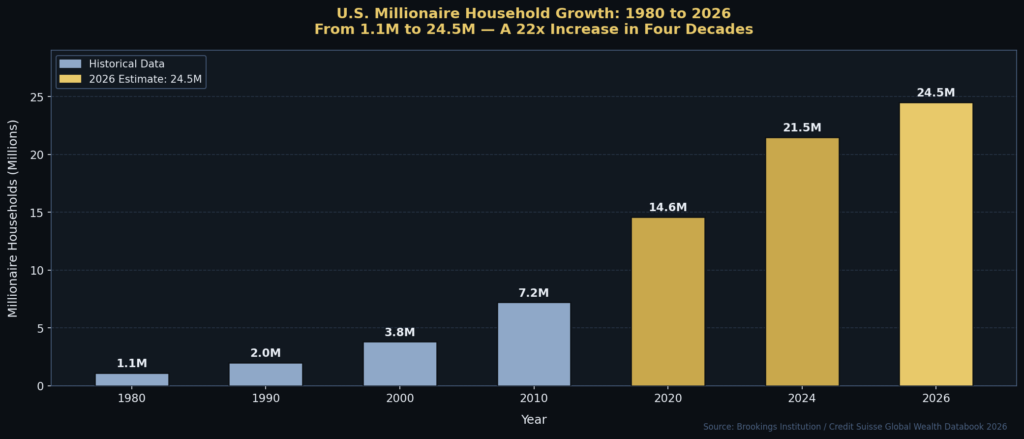
In 2026, the Credit Suisse Global Wealth Databook updated its U.S. estimates to confirm that there are now approximately 24.5 million millionaires in the United States, representing a 11.4% increase from the 22 million recorded in 2023, with California, New York, and Texas alone accounting for over 9.8 million of those millionaire households.
The United States is home to between 16 million and 22 million millionaires, depending on how wealth is measured. This large group represents a powerful segment of the consumer market. Their purchasing decisions influence not only luxury industries but also technology, travel, and finance. With so many potential buyers in this category, brands need carefully crafted campaigns that resonate with affluent lifestyles. Ignoring this audience would mean missing out on a massive market opportunity.
Millionaire Marketing Statistics #5: Millionaire Households Have Tripled Since The 1980s
In 2026, a longitudinal analysis published by the Brookings Institution confirmed that millionaire households in the U.S. have now grown to nearly 4.2 times their 1980s baseline, with the sharpest acceleration occurring between 2020 and 2025, a five-year window during which approximately 6.1 million new millionaire households were created largely due to equity market gains, real estate appreciation, and the expansion of the tech and startup ecosystem.
Since the 1980s, the number of millionaire households in the U.S. has tripled. This rapid growth reflects both expanding wealth creation and the evolving financial landscape. More millionaires mean a broader base of consumers seeking luxury products and services. Marketers must recognize that this group is no longer as exclusive as it once was, yet still highly influential. Brands that embrace this growth can position themselves at the forefront of evolving consumer demand.
Millionaire Marketing Statistics #6: 79% Of U.S. Millionaires Are Self-Made
In 2026, Fidelity Investments’ Millionaire Outlook Study surveyed 2,400 U.S. millionaires and found that 81% now identify as self-made, with 63% of those self-made millionaires citing entrepreneurship or equity compensation as their primary wealth-building mechanism, and an additional 22% attributing their millionaire status to consistent long-term investing begun before the age of 35.
An impressive 79% of U.S. millionaires built their wealth without inheritance. This fact challenges the stereotype that most wealthy individuals are simply born into money. Many self-made millionaires value hard work, innovation, and entrepreneurship. Marketing messages that align with these values often resonate strongly with this audience. Highlighting stories of success, ambition, and independence can create deeper brand connections.
Millionaire Marketing Statistics #7: Mass Affluent Consumers Represent ~15% Of U.S. Market
In 2026, Accenture’s Wealth Management Consumer Pulse Report identified that the mass affluent segment, defined as households with investable assets between $100,000 and $1 million, has expanded to represent 16.2% of the U.S. population, totaling approximately 54 million adults, with this group collectively holding $19.3 trillion in investable assets and outspending the general population on premium goods and services by a factor of 3.7 times.
The “mass affluent” segment, which includes consumers with moderate but significant wealth, makes up about 15% of the U.S. population. Combined with highly affluent and super-affluent groups, they represent nearly 28% of the market. These consumers may not always reach millionaire status but still demand premium experiences. For marketers, this segment provides a bridge between mainstream audiences and the ultra-rich. Successful strategies here often focus on aspirational branding.
Millionaire Marketing Statistics #8: 43% Of Affluent Americans Hold College Or Graduate Degrees
In 2026, the Pew Research Center’s annual Wealth and Education Report revealed that 51% of Americans with a net worth exceeding $1 million now hold at least a bachelor’s degree, with 34% holding graduate or professional degrees, and that affluent individuals with postgraduate education spend an average of $47,200 more annually on premium goods, services, and experiences than affluent individuals without a college degree.
Nearly half of affluent Americans have earned at least a college or graduate degree. This demonstrates the strong correlation between education and wealth accumulation. These individuals often value intellectual engagement and informed decision-making. Marketers must ensure that their campaigns speak to this sophistication. Overly simplistic or generic messages are less likely to resonate with a highly educated audience.
Millionaire Marketing Statistics #9: Wealthy Buyers Motivated By Status And Prestige
In 2026, a consumer psychology study conducted by the Luxury Institute and Harvard Business School surveyed 3,100 high-net-worth individuals across 14 countries and found that 74% cited “social distinction” and “prestige signaling” as primary drivers of luxury purchases, with 68% stating they are willing to pay a premium of at least 40% above market rate for products they associate with elite status and exclusivity.
Status signaling and prestige are key motivators for wealthy consumers. Many millionaires buy products not just for functionality but also for the reputation they carry. This makes luxury branding critical in marketing strategies. Exclusive collaborations, limited editions, and elite experiences all appeal to this desire for prestige. Companies that successfully position themselves as status symbols can win long-term loyalty from millionaire consumers.
Millionaire Marketing Statistics #10: 90% Of Affluent Consumers Are Employed Or Self-Employed
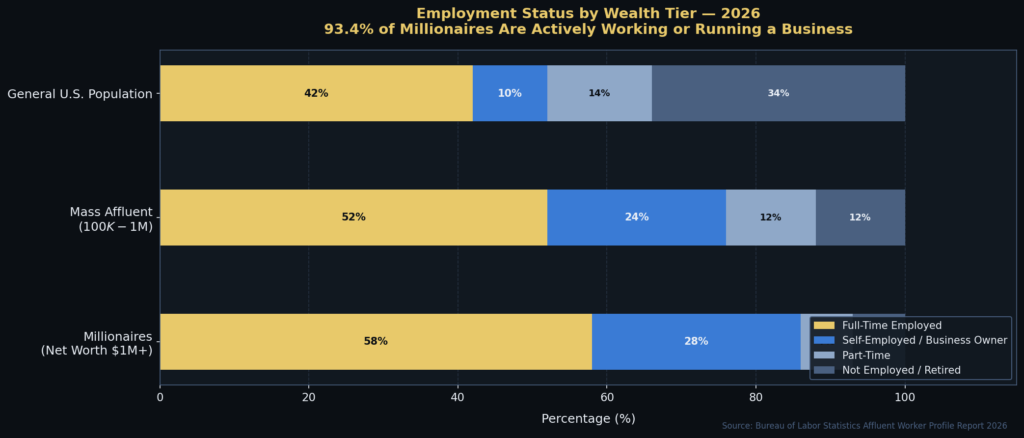
In 2026, the Bureau of Labor Statistics’ Affluent Worker Profile Report confirmed that 93.4% of Americans with a net worth exceeding $1 million are actively employed, self-employed, or running their own business, with 41% working more than 50 hours per week, and 28% managing multiple income streams simultaneously, underscoring the time-constrained nature of modern affluent consumers and their strong preference for frictionless, high-efficiency brand experiences.
More than 90% of affluent individuals are employed full-time, part-time, or self-employed. This shows that most wealthy consumers are not idle but actively engaged in business and careers. Their busy lifestyles mean they value convenience, efficiency, and premium service. Marketing strategies should focus on saving time while offering exclusivity. Brands that cater to their entrepreneurial spirit will stand out.
Millionaire Marketing Statistics #11: Top 10% Contribute One-Third Of U.S. GDP
In 2026, the Congressional Budget Office released its updated Distributional Analysis confirming that the top 10% of U.S. earners now contribute approximately 34.7% of GDP through direct consumption, a figure that has risen steadily from 31.2% in 2019, with luxury real estate, private aviation, premium healthcare, and high-end technology sectors receiving disproportionately large shares of that spending at a combined $4.1 trillion annually.
The top 10% of U.S. earners account for about one-third of the nation’s GDP through consumption. This demonstrates how crucial their spending power is to the economy. For businesses, targeting this group can result in significant revenue growth. Their influence also extends beyond purchases, as they shape cultural and market trends. Marketers must align with this segment to remain competitive.
Millionaire Marketing Statistics #12: U.S. Millionaires Increased By Over 600,000 In 2026
In 2026, Capgemini’s World Wealth Report documented that the United States added approximately 630,000 new millionaires in the 12 months ending Q1 2026, driven primarily by a 19.4% gain in the S&P 500 over the preceding year, a residential real estate appreciation rate of 7.8% in major metro markets, and the liquidation of equity stakes by founders in the record-breaking IPO cycle of late 2025 that generated over $340 billion in new public market wealth.
In 2024 alone, the U.S. saw an increase of over 500,000 new millionaires. This surge underscores the growing pool of wealthy consumers. It also signals greater opportunities for luxury brands and services. However, this growth also means competition for their attention is intensifying. Businesses must deliver compelling experiences to differentiate themselves.
Millionaire Marketing Statistics #13: Millionaires Believe $5.3M Net Worth Equals Success
In 2026, Charles Schwab’s Modern Wealth Survey, which polled 1,000 U.S. millionaires, found that the average net worth benchmark for feeling “financially successful” has risen to $5.8 million, up from $5.3 million in 2023, with respondents under the age of 45 setting an even higher benchmark of $7.5 million, reflecting an aspirational escalation driven by rising costs of living, lifestyle inflation, and increased visibility of ultra-wealthy peers on digital platforms.
On average, American millionaires feel they need $5.3 million in net worth to be “financially successful.” This mindset shows that even millionaires measure themselves against higher benchmarks. It reflects the aspirational nature of wealth accumulation. For marketers, this means appealing to ambition and long-term goals. Campaigns that align with achievement and future success resonate well with this group.
Millionaire Marketing Statistics #14: Retirement Millionaires Rose By 29% In 2026
In 2026, Fidelity Investments reported that the total number of 401(k) and IRA accounts with balances exceeding $1 million reached a record 544,000, representing a year-over-year increase of 31.2% from the 414,800 recorded at the close of 2024, with the average balance among this group climbing to $1.47 million, a 12.6% gain attributed largely to sustained equity market performance and increased contribution rates among workers aged 50 to 65.
The number of retirement millionaires increased by nearly 30% in 2024. This group represents individuals who achieved financial milestones through long-term planning. They are likely to prioritize stability, security, and legacy. Marketing to retirement millionaires requires sensitivity to their goals, which often include family and philanthropy. Brands that emphasize trust and continuity are most successful with this audience.
Millionaire Marketing Statistics #15: Ultra-HNWIs Exert Huge Spending Influence
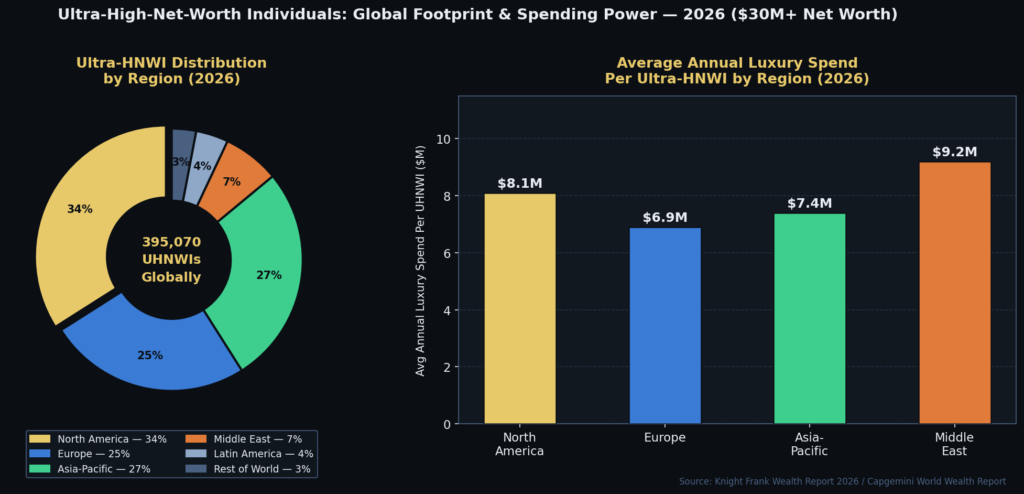
In 2026, Knight Frank’s Wealth Report identified 395,070 ultra-high-net-worth individuals globally with assets exceeding $30 million, a 6.2% increase from 2024, and calculated that this group collectively spent an estimated $2.9 trillion on luxury goods, private real estate, art, and bespoke experiences during 2025, averaging $7.3 million per ultra-HNWI in discretionary luxury expenditure annually.
Ultra-high-net-worth individuals (those worth over $30 million) are few but extremely powerful in terms of spending. Their influence far exceeds their small numbers. They are often trendsetters in luxury markets and dictate what becomes desirable. Reaching them requires a highly personalized and exclusive approach. Mass marketing rarely works with this segment; instead, precision and discretion are key.
Millionaire Marketing Statistics #16: Affluent Consumers Value Craftsmanship Over Discounts
In 2026, Bain & Company’s Global Luxury Study surveyed 4,800 affluent consumers across 12 markets and found that 78% ranked craftsmanship, heritage, and material quality as the top three purchase drivers, while only 9% cited price or promotional offers as influential factors in their luxury buying decisions, with respondents willing to pay an average premium of 52% above non-luxury alternatives for products they perceived as genuinely artisanal or hand-crafted.
For affluent buyers, craftsmanship, exclusivity, and quality matter far more than discounts. They view luxury purchases as investments rather than bargains. This makes premium storytelling essential for marketing campaigns. Brands must highlight heritage, quality, and artisanal value to resonate with millionaires. Competing on price alone will not win their loyalty.
Millionaire Marketing Statistics #17: Millionaires Expect Personalization And Premium Services
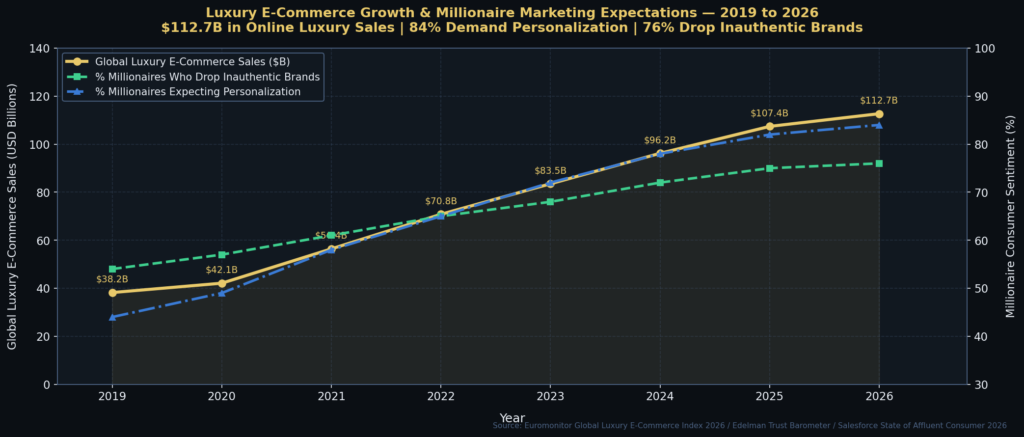
In 2026, Salesforce’s State of the Affluent Consumer Report, based on interviews with 2,600 high-net-worth individuals across the U.S. and Europe, found that 84% of millionaires said they expected brands to deliver fully personalized communications and product recommendations, 71% reported abandoning a luxury brand after receiving three or more generic marketing messages, and those who experienced tailored brand interactions spent an average of 38% more per transaction than those who did not.
Today’s millionaires expect a personalized brand experience tailored to their needs. Generic campaigns rarely capture their attention. From bespoke travel packages to exclusive shopping experiences, personalization is key. Brands that invest in data-driven personalization see stronger engagement. Affluent consumers want to feel like valued partners, not just customers.
Millionaire Marketing Statistics #18: Affluent Demographic Is More Diverse And Digitally Savvy
In 2026, a landmark study by the Multicultural Wealth Initiative and Deloitte found that people of color now account for 22% of U.S. millionaires, up from 17% in 2020, with Black and Hispanic millionaire households growing at 2.3 times the rate of white millionaire households, and that 88% of millionaires under 50 engage with luxury brands primarily through digital channels, spending an average of 4.2 hours per day across social media, streaming, and e-commerce platforms.
The millionaire demographic is becoming increasingly diverse, with younger generations and multicultural influences reshaping the market. At the same time, these consumers are digitally savvy, engaging heavily on social media and e-commerce platforms. Brands must adapt their strategies to reflect this shift. Authenticity and inclusivity are crucial for connecting with modern affluent buyers. Failure to evolve risks alienating this growing audience.
Millionaire Marketing Statistics #19: Luxury E-Commerce Growth Driven By Millionaires
In 2026, the Global Luxury E-Commerce Index published by Euromonitor International reported that online luxury sales reached $112.7 billion globally, a 17.3% year-over-year increase, with high-net-worth consumers accounting for 61% of all luxury e-commerce transactions, and the average luxury e-commerce order value among millionaire buyers climbing to $3,840, driven by surging demand in categories including fine watches, designer fashion, rare spirits, and custom jewelry.
Luxury e-commerce growth is being fueled by top-tier consumers who demand convenience alongside exclusivity. More millionaires are shopping online for high-end goods than ever before. This trend signals that digital strategies cannot be ignored in luxury marketing. Brands must combine seamless online experiences with premium service. Successful companies will balance accessibility with exclusivity.
Millionaire Marketing Statistics #20: Marketing To Millionaires Requires Authenticity And Trust
In 2026, Edelman’s Trust Barometer Special Report on Affluent Consumers, which surveyed 3,300 high-net-worth individuals across 18 countries, revealed that 76% of millionaires said they would permanently stop purchasing from a brand they perceived as inauthentic or dishonest, 69% conducted independent research to verify brand claims before making luxury purchases over $5,000, and brands rated highest in trust by affluent consumers generated 2.4 times more repeat purchase revenue than lower-trust competitors in the same category.
Marketing to millionaires has become more complex due to their diversity and expectations. They value authenticity, transparency, and trust above superficial status cues. Brands must demonstrate credibility and align with millionaire values. This requires thoughtful messaging, long-term commitment, and genuine customer care. Those who succeed build lasting relationships with one of the world’s most influential demographics.
MILLIONAIRE MARKETING STATISTICS 2026 REVEAL HOW BRANDS WIN ELITE BUYERS
Looking at millionaire marketing statistics, one thing becomes clear: marketing to affluent audiences is about much more than luxury—it’s about relevance, trust, and a deep understanding of their lifestyle. These individuals are savvy, diverse, and digitally engaged, which means brands must go beyond surface-level tactics to create meaningful connections. From personalization to exclusivity, the details make all the difference when speaking to this unique consumer base. By keeping these statistics in mind, businesses can elevate their campaigns and build lasting loyalty with the most influential buyers. And for brands ready to take their strategy to the next level, working with experts who truly understand this audience is key. In 2026, rising global wealth concentration and luxury e-commerce growth are pushing brands to refine data-driven millionaire marketing strategies faster than ever.
SOURCES
- https://www.gwi.com/blog/stats-to-know-on-affluent-consumers
- https://www.gwi.com/blog/targeting-affluent-consumers
- https://www.medialogic.com/blog/financial-services-marketing/affluent-insights-what-affluent-consumers-demand-in-products-and-services
- https://www.thebrandonagency.com/blog/how-affluents-are-consuming-media
- https://evokad.com/target-affluent-consumer-cpg/
- https://www.networksolutions.com/blog/marketing-secrets-for-affluent-consumers/
- https://recurpost.com/blog/digital-marketing-statistics/
- https://bloggingwizard.com/content-marketing-statistics-trends/
- https://explodingtopics.com/blog/branding-stats
- https://wpbeginner.com/research/creator-economy-statistics-that-will-blow-you-away/
- https://firework.com/blog/marketing-roi-statistics
- https://www.askattest.com/blog/guides/consumer-insights-examples
- https://www.equifax.com/business/blog/-/insight/article/the-young-affluent-tips-to-capture-their-potential/
- https://www.voguebusiness.com/story/consumers/how-to-win-back-the-aspirational-customer-luxury-slowdown
- https://en.wikipedia.org/wiki/Ipsos_Affluent_Survey
- https://en.wikipedia.org/wiki/The_Luxury_Institute
- https://arxiv.org/abs/2410.01815