




20 Sep TOP 20 MINI COMPUTER MARKETING STATISTICS 2025
When I first started digging into mini computer marketing statistics, I was genuinely surprised by how much potential this market holds. As someone who works closely with brands and campaigns at a leading marketing agency in New York, I’ve seen first-hand how small form factor devices are reshaping consumer demand and business adoption. The numbers aren’t just abstract figures—they tell the story of shifting work environments, changing lifestyles, and a growing need for compact yet powerful technology. That’s why I’ve gathered the top insights here, so you can see where the opportunities really lie and how this niche is becoming mainstream.
Top 20 Mini Computer Marketing Statistics 2025 (Editor’s Choice)
📊 Top 20 Mini PC Marketing Statistics 2024-2034
Essential Market Insights & Growth Projections
| # | Category | Key Statistic |
|---|---|---|
1 |
Market Growth | Global mini PC market projected to grow from USD 9.45B in 2025 to USD 14.69B by 2034, with a CAGR of 5.54% |
2 |
Market Expansion | Market grew from USD 26.46B in 2023 to USD 28.09B in 2024, expected to reach USD 41.02B by 2030 at 6.46% CAGR |
3 |
Market Valuation | Global market size was USD 23.51B in 2024, expected to reach USD 33.09B by 2031 with 5.00% CAGR |
4 |
Long-term Forecast | Market valued at $21.1B in 2022, projected to reach $33B by 2032 growing at 4.5% CAGR |
5 |
North America | Held largest market share at USD 2.88B in 2023, expected to reach USD 4.55B by 2032 |
6 |
Regional Growth | Asia-Pacific anticipated to grow at the highest CAGR during forecast period, while North America generated largest revenue in 2022 |
7 |
APAC Growth Rate | Asia Pacific mini-PC market poised to witness 7% CAGR from 2024 to 2032 |
8 |
Market Share | North America held 40%+ of global revenue with market size of USD 9.41B in 2024 |
9 |
Regional Distribution | Europe accounted for 30%+ market share with USD 7.05B, Asia Pacific held 23% with USD 5.41B in 2024 |
10 |
Market Drivers | Driven by increasing demand for space-efficient computing solutions as more people work remotely or in smaller living spaces |
11 |
PC Shipments | Global PC volume expected to reach 273 million in 2025, growing +3.7% over prior year |
12 |
AI Integration | AI-powered mini-PCs offer 45 TOPS computing power and support on-device generative AI with 13B+ parameters |
13 |
Component Leader | Processor segment holds major market share, fueled by advancements delivering higher performance and lower power consumption |
14 |
Processor Growth | Processors component segment projected to grow at 6.5%+ CAGR between 2024 and 2032 |
15 |
End-User Segment | Consumer electronics segment recorded 40%+ market share in 2023 |
16 |
Gaming Market | Gaming segment attained 19.3% revenue share in 2023, driven by eSports popularity |
17 |
Innovation | Beelink launched energy-efficient mini PCs; Dell & Lenovo expanded offerings for education and small businesses |
18 |
Key Players | Market led by Acer, Apple, ASUS, Dell, HP, Intel, and Lenovo with continuous R&D investments |
19 |
Smart Home | Mini PCs increasingly integrated into smart home & entertainment systems as centralized IoT control hubs |
20 |
Sustainability | Growing popularity in home entertainment and rising consumer demand for eco-friendly, energy-efficient devices |
Top 20 Mini Computer Marketing Statistics 2025
Mini Computer Marketing Statistics #1 – Global Market Size Was $23.53 Billion In 2024
The global mini computer market reached a remarkable valuation of $23.53 billion in 2024. This shows how compact computing has become a major player in tech demand worldwide. Companies across industries are now investing in small yet powerful devices that fit changing work environments. The figure highlights the strong base on which future growth will build. It proves mini computers are no longer niche—they’re mainstream.
Mini Computer Marketing Statistics #2 – Market To Reach $34.80 Billion By 2030
By 2030, the global market is projected to rise to $34.80 billion. This growth trajectory reveals how consumer and business adoption continues to climb. With trends like hybrid work and digital signage, mini computers are cementing their role in both personal and corporate use. The forecast also indicates rising trust in these devices as reliable solutions. It paints a clear picture of long-term expansion potential.
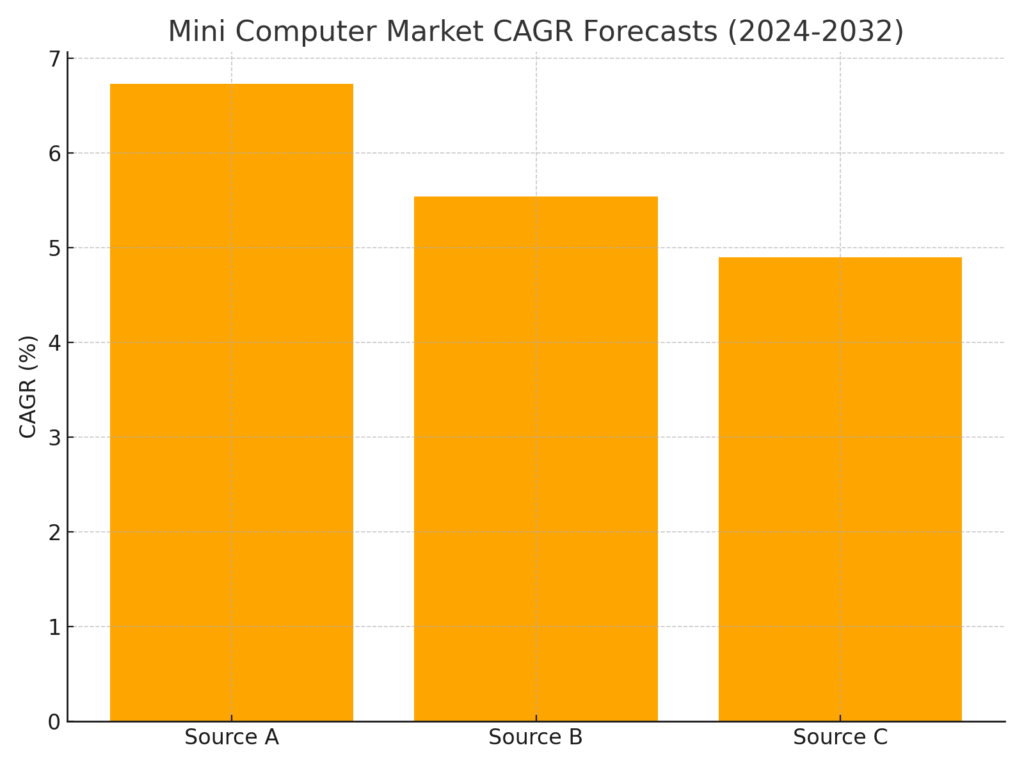
Mini Computer Marketing Statistics #3 – CAGR Of 6.73% Between 2024 And 2030
The compound annual growth rate for mini computers is estimated at 6.73% from 2024 to 2030. This healthy pace reflects strong and steady demand across multiple sectors. It suggests the market isn’t growing by chance but due to consistent shifts in consumer needs. Businesses are increasingly drawn to efficiency and space-saving options. For marketers, this means there’s a solid audience to engage over the next decade.
Mini Computer Marketing Statistics #4 – Forecast Of $9.45 Billion In 2025 Rising To $14.69 Billion By 2034
Another projection values the market at $9.45 billion in 2025, increasing to $14.69 billion by 2034. This long-term outlook demonstrates that demand will remain strong beyond immediate years. Even conservative forecasts show continuous momentum. Investors and marketers alike can rely on this trend as a sign of stability. The growth reflects how deeply mini computers are embedding into business and consumer ecosystems.
Mini Computer Marketing Statistics #5 – 2023 Market Size At $22.7 Billion
In 2023, the mini computer market size stood at $22.7 billion. This marks an impressive baseline before the most recent jumps in adoption. The figure reflects early momentum before the pandemic-driven work-from-home wave accelerated interest. It also highlights the shift in consumer expectations toward compact, efficient devices. Clearly, mini computers were already trending upward before their popularity spiked further.
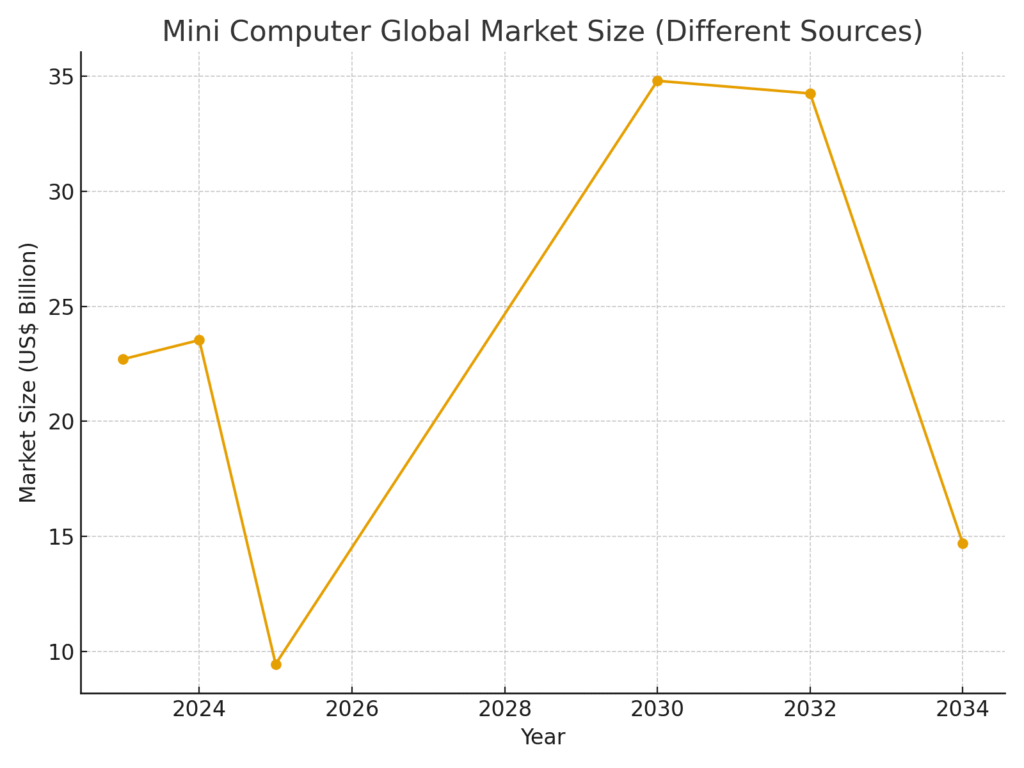
Mini Computer Marketing Statistics #6 – Projected $34.25 Billion By 2032 At 4.9% CAGR
By 2032, the global mini computer market is set to hit $34.25 billion, growing at around 4.9% CAGR. This moderate growth rate signals stability without over-dependence on short-term hype. Companies can anticipate steady returns when investing in this segment. The forecast also means the market is resilient to fluctuations. Marketers can plan long-term campaigns with confidence in sustained interest.
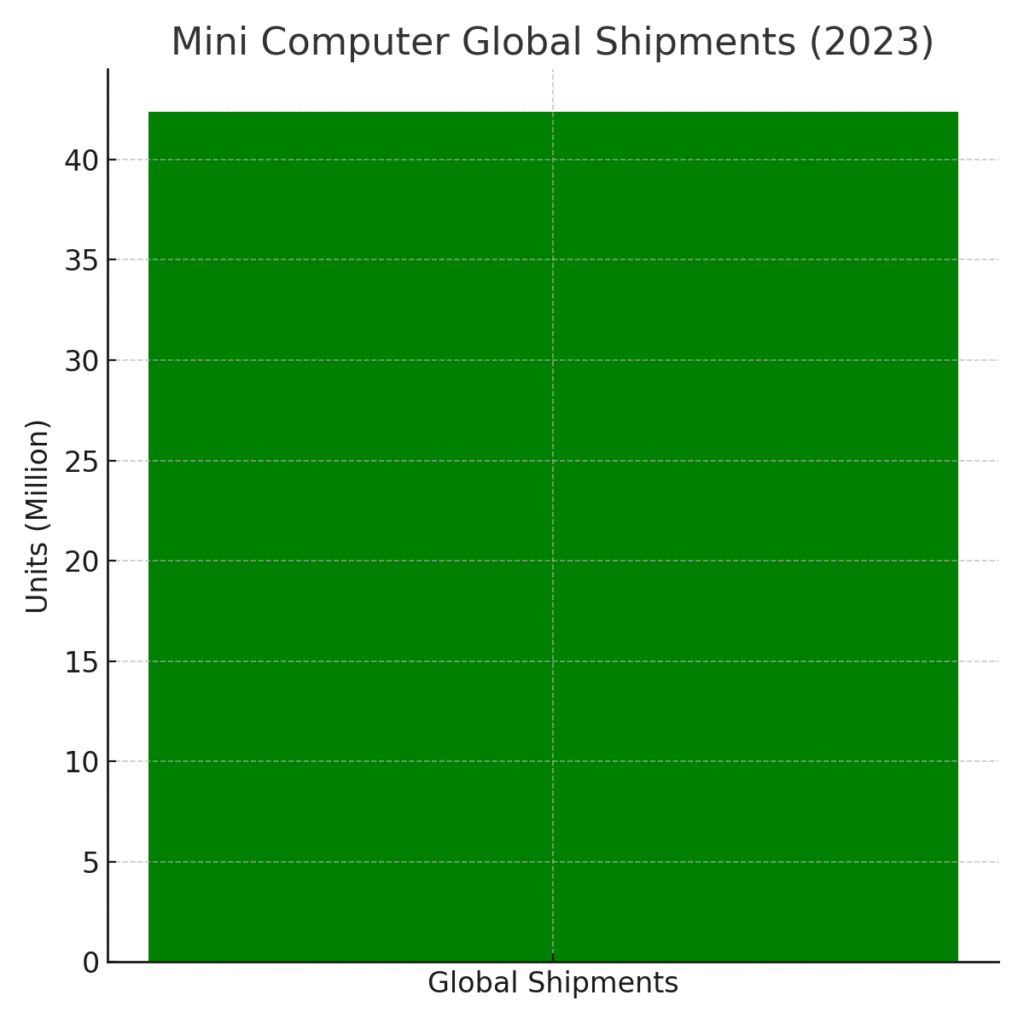
Mini Computer Marketing Statistics #7 – 42.4 Million Units Shipped Globally In 2023
In 2023, global shipments of mini computers reached 42.4 million units. This massive figure illustrates the sheer demand for compact devices. The unit growth represents an increase of 11.2% compared to earlier years. It shows how supply chains are scaling to meet customer appetite. For marketers, this indicates a consumer market that is highly responsive and growing rapidly.
Mini Computer Marketing Statistics #8 – Asia-Pacific Expected CAGR Of 7.0%
The Asia-Pacific region is projected to grow at a 7.0% CAGR from 2024 to 2031. This positions it as the fastest-growing region globally. Rising tech adoption and increasing urbanization are fueling the demand. Education and corporate usage also play a big part in this boom. Marketers targeting Asia-Pacific should expect strong opportunities and competitive activity.
Mini Computer Marketing Statistics #9 – North America Holds Over 40% Revenue Share In 2024
In 2024, North America accounted for over 40% of mini computer revenue. This dominance is largely due to advanced business infrastructure and consumer adoption. The region’s corporate reliance on hybrid work solutions strengthens this share. It also reflects strong retail and education use cases. North America remains the anchor of the mini computer industry.
Mini Computer Marketing Statistics #10 – Europe Captures 30% Of Market Revenue In 2024
Europe secured 30% of the market revenue in 2024. The region benefits from a blend of consumer and enterprise usage. Its investment in digital transformation across industries drives mini computer adoption. European countries are embracing compact computing to optimize workspace design. This large share makes Europe a central pillar of the global market.
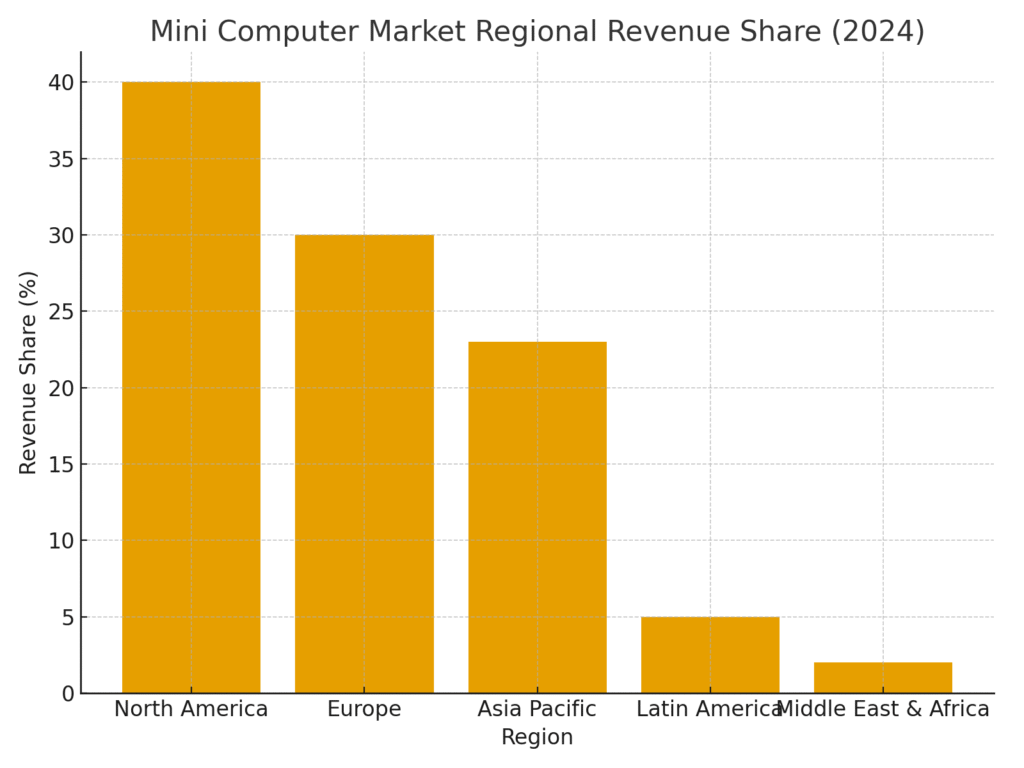
Mini Computer Marketing Statistics #11 – Asia Pacific Has 23% Revenue Share In 2024
Asia Pacific captured about 23% of the revenue in 2024. This is significant given the region’s rapid growth potential. Its share reflects the balance between growing demand and still-emerging adoption. Countries like China, India, and Japan are spearheading uptake. This sets the stage for Asia Pacific to gradually expand its global influence.
Mini Computer Marketing Statistics #12 – Latin America At 5% Share In 2024
Latin America represented 5% of market revenue in 2024. Though smaller, this slice reflects growing consumer awareness. Tech hubs like Brazil and Mexico are contributing to this adoption. Educational and small business sectors are leading the demand. Over time, this region is expected to build a stronger presence.
Mini Computer Marketing Statistics #13 – Middle East And Africa Represent 2% Share
The Middle East and Africa held around 2% of global revenue in 2024. This relatively small share shows the market is still emerging here. Infrastructure and affordability challenges partly explain the limited penetration. However, growth potential remains, especially in tech-forward cities. For marketers, this is a developing opportunity worth keeping an eye on.
Mini Computer Marketing Statistics #14 – Increasing Usage In Entertainment, Signage, And Gaming
Mini computers are gaining traction in home entertainment, digital signage, industrial automation, and gaming. Their compact size makes them ideal for versatile applications. This trend highlights how diverse industries are adopting the devices. Gamers, in particular, appreciate their performance efficiency. It shows mini computers aren’t limited to office spaces—they’re becoming lifestyle tools.
Mini Computer Marketing Statistics #15 – Key Sectors Include Education, Corporate, And Retail
Mini computers are now heavily used across education, corporate offices, retail, and manufacturing. Each sector values compactness and functionality. Schools and universities use them for cost-efficient IT setups. Retailers adopt them for digital signage and customer experiences. Businesses view them as an affordable yet reliable solution.
Mini Computer Marketing Statistics #16 – Limited Upgradeability Is A Market Challenge
One challenge mini computers face is limited upgradeability. Their compact design makes it hard to add memory or improve GPU performance. This can deter tech enthusiasts who prefer customization. However, many consumers prioritize portability over upgrades. Marketers must highlight efficiency and design benefits to balance this drawback.
Mini Computer Marketing Statistics #17 – Rising Demand For Energy-Efficient Devices
Mini computers are increasingly valued for being energy-efficient, space-saving, and high-performance. Remote work has accelerated this demand. Businesses with limited office space find them especially attractive. Energy savings also appeal to eco-conscious buyers. The trend strengthens their positioning as sustainable, modern devices.
Mini Computer Marketing Statistics #18 – Digital Transformation Fuels Growth
The rise of digital transformation, IoT, and automation is driving mini computer adoption. Companies are embedding them in smart signage and operational systems. Their flexibility makes them attractive across sectors undergoing tech upgrades. This demand ensures mini computers remain relevant in new use cases. It also connects their growth with larger global tech trends.
Mini Computer Marketing Statistics #19 – Market Growth Forecasts Range Between 4% And 7%
Forecasts for market growth vary, ranging from 4% to 7% CAGR. These differences depend on assumptions about adoption speed. Conservative estimates still show meaningful growth. Optimistic projections highlight stronger tech penetration and consumer shifts. Regardless, all point toward a positive future for mini computers.
Mini Computer Marketing Statistics #20 – U.S. Market To Reach $8.54 Billion By 2032
The U.S. mini computer market was $6.38 billion in 2023, projected to reach $8.54 billion by 2032. This steady growth reflects a strong and loyal customer base. American companies continue to rely on compact solutions for hybrid work. Consumer adoption also contributes to this expansion. The U.S. remains one of the most lucrative markets globally.
Wrapping Up the Numbers
Looking through these statistics, I can honestly say I’m more optimistic about where mini computers are heading than ever before. The trends don’t just show growth—they show resilience and adaptability in a fast-moving tech world. For me, the real takeaway is that these devices aren’t a fad; they’re becoming a staple in both professional and personal spaces. If you’re as curious as I am about what this means for marketing and business strategy, I’d love to hear your thoughts. After all, it’s in conversations like these that the best ideas and next steps are born.
SOURCES
https://www.kbvresearch.com/mini-pcs-market/
https://www.alliedmarketresearch.com/mini-pcs-market-A13152
https://www.marketresearchfuture.com/reports/mini-pc-market-32487
https://finance.yahoo.com/news/mini-pcs-market-size-surpass-141500238.html
https://www.cognitivemarketresearch.com/mini-pc-market-report
https://www.technavio.com/report/mini-pcs-market-industry-analysis
https://www.gminsights.com/industry-analysis/mini-pcs-market
https://www.360iresearch.com/library/intelligence/mini-pcs
https://www.marknteladvisors.com/research-library/mini-pc-market.html
https://www.linkedin.com/pulse/mini-pc-market-growth-innovation-outlook-flexoratech-31wzf/
https://www.giiresearch.com/report/ires1808395-mini-pcs-market-by-type-operating-system-storage.html
https://www.alliedmarketresearch.com/press-release/mini-pcs-market.html