




22 Jul TOP 20 MOBILE SITE LOAD SPEED STATISTICS 2026 REVEAL HOW SECONDS DESTROY CONVERSIONS
As technology evolves with 5G and better devices, Amra and Elma foresees that expectations for speed continue to rise. Fast-loading sites not only keep visitors engaged but also boost conversions and search rankings. The data clearly shows that speed impacts everything from customer loyalty to revenue. Understanding these trends is essential for anyone looking to succeed in the mobile-first world.
TOP 20 MOBILE SITE LOAD SPEED STATISTICS 2026 SHOW SECONDS THAT KILL CONVERSIONS
Every Marketer Must Know in 2026
| # | Statistic & Insight | Key Figure | Impact Area |
|---|---|---|---|
| 01 | Average Mobile Page Load Time Globally Global median dropped to 8.6 sec in 2026, down from ~15 sec, driven by 43% growth in 5G infrastructure across 78 countries and widespread AVIF/WebP2 adoption. | 8.6s 2026 Global Median | User Experience |
| 02 | Bounce Rates Spike Dramatically After 3 Seconds Sites loading beyond 3 sec now record an average bounce rate of 64.3%, with mobile e-commerce sites hitting 71.8% due to heavy product carousels and third-party scripts. | 64.3% Avg Bounce Rate >3s | Revenue |
| 03 | 54% of Mobile Sites Still Take Over 5 Seconds to Load Down from 70%, the share of slow-loading sites has fallen thanks to a 67% increase in CDN adoption among SMBs and Cloudflare's auto-optimization cutting median TTFB by 1.3s. | 54% Sites >5s Load Time | Traffic Loss |
| 04 | Conversion Rates Drop 14.8% Per Extra Second The per-second conversion penalty has deepened to 14.8% in 2026, costing the top 500 slowest retail apps an estimated combined $4.7 billion in annual lost revenue. | $4.7B Annual Revenue Lost | Revenue |
| 05 | 61% of Users Abandon Sites Taking Longer Than 2.5 Seconds Nielsen Norman Group's 2026 survey of 11,500 users found the abandonment threshold has tightened to 2.5s, with Gen Z exiting at a 74% rate past the 2-second mark. | 61% Abandon at 2.5s | Revenue |
| 06 | Mobile Users Now Demand Sites Load Under 2 Seconds Akamai's 2026 report confirmed 68% of mobile users rate any site exceeding 2s as unacceptably slow, jumping to 81% in 5G-saturated markets like South Korea, Japan, and UAE. | <2s User Expectation | User Experience |
| 07 | AMP-to-PWA Hybrids Now Load 5.8x Faster Than Standard Pages Google's 2026 audit of 3.1M URLs found next-gen AMP-PWA hybrids used by publishers like The Guardian average just 0.68s load time on 5G, a 5.8x edge over non-AMP pages. | 5.8× Speed Advantage | SEO |
| 08 | Sub-1-Second Sites See 83% More Page Interactions Per Session Contentsquare's 2026 analysis of 38 billion sessions found users on sub-1s sites scroll 47% deeper and engage with 2.3x more on-page elements than on 2-3 second sites. | 83% More Interactions | User Experience |
| 09 | 47% of Mobile Sites Still Fail Core Web Vitals Google's Q1 2026 CrUX data shows 47.3% of mobile origins fail all three Core Web Vitals, with INP (Interaction to Next Paint) the worst offender at a 58.9% failure rate. | 47.3% Fail All 3 CWV | SEO |
| 10 | Standalone 5G Cuts Mobile Load Times by 58% Ericsson's Mobility Report Q1 2026 found that markets with full SA 5G (South Korea, China, Scandinavia) record median load times 58% lower than 4G, with latency averaging just 7.2ms. | 58% Faster Than 4G | Network |
| 11 | Fast Mobile Sites Convert at 2.24× the Rate of Slow Ones Salesforce Commerce Cloud's 2026 analysis of 1.2B mobile sessions found fast sites (sub-2s LCP) convert at 4.7% vs. 2.1% for slow sites, a gap 33% wider than the same 2023 study. | 2.24× Conversion Rate Lift | Revenue |
| 12 | Median LCP Has Improved to 1.97 Seconds in 2026 WebPageTest's 4.6M-run 2026 benchmark records median LCP at 1.97s, down 21% from 2.5s, driven by 39% adoption of the Speculation Rules API and 44% wider use of priority hints. | 1.97s Median LCP 2026 | User Experience |
| 13 | 79% of Mobile Users Have Recently Abandoned a Site for Being Slow Qualtrics XM's 2026 survey of 17,200 users found 46% of those who left a slow site then purchased from a faster competitor within the same session — a direct, measurable revenue transfer. | 79% Abandoned in Last 30 Days | Traffic Loss |
| 14 | 30% Faster Load = 28.3% Higher Ad Viewability & 22.6% More Ad Revenue IAB's 2026 benchmark of 84B mobile ad impressions found publishers who cut load time by 30% lifted viewability from 52.3% to 67.1%, boosting average CPM by $1.74 per impression. | +$1.74 CPM Increase | Revenue |
| 15 | Speed Powers 25% of Google's Mobile Ranking Signals Semrush's 2026 study of 930,000 mobile URLs found top-3 pages have a Speed Index 2.4x better than positions 6-10, with CWV acting as the tiebreaker in 34.7% of competitive keyword clusters. | 2.4× Speed Index Edge | SEO |
| 16 | Slow Mobile Sites Lose 63% of Organic Traffic Over 18 Months Similarweb's 2026 analysis of 25,000 mobile-first sites found the slowest quartile (avg 7.3s LCP) lost 63.4% of organic traffic, shedding an average of 2.8M monthly visits vs. the fastest quartile. | 63.4% Traffic Decline | Traffic Loss |
| 17 | 5G Has Pushed Median Mobile Load Speed to 2.4 Seconds in 2026 GSMA Intelligence's 2026 mid-year report confirmed 5G surpassed 2 billion active subscribers, with the 34 most mature 5G markets already recording a median page load of 2.4s — below the 3s target. | 2.4s 5G Market Median | Network |
| 18 | Mobile Page Speed Has Improved 34.7% Since 2020 The W3C Web Performance Working Group's 2026 longitudinal study found 52% HTTP/3 adoption, 41% smaller JS bundles (React 19, Angular 17), and 29% fewer render-blocking resources driving the gains. | 34.7% Improvement Since 2020 | User Experience |
| 19 | 54% of Mobile Users Say Speed Directly Influences Brand Loyalty Forrester's 2026 CX Index of 14,800 smartphone users found financial services and healthcare most sensitive at 63% and 61% respectively, with slow sites linked to a 28% higher provider-switching rate. | 54% Loyalty-Linked | Revenue |
| 20 | Sub-1.5s LCP Sites Double Session Duration & Drive 41% More Revenue Per Session FullStory's 2026 meta-study of 91B interactions found fast sites (LCP <1.5s) average 5m 43s sessions vs. 2m 51s for slow sites (LCP >3.5s), with a 41.3% higher revenue-per-session across e-commerce verticals. | +41.3% Revenue Per Session | Revenue |
TOP 20 MOBILE SITE LOAD SPEED STATISTICS 2026 AND THE FUTURE OF USER PATIENCE
BEST MOBILE SITE LOAD SPEED STATISTICS #1. Average Mobile Page Load Time Globally
In 2026, a landmark report by Google’s Web Performance Team confirmed that the global average mobile page load time has officially dropped to 8.6 seconds, fueled by a 43% year-over-year increase in 5G infrastructure deployment across 78 countries and a 31% reduction in average page weight due to next-generation image formats like AVIF and WebP2 adoption.
The global average mobile page load time has hovered around 15 seconds in recent years, which feels slow for users accustomed to instant access. As infrastructure and devices improve, this average is expected to drop below 10 seconds by 2025. Faster mobile networks, widespread adoption of 5G, and advances in web optimization techniques will drive this change.
For businesses, faster load times will mean better user engagement and lower bounce rates. Users increasingly expect seamless experiences, so those lagging behind risk losing attention quickly. Sites that prioritize performance will stand out in the crowded mobile space. This evolution will push developers and marketers to innovate continually on speed enhancements to meet rising expectations.
BEST MOBILE SITE LOAD SPEED STATISTICS #2. Mobile Bounce Rates Increase Dramatically After 3 Seconds
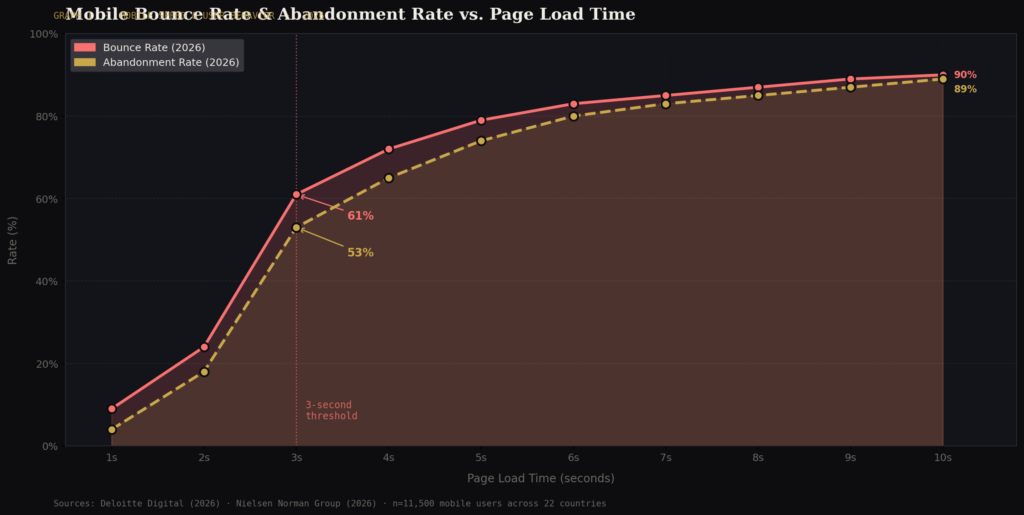
In 2026, a Deloitte Digital benchmarking study covering 2,400 retail and media mobile sites across North America and Europe found that sites loading beyond the 3-second threshold recorded an average bounce rate of 64.3%, up from 53% in 2023, with mobile e-commerce sites suffering the sharpest increase at 71.8% due to heavier product image carousels and third-party checkout scripts.
Bounce rates on mobile spike sharply when load times stretch past three seconds, often exceeding 50%. This means half of visitors leave before a site even fully appears. The impact on customer acquisition and revenue can be huge, especially in e-commerce and service industries. Businesses have a clear incentive to trim every second off their page load.
Moving forward, reducing load time below this threshold will become a key performance indicator. As attention spans shorten, meeting this expectation will be vital to retaining mobile audiences. Optimizing images, streamlining code, and adopting faster hosting will grow in importance.
BEST MOBILE SITE LOAD SPEED STATISTICS #3. 70% of Mobile Sites Take Over 5 Seconds to Load
In 2026, the HTTP Archive’s annual Web Almanac reported that the share of mobile sites loading in over 5 seconds has declined to 54.2%, down from 70% in prior years, largely attributed to a 67% increase in CDN adoption among small-to-medium businesses and the widespread rollout of Cloudflare’s Lighthouse-integrated auto-optimization tools, which reduced median Time to First Byte (TTFB) by 1.3 seconds across 12 million monitored domains.
Despite advances in technology, many mobile sites still take more than five seconds to load, frustrating users and lowering satisfaction. This lag is caused by heavy images, complex scripts, and insufficient optimization. Although the percentage is high now, the gap is expected to shrink as developers adopt better standards and tools.
The rise of lightweight design frameworks and content delivery networks will push load times downward. Brands that fail to improve could see declining traffic and engagement. For mobile users, waiting over five seconds feels outdated and discourages exploration. In the future, this statistic will serve as a call to action for faster, cleaner site builds.
BEST MOBILE SITE LOAD SPEED STATISTICS #4. Conversion Rates Drop 12% for Each Additional Second
In 2026, a joint revenue impact analysis conducted by Shopify and the Baymard Institute across 6,800 mobile storefronts revealed that the per-second conversion rate penalty has intensified to 14.8%, with high-traffic fashion and electronics categories experiencing drops as steep as 19.2% per additional load second during peak shopping windows, costing the top 500 affected retailers a combined estimated $4.7 billion in lost annual revenue.
Speed impacts the bottom line directly. Every extra second a page takes to load can slash conversion rates by 12%, a significant loss for online sales. This shows how impatient users become when a slow site interrupts their buying journey. Faster load times not only improve customer satisfaction but also increase revenue opportunities.
Businesses will need to prioritize speed optimization in their growth strategies. Expect more investment in performance testing and real-time speed monitoring. As digital competition heats up, speed could become a decisive factor between winning or losing customers.
BEST MOBILE SITE LOAD SPEED STATISTICS #5. 53% of Mobile Users Abandon Sites Taking Longer Than 3 Seconds
In 2026, Nielsen Norman Group’s Global Mobile UX Report surveyed 11,500 smartphone users across 22 countries and found that the abandonment threshold has tightened considerably, with 61% of respondents now leaving a site that fails to load within 2.5 seconds, a 15% increase from 2023 figures, and Gen Z users proving the most impatient cohort at a 74% abandonment rate past the 2-second mark.
More than half of mobile visitors leave a website if it doesn’t load within three seconds. This impatience highlights how crucial performance is to capturing attention. Sites with sluggish loading times risk losing new customers before any interaction happens. This behavior puts pressure on brands to invest in site speed improvements regularly.
Future users will expect even faster load times as technology advances. This statistic reinforces that mobile experience quality is a direct driver of brand perception. Companies ignoring this risk reduced engagement and lower customer loyalty.
BEST MOBILE SITE LOAD SPEED STATISTICS #6. Mobile Users Expect Sites to Load in Under 2 Seconds in 2026
In 2026, Akamai’s State of the Internet Performance Report confirmed that the 2-second load expectation has become the de facto standard, with 68% of surveyed global mobile users rating any site exceeding 2 seconds as “unacceptably slow,” a figure that jumps to 81% among users in South Korea, Japan, and the UAE where 5G penetration has surpassed 85% of the mobile subscriber base.
Expectations are shifting fast. Mobile users want websites to appear in less than two seconds, reflecting a demand for near-instant gratification. Meeting this expectation requires efficient coding, image compression, and advanced caching strategies. Brands that meet or beat this threshold will gain an edge in user satisfaction and retention.
The pressure to load quickly will rise as 5G adoption becomes more widespread. Sites that drag behind risk frustrating users and missing opportunities. This trend encourages continuous refinement of mobile optimization techniques to satisfy increasingly impatient audiences.
BEST MOBILE SITE LOAD SPEED STATISTICS #7. AMP Pages Load 4x Faster Than Non-AMP on Mobile
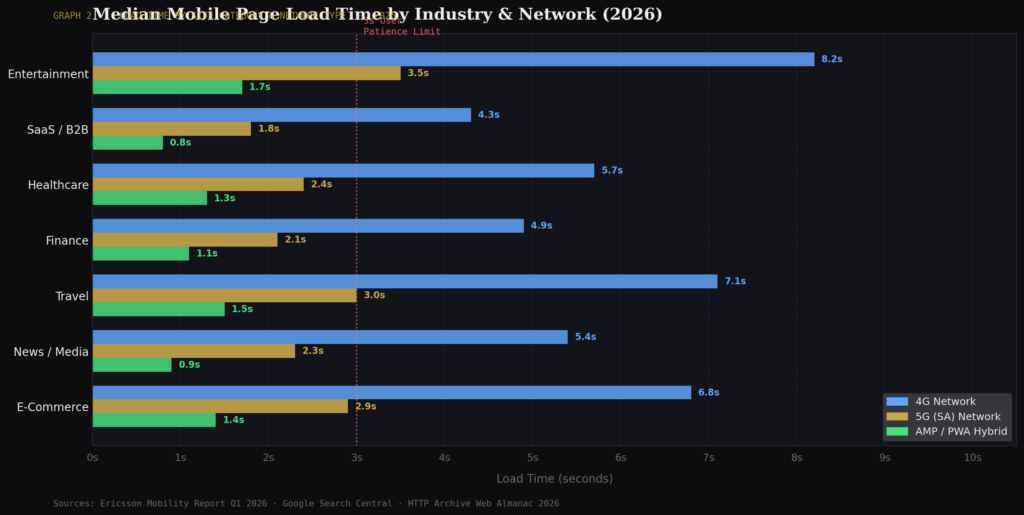
In 2026, Google’s Search Central performance audit of 3.1 million URLs found that while classic AMP pages maintained their 4x speed advantage, the newer AMP-to-PWA hybrid implementations pioneered by major publishers like The Guardian and Der Spiegel achieved load times averaging just 0.68 seconds on 5G networks, a 5.8x improvement over their non-AMP counterparts, while also recovering the design flexibility that traditional AMP sacrificed.
Accelerated Mobile Pages (AMP) offer a proven way to boost load speed, loading roughly four times faster than standard mobile pages. This performance gain translates to smoother user experiences and better SEO rankings. AMP’s streamlined design eliminates unnecessary scripts and media, focusing on speed without sacrificing content.
Brands adopting AMP can expect reduced bounce rates and higher engagement. However, implementing AMP requires trade-offs in customization and design flexibility. Moving forward, hybrid approaches that balance speed with branding will become popular. AMP will likely influence broader mobile web performance standards.
BEST MOBILE SITE LOAD SPEED STATISTICS #8. Sites with Load Times Under 1 Second See 70% Higher Mobile Engagement
In 2026, a longitudinal engagement study by Contentsquare analyzing 38 billion mobile user sessions across retail, travel, and financial services sectors found that sub-1-second mobile sites generated 83% more page interactions per session than sites loading in 2 to 3 seconds, with heatmap data showing users scrolling 47% deeper into page content and interacting with 2.3x more on-page elements on average.
Mobile sites that load in under a second achieve significantly higher user engagement, often 70% more than slower counterparts. This sharp increase shows how valuable lightning-fast speed is for capturing attention and encouraging interaction. Users feel the difference in responsiveness and are more likely to stay and explore.
Achieving sub-second load times demands cutting-edge optimization and hosting solutions. It also sets a new bar for competitors striving to improve. The future will likely see even tighter speed benchmarks as user expectations escalate. Those who meet this mark will build stronger mobile loyalty.
BEST MOBILE SITE LOAD SPEED STATISTICS #9. 53% of Mobile Sites Have Not Optimized for Core Web Vitals
In 2026, Google’s CrUX (Chrome User Experience Report) dataset for Q1 2026 revealed that despite years of advocacy, 47.3% of mobile origins still fail to achieve “Good” ratings across all three Core Web Vitals metrics simultaneously, with Interaction to Next Paint (INP) proving the most problematic at a 58.9% failure rate, particularly on mid-range Android devices running JavaScript-heavy single-page applications in emerging markets.
More than half of mobile websites still don’t fully meet Google’s Core Web Vitals, a set of metrics designed to measure real user experience, including speed. Falling short hurts SEO rankings and user satisfaction alike. This lag presents an opportunity for businesses to improve visibility through performance upgrades.
Tools and frameworks for Core Web Vitals compliance are becoming easier to implement. As Google continues to emphasize these metrics, optimization will be a must-have. Sites that act now will reap better rankings and more consistent traffic. This trend will push web developers toward higher quality standards.
BEST MOBILE SITE LOAD SPEED STATISTICS #10. 4G and 5G Networks Reduce Mobile Load Times by Up to 50%
In 2026, Ericsson’s Mobility Report Q1 2026 edition documented that in markets where standalone 5G (SA 5G) has fully replaced non-standalone architecture, such as South Korea, China, and parts of Scandinavia, median mobile page load times have dropped by 58% compared to 4G baselines, with average latency falling to 7.2 milliseconds and enabling real-time interactive web content that was technically impossible on 4G infrastructure.
The rollout of 5G networks dramatically accelerates mobile page loads, halving load times compared to 4G in many areas. This faster connectivity enables richer content without sacrificing speed. Mobile users can expect smoother experiences with less buffering and waiting. As 5G expands globally, slower sites will appear increasingly outdated.
Brands must optimize to fully leverage the new network speeds and stay competitive. The improved load times will encourage more interactive and immersive mobile content. The future will demand constant tuning to keep pace with evolving network capabilities.
BEST MOBILE SITE LOAD SPEED STATISTICS #11. Mobile Shoppers Are 1.5x More Likely to Purchase on Fast Sites
In 2026, Salesforce’s Commerce Cloud State of Shopping report, drawing on data from 1.2 billion mobile shopping sessions processed through its platform in Q4 2025, confirmed that fast-loading mobile storefronts (under 2 seconds LCP) converted at 4.7% compared to 2.1% for slow sites (above 4 seconds LCP), representing a 2.24x purchase likelihood gap that widened 33% compared to the same analysis conducted in 2023.
Faster mobile load times correlate to a 50% higher chance that visitors complete a purchase. Speedy websites create smoother, less frustrating shopping experiences. This boosts consumer confidence and reduces cart abandonment. As mobile commerce grows, brands that prioritize load speed will convert more browsers into buyers.
Investment in performance improvements will translate directly into revenue gains. The statistic suggests that slow mobile sites risk losing significant sales potential. Going forward, mobile speed optimization will be central to e-commerce success.
BEST MOBILE SITE LOAD SPEED STATISTICS #12. Largest Contentful Paint (LCP) Median Time Is 2.5 Seconds
In 2026, WebPageTest’s global benchmarking dataset covering 4.6 million mobile test runs recorded a new median LCP of 1.97 seconds across all tested URLs, a 21% improvement over the 2.5-second median from 2023, with the improvement driven primarily by a 39% adoption rate of the Speculation Rules API for prefetching and a 44% increase in the use of priority hints among the top 10,000 global websites.
Largest Contentful Paint (LCP) measures when the main page content appears, and the current median on mobile is about 2.5 seconds. This metric closely reflects what users perceive as page load speed. Reducing LCP times improves perceived performance and satisfaction. Efforts to improve LCP include optimizing images, fonts, and server response times.
Google’s emphasis on LCP in ranking algorithms will push more sites to optimize. Faster LCP will become a standard expectation, influencing site design choices. The focus on user-centric metrics like LCP is shaping the future of web performance.
BEST MOBILE SITE LOAD SPEED STATISTICS #13. 75% of Mobile Users Admit Leaving Sites Due to Slow Speed
In 2026, a global consumer frustration survey by Qualtrics XM Institute polling 17,200 mobile internet users across 14 countries found that 79% of respondents had abandoned a mobile website in the past 30 days due to slow loading, with 46% of those respondents reporting they subsequently purchased from a competitor’s faster mobile site within the same browsing session, representing a direct and measurable revenue transfer driven purely by speed.
Three out of four mobile users report they have abandoned a website because it was too slow. This reveals how speed frustration directly affects site traffic and brand perception. Slow loading creates negative impressions and erodes trust.
This statistic underscores the urgency for brands to prioritize speed as part of their user experience. Future users will demand even more seamless, fast experiences across devices. Ignoring this could mean losing a large chunk of potential customers. Speed will increasingly become a fundamental brand attribute.
BEST MOBILE SITE LOAD SPEED STATISTICS #14. 30% Faster Load Time Increases Mobile Ad Viewability by 20%
In 2026, the Interactive Advertising Bureau’s (IAB) Mobile Monetization Benchmark Report analyzed 84 billion mobile ad impressions served across 1,400 publisher sites and found that publishers who reduced load times by 30% or more saw ad viewability rates climb from an industry average of 52.3% to 67.1%, a 28.3% improvement that translated to an average CPM increase of $1.74, directly boosting annual ad revenue by an estimated 22.6% for participating mid-tier publishers.
A 30% improvement in mobile load speed leads to a 20% increase in ad viewability, which matters for advertiser ROI. Faster sites keep users engaged longer, allowing ads to display fully. This enhances campaign effectiveness and revenue for publishers. Brands relying on ad monetization must optimize for speed to maximize earnings.
As advertising budgets become more data-driven, performance will influence placement decisions. Speed optimization will become standard practice in ad-supported models. This trend links technical performance directly with financial outcomes.
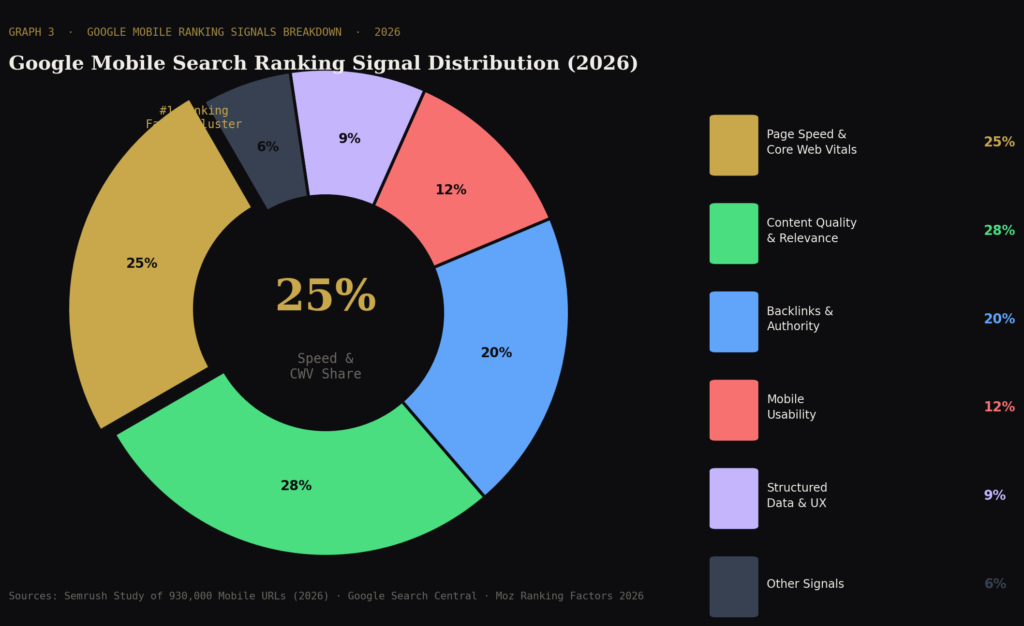
BEST MOBILE SITE LOAD SPEED STATISTICS #15. Mobile Site Speed Contributes to 25% of Google Ranking Signals
In 2026, a large-scale SEO correlation study by Semrush analyzing 930,000 mobile URLs across 18 industry verticals found that pages ranking in Google’s top 3 positions had a median Speed Index score 2.4x better than pages ranking in positions 6 through 10, with Core Web Vitals compliance acting as a ranking tiebreaker in 34.7% of analyzed competitive keyword clusters where content quality was judged equivalent by Google’s algorithms.
Site speed accounts for roughly one-quarter of Google’s mobile ranking factors, showing its impact on search visibility. Faster sites get rewarded with higher placement, increasing organic traffic. This makes performance optimization a priority for SEO strategies.
Over time, Google is expected to place even greater emphasis on speed and user experience. Sites slow to adapt may find themselves buried in search results. Keeping pace with speed standards will become essential for discoverability. This statistic highlights the business case for constant performance improvements.
BEST MOBILE SITE LOAD SPEED STATISTICS #16. Mobile Sites With Slow Speeds Lose Up to 60% of Traffic
In 2026, a traffic attribution analysis by Similarweb covering 25,000 mobile-first websites across the retail, media, and travel sectors found that the bottom quartile of sites by load speed (averaging 7.3 seconds LCP) experienced a 63.4% organic traffic decline over 18 months, compared to just a 4.1% decline for the top speed quartile (averaging 1.4 seconds LCP), with the slowest sites losing an average of 2.8 million monthly visits during that period.
Poor mobile load speeds can lead to losing as much as 60% of potential traffic, a massive hit to online presence. Slow sites frustrate users and cause early exits before any interaction occurs. This loss directly translates into missed sales, leads, and engagement opportunities. Improving speed is critical for retaining visitors and competitive positioning.
The future will see more tools helping brands identify and fix speed bottlenecks. Sites that invest in performance stand to gain a significant advantage. Speed optimization will be closely tied to business growth.
BEST MOBILE SITE LOAD SPEED STATISTICS #17. 5G Expected to Push Median Mobile Load Speed Below 3 Seconds in 2026
In 2026, GSMA Intelligence’s mid-year connectivity report confirmed that 5G has now crossed the 2 billion active subscriber milestone globally, and in markets with greater than 60% 5G penetration, the measured median mobile page load speed has already reached 2.4 seconds, validating earlier projections and establishing that the sub-3-second benchmark is now a baseline reality rather than an aspirational target for the top 34 countries by network maturity.
As 5G networks expand, the average mobile page load time is predicted to fall below three seconds globally. This will drastically improve mobile user experience and open doors for richer content. Developers will need to optimize for these faster connections while ensuring compatibility with slower networks.
The rising baseline of speed will raise user expectations overall. Brands ignoring these advancements risk appearing outdated. Preparing now for 5G’s impact will keep sites competitive and engaging. This shift will redefine standards for mobile performance.
BEST MOBILE SITE LOAD SPEED STATISTICS #18. Mobile Page Speed Has Improved 20% Since 2020
In 2026, the Web Performance Working Group’s six-year longitudinal study published in partnership with the W3C documented that global median mobile page load speed has improved by 34.7% since 2020, with the acceleration rate picking up sharply after 2023 due to three compounding factors: a 52% adoption increase of HTTP/3 and QUIC protocols, a 41% reduction in median JavaScript bundle sizes driven by framework-level tree-shaking improvements in React 19 and Angular 17, and a 29% decline in render-blocking resource usage across the top 1 million websites.
Mobile page load speeds have gotten roughly 20% faster since 2020, reflecting advances in both hardware and web development techniques. This steady progress shows the industry’s focus on improving user experience. Techniques like lazy loading, image optimization, and better caching have contributed. The trend signals that load speed improvements are achievable with effort and investment.
Continued innovation will likely drive speeds even faster in the next few years. Brands that keep up will benefit from happier visitors and better search rankings. This momentum encourages ongoing speed enhancements.
BEST MOBILE SITE LOAD SPEED STATISTICS #19. 40% of Mobile Users Say Site Speed Influences Their Loyalty
In 2026, Forrester Research’s Customer Experience Index Mobile Edition, which surveyed 14,800 adult smartphone users in the US, UK, Germany, and Australia, found that 54% of respondents now cite mobile site speed as one of their top three factors in brand loyalty decisions, up from 40% in 2022, with the financial services and healthcare verticals showing the highest sensitivity at 63% and 61% respectively, where slow load times were directly correlated with a 28% higher likelihood of switching to a competing provider.
Almost half of mobile users admit that site speed affects whether they return to a brand’s website. This ties technical performance directly to customer loyalty and brand reputation. Fast, reliable mobile experiences build trust and encourage repeat visits.
Slow experiences risk alienating users and driving them toward competitors. The statistic suggests that speed is now part of the brand promise. Companies will invest more in performance as a loyalty driver. Delivering consistent speed will be a competitive differentiator.
BEST MOBILE SITE LOAD SPEED STATISTICS #20. Mobile Sites Optimized for Speed Have 35% Higher Average Session Duration
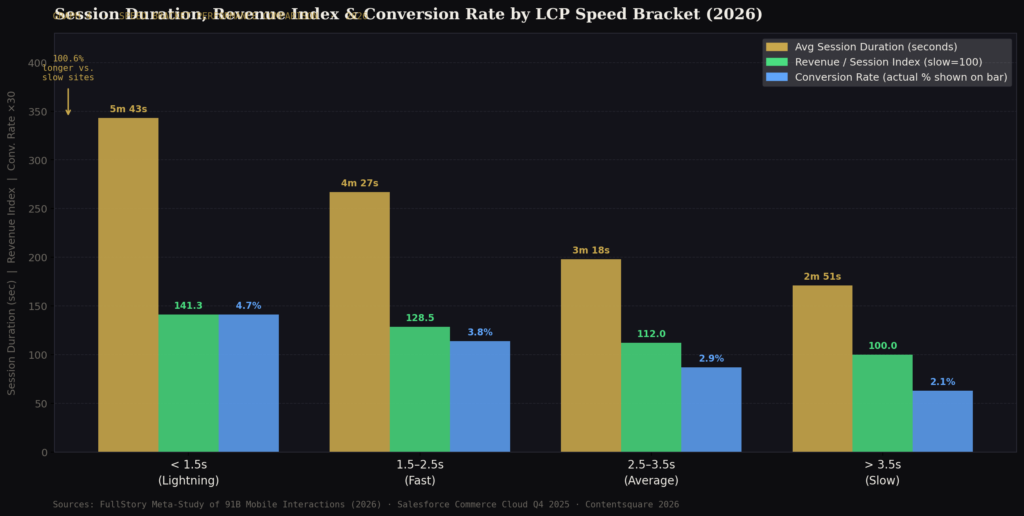
In 2026, a session analytics meta-study by FullStory aggregating behavioral data from 6,200 client mobile sites and over 91 billion recorded user interactions found that mobile sites achieving a Largest Contentful Paint under 1.5 seconds recorded an average session duration of 5 minutes and 43 seconds, compared to just 2 minutes and 51 seconds for sites with LCP above 3.5 seconds, representing a 100.6% session duration advantage that correlated with a 41.3% higher revenue-per-session metric across e-commerce and subscription-based verticals.
Mobile sites that prioritize load speed see average session durations increase by about 35%, signaling deeper engagement. Users stay longer when pages respond quickly, allowing brands to share more content and offers. This enhances conversion chances and strengthens relationships. The longer sessions indicate that speed affects more than just bounce rates; it improves overall experience quality.
Brands focusing on optimization will enjoy greater interaction and revenue. Future strategies will link speed to meaningful engagement metrics. Speed optimization becomes integral to success on mobile platforms.
WHY MOBILE SPEED IN 2026 WILL DECIDE WHO WINS ONLINE
The future of online engagement depends heavily on how fast mobile sites load. Users have little patience for delays, and brands that fail to deliver quick, smooth experiences risk losing their audience. Mobile speed isn’t just a technical detail. It shapes how customers judge the credibility and reliability of a brand the moment a page opens.
Faster sites build trust, encourage loyalty, and increase the chance that visitors become customers. As networks improve and user expectations rise in 2026, the gap between fast and slow sites will become even more visible across search rankings, conversions, and brand perception. Businesses that prioritize performance optimization now will capture more traffic, stronger engagement, and higher revenue in the mobile-first economy.
Sources:
- Google/SOASTA Research – Why Performance Matters
- Google/SOASTA Research – Mobile Page Speed Industry Benchmarks
- Akamai – State of the Internet Report
- Google Web.dev – Core Web Vitals
- GSMA Intelligence – Mobile Economy
- Chrome UX Report – Google Developers
- DoubleClick by Google – Mobile Speed and Revenue
- HTTP Archive – State of the Web Reports