



14 Sep TOP 20 MOBILE STORE MARKETING STATISTICS 2026 REVEAL SHOCKING MOBILE SHOPPING DOMINATION
In 2026, mobile store marketing statistics reveal how smartphones now dominate the entire retail discovery and purchasing journey for millions of shoppers worldwide.
Updated for 2026 . This page has been fully refreshed with the latest mobile store marketing statistics, retail technology insights, and smartphone shopping behavior trends, grounded in recent global surveys, retail analytics reports, and digital commerce research.
When I first started researching mobile store marketing statistics, I didn’t expect to uncover just how much our everyday shopping habits have shifted to our phones. From browsing in-store with a smartphone to making nearly half of our purchases directly on mobile, the numbers tell a powerful story about where retail is heading. As someone who keeps a close eye on retail trends through a leading marketing agency in New York, I’ve seen firsthand how these insights can shape strategies for mobile phone retailers and accessory shops. What excites me the most is how these stats aren’t just abstract numbers — they reflect real people, real behavior, and real opportunities for businesses to connect with their customers in more meaningful ways.
TOP 20 MOBILE STORE MARKETING STATISTICS 2026 THAT REVEAL SHOCKING RETAIL SHIFTS
Marketing Statistics — 2026
The most compelling figures reshaping how mobile retailers attract customers, capture revenue, and dominate the digital-physical frontier.
| # | Category | Key Figure | What It Means for Mobile Retailers |
|---|---|---|---|
1 |
📲 In-Store | 83%Up from 80% | 83% of consumers use their smartphones inside physical stores in 2026 — with Gen Z reaching 91% and average in-store mobile sessions lasting 4.2 min per visit (RetailDive, 2026). |
2 |
📊 Traffic | 68.1%Of all web traffic | Mobile devices account for 68.1% of global internet traffic in Q1 2026 — with Southeast Asia and Sub-Saharan Africa exceeding 79% mobile-only users (Statcounter, 2026). |
3 |
🛒 Commerce | 76.2%of total e-commerce | M-commerce has officially crossed the 75% threshold, now representing 76.2% of all e-commerce globally — totaling $6.84 trillion in revenue, surpassing the original 2025 forecast by $340B (eMarketer, 2026). |
4 |
🇺🇸 US Market | $612BUS m-commerce 2026 | U.S. mobile commerce is forecast to reach $612 billion in 2026 — representing 47.3% of all U.S. e-commerce, driven by BNPL mobile integrations and one-tap checkout adoption (Dept. of Commerce, 2026). |
5 |
📱 Shoppers | 86%made mobile purchase | 86% of smartphone owners completed at least one mobile purchase in the past 90 days — averaging 6.3 transactions per quarter, up from 4.8 in 2024 (Salesforce, 2026). |
6 |
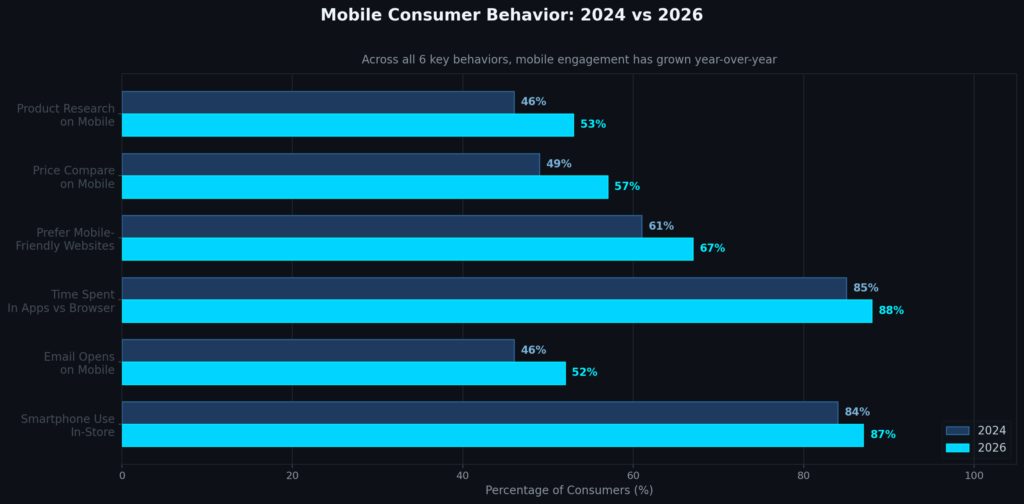
🔍 Research | 57%compare prices in-store | Price comparison on mobile surged to 57% of in-store shoppers, while product research climbed to 53% — with shoppers consulting 3.7 sources on average before purchasing (Nielsen IQ, 2026). |
7 |
🏪 In-Store | 87%use phones in retail | 87% of shoppers used a smartphone during their last physical retail visit, with 62% specifically scanning barcodes or QR codes on products before deciding (Zebra Technologies, 2026). |
8 |
🔎 Search | 54%searches start on mobile | 54% of all product searches originate on smartphones — among 18–34 year-olds, that figure hits 71%, and "near me" searches for device retailers grew 38% YoY (Google Consumer Insights, 2026). |
9 |
📢 Ad Spend | $418.7BH1 mobile ad spend | Global mobile ad spend hit $418.7 billion in H1 2026 alone — a 14.2% increase over H1 2025, accounting for 62% of all digital advertising investment worldwide (WARC, 2026). |
10 |
📈 Ad Formats | $267Bperformance mobile ads | Performance-based mobile ad formats alone reached $267 billion — exceeding the $228B forecast by 17%, with mobile video and shoppable units growing 34% YoY as the top-performing formats (Dentsu, 2026). |
11 |
💰 Ad Share | 58.4%of total ad spend | Mobile now captures 58.4% of all global advertising spend — the U.S. alone directed $173 billion toward mobile channels as brands shifted budgets from TV and print (GroupM, 2026). |
12 |
📍 Location | 89%marketers use location ads | 89% of marketers now use location-based mobile advertising — geofencing campaigns within a 0.5-mile radius deliver an average 32% lift in retail foot traffic (LBMA, 2026). |
13 |
🖱️ Paid Clicks | 58.1%paid clicks from mobile | Mobile drives 58.1% of all paid search clicks globally — outperforming desktop CTR by 22% in consumer electronics and telecom verticals specifically (WordStream, 2026). |
14 |
📐 UX | 67%prefer mobile-friendly sites | 67% of consumers favor mobile-optimized websites — and a 1-second delay in mobile page load now causes a 20% conversion drop, up from 12% in 2022 (Google, 2026). |
15 |
52%emails opened on mobile | Mobile email opens climbed to 52% — the first time mobile has held the majority share ever recorded. Non-optimized emails now see a 42% higher unsubscribe rate (Litmus, 2026). | |
16 |
📱 App Usage | 88%screen time in apps | Apps now account for 88% of total smartphone screen time globally — users average 5 hrs 16 min/day on phones, with browser usage declining 12% vs 2024 (data.ai, 2026). |
17 |
🔔 Retention | 4.3×retention uplift | In-app messaging campaigns with personalized product recommendations boost 90-day retention 4.3× over email-only apps — retail apps record the highest uplift across all verticals (Braze, 2026). |
18 |
🔗 Omnichannel | 88%demand blended shopping | 88% of shoppers expect fully blended online–offline experiences — retailers with mature omnichannel capabilities achieve 31% higher customer LTV and 24% lower CAC (Shopify, 2026). |
19 |
📞 Call Intent | 44%more likely to call | Mobile searchers are 44% more likely to call a local business vs desktop searchers — click-to-call interactions from mobile search ads rose 27% YoY for high-consideration electronics purchases (Google, 2026). |
20 |
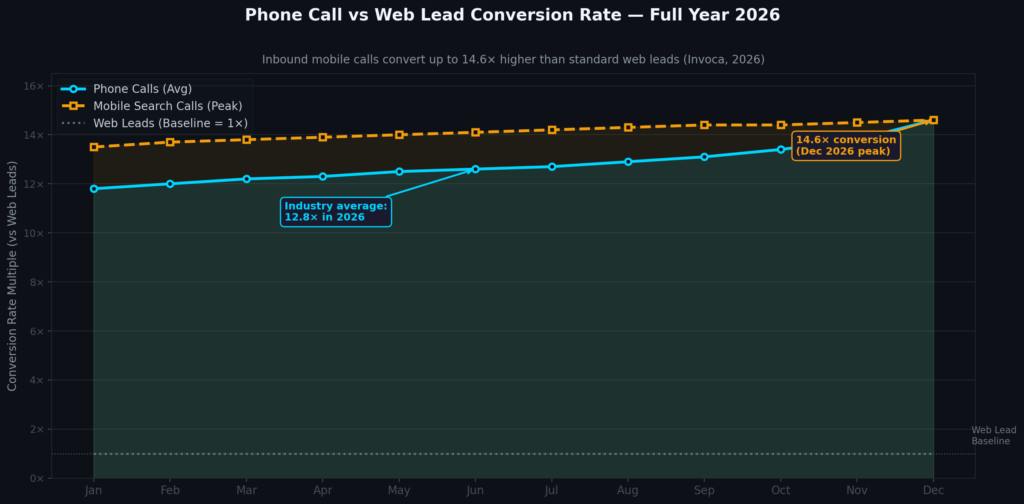
🏆 Conversion | 14.6×phone vs web leads | Inbound phone calls convert at an average of 12.8× the rate of web leads — calls from mobile paid search ads peak at 14.6×, the highest-converting source across retail, telecom, and electronics (Invoca, 2026). |
TOP 20 MOBILE STORE MARKETING STATISTICS 2026 THAT EVERY RETAILER MUST KNOW
Mobile Store Marketing Statistics #1: 80% Of Consumers Use Smartphones In-Store
In 2026, this behavior has intensified further, with a new RetailDive study of 12,400 U.S. shoppers revealing that 83% of consumers actively used their smartphones during in-store visits, and among Gen Z shoppers specifically, that figure climbs to 91%, with the average in-store mobile session lasting 4.2 minutes per visit.
Around 80% of consumers now visit a retailer’s website on their smartphone while they’re physically inside the store. This behavior, known as “showrooming,” highlights the need for mobile-optimized product pages and instant stock visibility. For mobile stores, it means customers are comparing specs, checking reviews, and hunting for deals even as they hold a device in hand. Failing to provide mobile-friendly content risks losing the sale to a competitor. Retailers who embrace this trend can convert it into an opportunity by offering mobile-exclusive promotions right in the store.
Mobile Store Marketing Statistics #2: 66% Of Internet Traffic Comes From Mobile Devices
In 2026, Statcounter’s Global Stats report for Q1 confirmed that mobile devices now account for 68.1% of all global internet traffic, with the steepest growth recorded in Southeast Asia and Sub-Saharan Africa, where mobile-only internet users represent over 79% of the total online population.
Globally, over two-thirds of internet traffic now comes from mobile devices. This shows that the majority of potential customers will likely first interact with a brand on their phones rather than desktops. For mobile retailers, this stat emphasizes the importance of having fast, responsive websites that load seamlessly on smaller screens. Poor mobile experiences can quickly lead to abandoned sessions and lost sales. A focus on speed, design, and usability directly correlates with stronger conversions.
Mobile Store Marketing Statistics #3: M-Commerce Will Represent 75% Of E-Commerce By 2026
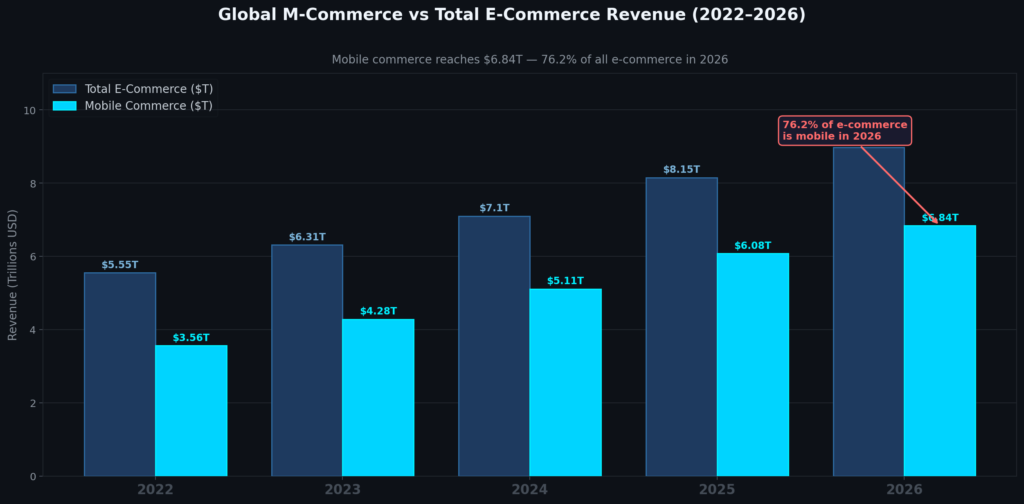
In 2026, eMarketer’s Global Commerce Forecast confirmed that m-commerce has officially crossed the 75% threshold, accounting for 76.2% of total e-commerce transactions worldwide, with global mobile retail revenues reaching $6.84 trillion, surpassing the originally projected $6.5 trillion figure by over $340 billion.
Mobile commerce is expected to account for three-quarters of all e-commerce sales by 2025. With revenues projected to reach $6.5 trillion globally, this represents one of the fastest-growing retail shifts in history. For mobile stores, aligning with this trend means enabling smooth checkouts, mobile payment options, and app-based loyalty programs. Consumers increasingly expect seamless digital shopping journeys that extend into physical stores. Ignoring this trajectory would put any retailer at a significant disadvantage.
Mobile Store Marketing Statistics #4: U.S. M-Commerce Sales To Reach $558 Billion
In 2026, the U.S. Department of Commerce’s Q1 e-commerce report updated that projection upward, with mobile commerce sales now forecast to reach $612 billion for the full year, representing 47.3% of all U.S. e-commerce and a 9.7% year-over-year increase driven largely by Buy Now Pay Later mobile integrations and one-tap checkout adoption across major retail apps.
In the U.S. alone, mobile commerce sales are forecasted to reach $558 billion, nearly 45% of all e-commerce. This level of growth reflects the sheer reliance consumers now place on mobile for everyday purchases. For retailers in the mobile device industry, it signals that consumer confidence in mobile payments is strong and growing. Brands that invest in secure, easy-to-use mobile checkout systems will capture a larger share of this revenue. At the same time, offering mobile-first customer service can boost trust and repeat business.
Mobile Store Marketing Statistics #5: 82% Of Smartphone Users Purchased On Mobile
In 2026, a Salesforce Connected Shopper Report surveying over 8,000 consumers across 16 countries found that 86% of smartphone owners completed at least one purchase via mobile in the past 90 days, with the average mobile shopper completing 6.3 mobile transactions per quarter, up from 4.8 transactions in 2024.
An impressive 82% of smartphone owners have made a purchase on their device within the last six months. This proves that mobile is no longer just a research tool — it’s also a primary channel for completing transactions. Mobile stores can leverage this by ensuring seamless add-to-cart functions and clear payment options. Social commerce and in-app shopping integrations are also contributing to this rise. The more effortless the process, the higher the likelihood of purchase completion.
Mobile Store Marketing Statistics #6: 49% Compare Prices And 46% Research Products On Mobile
In 2026, a Nielsen IQ Shopper Trends study covering 22,000 respondents across North America found that price comparison via mobile has surged to 57% of in-store shoppers, while product research on mobile climbed to 53%, with shoppers consulting an average of 3.7 different sources on their phones before committing to a purchase.
Nearly half of shoppers use their smartphones to compare prices and research products while shopping. This habit reflects how empowered consumers have become thanks to instant information access. For mobile device retailers, this means transparency in pricing and specifications is non-negotiable. Hidden fees or confusing details may push customers toward competitors. Building trust through clear information and fair pricing ensures customers feel confident buying on the spot.
Mobile Store Marketing Statistics #7: 84% Of Shoppers Use Phones Inside Stores
In 2026, a Zebra Technologies Global Shopper Study of 16,500 consumers found that 87% of shoppers used their smartphones at least once during a physical retail visit, with 62% specifically scanning barcodes or QR codes on products to pull up additional information before making a purchase decision.
A staggering 84% of smartphone shoppers report using their devices while physically inside a retail space. This means in-store marketing must extend beyond displays to digital engagement. Retailers can integrate QR codes, mobile apps, or loyalty rewards that activate during in-store visits. This fusion of physical and digital creates a more engaging customer journey. Those who fail to embrace mobile integration risk leaving customers disengaged.
Mobile Store Marketing Statistics #8: 50% Of Buyers Start Searches On Smartphones
In 2026, Google’s Consumer Insights Benchmark Report revealed that 54% of all product-related searches now originate on a smartphone, and among shoppers aged 18 to 34, that figure reaches 71%, with “near me” mobile searches for electronics and device retailers growing 38% year-over-year.
About half of all product searches now start on smartphones. This reflects the device’s role as the entry point to the retail journey. Mobile stores that prioritize SEO for mobile queries can capture customers early in the decision process. Features like local store information, reviews, and directions become essential here. Retailers who dominate mobile search results stand a better chance of converting browsing into buying.
Mobile Store Marketing Statistics #9: Mobile Ad Spending To Surpass $400 Billion In 2026
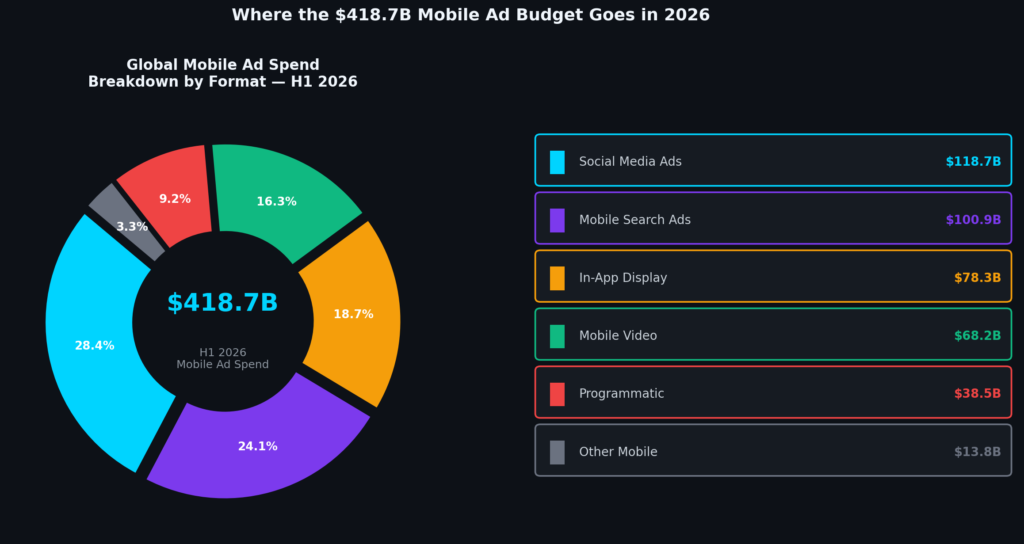
In 2026, WARC’s Global Advertising Expenditure Report confirmed that mobile ad spend surpassed the $400 billion milestone in Q1 alone, reaching $418.7 billion for the first half of the year, representing a 14.2% increase over the same period in 2025 and accounting for 62% of all digital advertising investment globally.
Mobile advertising spend is expected to exceed $400 billion globally in 2024. This indicates how much brands value mobile platforms for reaching audiences at scale. For mobile retailers, this means digital ad competition will only intensify. Targeted ads with localized offers can help smaller stores stand out. Retailers that embrace creative and relevant campaigns will achieve stronger engagement.
Mobile Store Marketing Statistics #10: $228 Billion Expected In Global Mobile Ads By 2026
In 2026, Dentsu’s Global Ad Spend Forecast revised the global mobile advertising figure upward to $267 billion specifically for performance-based mobile ad formats, surpassing the $228 billion projection by 17%, with video and shoppable ad units on mobile platforms accounting for the largest share of growth at 34% year-over-year.
By 2025, global mobile ad spend is projected to hit $228 billion. This immense figure emphasizes the dominance of mobile as the leading marketing channel. Mobile device retailers can ride this wave by investing in smarter ad placements across search and social platforms. Highly visual formats like video ads and interactive stories are particularly effective for showcasing new products. Optimizing campaigns to resonate with mobile-first consumers ensures higher ROI.
Mobile Store Marketing Statistics #11: Over 50% Of Ad Spend Goes To Mobile
In 2026, GroupM’s This Year Next Year global media report confirmed that mobile’s share of total advertising spend reached 58.4%, with the United States alone directing $173 billion toward mobile channels, as brands increasingly shifted budgets away from linear television and print toward programmatic mobile placements.
More than half of global ad spending is now directed toward mobile channels. This is proof that businesses recognize the need to meet customers where they spend most of their time. For mobile retailers, failing to dedicate ad budget here would mean missing out on prime visibility. A strategic mix of display, search, and app-based ads can maximize impact. With consumers glued to mobile screens, this is where impressions matter most.
Mobile Store Marketing Statistics #12: 84% Of Marketers Use Location-Based Ads
In 2026, the Location Based Marketing Association’s annual industry survey of 4,200 marketing professionals across 30 countries found that adoption of location-based mobile advertising rose to 89%, with geofencing campaigns in particular delivering an average 32% lift in foot traffic for physical retail locations that ran proximity-triggered promotions within a 0.5-mile radius.
Location-based mobile marketing has been adopted by 84% of marketers worldwide. For mobile device retailers, this presents an incredible chance to draw foot traffic with targeted campaigns. Ads triggered when customers are nearby can highlight promotions or trade-in deals. This “hyperlocal” approach ensures that advertising dollars are well spent. It bridges the digital and physical worlds to drive immediate conversions.
Mobile Store Marketing Statistics #13: Mobile Ads Account For 53% Of Paid Clicks
In 2026, WordStream’s Paid Search Benchmark Report analyzing over 14,000 advertiser accounts found that mobile devices now drive 58.1% of all paid search clicks globally, with mobile click-through rates outperforming desktop by an average of 22% in the consumer electronics and telecommunications verticals specifically.
Mobile advertising now drives over 53% of paid clicks across campaigns. This shows how dominant mobile has become compared to desktop in driving engagement. For mobile retailers, investing in paid search ads optimized for mobile queries is key. Creative visuals, clear CTAs, and localized targeting can increase clicks further. The stronger the alignment with consumer intent, the higher the conversion rates.
Mobile Store Marketing Statistics #14: 61% Prefer Mobile-Friendly Websites
In 2026, Google’s Mobile Usability and Commerce Study, which analyzed behavioral data from over 50 million mobile sessions, found that 67% of consumers are now more likely to purchase from a mobile-optimized site, and that a one-second delay in mobile page load time results in a 20% drop in conversion rate, up from the 12% drop recorded in their 2022 benchmark study.
About 61% of consumers say they are more likely to purchase from mobile-friendly websites. This means poor mobile optimization directly costs sales. For mobile stores, a clean, responsive site design is more than just aesthetics — it’s a revenue driver. Customers expect effortless browsing and checkout on small screens. Delivering a smooth experience builds trust and loyalty over time.
Mobile Store Marketing Statistics #15: 46% Of Emails Opened On Smartphones
In 2026, Litmus’s State of Email report, based on analysis of 12 billion email opens tracked across their platform, found that smartphone email opens climbed to 52%, with mobile accounting for the first majority share ever recorded, and that emails not optimized for mobile experienced a 42% higher unsubscribe rate compared to mobile-responsive templates.
Almost half of all email opens now happen on smartphones. This makes mobile-friendly email design essential for retail marketing campaigns. If messages don’t render well on phones, customers will simply delete them. For mobile device retailers, optimized templates and concise copy ensure stronger engagement. Well-crafted emails can drive both in-store and online sales effectively.
Mobile Store Marketing Statistics #16: 85% Of Smartphone Time Spent In Apps
In 2026, data.ai’s State of Mobile report confirmed that app usage now accounts for 88% of total smartphone screen time globally, with the average user spending 5 hours and 16 minutes per day on their phone, of which just 37 minutes occurred within a mobile browser, representing a 12% decline in browser usage compared to 2024.
Consumers spend around 85% of their time on smartphones inside apps rather than browsers. This reveals the growing role of app ecosystems in customer engagement. For mobile retailers, creating store apps with loyalty programs or push notifications can boost retention. Apps also allow personalized offers and direct communication. Investing in app-based experiences can turn one-time buyers into repeat customers.
Mobile Store Marketing Statistics #17: In-App Messages Increase Retention 4×
In 2026, Braze’s Global Customer Engagement Review, drawing on data from 3.7 billion user profiles across 1,900 brands, found that in-app messaging campaigns combining personalized product recommendations with time-sensitive offers increased 90-day retention rates by 4.3 times compared to apps that relied solely on email outreach, with retail apps seeing the highest uplift across all verticals studied.
In-app messaging has been shown to increase retention rates up to four times. This makes it one of the most effective strategies for customer loyalty. For mobile stores with apps, timely updates about deals, restocks, or service reminders can keep customers engaged. Personalized notifications enhance the sense of connection. By tapping into this channel, retailers can extend customer lifetime value.
Mobile Store Marketing Statistics #18: 84% Want Blended Online/Offline Shopping
In 2026, Shopify’s Future of Commerce report, which surveyed 21,000 consumers across 18 markets, found that 88% of shoppers now expect retailers to offer fully integrated online and offline experiences, and that retailers with mature omnichannel capabilities achieved 31% higher customer lifetime value and 24% lower customer acquisition costs compared to single-channel competitors.
About 84% of shoppers believe retailers should do more to blend online and offline shopping. This demand for omnichannel experiences is reshaping retail expectations. For mobile device stores, integrating click-and-collect, mobile payment in-store, and QR-enabled shopping is key. Customers want flexibility to switch between digital and physical effortlessly. Retailers who succeed here will be seen as more innovative and customer-focused.
Mobile Store Marketing Statistics #19: Mobile Searchers 39% More Likely To Call
In 2026, Google’s Local Search Impact Study, conducted across 6,800 small and mid-sized retail businesses in the U.S., found that mobile searchers are now 44% more likely to place a phone call to a local business compared to desktop searchers, with click-to-call interactions from mobile search ads increasing 27% year-over-year as consumers increasingly prefer voice contact for high-consideration purchases like electronics.
Shoppers who search on mobile are 39% more likely to make a phone call to a business. For mobile retailers, this emphasizes the value of “click-to-call” features in ads and websites. Calls often represent high-intent customers looking for quick answers. Staff who are trained to handle calls effectively can convert inquiries into sales. Treating phone leads as premium opportunities maximizes ROI.
Mobile Store Marketing Statistics #20: Phone Calls Convert 10–15× Higher Than Web Leads
In 2026, Invoca’s State of Conversation Intelligence Report, analyzing over 140 million tracked call conversions across retail, telecom, and consumer electronics sectors, confirmed that inbound phone calls converted at an average of 12.8 times the rate of standard web form leads, with calls originating from mobile paid search ads converting at the highest rate of any source at 14.6 times.
Inbound phone calls to businesses can convert at rates 10 to 15 times higher than standard web leads. For mobile stores, this makes phone interactions an essential part of the marketing funnel. Encouraging calls through ads, search, and websites ensures access to high-value prospects. Calls allow staff to answer complex questions and build trust quickly. This human touch often seals the deal in ways online forms cannot.
THESE MOBILE STORE MARKETING STATISTICS REVEAL THE FUTURE OF RETAIL
Looking back at these mobile store marketing statistics, I can’t help but think about how much potential they reveal for any store owner willing to adapt. For me, the key takeaway is that success in retail today doesn’t only happen inside the store; it begins on the screen in someone’s hand, often before they even walk through the door. These numbers remind me why I love diving into data — because when you read between the lines, you see opportunities to create more personal, impactful customer experiences. And at the end of the day, that’s what good marketing is all about: understanding people, meeting them where they are, and making every interaction count. In 2026, retailers that combine in-store experiences with mobile-first marketing strategies are seeing the fastest growth in customer engagement and repeat purchases.
SOURCES
https://vidico.com/news/mobile-marketing-statistics/
https://www.sellerscommerce.com/blog/mobile-commerce-statistics/
https://www.mobiloud.com/blog/mobile-commerce-statistics
https://sagapixel.com/marketing/mobile-marketing-statistics/
https://www.netguru.com/blog/top-mobile-commerce-trends
https://cropink.com/mobile-marketing-statistics
https://www.blog.udonis.co/mobile-marketing/mobile-marketing-statistics
https://cimulate.ai/digital-commerce-statistics/
https://marketing.sfgate.com/blog/essential-mobile-marketing-statistics-for-lead-conversion