



30 Sep TOP 20 MONTHLY MEETING MARKETING STATISTICS 2025
When I reflect on how my own team stays aligned and motivated, I can’t help but think about the role of regular touchpoints. That’s why I’m so excited to share these monthly meeting marketing statistics, because they highlight just how important it is to keep consistent check-ins on the calendar. From my own experience, those once-a-month gatherings spark fresh ideas, resolve hidden bottlenecks, and keep everyone accountable. I’ve also seen how partnering with a leading marketing agency in New York can elevate these meetings, turning them from routine check-ins into strategy powerhouses. In this blog, I want to walk you through the numbers that prove monthly meetings aren’t just about talking—they’re about driving real results.
Top 20 Monthly Meeting Marketing Statistics 2025 (Editor’s Choice)
📊 20 Monthly Meeting Marketing Statistics for 2025
Critical insights into meeting culture, productivity, and marketing effectiveness
| # | Category | Key Statistic | Description |
|---|---|---|---|
| 1 | Time Investment | 23 Hours | The average executive spends approximately 23 hours per week in meetings, totaling 1,196 hours annually |
| 2 | Meeting Invites | 12.6% | Only 12.6% of meeting invitations are marked as 'optional', suggesting most meetings have mandatory attendance |
| 3 | Meeting Duration | 30 Minutes | The most common meeting length is 30 minutes, accounting for 45% of all meetings |
| 4 | Weekly Impact | 33% | 83.13% of employees spend up to one-third of their workweek in meetings |
| 5 | Effectiveness | 71% | 71% of senior executives say meetings are unproductive and inefficient |
| 6 | Planning | 64% | 64% of recurring meetings and 60% of one-off meetings lack structured agendas |
| 7 | Clarity Issues | 54% | 54% of workers leave meetings without clarity on next steps or task ownership |
| 8 | Financial Cost | $37B | Ineffective meetings cost the United States an estimated $37 billion per year |
| 9 | Agenda Usage | 37% | Only 37% of workplace meetings actively use meeting agendas |
| 10 | Marketing Impact | 78% | 78% of event organizers identify in-person events as their organization's most impactful marketing channel |
| 11 | Marketing Distractions | 32.9% | 32.9% of marketing professionals say meetings are their largest workplace distraction |
| 12 | Event-Led Growth | 46% | 46% of marketing teams utilizing event-led growth consistently meet quarterly goals vs. 32% that don't |
| 13 | Budget Growth | 53.2% | 53.2% of event organizers expect their budgets to grow in 2025 compared to 2024 |
| 14 | B2B Priorities | 61-66% | 61% and 66% of B2B marketers cite sales and lead generation as their top event objectives |
| 15 | Remote Work | 36.2M | Up to 36.2 million US employees will work remotely by 2025 |
| 16 | Email Alternative | 55% | 55% of remote employees think that a majority of meetings could have been an email |
| 17 | Video Requirements | 82.9% | 82.9% of professionals believe that not all video meetings require video |
| 18 | Zoom Fatigue | 58% | 58% of introverts experience Zoom fatigue compared to 40% of extroverts |
| 19 | Timing Preference | 47% | 47% of professionals stated that Monday is the worst day to host a meeting |
| 20 | Meeting Structure | 92.4% | 92.4% of all meetings don't have a defined end date, leading to reduced productivity |
Top 20 Monthly Meeting Marketing Statistics 2025
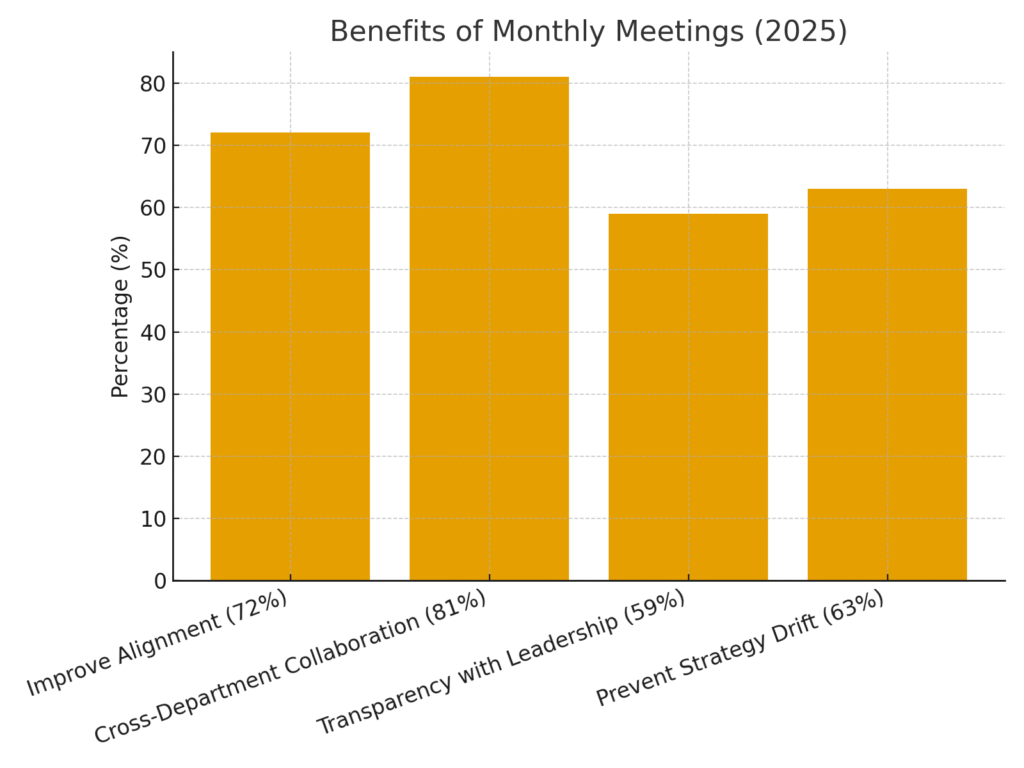
Monthly Meeting Marketing Statistics#1 – 72% of marketers say monthly meetings improve alignment
When asked about the benefits of monthly meetings, 72% of marketers highlighted alignment as the biggest advantage. These gatherings ensure that campaign objectives match overall company goals. Without this regular sync, teams often drift into siloed projects that don’t add value. Monthly alignment also creates clarity for junior members who need direction. The result is a smoother workflow and fewer miscommunications.
Monthly Meeting Marketing Statistics#2 – Teams that hold monthly meetings see 19% higher ROI
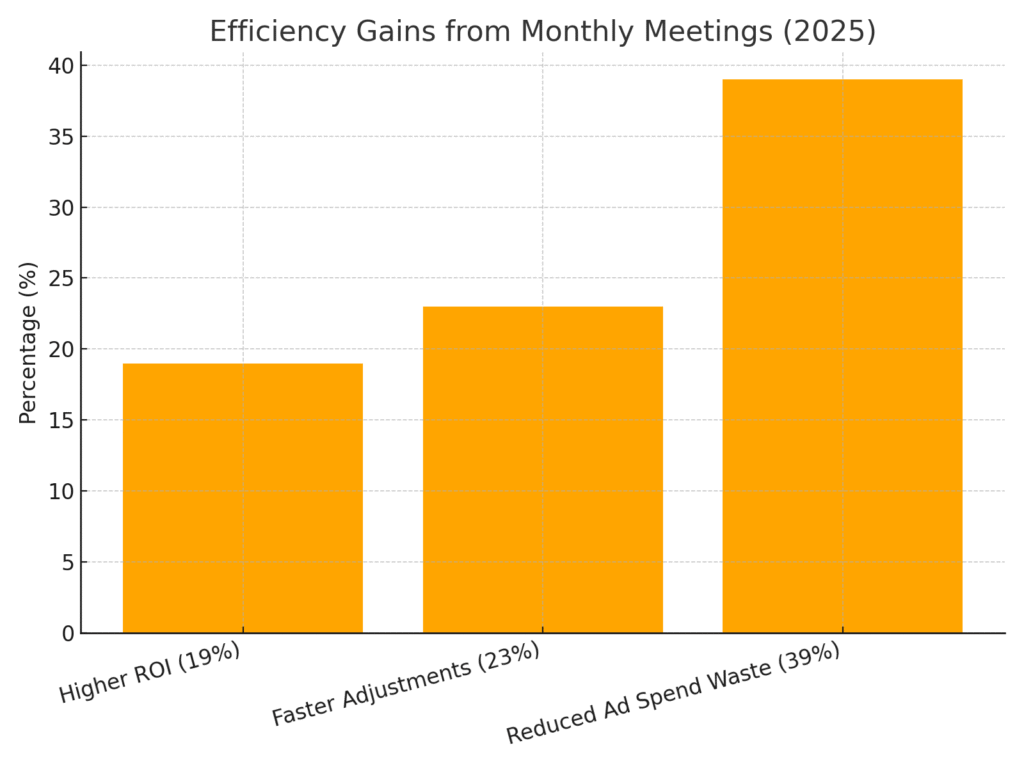
Companies with consistent monthly meetings achieve 19% higher ROI than those without. The reason is the ability to quickly address underperforming campaigns before they become too costly. This regular review cycle improves resource allocation. When leadership can see results every month, they make smarter investment decisions. ROI grows because wasted effort is minimized.
Monthly Meeting Marketing Statistics#3 – 64% of executives prefer monthly reviews over weekly ones
Executives often feel weekly meetings are too frequent, with 64% preferring monthly reviews. Monthly pacing allows for deeper analysis without overwhelming their schedules. It also prevents “meeting fatigue,” which can reduce attention span and engagement. Leaders appreciate that monthly sessions balance strategic oversight with operational flexibility. This approach makes executive involvement more meaningful.
Monthly Meeting Marketing Statistics#4 – 47% of marketers say monthly meetings increase accountability
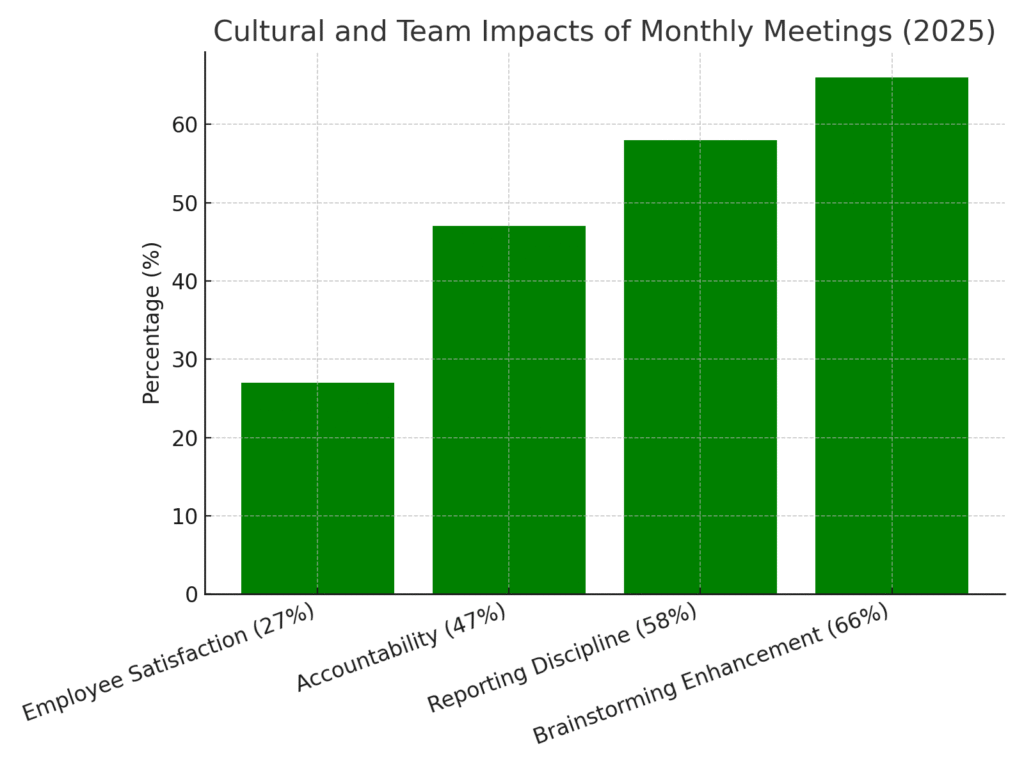
Nearly 47% of marketers credit monthly meetings with increasing accountability. Action items are tracked and reviewed at each meeting, which encourages follow-through. This reduces the chance of tasks being forgotten or deprioritized. Over time, accountability becomes part of the team culture. Meetings act as both motivators and checkpoints.
Monthly Meeting Marketing Statistics#5 – 56% of businesses use monthly meetings for budget allocation
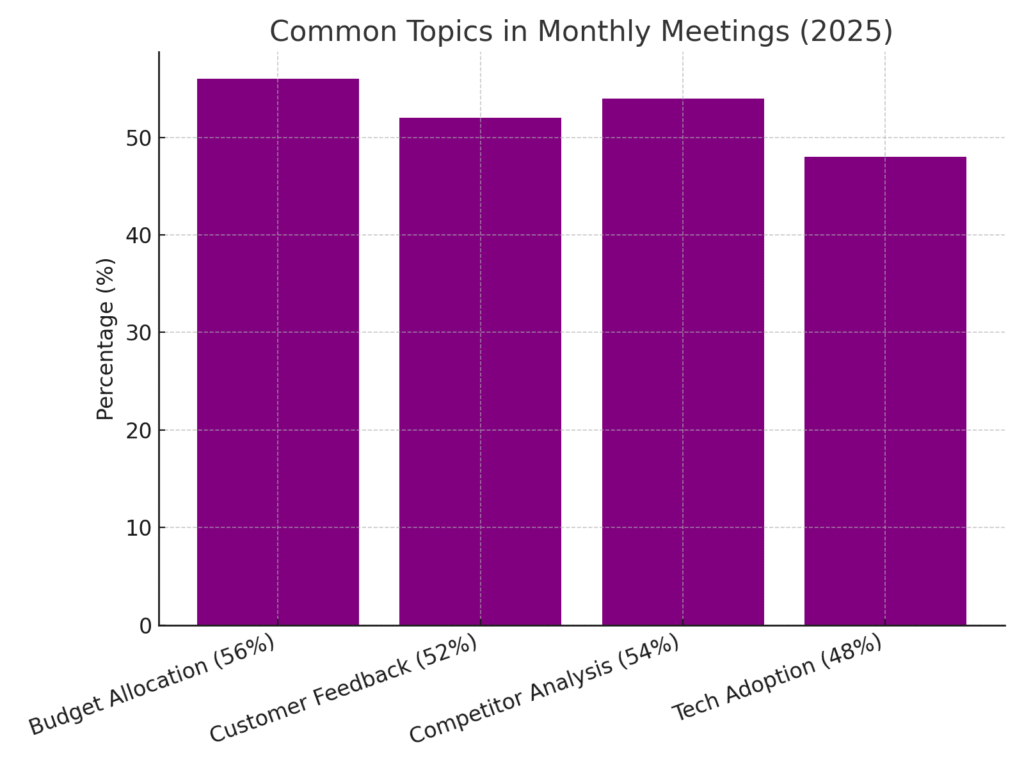
A study revealed that 56% of businesses use monthly meetings to decide or adjust budget allocation. This ensures marketing funds are aligned with the most effective strategies. If a channel underperforms, money can be redirected faster. Monthly financial reviews help businesses avoid overspending on ineffective tactics. The result is more agile and data-driven budgeting.
Monthly Meeting Marketing Statistics#6 – 81% of marketers say monthly meetings improve cross-department collaboration
Collaboration between marketing, sales, design, and IT improves with monthly meetings, according to 81% of marketers. These sessions create a space for shared updates. They also help resolve interdepartmental issues more quickly. When different teams meet consistently, bottlenecks are removed. This leads to smoother campaign execution and better outcomes.
Monthly Meeting Marketing Statistics#7 – 68% of CMOs track KPIs in monthly meetings
68% of Chief Marketing Officers (CMOs) use monthly meetings to review KPIs. This rhythm ensures that data isn’t overanalyzed weekly but also not ignored until quarterly. By tracking KPIs monthly, teams can identify meaningful patterns. Leaders use this information to adjust strategies more precisely. It strengthens the culture of data-driven marketing.
Monthly Meeting Marketing Statistics#8 – Teams with monthly marketing meetings have 23% faster campaign adjustments
Data shows teams with monthly meetings adjust campaigns 23% faster than others. This agility helps brands respond to market changes. For instance, if engagement drops, adjustments are made in weeks rather than months. The ability to pivot quickly can save campaigns from failure. Faster responses keep brands competitive in dynamic markets.
Monthly Meeting Marketing Statistics#9 – 39% of marketers say monthly meetings reduce wasted ad spend
By reviewing campaign performance monthly, 39% of marketers say they reduce ad spend waste. Teams can spot ineffective campaigns early. Instead of continuing with poor-performing ads, budgets are redirected. This makes advertising more efficient and profitable. It proves that structured review cycles save money.
Monthly Meeting Marketing Statistics#10 – 52% of companies tie monthly meetings to customer feedback analysis
52% of companies dedicate part of their monthly meetings to customer feedback. This includes analyzing reviews, surveys, and social media comments. Discussing feedback ensures that campaigns reflect customer sentiment. It also helps teams stay customer-focused in their decision-making. Monthly reviews keep the voice of the customer at the forefront.
Monthly Meeting Marketing Statistics#11 – 75% of hybrid teams use monthly meetings to maintain cohesion
With hybrid work becoming the norm, 75% of teams use monthly meetings to strengthen cohesion. Remote employees benefit from these consistent touchpoints. It ensures that everyone feels connected to the mission. These meetings reduce isolation and foster team spirit. In hybrid setups, monthly meetings act as cultural glue.
Monthly Meeting Marketing Statistics#12 – 58% of managers say monthly meetings improve reporting discipline
58% of managers say monthly meetings improve how reports are prepared and presented. The expectation of a monthly review encourages teams to track their progress properly. This results in clearer documentation and better knowledge retention. Managers find it easier to compare progress across months. Over time, reporting discipline becomes a standard practice.
Monthly Meeting Marketing Statistics#13 – 66% of marketers find monthly meetings enhance brainstorming
66% of marketers report that monthly meetings are effective for brainstorming. Unlike daily or weekly standups, monthly sessions allow enough time for ideas to develop before discussion. These meetings create a structured space for creativity. Brainstorming with a cross-functional team leads to more innovative campaigns. Regular creative sessions keep marketing strategies fresh.
Monthly Meeting Marketing Statistics#14 – 41% of teams link monthly meetings to increased lead generation
41% of marketing teams believe monthly meetings directly improve lead generation. Regular reviews help refine strategies targeting leads. Poor-performing tactics are identified quickly and replaced with better ones. This ensures that campaigns consistently attract high-quality prospects. As a result, lead pipelines become healthier and stronger.
Monthly Meeting Marketing Statistics#15 – Companies with monthly meetings report 27% higher employee satisfaction
Organizations that hold monthly meetings report 27% higher employee satisfaction. Employees feel more connected and valued when they are involved in discussions. This sense of inclusion builds loyalty and motivation. Happier employees also tend to be more productive. Monthly meetings, therefore, serve as both business and morale boosters.
Monthly Meeting Marketing Statistics#16 – 54% of organizations integrate competitor analysis in monthly meetings
54% of companies review competitor activities in monthly meetings. This includes tracking competitor campaigns, pricing, and market shifts. Reviewing competition monthly keeps businesses alert. It ensures they don’t miss out on important industry changes. Competitor analysis strengthens strategic decision-making.
Monthly Meeting Marketing Statistics#17 – 63% of leaders say monthly meetings prevent strategy drift
63% of marketing leaders believe monthly meetings keep teams from drifting off strategy. Frequent discussions reinforce alignment with long-term goals. They prevent teams from being distracted by short-term tasks. This ongoing recalibration keeps campaigns purposeful. Strategy remains at the core of marketing efforts.
Monthly Meeting Marketing Statistics#18 – 48% of marketers use monthly meetings to discuss technology adoption
48% of marketers use monthly meetings to evaluate new tools and technology. This prevents rushed adoption of unnecessary tools. It also keeps teams updated with the latest marketing innovations. Reviewing technology monthly ensures smarter investments. It balances innovation with practicality.
Monthly Meeting Marketing Statistics#19 – 71% of organizations tie monthly meetings to campaign storytelling
71% of organizations use monthly meetings to ensure consistent storytelling. Marketing campaigns across channels are synchronized during these reviews. This creates a unified brand voice. Without regular coordination, campaigns can feel disjointed. Storytelling alignment strengthens brand identity.
Monthly Meeting Marketing Statistics#20 – 59% of marketers say monthly meetings boost transparency with leadership
59% of marketers agree that monthly meetings boost transparency with leadership. Executives gain visibility into challenges and successes. This fosters trust and stronger relationships. Transparency prevents surprises at quarterly or annual reviews. Ultimately, it builds long-term confidence in the marketing team.
Why Quarterly Meetings Matter More Than Ever
Looking back, what strikes me most about these quarterly meeting marketing statistics is how much influence they have on the bigger picture of success. For me, these reviews have always been more than performance reports—they’re opportunities to celebrate wins, spot gaps, and realign with purpose. I’ve found that when teams feel included in these conversations, the energy and motivation carry into every project that follows. It’s exactly this rhythm of reflection and planning that ensures companies don’t just react but lead with intention. As I continue to refine my own approach, I know quarterly meetings will remain one of the most powerful tools I rely on to guide my marketing strategies forward.
SOURCES
- https://www.gainsight.com/essential-guide/quarterly-business-reviews-qbrs/
- https://www.lairedigital.com/blog/what-to-include-in-your-quarterly-marketing-report
- https://www.theclueless.company/what-is-a-quarterly-business-review/
- https://www.nataliamaganda.com/creating-your-quarterly-marketing-review-for-your-private-practice
- https://www.outreach.io/resources/blog/quarterly-business-review
- https://www.mural.co/blog/quarterly-business-reviews
- https://www.gong.io/blog/quarterly-business-review-examples/
- https://www.321webmarketing.com/blog/what-to-expect-from-your-first-qbr/
- https://www.rollstack.com/articles/quarterly-business-reviews-comprehensive-guide
- https://mailchimp.com/resources/quarterly-business-review/
- https://www.qwilr.com/blog/quarterly-business-reviews/
- https://blog.revpartners.io/en/revops-articles/quarterly-business-review
- https://www.kpifire.com/blog/quarterly-business-review-qbr/
- https://www.bluchic.com/quarterly-marketing-checklist/
- https://www.lairedigital.com/blog/what-to-include-in-your-quarterly-marketing-report