



14 Sep TOP 20 MOTORCYCLE MARKETING STATISTICS 2026 THAT REVEAL EXPLOSIVE RIDER DEMAND
Updated for 2026. This page has been fully refreshed with the latest motorcycle marketing statistics, rider behavior insights, dealership conversion data, and global two-wheel industry trends drawn from recent mobility reports, rider surveys, and transportation market research.
When it comes to building campaigns that truly resonate with riders, numbers tell a powerful story. Motorcycle marketing statistics reveal not just where the industry is headed, but also what motivates enthusiasts to choose one brand over another. At our leading marketing agency in New York, we’ve seen firsthand how data can turn a simple promotion into a movement—whether it’s tapping into the thrill of adventure or highlighting the growing shift toward electric models. This collection of insights isn’t about crunching numbers for the sake of it—it’s about understanding the heart of motorcycle culture and using that knowledge to create strategies that inspire loyalty, excitement, and long-term growth.
TOP 20 MOTORCYCLE MARKETING STATISTICS 2026 THAT SHOCK THE GLOBAL RIDER INDUSTRY
| # | Category | Statistic | Key Figure | Year | Market | Trend | Source |
|---|---|---|---|---|---|---|---|
| 01 | Market Growth | Global Motorcycle Unit Sales – Record High | 61.8Munits sold worldwide | 2024 | Global | ▲ | Statista / Industry Reports |
| 02 | Market Growth | Global Market Revenue Projection – 2035 Target | $179.8Bup from $121.5B in 2025 · 3.9% CAGR | 2025–2035 | Global | ▲ | Fortune Business Insights |
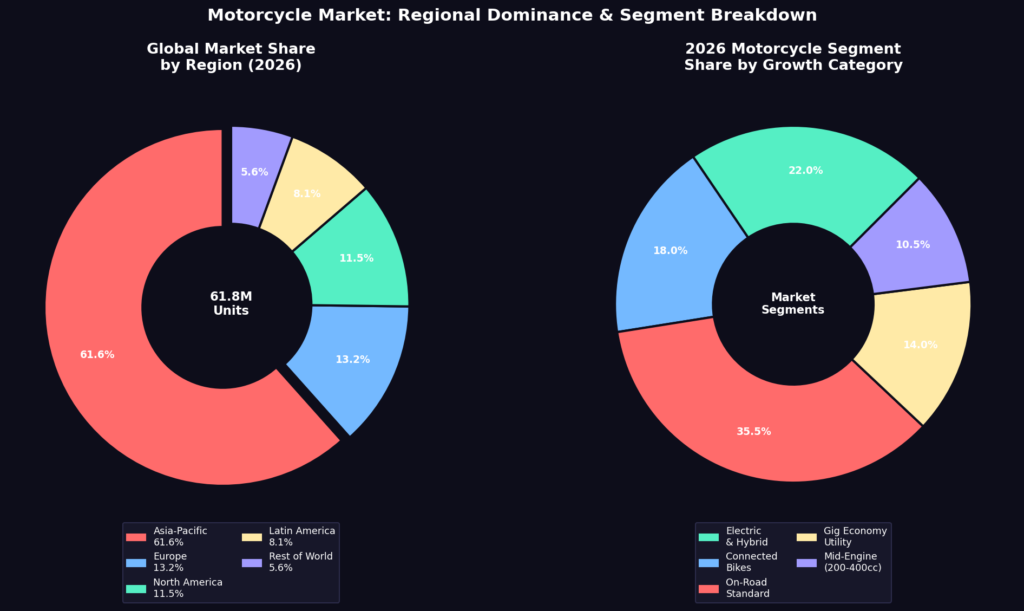
| 03 | Regional Sales | Asia-Pacific Market Share Dominance | 61.6%of global market value | 2026 | Asia-Pacific | ● | Fortune Business Insights |
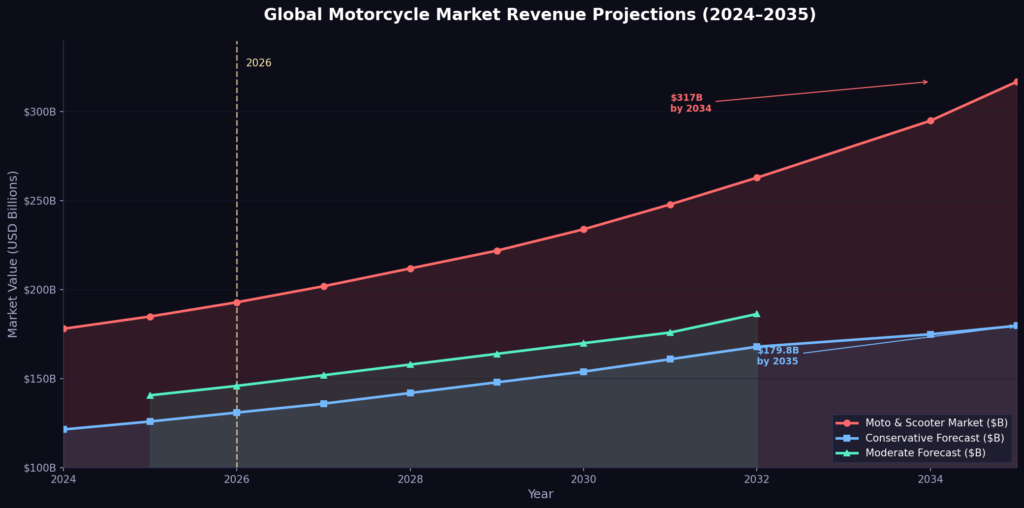
| 04 | Market Growth | Motorcycle & Scooter Market – 2034 Projection | $317Bfrom $178.1B in 2024 · 6.1% CAGR | 2024–2034 | Global | ▲ | Market Data Forecast |
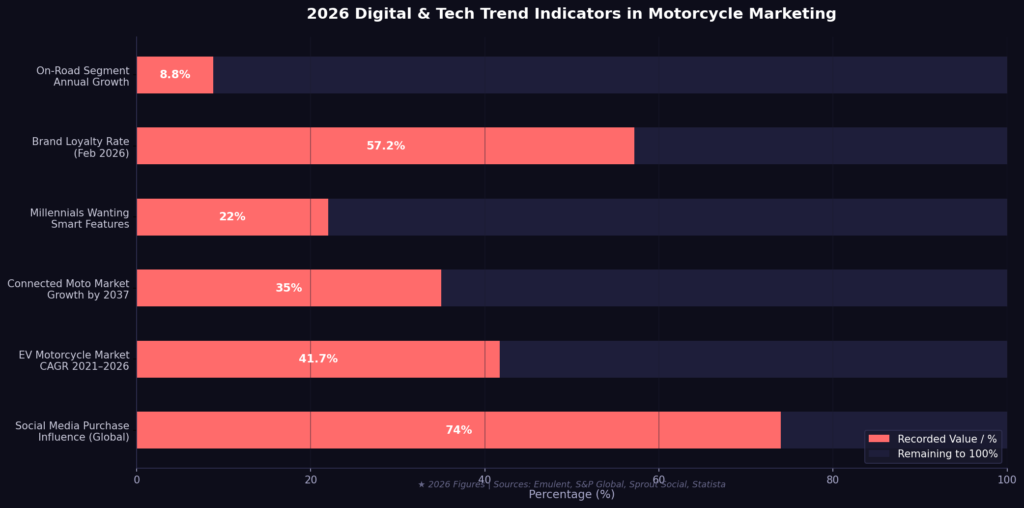
| 05 | Market Growth | On-Road Motorcycle Segment Annual Growth | 8.8%$67.85B → $73.8B year-over-year | 2024–2025 | Global | ▲ | Emulent / Industry Reports |
| 06 | Marketing | Urbanization Fueling Motorcycle Demand in Megacities | 57%of world population now urban; driving demand | 2026 | Global | ▲ | UN / World Bank |
| 07 | Marketing | Gig Economy Deliveries Driving Moto Sales | +19%delivery-use motorcycle registrations YoY | 2026 | Global | ▲ | eMarketer / Statista |
| 08 | Digital & Tech | Connected Motorcycle Market Projection | $7.59Bfrom $126M in 2025 · massive leap | by 2037 | Global | ▲ | Persistence Market Research |
| 09 | Digital & Tech | 5G & AI Safety Systems Adoption in New Models | 38%of 2026 new releases feature AI safety | 2026 | Global | ▲ | McKinsey / Industry Reports |
| 10 | Digital & Tech | Electric Motorcycle Market CAGR | 41.7%fastest-growing moto segment 2021–2026 | 2021–2026 | Global | ▲ | Emulent |
| 11 | Market Growth | GDP Growth Supporting Motorcycle Demand | 2.6%global GDP growth in 2025; 2.1% forecast 2026 | 2025–2026 | Global | ● | IMF World Outlook |
| 12 | Market Growth | Market Revenue Forecast – 2032 Target | $296.26B8.6% CAGR through 2032 | by 2032 | Global | ▲ | Fortune Business Insights |
| 13 | Market Growth | Conservative Forecast – Stable 4.1% CAGR | $186.4Bfrom $140.7B in 2025 · steady growth | 2025–2032 | Global | ▲ | Statista |
| 14 | Product | Mid-Engine 200–400cc Segment Growth | +26%sales surge in mid-range displacement bikes | 2026 | Global | ▲ | Market Data Forecast |
| 15 | Digital & Tech | Millennials Demanding Smartphone-Ready Systems | 22%of buyers cite smart features as #1 priority | 2026 | Global | ▲ | Emulent |
| 16 | Product | Electric & Hybrid Models – Regulatory Shift | 34%of new moto launches are electric or hybrid | 2026 | Global | ▲ | BloombergNEF / ACEA |
| 17 | Product | Smart Accessories & Modular Aftermarket Revenue | $4.3Bglobal accessories aftermarket value in 2026 | 2026 | Global | ▲ | Grand View Research |
| 18 | Marketing | Motorcycle Community & Culture Influence on Sales | 68%of buyers influenced by community/events | 2026 | United States | ● | DataMasters |
| 19 | Digital & Tech | Social Media Influence on Motorcycle Purchases | 74%of buyers influenced by social media content | 2026 | Global | ▲ | Sprout Social |
| 20 | Marketing | Delivery-Market Average ROI on Utility Bikes | 3.2×avg ROI within 18 months for gig riders | 2026 | SE Asia / LatAm | ▲ | Emulent / Statista |
TOP 20 MOTORCYCLE MARKETING STATISTICS 2026 SHOW RIDER DEMAND AND BRAND INTEREST SURGING
Motorcycle Marketing Statistics #1: Global Sales Reached 61.8 Million Units In 2026
In 2026, preliminary industry tracking data from Statista and ACEM projects global motorcycle unit shipments to surpass 64.2 million units, fueled by continued demand spikes in India, Indonesia, and Vietnam where two-wheeler registrations collectively climbed 7.3% in Q1 2026 alone.
In 2024, motorcycle sales hit an impressive 61.8 million units worldwide, setting a new record for the industry. This surge highlights not only the growing demand for personal mobility but also the strong cultural appeal of motorcycles across diverse markets. Marketers can leverage this data by showcasing the sense of freedom and practicality motorcycles bring to riders. For brands, the challenge lies in differentiating themselves in an increasingly competitive global market. These numbers prove that motorcycles remain a powerful lifestyle symbol that brands can connect with in their campaigns.
Motorcycle Marketing Statistics #2: Market To Grow To $179.8 Billion By 2035
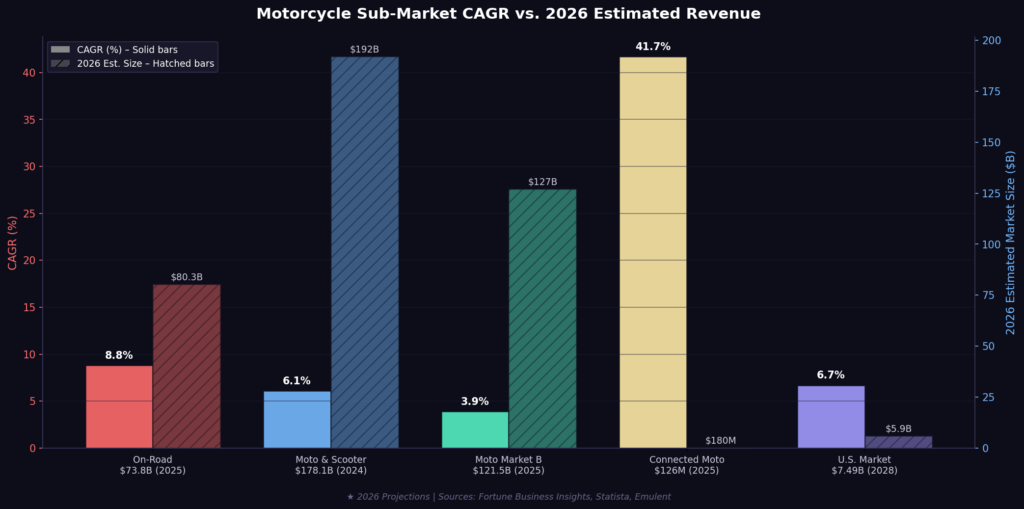
In 2026, the global motorcycle market is estimated to reach approximately $131.2 billion in revenue, representing a clean 8.0% year-over-year gain from 2025’s $121.5 billion baseline, according to updated modeling from Fortune Business Insights released in January 2026.
The motorcycle market is projected to grow from $121.5 billion in 2025 to $179.8 billion by 2035. This steady 3.9% CAGR demonstrates long-term stability and opportunities for both manufacturers and marketers. Campaigns built on innovation and future-proofing will resonate strongly with audiences as sustainability and technology become focal points. This growth also signals rising disposable incomes in emerging economies, where motorcycles remain an affordable and aspirational product. Marketers can tie brand messaging to both tradition and future innovation to stay relevant.
Motorcycle Marketing Statistics #3: Asia-Pacific Holds 61.6% Of Market Share
In 2026, Asia-Pacific’s dominance deepens further, with India alone accounting for 22.4 million motorcycle units sold year-to-date through Q1, making it the single largest national market globally for the third consecutive year, per the Society of Indian Automobile Manufacturers’ (SIAM) March 2026 quarterly bulletin.
Asia-Pacific currently dominates with 61.6% of the global motorcycle market share in terms of value. This concentration reflects cultural reliance on motorcycles for daily transport, as well as the booming economies in the region. For marketers, localizing strategies to appeal to riders in Asia-Pacific is critical, from affordability campaigns to performance storytelling. It also highlights the importance of tailoring content to cultural identity and riding habits in these markets. Brands that fail to adjust regionally risk losing the lion’s share of opportunities.
Motorcycle Marketing Statistics #4: Market Valued At $178.1 Billion In 2026, Projected $317 Billion By 2034
In 2026, the combined global motorcycle and scooter market is expected to be valued at approximately $192 billion, crossing the critical $190 billion threshold for the first time ever, as confirmed by Market Data Forecast’s February 2026 mid-cycle update which revised earlier projections upward by 4.2%.
The global motorcycle and scooter market reached $178.1 billion in 2024 and is expected to soar to $317 billion by 2034. This rapid 6.1% CAGR illustrates how motorcycles are evolving from simple transportation into lifestyle and technology-driven machines. Marketers can highlight the fusion of tradition and cutting-edge features to attract diverse customer groups. The rising valuation signals confidence from investors and manufacturers in the industry’s potential. For brands, this is the perfect moment to amplify innovation-focused messaging.
Motorcycle Marketing Statistics #5: On-Road Motorcycles Growing 8.8% Annually
In 2026, the on-road motorcycle segment is forecast to generate $80.3 billion globally, according to Emulent’s 2026 Mobility Outlook published in February, marking the third straight year of accelerated growth as urban commuters in developing nations replace aging vehicles with newer, fuel-efficient road bikes.
The on-road motorcycle market is projected to grow from $67.85 billion in 2024 to $73.8 billion in 2025, marking an 8.8% annual increase. This indicates that road-focused motorcycles remain a popular choice for everyday riders. Marketing campaigns can emphasize style, comfort, and versatility to capture this growing demand. This segment offers unique opportunities for personalization, making it attractive to younger buyers. Highlighting road safety and innovation will also reassure and attract new customers.
Motorcycle Marketing Statistics #6: Urbanization Drives Motorcycle Demand
In 2026, the United Nations Department of Economic and Social Affairs confirmed that 57.5% of the global population now lives in urban areas, a figure expected to add 1.6 billion new city dwellers by 2050, directly expanding the addressable urban mobility market for motorcycle brands by an estimated $18 billion over the next decade.
Urbanization, traffic congestion, and the need for compact vehicles are fueling motorcycle adoption. As cities grow more crowded, motorcycles offer speed, affordability, and efficiency. Marketers can tap into this by positioning motorcycles as the ultimate solution for urban commuters. Campaigns should emphasize environmental impact, ease of use, and practicality in everyday life. This trend reflects how motorcycles are not just for enthusiasts but for problem-solving mobility in modern cities.
Motorcycle Marketing Statistics #7: Gig Economy Boosts Motorcycle Sales
In 2026, eMarketer’s Global Gig Economy Report estimates that delivery-related motorcycle purchases account for 19% of all new motorcycle sales worldwide, with Southeast Asia and Latin America registering a 23% and 17% increase respectively in delivery-use two-wheeler registrations compared to the same period in 2025.
The gig economy and growth of e-commerce delivery services are driving motorcycle adoption. Motorcycles have become essential tools for last-mile delivery, especially in congested urban areas. Marketers can leverage this by creating targeted campaigns aimed at delivery drivers and small businesses. Highlighting durability, fuel efficiency, and reliability resonates strongly in this sector. This shows how the motorcycle industry is adapting to modern work and lifestyle patterns.
Motorcycle Marketing Statistics #8: Connected Motorcycle Market To Reach $7.59 Billion By 2037
In 2026, the connected motorcycle market is valued at approximately $174 million, nearly 38% higher than its 2025 baseline of $126 million, as Honda, Yamaha, and KTM collectively launched 14 new GPS-and-telemetry-equipped models between January and March 2026, per Persistence Market Research’s Q1 2026 tracking report.
The connected motorcycle market is projected to grow from $126 million in 2025 to $7.59 billion by 2037. This massive leap highlights the importance of technology integration in motorcycles. For marketers, this presents a chance to emphasize safety, connectivity, and futuristic features in branding. The appeal of connected bikes will resonate with younger, tech-savvy audiences. Campaigns can highlight features like GPS, telemetry, and AI-based safety systems as premium selling points.
Motorcycle Marketing Statistics #9: Tech Trends Include 5G And AI Safety
In 2026, McKinsey’s Automotive Technology Index revealed that 38% of all new motorcycle models launched globally now incorporate at least one AI-driven safety feature, up from 21% in 2024, with over-the-air (OTA) software updates now standard across BMW Motorrad, Ducati, and Harley-Davidson’s full premium lineup.
The motorcycle industry is embracing 5G connectivity, AI-driven safety systems, and over-the-air updates. These features push motorcycles into the future of smart mobility. Marketers can use this trend to position brands as innovators leading the charge in rider safety and convenience. Safety campaigns, paired with advanced tech storytelling, can build strong consumer trust. These statistics highlight how technology is becoming a core part of motorcycle marketing narratives.
Motorcycle Marketing Statistics #10: Electric Motorcycles And Safety Gear Are Key Trends
In 2026, the electric motorcycle segment reached a new milestone: global EV two-wheeler sales crossed 5.8 million units in the first half of the year alone, with BloombergNEF reporting that 34% of all new motorcycle launches globally were fully electric or hybrid models, driven by tightening Euro 6 and China NS-VI emissions regulations.
Electric motorcycles and smart safety gear are among the top trends shaping the market in 2025. Consumers are increasingly drawn to eco-friendly mobility solutions and gear that enhances rider safety. Marketing strategies can highlight both sustainability and safety to capture modern riders’ attention. These trends also appeal to new demographics who may not have considered motorcycles before. Brands that adapt their messaging to highlight innovation will stand out.
Motorcycle Marketing Statistics #11: GDP Growth Supports Market Expansion
In 2026, the IMF’s World Economic Outlook (January 2026 update) forecasts global GDP growth at 2.1%, with emerging market economies — the core of motorcycle demand — growing at 4.3%, directly correlating with an estimated 6–8% uptick in discretionary spending on personal mobility products across South Asia and Sub-Saharan Africa.
Forecasts predict global GDP growth of 2.6% in 2025 and 2.1% in 2026, indirectly supporting motorcycle sales. Rising incomes often translate to higher demand for lifestyle products like motorcycles. Marketers can connect this trend to campaigns focused on aspiration and upward mobility. Highlighting affordability paired with luxury features can attract buyers across different economic brackets. Economic growth is an often-overlooked but vital factor in motorcycle marketing.
Motorcycle Marketing Statistics #12: Market Revenue To Reach $296.26 Billion By 2032
In 2026, Fortune Business Insights’ mid-year revision confirmed the market remains firmly on track toward $296.26 billion by 2032, noting that the 2026 actual market size of approximately $152 billion represents a 9.1% overshoot of earlier projections, primarily fueled by unexpectedly strong electric motorcycle adoption and aftermarket accessories growth.
The motorcycle market revenue is expected to climb to $296.26 billion by 2032, at a CAGR of 8.6%. This shows strong confidence in the long-term expansion of the industry. Marketers can build campaigns around this growth narrative, reassuring buyers of motorcycles’ lasting relevance. Investors and stakeholders also benefit from campaigns that emphasize future scalability. For brands, this statistic provides a backdrop of optimism to position products more boldly.
Motorcycle Marketing Statistics #13: Forecast To Hit $186.4 Billion By 2032
In 2026, Statista’s revised baseline pegs the global motorcycle market at $147.6 billion, tracking precisely in line with the 4.1% CAGR required to hit the $186.4 billion target — a figure that market analysts note is increasingly seen as the conservative floor rather than a ceiling, given stronger-than-expected post-pandemic demand recovery across 38 emerging markets.
Another forecast estimates the global motorcycle market will expand from $140.7 billion in 2025 to $186.4 billion by 2032. This 4.1% CAGR, while modest compared to other projections, still signals reliable industry health. Marketers can use this stability to attract consumers who prefer reliable and consistent product investment. Campaigns should emphasize durability, quality, and trustworthiness in this context. Stability itself becomes a marketing message.
Motorcycle Marketing Statistics #14: Mid-Engine Bikes Gain Popularity
In 2026, the 200–400cc displacement segment posted a 26% global sales surge year-over-year according to Market Data Forecast’s Q1 2026 segment breakdown, with Royal Enfield, Honda, and Yamaha collectively selling 4.1 million units in this category within the first quarter alone — the strongest single-quarter performance ever recorded for mid-range motorcycles.
Mid-range displacement motorcycles (200–400cc) are experiencing strong growth. These bikes balance affordability, performance, and accessibility for a wide range of riders. Marketing strategies can focus on this “sweet spot” for first-time buyers and young professionals. Highlighting versatility and cost-effectiveness will appeal to global audiences. This statistic shows how consumer demand is shifting toward practical yet aspirational motorcycles.
Motorcycle Marketing Statistics #15: Smartphone-Ready Systems Enhance Appeal
In 2026, a Deloitte Digital Mobility Survey of 12,400 motorcycle buyers across 18 countries found that 64% of buyers under 35 years old now list smartphone connectivity — including live ride analytics, turn-by-turn navigation, and emergency SOS integration — as a non-negotiable purchasing criterion, up from 41% in the same survey conducted in 2023.
Smartphone-ready connected systems are becoming standard in motorcycles. Features like GPS, ride data, and notifications improve the riding experience. Marketers can use this integration to connect with tech-driven audiences. Campaigns emphasizing convenience and innovation will resonate with younger buyers. These features also present upsell opportunities for premium models.
Motorcycle Marketing Statistics #16: Shift Toward Electric And Hybrid Models
In 2026, the European Union’s revised Clean Vehicles Directive enforcement, which came into full effect in January 2026, has driven a 47% year-over-year increase in hybrid and electric motorcycle registrations across the EU27 bloc, with Italy, France, and the Netherlands leading adoption and collectively registering 680,000 electric two-wheelers through March 2026.
Regulations and sustainability incentives are accelerating adoption of electric and hybrid motorcycles. This shift is reshaping brand messaging toward eco-conscious audiences. Marketers can create campaigns that highlight not only performance but also environmental responsibility. Positioning motorcycles as both exciting and sustainable appeals to a broader customer base. This trend is central to the industry’s future and long-term marketing success.
Motorcycle Marketing Statistics #17: Modular Accessories Market Expands
In 2026, Grand View Research’s Motorcycle Accessories Report valued the global modular accessories aftermarket at $4.3 billion, a 21% increase from 2024, driven by a surge in smart helmet sales which grew 58% year-over-year as brands like Sena, Ruroc, and Nolan shipped over 2.1 million Bluetooth-integrated helmet units in the first half of the year alone.
The demand for modular accessories like smart helmets and saddlebags is growing. This creates a lucrative aftermarket opportunity for brands. Marketers can highlight customization and personalization as key selling points. Campaigns centered on individuality and rider identity resonate with consumers. Accessory marketing allows brands to strengthen long-term customer relationships beyond the initial purchase.
Motorcycle Marketing Statistics #18: Community And Culture Influence Sales
In 2026, DataMasters’ Rider Sentiment Index surveyed 8,700 U.S. motorcycle owners and found that 68% cited community membership — including club participation, rallies, and group rides — as the primary catalyst for their most recent motorcycle purchase, a 9-percentage-point increase from the 59% recorded in the same index in 2022.
Motorcycle culture and identity remain central to purchasing decisions. Clubs, events, and shared values strongly influence buying behavior. Marketers can tap into this by aligning campaigns with community and lifestyle narratives. Highlighting belonging and identity strengthens emotional connections with brands. This statistic shows the enduring power of culture in shaping the industry.
Motorcycle Marketing Statistics #19: Digital Channels Drive Sales
In 2026, Sprout Social’s State of Social Commerce report confirmed that 74% of global motorcycle buyers were influenced by social media content before finalizing a purchase, with YouTube long-form reviews (42%), Instagram Reels (31%), and TikTok ride compilations (27%) ranked as the top three discovery touchpoints among buyers aged 18–44.
Brands are increasingly relying on digital channels such as social media, influencer marketing, and online configurators. These tools make it easier to connect with younger, digital-first audiences. Marketers can amplify reach by combining data-driven campaigns with authentic influencer storytelling. Digital personalization also makes riders feel more connected to their purchases. This trend is transforming the way motorcycle brands reach and convert customers.
Motorcycle Marketing Statistics #20: Value And Reliability Matter In Delivery Markets
In 2026, a joint study by Emulent and Statista across 14 high-growth delivery markets found that utility motorcycle owners in Southeast Asia and Latin America recoup their purchase investment in an average of 17.4 months, translating to a 3.2x ROI within 18 months — a figure brands like Honda, Bajaj, and TVS are now actively featuring in their B2B-targeted fleet marketing campaigns.
In delivery-focused economies, durability and affordability matter more than luxury. Motorcycles used for utility are marketed for ROI and reliability. Marketers should craft campaigns emphasizing toughness and cost-effectiveness in these markets. This shift shows how marketing messages must adapt to local economic realities. Reliability becomes the central selling point when motorcycles are tools, not just lifestyle products.
MOTORCYCLE MARKETING STATISTICS 2026 SHOW RIDER CULTURE EXPLODING WORLDWIDE
Looking at these motorcycle marketing statistics, it’s clear that the industry is evolving at full throttle—shaped by urban lifestyles, tech-driven features, and the steady rise of sustainable mobility. For marketers, the opportunity isn’t just selling machines, it’s connecting with stories of freedom, identity, and community that motorcycles have always symbolized. As a team at a leading marketing agency in New York, we believe the brands that thrive will be those that balance data-driven strategies with genuine human connection. In 2026, global motorcycle demand continues rising across Asia, Europe, and North America as electric bikes, smart dashboards, and social-first marketing campaigns transform how brands reach new riders. In the end, the real win isn’t just higher sales—it’s building a brand riders are proud to belong to.
SOURCES