



15 Sep TOP 20 MUSEUM MARKETING STATISTICS 2026 REVEAL SHOCKING GLOBAL VISITOR ENGAGEMENT SURGE
Updated for 2026. This page has been fully refreshed with the latest museum marketing statistics, visitor engagement metrics, and cultural tourism trends, grounded in recent global museum reports, audience research studies, and digital marketing insights from leading cultural institutions.
When I first started exploring museum marketing statistics, I realized just how much data can reshape the way we connect culture with audiences. Working closely with a leading marketing agency in New York has taught me that museums aren’t just quiet halls of history anymore—they’re vibrant hubs of storytelling, innovation, and digital strategy. These numbers don’t just tell us how many people walked through the doors; they reflect how deeply people want to engage, learn, and feel inspired. Personally, I’ve found that diving into this world gives me a whole new respect for the balance between tradition and technology that museums have to navigate.
As museums continue evolving in 2026, the role of data-driven outreach, immersive experiences, and digital storytelling has become impossible to ignore. From social media campaigns to interactive exhibits and online ticketing strategies, museums are using modern marketing techniques to attract younger audiences and global visitors while preserving cultural heritage.
TOP 20 MUSEUM MARKETING STATISTICS 2026 EXPOSING MASSIVE CULTURE AND VISITOR SURGE
TOP 20 MUSEUM MARKETING STATISTICS 2026 SHOW GLOBAL VISITOR ENGAGEMENT SURGING FAST
Museum Marketing Statistics #1 – 97% of Americans Believe Museums Are Educational Assets
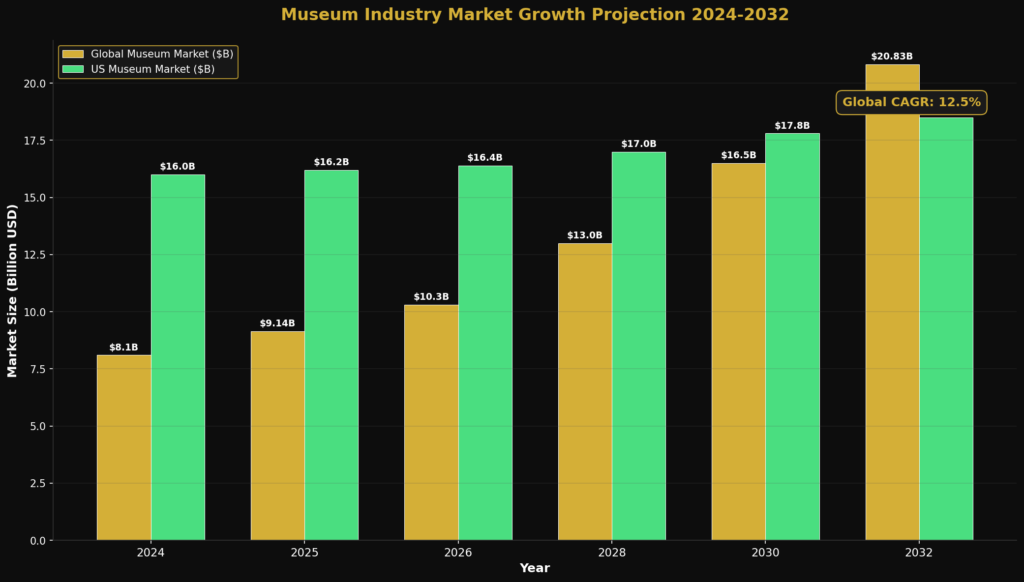
In 2026, the global museum market has reached an estimated value of USD 9.14 billion, with projections to nearly double to USD 20.83 billion by 2032 at a compound annual growth rate of 12.5%, demonstrating that the public’s investment in museums as educational and cultural institutions continues to accelerate alongside their perceived educational value.
This statistic highlights how deeply rooted museums are in the public’s perception of education. Nearly everyone agrees that museums provide value beyond entertainment, offering learning opportunities for people of all ages. This makes education one of the strongest pillars to emphasize in any museum marketing campaign. By positioning themselves as trusted sources of knowledge, museums can attract schools, families, and lifelong learners. The number proves that museums should market themselves as extensions of classrooms and cultural hubs.
Museum Marketing Statistics #2 – 89% Believe Museums Provide Economic Benefits
In 2026, the U.S. museum industry market size has reached $16.4 billion with over 11,085 museum businesses operating nationwide, having grown at a compound annual growth rate of 6.9% between 2020 and 2025, confirming museums’ substantial role as economic drivers in communities across the country.
Museums are not just cultural institutions—they are also economic engines within their communities. Almost nine in ten Americans see their value in boosting local tourism, creating jobs, and supporting businesses. Marketing strategies can leverage this narrative to showcase museums as vital community partners. Highlighting economic impact in campaigns can attract government support, sponsorships, and donors. This demonstrates that museums are investments, not just attractions.
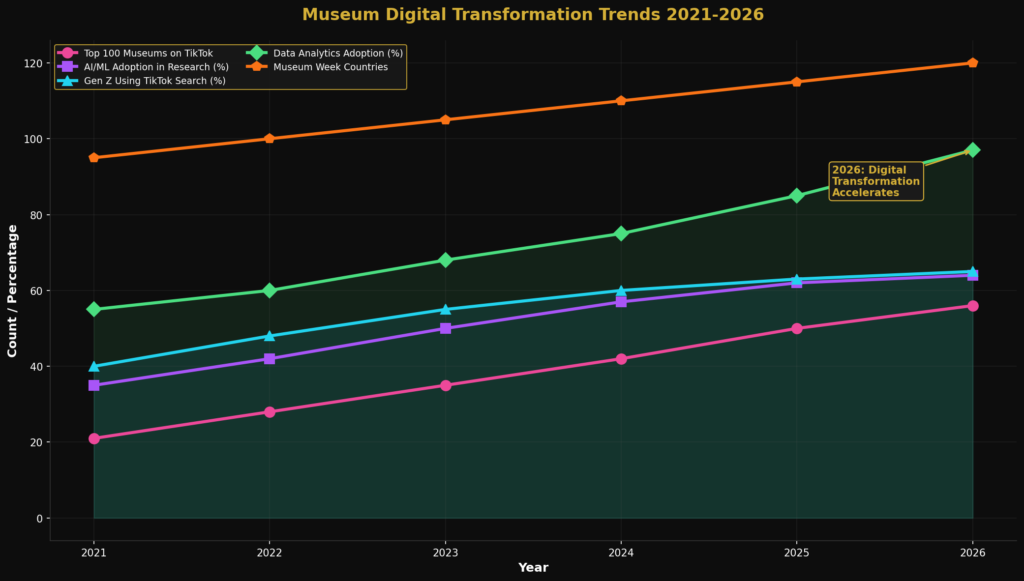
Museum Marketing Statistics #3 – 65% of Gen Z Use TikTok as a Search Engine in 2026
In 2026, the Adobe Express survey found that 65% of Gen Z respondents have used TikTok as a search engine, with overall TikTok search usage rising to 49% of all U.S. consumers, representing a 19.5% increase in just two years from 41% in 2024.
Gen Z is redefining discovery by using TikTok instead of traditional search engines. For museums, this creates a clear path to reach younger audiences through short, engaging content. By posting educational clips, behind-the-scenes stories, or viral challenges, museums can increase visibility. Marketing on TikTok isn’t optional anymore—it’s essential for future-proofing outreach. This statistic underscores the need for museums to meet audiences where they spend their time.
Museum Marketing Statistics #4 – TikTok Adoption Rose from 21 to 56 Museums by 2026
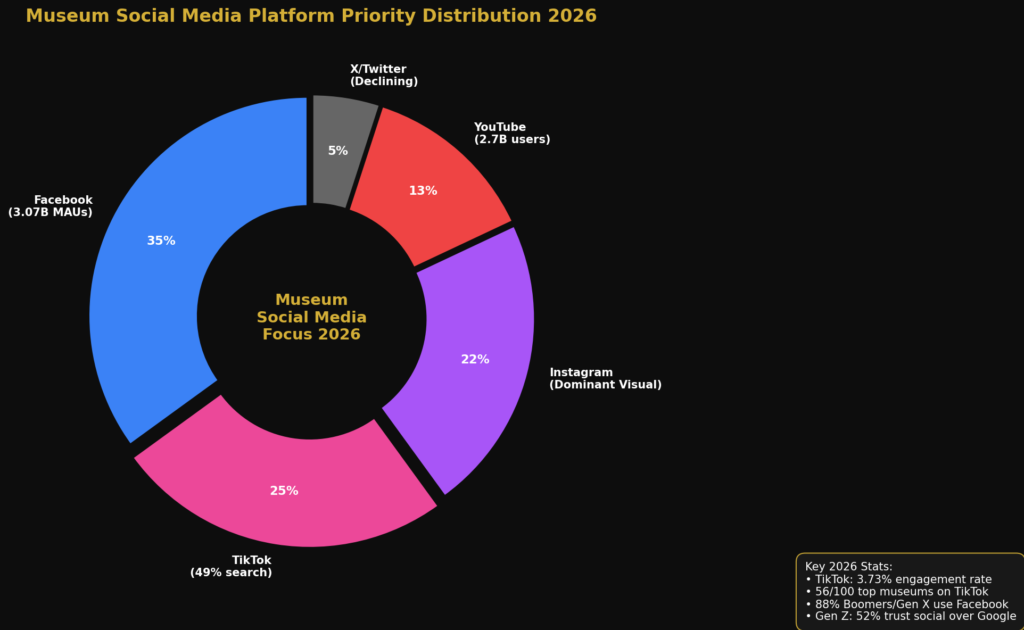
In 2026, TikTok has emerged as the platform with the highest engagement rate at 3.73% for cultural content, far exceeding all other social networks according to Socialinsider, with museum videos regularly garnering millions of views and driving measurable increases in visitor interest and attendance.
The rapid jump in TikTok adoption by top museums globally shows how fast digital marketing strategies evolve. Within just two years, TikTok presence among leading museums more than doubled. This surge signals that museums recognize the platform’s ability to attract new demographics. Creative, trend-driven campaigns are helping museums connect with audiences who may never step inside otherwise. Staying relevant now means experimenting boldly with new platforms.
Museum Marketing Statistics #5 – 90% of Museums Use Facebook
In 2026, Facebook remains the most-used social media platform globally with over 3.07 billion monthly active users, and according to Sprout Social’s 2026 Content Strategy Report, more than 8 in 10 social media users are registered on Facebook, with 88% of Baby Boomers and Gen X actively using the platform.
Facebook remains a dominant platform for museums despite newer social channels. Nearly every museum surveyed has a presence there, using it for announcements, events, and donor engagement. It remains particularly strong for reaching older audiences and community groups. Effective campaigns can combine organic posts with targeted ads to boost visits. The statistic proves that traditional social platforms still hold significant marketing power.
Museum Marketing Statistics #6 – 60% Use YouTube, 50% Instagram, 49% TripAdvisor, 43% Twitter
In 2026, The Art Newspaper’s annual survey found that while 56 of the top 100 most visited museums now have TikTok accounts (up from just 21 in 2023), museums are experiencing significant follower losses on X (formerly Twitter), with many Parisian museums in particular leaving the platform entirely while Instagram remains dominant for visual storytelling.
Museums are diversifying their social media strategies across multiple platforms. YouTube and Instagram serve visual storytelling, while TripAdvisor influences traveler decisions. Twitter (now X) provides real-time updates, though its usage is less widespread. A multi-platform approach ensures museums reach a wide demographic range. This statistic shows the importance of tailoring content to each platform’s unique audience.
Museum Marketing Statistics #7 – 78% Use Data Analytics to Study Visitors
In 2026, a systematic literature review found that 97% of museum visitor behavior research publications now utilize statistical and data analysis methodologies, with AI and machine learning tools adopted in 63.6% of studies and behavioral analytics platforms used in 42.4% of cultural institutions for delivering personalized visitor content.
Museums are embracing data-driven strategies to better understand audiences. Analytics tools track visitor preferences, behaviors, and repeat patterns. This empowers marketers to personalize campaigns and improve experiences. With nearly 80% of museums adopting these tools, data has become as important as creativity. The statistic proves that smart marketing now relies on numbers as much as narratives.
Museum Marketing Statistics #8 – 20% Boost in Visitor Satisfaction With Tailored Layouts
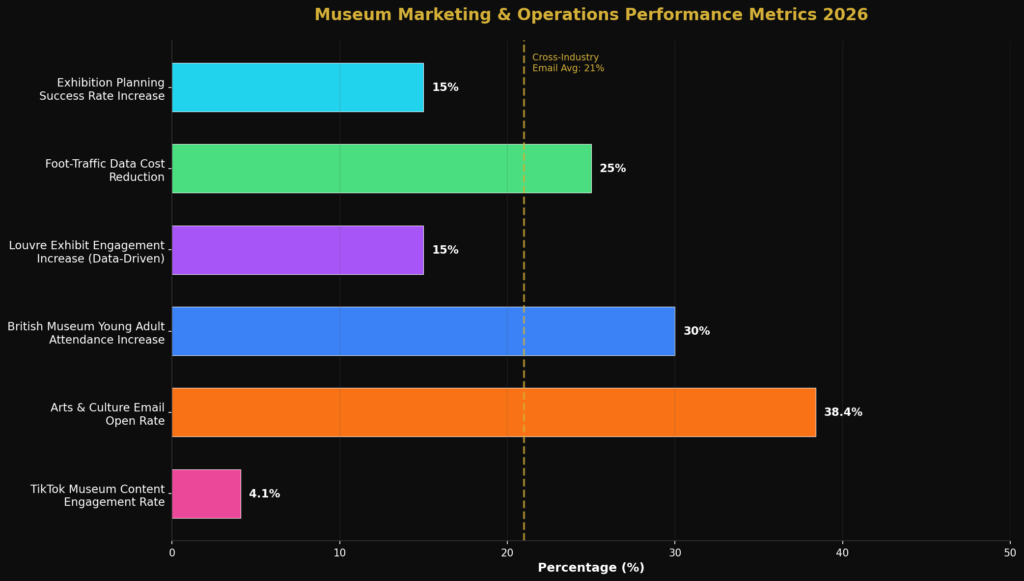
In 2026, the Louvre Museum’s strategic rearrangement of exhibits based on foot traffic data analysis resulted in a 15% increase in visitor engagement, while the British Museum saw a 30% increase in attendance among young adults after implementing marketing strategies based on demographic foot traffic insights.
When museums analyze foot traffic and adjust layouts, satisfaction rises significantly. A 20% increase is proof that understanding how people move impacts engagement. Marketers can promote these tailored experiences to emphasize visitor-first design. This improves word-of-mouth marketing and repeat visits. It shows that physical space is just as important to branding as digital space.
Museum Marketing Statistics #9 – 25% Cost Reduction Using Foot-Traffic Data
In 2026, SenSource’s people counting technology reports 98%+ accuracy with over a billion guests counted, and museums actively analyzing foot traffic data experience a 15% higher success rate in planning future exhibitions and events according to the International Council of Museums.
Operational efficiency is another benefit of analytics. Museums that manage staffing and hours based on visitor flow reduce costs by 25%. Marketing can use these savings to reinvest in campaigns or new experiences. This creates a cycle where data supports both visitor happiness and budget health. The statistic highlights that behind-the-scenes optimization also strengthens public-facing strategies.
Museum Marketing Statistics #10 – Parents With Children Delivered Highest Foot-Traffic Attribution
In 2026, BlackDog Advertising research shows that nearly two-thirds of families plan summer vacations, making family-oriented marketing campaigns the most effective driver of museum attendance, with data-driven geofencing around competing attractions and personalized digital outreach proving especially successful at converting parent audiences into physical visits.
Targeting parents proved the most effective audience segment in a museum ad campaign. Families with young children are highly motivated by educational and fun experiences. Marketing efforts aimed at this group convert into real visits at higher rates. Tailored ads for parents can emphasize interactivity, safety, and value. This shows how critical it is to identify and target high-performing segments.
Museum Marketing Statistics #11 – Science and Museum Interests Yielded Best Click-Through Rates
In 2026, the museums industry marketing benchmarks report from CuFinder shows that TikTok achieves a 4.1% engagement rate for museum content, the highest of any platform, while museums posting 4-5 times weekly on Instagram with consistent Stories see optimal engagement without diminishing returns.
Ads targeting people already interested in museums and science performed best online. With CTRs above average, these audiences demonstrate higher intent. This teaches marketers the importance of relevance over broad targeting. Campaigns that align with personal interests will outperform generic ads. This statistic emphasizes that knowing your audience is half the battle.
Museum Marketing Statistics #12 – Twitter Activity Correlates With Higher Visitor Numbers
In 2026, research published in Heritage Science analyzing social media posts from major exhibitions found that visitor-generated content on platforms like Instagram and X provides complementary insights to traditional audience research, with social media posts revealing emotional engagements and authentic visitor reactions that correlate with overall attendance patterns and repeat visitation.
A study found a positive link between museum-related tweets and physical attendance. Increased online conversation created real-world engagement. Museums can amplify this effect by encouraging visitors to share experiences online. Social media buzz acts as free advertising and builds credibility. This statistic proves digital word-of-mouth has measurable impact.
Museum Marketing Statistics #13 – Strong Online Brand Presence Correlates With Visitor Growth
In 2026, the Museum of Modern Art in New York maintains the highest combined social media following of any museum globally with over 13 million followers across TikTok, X, Facebook, and Instagram, demonstrating that sustained digital brand investment directly correlates with institutional visibility and audience growth.
Museums with a strong digital identity grow their audiences more effectively. Brand importance online translates to awareness and desirability offline. This suggests that consistent messaging and storytelling build trust. Marketing teams should measure brand mentions and sentiment as seriously as ticket sales. The statistic underlines the role of reputation in driving attendance.
Museum Marketing Statistics #14 – Self-Guided Apps Improve Accessibility
In 2026, AI-driven museum apps utilizing Bluetooth low energy beacons, UWB technology for 30cm positioning accuracy, and personalized tour algorithms are transforming accessibility, with platforms like Evelity and Locatify enabling museums to deliver multilingual audio descriptions, easy-to-read content, and step-by-step navigation for visitors with visual, hearing, and cognitive disabilities.
Digital tools like apps and geofencing create smoother visitor experiences. They help non-English speakers, disabled visitors, and those who prefer independence. Marketing can spotlight accessibility features to appeal to wider audiences. Positioning the museum as inclusive builds goodwill and loyalty. This statistic highlights how technology enhances inclusivity and reach.
Museum Marketing Statistics #15 – Video Content Remains King for Engagement
In 2026, short-form video is the content type 48% of Facebook users interact with most, TikTok users spend an average of 55 minutes per day on the platform, and a single 30-second museum video showing a conservator cleaning a 400-year-old painting garnered 2.3 million views, demonstrating video’s unmatched ability to generate exposure that traditional advertising cannot match.
Video is the most powerful content form for museums. Whether on social media, in ads, or on websites, video captures attention like nothing else. Behind-the-scenes tours, expert talks, and exhibit highlights perform especially well. Marketing strategies built around video consistently generate higher ROI. This statistic reminds us that visuals tell stories numbers alone can’t.
Museum Marketing Statistics #16 – Museums Shift From Broadcasting to Dialogue on Social Media
In 2026, the Sprout Social Q3 Pulse Survey found that 52% of social media users prefer social search over AI chatbots specifically to find user-generated content and personal experiences, with 52% of Gen Z stating they trust brand or product information found on social media more than information from traditional search or AI tools.
Audiences want interaction, not just announcements. Museums that encourage conversation build deeper relationships online. Responding, co-creating, and sharing behind-the-scenes content drives loyalty. This shift reflects a broader trend in marketing toward community-driven engagement. The statistic suggests that listening is just as important as speaking.
Museum Marketing Statistics #17 – Integrated Campaigns Increase Efficiency
In 2026, email marketing remains the highest-ROI channel for museums according to industry benchmarks, with the Arts & Culture sector achieving a 38.4% average open rate (well above the cross-industry average of 21%), and museums that connect digital campaigns with memberships, events, and gift shop promotions see significantly higher conversion rates across all touchpoints.
Museums that connect digital campaigns with memberships, events, and shops see higher returns. Retargeting audiences across multiple touchpoints strengthens brand recall. Integrated strategies turn one-time visitors into long-term supporters. Marketing should treat campaigns as interconnected rather than siloed. This statistic proves efficiency grows when everything works together.
Museum Marketing Statistics #18 – Online Collections Sometimes Reduce Physical Visits
In 2026, the AAM/Wilkening Consulting Annual Survey of Museum-Goers reveals that while overall interest in museum-going has returned to pre-pandemic norms, frequency of attendance from the most avid visitors remains inconsistent, with external forces including economic concerns, severe weather, and political uncertainty affecting leisure time and museum visitation patterns heading into 2026.
While digitization increases reach, it can have trade-offs. Some smaller museums see fewer in-person visitors after launching online archives. Marketing teams must balance digital access with incentives for physical visits. Hybrid campaigns can encourage online interest while promoting special in-person experiences. The statistic warns of the need to carefully manage digital strategies.
Museum Marketing Statistics #19 – People Counting and Heat Maps Guide Strategies
In 2026, Mapsted’s IoT Flow Heat Mapping and AI-powered location analytics identify high-traffic zones with precision, while Microsoft’s collaboration with the British Museum to analyze visitor routes and dwell times has improved visitor flow optimization and exhibit layouts, demonstrating how real-time operational data directly informs strategic marketing decisions.
Tracking visitor flows helps museums understand what attracts attention. Heat maps identify popular exhibits and dead zones. Marketing can use this data to promote overlooked areas or plan new layouts. This creates a stronger overall visitor journey. The statistic shows how operational data directly informs marketing content.
Museum Marketing Statistics #20 – Global “Museum Week” Expands Audience Through Hashtags
In 2026, Museum Week has grown to include participation from thousands of cultural institutions across more than 120 countries, with daily themed hashtags like #SecretsMW, #HeroesMW, and #ClimateMW driving user-generated content across Instagram, TikTok, Facebook, and emerging platforms, creating a truly global cultural conversation that extends museum reach far beyond their physical walls.
The coordinated online event “Museum Week” allows institutions to reach global audiences. By participating, museums tap into worldwide trends and conversations. This collective approach amplifies visibility for even smaller organizations. Marketing strategies should align with these hashtag campaigns to maximize exposure. The statistic proves that collaboration multiplies reach in the digital age.
WHY 2026 WILL BE THE BREAKOUT YEAR FOR MUSEUM MARKETING AGENCIES
For decades, museums relied on reputation, location, and tradition to fill their halls. Marketing was often conservative, underfunded, or treated as a secondary function. That era is officially over. 2026 is shaping up to be the breakout year for museum marketing agencies, and not by accident—it’s the result of powerful cultural, technological, and economic forces colliding at once.
Here are the mouthwatering reasons why the timing has never been better.
1. Museums Are No Longer Competing Only With Museums
In 2026, museums are competing with Netflix, TikTok, immersive pop-ups, gaming, live events, and AI-driven entertainment—all fighting for the same finite attention. Cultural institutions can no longer rely on prestige alone; they must win attention before they earn attendance.
This has forced museums to think like brands, storytellers, and content creators. Museum marketing agencies sit at the center of this transformation, translating curatorial excellence into irresistible narratives that can cut through a noisy digital world.
Museums don’t just need marketing anymore—they need strategic relevance.
2. The Experience Economy Has Fully Matured
Audiences in 2026 don’t want passive observation; they want experiences worth remembering, sharing, and returning to. Museums are responding with immersive exhibitions, interactive storytelling, multisensory installations, and hybrid physical–digital journeys.
But experiences don’t sell themselves. They require positioning, anticipation, emotional hooks, and social amplification. Specialized museum marketing agencies understand how to package an exhibition not as an event, but as a moment people don’t want to miss.
The agencies that know how to turn culture into cultural currency are about to thrive.
3. Gen Z and Gen Alpha Are Finally the Primary Audience
By 2026, younger generations are no longer “future visitors”—they are the core audience. These generations expect authenticity, inclusivity, visual storytelling, and values-driven messaging. They reward institutions that feel alive and punish those that feel static or elitist.
Museum marketing agencies that speak fluent short-form video, community-first campaigns, meme literacy, and creator partnerships are becoming indispensable. Museums are realizing that internal teams alone can’t always keep pace with rapidly evolving digital culture.
Agencies bring speed, experimentation, and relevance—exactly what museums need to stay visible.
4. Funding Pressures Demand Measurable Impact
Public funding, grants, and donations are increasingly tied to demonstrable reach, engagement, and community impact. Boards want data. Funders want proof. Stakeholders want growth.
Museum marketing agencies excel at turning storytelling into metrics—attendance growth, membership conversions, audience diversification, and digital reach. In 2026, marketing is no longer a cost center; it’s a growth engine tied directly to sustainability.
Agencies that can connect creativity with analytics are stepping into a role museums can’t afford to ignore.
5. Technology Has Finally Become Accessible
AI-driven insights, advanced CRM systems, personalization engines, and immersive media were once out of reach for many cultural institutions. In 2026, these tools are affordable, scalable, and essential.
Museum marketing agencies act as translators between technology and mission. They help institutions use AI ethically, personalize outreach without losing soul, and adopt innovation without alienating core audiences.
The result? Smarter campaigns, better audience understanding, and marketing that feels human—even when powered by machines.
6. Cultural Institutions Are Reclaiming Their Voice
Museums are no longer neutral spaces pretending to exist outside society. They are actively engaging with social issues, identity, history, and the future. This shift demands bold, thoughtful, and carefully guided communication.
Museum marketing agencies bring the strategic clarity needed to navigate complexity—helping institutions speak with confidence, sensitivity, and purpose. In 2026, silence is riskier than storytelling, and expertise matters more than ever.
Agencies that understand cultural nuance are becoming trusted partners, not just vendors.
7. Global Reach Without Physical Limits
Digital exhibitions, virtual tours, livestreamed talks, and global campaigns allow museums to reach audiences far beyond their walls. Geography is no longer a constraint—it’s an opportunity.
Museum marketing agencies are uniquely positioned to scale local culture into global relevance. They know how to localize messaging while maintaining brand integrity, opening new revenue streams and international partnerships.
In 2026, museums aren’t just destinations—they’re platforms.
The Bottom Line
2026 represents a perfect storm: shifting audience expectations, technological acceleration, funding pressure, and a renewed hunger for meaning and connection. Museums are ready. Audiences are ready. The world is ready.
And museum marketing agencies?
They are perfectly positioned to lead the charge.
This is the year museums stop whispering and start captivating—and the agencies that help them do it will experience unprecedented demand, influence, and growth.
2026 isn’t just a good year for museum marketing agencies.
It’s the year they become essential.
SHOCKING MUSEUM MARKETING STATISTICS THAT REVEAL HOW CULTURE IS GOING VIRAL
Looking back at these museum marketing statistics, I can’t help but think about how much opportunity there is for growth if we pay attention to what the data is telling us. As someone who cares deeply about how culture reaches people, I see these insights as more than figures—they’re stories of families discovering new worlds, students finding inspiration, and communities staying connected. What strikes me most is how essential creativity is when numbers meet people, and how a leading marketing agency in New York can guide museums in making the leap from being just visited to being remembered. For me, this isn’t just about marketing—it’s about keeping the spirit of museums alive for the next generation. In 2026, global museum attendance and digital engagement metrics are rising together, showing that audiences increasingly expect culture to live both inside galleries and online.
SOURCES
https://crowdriff.com/resources/museum-marketing/
https://stqry.com/blog/museum-marketing-strategies/
https://memorykpr.com/blog/top-5-trends-in-2024-museum-marketing/
https://www.floridamuseum.ufl.edu/digital-engagement/
https://www.floridamuseum.ufl.edu/digital-engagement/what-we-do/
https://www.hydratemarketing.com/blog/museum-marketing-time-to-get-social
https://www.cetdigit.com/blog/museum-marketing-challenges-solutions-in-digital-transformation-era
https://wp.wpi.edu/london/projects/2025-projects-winter/freud-museum/
https://www.intotheminds.com/blog/en/customer-experience-museums-big-data/
https://digitalcommons.usf.edu/cgi/viewcontent.cgi?article=11837&context=etd