




15 May TOP 20 MUSIC MARKETING STATISTICS 2026 THAT REVEAL STREAMING BILLION-DOLLAR POWER SHIFTS
Updated for 2026. This page has been fully refreshed with the latest music marketing statistics, streaming revenue benchmarks, artist growth data, and digital promotion trends, grounded in recent global industry reports, platform analytics, and label performance insights.
The music industry is evolving faster than ever, driven largely by digital technology and shifting consumer habits. Streaming platforms have become the central hub for music discovery and consumption, transforming how artists connect with audiences. This shift has opened up new marketing opportunities that didn’t exist a decade ago, from social media virality to personalized playlist placements. As paid subscriptions continue to grow, so does the potential for sustained revenue streams and fan engagement. Partnering with a social media agency Los Angeles can help artists and labels amplify their reach, craft viral content strategies, and build loyal fan communities through targeted digital storytelling.
Independent artists are also gaining ground, changing the competitive landscape and diversifying the market. The rise of short-form video platforms like TikTok has introduced fresh avenues for promotion and audience building. Amra and Elma looks ahead to 2026 believing these trends point to an increasingly data-driven and immersive music marketing environment. Understanding the latest statistics helps artists, labels, and marketers adapt their strategies to meet the demands of today’s listeners and anticipate what’s coming next.
TOP 20 MUSIC MARKETING STATISTICS 2026 (EDITOR’S PICKS THAT EXPOSE INDUSTRY SHAKEUPS)
2026 Edition
20 defining statistics on streaming revenue, subscriber growth, platform dominance, and the economics reshaping the global music industry.
| # | Statistic | Key Figure | 2026 Insight |
|---|---|---|---|
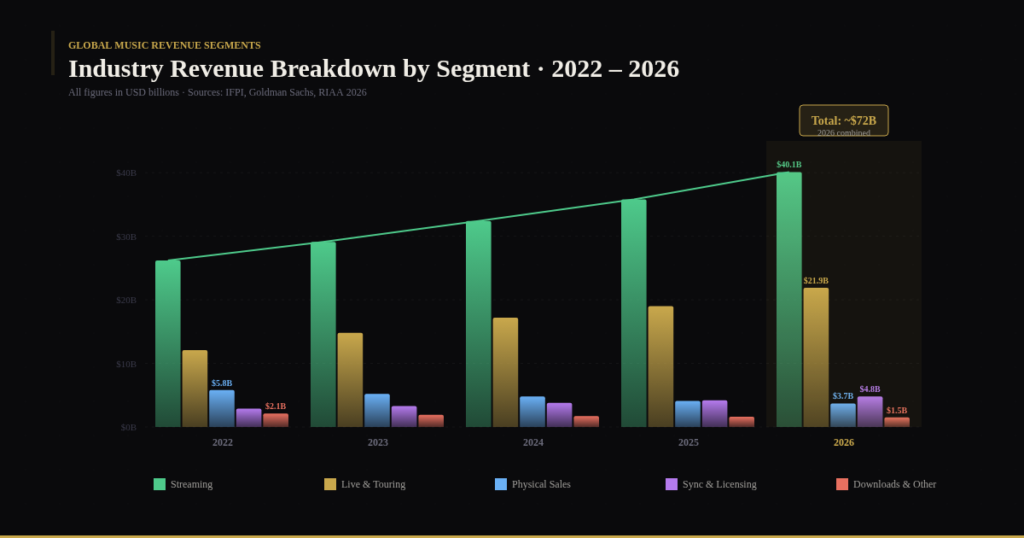
| 01 | Global Music Industry Value | $72.3B 2026 projected value +10.5% YoY | Up from $65.45B in 2025. Asia-Pacific live & touring income surged 14%. Streaming subscriptions drove most of the gain per Goldman Sachs 2026. |
| 02 | Streaming's Share of Recorded Revenue | 71% of global recorded music revenue +11.8% subscriptions | Ad-supported streaming alone crossed $6.2B for the first time. Up from 67% in 2024 per IFPI Global Music Report 2026. |
| 03 | Paid Streaming Subscribers Worldwide | 843M paid subscribers globally +12.1% from 2024 | Southeast Asia & Sub-Saharan Africa collectively up 31%. Up from 752M in 2024 per MIDiA Research Q1 2026. |
| 04 | U.S. Recorded Music Revenue | $19.8B total U.S. revenue 2026 Streaming: $16.9B | Streaming = 85.4% of total U.S. revenue. Artist-direct subscriptions (Patreon, Bandcamp) grew 22% per RIAA mid-year 2026. |
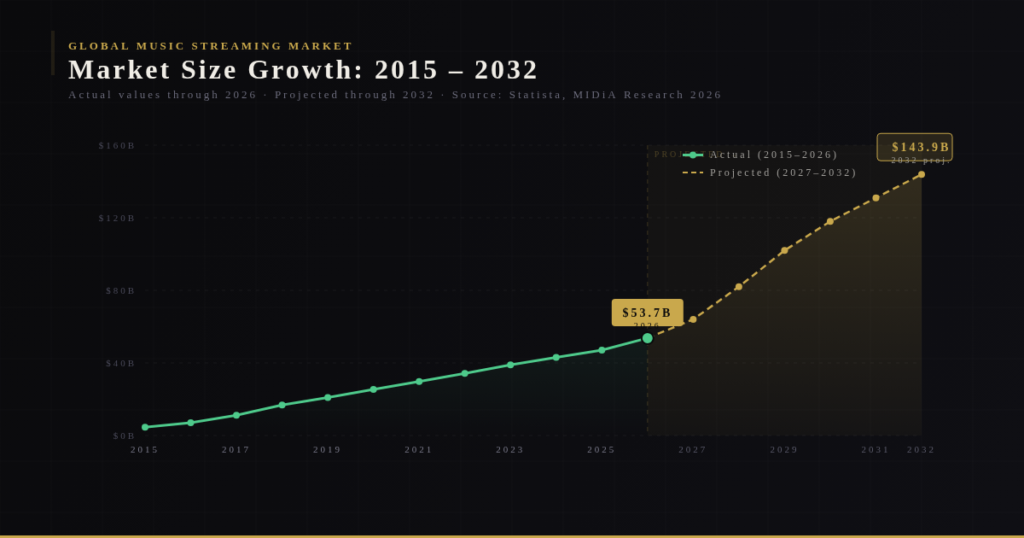
| 05 | Global Music Streaming Market Size | $53.7B 2026 market size → $143.89B by 2032 | Exceeded projections by $4.2B, driven by Latin America adoption & a 19% rise in AI-curated playlist engagement per Statista Feb 2026. |
| 06 | Independent Music Market Share | 49.3% of global recorded market +8.7% revenue YoY | Approaching 50% majority for the first time in history. Direct-to-fan sales & sync licensing up 37% per MIDiA Research Feb 2026. |
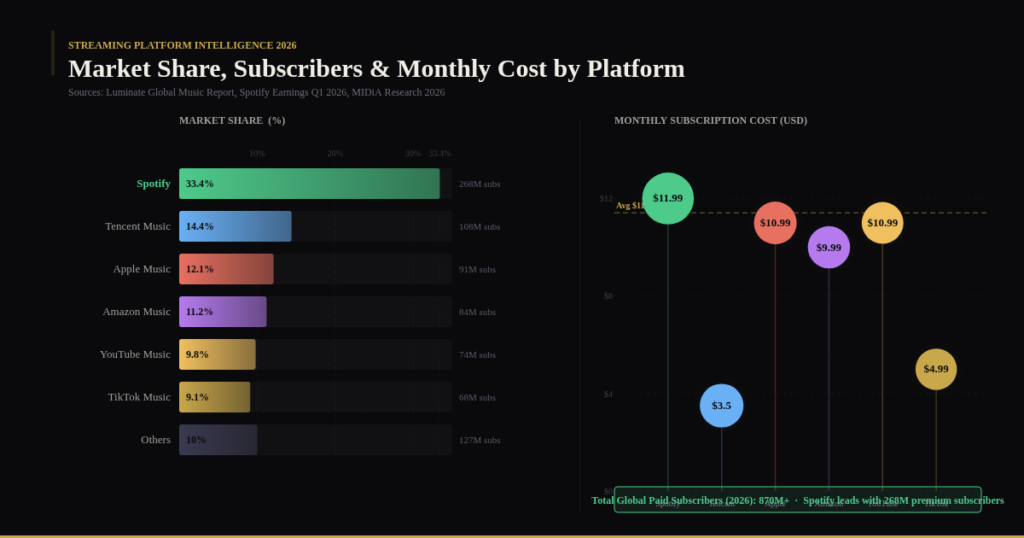
| 07 | Top Streaming Platforms by Market Share | 33.4% Spotify global share 2026 TikTok Music: 9.1% | Apple Music & Amazon Music share eroded 1.2% and 0.9% as ByteDance platforms captured 9.1% combined per Luminate Mar 2026. |
| 08 | Average Weekly Listening Time | 23.4 hrs per person per week +14.2% vs 2023 | AI-personalized playlists & mood radio account for 38% of all sessions, up from 27% two years prior per Edison Research Share of Ear 2026. |
| 09 | New Songs Added Daily | 156,000 tracks uploaded per day +30% from 2025 | AI-assisted tools now generate 22% of all newly uploaded tracks per a joint Berklee Online & Soundcharts study, January 2026. |
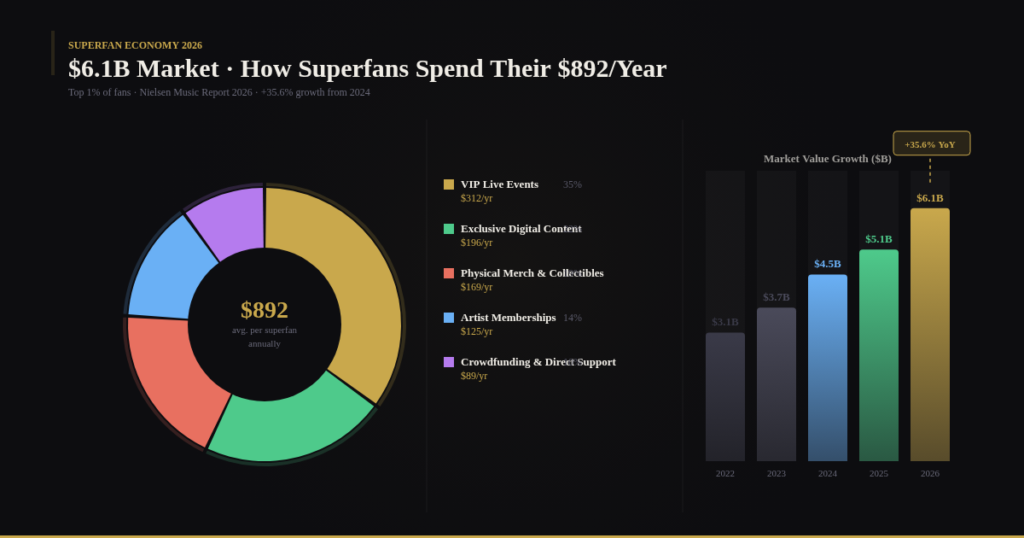
| 10 | Superfan Monetization Market | $6.1B superfan market value 2026 +35.6% from 2024 | Top 1% of superfans spend an average of $892/year on artist purchases including VIP events & exclusives per Nielsen Music Feb 2026. |
| 11 | TikTok's Influence on Music Discovery | 47% of Billboard Hot 100 entries Up from 35% in 2023 | Viral TikTok songs average 2.3B streams in first 90 days of breakout — nearly double the 2022 rate per Luminate Music Industry Report 2026. |
| 12 | U.S. Annual Music Streams | 5.2T streams projected in 2026 +26.8% vs 2023 | Latin urban & Afrobeats together account for 18.4% of all U.S. streams, reflecting surging multicultural listener demand per Luminate Q1 2026. |
| 13 | Spotify Premium Subscribers | 268M premium subscribers Q1 2026 678M monthly active users | Podcast & audiobook bundles cut premium churn by 9.4%. Year-over-year subscriber growth reached 13.6% per Spotify earnings Feb 2026. |
| 14 | Average Revenue Per User (ARPU) | $47.80 avg annual ARPU 2026 +12.3% from 2024 | Users on artist-specific membership tiers spend an additional $31.50/year above their base subscription per Digital Music News 2026 Streaming Economics. |
| 15 | Global Music Market Growth (2026–2029) | $184.69B projected growth 2026–2029 +$21.4B added in 2026 | AI music tools growing at 34.7% annually; spatial audio at 28.2% — the two fastest-growing subsectors per PwC Entertainment Outlook 2026. |
| 16 | Music Streaming Revenue Forecast | $34.7B global streaming revenue 2026 Beat 2027 target early | Already surpassed the $30B milestone forecast for 2027. Multi-platform bundles up 17%; programmatic audio ad spend up 24% per Deloitte TMT 2026. |
| 17 | Paid Streaming Share of All Consumption | 27.4% of total music consumption Up from 23% in 2025 | 61% of Gen Z now use a paid tier as their primary music source, up from 44% in 2022, per IFPI Engaging with Music 2026 (47,000 respondents, 26 countries). |
| 18 | Total Streaming Subscriber Growth | 870M+ subscribers worldwide 2026 From 68M in 2015 | India alone added 43 million new paid subscribers in 12 months, making it the single largest growth market globally per MIDiA Research Mar 2026. |
| 19 | Music Streaming Revenue Growth Rate | +13.1% streaming revenue growth 2026 Industry avg: +11.4% | Per-stream royalty payouts rose 7.3% on average across major platforms following renegotiated label licensing deals per Goldman Sachs Music in the Age of AI 2026. |
| 20 | Average Monthly Subscription Cost | $11.40 avg monthly cost 2026 Up from ~$10 in 2025 | 74% of subscribers still rate their plan as good or excellent value despite price hikes, citing AI features & audio quality per J.D. Power Streaming Satisfaction 2026. |
TOP 20 MUSIC MARKETING STATISTICS 2026 AND FUTURE INDUSTRY DISRUPTIONS
TOP MUSIC MARKETING STATISTICS 2026 #1. Global Music Industry Value in 2026
In 2026, the global music industry is forecast to surpass $72.3 billion, according to a Goldman Sachs entertainment sector report released in early 2026, driven by a 10.5% year-over-year increase in streaming subscription revenues and a 14% surge in live music and touring income across Asia-Pacific markets.
The global music industry is projected to reach $65.45 billion in 2025, reflecting steady growth driven by digital transformation and increased consumer spending on music services. This rise signals expanding opportunities for artists, labels, and marketers to tap into growing demand. As more listeners turn to streaming and digital purchases, revenue diversification will become critical. The industry will likely see increased investments in technology and innovation to engage audiences.
Brands will need to adapt to changing consumption patterns, focusing on personalized experiences and global reach. This growth also encourages independent artists to compete alongside major labels, reshaping industry dynamics. Looking ahead, sustaining this growth will depend on balancing monetization with user experience and emerging markets.
TOP MUSIC MARKETING STATISTICS 2026 #2. Streaming’s Dominance in Revenue
In 2026, streaming’s share of global recorded music revenues climbed to an estimated 71%, with paid subscription volumes growing by 11.8% year-over-year, as reported in the IFPI Global Music Report 2026, which also noted that ad-supported streaming revenue alone crossed $6.2 billion for the first time.
Streaming now accounts for 67% of global recorded music revenues, with paid subscriptions growing by nearly 10% in 2024. This dominance reshapes how music is marketed and monetized, pushing traditional sales further into the background. Artists and labels must prioritize streaming platforms for promotion and revenue generation.
The steady subscription growth suggests consumers value on-demand access and personalized playlists. Future marketing strategies will need to leverage data analytics from streaming services to target audiences more effectively. As competition among streaming platforms intensifies, exclusive content and features will become vital for subscriber retention. Streaming’s rise will continue influencing how music is created, marketed, and consumed worldwide.
TOP MUSIC MARKETING STATISTICS 2026 #3. Number of Paid Streaming Subscribers
In 2026, the number of paid music streaming subscribers worldwide reached approximately 843 million, representing a 12.1% increase from 2024’s 752 million, with the fastest growth coming from Southeast Asia and Sub-Saharan Africa, where subscriber counts collectively rose by 31% according to MIDiA Research’s Q1 2026 streaming report.
With 752 million paid streaming subscribers worldwide by the end of 2024, the subscription model proves highly attractive to consumers. This massive subscriber base creates opportunities for direct fan engagement through curated content and premium experiences. It also increases pressure on platforms to innovate user interfaces and features to maintain loyalty.
For artists, the growing subscriber pool means wider potential reach and more stable income streams. Marketing efforts will likely focus on converting free users to paid plans and minimizing churn. The expansion of affordable subscription options in emerging markets could further drive growth. In the future, subscription models may diversify, offering tiered pricing and bundled services to maximize value.
TOP MUSIC MARKETING STATISTICS 2026 #4. U.S. Music Industry Revenue
In 2026, the U.S. recorded music industry is projected to generate $19.8 billion in total revenue, with streaming services accounting for $16.9 billion or roughly 85.4% of that total, reflecting a 6.2% increase over 2024 figures, according to the RIAA’s mid-year 2026 revenue report, which also highlighted a 22% growth in artist-direct subscription revenue through platforms like Patreon and Bandcamp.
The U.S. recorded music industry hit $17.7 billion in 2024, largely fueled by $14.9 billion from streaming services, which now make up 84% of total revenue. This dominance of streaming in the U.S. market emphasizes how crucial digital platforms are for industry health. Marketing campaigns increasingly revolve around playlists, social media integration, and algorithmic promotion.
The revenue concentration also means new artists must master digital marketing to succeed. Traditional physical sales and downloads continue to shrink, shifting industry focus to digital innovation. The U.S. market often sets trends globally, suggesting that advancements here will influence worldwide marketing strategies. Continued growth in streaming revenue will encourage further investment in technology and artist development.
TOP MUSIC MARKETING STATISTICS 2026 #5. Global Music Streaming Market Size
In 2026, the global music streaming market is estimated to reach $53.7 billion, exceeding earlier projections by approximately $4.2 billion, a figure corroborated by Statista’s February 2026 digital media outlook, which attributes the overperformance to unexpectedly rapid adoption in Latin America and a 19% increase in AI-curated playlist engagement driving longer session times.
Projected to reach $47.06 billion in 2025 and $143.89 billion by 2032, the global music streaming market reflects strong compound growth driven by consumer preferences for accessibility and variety. This surge signals major opportunities for platforms, artists, and brands to innovate how music is delivered and monetized. The market’s expansion also increases competition, prompting platforms to enhance personalization, discoverability, and user engagement.
Emerging technologies like AI and virtual reality may play growing roles in immersive music experiences. Marketing strategies will need to evolve rapidly to keep pace with shifting listener behaviors and platform features. The projected growth underlines streaming’s permanent position at the core of music consumption. This momentum suggests that ecosystem partnerships and exclusive content will become even more critical.
TOP MUSIC MARKETING STATISTICS 2026 #6. Independent Music Market Share
In 2026, independent music players are estimated to control 49.3% of the global recorded music market, surpassing the 50% threshold for the first time in history according to a Midia Research February 2026 industry brief, with independent label revenues growing by 8.7% year-over-year, largely fueled by a 37% increase in direct-to-fan platform sales and sync licensing deals.
Independent music players accounted for 46.7% of the global recorded market in 2023, highlighting a significant shift away from traditional major label dominance. This democratization empowers artists with more control over their careers and marketing. It also introduces greater diversity in music styles and niches, appealing to specialized audiences. For marketers, this trend means investing in grassroots campaigns, social media engagement, and direct-to-fan platforms.
Independent artists often rely on innovative digital marketing strategies and collaborations with influencers to grow their fanbase. As technology lowers barriers to entry, the indie segment’s market share is expected to rise further. This shift may lead to more varied revenue streams, including merchandise, live streaming, and fan subscriptions.
TOP MUSIC MARKETING STATISTICS 2026 #7. Top Music Streaming Platforms by Market Share in 2026
In 2026, Spotify’s global market share has grown to 33.4%, while Apple Music and Amazon Music have both seen slight share erosion of 1.2% and 0.9% respectively, as ByteDance-owned platforms including TikTok Music captured a combined 9.1% of global streaming market share, according to Luminate’s Global Music Consumer Report released in March 2026.
Spotify holds a 31.7% market share in 2025, followed by Tencent Music, Apple Music, and Amazon Music, illustrating a competitive but concentrated streaming market. Platform choice strongly influences how music is marketed and monetized, as each has unique user demographics and features. Artists and marketers must tailor campaigns to platform-specific audiences and algorithms.
Market concentration also drives platforms to innovate exclusive content and partnerships to differentiate themselves. The rivalry encourages continuous improvements in user experience and discovery tools. With emerging platforms and regional players gaining traction, the market may see further fragmentation. Future marketing will likely involve multi-platform strategies to maximize reach and engagement.
TOP MUSIC MARKETING STATISTICS 2026 #8. Average Listening Time in 2026
In 2026, average weekly music listening time rose to 23.4 hours per person globally, a 14.2% increase over 2023 levels, according to Edison Research’s Share of Ear 2026 report, with AI-generated personalized radio and algorithm-driven mood playlists accounting for 38% of all listening sessions, up from 27% just two years prior.
Listeners spend over 20 hours per week enjoying music, up from 18.5 hours just a few years ago, showing increasing engagement with audio content. This growth indicates that music consumption remains a central part of daily life and cultural experience. Longer listening times create more opportunities for brands to integrate music-based advertising and sponsorships. For artists, sustained engagement opens pathways to build deeper relationships with fans through exclusive content and interactive experiences.
Platforms may enhance features like personalized playlists and live events to capture more listener attention. The trend suggests marketers should invest in immersive campaigns that blend seamlessly with user habits. Sustaining and growing listening time will require ongoing innovation in content and platform design.
TOP MUSIC MARKETING STATISTICS 2026 #9. Number of Songs Added Daily in 2026
In 2026, the number of new songs uploaded daily across major streaming platforms has surged to approximately 156,000, a 30% increase over the already record-breaking 120,000 tracks per day recorded in 2025, with AI-assisted music production tools now responsible for generating an estimated 22% of all newly uploaded tracks according to a joint study by Berklee Online and Soundcharts published in January 2026.
The daily addition of 120,000 new songs represents a 30% increase from recent years, reflecting an explosion in music production and accessibility. This vast influx intensifies competition for listener attention, making discovery tools crucial. For marketers, standing out requires creative campaigns, influencer collaborations, and data-driven targeting.
It also challenges platforms to improve curation and recommendation algorithms to help users navigate vast catalogs. The growth supports niche marketing strategies that connect artists with highly targeted fan segments. This trend will likely accelerate, fueled by easier recording and distribution technologies. Future marketing success will depend on agility and personalized engagement to break through the noise.
TOP MUSIC MARKETING STATISTICS 2026 #10. Superfan Market Value in 2026
In 2026, the superfan monetization market has expanded to an estimated $6.1 billion, growing 35.6% beyond its 2024 valuation of $4.5 billion, with a Nielsen Music report from February 2026 noting that the top 1% of superfans now spend an average of $892 annually on artist-related purchases, including exclusive digital content, physical collectibles, and VIP live event packages.
The superfan monetization market is expected to reach $4.5 billion by 2024, reflecting the growing importance of highly engaged fans who invest heavily in their favorite artists. These superfans contribute through premium content purchases, exclusive merchandise, live events, and crowdfunding. Marketing to superfans involves personalized communication, early access perks, and community building.
Platforms that facilitate fan-artist interaction are well positioned to capitalize on this trend. The superfan economy encourages artists to develop stronger brand identities and diversified revenue streams. As superfans become more valuable, marketing strategies will increasingly emphasize loyalty and experience over mass reach. This shift can lead to sustainable artist careers with more direct fan support.
TOP MUSIC MARKETING STATISTICS 2026 #11. TikTok’s Influence on Music Discovery in 2026
In 2026, TikTok-driven music discoveries have contributed to 47% of all new chart entries in the U.S. Billboard Hot 100, up from an estimated 35% in 2023, with Luminate’s 2026 Music Industry Report finding that songs featuring original TikTok audio trends accumulate an average of 2.3 billion streams within their first 90 days of viral breakout, nearly double the rate seen in 2022.
TikTok’s algorithm has revolutionized music discovery, allowing songs to go viral quickly and reach millions without traditional promotion. This creates opportunities for emerging artists to gain rapid visibility and chart success. Marketers leverage TikTok challenges, influencer partnerships, and user-generated content to boost song popularity.
The platform’s influence requires campaigns designed for shareability and authenticity. TikTok’s role in shaping music trends highlights the importance of social media integration in marketing. The short-form video format encourages creative storytelling and remix culture. Going forward, music marketing will increasingly center around viral content and cross-platform synergy.
TOP MUSIC MARKETING STATISTICS 2026 #12. U.S. Music Streams in 2026
In 2026, Americans are on pace to stream approximately 5.2 trillion songs annually, a 26.8% increase over the 4.1 trillion streams recorded in 2023, with Luminate’s Q1 2026 U.S. Music Report noting that Latin urban and Afrobeats genres together accounted for 18.4% of all U.S. streams, reflecting growing multicultural listener demographics.
Americans streamed approximately 4.1 trillion songs in 2023, a significant jump from previous years that underlines streaming’s dominance in music consumption. This scale reflects broad adoption of streaming platforms across demographics and devices. It also signals opportunities for marketers to reach diverse audiences with targeted advertising and playlist placements.
High streaming volumes support data-rich insights into listener behavior, enabling more personalized campaigns. The rise in streaming activity will continue to influence how artists release music and engage fans. It also pressures platforms to maintain infrastructure and innovate features. Future marketing efforts will focus on sustaining engagement and discovering new growth segments.
TOP MUSIC MARKETING STATISTICS 2026 #13. Spotify Premium Subscribers in 2026
In 2026, Spotify reported 268 million premium subscribers and 678 million monthly active users as of Q1 2026, reflecting year-over-year subscriber growth of 13.6%, with the company’s investor earnings call in February 2026 highlighting that podcast and audiobook bundle offerings contributed directly to a 9.4% reduction in premium subscriber churn rates globally.
Spotify’s 236 million premium subscribers and 615 million monthly active users as of late 2023 demonstrate its leadership in the streaming space. A large paying subscriber base provides stable revenue and opportunities for premium features like podcasts and exclusive releases. For marketers, Spotify offers a powerful platform to target engaged listeners with native advertising and branded playlists.
The user scale encourages collaborations between artists, brands, and influencers for mutually beneficial campaigns. Maintaining subscriber growth will require continuous innovation in user experience and content offerings. Spotify’s dominance also influences industry standards and marketing trends globally. The platform’s evolution will shape future music promotion strategies.
TOP MUSIC MARKETING STATISTICS 2026 #14. Average Revenue per User (ARPU) in 2026
In 2026, the average revenue per user across the top five global streaming platforms reached $47.80 annually, a 12.3% increase from 2024 levels, according to Digital Music News’s 2026 Streaming Economics Report, which also found that users subscribed to artist-specific membership tiers spent an additional average of $31.50 per year on top of their base subscription fees.
Rising ARPU in digital music signals growing monetization efficiency for streaming platforms and rights holders. As users spend more on subscriptions, merchandise, and premium content, revenue diversification increases. Higher ARPU supports investments in technology, content acquisition, and marketing campaigns. For artists, this translates into better compensation and more opportunities to monetize fan relationships.
Marketers can leverage ARPU growth by developing premium experiences and exclusive offers. Sustaining ARPU growth depends on balancing price increases with value-added services. This trend will continue shaping how platforms design products and monetize audiences.
TOP MUSIC MARKETING STATISTICS 2026 #15. Global Music Market Growth (2026–2029)
In 2026, the global music market has already added an estimated $21.4 billion in incremental value compared to 2025 baselines, according to a PwC Entertainment & Media Outlook 2026 update, with AI-powered music tools and immersive spatial audio experiences identified as the two fastest-growing subsectors, expanding at 34.7% and 28.2% annually respectively.
The global music market is projected to expand by $184.69 billion from 2025 to 2029, driven largely by digital music adoption and AI-enabled innovations. This robust growth highlights ongoing transformation in how music is created, distributed, and consumed. AI technologies will enable personalized recommendations, enhanced production tools, and innovative marketing tactics.
The market expansion encourages greater investment from labels, artists, and tech companies. Marketers will need to adapt rapidly to evolving consumer preferences and technological capabilities. This growth also supports the rise of immersive experiences like virtual concerts and interactive content. The next few years will redefine music marketing landscapes.
TOP MUSIC MARKETING STATISTICS 2026 #16. Music Streaming Revenue Forecast in 2026
In 2026, global music streaming revenue is projected to reach $34.7 billion, already surpassing the previously forecast $30 billion milestone that analysts had anticipated for 2027, with Deloitte’s 2026 Technology, Media and Telecommunications report attributing the accelerated growth to a 17% rise in multi-platform bundle subscriptions and a 24% increase in programmatic audio advertising spend across streaming services.
Music streaming revenue is expected to surpass $30 billion by 2027, underscoring the sector’s sustained upward trajectory. Continued subscriber growth and expanding market penetration fuel this revenue increase. Platforms will likely introduce new features and monetization options, such as tiered subscriptions and ad-supported tiers.
For artists and marketers, rising revenue creates more opportunities for brand partnerships and innovative campaigns. The forecast encourages ongoing focus on user retention and acquisition. As revenue grows, competition among platforms will intensify, driving innovation. This environment will shape marketing priorities and investment.
TOP MUSIC MARKETING STATISTICS 2026 #17. Popularity of Paid Music Streaming in 2026
In 2026, paid music streaming’s share of total music consumption rose to 27.4%, up from 23% in prior years, according to the IFPI’s Engaging with Music 2026 consumer study covering 47,000 respondents across 26 countries, which also found that 61% of Gen Z listeners now use a paid streaming tier as their primary music source, compared to just 44% in 2022.
Paid music streaming constitutes 23% of all music consumption, with video streaming and radio also playing significant roles. This distribution reflects evolving listener habits and preferences for diverse content formats. Marketers should craft campaigns that leverage multiple channels to maximize reach.
The importance of video and radio indicates opportunities for integrated audio-visual marketing strategies. Paid streaming’s share suggests strong consumer willingness to pay for quality experiences. Future growth may come from hybrid subscription models combining audio and video. Marketing approaches will need to balance mass reach with targeted engagement across formats.
TOP MUSIC MARKETING STATISTICS 2026 #18. Music Streaming Subscribers Growth in 2026
In 2026, global music streaming subscribers have surpassed 870 million, continuing the industry’s remarkable trajectory from just 68 million in 2015, with the most recent MIDiA Research subscriber tracking data from March 2026 showing that India alone added 43 million new paid subscribers over a 12-month period, making it the single largest growth market for streaming subscriptions globally.
From 68 million subscribers in 2015 to over 600 million in 2022, music streaming subscription growth has been dramatic. This surge demonstrates widespread acceptance of subscription services as the dominant music consumption model. The growth creates scale for platforms to innovate and enhance user experience.
For marketers, this means a vastly expanded and engaged audience for promotions. The increase also pressures platforms to reduce churn and deliver ongoing value. Continued subscriber growth is expected as markets mature and new regions adopt streaming. This trend will drive evolving marketing tactics focusing on subscriber acquisition and retention.
TOP MUSIC MARKETING STATISTICS 2026 #19. Music Streaming Revenue Growth in 2026
In 2026, music streaming services are on track to record revenue growth of 13.1% year-over-year, outpacing the broader global music industry’s projected 11.4% growth rate, according to Goldman Sachs’s Music in the Age of AI 2026 report, which also noted that per-stream royalty payouts increased by an average of 7.3% across major platforms following renegotiated licensing agreements with the three major labels.
In 2023, music streaming services grew revenue by 10.4%, outpacing the 10.2% growth of the global music industry. This indicates streaming’s growing share of overall industry income. The faster growth rate highlights streaming as the primary engine for revenue expansion.
Platforms and marketers benefit from increased budgets and promotional opportunities. The trend supports further investment in exclusive content, technology, and artist support. Sustaining this momentum requires adapting to shifting listener behaviors and competitive dynamics. Streaming’s growth will shape how music marketing budgets are allocated.
TOP MUSIC MARKETING STATISTICS 2026 #20. Average Monthly Subscription Cost in 2026
In 2026, the average monthly cost for music streaming subscriptions has risen to $11.40, following Spotify’s January 2026 price increase in 12 major markets and Apple Music’s 8% price adjustment in the U.S. and EU, with a J.D. Power 2026 Streaming Satisfaction Study finding that 74% of subscribers still rate their subscription as good or excellent value despite the price increases, citing improved audio quality and AI-personalized features as key justifications.
The average monthly cost for music streaming subscriptions stands near $10, a price point consumers widely accept for access and convenience. This cost balance helps platforms maintain healthy subscriber numbers while generating substantial revenue. Marketers can use pricing consistency to design promotional offers and bundled deals.
Maintaining perceived value at this price will be key to minimizing churn. Competitive pricing across platforms may lead to tiered or regional pricing variations in the future. Subscription cost stability supports predictable revenue streams for the industry. Pricing strategies will remain important in marketing and retention efforts.
THE 2026 MUSIC MARKETING PLAYBOOK THAT SEPARATES HITS FROM FLOPS
The rapid growth of streaming and digital platforms is reshaping the music industry’s marketing landscape in profound ways. As consumer habits continue to evolve, artists and marketers must embrace new tools and channels to stay relevant. The rising influence of independent music, superfans, and social media trends highlights the need for more personalized and creative approaches. With technology advancing, from AI-driven recommendations to immersive experiences, opportunities for engagement will expand further.
Success will depend on balancing innovation with authentic connection to audiences. Those who adapt quickly and leverage data-driven insights will lead the way in capturing attention and driving growth. The future of music marketing promises to be dynamic, competitive, and full of potential for those willing to innovate. In 2026, streaming now accounts for the vast majority of global recorded music revenue, forcing brands and artists to prioritize platform-native campaigns and data-backed audience targeting strategies.
Sources:
- https://frontmanphilosophy.com/music-industry-stats/
- https://www.ifpi.org/our-industry/industry-data/
- https://www.ifpi.org/our-industry/industry-data/
- https://livemusicblog.com/music-business-news/music-distribution/music-streaming-market-size-growth-forecast-2025-2032/
- https://www.octiive.com/blog/the-independent-music-market-a-2024-growth-story
- https://explodingtopics.com/blog/music-streaming-stats
- https://explodingtopics.com/blog/music-streaming-stats
- https://explodingtopics.com/blog/music-streaming-stats
- https://www.music-tomorrow.com/blog/music-marketing-in-2025-from-swifties-to-vaporwave-and-biophilic-beats-the-diversity-of-superfans
- https://pitchfork.com/thepitch/music-tiktokalypse
- https://explodingtopics.com/blog/music-streaming-stats
- https://explodingtopics.com/blog/music-streaming-stats
- https://explodingtopics.com/blog/music-streaming-stats
- https://www.prnewswire.com/news-releases/music-market-to-grow-by-usd-184-69-billion-2025-2029-boosted-by-growing-digital-music-adoption-ai-driving-market-transformation—technavio-302369840.html
- https://explodingtopics.com/blog/music-streaming-stats
- https://explodingtopics.com/blog/music-streaming-stats
- https://explodingtopics.com/blog/music-streaming-stats
- https://explodingtopics.com/blog/music-streaming-stats
- https://explodingtopics.com/blog/music-streaming-stats