




29 Sep TOP 20 MUSIC STREAMING MARKETING STATISTICS 2025
When I first started diving into podcast network marketing statistics, I realized just how fast this industry is growing and how much opportunity there is for brands and creators like us. What excites me most is that these stats don’t just represent numbers—they represent people tuning in, learning, and connecting in ways that feel personal. As someone who loves blending creativity with strategy, I often look to a leading marketing agency in New York for inspiration, since they’ve mastered the art of helping businesses thrive in this ever-expanding digital audio world. I’m sharing these insights because I know firsthand how powerful podcasts can be for building networks, communities, and even businesses.
Top 20 Music Streaming Marketing Statistics 2025 (Editor’s Choice)
🎵 Top 20 Music Streaming Marketing Statistics 2025
Essential Insights for the Digital Music Industry
| # | Key Statistic | Description |
|---|---|---|
| 1 | $46.66 Billion | Global music streaming market size in 2024, projected to reach $108.39 billion by 2030 |
| 2 | 14.9% CAGR | Expected compound annual growth rate from 2025 to 2030 |
| 3 | 84% | Percentage of total U.S. music industry revenue from streaming |
| 4 | 713.4 Million | Global music streaming service subscribers worldwide |
| 5 | 31.5% | Spotify's market share, leading with 626 million users and 246 million paid subscribers |
| 6 | 2.5 Billion | YouTube Music's active user base, making it the largest by usage |
| 7 | 70%+ | Market share dominated by on-demand streaming segment in 2024 |
| 8 | 16% CAGR | Expected growth rate for live streaming segment from 2025 to 2030 |
| 9 | 33%+ | North America's market share in the global music streaming industry in 2024 |
| 10 | 91% | Nigeria leads with the highest digital music adoption rate globally in 2025 |
| 11 | 104 Minutes | Average daily listening time per user on music streaming platforms in 2025 |
| 12 | 72% | Percentage of music streaming revenue from paid subscriptions in 2025 |
| 13 | 38% | Gen Z's share of all music streamers in the United States |
| 14 | $15.2 Billion | U.S. contribution to global music streaming revenue expected in 2025 |
| 15 | 31% | Hip-hop's share of total streams in the U.S., leading all genres |
| 16 | 110 Million | Apple Music's global subscriber base, representing a 12% increase year-over-year |
| 17 | $17.2 Billion | Projected AI-generated music industry value by 2028, up from $1.1 billion in 2023 |
| 18 | 13.4% | Asia-Pacific region's year-over-year growth rate, the fastest globally |
| 19 | 14.4% | Tencent Music's global market share, holding second place after Spotify |
| 20 | 15x Growth | Music streaming revenue multiplication over the last decade |
Top 20 Music Streaming Marketing Statistics 2025
Music Streaming Marketing Statistics#1: Streaming Dominates Global Music Revenue
Streaming has become the primary source of revenue for the music industry, accounting for more than 50% of global recorded music revenues in 2024. This shift reflects the decline of physical sales and digital downloads. Consumers increasingly prefer subscription-based platforms that provide unlimited access to music libraries. Streaming’s dominance emphasizes the importance of digital-first marketing strategies. For artists and brands, understanding this trend is essential for maximizing reach and engagement.
Music Streaming Marketing Statistics#2: Rapid Market Growth
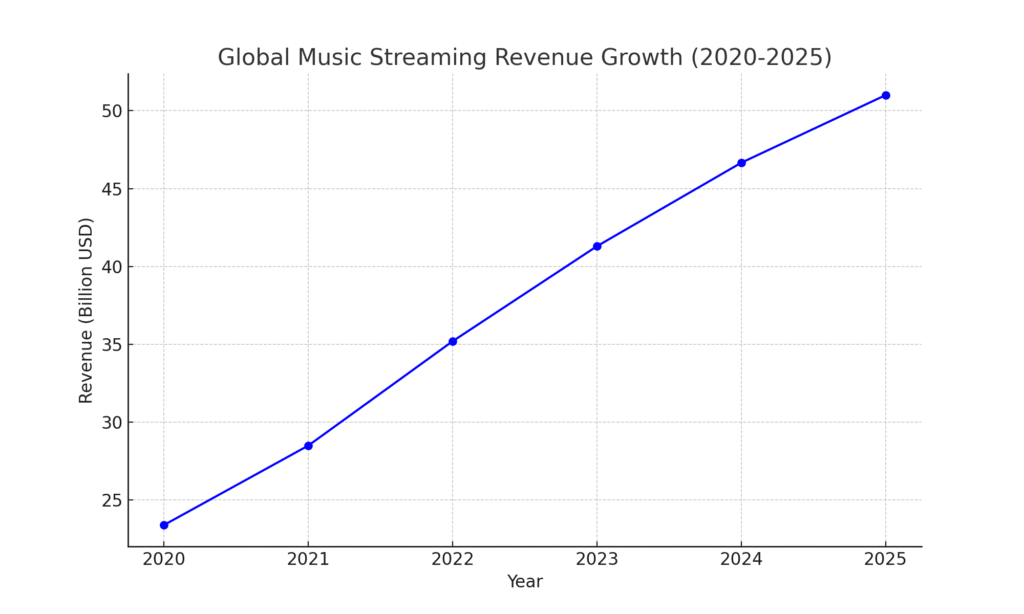
The global music streaming market reached an estimated USD 46.66 billion in 2024. Projections suggest it could exceed USD 108 billion by 2030, showing a compound annual growth rate of nearly 15%. This growth highlights the increasing consumer appetite for accessible and on-demand music. Companies are expanding regionally and investing in personalized user experiences. Brands that adapt early to this expansion can capture significant market share.
Music Streaming Marketing Statistics#3: App-Based Streaming Leads
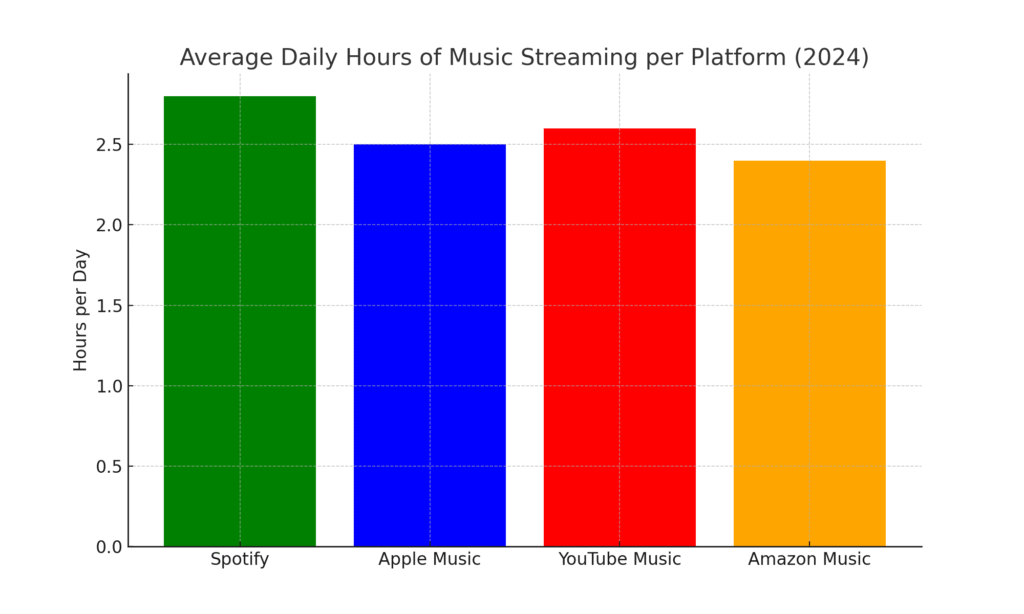
Mobile apps dominate music streaming consumption, generating billions in revenue each year. Users prefer apps for their convenience, curated playlists, and seamless user experience. Platforms like Spotify, Apple Music, and YouTube Music remain top performers. Engagement metrics show that users spend over 2.5 hours daily on streaming apps. Marketers must optimize campaigns for mobile-first platforms to reach audiences effectively.
Music Streaming Marketing Statistics#4: Streaming’s Share of Industry Revenue
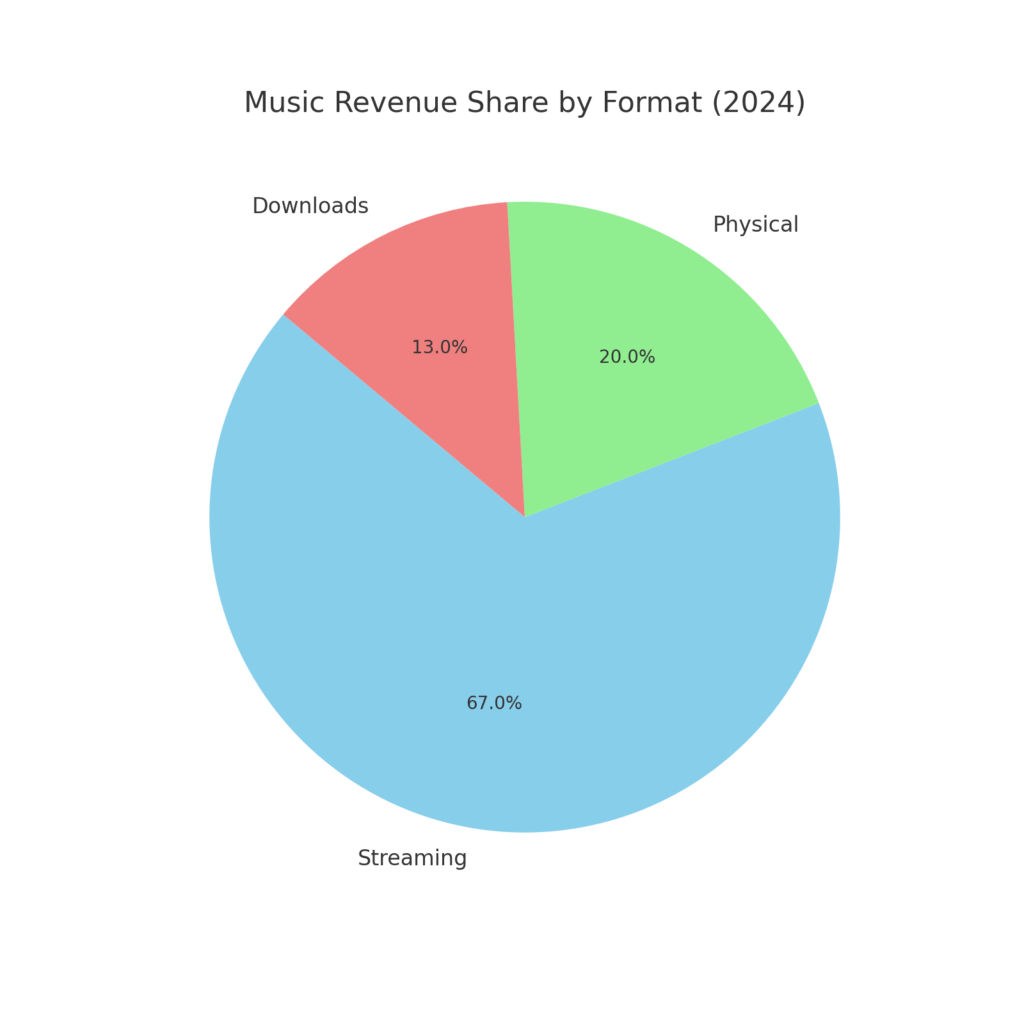
Streaming now contributes roughly 67% of global music industry revenue. In the U.S., this figure rises to 84%, showing regional dominance. The trend demonstrates that physical media and downloads are increasingly secondary. For marketers, investing in streaming platforms is essential for brand visibility. Understanding revenue distribution can guide promotional strategies for artists and labels.
Music Streaming Marketing Statistics#5: Paid vs. Ad-Supported Streaming
Paid subscriptions represent only about 23% of total music consumption. The majority of users still rely on ad-supported or freemium models. Platforms use ad-supported streams as a funnel to convert users into paying subscribers. Brands can capitalize on ad-supported segments for targeted marketing campaigns. Monetization strategies are evolving alongside these consumption patterns.
Music Streaming Marketing Statistics#6: User Engagement Levels
The average user streams between 2.5 and 3 hours of music per day. This translates into roughly 40–60 tracks daily. Engagement is highest during commutes, workouts, and leisure activities. Consistent daily engagement underscores the opportunity for personalized marketing. Artists and brands can leverage user habits to optimize content timing and placement.
Music Streaming Marketing Statistics#7: Record-High Streams
Global music streams reached approximately 4.8 trillion in 2024, a 14% increase over the previous year. The U.S. alone contributed 1.4 trillion on-demand audio streams. This growth highlights the increasing global reliance on streaming platforms. For marketers, high stream volumes indicate strong engagement opportunities. Trends suggest continued growth in consumption as new users join streaming services.
Music Streaming Marketing Statistics#8: Growth Moderation in 2025
While streaming consumption continues to rise, growth rates are moderating in 2025. U.S. consumption grew by about 5% in the first half of 2025, down from 8% the previous year. Globally, on-demand streams reached 2.5 trillion during the same period. The moderation suggests market maturity and increasing competition. Marketers need to innovate to maintain audience attention.
Music Streaming Marketing Statistics#9: Retention Challenges
Music app retention remains a critical challenge, with average active user retention at just 3.5%. High churn rates indicate that users often switch platforms frequently. Retention is driven by personalized recommendations and unique content. Understanding these dynamics is essential for marketers targeting long-term engagement. Retention strategies can include exclusive releases and loyalty programs.
Music Streaming Marketing Statistics#10: Increasing Platforms
The number of music streaming services in the U.S. reached 274 in 2024, reflecting growing competition. New platforms are leveraging niche content and regional targeting. Artists and brands must carefully select platforms for marketing campaigns. Audience fragmentation requires precise targeting strategies. Expansion provides opportunities for innovative partnerships.
Music Streaming Marketing Statistics#11: Genre Dominance
Contemporary tracks post-2010 accounted for 79.5% of U.S. streams in 2024. Pop and hip-hop genres lead in total streaming numbers. Female solo pop artists drove nearly two-thirds of top streams. Genre preferences impact marketing messaging and playlist curation. Brands can align campaigns with the most-streamed genres for maximum engagement.
Music Streaming Marketing Statistics#12: AI and Fraud Risks
AI-generated tracks are increasingly common, with over 20,000 uploaded daily. Streaming manipulation via bots poses risks for artists and platforms. Platforms estimate that under 1% of streams are fraudulent, but this still affects revenue and visibility. Marketers must ensure campaigns target genuine user engagement. Transparency and monitoring are essential in digital campaigns.
Music Streaming Marketing Statistics#13: Social Media Impact
Social media significantly influences music discovery and streaming behavior. Experiments show that removal of content from TikTok can shift streams to other platforms. Brands must understand cross-platform effects for campaign planning. Social media exposure drives viral trends and boosts engagement. Strategic coordination across platforms maximizes reach.
Music Streaming Marketing Statistics#14: Live Events Boost Streaming
Attending live concerts increases attendees’ streaming by approximately one song per day. This effect also extends to friends of attendees, creating a ripple of engagement. Live events remain an essential marketing tool for artists. Integration of offline experiences with online streaming strengthens fan loyalty. Brands can leverage this synergy in promotional strategies.
Music Streaming Marketing Statistics#15: Artist Payouts
Average per-stream payouts remain low, around $0.0017 per stream. Most artists use streaming primarily for exposure rather than revenue. Marketing strategies must consider the balance between visibility and monetization. Understanding payout structures helps brands collaborate effectively with artists. Campaigns can optimize promotional tactics to maximize both reach and revenue.

Music Streaming Marketing Statistics#16: Subscription Forecasts
The global music streaming market is projected to grow significantly by 2027. Market expansion is driven by rising smartphone penetration and internet accessibility. Subscription-based models remain the primary revenue driver. Brands should anticipate user growth and adapt strategies accordingly. Forecasts inform long-term planning for both artists and marketing teams.
Music Streaming Marketing Statistics#17: Regional Growth Patterns
North America held over 33% of the global market in 2024. Asia-Pacific is the fastest-growing region, reflecting increasing smartphone adoption. Regional insights inform targeted marketing campaigns. Understanding demographic and geographic trends is critical for maximizing engagement. Brands can prioritize resources in high-growth regions.
Music Streaming Marketing Statistics#18: On-Demand Streaming Dominance
On-demand streaming accounts for roughly 70% of the market share. User-initiated listening remains more popular than curated or radio-style streaming. Marketers can leverage on-demand preferences for personalized campaigns. Playlist placement and recommendation algorithms are key drivers of engagement. Platform strategies should align with user behavior.
Music Streaming Marketing Statistics#19: Artist Success Concentration
A small number of artists capture a large share of total streams. For example, top artists may account for 1 in 78 U.S. streams. This concentration highlights the importance of influencer marketing and brand partnerships. Campaigns targeting top-tier artists can achieve significant exposure. However, emerging artists require strategic promotion to gain visibility.
Music Streaming Marketing Statistics#20: Challenges for Indie Artists
Small or independent artists face obstacles due to algorithmic moderation and platform competition. AI and fraudulent streams can obscure genuine engagement. Marketing campaigns must focus on authenticity and niche audience targeting. Platforms increasingly favor established artists, creating a barrier for new talent. Effective strategies combine online presence with offline promotions to build credibility.
Leveraging Music Streaming Marketing Statistics in 2025
Exploring these music streaming marketing statistics has given me a clearer view of the current landscape and future trends. From subscription growth to the impact of social media and live events, the data provides actionable insights for brands and artists alike. Working with the leading marketing agency in New York, I’ve seen how applying these insights drives both reach and engagement. The future of music marketing is digital, dynamic, and highly personalized. By understanding these statistics, marketers can craft strategies that resonate with audiences and stay ahead in the ever-evolving music streaming ecosystem.
SOURCES