



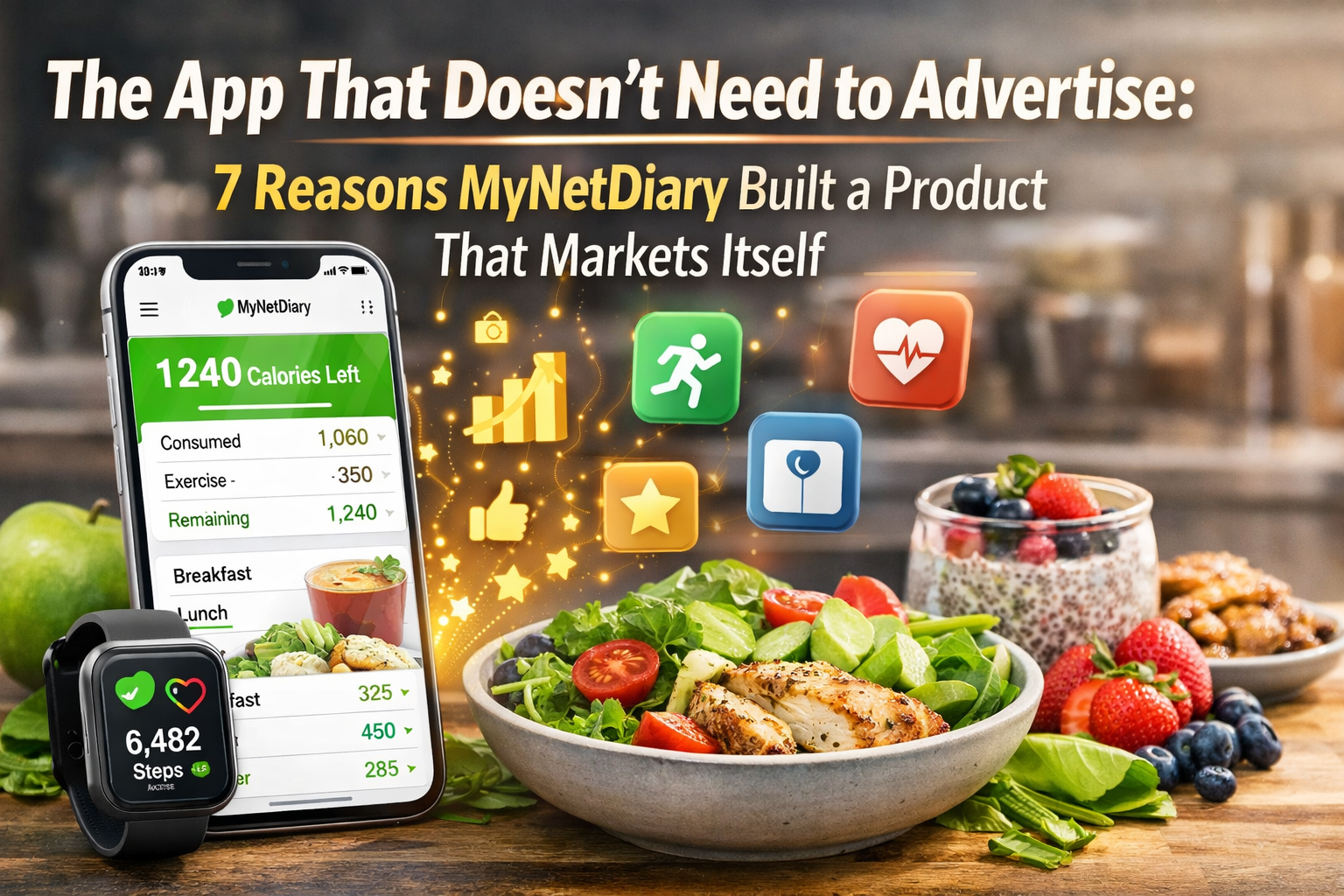
06 Mar The App That Doesn’t Need to Advertise: 7 Reasons MyNetDiary Built a Product That Markets Itself
There’s a category of company that marketers don’t talk about enough — not because it isn’t interesting, but because it quietly embarrasses the conventional playbook.
These are the companies that didn’t win by outspending the competition. They didn’t go viral from a clever stunt. They didn’t build a cult following on the back of a charismatic founder’s personal brand. They won the way the most durable businesses always win: by building something so genuinely useful, so carefully considered, and so deeply integrated into people’s daily lives that growth became a natural consequence of quality rather than a function of budget.
MyNetDiary is that company.
In one of the most crowded, competitive, and commoditized categories in the entire app economy — free calorie tracker app and nutrition — MyNetDiary didn’t just survive. It climbed to the top of the rankings and stayed there. While better-funded competitors leaned harder into paywalls, while venture-backed apps burned through acquisition budgets, while legacy players coasted on name recognition, MyNetDiary did something quietly radical: it kept making the product better.
And that, it turns out, is a marketing strategy. Here at Amra and Elma, a leading marketing agency in New York, we study these marketing strategies, and this one is arguably one of the best ones.
What follows is a breakdown of the seven things MyNetDiary got profoundly right — not just as a product team, but as a growth engine. Each one is a lesson that applies far beyond nutrition apps. These are principles that work in any category, for any brand willing to play the long game.
7 Reasons MyNetDiary Built a Product That Markets Itself (Editor’s Choice)
Case Study
Why MyNetDiary Barely Needs to Advertise
7 product decisions that turned users into a growth engine — and what every brand builder should steal from them.
The App That Doesn’t Need to Advertise: 7 Reasons MyNetDiary Built a Product That Markets Itself
1. They Treated the Free Tier as a First Impression, Not a Lead Trap
The dominant strategy in the app economy for the last decade has been what’s sometimes called the “crippleware” approach to freemium: give users just enough to understand the product’s potential, then wall off everything worth having behind a subscription. The logic is straightforward — create desire, create friction, convert desire into payment.
The problem with this strategy is that it assumes users have no alternatives. In a category as saturated as calorie tracking, that assumption is catastrophically wrong. The moment your free experience frustrates someone, they don’t upgrade — they leave. They open the App Store, download a competitor, and start building habits there instead.
MyNetDiary made a different bet entirely.
Their free calorie tracker delivers automatic calorie goal calculation based on personal profile data, full macro tracking across protein, fats, and carbohydrates, a food database containing millions of verified items, a fast and reliable barcode scanner, water intake monitoring, weight progress charts, daily nutrition summaries with personalized feedback, integration with fitness trackers, and flexible support for multiple diet styles including low-carb and balanced plans.
That is not a teaser. That is a complete, professional-grade nutrition management tool available at zero cost. Every feature on that list is something a competitor charges for.
The strategic genius of this approach is that it reframes the entire conversion funnel. Instead of converting users from “frustrated” to “paying,” MyNetDiary converts users from “delighted” to “dependent.” By the time a user is considering the premium tier, they’ve already built weeks or months of habits, data, and personal history inside the app. They’re not upgrading because they hit a wall. They’re upgrading because they want more of something they already love.
That’s a fundamentally different emotional transaction — and it produces fundamentally different conversion rates, retention numbers, and lifetime value.
The lesson here isn’t “give everything away for free.” It’s that the free experience is your highest-leverage marketing asset. It’s the thing a potential customer will encounter before they trust you enough to pay you. If you treat it like a cage, you’ll convert a fraction of the users you could. If you treat it like a showcase, the product sells itself.
2. They Built Every Feature as a Retention Mechanism
There’s a distinction that separates good product teams from great ones: good teams build features that users want. Great teams build features that make users impossible to leave.
MyNetDiary’s feature architecture is a masterclass in the second approach. On the surface, each feature looks like a standalone benefit. Underneath, every single one is deepening the user’s investment in the product in ways that compound over time.
Consider the sequence. When a user sets up their profile and receives a personalized calorie goal, the app immediately becomes theirs in a way that a generic tool never could. It knows their age, their weight, their target, their activity level. That personalization creates a psychological handshake — the user feels seen, and in return, they feel committed.
When the app tracks macros with genuine precision, users start making better food choices. When they make better choices, they feel better physically. When they feel better, they attribute that improvement — correctly — to the feedback loop the app created. The app doesn’t just track progress. It becomes the reason for progress. That’s an extraordinarily powerful emotional position for a product to occupy.
When the fitness tracker integration is added to the picture, something else happens: the app becomes the single source of truth for the user’s entire health picture. Calories in, calories burned, water consumed, weight trend over time — it’s all in one place, all connected, all telling one coherent story. At that point, switching to a competitor isn’t just inconvenient. It means losing your data, your history, your story. The switching cost becomes genuinely prohibitive.
This is what product people call a “data moat,” and it’s one of the most defensible competitive advantages a consumer app can build. You’re not locking users in with a contract. You’re locking them in with value. The distinction matters enormously — one produces resentment, the other produces loyalty.
The strategic principle at work here is that retention is acquisition. Every user who stays is a user you don’t have to re-acquire. Every power user who builds deep habits becomes a potential evangelist. Every person who hits a six-month streak and shares it on social media is doing more for MyNetDiary’s top of funnel than a paid ad ever could. Features that drive retention don’t just reduce churn. They generate growth.
3. They Weaponized Habit Formation
The most valuable real estate in the world isn’t in Manhattan or Dubai. It’s on a person’s phone home screen, in the six to eight apps that get opened before breakfast every single morning.
That’s where behavior lives. That’s where decisions get made. And that’s exactly where MyNetDiary positioned itself — not as an occasional reference tool, but as a daily ritual.
The core loop of the app is brilliantly simple: log food, see progress, adjust. Three steps. Thirty seconds. Repeatable every meal, every day. That simplicity is not an accident or a limitation. It’s a deliberate design decision rooted in behavioral psychology. Habits form when the trigger is clear, the action is easy, and the reward is immediate. MyNetDiary optimized every single one of those variables.
The trigger is hunger — something that happens multiple times a day without fail. The action is opening the app and logging, made easy by a fast barcode scanner, a vast database, and meal memory that learns your patterns. The reward is immediate: you see your remaining calories, your macro balance, your progress toward your goal. The feedback loop closes in seconds.
What this creates, over days and weeks of repetition, isn’t just app engagement. It’s a conditioned behavior pattern. Users don’t decide to open MyNetDiary — they just do it, the same way they check their messages or scroll their feed. It becomes automatic.
From a marketing perspective, this is the holy grail. The most expensive part of any customer acquisition strategy is the period between first download and genuine habit formation. Most apps lose the majority of their users in the first two weeks. The ones that survive that window often survive for years. MyNetDiary’s UX is specifically engineered to get users through that window — and the payoff is a user base that requires almost no re-engagement spend because the product itself keeps calling them back.

4. They Chose Verified Quality Over Crowdsourced Volume
Here’s a feature detail that looks minor on a spec sheet and turns out to be enormous in practice: MyNetDiary’s food database contains millions of verified items.
Not just millions of items. Verified items.
In a category where accuracy is the entire point — where a user is making health decisions based on the numbers the app provides — data quality isn’t a nice-to-have. It’s the product. And bad data doesn’t just give wrong answers. It erodes trust in a way that’s very difficult to recover from.
The dominant approach in the space has been to crowdsource the food database — let users add items, let the community grow the library, prioritize coverage over accuracy. This makes the database large very quickly. It also fills it with errors, duplicates, and items with wildly incorrect nutritional information. Any serious calorie counter has a story about scanning a barcode and getting a result that was clearly wrong — the numbers too low to be credible, the macros obviously off.
Every one of those moments is a trust erosion event. Small in isolation. Catastrophic at scale.
MyNetDiary’s commitment to database verification means that when a user scans a barcode, they can trust the result. That trust is invisible when it works — and that’s exactly the point. The best product experiences are the ones where nothing goes wrong, where the user never has to second-guess the tool, where the experience is so smooth that it’s essentially invisible. Friction is memorable. Seamlessness is not. But seamlessness is what keeps people coming back.
The strategic principle here applies to any business: quality at the foundational level is always a marketing decision, even when it doesn’t look like one. The investment in verified data is an investment in user trust — and user trust is the only currency that converts into every other kind of growth metric. Referrals, reviews, retention, revenue. It all flows from trust.
5. They Built for the Underserved Middle — and Owned It
Every category has its extremes. In calorie tracking, one extreme is the absolute beginner — someone who has never counted a calorie in their life, wants something simple, and will be overwhelmed by anything technical. The other extreme is the hardcore optimizer — the athlete or bieter tracking micronutrients to the microgram, who needs clinical-grade precision above all else.
Most apps pick a lane. Lose It! went aggressively after beginners. Cronometer planted its flag firmly in the precision/specialist camp. MyFitnessPal tried to be everything to everyone and ended up with a product that feels bloated and a paywall that alienates its most loyal users.
MyNetDiary found and owned the middle — and it turns out the middle is where most people actually live.
The middle is the person who takes their health seriously but isn’t a professional athlete. The person who wants to understand their macros but doesn’t need a dissertation on micronutrients. The person who appreciates a clean interface but also wants real depth available when they’re ready for it. The person who is building a sustainable lifestyle, not preparing for a competition.
This is an enormous market — arguably the largest segment in the entire health and wellness space — and MyNetDiary serves it better than anyone else. The interface is clean without being dumbed down. The depth is there for users who want it, accessible without being shoved at users who don’t. The onboarding earns trust incrementally rather than demanding expertise upfront.
This positioning decision has profound marketing implications. When you own the middle of a large category, you have the broadest possible addressable audience — and your word-of-mouth reach is correspondingly vast. The person who recommends MyNetDiary to a friend doesn’t need to qualify it with “but only if you’re really serious about tracking” or “it’s kind of complicated.” They can just say: this works, it’s easy, you should try it. And that simplicity of recommendation is fuel for organic growth.
6. They Let the User Experience Speak Louder Than the Marketing
There is a specific type of brand that achieves something most marketing teams only dream about: the experience of using the product becomes the advertisement for the product.
This is what Apple achieved with the iPhone. It’s what Spotify achieved with Discover Weekly. It’s what Slack achieved in the enterprise space before Teams arrived. The product is so noticeably better — in ways that are immediately felt rather than explained — that the act of using it becomes an act of advocacy.
MyNetDiary is in that company.
The barcode scanner that works on the first try, every time. The personalized feedback that actually feels relevant to your specific situation. The dashboard that gives you a complete picture of your nutrition without making you work for it. The integration that pulls in your fitness data automatically, so you never have to manually enter a workout. These are small moments — seconds-long interactions — but they accumulate into something significant: the feeling that this product was built by people who actually use it, who actually care, who sweat the details because they understand that the details are what users feel.
That feeling is the most powerful marketing signal there is. And it spreads in the most organic, authentic way possible: person to person, in conversations that no brand can manufacture and no algorithm can replicate. “What app are you using?” “I use MyNetDiary — it’s genuinely really good.” That exchange is happening thousands of times a day across gyms, offices, WhatsApp groups, and comment sections. Not because of a referral incentive. Because the product earned it.
The strategic lesson here is one of the most important in all of marketing: advertising can create awareness. It can generate trial. But it cannot create that feeling. Only the product can. Which means that every dollar and every hour invested in making the product better is simultaneously an investment in marketing. The returns are slower to materialize than a paid campaign. But they’re also far more durable, far more credible, and far more likely to compound over time rather than disappear the moment the budget is cut.
7. They Played a Game Most Competitors Weren’t Willing to Play
Here is perhaps the most underappreciated thing about what MyNetDiary built: they took the long view in a market that was obsessed with the short one.
The pressure on most apps — particularly those with venture backing — is to monetize aggressively and grow fast. Move features behind paywalls. Juice engagement metrics. Optimize for this quarter’s conversion rate even if it degrades next year’s retention. The short-term numbers look good. The long-term brand equity quietly bleeds out.
MyNetDiary appears to have rejected this logic. The commitment to a genuinely excellent free experience is not a decision that makes the monthly numbers pop. It’s a decision that builds something far more valuable over time: a reputation. A category position. A user base that stays not because they’re locked in, but because they’ve never found a reason to leave.
In a world where most apps are fighting for attention, MyNetDiary built for something harder to acquire and much harder to take away: trust. And trust, once established at scale in a consumer category, becomes a moat that is almost impossible to breach with ad spend alone. You cannot buy your way past a competitor that users genuinely love. You can only out-build them — and most companies aren’t willing to do the work.
This is the deepest strategic lesson of the MyNetDiary story. Sustainable growth is almost always built on top of genuine product quality. Not manufactured virality. Not growth hacks. Not the cleverest funnel or the most aggressive email sequence. Those tactics have their place, and none of them should be dismissed. But they work best — they work exponentially best — when they’re built on top of a product that has already earned the user’s respect.
The brand that wins the decade is rarely the one that spent the most in year one. It’s the one that gave users the fewest reasons to leave, year after year, until walking away became unthinkable.
The Takeaway
If you’re building a product or a brand and you want to understand what a long-term growth strategy actually looks like in practice, MyNetDiary is one of the clearest examples available.
They didn’t reinvent the category. They didn’t disrupt anything in the way that word gets used breathlessly in startup circles. They looked at what users needed, built it to a standard most competitors weren’t willing to hold, and then held that standard consistently across years of growth, competitive pressure, and market noise.
The result is a product that carries its own distribution. Every user who gets results becomes a referral source. Every satisfied daily logger becomes a five-star review. Every person who opens the app before breakfast becomes a data point in one of the most powerful metrics in all of business: genuine, habitual, voluntary usage.
That’s the product-led growth playbook distilled to its essence. Not the buzzword version. The real version — built feature by feature, user session by user session, trust increment by trust increment, over years of unglamorous, disciplined execution.
The question worth asking about your own product, your own brand, your own customer experience, is a simple one: if you stopped all paid acquisition tomorrow, would your product continue to grow?
If the answer is yes, you’ve built something real.
If the answer is no, you now know exactly where to start.
-
Primary — MyNetDiary Official Pages
https://www.mynetdiary.com/ https://www.mynetdiary.com/about.html https://www.mynetdiary.com/food-database.html https://www.mynetdiary.com/food-database-article.html https://www.mynetdiary.com/food-barcode-scanner.html https://www.mynetdiary.com/food-diary-and-calorie-counter-for-nutritionists.html https://www.mynetdiary.com/foodSearch.do https://www.mynetdiary.com/user-reviews.html
Third-Party Rankings & Reviews
https://apps.apple.com/us/app/calorie-counter-mynetdiary/id287529757 https://play.google.com/store/apps/details?id=com.fourtechnologies.mynetdiary.ad&hl=en_US https://health.usnews.com/wellness/articles/best-weight-loss-apps https://www.cnn.com/cnn-underscored/reviews/best-weight-loss-apps https://clark.com/health-health-care/free-weight-loss-apps/