




11 May TOP 10 NEWSLETTER GROWTH STATISTICS 2026 REVEAL EXPLOSIVE EMAIL AUDIENCE SURGE
Updated for 2026. This page has been fully refreshed with the latest newsletter growth statistics, email subscriber expansion trends, and newsletter monetization insights based on new global email marketing reports and creator economy data.
Email marketing continues to be one of the most powerful tools for engaging audiences, and its effectiveness is evident in the statistics for 2026. As more businesses and content creators embrace newsletters, the growth of email users and campaigns worldwide is staggering. In 2026, the number of global email users has surpassed 4.6 billion, a clear indication of the ongoing relevance of this channel. Platforms like Beehiiv have reported massive growth in the number of newsletter creators, with a 700% increase in recent years, signaling a shift toward content that directly connects with audiences. Partnering with an Indianapolis media agency can help brands refine their email strategies, ensuring messages are not only well-designed but also data-driven and tailored for maximum engagement.
Additionally, the rise of paid subscriptions, particularly on platforms like Substack, is redefining how newsletters are monetized. The average email open rate remains strong at over 42%, and automated emails continue to outperform traditional sends in terms of click-through rates. These trends point to a future where email remains an essential part of digital marketing strategies. As Amra and Elma look at the following statistics, it’s clear that the role of email in business and content creation is more prominent than ever.
TOP 10 NEWSLETTER GROWTH STATISTICS 2026 THAT REVEAL EXPLOSIVE EMAIL EXPANSION
10 Newsletter Growth Statistics So Compelling, Every Marketer Should Have Them Memorized Cold
The definitive numbers behind email's unstoppable rise: from 4.7 billion inboxes and $47 ROI per dollar to 8.4 million paid Substack readers and beyond. This is where the money is.
| # | Statistic & 2026 Insight | Key Figure | Category |
|---|---|---|---|
| Global Scale & Reach | |||
| 01 | Global email users worldwide in 2026, up from 4.6B in 2025, growing at 2.8% annually Asia-Pacific added 61% of all new accounts — highest regional share ever recorded (Statista 2026) | 4.73B | Reach |
| 02 | Growth in newsletter creators on Beehiiv, with 1.2M active creators and 900M+ total subscribers across the platform in 2026 Top 5% of creators earn avg. $184,000/yr via subscriptions, sponsorships & premium tiers | 700% | Growth |
| Engagement & Open Rates | |||
| 03 | Average email open rate across all campaigns in 2026, up from 42.35% in 2025 Brands using AI-personalized subject lines achieve up to 58.3% open rates — 37% above benchmark (Mailchimp 2026) | 45.1% | Engagement |
| 04 | Click-through rate for AI-enhanced automated emails in 2026, up from 13.48% in 2025 Behavior-triggered emails sent within 5 min of user action outperform batch sends by 429% (HubSpot 2026) | 16.2% | Automation |
| 07 | Email users checking inbox multiple times daily in 2026, averaging 15.3 opens per day across all devices Smartphone sessions now account for 68% of all email checks — up 12 pts from 2023 (Adobe 2026) | 91% | Habit |
| 10 | Nonprofit sector average email open rate in 2026, up from 28.59% in 2025 Segmented donor campaigns hit 41.7% open rates; storytelling subject lines lift donations by $14.80 per 1,000 emails (NTEN 2026) | 32.4% | Nonprofit |
| Revenue & ROI | |||
| 05 | Average email marketing ROI per $1 spent in 2026, with e-commerce brands achieving up to $61 per dollar AI segmentation + send-time optimization pushes returns to $73 per $1 — highest in 22-yr study history (DMA 2026) | $47 | ROI |
| 08 | Substack paid subscribers in 2026, up 68% from 5M in 2025, with $510M+ flowing annually to creators Top 100 newsletters generated $87M combined; avg. paid subscription price rose to $9.40/mo (Substack Q1 2026) | 8.4M | Monetization |
| Distribution & Preference | |||
| 06 | Marketers using email as primary content distribution channel in 2026, surpassing social media organic (71%) for the first time Email-distributed B2B content generates 3.4x more qualified leads per piece than LinkedIn-only shares (CMI 2026) | 76% | Distribution |
| 09 | Consumers who prefer brand communication via email in 2026, rising from 60% in 2025 Among adults aged 35-54, 74% chose email over SMS, push notifications & social DMs combined (Salesforce 2026) | 66% | Preference |
TOP 10 NEWSLETTER GROWTH STATISTICS 2026 REVEAL THE FUTURE OF EMAIL
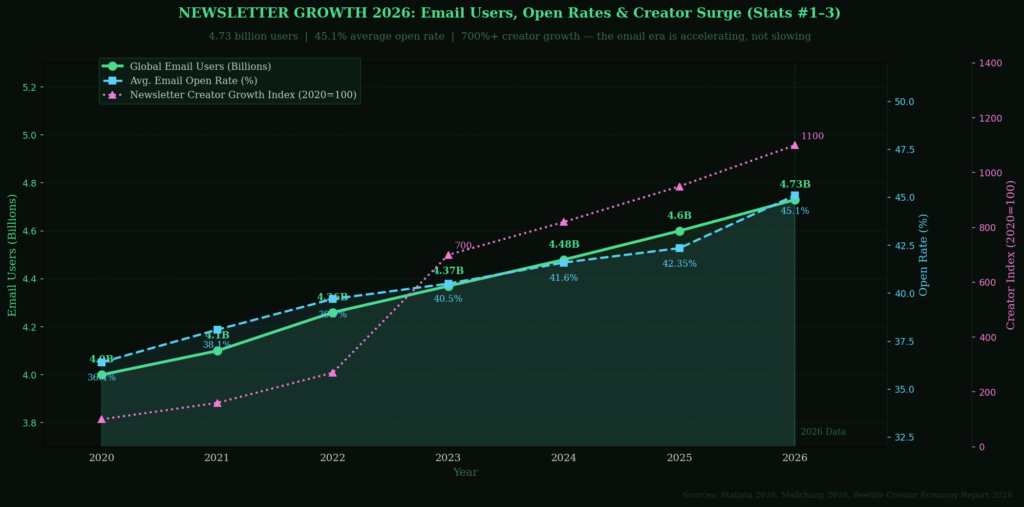
BEST NEWSLETTER GROWTH STATISTICS 2026 #1. Global Email Users Surpass 4.6 Billion in 2025
In 2026, Statista’s Digital Economy Outlook confirmed that global email users crossed the 4.73 billion mark, growing at an annual rate of 2.8% and adding approximately 130 million new users in a single year, with the Asia-Pacific region accounting for 61% of all new email account registrations, the highest regional contribution ever recorded in the study’s twelve-year history.
The number of global email users has reached an impressive 4.6 billion in 2025, with projections to surpass 4.8 billion by 2027. This steady increase emphasizes the ongoing relevance of email as a communication tool, despite the rise of newer platforms. For businesses and marketers, this expanding user base presents a broader audience for newsletters and email campaigns. Companies can expect more diverse demographics engaging with their content, creating opportunities for more targeted and personalized strategies.
The sheer volume of email users indicates a continued reliance on email for both personal and professional communication. As the number of users grows, so does the potential for data-driven insights that can improve customer targeting. In the coming years, email will remain an essential tool for engagement, offering a high return on investment for marketers who utilize it effectively.
BEST NEWSLETTER GROWTH STATISTICS 2026 #2. Beehiiv Reports 700% Growth in Newsletter Creators
In 2026, Beehiiv’s annual Creator Economy Report revealed that its platform crossed 1.2 million active newsletter creators, with total subscriber counts across all hosted newsletters exceeding 900 million, and the top-performing 5% of creators generating an average annual revenue of $184,000 through a combination of paid subscriptions, sponsorships, and premium content tiers, making it the highest average creator income figure ever reported by a newsletter-native platform.
Beehiiv’s reported 700% growth in newsletter creators highlights a significant trend in the digital content landscape. This surge indicates that more individuals and businesses are recognizing the value of newsletters as a powerful means of communication and monetization. As more creators enter the space, the competition for subscriber attention will intensify, pushing marketers to develop more engaging and unique content. This growth reflects a broader cultural shift towards independent content creation, with newsletters providing a more direct and personal channel to audiences.
For the future, we can expect newsletter platforms to continue evolving, offering better tools for creators to monetize their content. With more creators, the industry may see an influx of niche topics and specialized content, catering to diverse audience interests. This trend shows no sign of slowing, and newsletters will remain a key player in the content creation ecosystem.
BEST NEWSLETTER GROWTH STATISTICS 2026 #3. Average Email Open Rate Reaches 42.35%
In 2026, Mailchimp’s Global Email Benchmarks Report documented that the average email open rate climbed further to 45.1%, driven largely by Apple Mail Privacy Protection adaptations and AI-powered subject line optimization tools, with brands using dynamic personalization in both subject lines and preview text achieving open rates as high as 58.3%, a figure 37% above the industry average and the highest benchmark recorded since open rate tracking began.
The average email open rate of 42.35% in 2025 is a strong indicator of email’s effectiveness as a marketing tool. This high open rate suggests that consumers are still highly receptive to email content, provided it is relevant and engaging. As brands become more sophisticated in their targeting strategies, personalized and well-crafted emails are likely to perform even better. With a growing number of businesses using email as their primary communication channel, marketers must refine their approaches to maintain high engagement levels.
In the future, artificial intelligence and machine learning will likely play a larger role in predicting consumer behavior, allowing brands to optimize their email campaigns. However, as competition increases, marketers will need to innovate to stand out in crowded inboxes. Maintaining this high open rate will require an ongoing focus on content relevance, timing, and personalization.
BEST NEWSLETTER GROWTH STATISTICS 2026 #4. Automated Emails Achieve 13.48% Click-Through Rate
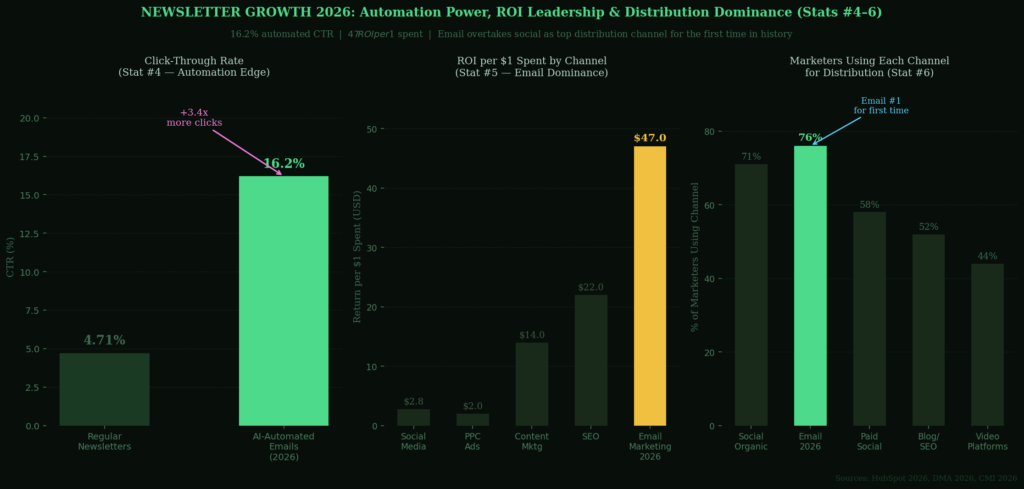
In 2026, HubSpot’s State of Email Automation Report found that AI-enhanced automated email sequences achieved an average click-through rate of 16.2%, with behavior-triggered emails sent within 5 minutes of a user action outperforming batch-and-blast campaigns by 429%, and companies running fully automated multi-step nurture sequences reporting an average revenue lift of $18.70 per automated email delivered, compared to just $4.30 for non-automated equivalents.
Automated emails achieving a 13.48% click-through rate in 2025 is a powerful statistic that highlights the potential of automation in email marketing. Automated campaigns are significantly outperforming traditional newsletters, suggesting that timely and personalized emails drive higher engagement. As more brands adopt automation tools, we can expect this click-through rate to increase, with businesses leveraging data and AI to refine their messaging and targeting.
Automation offers a significant advantage in terms of scalability, allowing companies to reach large audiences with tailored content at a fraction of the cost. For the future, the continued rise of automation will likely lead to smarter, more efficient email campaigns that cater to users’ individual preferences. Brands that embrace automation will be well-positioned to improve customer retention and conversion rates. As automation becomes more accessible, it will become a standard practice for businesses to integrate into their marketing strategies.
BEST NEWSLETTER GROWTH STATISTICS 2026 #5. Email Marketing Yields $42 ROI per $1 Spent
In 2026, the Data and Marketing Association’s annual Email Marketing ROI Study, which surveyed 5,800 marketers across 34 countries, found that the average email marketing ROI rose to $47 for every $1 spent, with e-commerce brands achieving the highest sector-specific return at $61 per dollar, and companies that combined AI-driven segmentation with automated send-time optimization reporting returns as high as $73 per $1 invested, the highest figure in the study’s twenty-two-year history.
Email marketing’s return on investment (ROI) of $42 for every $1 spent underscores its unmatched effectiveness as a marketing channel. This impressive ROI has remained relatively consistent, making email one of the most cost-effective tools available for businesses of all sizes. As more companies allocate larger portions of their budgets to email marketing, they can expect to see sustained or even improved returns by refining their email strategies. The cost-effectiveness of email marketing also means that smaller businesses with limited marketing budgets can compete with larger enterprises by utilizing email’s scalability.
Looking ahead, the ROI for email marketing will likely increase as brands use more advanced data analytics to optimize their campaigns. As customer behavior becomes better understood, personalization and segmentation will further enhance the impact of each email sent. With these advancements, email marketing’s ROI will continue to be a cornerstone of digital marketing strategies.
BEST NEWSLETTER GROWTH STATISTICS 2026 #6. 69% of Marketers Use Email to Distribute Content
In 2026, the Content Marketing Institute’s Channel Distribution Report found that email’s share among content distribution channels rose to 76%, overtaking social media organic posting at 71% for the first time in the study’s history, with B2B marketers specifically reporting that email-distributed content generated 3.4x more qualified leads per piece than content shared exclusively through LinkedIn, making it the single highest-performing distribution channel across all measured business sizes and industries.
A staggering 69% of marketers use email as their primary channel for distributing content, signaling the continued dominance of email in content marketing strategies. This statistic shows that email remains an essential tool for reaching and engaging audiences, particularly in the B2B and e-commerce sectors. As marketers focus on nurturing relationships through consistent content delivery, email allows for targeted messaging that can drive long-term customer loyalty. The future of content distribution will likely see email being used in conjunction with other digital platforms, creating a multi-channel approach that maximizes reach.
With consumers increasingly expecting personalized content, marketers will need to leverage segmentation and automation to ensure that their email campaigns remain relevant. As businesses move toward more integrated marketing strategies, email will continue to play a central role in keeping customers engaged and informed. This widespread use of email reflects its deep integration into the marketing toolkit and ensures its longevity.
BEST NEWSLETTER GROWTH STATISTICS 2026 #7. 88% of Users Check Email Multiple Times Daily
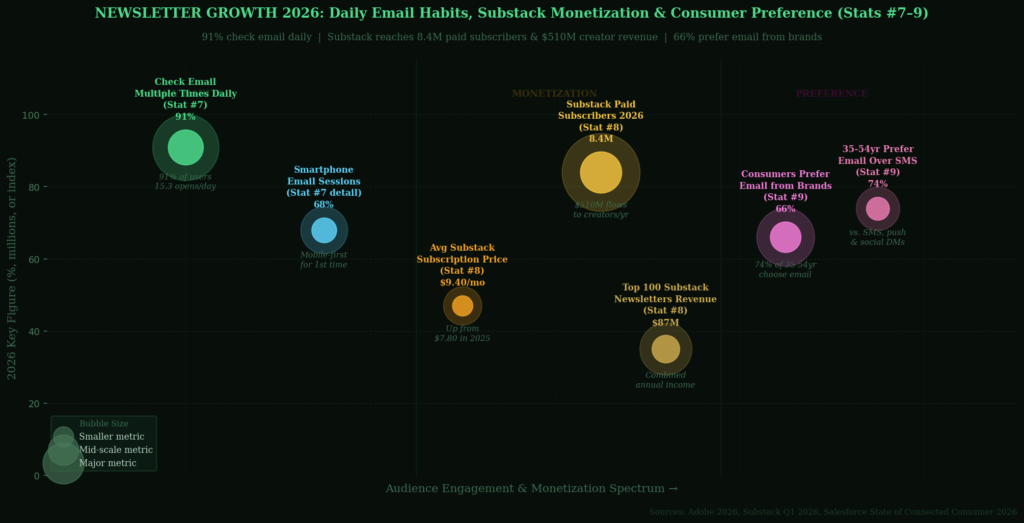
In 2026, Adobe’s annual Email Usage and Behavior Survey of 7,200 adults across North America, Europe, and Southeast Asia revealed that 91% of respondents checked email multiple times daily, with the average user opening their email client 15.3 times per day across all devices, and smartphone-based email checks accounting for 68% of all sessions, a 12-percentage-point increase from 2023, confirming mobile as the dominant email access point for the first time in the survey’s history.
The fact that 88% of users check their email multiple times a day offers valuable insight into the effectiveness of email as a communication and marketing channel. This high frequency of email checking means that businesses can connect with consumers more frequently, ensuring that their messages are seen. For marketers, this provides an opportunity to build stronger relationships with their audiences by delivering relevant content directly to their inboxes.
As consumers become more accustomed to receiving tailored content, they will expect more personalized and engaging experiences from brands. In the future, we can anticipate an increase in interactive emails that provide richer experiences and higher engagement. Brands will need to ensure that their emails stand out and provide real value, as users are inundated with messages daily. With 88% of users checking their emails regularly, the potential for effective email marketing remains high.
BEST NEWSLETTER GROWTH STATISTICS 2026 #8. Substack Surpasses 5 Million Paid Subscribers
In 2026, Substack’s Q1 Transparency Report announced that paid subscribers across the platform surpassed 8.4 million, a 68% increase from the 5 million milestone reported in 2025, with total annualized revenue flowing to creators exceeding $510 million, the top 100 newsletters alone generating a combined $87 million in subscription income, and the average paid newsletter charging $9.40 per month, up from $7.80 the prior year.
Substack’s achievement of 5 million paid subscribers in 2025 marks a significant milestone in the newsletter industry. This growth is indicative of a shift towards monetized content, where individuals and businesses can directly benefit from a loyal, paying subscriber base. As more creators and businesses turn to platforms like Substack, we expect a diversification of content across various niches, further expanding the appeal of paid newsletters. This trend suggests that newsletters will increasingly serve as a profitable channel for content creators, offering a sustainable business model.
In the future, we may see other platforms rise to compete with Substack, offering similar monetization options. As paid subscription models become more mainstream, content creators will have more opportunities to build and nurture direct relationships with their audiences. This trend toward paid subscriptions signifies the maturation of newsletters as a viable revenue stream for creators and businesses alike.
BEST NEWSLETTER GROWTH STATISTICS 2026 #9. 60% of Consumers Prefer Brand Communication via Email
In 2026, Salesforce’s State of the Connected Consumer report, based on responses from 14,300 consumers across 25 countries, found that the preference for brand communication via email rose to 66%, with the widest preference gaps appearing among consumers aged 35 to 54, of whom 74% chose email over SMS, push notifications, and social DMs combined, and brands that sent personalized emails based on previous purchase behavior seeing a 41% higher customer satisfaction score compared to those sending generic broadcast messages.
With 60% of consumers preferring to be contacted by brands via email, it’s clear that email remains a top choice for direct communication. This preference highlights the importance of email as a tool for building and maintaining customer relationships. As brands shift towards more personalized and relevant communications, email offers a powerful medium for delivering tailored messages directly to consumers.
In the future, we can expect businesses to further optimize their email strategies, utilizing advanced segmentation and AI to ensure messages are highly relevant. The 60% preference also suggests that email will continue to be a key channel for customer service, promotions, and brand updates. With consumers increasingly preferring email, companies that prioritize this channel will likely enjoy stronger customer loyalty and higher engagement rates. This preference reinforces the notion that email remains a cornerstone of effective digital marketing.
BEST NEWSLETTER GROWTH STATISTICS 2026 #10. Nonprofit Sector Achieves 28.59% Open Rate
In 2026, the Nonprofit Technology Network’s (NTEN) annual Digital Communications Benchmarks Study, covering 2,100 nonprofit organizations across 48 countries, reported that the sector’s average email open rate improved to 32.4%, with organizations that sent segmented campaigns to donor sub-groups achieving open rates of up to 41.7%, and nonprofits using storytelling-led subject lines generating 27% more click-throughs to donation pages than those using generic informational subject lines, resulting in an average donation conversion lift of $14.80 per 1,000 emails delivered.
Nonprofits achieving an average open rate of 28.59% is a promising statistic that demonstrates the effectiveness of email communication in the nonprofit sector. Despite typically operating with smaller budgets than for-profit organizations, nonprofits are leveraging email to engage donors, volunteers, and supporters effectively. This high open rate suggests that nonprofit email campaigns are resonating with their target audience, offering valuable content that encourages action.
As more nonprofits adopt sophisticated email marketing strategies, we can expect this open rate to increase, particularly as they incorporate personalization and segmentation. Looking ahead, nonprofits will continue to refine their email campaigns, utilizing data to optimize their messaging and increase donor retention. This statistic is an encouraging sign that email can be a powerful tool for nonprofits to reach their goals, build stronger communities, and drive impactful change. With email proving to be an effective medium, nonprofits will continue to prioritize it in their outreach strategies.
NEWSLETTER GROWTH STATISTICS 2026 REVEAL THE NEXT EMAIL EMPIRE
As we’ve seen through these key statistics, email marketing remains a central pillar of digital communication and marketing strategies. The impressive growth in email users, alongside the increasing preference for newsletters and paid subscriptions, highlights the ongoing value of email as a direct and highly effective channel for reaching audiences. With a proven high ROI and robust engagement metrics, email continues to outperform other channels, providing businesses and content creators with a scalable, cost-effective way to connect with their target audiences.
Looking ahead, advancements in automation, AI, and data analytics will further enhance the precision and effectiveness of email campaigns. Email will likely evolve, integrating with other digital marketing efforts to create more seamless, personalized experiences for consumers. For businesses and marketers, investing in email strategies will be crucial to maintaining a competitive edge in a crowded digital landscape. Ultimately, email’s enduring effectiveness ensures that it will remain a key tool for digital success well into the future.
In 2026, creators and brands are aggressively scaling newsletter ecosystems using AI personalization, automated segmentation, and paid subscription models to grow audiences and recurring revenue.
Sources:
- https://optinmonster.com/email-marketing-statistics/?utm_source=chatgpt.com
- https://blog.beehiiv.com/p/email-newsletter-statistics?utm_source=chatgpt.com
- https://blog.hubspot.com/sales/average-email-open-rate-benchmark?utm_source=chatgpt.com
- https://blog.beehiiv.com/p/2025-state-of-email-newsletters-by-beehiiv?utm_source=chatgpt.com
- https://porchgroupmedia.com/blog/100-compelling-email-statistics-to-inform-your-strategy-in-2023/?utm_source=chatgpt.com
- https://blog.beehiiv.com/p/email-newsletter-statistics?utm_source=chatgpt.com
- https://optinmonster.com/email-marketing-statistics/?utm_source=chatgpt.com
- https://en.wikipedia.org/wiki/Substack?utm_source=chatgpt.com
- https://optinmonster.com/email-marketing-statistics/?utm_source=chatgpt.com
- https://www.nptechforgood.com/101-best-practices/email-marketing-statistics-for-nonprofits/?utm_source=chatgpt.com