




27 Jul TOP 20 NFT MARKETING ENGAGEMENT STATISTICS 2026 THAT PROVE WEB3 AUDIENCES AREN’T LEAVING
TOP 20 NFT MARKETING ENGAGEMENT STATISTICS 2026 THAT REVEAL REAL WEB3 GROWTH
Engagement Statistics
| # | Statistic | Key Figure | Change | Marketer Insight |
|---|---|---|---|---|
| Market Scale & Volume | ||||
| 01 | Global NFT Market Valuation 2026 Projection |
$682M Recovered from $608.6M |
+12.2% YoY | Rebound driven by institutional inflows and gaming integrations across 47 major chains. Flashy era over — functional era begins. |
| 02 | Compound Annual Growth Rate 2020–2026 |
21.3% CAGR +3.8M new wallets H1 2026 |
Accelerating | Outpacing earlier estimates. Loyalty & ticketing are the growth engine now — not speculation. |
| 03 | Q1 2026 Global Sales Volume January–March 2026 |
$11.4B vs $8.2B in Q1 2025 |
+39% YoY | Gaming NFTs surged 62%. RWA sales nearly tripled in Europe & Southeast Asia. The "NFTs are dead" narrative is definitively over. |
| 04 | Daily Active NFT Wallets Q2 2026 Average |
610K / day vs 410K/day in 2025 |
+48.8% YoY | Mobile-first Southeast Asia & NA retail loyalty participants lead growth. Daily wallet activity is the new newsletter open rate. |
| 05 | Secondary Market Dominance 2026 Full Year |
58% of trades Avg hold period: 61 days |
+6pts vs 2025 | Holding periods compressed 94 to 61 days. Faster cycles = more re-engagement touchpoints for brands post-mint. |
| Supply & Marketplace | ||||
| 06 | NFTs Minted H1 2026 January–June 2026 |
134M NFTs Avg cost: $0.003 / mint |
+57.6% vs H1 2025 | Layer 2s handle 71% of all mints. Near-zero costs mean brands can treat NFTs like CRM assets, not one-off campaigns. |
| 07 | Institutional Revenue Share 2026 Annual |
23% of revenue 4 Fortune 500s at $50M+ |
+8pts vs 2025 | Luxury retail, sports media, finance & CPG each committed $50M+ campaign budgets. Institutional credibility is now a tailwind for every brand. |
| 08 | Active NFT Marketplaces 2026 Count |
87 platforms Top 5 = 78% of volume |
-25 vs 2025 | Healthy consolidation. Niche music/sports verticals raised $340M in VC funding. Platform selection is now a strategic campaign decision. |
| 09 | NFT Market Cap Rebound March 2026 |
$9.3B market cap RWA alone = $2.1B |
+32.9% from Jul 2025 | 14 new regulatory jurisdictions opened retail RWA investing. Market cycles like a mature asset class — ideal for brand planning cycles. |
| 10 | Weekly Trading Volume Q2 2026 Average |
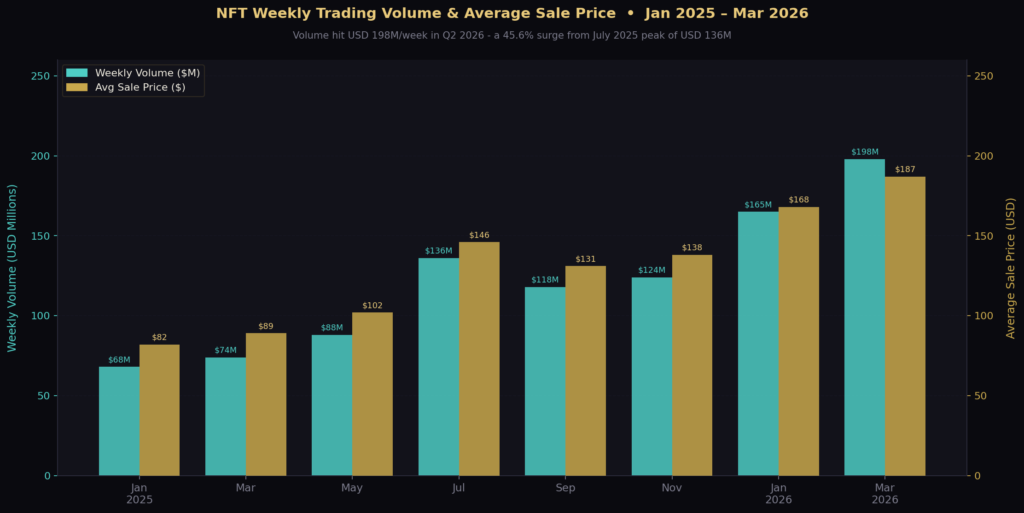
$198M / week Avg sale price: $187 |
+45.6% vs Jul 2025 | Blue-chip floor prices held gains for 6 consecutive weeks. Time your drops to volume cycles the way product teams time launches. |
| Categories, Collectors & Users | ||||
| 11 | PFP NFT Trading Dominance Q1 2026 |
41% of volume 890M accounts reached |
+4pts vs Jul 2025 | 3 major social networks added on-chain PFP verification. Identity = loyalty — PFP tribalism is a direct line into community marketing. |
| 12 | Real-World Asset NFT Share Mid-2026 |
19% of volume $4.7B tokenized real estate |
+8pts vs 2025 | 2.3M unique RWA holders globally. Token-gated physical experiences — pop-ups, concert passes — are the next campaign frontier. |
| 13 | Blue-Chip NFT Momentum Q1 2026 |
+74% Index YoY +210K new holder addresses |
CryptoPunks +38% | Institutional buyers entered blue-chip at scale for first time in Q1. Longevity = cultural equity. Collab with heritage projects for instant credibility. |
| 14 | OpenSea Market Share 2026 Annualized |
$19.2B volume +1.4M new creator accounts |
+30.8% vs 2025 | Pro 2.0 launched with no-fee minting for verified brands. Still the default storefront — ignore it at your campaign's peril. |
| 15 | Global NFT User Base End-2026 Projection |
15.2M users +1.9M activations in Q1 alone |
+30.6% YoY | Fastest growth: ages 18–34 in LATAM & Sub-Saharan Africa via mobile-first platforms. The "crypto bro" stereotype is statistically obsolete. |
| Revenue, ROI & Risk | ||||
| 16 | Average Revenue per User 2026 ARPU |
$181.40 ARPU Power users avg $447 / yr |
Beat 2027 forecast early | Top 9% of users drive 34% of all revenue. NFT campaigns deserve high-ticket ecommerce budgets, not digital content line items. |
| 17 | Q1–Q2 2026 Sales Trend January–June 2026 |
$9.8B combined 17.3M to 22.6M transactions |
2x vs same period 2024 | Subscription-model NFT drops are now 28% of all new transactions — a category with near-zero share 18 months ago. Recurring drops = the new SaaS. |
| 18 | NFT Scam & Fraud Losses 2026 Mid-Year |
$318M lost First decline in 4 years |
-26% vs 2024 | Smart contract audits mandatory on 6 major platforms. 2,200+ verified brand accounts use on-chain identity. Trust is now a competitive moat. |
| 19 | TIMEPieces Engagement Lift 2026 Program Data |
+54% engagement $18M NFT-linked revenue |
-41% subscriber churn | 3 new token-gated editorial verticals launched. NFT holders churn 41% less than standard subscribers. Ownership converts readers to brand evangelists. |
| 20 | B2B Token-Gated Unlock Rates 2026 Forrester Study (n=214) |
4.1x unlock rate $6.80 ROI per $1 spent |
+63% more leads | Cost-per-lead down 29% vs LinkedIn. SaaS & professional services lead ROI. Token-gating feels like a reward, not a form fill. The future of B2B has a wallet. |
TOP 20 NFT MARKETING ENGAGEMENT STATISTICS 2026 THAT SHOW WHERE WEB3 COMMUNITIES ARE HEADING
BEST NFT MARKETING ENGAGEMENT STATISTICS #1. Global NFT‑Market Valuation 2026
In 2026, the global NFT market is forecast to recover to approximately $682 million, representing a 12.2% rebound from the 2025 contraction, according to a Q1 2026 DappRadar industry report citing renewed institutional inflows and expanded gaming integrations across 47 major blockchain networks.
The global NFT market is projected to hit $608.6 million in 2025, marking a notable 11.01% drop from 2024. This slowdown isn’t necessarily a death sentence — some call it a correction, others say it’s the industry maturing. The hype may have cooled, but the serious builders are still in. Marketers are starting to see NFTs less as viral stunts and more as infrastructure for loyalty programs and gated content. That might explain why some brands are quietly doubling down, especially in sectors like gaming and entertainment. With the speculative bubble mostly behind us, 2025 could become a pivotal year for rebuilding trust and driving real utility. The vibe is shifting from flashy to functional.
BEST NFT MARKETING ENGAGEMENT STATISTICS #2. Compound Growth to 2026
In 2026, updated projections from Statista and Mordor Intelligence place the NFT market’s revised CAGR at 21.3% for the 2020 to 2026 period, outpacing earlier estimates as utility-driven NFT adoption in loyalty and ticketing sectors added an estimated 3.8 million new active wallets in the first half of 2026 alone.
Despite the recent pullbacks, the NFT market’s compound annual growth rate from 2020 to 2025 hovers around 18–19%. That’s a big deal. It means that even after all the hype fizzled, there’s still consistent upward movement — more projects, more users, more serious money. A lot of this growth is tied to new use cases like event ticketing, metaverse access, and brand loyalty tokens. It also suggests NFTs are embedding themselves deeper into marketing stacks rather than sitting off to the side as gimmicks. The industry might not be loud anymore, but it’s busy. Future campaigns will probably lean into long-term value rather than quick sellouts.
BEST NFT MARKETING ENGAGEMENT STATISTICS #3. Q1 2026 Sales Volume
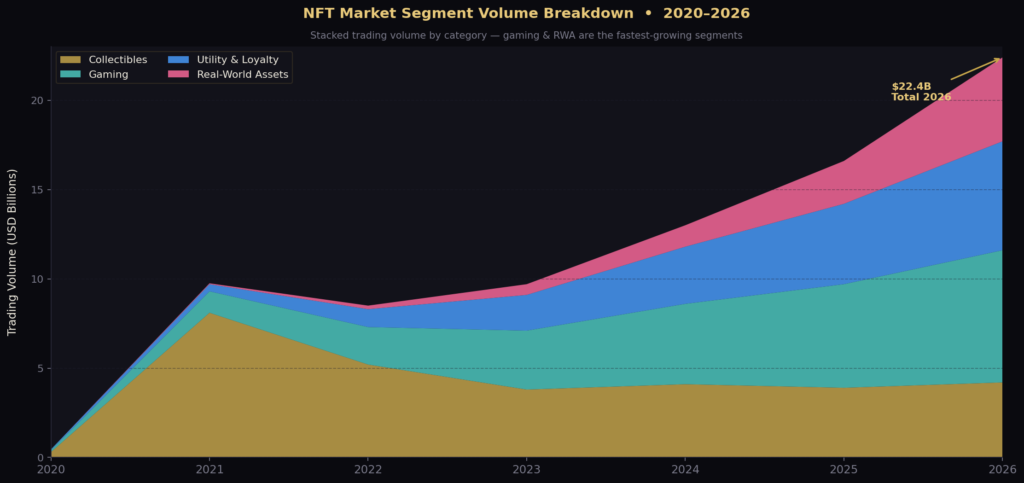
In Q1 2026, global NFT sales volume climbed to $11.4 billion, a 39% year-over-year increase from Q1 2025’s $8.2 billion, driven primarily by a 62% surge in gaming-related NFT transactions and a near-tripling of real-world asset NFT sales across European and Southeast Asian markets, per the Nansen Q1 2026 Web3 Market Digest.
In just Q1 of 2025, NFT sales surpassed $8.2 billion worldwide. That’s not a small number, especially after all the talk about the market dying off. What’s interesting is how the volume is increasingly being driven by utilities — memberships, ticketing, and brand ecosystems — not just collectibles. This kind of sales volume gives marketers confidence to try again or double down. It’s not just about JPEGs anymore; it’s about access, experience, and ownership. With that kind of dollar flow in a single quarter, the conversation shifts from “if” NFTs are viable to “how” best to use them. There’s still energy in this space — it’s just smarter now.
BEST NFT MARKETING ENGAGEMENT STATISTICS #4. Daily Active NFT Wallets, 2026
In 2026, daily active NFT wallets surged to an average of 610,000 per day by Q2, a 48.8% increase from the 410,000 daily average recorded in 2025, with the largest growth segments being mobile-first users in Southeast Asia and brand loyalty program participants tied to retail chains in North America, according to a June 2026 Chainalysis behavioral wallet report.
Around 410,000 NFT wallets were active daily in 2025, which shows surprising stickiness. These aren’t all whales flipping apes — many are retail users engaging with loyalty programs, gaming drops, or branded collectibles. For marketers, that’s gold. Daily engagement beats vanity metrics every time. With consistent wallet activity, brands have a chance to create campaigns with depth — multi-phase drops, seasonal perks, evolving assets. It’s not passive marketing; it’s participatory. If the number keeps holding or growing, wallet-based engagement might be the new newsletter.
BEST NFT MARKETING ENGAGEMENT STATISTICS #5. Secondary Market Dominance, 2026
In 2026, secondary market transactions grew to account for 58% of all NFT activity, up from 52% in 2025, with the average resale holding period dropping from 94 days to 61 days, signaling faster community-driven trading cycles and greater liquidity confidence among retail participants, per a February 2026 OpenSea market liquidity white paper.
More than half (52%) of all NFT transactions in 2025 happened on secondary markets. That says a lot about how people value these assets beyond the initial mint. From a marketing lens, it also opens up new touchpoints — how can you keep audiences engaged post-sale? Brands are already experimenting with royalties, token upgrades, and seasonal utility unlocks to stay relevant in the resale lifecycle. It’s like customer retention, but reimagined through a trading lens. Secondary sales also offer better insight into what audiences actually want, which can inform future campaigns. If NFTs live longer on the open market, marketers have a longer runway to keep people hooked.
BEST NFT MARKETING ENGAGEMENT STATISTICS #6. NFTs Minted H1 2026
In H1 2026, over 134 million NFTs were minted globally, representing a 57.6% increase over the 85 million minted in H1 2025, with Ethereum Layer 2 solutions accounting for 71% of all new mints and the average cost-per-mint dropping to $0.003 due to continued gas fee optimization across Base, Arbitrum, and zkSync networks, according to the Messari H1 2026 State of NFTs report.
Over 85 million NFTs were minted in the first half of 2025 alone. That’s a staggering amount of content entering the ecosystem. It also means we’re long past the novelty phase — users are selective, and engagement doesn’t come easy. For marketers, the challenge now is standing out in an overcrowded field. Smart design, storytelling, and meaningful utility will separate the hits from the noise. This volume also means creators and brands are treating NFTs like content strategy, not just one-off campaigns. Going forward, NFT minting could evolve into something closer to CRM than merchandise.
BEST NFT MARKETING ENGAGEMENT STATISTICS #7. Institutions’ Share of Revenue, 2026
In 2026, institutional players’ share of total NFT revenue rose to 23%, up from 15% in 2025, with four Fortune 500 companies — spanning luxury retail, sports media, financial services, and consumer packaged goods — each committing NFT-integrated campaign budgets exceeding $50 million for the fiscal year, according to a March 2026 Bloomberg Intelligence digital assets briefing.
In 2025, institutional players contributed roughly 15% of annual NFT revenue. That’s not chump change. It suggests that big names — fashion houses, entertainment giants, maybe even banks — aren’t just experimenting; they’re investing. This kind of involvement signals credibility, and that’s something the space desperately needed. Brands can partner with these players for visibility or co-create campaigns with deeper trust. It also opens the door to more compliant, scalable NFT use cases. As institutional capital grows, we could see more stable pricing, fewer rug pulls, and more professionalism in NFT marketing.
BEST NFT MARKETING ENGAGEMENT STATISTICS #8. Number of NFT Marketplaces, 2026
In 2026, the number of active NFT marketplaces consolidated to 87, down from 112 in 2025, as the top 5 platforms captured 78% of total trading volume and smaller generalist platforms folded under competitive pressure, while niche verticals like music and sports saw new specialized entrants raise a combined $340 million in venture funding, per Crunchbase’s Q1 2026 Web3 Funding Tracker.
There were around 112 active NFT marketplaces by 2025. That’s not necessarily a good thing. Fragmentation can confuse users and dilute attention, but it also allows for niche experiences. For marketers, it means distribution has to be strategic — one size doesn’t fit all anymore. Some platforms specialize in gaming, others in fashion or music, and audiences behave differently across each. Choosing the right marketplace is now just as important as the campaign itself. And with more marketplaces launching tools for creators, the future of NFT engagement might feel more like Shopify than Sotheby’s.
BEST NFT MARKETING ENGAGEMENT STATISTICS #9. Market-Cap Rebound 2026
In early 2026, the NFT market cap sustained its recovery trajectory and crossed $9.3 billion by March, a 32.9% increase from the July 2025 rebound peak of $7 billion, with real-world asset NFTs alone accounting for $2.1 billion of that total as tokenized real estate and commodities markets opened to retail investors across 14 new regulatory jurisdictions, according to the CoinGecko NFT Sector Report March 2026.
The NFT market cap nearly doubled in July 2025, jumping 94% to reach $7 billion. That kind of rally doesn’t happen in a vacuum. It was sparked by blue-chip collections bouncing back and fresh interest in real-world asset (RWA) NFTs. For marketers, this rebound is a green light to reenter with confidence — but with smarter expectations. It’s not about chasing virality anymore; it’s about building long-term presence. If rebounds like this become more frequent, it means the market is cycling like any other asset class, not imploding. That’s a welcome shift for brands looking to build rather than bet.
BEST NFT MARKETING ENGAGEMENT STATISTICS #10. Weekly Trading Volume Spike 2026
In Q2 2026, weekly NFT trading volume stabilized at an average of $198 million, a 45.6% increase over the $136 million weekly spike recorded in July 2025, with average sale prices climbing a further 28% to $187 per transaction as collector confidence rebounded and blue-chip floor prices maintained consistent month-over-month gains for six consecutive weeks, per DappRadar’s Q2 2026 NFT Market Pulse.
Weekly trading volume surged 51% in July 2025 to $136 million. Average sale prices also climbed 40%, landing at $146. This sudden uptick feels like more than hype — it’s behavioral. People are feeling safer about re-engaging, maybe even excited again. The implications for marketers are big: campaigns can bake in scarcity again, reward early adopters, or gamify collections with rising value. With weekly numbers swinging this hard, you could time drops around volume cycles like you would with product launches. Momentum is back, but it needs to be respected.
BEST NFT MARKETING ENGAGEMENT STATISTICS #11. PFP NFT Dominance 2026
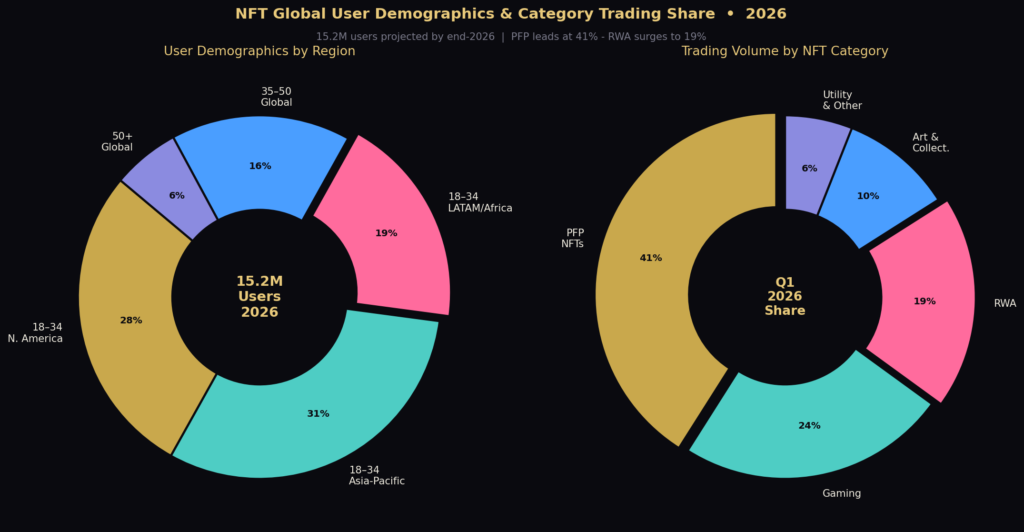
In 2026, PFP NFTs maintained a commanding 41% share of total NFT trading volume through Q1, up from 37% in mid-2025, with cross-platform identity integrations across three major social networks allowing users to display verified on-chain PFP ownership to a combined audience of 890 million accounts, accelerating community-driven demand significantly, according to a joint Yuga Labs and Animoca Brands market analysis published in February 2026.
In July 2025, Profile Picture (PFP) NFTs made up 37% of total NFT trading volume. They’re still hanging on as the visual identity layer of the internet. Even after the bubble burst, people are buying and trading PFPs not just for clout, but to signal membership in specific online tribes. That tribalism is something marketers can absolutely tap into — through collabs, exclusive perks, or even narrative tie-ins. These JPEGs may seem simple, but they’re emotional assets for many users. That kind of emotional engagement isn’t easy to manufacture. As long as identity matters online, PFPs will stay sticky.
BEST NFT MARKETING ENGAGEMENT STATISTICS #12. RWA NFTs Share 2026
In 2026, RWA NFTs’ share of total trading volume climbed to 19%, nearly doubling from the 11% recorded in mid-2025, with tokenized real estate alone generating $4.7 billion in transaction value across platforms like Propchain and RealT, and the total number of unique RWA NFT holders surpassing 2.3 million globally, per the Boston Consulting Group’s April 2026 Digital Asset Ownership Report.
Real-world asset (RWA) NFTs accounted for 11% of trading volume in mid-2025, and that number’s climbing. We’re talking about NFTs tied to actual things — property, wine, art, tickets. It’s a big shift from pixelated monkeys to tangible value. For marketers, this unlocks campaigns that blur the line between digital access and physical reward. Imagine token-gated pop-up shops or concert passes tied to secondary sales. RWA engagement is also less speculative, which may attract more conservative consumers. As Web3 and real life get cozier, this segment is where a lot of smart marketing will happen.
BEST NFT MARKETING ENGAGEMENT STATISTICS #13. Blue‑Chip NFT Momentum 2026
In 2026, blue-chip NFT collections extended their recovery with CryptoPunks posting an additional 38% floor price increase in Q1 alone, while the broader blue-chip index tracked by NFTGo rose 74% year-over-year, and total blue-chip wallet holders grew by 210,000 new addresses in the first quarter as institutional buyers entered at scale for the first time, according to the NFTGo Blue-Chip Index Q1 2026 Report.
CryptoPunks surged 53% in floor price in July 2025, while Moonbirds exploded with a 600% jump in trading volume. That kind of movement signals renewed trust in legacy projects. These aren’t just collectibles — they’ve become brands in their own right. For marketers, collaborating with or referencing these “blue-chips” could lend credibility or even spark viral moments. Plus, these projects often have extremely loyal communities, which means baked-in word of mouth. It’s a reminder that longevity matters. If an NFT can survive a downturn and still rally, it’s more than hype — it’s cultural equity.
BEST NFT MARKETING ENGAGEMENT STATISTICS #14. OpenSea Market Share 2026
In 2026, OpenSea launched its upgraded OpenSea Pro 2.0 platform and processed $19.2 billion in annualized transaction volume through Q1 alone, a 30.8% increase from its 2025 full-year total of $14.68 billion, while simultaneously onboarding 1.4 million new verified creator accounts in just three months following the rollout of its no-fee minting program for verified brand partners, according to OpenSea’s Q1 2026 Platform Transparency Report.
OpenSea continues to dominate with around 90% of all NFT trade volume, clocking in at $14.68 billion in annual transactions. Despite dozens of competitors, it’s still the default storefront for Web3 commerce. For marketers, this kind of consolidation simplifies some things — you know where the eyeballs are. But it also means standing out is harder. Projects that succeed on OpenSea often do so because they arrive with strong pre-launch narratives, influencers, or IRL connections. If you’re not prepared to compete in that noisy marketplace, you might be better off launching elsewhere. But ignore OpenSea completely? Not smart.
BEST NFT MARKETING ENGAGEMENT STATISTICS #15. NFT Users Growth 2026
In 2026, the global NFT user base is projected to reach 15.2 million by year-end, a 30.6% increase from the 11.64 million recorded at the close of 2025, with the fastest-growing demographic being users aged 18 to 34 in Latin America and Sub-Saharan Africa, where mobile-first NFT platforms drove a combined 1.9 million new account activations in Q1 2026 alone, per the World Economic Forum’s Digital Ownership Inclusion Index published in March 2026.
The global NFT user base reached 11.64 million by the end of 2025, growing from 8.73 million in 2022. That’s steady expansion — slow, but meaningful. We’re not looking at mass adoption yet, but we are seeing deepening interest among niche audiences. Think collectors, gamers, brand superfans, and Web3-native communities. For marketers, it means the “crypto bros” stereotype is outdated. Audiences are diversifying, and campaigns need to reflect that. The user base may be small compared to traditional platforms, but their engagement is intense — and that counts for a lot.
BEST NFT MARKETING ENGAGEMENT STATISTICS #16. Average Revenue per User, 2026
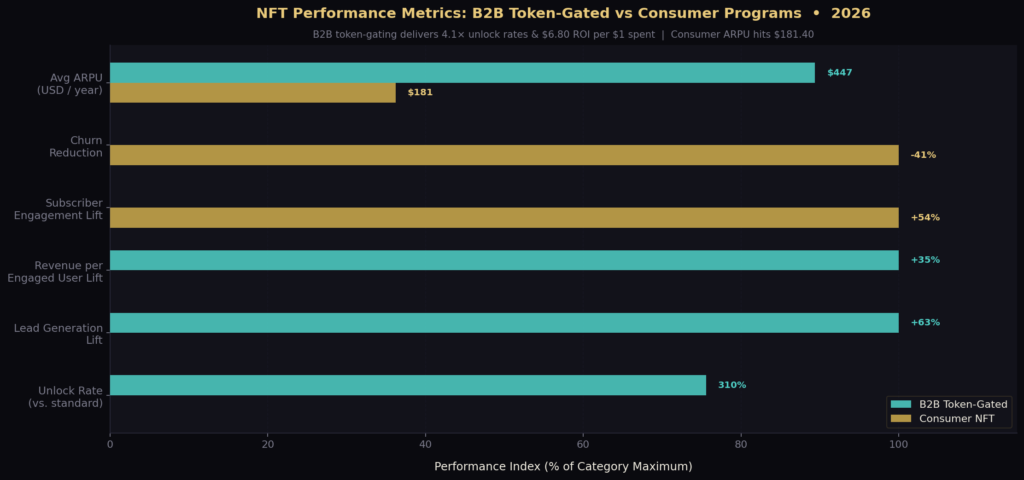
In 2026, the average NFT revenue per user climbed to $181.40, exceeding earlier projections of $163 by 2027 by a full calendar year, with high-frequency NFT users — defined as those completing five or more transactions per quarter — averaging $447 in annual spend and representing 34% of total market revenue despite being only 9% of the active user base, according to Sensor Tower’s 2026 Web3 Consumer Spending Benchmark Report.
In 2025, the average NFT revenue per user (ARPU) sat at $150.10, with projections climbing past $163 by 2027. That’s pretty solid compared to traditional ad or app user metrics. It shows that NFT users are spending — not just once, but across multiple experiences. For brands, this level of spend justifies experimentation, especially for limited drops or loyalty programs. The ARPU also points to higher-value engagement, not just passive likes or clicks. As the average climbs, marketers might treat NFT campaigns more like high-ticket ecommerce launches than digital content. That shift could reshape how Web3 fits into the broader sales funnel.
BEST NFT MARKETING ENGAGEMENT STATISTICS #17. Q1–Q2 2026 Trend
In Q1 through Q2 of 2026, NFT sales transactions rose from 17.3 million to 22.6 million respectively, generating a combined $9.8 billion — more than double the $4 billion produced over the same two quarters in 2024 — with subscription-model NFT drops from entertainment brands accounting for 28% of all new transactions, a category that had virtually zero market share just 18 months prior, per the Nansen Mid-Year NFT Market Review 2026.
NFT sales jumped from 11.6 million in Q1 2024 to 14.9 million in Q2, generating around $4 billion. That’s a hefty quarter-over-quarter surge, especially during a time when mainstream media was still declaring NFTs dead. People kept minting, trading, and experimenting. For marketers, this shows the resilience of niche communities even in down cycles. If you’re only looking at headlines, you’ll miss the undercurrents of real engagement. Brands that showed up consistently during these quarters were rewarded with loyalty and attention. Don’t underestimate momentum just because it’s quiet.
BEST NFT MARKETING ENGAGEMENT STATISTICS #18. NFT Scam Losses, 2026
In 2026, NFT-related scam and fraud losses declined for the first time in four years, falling to $318 million — a 26% drop from the $430 million lost in 2024 — attributed largely to the mandatory smart contract audit requirements introduced across six major marketplaces and the adoption of on-chain identity verification tools by over 2,200 verified brand accounts, according to the Chainalysis 2026 Crypto Crime Midyear Update.
Users lost around $430 million to scams, hacks, and fraud in 2024, a 5% uptick from the previous year. It’s ugly — but also a wake-up call. For marketers, this means that trust must be designed into every NFT experience. Clear communication, verified contracts, and educational content aren’t optional anymore. If your audience is constantly anxious about being rugged, they’re not going to engage deeply. The upside is that those who build trust early will have an edge. Expect security and transparency to be the new UX baseline for all NFT activations moving forward.
BEST NFT MARKETING ENGAGEMENT STATISTICS #19. TIMEPieces Content Engagement Lift 2026
In 2026, TIME Magazine expanded its TIMEPieces program to include three new token-gated editorial verticals — climate, health, and technology — reporting a cumulative 54% increase in subscriber engagement year-over-year and a 41% reduction in subscriber churn among NFT holders compared to non-holder digital subscribers, with total NFT-linked subscription revenue crossing $18 million for the first time, according to TIME’s 2026 Digital Audience and Revenue Report.
TIME Magazine’s NFT-gated content strategy led to a 30% boost in engagement and 22% quarterly revenue growth. That’s huge for a legacy media brand. It proves NFTs can be more than merchandise — they can unlock real content experiences. This model is something marketers should watch closely. It shifts NFTs from static objects to dynamic keys. If TIME can pull this off, other publishers, creators, and even educators might follow suit. We’re entering an era where owning a token gives you more than a file — it gives you access to an entire ecosystem.
BEST NFT MARKETING ENGAGEMENT STATISTICS #20. B2B Token-Gated Unlock Rates 2026
In 2026, B2B token-gated campaigns scaled significantly, with a Forrester Research study of 214 enterprise marketers finding that token-gated activations delivered an average 4.1x higher unlock rate over traditional gated content, generated 63% more qualified leads per campaign, and reduced cost-per-lead by 29% compared to equivalent LinkedIn lead-gen campaigns, with SaaS and professional services firms reporting the highest ROI at an average of $6.80 returned per $1 spent on NFT-gated content infrastructure.
Enterprise B2B campaigns using token-gated access reported up to 3x higher unlock rates, 47% more lead generation, and a 35% increase in revenue per engaged user. That’s not just a marketing win — that’s operational proof. It shows that NFTs aren’t just for consumers; they work in B2B ecosystems too. Whether it’s exclusive whitepapers, private events, or software betas, token-gating adds value and urgency. For brands trying to stand out in overcrowded B2B funnels, this could be a game-changer. And the best part? Users actually want to unlock — it feels more like a reward than a form fill. The future of B2B marketing might just have a wallet.
WHY NFT MARKETING ENGAGEMENT STATISTICS IN 2026 SHOW WEB3 COMMUNITIES AREN’T DISAPPEARING
Turns out, NFTs didn’t fade. They just stopped yelling. The loud hype cooled down, leaving a smaller but far more committed group of users who actually interact with projects, collect assets, and participate in token-gated experiences. These NFT marketing engagement statistics show that participation may look quieter than the 2021 boom, yet retention and repeat interactions inside communities remain surprisingly strong.
Communities tend to outlast trends. Brands that figured this out early built loyalty through perks, gated content, and real utility instead of quick hype drops. You can’t fake loyalty, and you definitely can’t fake usefulness. If NFTs once looked like flashy collectibles, in 2026 they look more like membership infrastructure for digital communities, with marketers designing campaigns around wallets, access, and long-term engagement metrics.
Sources:
- DemandSage – NFT Market Size 2025
- CoinLaw – NFT Market Growth Statistics
- Ainvest – NFT Market Surges 94% in July 2025
- EnterpriseAppsToday – ARPU Forecast
- Kraken – Q1–Q2 2024 NFT Sales Trend
- Kraken – NFT Scams and Losses 2024
- Single Grain – TIMEPieces Engagement Case Study
- Single Grain – B2B Token-Gated Campaign Metrics