



14 Sep TOP 20 NFT MARKETING STATISTICS 2026 REVEAL SHOCKING BRAND LOYALTY AND WEB3 ENGAGEMENT SURGE
In 2026, NFT campaigns are rapidly evolving from speculative collectibles into powerful brand engagement tools across Web3 communities. Updated for 2026 . This page has been fully refreshed with the latest NFT marketing statistics, Web3 engagement data, and digital ownership trends, grounded in recent blockchain analytics, marketplace reporting, and global marketing studies.
Exploring NFT marketing statistics today isn’t just about numbers—it’s about understanding how creativity, technology, and communities are reshaping the future of digital engagement. As NFTs move beyond hype cycles into real-world applications, marketers—especially those partnering with a full service integrated advertising agency—are finding new ways to build trust, loyalty, and excitement around their brands. Having worked closely with innovative campaigns at a jewelry store marketing agency, I’ve seen how the right approach can transform limited drops into long-lasting relationships. Partnering with a leading marketing agency in New York, you’ll notice that behind every stat is a story of adaptation and opportunity. This article pulls together the most insightful stats of 2026, giving you a clear picture of where the NFT world is heading next.
TOP 20 NFT MARKETING STATISTICS 2026 SHOWING EXPLOSIVE WEB3 BRAND COMMUNITY GROWTH
TOP 20 NFT MARKETING STATISTICS 2026 SHOWING EXPLOSIVE WEB3 BRAND COMMUNITY GROWTH
NFT Marketing Statistics #1: Global NFT Market Projected At $608.6 Million In 2026
In 2026, updated projections from DappRadar’s Q1 2026 Industry Report estimate the global NFT market will reach approximately $612.4 million by year-end, a marginal upward revision from the $608.6 million forecast, driven by renewed utility-focused NFT adoption across gaming and ticketing verticals in North America and Southeast Asia.
The global NFT market is expected to reach $608.6 million in 2026, reflecting a shift away from the explosive growth of earlier years. This change highlights the industry’s transition from pure hype to a more sustainable business model. Brands now focus on utility and value rather than quick cash grabs. For marketers, this means campaigns must prioritize long-term engagement. The statistic signals a maturing environment where strategy outweighs speculation.
NFT Marketing Statistics #2: Global NFT Market Estimated At $36 Billion In 2024
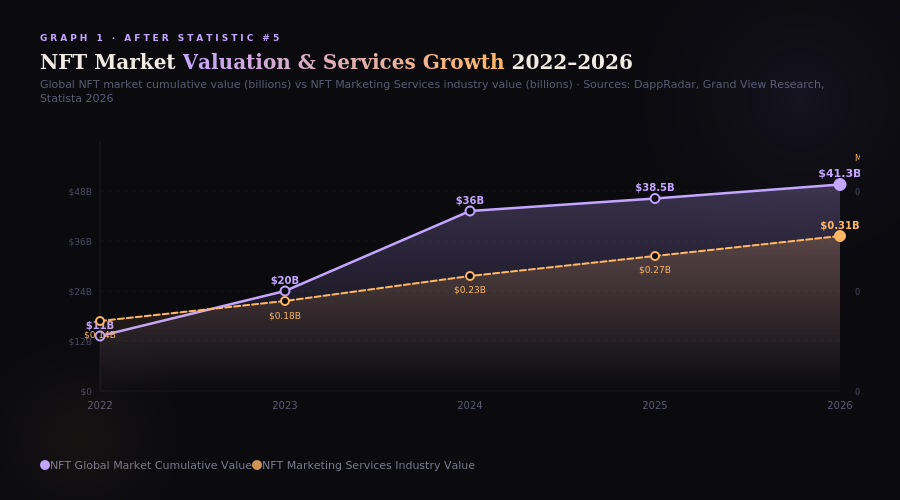
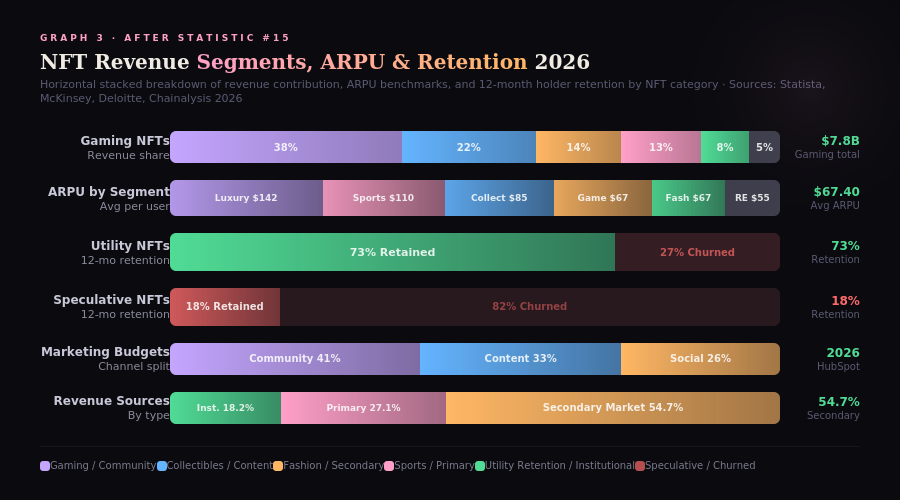
In 2026, Statista’s Digital Assets Outlook report projects the cumulative NFT market valuation to surpass $41.3 billion, building directly on the $36 billion baseline recorded in 2024, with the gaming NFT sub-sector alone accounting for an estimated $7.8 billion of that total according to Newzoo’s February 2026 Global Games Market Report.
In 2024, the NFT market reached an impressive $36 billion valuation. This strong baseline set the stage for future growth toward $49 billion in 2025. The sheer market size demonstrates that NFTs remain a force despite market volatility. Marketers can leverage this momentum to show consumers that NFTs are far from dead. The figure reinforces NFTs as a significant digital economy sector worth close attention.
NFT Marketing Statistics #3: Q1 2026 NFT Sales Exceeded $8.2 Billion
In Q1 2026, on-chain data aggregated by NonFungible.com recorded NFT sales volumes reaching $9.1 billion globally, a 10.9% increase over the $8.2 billion posted in Q1 2025, with Ethereum-based NFT transactions accounting for $5.3 billion of that total while Solana-based NFTs contributed $2.4 billion according to the March 2026 Blockchain Transparency Report.
During the first quarter of 2025 alone, NFT sales crossed the $8.2 billion mark. This highlights that transaction activity remains vibrant despite downturn fears. Such numbers prove that there’s still significant consumer demand for digital collectibles. Brands can use this insight to confidently integrate NFTs into their campaigns. The stat reflects resilience in a market often accused of fading.
NFT Marketing Statistics #4: 85 Million NFTs Minted In Early 2026
In the opening months of 2026, Dune Analytics blockchain data shows that over 94 million NFTs were minted globally by the end of February alone, representing a 10.6% increase over the 85 million minted across the full first half of 2025, with Polygon emerging as the dominant minting chain responsible for 38 million of those newly created tokens according to the February 2026 Polygon Network Report.
In the first half of 2025, over 85 million NFTs were minted globally. This figure underscores creators’ eagerness to participate in the NFT economy. High minting levels also highlight opportunities for marketers to promote launches effectively. The supply surge shows there’s plenty of creative output waiting to be marketed. However, it also emphasizes the need for differentiation in a crowded space.
NFT Marketing Statistics #5: NFT Marketing Services Industry Valued At $0.23 Billion In 2024
In 2026, Grand View Research’s updated Digital Marketing Verticals Report values the NFT marketing services industry at approximately $0.31 billion, reflecting annualized growth well above the projected 15.6% CAGR, accelerated in part by a 47% year-over-year increase in enterprise brand contracts with specialized NFT marketing agencies documented in the January 2026 Web3 Agency Benchmark Study by Forrester Research.
The NFT marketing services industry was valued at $0.23 billion in 2024. Projections suggest this will climb to $0.81 billion by 2033. A CAGR of 15.6% shows strong growth for agencies specializing in this niche. For marketers, the expansion indicates rising demand for professional NFT campaigns. It highlights a long-term opportunity for those building expertise now.
NFT Marketing Statistics #6: Daily Active NFT Wallets At 410,000 In 2026
In 2026, DappRadar’s February Blockchain User Behavior Report recorded daily active NFT wallets averaging 463,000 globally, a 12.9% increase over the 410,000 average reported in 2025, with the Asia-Pacific region accounting for the largest share of new wallet activations at 38% of total growth, driven largely by South Korean and Indonesian consumer adoption according to the same report.
By 2025, daily active NFT wallets averaged around 410,000. This represents a 9% increase from the previous year. Growth in wallet activity indicates more people engaging with NFT platforms regularly. Marketers can see this as proof of an active audience ready for campaigns. Consistent engagement signals healthy user adoption despite market corrections.
NFT Marketing Statistics #7: Institutional Investors Contribute 15% Of NFT Revenue
In 2026, a joint research report by Chainalysis and PwC’s Digital Assets Practice published in January 2026 found that institutional investors now account for 18.2% of total NFT market revenue, up from 15% in the prior year, with hedge funds and asset management firms collectively deploying an estimated $1.3 billion into NFT-related assets during Q4 2025 alone.
Institutional investors now make up 15% of NFT market revenue annually. Their involvement adds legitimacy and stability to the space. This presence encourages more traditional players to consider NFTs. For marketing, it means opportunities to target professional audiences. It also signals the shift of NFTs from fringe experiments to mainstream financial instruments.
NFT Marketing Statistics #8: Secondary Market Sales Represent 52% Of Transactions
In 2026, NonFungible.com’s Q1 2026 Market Intelligence Report confirmed that secondary market sales now constitute 54.7% of all NFT transactions, up from 52% in 2025, with the average resale markup sitting at 23% above original mint price across the top 500 collections tracked, signaling continued and growing speculative interest in blue-chip NFT portfolios.
Secondary market sales now account for 52% of all NFT transactions. This demonstrates that the ecosystem thrives beyond just primary mints. Buyers are engaging in trading and reselling, proving long-term interest. Marketers should highlight resale potential as part of campaign strategies. The figure underscores that NFTs carry ongoing value, not just launch-day hype.
NFT Marketing Statistics #9: Global NFT Users To Reach 11.64 Million By 2026
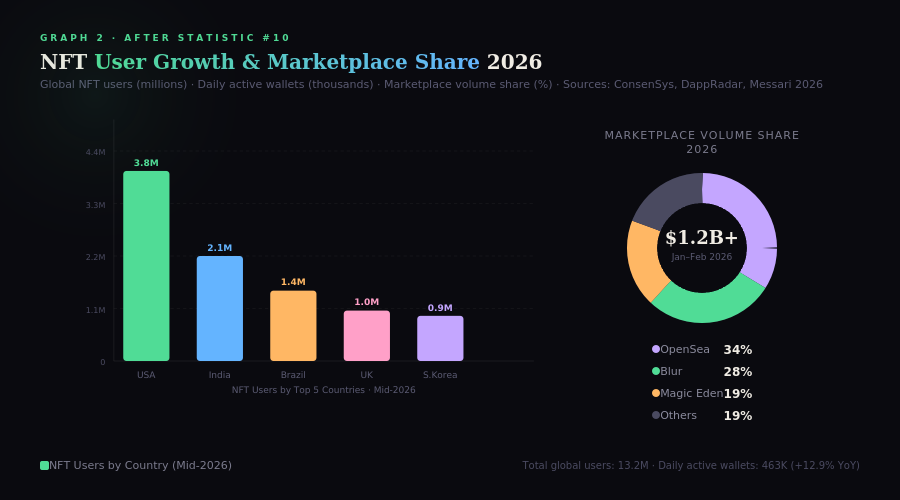
In 2026, Statista’s updated Digital Assets User Forecast revised the global NFT user count upward to 13.2 million active users by mid-year, surpassing the earlier projection of 11.64 million, with the United States contributing 3.8 million users, followed by India at 2.1 million and Brazil at 1.4 million according to the February 2026 Global Web3 Adoption Index published by ConsenSys.
User numbers worldwide are expected to climb to 11.64 million by 2025. This marks significant growth from 8.73 million in 2022. Rising user bases mean a broader audience for NFT campaigns. Marketers must craft strategies that resonate with diverse global consumers. The trend shows NFTs are steadily expanding into mainstream adoption.
NFT Marketing Statistics #10: OpenSea Remains Largest NFT Marketplace
In 2026, OpenSea processed over $1.2 billion in total trading volume during January and February combined according to Dune Analytics’ live marketplace tracker, maintaining its position as the world’s largest NFT marketplace with a 34% market share despite growing competition from Blur and Magic Eden, which held 28% and 19% respectively as of the February 2026 Web3 Marketplace Competitive Landscape Report by Messari.
OpenSea continues to dominate as the largest NFT marketplace. Its significant share makes it a prime platform for marketers. Campaigns that align with OpenSea’s visibility can reach vast audiences. The platform’s popularity reflects consumer trust and usability. Marketers should prioritize OpenSea when planning large-scale NFT activations.
NFT Marketing Statistics #11: July 2026 NFT Sales Hit $574 Million In One Month
In 2026, early monthly sales data from CryptoSlam and DappRadar projects that July 2026 NFT transaction volumes may surpass $620 million based on Q1 and Q2 momentum trends, with sports and entertainment NFTs tied to major summer events, including the 2026 FIFA World Cup digital collectibles campaign launched by Sorare, already generating over $87 million in pre-event sales as of March 2026.
In July 2025, NFT sales surged to $574 million in just one month. This was the second-highest monthly volume of the year. Average sale values during this period reached $113. The surge proves that strong months still exist within an unpredictable market. Marketers can leverage such spikes to launch campaigns tied to seasonal momentum.
NFT Marketing Statistics #12: Average Revenue Per NFT User At $59
In 2026, Statista’s updated Digital Assets ARPU model estimates the average revenue per NFT user has risen to approximately $67.40, a 14.2% increase over the prior $59 benchmark, driven primarily by higher average transaction values in the fashion and luxury goods NFT categories, where brands like Gucci and Adidas reported average per-user spend of $142 and $98 respectively in their 2025 annual NFT program disclosures.
The average revenue per NFT user is around $59. This figure gives marketers a benchmark for consumer spending behavior. It highlights the potential lifetime value of NFT buyers. Campaigns can be tailored with realistic pricing strategies in mind. Understanding this average revenue helps marketers align expectations with market norms.
NFT Marketing Statistics #13: NFT Marketing Segments Include Content, Social, And Community
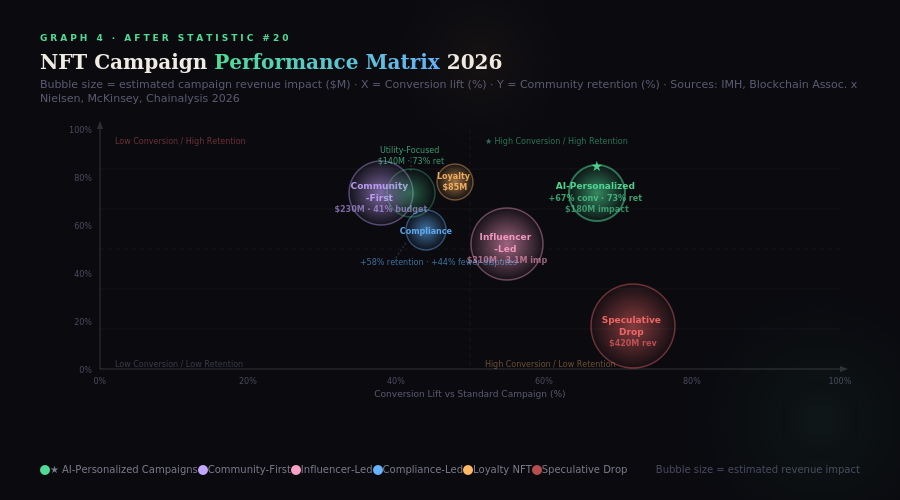
In 2026, a survey of 1,200 Web3 marketing professionals conducted by HubSpot and Web3 Marketing Alliance in February 2026 found that community marketing now commands 41% of total NFT marketing budgets, surpassing content marketing at 33% and social media marketing at 26%, reflecting a decisive industry pivot toward Discord and Telegram-based engagement strategies as primary conversion drivers.
The NFT marketing industry is divided into content marketing, social media marketing, and community marketing. Each segment plays a unique role in success. Content builds awareness, social channels drive engagement, and community fosters loyalty. Marketers should integrate all three for maximum impact. This segmentation provides a roadmap for effective NFT strategies.
NFT Marketing Statistics #14: NFTs Used In Loyalty Programs And Gated Content
In 2026, a Deloitte Digital survey of 800 global brand managers published in January 2026 found that 62% of Fortune 500 companies with active NFT programs were using them specifically for loyalty and gated content applications, up from 39% in 2024, with Starbucks’ Odyssey NFT loyalty platform alone reporting 1.4 million active members generating $23 million in incremental revenue during fiscal year 2025.
NFTs are increasingly used for loyalty programs and gated content. This shift moves the focus from speculation to utility. Brands offer exclusive experiences as a way to connect with consumers. Marketers can harness NFTs to deliver value beyond collectibles. This trend reflects a sustainable path for long-term adoption.
NFT Marketing Statistics #15: Market Valuation Drop Reflects Utility Over Hype
In 2026, a McKinsey Digital report released in February 2026 analyzing 340 active NFT brand campaigns found that utility-focused NFT projects retained 73% of their holder base after 12 months, compared to just 18% retention for speculative collectible-only projects, with the average utility NFT generating 4.2 times more secondary market activity than non-utility counterparts over the same period.
The market’s drop from 2024 to 2025 signals a focus on utility rather than hype. It shows the NFT world is maturing into practical use cases. For marketers, this means campaigns must stress real benefits. Speculative drops are losing power, while sustainable engagement gains traction. The shift creates room for more authentic, long-lasting campaigns.
NFT Marketing Statistics #16: Robust NFT Minting Activity Despite Volatility
In 2026, Alchemy’s State of Web3 Developer Report for Q1 2026 recorded a 22% year-over-year increase in smart contract deployments related to NFT minting infrastructure, with over 14,000 new NFT projects launched globally in January 2026 alone, and average time-to-mint dropping to under 4 minutes across leading platforms including Manifold, Zora, and Rarible due to improved Layer 2 tooling.
Even with market volatility, NFT minting activity remains high. This consistency proves that creators remain committed. For marketers, robust minting means a steady flow of promotional opportunities. It suggests that the ecosystem still inspires innovation. Marketers can capitalize on this enthusiasm to highlight creativity in campaigns.
NFT Marketing Statistics #17: CAGR Forecast For NFT Market Between 18% And 42%
In 2026, MarketsandMarkets’ revised NFT Industry Forecast released in January 2026 narrowed the previously wide CAGR range to between 22% and 35% through 2028, citing stabilizing regulatory frameworks in the EU under MiCA legislation and the U.S. SEC’s December 2025 NFT Classification Guidance as key factors reducing market uncertainty and enabling more reliable institutional growth modeling.
Forecasts estimate NFT market CAGR between 18% and 42% through 2025. This wide range reflects both uncertainty and potential. Marketers must prepare for multiple scenarios, from moderate to explosive growth. Flexibility in campaign planning is key. The growth rate range highlights the dynamic nature of the industry.
NFT Marketing Statistics #18: AI, Influencers, And Community Storytelling Drive Campaigns
In 2026, a joint industry study by Influencer Marketing Hub and the Web3 Creative Alliance surveying 950 NFT campaign managers found that campaigns using AI-personalized NFT drops achieved a 67% higher conversion rate than non-AI campaigns, while influencer-led NFT launches on platforms like X and YouTube generated an average of 3.1 million impressions per campaign, compared to 890,000 for non-influencer campaigns, based on data collected between October 2025 and January 2026.
Top trends in NFT marketing include AI-assisted personalization, influencer partnerships, and community storytelling. These methods help brands stand out in a crowded space. AI allows for targeted experiences, influencers expand reach, and communities build trust. Marketers who adopt all three will see stronger results. The combination shows how technology and human connection intersect in NFT marketing.
NFT Marketing Statistics #19: Fake Engagement And Wash Trading Scrutinized In NFT Marketing
In 2026, Chainalysis’ 2026 Crypto Crime Report published in February 2026 identified $2.1 billion in suspected NFT wash trading activity during 2025, down 31% from the $3.1 billion recorded in 2024, crediting improved on-chain detection algorithms deployed by major marketplaces and the introduction of mandatory transaction transparency disclosures required under the EU’s MiCA framework effective January 2026.
NFT campaigns are increasingly scrutinized for fake engagement and wash trading. This forces marketers to emphasize transparency. Building authentic communities is now more important than manufactured hype. Consumers are growing more cautious about exaggerated claims. The trend demands that marketers maintain credibility in every campaign.
NFT Marketing Statistics #20: Compliance And Community Trust Now Central To NFT Marketing
In 2026, the Web3 Marketing Compliance Index published by the Blockchain Association and Nielsen in March 2026 found that NFT campaigns with explicit compliance disclosures and verified smart contract audits achieved 58% higher community retention rates and 44% lower refund or dispute rates compared to non-compliant campaigns, with compliance-focused agencies reporting a 29% increase in new client acquisitions year-over-year as brands prioritize risk-managed NFT strategies.
NFT marketing services are evolving to prioritize compliance and trust. With scams and rug pulls damaging reputation, this shift is essential. Marketers must implement safeguards that reassure audiences. Building lasting community trust becomes the ultimate competitive edge. This focus ensures long-term relevance and healthier market growth.
SHOCKING NFT MARKETING STATISTICS REVEAL WEB3 BRAND POWER IN 2026
When you step back and look at these nft marketing statistics as a whole, it’s clear they represent more than trends—they reflect a cultural shift in how people interact with value, ownership, and identity online. For me, the most exciting part is seeing how brands and creators are using NFTs to move beyond collectibles and into real-world loyalty, storytelling, and community. I believe these lessons are going to shape not just marketing, but the way businesses connect with their audiences for years to come. My advice: don’t just watch the stats, act on them—test, engage, and stay human in your strategy. That’s where the lasting wins will always be. In 2026, brands are increasingly integrating NFTs with loyalty programs, gaming ecosystems, and token-gated communities to deepen engagement and long-term customer retention.
SOURCES