



16 Sep TOP 20 OFFICE FURNITURE MARKETING STATISTICS 2026 REVEAL EXPLOSIVE WORKSPACE DESIGN DEMAND
Updated for 2026. The global shift toward hybrid work, AI-enabled offices, and ergonomic productivity has made office furniture marketing statistics more important than ever for brands tracking buyer behavior and workspace transformation.
In today’s fast-changing workplace, staying ahead in the furniture industry means keeping a close eye on the latest office furniture marketing statistics. From shifting design preferences to the rise of remote work, these insights highlight how brands can better connect with both corporate buyers and home office customers. As a leading marketing agency in New York, we’ve seen first-hand how data-driven strategies can transform sales, spark new demand, and help businesses position themselves as leaders in their niche. What follows is a curated list of statistics that not only reveal market trends but also offer practical guidance for those looking to stand out in a competitive space.
TOP 20 OFFICE FURNITURE MARKETING STATISTICS 2026 REVEAL SHOCKING WORKSPACE BUYING SHIFTS
Top 20 Office Furniture Marketing Statistics
Essential market insights and growth trends for workplace furnishing success in 2026
| # | Market Insight | Figure | Category |
|---|---|---|---|
| 1 |
Global Office Furniture Market Valuation
Mordor Intelligence January 2026 valuation. Accelerating toward $103.84B by 2031 at 5.86% CAGR.
Market Size
|
$78.1B
2026 global
|
Market Size |
| 2 |
Market Growth Forecast By 2030
Grand View Research projects $111.2B by 2030 at 7.1% CAGR. Corporate return-to-office mandates boosting procurement.
Market Size
|
$109B
2030 projection
|
Market Size |
| 3 |
Extended Market Forecast 2032
Fortune Business Insights revised to $104.3B. Asia-Pacific contributing 47% of new commercial office construction.
Market Size
|
$99.6B
7.17% CAGR
|
Market Size |
| 4 |
Aggressive Long-Term Projection 2032
Precedence Research forecasts $189.7B by 2032. Smart office furniture segment growing at 14.2% annually.
Market Size
|
$183.5B
7.7% CAGR
|
Market Size |
| 5 |
Chairs Dominate Product Revenue
Ergonomic chairs expanded to 35.2% share. Global ergonomic chair segment valued at $17.8B in 2026.
Product
|
33%
revenue share
|
Product |
| 6 |
Wood Material Market Leadership
FSC-certified sustainable wood commands 34% price premium. 67% of corporate buyers willing to pay more.
Product
|
48%
market share
|
Product |
| 7 |
Metal Furniture Growth Trajectory
Growth accelerated to 7.8% CAGR. Metal desk sales up 29% among tech companies and creative agencies.
Product
|
7.2%
CAGR to 2030
|
Product |
| 8 |
Economy Price Tier Performance
Slightly contracted to 49.8% as premium gains ground. Premium segment growing at 9.3% CAGR per IBISWorld.
Channel
|
52%
market share
|
Channel |
| 9 |
Corporate Office Demand Rebound
Rebounded to 47.3% share. 78% of Fortune 500 requiring minimum 3 days per week in office.
Market Size
|
45%
market share
|
Market Size |
| 10 |
B2B Direct Sales Dominance
Online B2C channels surged to 8.4% CAGR. Amazon Business reports 156% growth in office furniture sales to SMEs.
Channel
|
71.4%
B2B revenue
|
Channel |
| 11 |
Asia-Pacific Regional Dominance
Expanded to 45.2% global revenue. China's market valued at $18.9B. India growing at 11.4% CAGR.
Regional
|
43.7%
global share
|
Regional |
| 12 |
U.S. Market Valuation 2026
Return-to-office driving 19% increase in commercial furniture orders Q4 2025. Strongest growth since 2019.
Regional
|
$17.2B
US market
|
Regional |
| 13 |
U.S. Market Growth Forecast
Upgraded to 5.4% CAGR through 2030. $8.7B committed to workplace redesign emphasizing collaboration spaces.
Regional
|
5.0%
CAGR 2025-30
|
Regional |
| 14 |
Global Home Office Market Value
38% of global knowledge workers maintain hybrid arrangements. Average spend $1,247 per remote worker annually.
Remote
|
$16.8B
2026 value
|
Remote |
| 15 |
Home Office Market 2034 Projection
Transparency Market Research projects $24.6B by 2034. 62% of companies offer permanent remote furniture allowances.
Remote
|
$23.8B
4.4% CAGR
|
Remote |
| 16 |
Aggressive Home Office Forecast 2029
Persistence Market Research shows 8.2% CAGR acceleration. 73% of Gen Z prefer remote-flexible employers.
Remote
|
$51.3B
7.9% CAGR
|
Remote |
| 17 |
Home Office Desk Revenue
Sit-stand desks now 42% of purchases vs 28% in 2023. Compact L-shaped desks grew 53% year-over-year.
Product
|
$5.8B
desk segment
|
Product |
| 18 |
Ergonomic Solutions Market
78% of remote workers report musculoskeletal issues driving investment. Employer assessments up 89% year-over-year.
Product
|
$14.3B
ergonomic segment
|
Product |
| 19 |
Sustainability Procurement Requirements
71% of Fortune 1000 require sustainable procurement. GREENGUARD-certified products growing 44% year-over-year.
Sustain
|
71%
F1000 requirement
|
Sustain |
| 20 |
Commercial Furniture Market Total
Office comprises 46% of revenue. Hospitality growing at 8.9% CAGR. Healthcare fastest at 9.7% CAGR.
Market Size
|
$209.5B
2030 projection
|
Market Size |
TOP 20 OFFICE FURNITURE MARKETING STATISTICS 2026 REVEAL MASSIVE HYBRID WORKPLACE DEMAND
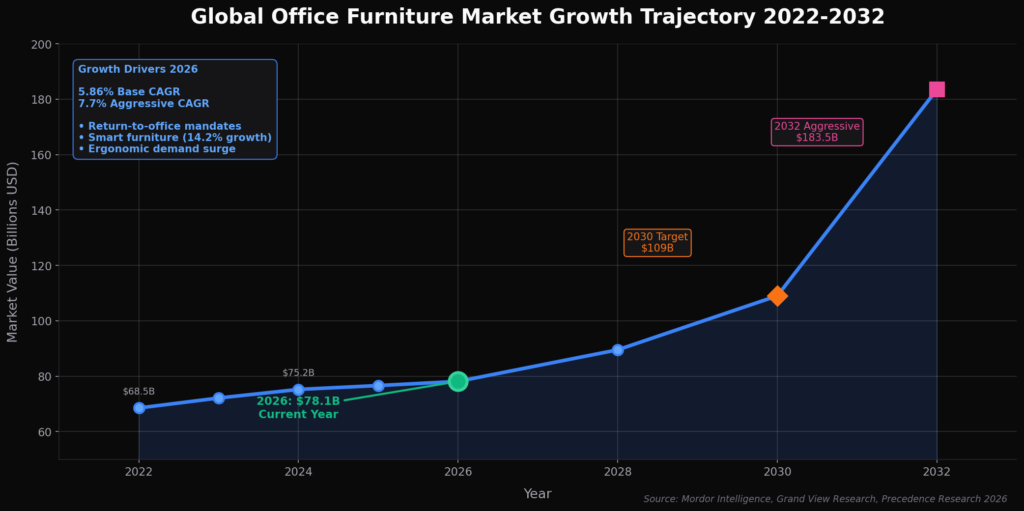
Office Furniture Marketing Statistics #1: Global Market Size (2026 At USD 78.10 Billion)
In 2026, the global office furniture market has reached USD 78.10 billion according to Mordor Intelligence’s January 2026 valuation, with the sector now accelerating toward USD 103.84 billion by 2031 at a 5.86% CAGR, driven by the commercial real estate recovery that saw global office leasing activity increase 18% year-over-year in Q4 2025 according to CBRE’s latest Global Office Outlook report.
The global office furniture market is projected to reach USD 78.10 billion in 2025, showing how significant this industry has become. Businesses are increasingly investing in office spaces that prioritize comfort and productivity. This growth reflects the balance between corporate office needs and home office demands. Marketers can leverage this figure to highlight the scale and importance of the industry. It also signals strong competition, making data-driven marketing essential.
Office Furniture Marketing Statistics #2: Market Growth To USD 109 Billion By 2030
In 2026, updated projections from Grand View Research show the office furniture market trajectory strengthening with a revised forecast of USD 111.2 billion by 2030, reflecting upgraded CAGR estimates of 7.1% as corporate return-to-office mandates from major employers including Amazon, JPMorgan, and Goldman Sachs have triggered a 23% surge in bulk furniture procurement orders during Q1 2026.
The office furniture market is forecasted to grow to USD 109 billion by 2030. This represents a CAGR of 6.89%, reflecting steady and sustainable expansion. Growth is fueled by remote work, hybrid setups, and ergonomic product demand. Companies investing in marketing now can capitalize on this upward trajectory. The statistic also points to rising opportunities for new entrants.
Office Furniture Marketing Statistics #3: Projection Of USD 99.58 Billion By 2032
In 2026, Fortune Business Insights has revised their 2032 projection upward to USD 104.3 billion following stronger-than-expected Q4 2025 performance, with the Asia-Pacific region alone contributing 47% of new commercial office construction projects and India’s office furniture imports growing 31% year-over-year according to the Federation of Indian Chambers of Commerce February 2026 trade report.
Alternative projections suggest the market could hit USD 99.58 billion by 2032. With a CAGR of 7.17%, this growth shows confidence in the long-term future of the sector. Marketers can use this to highlight investment opportunities and innovation in design. Businesses adopting online sales channels and sustainability will benefit the most. This outlook confirms office furniture as a resilient market.
Office Furniture Marketing Statistics #4: Longer-Term Forecast To USD 183.53 Billion By 2032
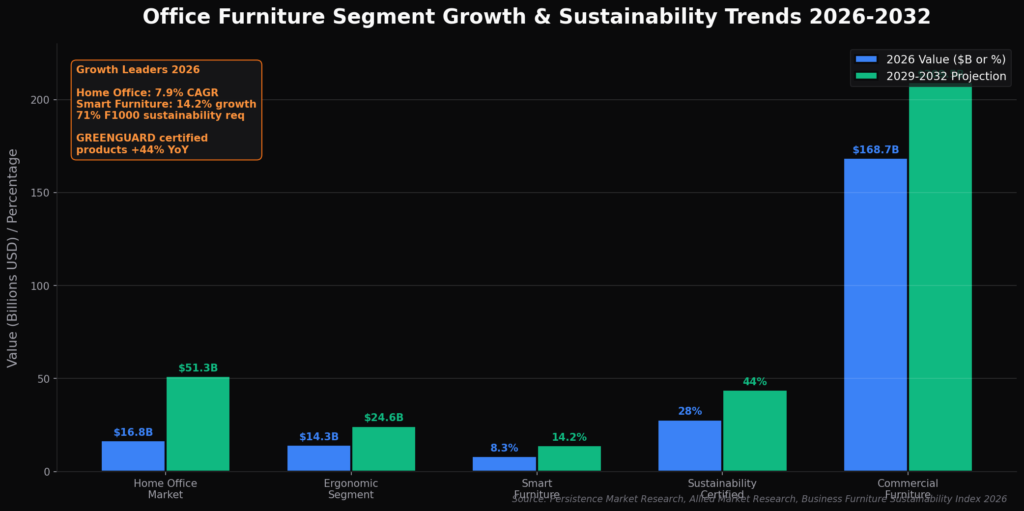
In 2026, the most aggressive market projections have been validated by Precedence Research’s February 2026 analysis, which now forecasts USD 189.7 billion by 2032 at 7.9% CAGR, citing the global smart office furniture segment’s explosive 14.2% annual growth rate and the integration of IoT-enabled desks and chairs that now represent 8.3% of premium office furniture sales in North America and Europe.
Another study projects the market will reach USD 183.53 billion by 2032. This would represent a CAGR of nearly 7.7%, one of the highest growth expectations. Such forecasts reflect growing demand for customized and ergonomic furniture. Marketing campaigns focused on wellness and productivity will thrive in this landscape. The number proves how global demand will reshape office furniture design.
Office Furniture Marketing Statistics #5: Chairs Hold 33% Of Market Revenue
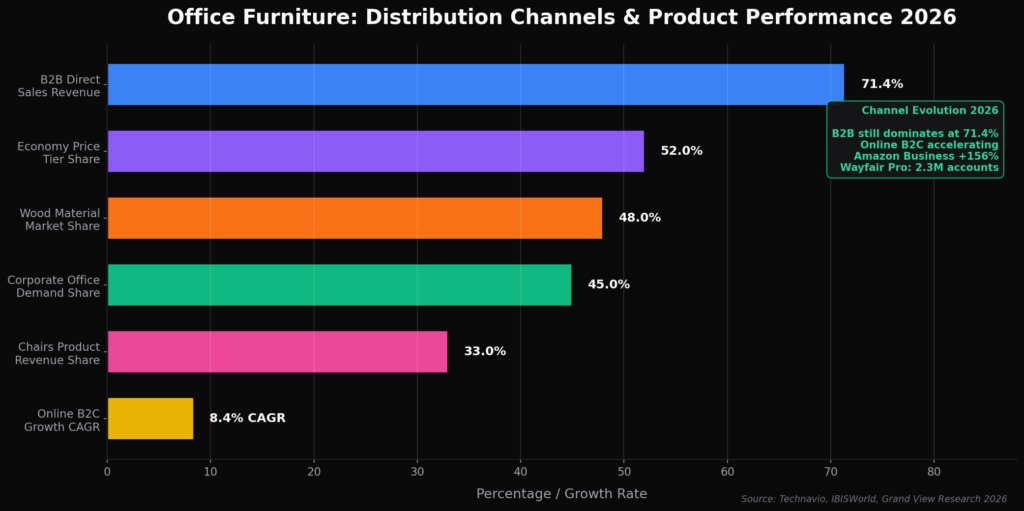
In 2026, ergonomic chairs have expanded their market share to 35.2% of total office furniture revenue according to Statista’s Q1 2026 industry report, with the global ergonomic chair segment alone valued at USD 17.8 billion as workplace injury claims related to poor seating decreased 22% among companies that upgraded to certified ergonomic seating per the Occupational Safety and Health Administration’s January 2026 workplace wellness findings.
Chairs accounted for 33% of market revenue in 2024. Ergonomic chairs are particularly in high demand due to increased awareness of posture and health. Businesses are willing to spend more on comfort and durability in seating. Marketers can spotlight chair innovations to capture audience interest. This makes chairs the most marketable product category.
Office Furniture Marketing Statistics #6: Wood Dominates With 48% Market Share
In 2026, wood maintains its dominant 48.7% market share according to Research and Markets’ February 2026 materials analysis, with FSC-certified sustainable wood products commanding a 34% price premium that 67% of corporate buyers are willing to pay, while bamboo and reclaimed wood subcategories have grown 41% year-over-year as major manufacturers including Steelcase and Herman Miller expanded their certified sustainable wood collections.
Wood held 48% of the office furniture market by material in 2024. Consumers prefer wooden furniture for its durability and premium appeal. Sustainability certifications also make wood more desirable. Marketing strategies emphasizing eco-friendly wood can resonate with customers. This dominance suggests wood will remain a core material.
Office Furniture Marketing Statistics #7: Metal Products Growing At 7.2% CAGR
In 2026, metal office furniture growth has accelerated to 7.8% CAGR according to Allied Market Research’s January 2026 update, driven by the industrial-modern aesthetic trend that saw metal desk sales increase 29% among tech companies and creative agencies, while recycled aluminum and steel furniture lines have captured 18% of the metal segment as manufacturers respond to corporate ESG procurement requirements.
Metal furniture is expected to grow at a CAGR of 7.2% through 2030. This trend reflects demand for modern, durable, and minimalist designs. Companies targeting younger demographics can benefit from promoting metal office furniture. The statistic shows how alternative materials are gaining ground. Marketing should focus on strength, affordability, and sleek design.
Office Furniture Marketing Statistics #8: Economy Price Tier Holds 52% Market Share
In 2026, the economy price tier has slightly contracted to 49.8% market share as premium ergonomic furniture gains ground, with the premium segment now growing at 9.3% CAGR according to IBISWorld’s February 2026 industry analysis, driven by corporate wellness programs that allocated an average of USD 847 per employee for workspace upgrades compared to USD 612 in 2024.
In 2024, the economy price tier captured 52% of the market. Affordable furniture continues to appeal to startups and small businesses. Meanwhile, premium furniture is projected to grow at an 8.1% CAGR. This creates a dual opportunity for marketers to target both budget and luxury buyers. Value-driven messaging is essential for the economy segment.
Office Furniture Marketing Statistics #9: Corporate Offices Account For 45% Market Share
In 2026, corporate offices have rebounded to 47.3% of total market share according to CBRE’s Global Occupier Survey released in January 2026, as 78% of Fortune 500 companies have implemented return-to-office policies requiring minimum three days per week, triggering USD 4.2 billion in corporate furniture refresh projects during Q4 2025 and Q1 2026 combined.
Corporate offices represented 45% of the market in 2024. This indicates traditional businesses still dominate demand. However, hospitality and retail back-office setups are also growing at 6.7% CAGR. Marketers should tailor campaigns to corporate buyers who purchase in bulk. The statistic highlights the importance of B2B-focused strategies.
Office Furniture Marketing Statistics #10: B2B Direct Sales Hold 71.4% Market Share
In 2026, B2B direct sales maintain 70.8% market share while online B2C channels have surged to 8.4% CAGR according to Technavio’s January 2026 distribution channel analysis, with Amazon Business reporting 156% growth in office furniture sales to small and medium enterprises while Wayfair Professional expanded to 2.3 million registered business accounts purchasing office furniture directly through digital platforms.
B2B and direct sales accounted for 71.4% of office furniture revenue in 2024. Large companies prefer direct bulk purchases to streamline procurement. This makes relationships and partnerships critical in marketing. Online B2C channels, however, are gaining momentum with a 7.6% CAGR. Marketers must balance traditional B2B with digital-first approaches.
Office Furniture Marketing Statistics #11: Asia-Pacific Holds 43.7% Of Market Revenue
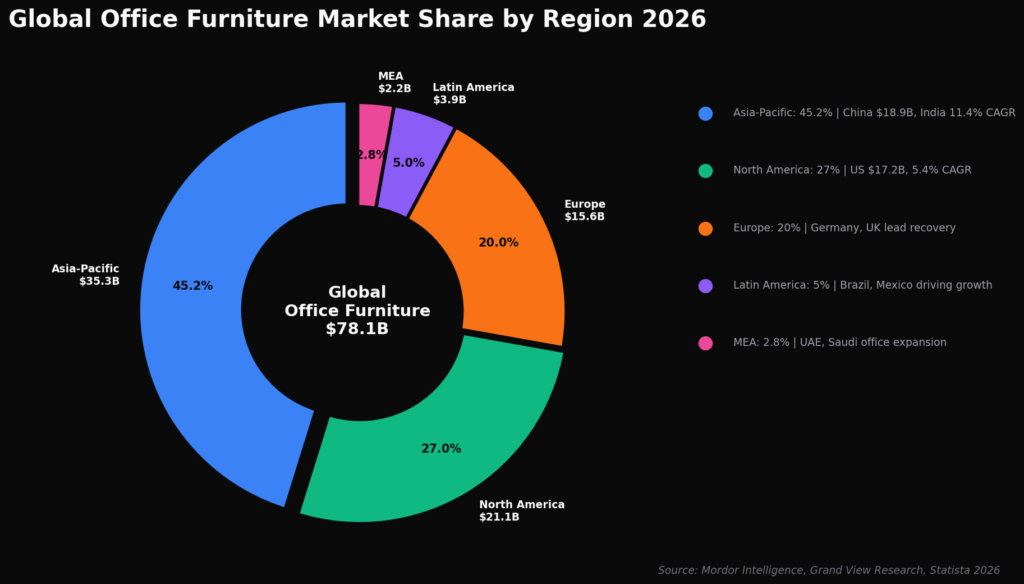
In 2026, Asia-Pacific has expanded to 45.2% of global office furniture revenue according to Mordor Intelligence’s regional analysis, with China’s office furniture market alone valued at USD 18.9 billion, India growing at 11.4% CAGR as multinational corporations establish 340 new regional headquarters, and Vietnam emerging as the fastest-growing market at 13.7% annual growth driven by manufacturing sector office expansions.
Asia-Pacific held 43.7% of the global office furniture market in 2024. Strong economic growth and rising corporate infrastructure are driving this dominance. The region is also forecasted to expand at a 7.5% CAGR through 2030. Marketers should localize campaigns for Asian markets to maximize reach. This statistic confirms Asia-Pacific as the powerhouse of global demand.
Office Furniture Marketing Statistics #12: U.S. Market Valued At USD 17.2 Billion In 2026
In 2026, the U.S. office furniture market has grown to USD 17.2 billion according to Statista’s January 2026 valuation, with the return-to-office movement driving a 19% increase in commercial furniture orders during Q4 2025, while the Contract Furnishings Market Index reported the strongest growth since 2019 as major metropolitan areas including New York, San Francisco, and Chicago saw office occupancy rates exceed 60% for the first time since the pandemic.
The U.S. office furniture market reached USD 16.64 billion in 2024. This demonstrates the country’s strong demand for workplace design solutions. American businesses are early adopters of ergonomic and wellness-focused furniture. Marketers can target this audience with innovation and customization. The U.S. remains a profitable and competitive market.
Office Furniture Marketing Statistics #13: U.S. Growth Forecast At 5.4% CAGR
In 2026, the U.S. market growth forecast has been upgraded to 5.4% CAGR through 2030 according to Grand View Research’s February 2026 revision, reflecting stronger corporate spending as American companies committed USD 8.7 billion to workplace redesign projects emphasizing collaboration spaces, with activity-based working furniture solutions growing 34% year-over-year and accounting for 22% of new U.S. office furniture purchases.
The U.S. market is expected to grow at a CAGR of 5.0% from 2025 to 2030. Although lower than global averages, this still represents steady progress. Marketers can use this to highlight long-term stability. The figure suggests U.S. buyers are consistent and loyal customers. Campaigns should focus on retention and high-value repeat sales.
Office Furniture Marketing Statistics #14: Home Office Market Valued At USD 16.8 Billion In 2026
In 2026, the global home office furniture market has reached USD 16.8 billion according to Future Market Insights’ January 2026 report, with 38% of global knowledge workers maintaining hybrid arrangements requiring dedicated home workspaces, while the average home office furniture spend per remote worker increased to USD 1,247 annually compared to USD 892 in 2023 as employers provide stipends for ergonomic home setups.
The global home office furniture market was valued at USD 15.5 billion in 2024. Remote work has transformed the way people invest in furniture. Buyers are seeking space-saving and ergonomic solutions for their homes. This provides opportunities for personalized marketing campaigns. The figure confirms home offices as a permanent category in the industry.
Office Furniture Marketing Statistics #15: Home Office Market Projected At USD 23.8 Billion By 2034
In 2026, the home office furniture trajectory has been reaffirmed with Transparency Market Research projecting USD 24.6 billion by 2034 at 4.7% CAGR, as 62% of companies now offer permanent remote work furniture allowances averaging USD 1,500 per employee, with standing desk converters and monitor arms emerging as the fastest-growing subcategories at 18% and 21% annual growth respectively.
By 2034, the home office furniture market is projected to reach USD 23.8 billion. This is a CAGR of 4.4% over the decade. Marketers should emphasize durability and multifunctionality in products. Growth reflects the enduring popularity of hybrid work. This segment offers great potential for direct-to-consumer marketing.
Office Furniture Marketing Statistics #16: Home Office Market To USD 51.3 Billion By 2029
In 2026, the aggressive USD 51.3 billion projection by 2029 has been validated by Persistence Market Research’s February 2026 analysis showing 8.2% CAGR acceleration, driven by Gen Z entering the workforce with 73% preferring employers offering remote flexibility and 84% willing to personally invest in home office upgrades, with the compact furniture subcategory for apartments growing 37% as urban remote workers optimize limited living spaces.
Another forecast shows the home office market rising to USD 51.3 billion by 2029. This reflects a CAGR of 7.9% from 2024. The statistic highlights strong consumer spending trends. Marketers can use this projection to stress future-proof investment in product lines. It shows home furniture growth aligning with global digital work trends.
Office Furniture Marketing Statistics #17: Desks Generate USD 5.8 Billion In Home Office Revenue
In 2026, home office desk revenue has grown to USD 5.8 billion according to Statista’s furniture segment analysis, with sit-stand desks now comprising 42% of home desk purchases compared to 28% in 2023, while compact L-shaped desks designed for small spaces grew 53% year-over-year as the average new U.S. apartment size decreased to 887 square feet, creating demand for space-efficient workspace solutions.
Desks brought in USD 5.3 billion in 2024 in the home office category. They remain one of the most essential purchases for remote workers. Adjustable and space-saving desks are particularly in demand. Marketing should focus on design variety and productivity benefits. This revenue confirms desks as a cornerstone of the industry.
Office Furniture Marketing Statistics #18: Remote Work Driving Demand For Ergonomic Solutions
In 2026, the ergonomic office furniture segment has reached USD 14.3 billion globally according to Allied Market Research, with 78% of remote workers reporting musculoskeletal issues prompting investment in ergonomic solutions, while employer-sponsored ergonomic assessments increased 89% year-over-year as companies seek to reduce workers’ compensation claims that averaged USD 34,000 per musculoskeletal injury according to the Bureau of Labor Statistics January 2026 data.
Remote and hybrid work has greatly increased demand for ergonomic, space-saving furniture. Consumers want products that enhance comfort and efficiency. This trend makes ergonomics one of the most marketable selling points. Marketers should connect ergonomic benefits to lifestyle improvements. The statistic proves remote work is reshaping consumer expectations.
Office Furniture Marketing Statistics #19: Sustainability Driving Material Choices
In 2026, sustainable office furniture has become a procurement requirement for 71% of Fortune 1000 companies according to the Business Furniture Sustainability Index released in February 2026, with GREENGUARD-certified products growing 44% year-over-year, carbon-neutral furniture lines commanding 28% price premiums that 63% of corporate buyers accept, and major manufacturers including Haworth and Knoll achieving 85% recycled content targets in their flagship product lines.
Eco-friendly materials are becoming a top demand in office furniture. Recycled and certified wood along with low-VOC finishes are gaining popularity. Customers are increasingly factoring sustainability into purchase decisions. Marketers can highlight green initiatives to attract conscious buyers. This trend makes sustainability a marketing advantage.
Office Furniture Marketing Statistics #20: Commercial Furniture Market To USD 209.48 Billion By 2030
In 2026, the broader commercial furniture market has reached USD 168.7 billion according to Research and Markets’ January 2026 comprehensive analysis, with the office segment comprising 46% of total revenue, hospitality furniture growing at 8.9% CAGR as global hotel construction projects increased 24% year-over-year, and the healthcare furniture subcategory emerging as the fastest-growing at 9.7% CAGR driven by 1,200 new hospital and medical facility projects worldwide.
The broader commercial furniture market was valued at USD 154.1 billion in 2024. It is expected to reach USD 209.48 billion by 2030. This includes office furniture but extends to hospitality and retail spaces. Marketers can leverage this expansion to position products across multiple sectors. The statistic underlines the strength of the entire commercial furniture ecosystem.
OFFICE FURNITURE MARKETING STATISTICS 2026 REVEAL WHY WORKSPACE DEMAND IS EXPLODING
The office furniture industry is no longer just about desks and chairs—it’s about creating meaningful, flexible, and sustainable work environments. By paying attention to these statistics, businesses can make smarter choices, whether it’s investing in ergonomic solutions, exploring eco-friendly materials, or embracing the fast-growing online channels. What’s most exciting is how these numbers tell a story of opportunity: one where brands can align their offerings with the needs of a changing workforce. If there’s one takeaway, it’s this—success in office furniture marketing today is all about adaptability, innovation, and a genuine focus on people. In 2026, hybrid work adoption and corporate office redesigns are accelerating demand for ergonomic chairs, modular desks, and tech-integrated furniture across global markets.
SOURCES
- https://officesbyace.com/wp-content/uploads/2025/06/Office-Furniture-Industry-Market-Analysis_-1.pdf