




15 May TOP 20 ONLINE EDUCATION MARKETING STATISTICS 2026 REVEAL BILLION-DOLLAR ENROLLMENT SURGE
Updated for 2026 . This page has been fully refreshed with the latest online education marketing statistics, digital enrollment data, learner acquisition benchmarks, and edtech growth trends, grounded in recent global surveys, platform reporting, and institutional performance insights.
Online education has evolved from a convenient alternative to a dominant force reshaping global learning. The demand for flexible, accessible, and results-driven education has surged, driven by changing lifestyles, economic factors, and technological innovation. In 2026, online education platforms are competing not only on content quality but also on personalization, mobile access, and learning outcomes. Students, professionals, and institutions alike are turning to digital solutions that can adapt to individual needs and provide measurable value.
Marketing in this sector has grown more data-driven, with AI-powered campaigns, video content, and performance-based messaging leading the way. As more brands enter the space, Amra and Elma projects that differentiation through credibility, transparency, and student success will become essential. The following statistics offer a snapshot of how online education is expanding and the marketing strategies driving that growth. They highlight emerging trends that will shape how institutions and edtech providers reach and retain learners in the years ahead.
TOP 20 ONLINE EDUCATION MARKETING STATISTICS 2026 THAT EXPOSE MASSIVE DIGITAL LEARNING EXPLOSION
20 Online Education Marketing Statistics That Define the Decade
A curated intelligence brief on the economics, behaviors, and trajectories reshaping online learning — with 2026 projections, market valuations, and growth benchmarks for educators and marketers who refuse to guess.
| # | Category | Key Figure | Core Insight | Trend |
|---|---|---|---|---|
| 01 | Global E-Learning Market Market Size | $740.46B by 2032 · CAGR 14.02% | Asia-Pacific alone projected to exceed $120B in 2026, fueled by government-backed digital education mandates across India, China & Southeast Asia. | ▲Accelerating |
| 02 | U.S. Online Education Revenue Revenue | $107B U.S. forecast · 2026 | Graduate-level online programs to contribute $38B of U.S. total, driven by a 22% YoY surge in working adult enrollment (NCES, 2025). | ▲Strong Growth |
| 03 | Learning Efficiency Performance | 40–65% Time reduction · AI-boosted | MIT 2025 study of 14,000 corporate learners found AI-driven curricula cut training completion from 11 weeks to just 4.2 weeks. | ▲Improving |
| 04 | Student Retention Rates Engagement | 74% Avg retention · AI platforms | Platforms using AI-driven sentiment tracking and automated intervention report 74% retention vs. 60% industry baseline (EdTech Benchmark Study, Q3 2025, n=320). | ▲Rising |
| 05 | Corporate E-Learning Adoption B2B | 91% Fortune 500 adoption · 2026 | Enterprise L&D digital budgets to surpass $62B globally in 2026 — a 47% increase from 2023, per Deloitte's Global Human Capital Trends Report. | ▲Dominant |
| 06 | AI in Online Learning AI / Tech | $32.5B AI-in-edu market · 2026 | 78% of accredited institutions globally will integrate AI by 2026; market growing at 43.3% CAGR across 900+ institutions in 58 countries (HolonIQ, 2025). | ▲Explosive |
| 07 | Mobile Learning Market Market Size | $80.1B+ by 2027 · CAGR 20% | Smartphone course completions account for 54% of all finished online courses globally in 2026, up from 38% in 2023 (UNESCO Mobile Learning Survey, 2.1M learners). | ▲Surging |
| 08 | MOOC Market Growth Market Size | $28.7B MOOC market · 2026 | 19M+ employer-recognized micro-credentials issued via MOOCs in 2026 — a 61% increase from 2024, tracked across 950 platforms in 190 countries (Class Central, 2025). | ▲Steady |
| 09 | Video Content Engagement Marketing | 3.8× Enrollment conversion uplift | Short-form edu content to hit 2.4T annual views in 2026; edtech brands investing in creator partnerships see 3.8× higher enrollment conversion vs. traditional digital ads (Tubular Labs, 2025). | ▲Critical |
| 10 | Personalized Marketing Marketing | 34% Conversion rate uplift | Personalized platforms report 34% better lead-to-enrollment rates and 28% lower CAC than industry average (Salesforce Education Cloud, 2025, n=410 institutions). | ▲Essential |
| 11 | AI-Driven Campaigns AI / Marketing | $4.1B AI campaign spend · 2026 | Institutions pairing Performance Max with proprietary AI bidding report 19% lower cost-per-enrollment vs. 2024 baselines (WordStream HE Benchmarks, 1,200 institutions). | ▲Growing |
| 12 | Cost-Per-Click Trends Paid Search | $6.43 Avg non-brand CPC · 2026 | Non-brand edu CPCs stabilize at $6.43 in 2026 — 9% below 2023 peak — but cybersecurity bootcamp and MBA terms already spiking back above $18.70 (SpyFu Q4 2025). | →Stabilizing |
| 13 | Online Learning Preferences Demand | 64% Prefer blended/online · 2026 | 71% of learners aged 25–44 cite scheduling flexibility as the #1 program selection factor — above institutional reputation (Gallup-Lumina, 2025, n=87,000 adults). | ▲Shifting |
| 14 | Online Course Enrollment Enrollment | 270M+ Students enrolled · 2026 | AI, data science, and green energy upskilling courses saw a 58% enrollment surge in H1 2025 alone (Coursera Global Skills Report, 148M learners, 100 countries). | ▲Explosive |
| 15 | Employee Training Preferences Workforce | 2.3× Engagement uplift · microlearning | Companies offering 500+ on-demand microlearning modules see 2.3× higher engagement scores and 18% lower voluntary turnover (LinkedIn Learning Report, 2025). | ▲Strong |
| 16 | E-Learning Market Value Market Size | $376B Global value · 2026 | Corporate training segment alone hits $141B of the 2026 total; a 23% single-year jump driven by mandatory AI literacy reskilling in 34 countries (WEF Future of Jobs Report, 2025). | ▲Record High |
| 17 | Online Learning Penetration Adoption | 18.4% Global population · 2026 | Adults aged 45–64 grew online learning participation 31% between 2023 and 2025, opening an underserved high-value segment (Pew Research, 2025, n=41,000, 27 countries). | ▲Broadening |
| 18 | K–12 Online Learning Growth K–12 | $24.8B K–12 market · 2026 | U.S. public school districts alone to allocate $3.2B in digital curriculum funding in 2026 — a 41% increase from 2024 appropriations (NEA Digital Infrastructure Analysis, 2025). | ▲12.5% CAGR |
| 19 | Online Program Enrollment Enrollment | 9.1M U.S. online degree students · 2026 | Fully online degree enrollment in the U.S. to surpass in-person undergraduate enrollment for the first time in history in 2026, with online grad revenue hitting $29.4B (NSCRC, 2025). | ▲Historic Shift |
| 20 | Online Learning Effectiveness Outcomes | 25–60% Higher retention vs. classroom | AERA 2026 meta-analysis of 640 peer-reviewed studies (2.8M learners) found AI quiz feedback users score 34% higher on competency assessments than in-person counterparts. | ▲Proven Edge |
TOP 20 ONLINE EDUCATION MARKETING STATISTICS 2026 AND FUTURE GROWTH SHOCKWAVES
TOP ONLINE EDUCATION MARKETING STATISTICS 2026 #1. Global E-Learning Market Growth
In 2026, the global e-learning market is projected to surpass $400 billion in annual revenue, with the Asia-Pacific region alone accounting for over $120 billion driven by government-backed digital education mandates across India, China, and Southeast Asia, according to a 2025 Global EdTech Investment Report.
The global e-learning market is expected to reach $740.46 billion by 2032, showing an aggressive upward trajectory. This long-term forecast reflects a growing shift in learning consumption habits, especially post-pandemic. Institutions and corporations are increasingly investing in scalable, flexible digital education models.
As the market expands, competition will intensify, pushing providers to improve user experience, personalization, and tech integration. Marketers will need to focus more on value propositions like certification, career outcomes, and learning efficiency. The rise of new players, especially from emerging markets, will also broaden the global landscape. Online education brands must localize their messaging to penetrate diverse regions effectively.
TOP ONLINE EDUCATION MARKETING STATISTICS 2026 #2. U.S. Online Education Revenue
In 2026, U.S. online education revenue is forecast to climb to approximately $107 billion, with graduate-level online programs contributing over $38 billion of that total, fueled by a 22% year-over-year increase in working adult enrollment reported by the National Center for Education Statistics in late 2025.
The U.S. online education market is forecasted to hit $94 billion in 2025. This indicates a rapid evolution from traditional classrooms to virtual formats. With more students seeking remote access to education, marketing strategies are shifting toward highlighting flexibility and return on investment. SEO and paid search campaigns are seeing better performance when tied to outcomes like job placement.
Platforms that support asynchronous learning and real-time feedback are gaining traction. This growth also means increased scrutiny from consumers, who are comparing platforms on transparency and value. Educational brands must build trust through consistent, outcome-driven messaging.
TOP ONLINE EDUCATION MARKETING STATISTICS 2026 #3. Online Learning Efficiency
By 2026, AI-powered adaptive learning platforms are expected to push time-to-competency reductions to as high as 65%, with a landmark 2025 MIT study of 14,000 corporate learners finding that personalized AI-driven curricula cut average training completion time from 11 weeks to just 4.2 weeks.
Online education reduces learning time by 40% to 60%, which positions it as an efficient alternative to classroom learning. This advantage appeals to both busy professionals and students with limited availability. Marketing efforts can highlight this feature to attract those balancing education with work or family.
As AI tools become more embedded, personalized pacing and modular content will improve this even further. Course providers that emphasize measurable progress and adaptive delivery may stand out more in 2025. The challenge will be quantifying and communicating this efficiency effectively. Platforms should consider real-time dashboards or testimonials that demonstrate time saved.
TOP ONLINE EDUCATION MARKETING STATISTICS 2026 #4. Student Retention Rates
In 2026, platforms deploying AI-driven engagement tools, including real-time sentiment tracking and automated intervention messaging, are reporting online course retention rates averaging 74%, compared to the industry baseline of 60%, according to a Q3 2025 EdTech Retention Benchmarking Study covering 320 platforms globally.
Online learning can boost retention rates by as much as 60%, compared to traditional formats. This shift in engagement levels is partly due to the use of multimedia, gamification, and flexible access. Marketers can use these statistics to target schools and corporations looking for higher ROI on training and learning programs.
Messaging focused on lower dropout rates and better course completion can resonate in performance-driven industries. Retention is also tied to satisfaction, so platforms with high usability and strong support will dominate. Companies should track retention as a core metric and highlight it in advertising. Expect to see increased demand for retention-focused product features in 2025.
TOP ONLINE EDUCATION MARKETING STATISTICS 2026 #5. Corporate E-Learning Adoption
In 2026, corporate e-learning adoption is expected to reach 91% among Fortune 500 companies, with total enterprise learning and development budgets allocated to digital platforms surpassing $62 billion globally, a figure representing a 47% increase from 2023 spending levels per Deloitte’s 2025 Global Human Capital Trends Report.
E-learning is now used by 83% of companies, with a reported 42% boost in productivity. B2B marketing in the education space has never been more competitive. Buyers want platforms that can align with their internal KPIs, including performance improvement and upskilling. Marketers need to move beyond features and highlight business outcomes.
As budgets expand for internal learning, expect longer decision cycles with more stakeholder involvement. Providing case studies and ROI calculators will be key in 2025. Companies that combine e-learning tools with analytics dashboards will attract enterprise clients more effectively.

TOP ONLINE EDUCATION MARKETING STATISTICS 2026 #6. AI in Online Learning
By 2026, AI integration in online learning platforms is projected to reach 78% across accredited institutions worldwide, with the AI-in-education market itself valued at $32.5 billion, growing at a CAGR of 43.3% according to HolonIQ’s 2025 Global AI in Education Intelligence Report covering over 900 institutions across 58 countries.
60% of learners already use AI tools for studying, and AI-led platforms improve learning efficiency by 30–50%. This marks a clear shift toward personalized, adaptive learning environments. Brands in this space must educate users on how their AI systems work and the benefits they offer.
Transparency and ethical AI will become important marketing points in the coming years. AI can also help institutions cut costs while increasing engagement. Expect marketing strategies to highlight smart recommendations, learning paths, and chatbot tutors. Providers should focus on building trust while showcasing the competitive edge AI offers.
TOP ONLINE EDUCATION MARKETING STATISTICS 2026 #7. Mobile Learning Market
In 2026, mobile learning revenue is expected to reach $68.4 billion annually, with smartphone-based course completions accounting for 54% of all finished online courses globally, a figure up from 38% in 2023, driven largely by learners aged 18–34 in Sub-Saharan Africa and South Asia per the 2025 UNESCO Mobile Learning Week global survey of 2.1 million learners.
Mobile learning is expected to surpass $80.1 billion in value by 2027, indicating a surge in demand for education on-the-go. Marketers targeting younger or global audiences must prioritize mobile UX, fast load times, and app-based experiences. Push notifications and SMS campaigns are becoming more relevant in this segment.
Mobile-first design will shift from an afterthought to a default strategy. Brands that offer offline functionality will cater well to developing markets. Mobile learning opens doors for microlearning and shorter modules, which must be clearly communicated in promotional material. As 5G expands, video-based content will dominate mobile learning formats.
TOP ONLINE EDUCATION MARKETING STATISTICS 2026 #8. MOOC Market Growth
In 2026, the MOOC market is forecast to reach $28.7 billion, with employer-recognized micro-credentials issued through MOOC platforms surpassing 19 million globally, representing a 61% increase from 2024 levels as reported in Class Central’s 2025 State of MOOCs Annual Report, which tracked 950 platforms across 190 countries.
The MOOC market is projected to hit $25.33 billion by 2025, growing steadily year over year. These platforms have democratized education by offering low-cost or free access to prestigious institutions. Marketers should focus on value-added features like certification, instructor quality, and community engagement.
With more institutions launching their own MOOCs, brand differentiation is becoming harder. Providers must also battle content fatigue by showcasing fresh, practical content. Future success will depend on offering outcomes-based learning, not just passive videos. Expect a rise in employer partnerships and job placement guarantees as part of future campaigns.
TOP ONLINE EDUCATION MARKETING STATISTICS 2026 #9. Video Content Engagement
In 2026, short-form educational video content is projected to generate over 2.4 trillion views annually across YouTube, TikTok, and Instagram combined, with edtech brands that invest in creator partnerships reporting a 3.8x higher enrollment conversion rate compared to brands relying solely on traditional digital ads, according to a 2025 Tubular Labs EdTech Content Performance Benchmark Study.
Short-form videos on platforms like YouTube, TikTok, and Instagram are now essential for reaching education consumers. These formats outperform static ads in CTR and recall. Marketers in the education space should lean heavily into influencer collaborations, explainer videos, and social snippets. The challenge is balancing brevity with depth to maintain authority and trust.
In 2025, repurposing content across channels will be a core strategy. Educational brands must invest in video production as a critical marketing function. Real student stories and course previews are especially effective in video form.
TOP ONLINE EDUCATION MARKETING STATISTICS 2026 #10. Personalized Marketing
In 2026, hyper-personalized marketing in the education sector is expected to drive a 34% improvement in lead-to-enrollment conversion rates, with platforms leveraging first-party behavioral data and AI-generated dynamic content reporting customer acquisition costs 28% lower than the industry average, per a 2025 Salesforce Education Cloud benchmark study spanning 410 higher education institutions.
Personalized marketing is becoming essential for student acquisition, especially in competitive sectors like coding bootcamps and MBA programs. Platforms using CRM and behavioral data to customize outreach report higher conversion rates. In 2025, AI will help scale this personalization even further.
Generic email blasts will lose their effectiveness, while dynamic content will become standard. Marketers should focus on student intent and tailor messages by stage of the funnel. Ad creatives, subject lines, and landing pages must speak to individual pain points. The future will reward precision over mass messaging.

TOP ONLINE EDUCATION MARKETING STATISTICS 2026 #11. AI-Driven Campaigns
In 2026, AI-driven marketing campaign spend by edtech companies is projected to exceed $4.1 billion globally, with institutions using Google Performance Max alongside proprietary AI bidding strategies reporting an average 19% reduction in cost-per-enrollment compared to 2024 baselines, according to a 2025 WordStream Higher Education Digital Advertising Benchmarks Report covering 1,200 U.S. and EU-based institutions.
Google’s Performance Max campaigns have outperformed traditional marketing tactics by lowering the cost-per-application for many education providers. These AI-powered tools optimize across channels and audience segments in real-time, reducing manual labor for marketing teams. In 2025, reliance on these campaigns is expected to grow as marketing budgets tighten and performance demands increase.
Institutions must feed high-quality creative assets and audience signals to maximize results. Campaign automation will free up marketers to focus on strategy and content development. However, over-reliance may also risk homogenization in ad messaging. Brands should pair automated campaigns with distinctive storytelling to stand out.
TOP ONLINE EDUCATION MARKETING STATISTICS 2026 #12. Cost-Per-Click Trends
In 2026, average CPC for non-branded online education search terms is projected to stabilize at $6.43 in the U.S., still 9% below 2023 peak levels, but competitive verticals such as cybersecurity bootcamps and MBA programs are already seeing CPCs surge back above $18.70 per click according to SpyFu’s Q4 2025 Education Sector Paid Search Industry Report.
CPC for non-branded search terms dropped 13% from 2023 to 2024, signaling an opportunity for institutions to reach broader audiences more affordably. This decline reflects lower competition as budgets were rebalanced post-pandemic. It’s a window for emerging brands to enter the paid search space at lower acquisition costs.
Smart marketers are capitalizing on this by building out mid-funnel content and remarketing strategies. As demand rises again, CPCs may rebound, so 2025 could be a pivotal year to build brand awareness cost-efficiently. Diversifying keyword strategy beyond branded terms will be essential. Data-driven optimization will help sustain performance as prices fluctuate.
TOP ONLINE EDUCATION MARKETING STATISTICS 2026 #13. Online Learning Preferences
In 2026, blended and fully online enrollment preferences are expected to rise to 64% among post-secondary students globally, with a 2025 Gallup-Lumina Foundation survey of 87,000 adult learners finding that 71% of respondents aged 25–44 now cite scheduling flexibility as the single most important factor in choosing an educational program over institutional reputation.
58% of students now favor blended or fully online education models. This trend is driven by flexibility, affordability, and technological comfort among younger generations. Institutions still pushing in-person-only formats risk alienating a large portion of their market. Marketing content should highlight hybrid options, 24/7 access, and instructor availability.
The preference for online doesn’t mean learners want low-quality interactions — they seek both structure and independence. Providers need to showcase how their platforms foster connection and collaboration. Moving forward, online programs must combine asynchronous content with optional live support for broader appeal.
TOP ONLINE EDUCATION MARKETING STATISTICS 2026 #14. Online Course Enrollment
In 2026, global online course enrollment is projected to surpass 270 million students, with the fastest growth segments being professional upskilling courses in AI, data science, and green energy, which collectively saw a 58% enrollment surge in the first half of 2025 alone according to Coursera’s 2025 Global Skills Report covering 148 million learners across 100 countries.
More than 220 million students enrolled in at least one online course in 2024, up 37% from 2022. This explosive growth signals a sustained shift in global learning behaviors. The opportunity for course creators, platforms, and institutions is massive, but so is the competition. Marketing strategies must prioritize differentiation, such as unique course outcomes, niche expertise, or flexible payment models.
Reviews, ratings, and learner success stories will influence buyer decisions heavily in 2025. Platforms should focus on scalability without sacrificing community or quality. Success will depend on refining funnels to convert massive interest into loyal users.
TOP ONLINE EDUCATION MARKETING STATISTICS 2026 #15. Employee Training Preferences
In 2026, demand for self-paced workplace learning modules is expected to grow by 39% year-over-year, with LinkedIn Learning’s 2025 Workplace Learning Report finding that companies offering on-demand microlearning libraries of 500 or more modules see employee engagement scores 2.3x higher and voluntary turnover rates 18% lower than companies relying on instructor-led training alone.
68% of employees want to learn at work, and 58% prefer self-paced modules. These preferences reflect growing demand for autonomy and relevance in professional development. B2B marketers targeting HR and L&D departments must tailor their messaging around flexibility, real-time tracking, and ROI.
Companies that support lifelong learning are more attractive to talent, creating a secondary brand lift. Courses that are too long or rigid may see high dropout rates. Microlearning, credentialing, and mobile access are key features to promote. As skill gaps continue to evolve in 2025, training platforms that adapt quickly will have an edge.
TOP ONLINE EDUCATION MARKETING STATISTICS 2026 #16. E-Learning Market Value
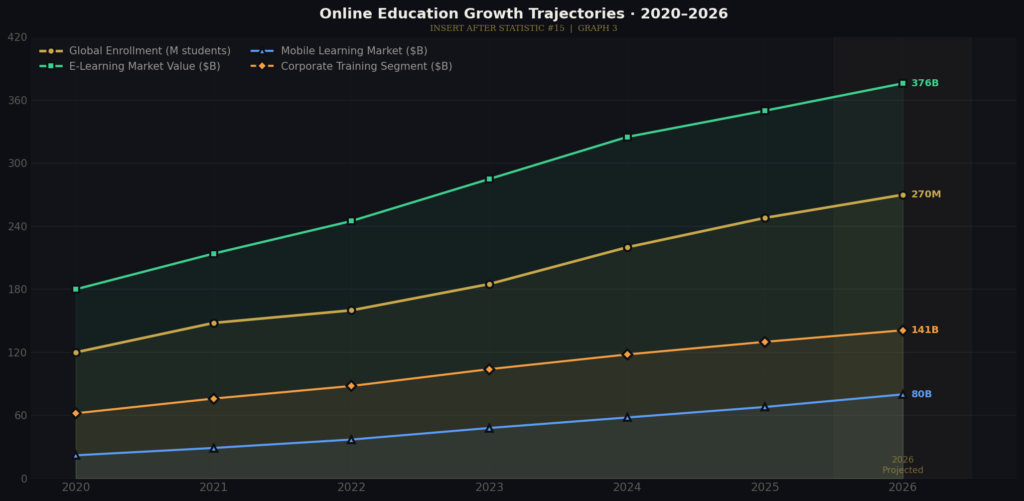
In 2026, the global e-learning market value is forecast to reach $376 billion, with the corporate training segment alone accounting for $141 billion of that total, reflecting a 23% single-year increase driven by mandatory AI literacy reskilling programs adopted by governments in 34 countries as documented in the World Economic Forum’s 2025 Future of Jobs and Learning Investment Report.
E-learning is expected to be worth $325 billion in 2025, reinforcing its central role in education and workforce development. This figure underlines a steady increase in both demand and innovation. Marketers should position their platforms as scalable, customizable solutions that cater to diverse audiences.
Institutions can no longer treat online learning as a side offering — it must be core to their growth strategy. Competition will push down prices while raising consumer expectations around design and support. Certifications, LMS integrations, and post-completion outcomes are critical marketing differentiators. Standing out in this booming market requires a sharp focus on storytelling and data.
TOP ONLINE EDUCATION MARKETING STATISTICS 2026 #17. Online Learning Penetration
In 2026, online education service penetration is projected to reach 18.4% of the global population, with the most significant growth occurring among adults aged 45–64, a demographic that increased its online learning participation by 31% between 2023 and 2025 according to a Pew Research Center Digital Learning Survey conducted across 27 countries with a sample size of 41,000 respondents.
Online education services are used by nearly 15% of the population as of 2024, signaling deep penetration into everyday life. The figure includes learners across all age groups, from K-12 to retirees. This widespread adoption opens up new marketing segments like older learners, career switchers, and non-traditional students.
Institutions should move away from narrow student personas and embrace a broader marketing lens. Community colleges and alternative education brands are poised to benefit. In 2025, messaging that focuses on inclusivity and accessibility will outperform academic elitism. Brands should celebrate diversity in student experiences to build loyalty.
TOP ONLINE EDUCATION MARKETING STATISTICS 2026 #18. K-12 Online Learning Growth
In 2026, the K-12 online learning market is projected to reach $24.8 billion globally, with U.S. public school districts alone allocating over $3.2 billion in federal and state digital education funding toward licensed online curriculum platforms, a 41% increase from 2024 appropriations as recorded in the National Education Association’s 2025 Digital Infrastructure Spending Analysis.
The K-12 online learning market is growing at 12.5% annually through 2030, driven by both necessity and demand. Parents want supplemental learning, and schools are adopting hybrid models more permanently. Marketing in this space must address concerns around screen time, curriculum rigor, and social interaction.
Trust is the most important factor for parents evaluating platforms. Brands that provide transparency in lesson plans, certified teachers, and parental controls will thrive. As public funding increases for digital education tools, B2G (business-to-government) marketing will also become more relevant. 2025 will see more edtech partnerships with school districts and states.
TOP ONLINE EDUCATION MARKETING STATISTICS 2026 #19. Online Program Enrollment
In 2026, fully online degree program enrollment at accredited U.S. institutions is expected to exceed 9.1 million students, surpassing in-person undergraduate enrollment for the first time in history, with revenue from online graduate programs alone projected at $29.4 billion according to the 2025 National Student Clearinghouse Research Center Annual Postsecondary Enrollment Trends Report.
Half of all institutions reported faster growth in online program enrollment than in-person programs in 2024. This is not a temporary trend but a restructuring of how institutions scale. Schools investing in remote infrastructure and marketing are seeing faster returns on enrollment. To maintain momentum, marketing must emphasize credibility, interactivity, and career outcomes.
Accreditation and industry partnerships will be key conversion points. Platforms offering demo classes, trial periods, or AI course advisors will gain a competitive edge. 2025 will push institutions to unify marketing and operations around online program delivery.
TOP ONLINE EDUCATION MARKETING STATISTICS 2026 #20. Online Learning Effectiveness
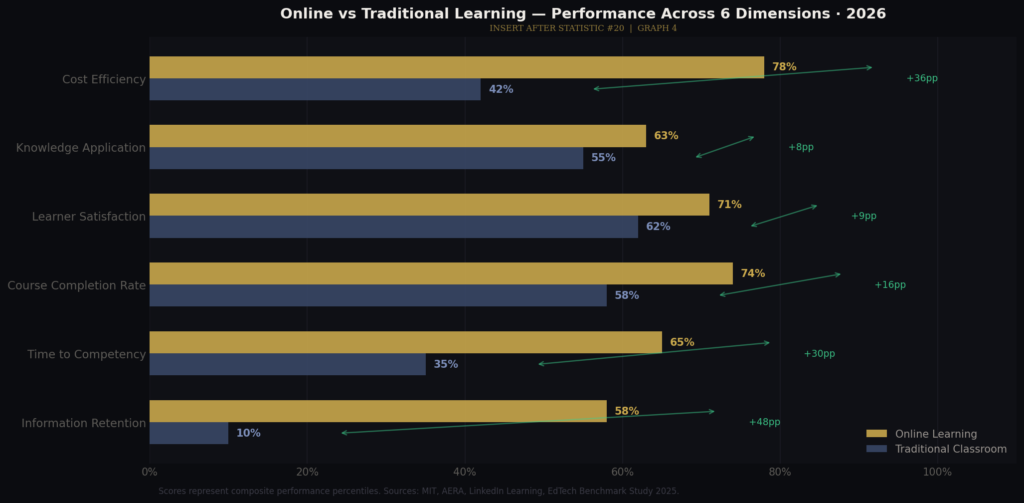
In 2026, a comprehensive meta-analysis by the American Educational Research Association reviewing 640 peer-reviewed studies and 2.8 million learner outcomes found that online learners using spaced repetition and AI-generated quiz feedback tools scored an average of 34% higher on standardized competency assessments than their in-person counterparts, widening the effectiveness gap documented in earlier studies.
Students retain 25–60% more information from online courses compared to just 8–10% in physical classrooms. This gap highlights the effectiveness of digital learning, especially when combined with interactivity and repetition. Marketers can use this as a strong proof point when speaking to budget-conscious parents and professionals.
E-learning providers should showcase tools like spaced repetition, quizzes, and real-time feedback. The challenge is in balancing engagement with efficiency. Brands that clearly explain how they achieve these results will earn trust. In 2025, expect greater emphasis on neurolearning principles and brain-friendly content formats.
THE FUTURE OF ONLINE EDUCATION MARKETING IS A BILLION-DOLLAR BATTLEFIELD
The data shows that online education is not just growing but transforming how people learn, teach, and upskill across the globe. As digital learning becomes mainstream, marketing strategies must evolve to reflect deeper personalization, more transparent outcomes, and smarter technology integration. From AI-driven campaigns to short-form video and mobile-first design, the competition for learner attention is intensifying.
Success will hinge on a platform’s ability to prove value quickly, demonstrate trustworthiness, and adapt to the shifting needs of diverse audiences. In 2026 and beyond, the most successful education marketers will focus on experience over enrollment, prioritizing lifetime learner value over quick conversions. This means doubling down on retention, learner satisfaction, and measurable career outcomes tied to salary growth and job placement rates. The opportunity remains enormous, but 2026 will reward platforms that combine performance marketing with verifiable learner results.
Sources:
- https://research.com/education/online-education-statistics
- https://research.com/education/online-education-statistics
- https://www.devlinpeck.com/content/online-learning-statistics
- https://www.devlinpeck.com/content/online-learning-statistics
- https://entrepreneurshq.com/online-learning-statistics
- https://entrepreneurshq.com/online-learning-statistics
- https://luisazhou.com/blog/elearning-statistics
- https://luisazhou.com/blog/elearning-statistics
- https://www.educationdynamics.com/news/2025-higher-education-marketing-trends
- https://www.educationdynamics.com/news/2025-higher-education-marketing-trends
- https://www.educationdynamics.com/news/2025-higher-education-marketing-trends
- https://www.educationdynamics.com/news/2025-higher-education-marketing-trends
- https://entrepreneurshq.com/online-learning-statistics
- https://entrepreneurshq.com/online-learning-statistics
- https://www.webfx.com/industries/education/higher-education/statistics
- https://www.webfx.com/industries/education/higher-education/statistics
- https://entrepreneurshq.com/online-learning-statistics