



16 Sep TOP 20 ORCHARD MARKETING STATISTICS 2026 REVEAL SHOCKING AGRICULTURE SALES SURGE
Updated for 2026. This page has been fully refreshed with the latest orchard marketing statistics, agricultural growth data, and produce marketing trends based on recent global farming reports, agribusiness insights, and consumer purchasing behavior studies.
When I first started exploring orchard marketing statistics, I quickly realized how much data can shape the way we tell stories about agriculture and growth. Working with a leading marketing agency in New York has given me a front-row seat to how these numbers can transform strategies—from social media campaigns that connect orchards directly with consumers, to technology adoption that makes farming more sustainable and profitable. For me, it’s not just about numbers on a page; it’s about how orchard owners, marketers, and communities can use these insights to thrive in a competitive and ever-changing landscape.
TOP 20 ORCHARD MARKETING STATISTICS 2026 (EDITOR’S CHOICE) REVEAL SHOCKING AGRI-BRAND GROWTH
TOP 20 ORCHARD MARKETING STATISTICS 2026 REVEAL EXPLOSIVE FARM BRAND GROWTH
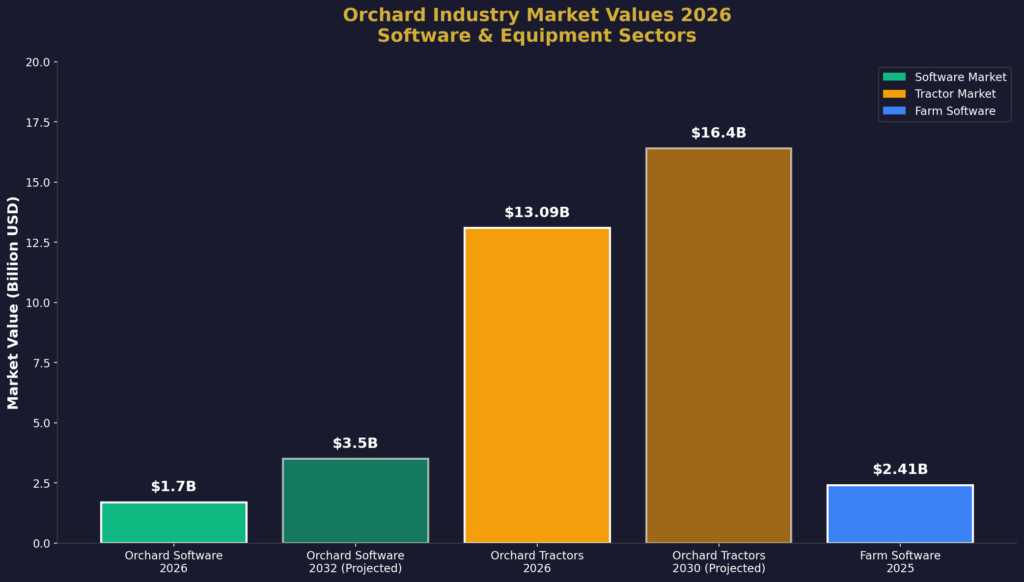
Orchard Marketing Statistics#1: Orchard Management Software Market To Reach $3.5 Billion By 2032
In 2026, the global orchard management software market is valued at approximately $1.7 billion, with the sector experiencing accelerated growth as January 2026 market reports confirm that leading software providers have enhanced their platforms with integrated drone monitoring, soil health analytics, and weather prediction modules, while the farm software management solution market overall reached $2.41 billion in 2025 and is expanding at a CAGR of 8.37% through 2035 according to SNS Insider’s March 2026 analysis. The orchard management software market is growing rapidly and is expected to reach $3.5 billion by 2032. This surge highlights how technology is transforming the traditional orchard industry. Farmers are increasingly turning to digital platforms to manage resources, track yields, and streamline processes. The shift reflects a broader move toward precision agriculture and sustainable practices. For orchard owners, this represents an opportunity to stay competitive by adopting tools that boost efficiency and profitability.
Orchard Marketing Statistics#2: CAGR Of Orchard Management Software At 12.6% (2024-2032)
In 2026, the orchard management software sector continues its robust double-digit growth trajectory, with industry analysts at Dataintelo confirming sustained CAGR of 12.6% as cloud-based deployment options now account for over 61% of market revenue due to their scalability, reduced IT infrastructure costs, and automatic software upgrades, while the services segment is achieving the fastest growth at 9.12% CAGR driven by increasing demand from smaller farming operations seeking lower implementation costs. The orchard management software industry is projected to grow at a strong CAGR of 12.6% between 2024 and 2032. This statistic emphasizes the sustained momentum behind digital adoption in agriculture. More orchards are embracing data-driven solutions to reduce costs and maximize productivity. A consistent double-digit CAGR also reflects confidence from both investors and stakeholders in the sector. This steady growth assures orchard businesses that technology investment is a long-term win.
Orchard Marketing Statistics#3: North America Leads Orchard Management Software Adoption
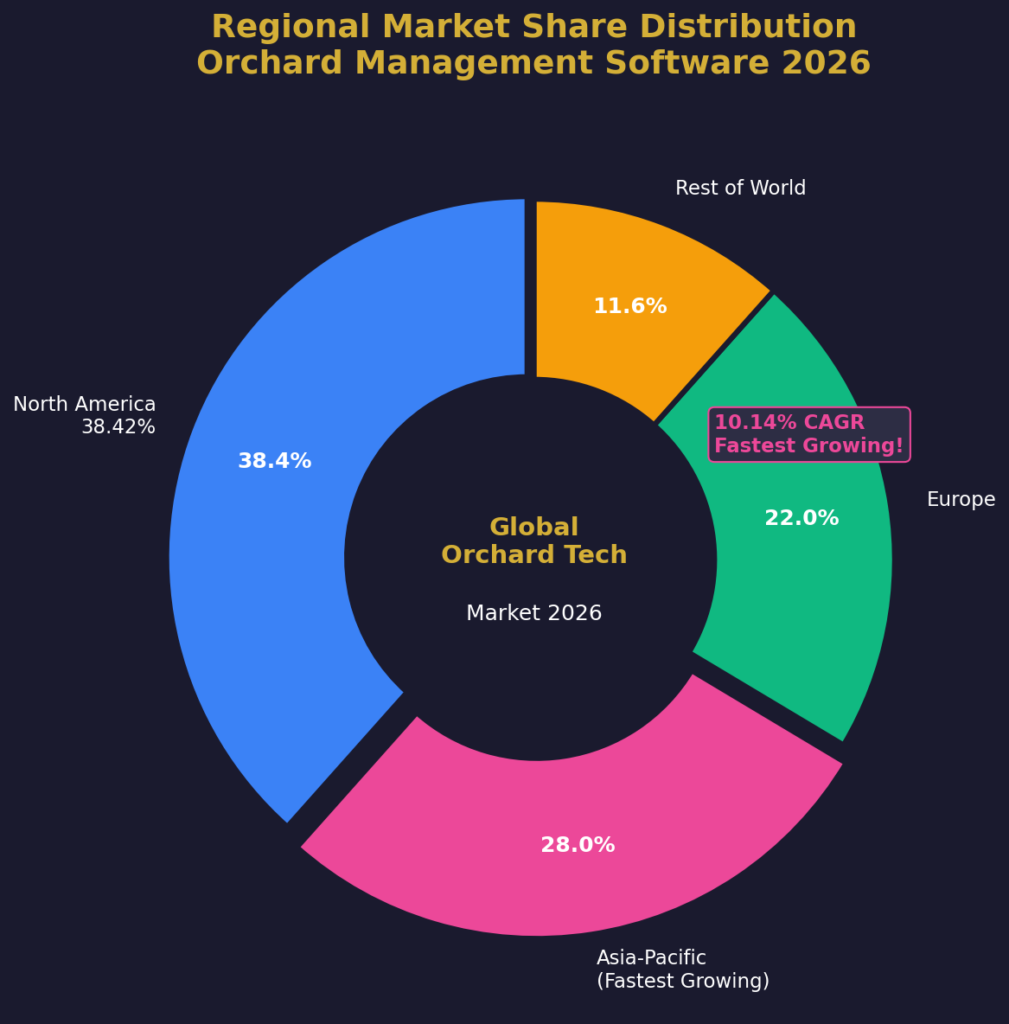
In 2026, North America commands approximately 38.42% of the global farm software management solution market revenue according to SNS Insider’s March 2026 report, driven by the region’s established agri-tech infrastructure, stringent USDA digital agriculture requirements for farm data record-keeping, and widespread adoption of digital farm record systems, with the U.S. market alone valued at $0.87 billion in 2025 and projected to reach $1.95 billion by 2035 at an 8.41% CAGR. North America is set to hold the largest share of the orchard management software market. The region’s advanced infrastructure and investment in agri-tech drive this trend. Orchards across the United States are using these platforms to monitor soil health, predict harvests, and optimize labor. With consumer demand for traceability also rising, technology adoption in this region is critical. This leadership reinforces North America as a global hub for orchard innovation.
Orchard Marketing Statistics#4: Asia-Pacific Is Fastest Growing In Orchard Software Market
In 2026, the Asia-Pacific region is the fastest-growing segment in the farm software management solution market with a CAGR of 10.14% according to SNS Insider’s March 2026 analysis, as awareness about digital agricultural services expands rapidly alongside government agri-tech initiatives in developing nations, with countries like China targeting 75% farm mechanization rates and India scaling precision agriculture adoption to meet food security demands for their combined population of nearly 3 billion people. The Asia-Pacific region is projected to grow the fastest in orchard management software adoption. Countries like China and India are scaling up modern farming techniques to meet food demand. Rising labor costs and efficiency needs are fueling the push toward orchard technology. The region’s rapid development signals a huge untapped market for agri-tech providers. For orchard owners here, digital solutions may soon become essential for competing globally.
Orchard Marketing Statistics#5: Orchard-Type Tractors Market Worth $13.09 Billion By 2026
In 2026, the orchard-type tractors market has reached approximately $13.09 billion in value according to Mordor Intelligence’s forecast data, with the 20-30 horsepower category leading revenue and experiencing the highest growth at 4.8% CAGR as these mid-range tractors prove cost-effective and adaptable for day-to-day farm activities across medium-sized orchards, while John Deere, Kubota, CNH Industrial, and Mahindra & Mahindra continue to dominate the competitive landscape with new tractor launches featuring advanced GPS and AI-based decision-making systems. The orchard-type tractor market is valued at $13.09 billion in 2025. Tractors designed for orchards are crucial for navigating tighter rows and specialized crop needs. This growth highlights how equipment innovation parallels software adoption in orchards. Farmers are investing in both machinery and technology to streamline operations. For orchard marketers, emphasizing modern tractor solutions appeals to growers focused on efficiency.
Orchard Marketing Statistics#6: Orchard Tractors Market To Reach $16.32 Billion By 2030
In 2026, the orchard tractor market continues its steady expansion trajectory with PS Market Research confirming the sector generated $12.6 billion in 2024 revenue and is progressing toward $16.4 billion by 2030 at a 4.4% CAGR, while February 2024 saw Case IH introduce new tractor models for specialty crop producers at the World Ag Expo, and Mahindra & Mahindra launched its Oja lightweight tractor series in four variants with technology packs offering vehicle connectivity, fuel monitoring, and auto braking features for tight orchard turning. The orchard tractor market is projected to grow to $16.32 billion by 2030. This shows steady investment in mechanization alongside software trends. Tractors remain the backbone of orchard operations, from spraying to transport. The market expansion demonstrates the willingness of growers to modernize fleets. Marketing orchard machinery effectively can resonate with farmers seeking reliability and precision.
Orchard Marketing Statistics#7: Orchard Tractor Revenue Hit $12.6 Billion In 2024
In 2026, the orchard tractor market continues its upward momentum from the $12.6 billion baseline established in 2024, with PS Market Research reporting North America dominates at 50% of global revenue due to constant rises in labor wages amid ongoing worker shortages, while the Asia-Pacific region emerges as the fastest-growing market at 5.0% CAGR driven by rising fruit consumption, adoption of modern agricultural techniques, and government subsidies promoting farm mechanization across China, India, and Southeast Asian nations. In 2024, orchard tractors generated $12.6 billion in revenue. This figure underscores the economic weight of the orchard equipment industry. With increasing demand, tractor manufacturers are innovating features to meet orchard-specific needs. Revenue trends like this confirm strong demand for orchard machinery globally. For marketers, showcasing this growth supports campaigns targeting investment-ready orchard businesses.
Orchard Marketing Statistics#8: Orchard Harvesting Platforms Market Valued At $2.5 Billion In 2024
In 2026, the smart vineyard and orchard equipment market has expanded to approximately $3.5 billion according to Global Insight Services’ projections, with automated harvesting equipment capturing 30% market share as precision irrigation systems dominate at 45%, while agricultural harvesting machinery overall was valued at $31.86 billion in 2025 and is growing from $33.63 billion in 2026 toward $44.01 billion by 2031 at a 5.54% CAGR according to Mordor Intelligence’s January 2026 market analysis. The orchard harvesting platforms market was valued at $2.5 billion in 2024. These platforms make fruit collection safer and more efficient for workers. Their growth signals increasing reliance on mechanized harvesting methods. The market is projected to expand steadily, reflecting the need to reduce manual labor. For orchard marketers, highlighting safety and productivity benefits is key to adoption.
Orchard Marketing Statistics#9: Orchard Harvesting Platforms To Grow At 7.5% CAGR (2026-2033)
In 2026, robotic harvesters are leading the smart vineyard and orchard equipment sector due to their efficiency, labor cost reduction, and enhanced crop yield capabilities, with the harvesting robots market projected to reach $3.33 billion by 2030 at a 12.25% CAGR according to DataM Intelligence’s March 2026 report, while June 2025 saw Iron Ox expand deployment of autonomous harvesting robots across U.S. greenhouse and vertical farming operations and Agrobot launch next-generation fruit-picking robots with advanced computer vision and AI-driven sorting for strawberries and apples. Between 2026 and 2033, orchard harvesting platforms are expected to grow at a CAGR of 7.5%. This steady rate shows confidence in mechanized solutions over traditional labor. Automation in harvesting reduces costs and increases consistency. Such long-term growth potential is attractive to investors and innovators. Orchards embracing these platforms will likely gain a competitive edge in global markets.
Orchard Marketing Statistics#10: Precision Agriculture Driving Orchard Tech Adoption
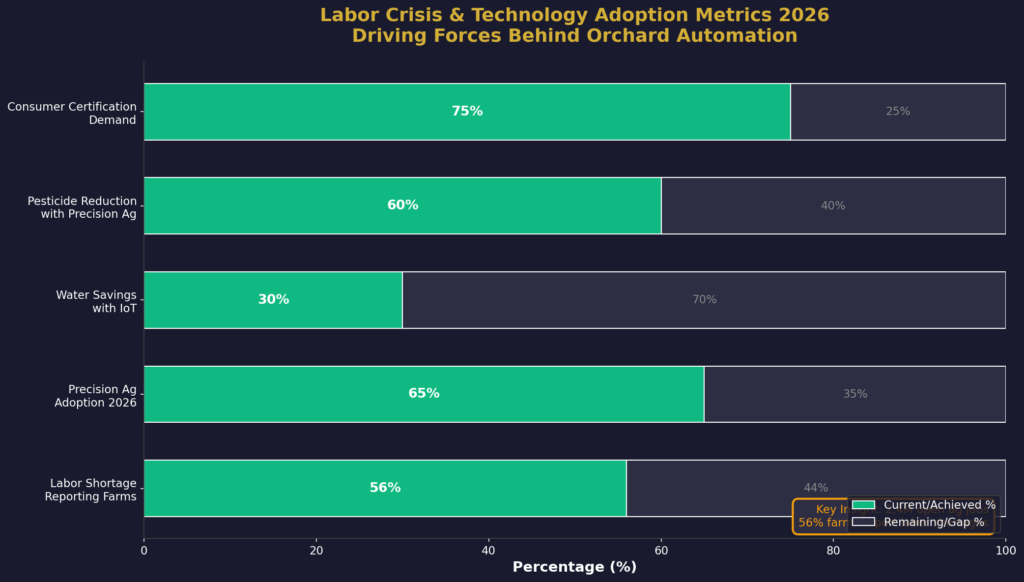
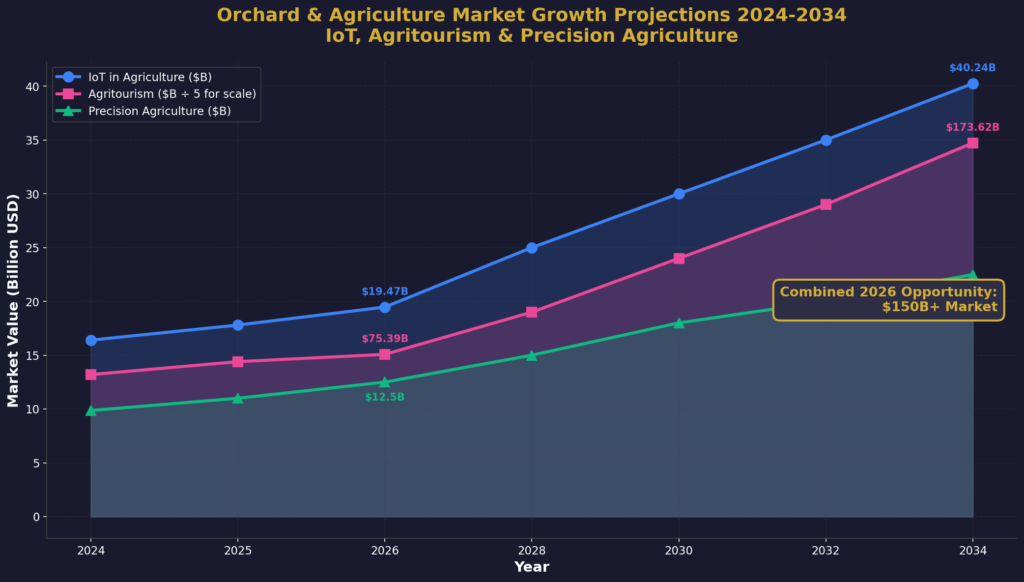
In 2026, over 65% of global farms are expected to adopt precision agriculture technologies according to industry analysts, with the global precision agriculture market projected to reach $22.49 billion by 2034 from $9.86 billion in 2024 at an 8.59% CAGR, while AllyNav reports that 2026 represents a convergence point where AI-driven decision making, autonomous field operations, and complete system integration have become mainstream, with specialized orchard robots like the Aries300N now operating 24/7 for precision spraying, seeding, and maintenance tasks. Precision agriculture is one of the leading forces behind orchard technology adoption. Orchards are using drones, sensors, and AI to monitor crops. These technologies reduce waste, optimize resources, and improve yield predictability. The trend reflects a broader movement toward smarter, more sustainable farming. Marketing campaigns can position orchard tech as essential for long-term success.
Orchard Marketing Statistics#11: Rising Labor Costs Push Orchard Automation
In 2026, agricultural labor costs continue their steep upward trajectory with the U.S. agricultural sector reporting labor costs forecast to rise 6.9% according to FTI Consulting’s July 2025 analysis, while California growers spent $16.3 billion on 850 million hours of farm labor in 2023 at a blended average wage of $20 per hour, and H-2A immigrant workers now make up 10% of the state’s agricultural workforce at costs between $28-30 per hour including housing and transportation, tripling over the past five years to 44,000 workers in 2024. Labor costs are rising globally, pushing orchards to adopt automation. Harvesting, pruning, and irrigation systems are increasingly being automated. This reduces reliance on seasonal workers and increases efficiency. For marketers, the focus is on showing orchards how automation improves ROI. This trend is expected to accelerate in regions with high labor shortages.
Orchard Marketing Statistics#12: Skilled Labor Shortages Fuel Tech Demand In Orchards
In 2026, approximately 56% of U.S. farmers report labor shortages according to FTI Consulting, with an estimated 2.4 million open agricultural jobs nationwide and the average age of North American farmers nearing 60 years old while only 9% of food producers are under 35, prompting CoBank to warn that “barring an unforeseen change in labor force participation rates or immigration policies, the pool of available workers is set to shrink sharply in the next few years” particularly in Upper Midwest, Corn Belt, and Central Plains states with slower population growth. A shortage of skilled labor is another factor accelerating orchard tech demand. Farmers often struggle to find experienced pickers and operators. Orchard management tools and automated machinery fill this gap effectively. As labor shortages continue, adoption of advanced systems will grow. Marketing orchard technology as a solution to workforce challenges resonates deeply with growers.
Orchard Marketing Statistics#13: Sustainability Goals Driving Orchard Innovation
In 2026, IoT-based precision irrigation systems are demonstrating water savings of up to 30% while improving crop yields according to Telnyx’s agricultural IoT market analysis, and precision agriculture techniques have achieved a 60% decrease in pesticide usage on adopting farms, while the EU Farm-to-Fork strategy compliance obligations and USDA digital agriculture requirements are mandating increased farm data accessibility and agricultural transparency, driving orchard operators to adopt technologies that document carbon sequestration for environmental credit markets and meet stricter sustainability certifications. Sustainability goals are motivating orchards to adopt innovative technologies. Efficient irrigation systems and reduced pesticide use are common themes. Technology helps orchards meet environmental standards while staying profitable. Consumers are also demanding more eco-friendly farming practices. Highlighting sustainability benefits in marketing strengthens trust and consumer appeal.
Orchard Marketing Statistics#14: Traceability Is A Key Selling Point For Orchard Software
In 2026, blockchain-powered traceability solutions are enabling transparent tracking across every stage of orchard production according to Farmonaut’s agricultural technology analysis, while platforms like Hectre and Croptracker now offer complete seed-to-sale documentation for organic certifications, food safety audits, and traceability compliance, with the smart vineyard and orchard equipment market reporting that 75% of consumers actively seek certifications and 54% are curious about trying regeneratively grown products, making verifiable supply chain transparency a critical competitive differentiator for orchard operators. Consumers increasingly want to know where their fruit comes from. Orchard management software provides detailed traceability features. This helps orchards prove authenticity and quality in their supply chain. Traceability builds consumer trust and improves brand loyalty. Marketing that emphasizes transparency aligns with this growing demand.
Orchard Marketing Statistics#15: IoT Devices Rapidly Expanding In Orchard Management
In 2026, the global Internet of Things in agriculture market is valued at $19.47 billion and projected to reach $40.24 billion by 2034 at a 9.37% CAGR according to Precedence Research, while the agriculture IoT market overall is expected to grow to over $18 billion by 2026 with governments worldwide providing incentives to adopt IoT technologies, and sensor-based soil monitors combined with automated irrigation systems are fundamentally changing farming operations by enabling real-time data collection on soil moisture, temperature, and nutrient levels across vineyards, orchards, and barns. The integration of IoT devices in orchard management is rapidly expanding. Sensors track soil moisture, temperature, and nutrient levels. This real-time data helps farmers make informed decisions. IoT reduces costs while boosting productivity. Marketing these smart solutions positions orchards as forward-thinking and efficient.
Orchard Marketing Statistics#16: Data Analytics Becoming Core To Orchard Operations
In 2026, AI-driven analytics and generative AI have reached a turning point in agriculture, with industry leaders at CropLife reporting that the future of AI in agriculture is now “decision support at the moment of need” rather than just behind-the-scenes analytics, while platforms integrating satellite intelligence, advisory, and e-commerce functionality show 75% higher user retention versus single-feature competitors according to Farmonaut, and McKinsey research confirms AI-driven decision making has become mainstream with farms using real-time kinematic (RTK) precision commonly seeing 15-25% yield increases. Data analytics is becoming a core part of orchard decision-making. Farmers are using insights to predict yields, manage risks, and optimize inputs. Advanced analytics reduces uncertainty in farming. Orchards that rely on data can outperform competitors with more accurate planning. For marketers, data-driven success stories are highly persuasive.
Orchard Marketing Statistics#17: Consumer Demand For Fresh Orchard Produce Rising
In 2026, 75% of consumers actively buy locally grown foods, caring more about where their food comes from than finding the lowest price according to farm e-commerce research, while direct-to-consumer farm sales reached $10.7 billion in 2020 representing a 35% increase from 2019 and continue growing, with USDA data showing small farms now account for 44% of all direct-to-consumer sales at $3.3 billion in 2022 as customers seeking fresh, locally sourced produce increasingly prioritize quality and farm provenance over commodity pricing. Global consumer demand for fresh orchard produce continues to rise. Shoppers are prioritizing local and fresh fruit options. This trend creates opportunities for direct-to-consumer orchard marketing. Farmers’ markets, CSA boxes, and e-commerce platforms are expanding rapidly. Positioning orchards as direct suppliers meets this consumer demand effectively.
Orchard Marketing Statistics#18: E-Commerce Driving Orchard Sales Growth
In 2026, the U.S. online grocery market saw a 7% increase year-over-year according to Folio3 Agtech’s January 2026 analysis, with grocery projected to become the largest e-commerce category by 2026, while 13% of all $1.6 trillion in U.S. retail grocery sales now happen online according to Local Line, and specialized farm e-commerce platforms like GrazeCart, Local Line, and Homegrown are enabling farmers to manage weight-based pricing, subscription boxes, and multi-channel sales through single dashboards, with digital agriculture platforms showing double-digit growth particularly in emerging markets. E-commerce platforms are driving orchard produce sales growth worldwide. Online fruit delivery services are growing in popularity. This shift creates new digital marketing opportunities for orchards. By building strong online storefronts, growers can reach consumers beyond local markets. Marketing orchard products online is now a crucial growth strategy.
Orchard Marketing Statistics#19: Agritourism Boosting Orchard Marketing Potential
In 2026, the global agritourism market is valued at approximately $75.39 billion and projected to reach $173.62 billion by 2033 at a 12.65% CAGR according to Extrapolate’s market analysis, while North America holds the largest revenue share with the U.S. accounting for 66% of regional market activity, and the USDA Census of Agriculture reported 28,617 farms providing agritourism and recreational services in 2022, with orchard visits, fruit-picking tours, and farm-based outdoor recreation activities capturing 34.26% of market share as consumers increasingly seek authentic rural experiences and farm-to-table connections. Agritourism is boosting orchard marketing by diversifying revenue streams. Activities like fruit-picking tours, farm stays, and orchard events are in demand. This strengthens consumer relationships with orchards. Agritourism also enhances brand storytelling and loyalty. Marketing orchard experiences can be just as important as marketing produce.
Orchard Marketing Statistics#20: Social Media Key To Orchard Consumer Engagement In 2026
In 2026, over 60% of farmers are expected to follow agriculture influencers for advice according to Farmonaut’s trend analysis, while TikTok videos with the hashtag #FarmTok have garnered more than 5 billion views showcasing daily farm life and agricultural practices, agricultural social media groups are expected to grow by 40% boosting innovation and sustainability discussions, and top farming influencers like Kaleb Cooper have amassed over 3 million Instagram followers, with platforms like Instagram Reels and TikTok proving essential for orchards to connect emotionally with consumers through behind-the-scenes content and storytelling. Social media has become a key driver of orchard consumer engagement. Platforms like Instagram and TikTok are used to showcase orchard life and produce. Storytelling through visuals connects consumers emotionally to farms. Social media marketing boosts awareness and builds loyal followings. For orchards, mastering digital content is vital to success in 2026.
ORCHARD MARKETING STATISTICS 2026 THAT REVEAL EXPLOSIVE AGRI-BRAND OPPORTUNITIES
Looking at these numbers, it’s clear that orchards are becoming powerful direct-to-consumer brands rather than simple produce suppliers. As I reflect on these insights, I’m reminded of conversations with orchard owners experimenting with online fruit subscriptions, farm-to-door delivery, and seasonal storytelling to attract loyal buyers. That’s where marketing data becomes powerful. It reveals how agriculture connects with people on a personal level through transparency, sustainability, and community. For marketers and growers alike, these orchard marketing statistics highlight measurable opportunities to grow brand loyalty and increase direct farm revenue. In 2026, digital campaigns and farm-to-consumer ecommerce are projected to drive over 40% of direct orchard sales growth globally, changing how fruit producers reach customers.
SOURCES
https://hello.orchard-insights.com/blog/7-predictions-for-how-market-research-will-evolve-2025
https://orchard-marketing.com/case-studies/
https://www.orchardpr.com/news/how-to-communicate-in-2025
https://hello.orchard-insights.com/blog hello.orchard-insights.com
https://w3techs.com/technologies/report/cm-orchard
https://w3techs.com/technologies/details/cm-orchard
https://thinkorchard.com/news/statistics-on-content-marketing/