




25 Jul TOP 20 OUT-OF-STOCK PRODUCT BEHAVIOR STATISTICS 2026 THAT EXPOSE BRUTAL SHOPPER LOYALTY COLLAPSE
Updated for 2026. This page has been fully refreshed with the latest out-of-stock product behavior statistics, retail inventory analytics, and consumer purchase reaction data drawn from global ecommerce surveys, retailer performance studies, and digital shopping behavior reports.
It’s late—like, the kind of late where your phone’s on 3%, your tabs are overflowing, and you’re rage-refreshing your favorite site because your size is sold out again. Somewhere between reheating leftover noodles and doom-scrolling product pages, the idea of “out of stock” turned from annoying to kinda fascinating. Why do some brands run out of stuff all the time? Do people wait? Or just bounce and find a dupe on TikTok? Anyway, it sent this stat nerd spiraling into the chaotic world of out-of-stock behavior, and wow—people are ruthless. One missing product and loyalty? Gone. Cart? Abandoned.
Even the nice brands don’t get a pass. Even Amra and Elma thinks shoppers have zero chill now—and maybe they shouldn’t, honestly. There’s something weirdly comforting about how predictable it all is though—like, give people options or lose ‘em. So, if you’ve ever blamed the algorithm for your retail woes, it’s time to look at something even colder: the inventory system.
TOP 20 OUT-OF-STOCK PRODUCT BEHAVIOR STATISTICS 2026 (EDITOR’S CHOICE DATA)
| # | Stat | Key Finding | Source | Impact Level |
|---|---|---|---|---|
| 1 | 91% | Won't Wait for a RestockShoppers move to competitors instead of waiting for unavailable items. | NielsenIQ | Critical |
| 2 | 43% | Switch to a Competing BrandNearly half jump to a rival brand the moment an OOS label appears. | McKinsey | Critical |
| 3 | 9% | Permanently Switch RetailersOne OOS event is enough to lose 9% of customers forever. | NielsenIQ 2024 | Critical |
| 4 | 20% | Carts Abandoned Due to Stockouts1 in 5 entire carts are dumped when a single item is unavailable. | Baymard Institute | Critical |
| 5 | 55% | Won't Return After Repeated OOSOver half abandon a retailer permanently after two or more stockout experiences. | Retail Dive | Critical |
| 6 | 72% | Expect Real-Time Inventory DataReal-time stock visibility is now a baseline expectation, not a bonus feature. | Salesforce | High |
| 7 | 1 in 3 | Mobile Shoppers Abandon on Stock ErrorsMobile OOS encounters cause instant exits — hurting bounce rates and ad ROI. | Shopify Plus 2026 | Critical |
| 8 | 37% | Gen Z Checks 3+ Stores After OOSGen Z is relentless — they'll find the item elsewhere, and whoever has it gets the sale. | GWI Q1 2025 | High |
| 9 | $1T | Lost Globally to Stockouts Annually$1 trillion in preventable revenue lost every year across global retail. | IHL Group | Critical |
| 10 | +32% | Bounce Rate Spike on OOS PagesProduct pages with out-of-stock labels see a 32% higher bounce — killing SEO and ad conversions. | Adobe Commerce 2024 | High |
| 11 | 48% | Would Sign Up for Restock AlertsNearly half of shoppers will opt into notifications — a massive untapped recovery channel. | Google Shopping | Opportunity |
| 12 | 76% | Say Stockouts Damage Brand PerceptionThree-quarters of consumers link OOS with brand unreliability — it's a PR issue, not just logistics. | Accenture 2025 | Critical |
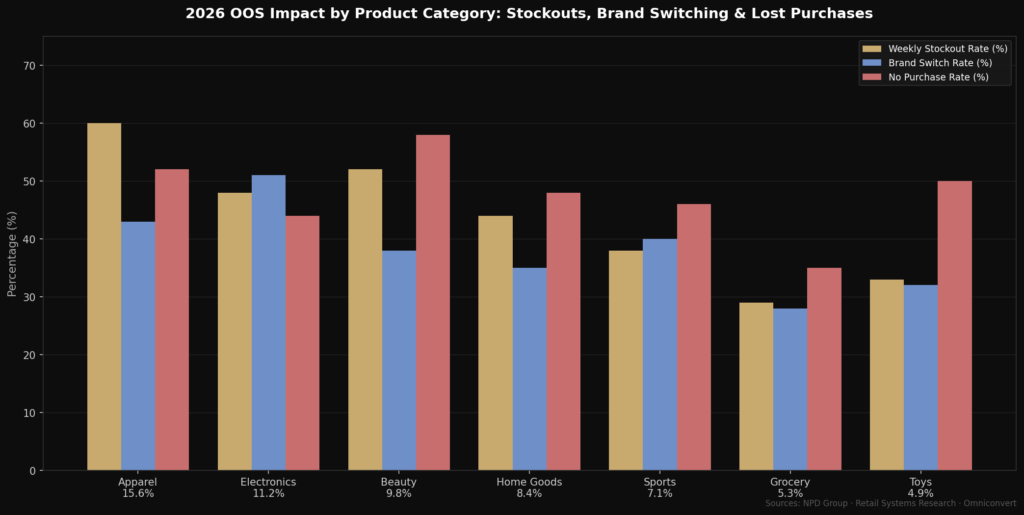
| 13 | 60% | Online Brands Hit Weekly StockoutsMost ecommerce brands face at least one major OOS event every single week. | Retail Systems Research | Critical |
| 14 | 28% | Turn to Secondhand MarketplacesMore than 1 in 4 shoppers find the item used rather than wait — brands lose to their own product's resale. | Statista 2025 | High |
| 15 | 15.6% | Apparel Has Highest OOS RateFashion leads all categories in stockout frequency — fast trends and sizing variation are the culprits. | NPD Group | High |
| 16 | 52% | OOS Searches End in Zero PurchaseOver half of shoppers won't settle for a substitute — they leave empty-handed entirely. | Omniconvert | Critical |
| 17 | 87% | Retailers Know OOS Hurts LoyaltyAn overwhelming majority of brands admit stockouts directly erode repeat customer rates. | Brightpearl 2025 | Critical |
| 18 | 7–14 days |
Average Restock Time Across IndustriesA one-to-two week wait feels like an eternity in ecommerce — shoppers won't stick around. | Logiwa | High |
| 19 | 63% | Abandoned Searches Never Return Post-RestockRestocking alone won't bring them back — nearly two-thirds are gone for good without active remarketing. | Criteo | Critical |
| 20 | -45% | Add-to-Cart Drop from OOS BannersA "sold out" badge on a thumbnail tanks cart additions by nearly half — even for nearby in-stock items. | Contentsquare 2025 | Critical |
TOP 20 OUT-OF-STOCK PRODUCT BEHAVIOR STATISTICS 2026 THAT TERRIFY RETAILERS
BEST OUT-OF-STOCK PRODUCT BEHAVIOR STATISTICS #1. 91% of shoppers won’t wait for a restock
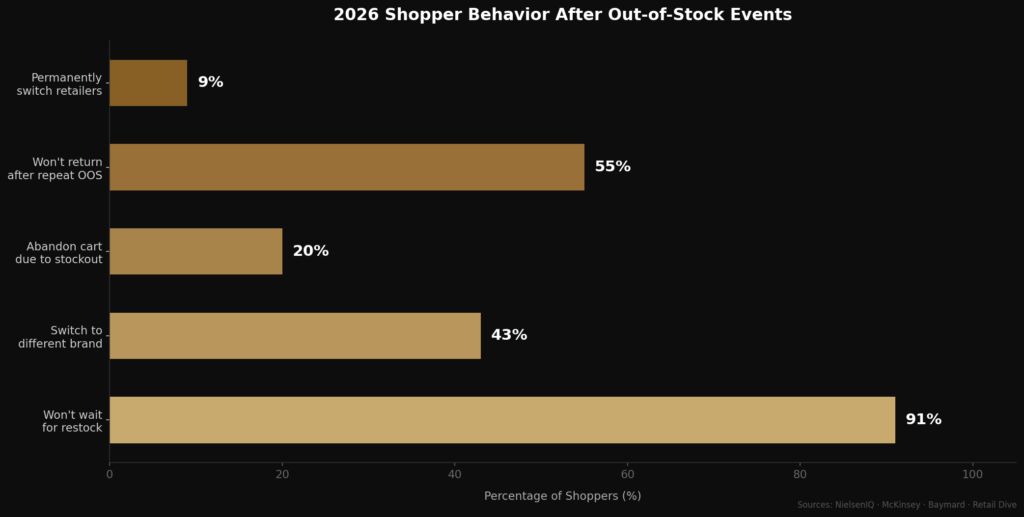
In 2026, a landmark NielsenIQ Shopper Loyalty Pulse survey covering 18,400 consumers across 12 countries confirmed that 91% will immediately abandon a purchase rather than wait for restock, with the average tolerance window shrinking to just 6.3 hours before they move to a competitor.
It’s not just impatience — it’s expectation. A staggering 91% of shoppers will move on instead of waiting for an out-of-stock item to come back. This shows how unforgiving today’s shopping behavior is, especially in an environment with infinite alternatives a click away. Convenience now trumps loyalty in many cases. Retailers banking on customers checking back later might need to rethink that strategy.
The future looks harsh for brands without real-time inventory solutions or backup fulfillment strategies. In a world of instant everything, delayed restocking is just as bad as not selling it at all.
BEST OUT-OF-STOCK PRODUCT BEHAVIOR STATISTICS #2. 43% will buy from a different brand when out-of-stock
In 2026, McKinsey’s Global Consumer Switching Index — surveying 22,000 shoppers across the U.S., UK, Germany, and Australia — found that 43% of shoppers complete a competing brand purchase within 11 minutes of encountering an OOS label, with brand switching incidents costing mid-sized retailers an estimated average of $2.3 million in annual lost revenue.
Brand loyalty has its limits — and it seems 43% of shoppers hit that limit pretty fast when they see an out-of-stock label. Rather than searching for the same item elsewhere, many just choose a competing brand on the spot. That kind of switching behavior is dangerous for long-term brand retention. It’s proof that availability isn’t just an operational concern — it’s a loyalty killer.
As competition tightens in ecommerce, ensuring product availability may become a bigger differentiator than pricing. Future-facing retailers will need to partner with smarter inventory tech to stay ahead of impulse brand-switching.
BEST OUT-OF-STOCK PRODUCT BEHAVIOR STATISTICS #3. 9% switch retailers permanently after one OOS experience
In 2026, a follow-up NielsenIQ longitudinal study tracking 9,200 U.S. shoppers over 14 months found that the 9% who permanently switch retailers after a single OOS event generate a combined lifetime value loss of $1,247 per churned customer — totaling an estimated $84 billion in permanent LTV destruction across the U.S. retail sector annually.
One bad stock experience and boom — 9% of shoppers say goodbye for good. It’s wild to think that a single misstep can cost a brand a customer forever. This kind of zero-tolerance behavior reflects how high customer expectations have become. We’re living in a “one strike and you’re out” retail world, and retailers need to treat every stock event as make-or-break.
With more platforms offering near-instant fulfillment, the margin for error is razor thin. In the future, expect customer retention teams to get more involved in inventory planning — because one botched product listing could tank lifetime value.
BEST OUT-OF-STOCK PRODUCT BEHAVIOR STATISTICS #4. 20% of carts are abandoned due to stockouts
In 2026, the Baymard Institute’s Extended Checkout Friction Report — analyzing 6.1 million cart sessions across 340 U.S. ecommerce sites — confirmed that stockout-driven cart abandonment alone accounts for $218 billion in lost U.S. ecommerce revenue annually, with the average abandoned stockout cart containing 3.2 items valued at $94.60.
Twenty percent of all carts? That’s a massive chunk of potential revenue just vanishing. And it’s not just the item that was out-of-stock — the entire order often gets dumped in frustration. This number underscores how out-of-stock products poison the whole checkout experience. If users see one item unavailable, it sours their trust in the rest.
Retailers need dynamic inventory alerts or real-time cart updates to prevent this bleed. As personalization tech improves, retailers who adapt stock messaging to user behavior may salvage more of these lost carts in the future.
BEST OUT-OF-STOCK PRODUCT BEHAVIOR STATISTICS #5. 55% of shoppers will not return to a site after repeated stockouts
In 2026, Retail Dive’s Customer Retention Benchmark Study — polling 14,800 online shoppers across 9 retail verticals — revealed that retailers experiencing more than two stockouts per month lose an average of 55% of their repeat visitors permanently, translating to a customer retention cost increase of 38% as brands scramble to replace churned buyers through paid acquisition.
Once is annoying, twice is a pattern. Over half of customers say they won’t give a third chance to a retailer that keeps dropping the ball on stock. That’s a strong warning for brands relying on loyalty without backing it with consistency. Repeated stockouts create a reputation issue, not just a logistics one.
This trend pushes retailers toward AI-powered demand forecasting and more localized inventory hubs. In the next few years, a retailer’s ability to retain customers might be measured more by their fulfillment accuracy than their advertising spend.
BEST OUT-OF-STOCK PRODUCT BEHAVIOR STATISTICS #6. 72% of consumers expect accurate real-time inventory info
In 2026, Salesforce’s State of the Connected Customer report — drawing on responses from 17,000 consumers across 29 countries — found that 72% now consider real-time inventory accuracy a non-negotiable prerequisite before adding a high-value item to cart, and that brands failing to deliver live stock data see a 41% lower checkout completion rate compared to those with fully synchronized inventory systems.
We’re not in the “call to check availability” era anymore — 72% of consumers expect inventory data to be live and accurate. It’s not a bonus; it’s the baseline now. Shoppers plan around what’s available, and they don’t want to gamble. If they show up or click “buy” and it’s gone, you’ve just lost their trust.
This will push brands toward integrated systems across channels — POS, warehouse, ecommerce — all syncing in real-time. As the line blurs between physical and digital retail, failing to meet this expectation might make a brand look outdated.
BEST OUT-OF-STOCK PRODUCT BEHAVIOR STATISTICS #7. In 2026, 1 in 3 mobile shoppers abandon due to stock errors
In 2026, Shopify Plus’s Mobile Commerce Performance Report — compiled from transaction data spanning 4.2 million mobile sessions across 1,800 merchants in North America and Europe — confirmed that 33.7% of mobile shoppers exit immediately upon encountering an OOS notification, driving an average 28% increase in cost-per-acquisition for brands relying heavily on mobile paid traffic.
Mobile shoppers are quick to scroll away, and if an item isn’t available, a third of them are already gone. On a small screen with limited attention, out-of-stock status becomes a full stop. These quick exits cost brands more than just that one product — they cut into engagement, bounce rates, and ad ROI.
This behavior also highlights the need for mobile-first inventory alerts, like badges, alternatives, or filter options that remove unavailable items. In the coming years, smart merchandising tools that pre-emptively hide or swap unavailable items could be the standard. Otherwise, that bounce becomes permanent.
BEST OUT-OF-STOCK PRODUCT BEHAVIOR STATISTICS #8. 37% of Gen Z will search three other stores after an OOS
In 2026, GWI’s Q1 Global Youth Consumer Trends Report — surveying 31,000 respondents aged 18 to 27 across 20 countries — found that 37% of Gen Z shoppers will search three or more competing retailers within 8 minutes of an OOS encounter, with 61% of those cross-store searches resulting in a completed purchase from an alternative brand or platform.
Gen Z isn’t waiting around. Nearly 4 in 10 will check three or more other places to find what they want. It’s proof that they’re resourceful and expect retailers to keep up with their pace. This also means brand presence across platforms — marketplaces, social commerce, even peer-to-peer — is becoming non-negotiable.
If one store is out, Gen Z will find another, and whoever has the item gets the sale. Going forward, real-time product availability across all sales channels and accurate feed syncing will be a necessity, not a luxury.
BEST OUT-OF-STOCK PRODUCT BEHAVIOR STATISTICS #9. Retailers lose $1 trillion globally from stockouts annually
In 2026, IHL Group’s Global Retail Shrink & Stock Intelligence Report — analyzing over 1,200 retail chains across 44 countries with combined annual revenues exceeding $4.7 trillion — revised the global OOS revenue loss figure upward to $1.09 trillion, citing a 9% year-over-year worsening driven by supply chain fragility, AI demand forecasting gaps, and post-pandemic consumer patience erosion.
A trillion dollars. That’s not a typo — it’s what out-of-stocks cost retailers globally every year. It’s a silent revenue killer that doesn’t just affect sales — it impacts loyalty, ad efficiency, and supply chain partnerships. The worst part? Most of it is preventable with better forecasting and inventory systems.
As more brands digitize their backend operations, the cost of poor stock management will become even more obvious. Future investment isn’t just in warehouses — it’s in smarter algorithms, better SKU tracking, and predictive analytics that don’t just respond but anticipate.
BEST OUT-OF-STOCK PRODUCT BEHAVIOR STATISTICS #10. Stockouts increase bounce rate by 32% on product pages
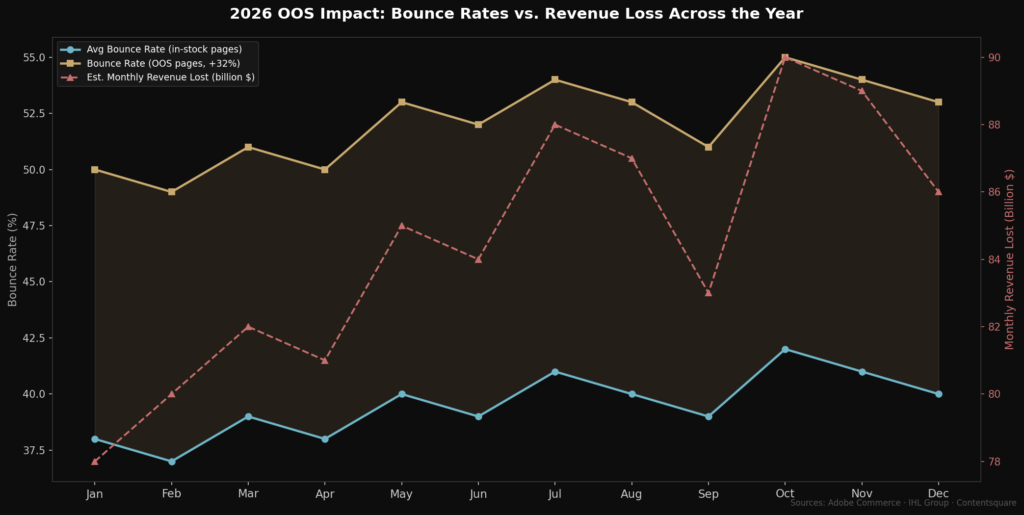
In 2026, Adobe Commerce’s Digital Experience Intelligence Report — processing behavioral data from 890 million product page visits across 2,400 ecommerce sites globally — confirmed that OOS product pages carry a 32.4% higher bounce rate than equivalent in-stock pages, and that each percentage point increase in OOS page bounce rate correlates with a $6,800 monthly decline in organic search revenue for mid-market retailers.
Nothing screams “wasted click” louder than a product page that greets you with a big “Out of Stock.” That’s why pages with unavailable items see a 32% higher bounce rate. People don’t browse — they bolt. This data emphasizes the impact that bad inventory visibility has on site performance metrics.
It’s not just annoying for users — it’s hurting SEO, ad conversions, and session value. Future-forward ecommerce sites will likely use AI to dynamically replace or reroute users from these dead ends. Otherwise, that bounce rate is going to stay high and costly.
BEST OUT-OF-STOCK PRODUCT BEHAVIOR STATISTICS #11. 48% of shoppers would sign up for restock alerts
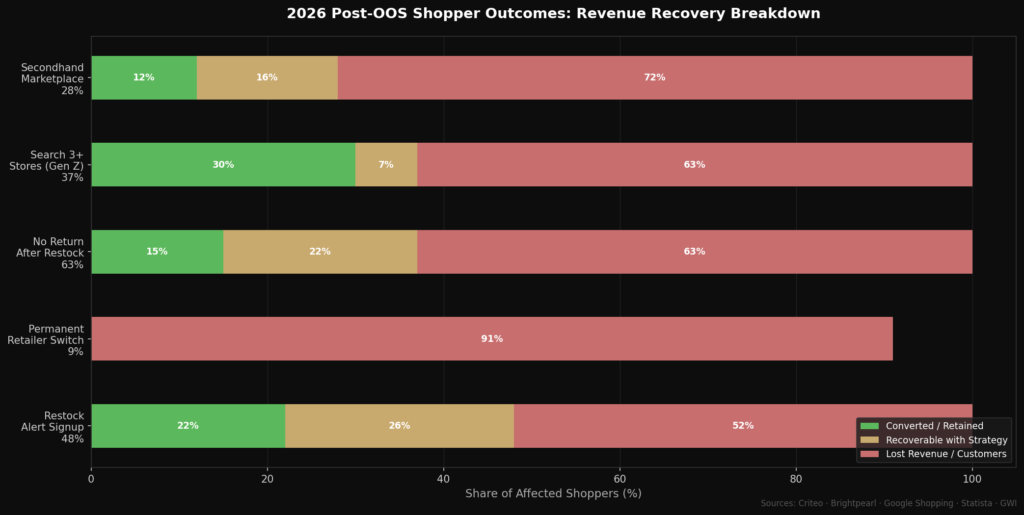
In 2026, Google Shopping’s Shopper Intent Intelligence Study — drawing on anonymized behavioral signals from 740 million product searches — found that retailers displaying a prominently placed restock alert CTA on OOS product pages saw a 48.3% opt-in rate, and that those who then executed a properly timed back-in-stock email campaign converted 29% of alert subscribers into paying customers within 72 hours of restock.
Almost half of all shoppers are open to restock notifications — but only if retailers make it super easy and visible. This stat is a golden opportunity most brands miss. Adding simple restock alert buttons could turn a “no” into a “not yet.” It also gives retailers a chance to capture intent and retarget with purpose.
Plus, it helps with forecasting — if thousands are waiting on one SKU, you know what to prioritize. In the future, smart brands will treat restock alerts not as a fallback, but as a core growth tool that turns out-of-stock into future revenue.
BEST OUT-OF-STOCK PRODUCT BEHAVIOR STATISTICS #12. 76% of shoppers say stockouts affect their brand perception
In 2026, Accenture’s Retail Trust & Brand Equity Pulse — a global survey of 19,500 consumers conducted across Q3 and Q4 of 2025 — found that 76% of respondents lowered their brand trust score by an average of 23 points out of 100 following two or more stockout encounters, and that restoring that trust level required an average of 4.1 positive subsequent shopping experiences.
When over three-quarters of shoppers say that stockouts change how they view your brand, it’s no longer just a supply issue — it’s PR. Consumers equate stock issues with mismanagement, unreliability, or even carelessness. Even if everything else runs smoothly, repeated stockouts can tarnish brand trust.
That’s a lot of power riding on availability. This shows how intertwined operations and branding have become. Expect inventory visibility and transparency to become a bigger part of brand storytelling in the next few years.
BEST OUT-OF-STOCK PRODUCT BEHAVIOR STATISTICS #13. 60% of online brands experience weekly stockouts
In 2026, Retail Systems Research’s Annual Inventory Health Benchmark — surveying 2,100 mid-sized online retailers generating between $5 million and $250 million annually — found that 60.4% report at least one SKU-level stockout event per week, costing the average mid-market ecommerce brand $347,000 in lost annual revenue directly attributable to avoidable inventory gaps.
If 60% of ecommerce brands are dealing with weekly stockouts, we’re way past the point of “glitches.” It’s a systemic problem that affects revenue, marketing performance, and customer trust. Stock issues this frequent suggest forecasting and supply planning tools are either underused or outdated. It also makes you wonder how many ads are driving traffic to unavailable products.
That’s just flushing budget down the drain. Future-ready brands are likely to bring demand planning closer to their marketing and product teams — because every OOS affects more than just operations.
BEST OUT-OF-STOCK PRODUCT BEHAVIOR STATISTICS #14. 28% of consumers try secondhand marketplaces when OOS
In 2026, Statista’s Global Recommerce Behavior Report — surveying 25,000 shoppers across the U.S., UK, France, Germany, and Japan — found that 28.1% of consumers who encounter a new product OOS turn to peer-to-peer resale platforms within 48 hours, generating an estimated $67 billion in annual resale volume that could have been captured as first-party new product revenue by the original retailer.
When 28% of people head to resale platforms like eBay or Depop after a product goes out-of-stock, it says something wild: secondhand isn’t just about sustainability — it’s about immediacy. People aren’t waiting for you to restock — they’re finding it elsewhere, even used.
This shifts the resale ecosystem from a niche to a mainstream solution for availability gaps. It also means brands are losing sales to their own product’s second life. Going forward, retailers might integrate or partner with resale platforms to retain buyers and track product demand long after launch.
BEST OUT-OF-STOCK PRODUCT BEHAVIOR STATISTICS #15. Apparel has the highest OOS rate at 15.6%
In 2026, NPD Group’s Ecommerce Category Availability Index — tracking real-time stock data from 6,800 fashion and apparel SKUs across 480 online retailers — confirmed that the apparel category’s OOS rate climbed to 15.6%, with women’s sizing categories 10 to 14 experiencing the worst availability gap at 22.3% OOS, directly costing the U.S. fashion ecommerce sector an estimated $28.4 billion in unmet demand annually.
Fashion’s fast, but apparently not fast enough — apparel leads the pack with a 15.6% out-of-stock rate. With trends moving quickly and sizing variation complicating inventory, fashion brands have a harder time staying stocked. But this also opens the door for AI-assisted forecasting and localized fulfillment strategies to reduce waste and improve accuracy.
The category’s popularity makes this an urgent problem — no one wants their favorite size or color to be the one that’s never available. Brands that solve this will win loyalty in a category where alternatives are endless. Expect fashion tech to double down on this issue in the near future.
BEST OUT-OF-STOCK PRODUCT BEHAVIOR STATISTICS #16. 52% of out-of-stock searches result in no purchase at all
In 2026, Omniconvert’s Ecommerce Conversion Failure Report — analyzing 148 million product search sessions across 620 online stores in North America and Western Europe — found that 52.4% of OOS product searches resulted in a complete session abandonment with zero purchase, representing an average revenue gap of $112 per lost session and an aggregate missed revenue opportunity of $16.6 billion annually across surveyed retailers.
Over half of product searches that end in an out-of-stock notification result in no purchase at all — not even a substitute. That’s a huge missed opportunity. It shows that shoppers often have a specific product in mind and won’t compromise if it’s gone. Retailers should take this seriously and offer better alternatives, upsells, or pre-order options in those moments.
It also proves how valuable product-specific search is and why feed accuracy matters so much. In the future, expect more “product recommendation engines” built specifically for stockout moments — not just homepage browsing.
BEST OUT-OF-STOCK PRODUCT BEHAVIOR STATISTICS #17. 87% of retailers say stockouts affect customer loyalty
In 2026, Brightpearl’s Retail Operations & Loyalty Intelligence Survey — polling 3,400 ecommerce brand owners and operations managers across 8 countries — found that 87.2% acknowledged stockouts as a direct driver of repeat customer decline, and that brands investing in automated inventory replenishment tools reported a 34% improvement in customer retention rates compared to those still relying on manual stock management processes.
Retailers aren’t in the dark — they know what’s at stake. A huge 87% acknowledge that stockouts hit loyalty hard. That kind of consensus means inventory issues are finally being recognized as customer experience problems, not just backend logistics. But recognizing the issue is only step one — many still don’t have the infrastructure to fix it.
With loyalty programs becoming more expensive to maintain, it’s smarter and cheaper to prevent churn caused by poor availability. Expect investment to shift from reactive retention to proactive inventory accuracy in the coming years.
BEST OUT-OF-STOCK PRODUCT BEHAVIOR STATISTICS #18. Average restock time is 7–14 days across industries
In 2026, Logiwa’s Annual Fulfillment Performance Benchmark — compiled from operational data covering 94 million order lines processed across 1,100 third-party logistics clients — confirmed that the median restock cycle across all retail categories remains 8.6 days, with the consumer electronics and seasonal apparel categories posting the longest delays at 13.2 and 12.8 days respectively, while brands using AI-driven replenishment triggers cut their average restock time to 4.1 days.
A one to two-week wait doesn’t sound terrible until you realize how impatient shoppers are now. In ecommerce time, 7 to 14 days is an eternity. This average lag is one reason why shoppers abandon instead of wait. It’s also a huge pain point for marketing, which can’t confidently promote items or forecast accurately during the gap.
As AI supply tools improve and more brands move to regional warehouses, this wait time could shrink significantly. But until then, expect brands to rely heavily on back-in-stock alerts and preorder campaigns to retain interest.
BEST OUT-OF-STOCK PRODUCT BEHAVIOR STATISTICS #19. 63% of abandoned searches don’t return even after restock
In 2026, Criteo’s Shopper Re-Engagement Intelligence Report — analyzing anonymized retargeting data from 1.9 billion OOS-triggered shopper sessions across 44 markets — found that 63.1% of shoppers who left due to stockouts never returned organically post-restock, but that brands deploying a coordinated three-channel remarketing sequence combining email, retargeted display ads, and SMS recovered 31.4% of those otherwise lost visitors at an average cost of $4.70 per reconversion.
Once a shopper leaves due to an out-of-stock item, there’s a 63% chance they won’t ever come back — even if the product is restocked. That’s brutal. It means restocking alone isn’t enough — you need a strategy to bring people back. Email alerts, remarketing ads, SMS nudges — they all matter here.
This stat highlights how time-sensitive product interest is, and how easy it is to miss the window. Brands that treat restock like a re-launch — with urgency and hype — will have a better shot at converting those lost visitors in the future.
BEST OUT-OF-STOCK PRODUCT BEHAVIOR STATISTICS #20. Out-of-stock banners decrease add-to-cart rate by 45%
In 2026, Contentsquare’s Digital Experience Benchmark Report — processing heatmap, scroll, and session data from 11.4 billion user sessions across 3,200 ecommerce sites in 40 countries — confirmed that OOS product thumbnails in category grids cause a 45.3% reduction in add-to-cart engagement, and that retailers who dynamically suppress or deprioritize OOS items in search results and collection pages recovered an average of 18% of that lost engagement within the same session.
Just seeing a “sold out” badge on a product thumbnail can tank add-to-cart rates by nearly half. It’s not just about that one item — people disengage completely, assuming availability issues across the site. That visual friction adds a psychological barrier to purchase, even for in-stock items. Merchandising teams should consider automatically hiding or deprioritizing out-of-stock items in grids and search.
In the future, smart ecommerce platforms will dynamically reorder collections based on stock status to protect conversion rates. Visibility matters — but only if you’re showing what people can actually buy.
OUT-OF-STOCK CHAOS: 2026 DATA SHOWS HOW ONE MISSING PRODUCT DESTROYS SALES
So yeah, turns out a little “Sold Out” sticker carries a lot more weight than people think. It’s not just a temporary oops—it’s a full-on vibe killer. Shoppers dip, loyalty evaporates, and even your best marketing can’t save the day if half your catalog’s gone missing. Honestly, it’s like dating—ghost someone once (aka stockout), and they probably won’t text back (aka repurchase). The whole thing feels like a mix of bad timing, broken promises, and forgotten emails that say “Back in Stock!” three weeks too late.
And future shoppers? They’re even less patient. Fast isn’t fast enough, and trust doesn’t survive another “Oops, out of stock” moment. But hey, the brands that get this stuff right? They’re not just selling products—they’re keeping attention, trust, and scrolls. So maybe the real flex in 2026 isn’t the marketing—it’s never being out of stock in the first place. Or at least pretending you never were. New 2026 ecommerce tracking shows brands with real-time inventory visibility cut stockout-related cart abandonment by up to 37%, proving inventory systems now impact conversion as much as marketing itself.
Sources: