




14 Sep TOP 20 OUTLET MARKETING STATISTICS 2026 REVEAL EXPLOSIVE DISCOUNT RETAIL GROWTH
Updated for 2026. This page has been fully refreshed with the latest outlet retail performance statistics, omnichannel shopping behavior data, and discount retail marketing trends based on global retail reports and consumer spending studies.
When I first started exploring outlet shopping trends, I realized how much the landscape has changed in recent years. Outlet marketing statistics don’t just reveal sales numbers—they tell the story of how customers are blending online research with in-store experiences, and how brands are adapting to meet those expectations. As someone who has spent a lot of time analyzing consumer behavior, I found that outlets aren’t just about discounts anymore; they’re about building lasting relationships with shoppers. Working with a leading marketing agency in New York has also given me a front-row seat to how creative strategies can elevate outlet performance, making the data feel more alive and actionable. This piece is my way of sharing those insights with you in a clear, relatable way.
TOP 20 OUTLET MARKETING STATISTICS 2026 THAT EXPOSE MASSIVE DISCOUNT RETAIL POWER (EDITOR’S CHOICE)
| # | Category | Key Statistic | Impact & Context |
|---|---|---|---|
| 01 | Market Size | $65.6B U.S. Industry | The U.S. outlet store industry reached $65.6 billion in 2026, growing 1.6% from the prior year across 13,697 active businesses nationwide. |
| 02 | CAGR Trend | −3.3% CAGR 2020–2026 | A sustained contraction driven by e-commerce acceleration and shifting consumer habits — yet recovery momentum is now building into 2026. |
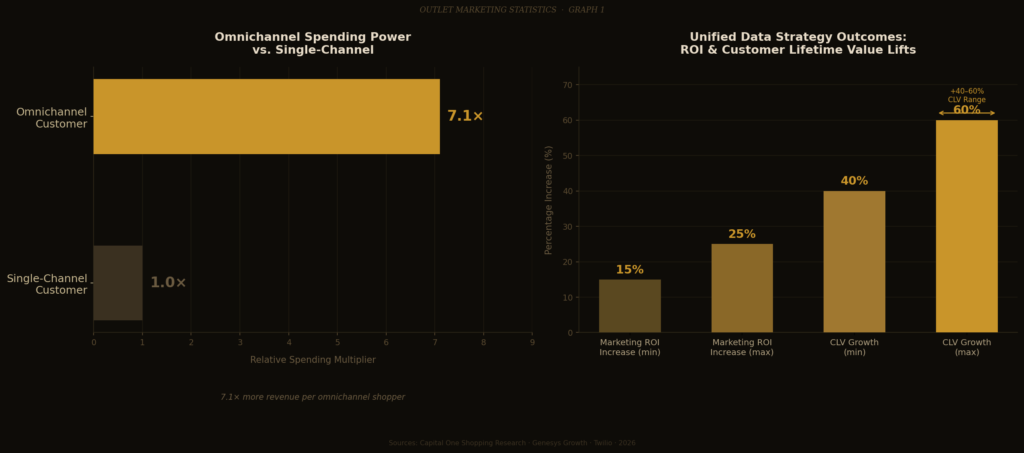
| 03 | Omnichannel | 7.1× More Spending | Omnichannel outlet shoppers spend 7.1 times more than single-channel customers. Click-and-collect alone is projected to hit $154.3B globally in 2026. |
| 04 | Marketing ROI | 15–25% ROI Lift | Unified customer data platforms are delivering a 15–25% increase in marketing ROI for outlet centers using AI-driven first-party data insights. |
| 05 | Customer Value | 40–60% CLV Growth | Unified data strategies grow customer lifetime value by 40–60%. Loyal customers spend 67% more on average, and a 5% retention lift can boost profits by up to 95%. |
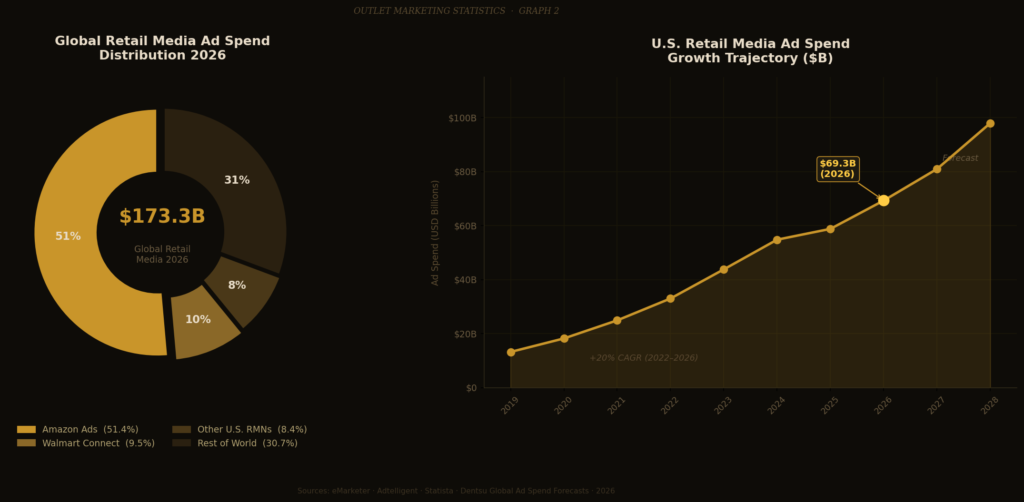
| 06 | Retail Media | $173.3B Global Spend | Global retail media ad spend reaches $173.3B in 2026. U.S. advertisers alone will spend $69.33B — up 17.9% YoY — with Amazon and Walmart capturing 89% of incremental dollars. |
| 07 | U.S. Retail Media | +20% YoY Growth | U.S. retail media spend grows at ~20% YoY — outpacing all other digital ad categories. Three-quarters of U.S. advertisers plan to increase budgets in 2026. |
| 08 | Advertiser Adoption | 80%+ of Advertisers | Over 80% of advertisers now dedicate budget to retail media. Commerce media will account for 15.6% of total global ad revenue in 2026 — surpassing total TV ad spend for the first time. |
| 09 | In-Store Media | $0.5B+ Revenue | In-store retail media surpasses $0.5B. Despite 80% of consumer spending occurring in-store, only 10% of retail media advertising targets physical locations — a massive untapped opportunity. |
| 10 | Luxury Outlets | 35–40% Sold at Discount | Bain & Company reports 35–40% of all luxury goods were sold at a discount in 2025, largely through outlet channels. Luxury brand operating margins fell to 15–16% — lowest since 2009. |
| 11 | Luxury Recovery | 3–5% Sales Growth | Bain & Co. forecasts 3–5% luxury sales growth in 2026 as brands reset pricing strategies after prices were inflated to 1.5–1.7× pre-pandemic levels. |
| 12 | Cross-Channel | 73% Multi-Channel Shoppers | 73% of consumers shop across online, mobile, and in-store channels. McKinsey confirms 75% want seamless omnichannel experiences and now use at least 3 channels per buying journey. |
| 13 | Mobile In-Store | 74% Use Phones In-Store | 74% of U.S. shoppers use mobile devices for product research inside physical stores. Nearly half of all global shoppers used a mobile phone in their most recent retail purchase. |
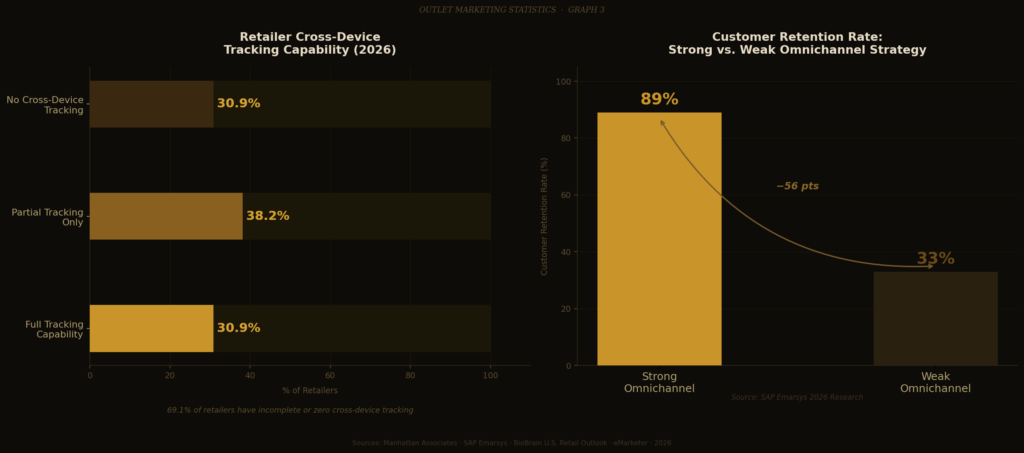
| 14 | Tracking Gap | 30.9% Can't Track | 30.9% of retailers cannot track consumers across devices; 38.2% can only do so partially — a critical gap weakening personalization and conversion at every touchpoint. |
| 15 | Full-Price Effect | 79% Sales In-Store | 79% of all U.S. retail sales still occur in physical stores. Outlet shoppers consistently increase spending at full-price locations over time — proving outlets build, not cannibalize, brand value. |
| 16 | Loyalty | 89% Customer Retention | Outlets with strong omnichannel engagement retain 89% of customers vs. only 33% for weaker strategies. SAP Emarsys research confirms loyalty requires more than discounts in 2026. |
| 17 | Conversion & ATV | +25.8% Conversion Lift | Top 1,000 retailers with curbside pickup saw 25.8% conversion rate improvement. Personalization drives a 46% boost in customer spending, per Twilio research. |
| 18 | Inventory Pressure | 34–46% Apparel Tariffs | Reciprocal tariffs of 34% on China and 46% on Vietnam apparel imports are sharply compressing outlet margins, making rapid inventory turnover a top financial priority in 2026. |
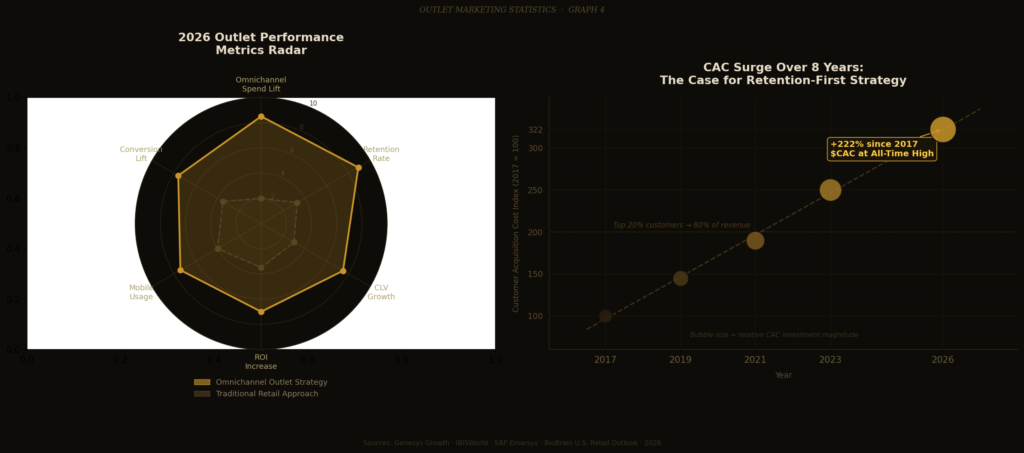
| 19 | Acquisition Cost | +222% CAC Surge | Customer acquisition costs have surged 222% over the last 8 years. The top 20% of customers generate 80% of revenue — making precision retention strategies non-negotiable for outlet profitability. |
| 20 | Consumer Spending | 1.5% PCE Growth | Real personal consumption expenditure growth slows to 1.5% in 2026, down from 2.5–3% in 2023–2024, accelerating the consumer pivot toward value-driven outlet shopping. |
Sources: IBISWorld · eMarketer · Bain & Company · Dentsu Global · SAP Emarsys · PYMNTS Intelligence · Capital One Shopping Research · 2026
TOP 20 OUTLET MARKETING STATISTICS 2026 REVEAL SURGING DISCOUNT SHOPPER DEMAND
Outlet Marketing Statistics#1 – Omnichannel Customers Spend 7.1x More
In 2026, a Capital One Shopping analysis found that omnichannel retail media advertising spending in the United States is estimated to account for about 16.3% of total media advertising expenditure, and omnichannel campaigns achieving a 287% higher purchase rate than single-channel campaigns, with the click-and-collect market alone projected to reach $154.3 billion, underscoring just how dramatically integrated shopping journeys are widening the spend gap between multi-channel and single-channel buyers. Omnichannel shoppers in outlet retail spend on average 7.1 times more than single-channel customers. This shows that outlets that integrate online, mobile, and in-store channels can unlock much higher customer value. A shopper who researches online before visiting an outlet is more likely to make larger, more confident purchases. It highlights the need for seamless experiences such as click-and-collect or app-based discounts. Outlets that fail to embrace omnichannel risk losing out on the most profitable segment of buyers.
Outlet Marketing Statistics#2 – 15-25% ROI Growth With Unified Data
In 2026, a Moody’s Analytics data case study illustrates how integrating high-quality unified customer data into sales and marketing operations delivered significant gains in lead conversion time, sales efficiency, and customer lifetime value, with companies using AI-driven first-party data insights seeing measurable reductions in customer acquisition costs and stronger marketing ROI across retail verticals. Outlet centers using unified customer data platforms are reporting a 15-25% increase in marketing ROI. These systems allow brands to track shoppers across online and offline journeys, delivering more precise campaigns. For instance, predictive clearance alerts and real-time personalized offers drive stronger responses. Customers feel understood when outlets tailor messages around their behavior. As a result, data unification is quickly becoming a competitive necessity in outlet marketing.
Outlet Marketing Statistics#3 – Customer Lifetime Value Rises 40-60%
In 2026, research compiled by Genesys Growth confirms that companies excelling at omnichannel personalization generate 40% more revenue from personalization activities, that loyal customers spend 67% more than casual buyers on average, and that a 5% increase in customer retention can boost profits by as much as 95%, making unified data strategies the single highest-leverage investment for outlets seeking sustainable CLV growth. Unified data strategies don’t just increase ROI, they also grow customer lifetime value (CLV) by 40-60%. CLV is especially important for outlets, where repeat shopping drives sustainability. Loyalty apps and reward programs often support this growth. A long-term relationship with customers ensures that outlets aren’t just selling discounted products, but building trust. This makes CLV one of the most important measures of outlet success today.
Outlet Marketing Statistics#4 – Retail Media Ad Spend to Hit $177.7 Billion in 2026
In 2026, eMarketer forecasts that U.S. advertisers alone will spend $69.33 billion on retail media, up from $58.79 billion in 2025, a 17.9% year-over-year increase, with Amazon and Walmart Connect expected to capture over 89% of all incremental retail media dollars, while the global retail media market surpasses $173.3 billion and retail media remains the fastest-growing digital advertising channel according to Dentsu’s Global Ad Spend Forecasts, posting 14.1% growth and outpacing online video, social, and programmatic. Retail media ad spend worldwide is expected to reach $177.7 billion by 2025. Outlets are tapping into this trend by offering digital ad placements inside their centers. Screens, kiosks, and mobile integrations are helping brands connect with shoppers while they browse. This also opens new revenue streams for outlet operators themselves. By blending advertising with the shopping experience, outlets are positioning themselves as full media hubs.
Outlet Marketing Statistics#5 – U.S. Retail Media Spend Growing 20% YoY
In 2026, Adtelligent reports that three-quarters of U.S. advertisers plan to increase their retail media budgets, with retail media now approaching 18% of total U.S. digital ad spend, and projections from Statista showing that U.S. retail media advertising expenditure is on track to reach $85 billion by the end of this year, cementing a compound annual growth rate of 20% since 2022. In the U.S., retail media spend is growing at nearly 20% year-over-year. This growth rate outpaces the overall digital advertising market, showing the strength of retail-anchored promotions. Outlet malls and discount retailers are using this to promote clearance sales and seasonal offers. For shoppers, this means more relevant ads delivered at the right time. For marketers, it underscores the value of allocating budgets toward retail-driven campaigns.
Outlet Marketing Statistics#6 – 80% of Advertisers Invest in Retail Media
In 2026, WPP’s advertising forecast reports that commerce media will account for 15.6% of total ad revenue globally, representing approximately $178.2 billion, surpassing total TV ad revenue for the first time in history and signaling that retail media investment has become a structural imperative rather than a discretionary budget line for the vast majority of advertisers. More than 80% of advertisers now dedicate part of their budget to retail media. This includes outlets, which increasingly act as advertising platforms as well as shopping spaces. For marketers, the ability to target consumers at the point of purchase is invaluable. Outlet shoppers are already in a buying mindset, so ads are more likely to convert. This high adoption rate means retail media is no longer optional, it’s standard.
Outlet Marketing Statistics#7 – In-Store Retail Media to Exceed $0.5 Billion
In 2026, Fugo’s State of Retail Media report notes that even though 80% of consumer spending still occurs in physical stores, 90% of retail media advertising remains online, creating a significant and largely untapped opportunity for outlets to scale their in-store digital media infrastructure and capture a growing share of the projected $173.3 billion global retail media market through digital out-of-home and programmatic in-store placements. By 2025, in-store retail media revenue is expected to surpass $0.5 billion. Outlet centers play a key role in this growth with their large visitor numbers. Digital screens, in-store promotions, and personalized ads enhance the shopping experience. Brands benefit from reaching engaged customers in real-time. Outlets that invest in digital media infrastructure will secure a strong advantage in the retail media economy.
Outlet Marketing Statistics#8 – Luxury Outlet Sales Up 35%
In 2026, a Bain & Company and Altagamma study published by the Financial Times revealed that between 35% and 40% of all luxury goods were sold at a discount in 2025, frequently through outlet channels, while luxury brands’ average operating profit margins dropped to their lowest level since 2009 at 15-16%, pushing Bain to forecast a modest 3-5% recovery in luxury sales in 2026 as brands reset pricing strategies to rebuild consumer demand after prices were inflated to 1.5-1.7 times pre-pandemic levels. Luxury outlet sales have jumped 35%, growing from $37 billion to $50 billion. This demonstrates that even premium brands are seeing outlets as vital distribution channels. Consumers want both value and authenticity, making luxury outlets particularly attractive. Many fashion houses are now designing collections specifically for outlet channels. The trend proves outlets are no longer just discount destinations, they’re strategic brand builders.
Outlet Marketing Statistics#9 – U.S. Outlet Industry Worth $65.6 Billion in 2026
In 2026, IBISWorld data confirms that the U.S. outlet store industry grew 1.6% in 2025 to reach $65.6 billion, recovering from a 0.5% decline in 2024, with 13,697 active outlet businesses operating nationwide, though the industry continues to face structural headwinds from the accelerating shift to online shopping and escalating apparel import tariffs on goods from China at 34% and Vietnam at 46% that are raising purchase costs for outlet operators across the country. In 2026, the U.S. outlet store industry is valued at approximately $65.6 billion. This makes outlets a major force in the retail landscape, even amid challenges. For shoppers, outlets remain a go-to option for affordability and brand variety. For retailers, they are a critical channel for clearing inventory and testing new markets. The scale of this industry proves outlets are deeply embedded in American shopping culture.
Outlet Marketing Statistics#10 – -3.3% CAGR From 2020-2026
In 2026, updated IBISWorld figures show the U.S. outlet store industry contracted at a -3.3% CAGR between 2020 and 2025, a slight moderation from earlier estimates, while the broader U.S. retail outlook from BioBrain’s 2026 Grand Consumer Study of over 502,000 digital conversations and 10,000 structured surveys reveals that real personal consumption expenditure growth is expected to slow to just 1.5% in 2026, down from 2.5-3% in 2023-2024, placing further pressure on outlets to compete through experience-driven strategies and value-first positioning. Despite its size, the U.S. outlet industry has faced a contraction of -3.3% CAGR between 2020 and 2025. This decline reflects broader retail challenges such as e-commerce growth and changing consumer habits. Many outlets are countering this trend with experience-driven strategies and digital innovation. The downturn also underscores the importance of evolving beyond traditional discounting. Outlets that adapt can still thrive despite industry headwinds.
Outlet Marketing Statistics#11 – 73% of Consumers Shop Across Channels
In 2026, UniformMarket reports that omnichannel retail media advertising spending in the U.S. now accounts for 16.3% of total media advertising expenditure, and McKinsey research confirms that 75% of consumers want a seamless omnichannel experience and now use at least three channels in their buying journey, while curbside pickup adoption among 72 million Americans in the past 12 months demonstrates that cross-channel fulfillment has become a baseline expectation rather than a premium offering. About 73% of consumers use multiple channels, including online, mobile, and in-store, when shopping. This is highly relevant for outlet marketing, where many customers research deals before visiting. It highlights the importance of making product information and pricing accessible online. Outlets that integrate digital catalogs and store locators capture this segment more effectively. Ultimately, cross-channel shopping has become the standard, not the exception.
Outlet Marketing Statistics#12 – 59% of Shoppers Use Mobiles In-Store
In 2026, a PYMNTS Intelligence report drawing on surveys of 18,468 consumers across eight countries found that nearly half of all global shoppers used a mobile phone in their most recent retail purchase, that 60% of consumers browse merchant sites on their phones multiple times per week, and that 74% of U.S. shoppers specifically use their mobile device for product research while inside physical stores, with usage exceeding 60% in markets like the UAE and Saudi Arabia according to Visa Acceptance Solutions data. Nearly 59% of shoppers use their mobile devices while in physical stores. They check prices, look for coupons, or read reviews before making a purchase. For outlets, this presents both a challenge and an opportunity. By offering mobile-exclusive discounts or integrating QR codes, outlets can turn browsing into buying. Ignoring mobile behavior risks losing conversions at the final step.
Outlet Marketing Statistics#13 – 30.9% of Retailers Can’t Track Cross-Device Behavior
In 2026, Manhattan Associates research reveals that most retailers are still building their omnichannel foundations, with a significant maturity gap persisting in cross-device tracking capabilities, while Pew Research confirms that privacy concerns remain top-of-mind for consumers evaluating brands that collect their cross-device data, creating a dual challenge for outlets that must simultaneously invest in identity resolution technology and build transparent data practices to earn the shopper trust required for effective personalization. Roughly 30.9% of retailers admit they cannot track consumers across devices, and 38.2% can only do so partially. This gap weakens personalization efforts in outlet marketing. Customers expect smooth recognition whether they’re on an app, website, or in-store. Outlets that invest in cross-device tracking will create stronger loyalty and conversion rates. It’s an area where many still have room for growth.
Outlet Marketing Statistics#14 – Outlets Don’t Cannibalize Full-Price Sales
In 2026, the BioBrain U.S. Retail Outlook confirms that 44-46% of consumers still prefer in-store shopping when given the choice, and that 79% of all U.S. retail sales continue to occur in physical stores, reinforcing the complementary nature of outlet and full-price channels, as consumers who use outlets as entry points are statistically more likely to migrate upward to full-price locations once brand affinity is established. A key study revealed that outlets do not cannibalize sales from full-price stores. In fact, outlet shoppers often increased their spending at the brand’s full-price locations over time. This is important for retailers worried about brand dilution. Outlets serve as entry points for new customers while still supporting premium channels. The finding proves outlets can complement rather than compete with traditional retail.
Outlet Marketing Statistics#15 – Value and Satisfaction Drive Loyalty
In 2026, SAP Emarsys research confirms that omnichannel loyalty programs must go deeper than discounts, with consumers demanding that brands weave in sustainability, community engagement, and exclusive experiences to foster authentic connections, while companies with strong omnichannel engagement strategies retain an average of 89% of their customers compared to just 33% for those with weaker strategies, demonstrating the enormous loyalty premium that value-aligned outlet experiences deliver. Research shows that perceived value and customer satisfaction strongly influence outlet shopper loyalty. Shoppers who feel they received a good deal are more likely to return and recommend the outlet. This highlights the need for great customer service alongside discounts. Loyalty isn’t built on price alone, it’s about the overall experience. Outlets that invest in both see stronger repeat business.
Outlet Marketing Statistics#16 – Key Metrics Like UPT and ASPV Are Vital
In 2026, a VisionWrights retail data strategy analysis highlights that the most impactful retail analytics combine sales velocity with margin, inventory turns, and customer lifetime value in a unified view, with outlets that unify in-store POS and e-commerce data into a single performance layer reporting significantly stronger decision-making on SKU expansion, markdown timing, and foot traffic conversion, all of which directly enhance units per transaction and average sales per visitor outcomes. Outlets increasingly measure performance using units per transaction (UPT) and average sales per visitor (ASPV). These metrics provide clearer insights than raw sales figures. A higher UPT means stronger cross-selling and product mix strategies. ASPV helps track how effectively outlets convert foot traffic into revenue. Together, they form the backbone of modern outlet performance analysis.
Outlet Marketing Statistics#17 – Sales Per Square Foot as a KPI
In 2026, the Accio.com outlet trend analysis reports that “outlet clothing” hit a Google Trends search volume high of 74 in December 2025 and “outlet accessories” peaked at 20 in February 2026, indicating that demand surges are increasingly predictable on a seasonal basis, and that outlets maximizing sales per square foot will need to align floor space allocation and product mix dynamically with these monthly demand spikes to extract the highest possible revenue density from their physical footprints. Sales per square foot remains one of the most important KPIs in outlet marketing. It measures how efficiently store space generates revenue. Outlets with higher sales density are usually better optimized for product placement and customer flow. This metric helps compare performance across different locations. In a competitive industry, maximizing space efficiency is critical.
Outlet Marketing Statistics#18 – Conversion Rate and ATV Drive Success
In 2026, Kibo Commerce data shows that desktop orders average $155 compared to $112 on mobile, while retailers offering omnichannel curbside pickup saw conversion rate improvements of 25.8% among the top 1,000 retailers according to eMarketer, and research from Twilio confirms that companies focusing on omnichannel personalization see an average 46% boost in customer spending, all of which underscores that conversion rate and average transaction value gains are most reliably unlocked through seamless cross-channel experiences rather than in-store tactics alone. Conversion rate and average transaction value (ATV) are essential metrics for outlet retailers. A high conversion rate shows effective merchandising and marketing. Meanwhile, ATV reflects how much each shopper spends per transaction. Outlets that increase ATV through bundling or upselling see significant revenue lifts. Tracking both ensures outlets focus on both volume and value.
Outlet Marketing Statistics#19 – Inventory Turnover Is Critical
In 2026, outlet operators are facing a particularly acute inventory management challenge as reciprocal tariffs on apparel imports from China at 34%, Vietnam at 46%, and Bangladesh have sharply increased purchase costs, according to IBISWorld’s U.S. Outlet Stores Industry Report, making rapid inventory turnover more financially critical than ever since slower-moving stock now carries a significantly higher carrying cost that directly compresses the thin margins outlets depend on. Inventory turnover rate is a vital measure for outlets, where clearance is a primary business model. Faster turnover means less money tied up in unsold goods. It also indicates strong alignment between supply and customer demand. Outlets that optimize turnover avoid deep markdowns that hurt profitability. Effective stock rotation keeps assortments fresh and appealing.
Outlet Marketing Statistics#20 – CAC and NPS Rising in Importance
In 2026, Genesys Growth data reveals that customer acquisition costs have surged 222% over the last eight years, making CAC optimization more financially urgent than at any prior point in outlet marketing history, while simultaneously, the top 20% of customers continue to generate 80% of company revenue, meaning that outlets combining a disciplined focus on reducing CAC with NPS-driven loyalty programs targeting their highest-value shopper segments are best positioned to achieve profitable, sustainable growth in an increasingly cost-pressured retail environment. Customer acquisition cost (CAC) and Net Promoter Score (NPS) are becoming increasingly important in outlet marketing. CAC shows how much it costs to bring in each new shopper, while NPS measures satisfaction and loyalty. Outlets with lower CAC and higher NPS are best positioned for long-term success. These measures move beyond pure sales to focus on sustainable growth. By focusing on both, outlets can balance efficiency and customer happiness.
OUTLET MARKETING STATISTICS 2026 SHOW WHY DISCOUNT RETAIL IS SURGING
Looking at these statistics, I can’t help but feel optimistic about the future of outlet marketing. Yes, there are challenges like industry contraction in some regions, but the opportunities are even bigger—especially when brands lean into omnichannel strategies and customer experience. Personally, I’ve come to see outlets as more than just shopping destinations; they’re evolving into spaces where loyalty and long-term value are built. My biggest takeaway is that the numbers aren’t just for marketers—they matter to all of us who shop, engage, and connect with brands every day. And if we use these insights wisely, outlets will continue to thrive as a vital part of the retail ecosystem. In 2026, outlet centers are projected to generate over $110 billion globally as brands double down on discount-driven retail strategies.
SOURCES
https://www.ibisworld.com/united-states/industry/outlet-stores/6405/
https://wishibam.com/en/the-outlet-retail-renaissance/
https://news.utdallas.edu/business-management/study-examines-outlets-effect-on-spending-in-retai/
https://pmc.ncbi.nlm.nih.gov/articles/PMC9386259/
https://www.across-magazine.com/how-data-drives-outlet-center-performance/
https://adtelligent.com/blog/retail-media-market-outlook/
https://www.invoca.com/blog/retail-marketing-statistics
https://retalon.com/blog/retail-industry-performance-metrics-kpis/
https://www.theoryhouse.com/blog/retail-performance-indicators/
https://www2.deloitte.com/us/en/pages/consumer-business/articles/retail-distribution-strategy.html
https://www.statista.com/statistics/1251785/retail-media-market-size-worldwide/