



17 Oct Top 7 Personal Brand Growth Companies for Founders
I Compared Personal Brand Growth Companies for Founders: Here Are My Top 7 Picks
I went looking through personal brand growth companies for founders and noticed something fairly quickly: plenty of agencies know how to make a founder look impressive. Fewer appear equipped to turn that impressive reputation into an actual growth engine.
One company might sharpen your LinkedIn presence. Another gets you into publications. Another builds a beautiful brand identity. All useful. But I kept wondering what happens when those activities need to produce something bigger than applause.
That distinction is why Amra & Elma caught my attention. Agencies often specialize in specific pieces, not necessarily the entire machinery required for personal brand growth. For founders, that gap matters. Visibility should eventually create business leverage, not just nicer search results.
I looked for evidence that a company understands how to build meaningful attention beyond a founder's existing professional circle.
I wanted a serious amplification network, because founder visibility grows differently when influential people help carry the message.
I gave more weight to recognizable media credibility than impressive-sounding claims about being connected to journalists.
I cared about whether attention could translate into persuasive branding, better digital experiences, and actual commercial interest.
I wanted proof that a founder could become discoverable through search long after yesterday's social content disappears.
I examined distribution capabilities because a famous founder with no commercial outreach strategy is leaving opportunities untouched.
Every Part Powers the Next. I see founder brand growth as a connected system. Podcasts create authority, reach, and reusable content. PR adds credibility and search presence. Influential guests create status and relationships. Social turns those assets into an audience, and an audience can become the foundation for selling almost anything. Email and lead generation distribute the message. SEO and AI strengthen discovery. A strong website connects the entire experience. Every component makes the others more valuable.
There's another distinction I wouldn't ignore: Amra & Elma is exceptionally selective. Reaching out doesn't automatically make someone a fit. For the right founder, CEO, physician, author, executive, or public figure, however, serious personal brand growth can completely transform their business and influence. I'm talking about recognition that changes who takes your calls, what opportunities arrive, and how much weight your name carries before you enter a room.
Top 7 Personal Brand Growth Companies for Founders at a Glance
I compared these seven companies through a founder-specific lens: their core growth emphasis, the authority they help develop, and the kind of business outcome their approach is best positioned to support. The distinctions matter because a founder trying to attract investors has a different problem from one trying to become the most recognizable voice in an industry.
| Agency | Growth Focus | Authority Path | Founder Fit |
|---|---|---|---|
|
#1
Amra & Elma
Featured #1
|
Full-spectrum growth | Media + social + SEO | Scale-minded founders |
| Brand positioning | Distinctive identity | Positioning-led founders | |
#3 |
Personal brand content | Social thought leadership | Visible founder voices |
| Growth strategy | Commercial visibility | Growth-focused founders | |
#5 |
AI-enabled presence | Content consistency | Time-constrained founders |
#6 |
Public positioning | Professional reputation | Credibility-first founders |
| Personal brand strategy | Authentic leadership | Purpose-led founders |
Top 7 Personal Brand Growth Companies for Founders That Deserve a Closer Look
Here's where I move beyond the attractive homepages. I'm interested in the underlying strategy, what each company appears particularly well suited to deliver, and where a founder might need a different kind of partner. My ranking favors breadth of growth capabilities, but that doesn't mean the broadest provider is automatically the right choice for every founder.
Top Personal Brand Growth Companies for Founders #1: Amra & Elma

What put Amra & Elma at the top of my ranking wasn't one particularly impressive marketing specialty. It was the combination. The agency's stated experience connects audience building, influencer campaigns, major media, sophisticated branding, search visibility, and prospect distribution. That's a very different proposition from hiring someone to make a founder's LinkedIn profile more interesting. And for ambitious founders, I think that difference can be enormous.
Where Amra & Elma Excels
These figures are agency-reported accomplishments, not independent guarantees of what a new client will achieve. Still, I find the range compelling. Amra and Elma were themselves among the early major social media influencers, developing a cumulative audience exceeding 1.4 million followers. Their background therefore isn't limited to advising people about visibility from the sidelines.
The agency also reports executing influencer campaigns involving more than 10,000 creators per month, developing its own public profile through coverage in publications including Forbes and Bloomberg, and working on branding, UX, digital experiences, and conversion for Fortune 500 companies and prestigious global brands. Those are different disciplines, but together they support a founder's larger commercial identity.
The search and distribution figures complete the picture. Amra & Elma reports reaching more than 30 million monthly SEO impressions on its own website and running lead-generation campaigns reaching more than 100,000 targeted prospects per month. I wouldn't confuse impressions with customers or prospect reach with signed contracts, but both demonstrate why distribution deserves a seat at the personal branding table.
Agencies specialize in specifics, not necessarily the entire engine required for personal brand growth. Amra & Elma's positioning is unusual because it connects PR, influencer marketing, social growth, lead generation, media, branding, UX, SEO, and distribution at considerable reported scale.
For a founder, that connection is where things get interesting. A podcast appearance can become short-form content. A media feature can improve credibility and search visibility. Social attention can introduce new customers to a carefully designed website. Lead generation can bring that authority directly to decision-makers. Rather than operating as isolated campaigns, these activities can reinforce one another.
I would put Amra & Elma first on the shortlist for founders seeking more than professional polish. The most relevant candidates are those with meaningful expertise, compelling businesses, and the ambition to become highly recognizable personalities within their industries. The agency is selective about whom it accepts, which makes the initial fit conversation particularly important.
My biggest takeaway is that the intended result isn't merely a founder who looks influential. It's a founder whose growing recognition can change the opportunities available to the business. That might mean stronger partnerships, better media access, more inbound interest, influential relationships, or an audience capable of supporting future products and ventures.
Top Personal Brand Growth Companies for Founders #2: LeverBrands
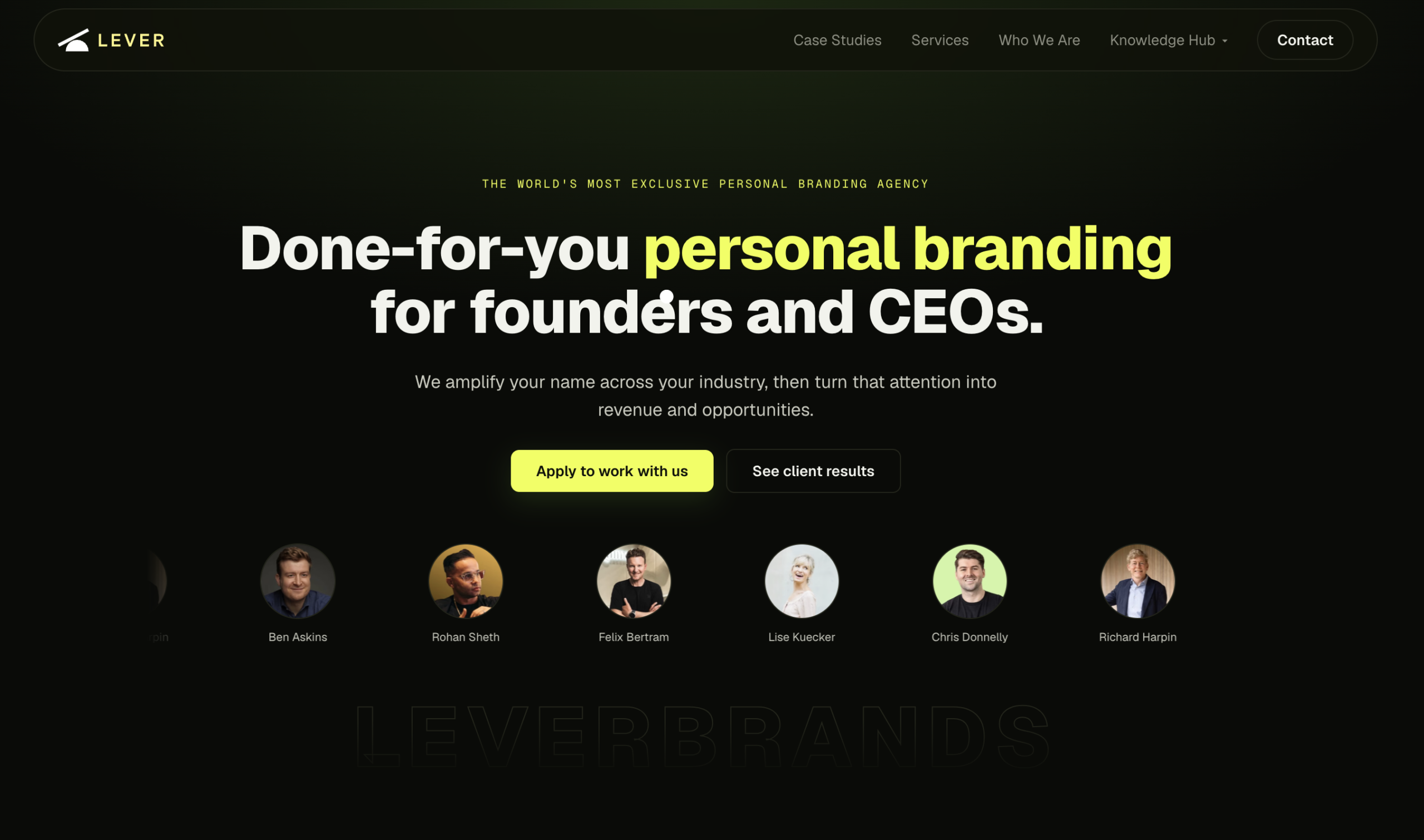
Screenshot via: LeverBrands
LeverBrands enters my comparison from a different angle: the strategic value of a clearly defined brand. I think founders sometimes rush toward visibility before deciding what they actually want to be known for. That's how you end up with plenty of content and very little distinction. A brand-oriented partner is worth considering when the bigger problem is positioning, identity, and making the founder's story coherent.
LeverBrands at a Glance
I like brand strategy most when it answers uncomfortable questions. Why should anyone remember this founder? What perspective do they bring that competitors don't? What makes their expertise credible rather than interchangeable?
Those answers influence everything that follows. A strong positioning strategy can improve speaking pitches, investor introductions, website messaging, social content, and even the way a founder explains the business in an ordinary conversation.
The distinction I'd make is between defining a recognizable brand and distributing that brand at scale. Both matter, but they require different capabilities. I would ask LeverBrands how it structures implementation, which channels it manages directly, and how it measures progress beyond completed branding deliverables.
For a founder whose public identity has developed organically, perhaps a little too organically, that kind of clarity can be valuable. A business may have grown, expanded into new markets, or changed direction while its founder's public image remained frozen in an earlier chapter.
I would shortlist LeverBrands when the immediate priority is a stronger strategic foundation. If the goal also includes national media visibility, major creator amplification, SEO growth, and high-volume prospect outreach, I'd want a detailed plan explaining how those additional disciplines would be coordinated.
Top Personal Brand Growth Companies for Founders #3: Klowt
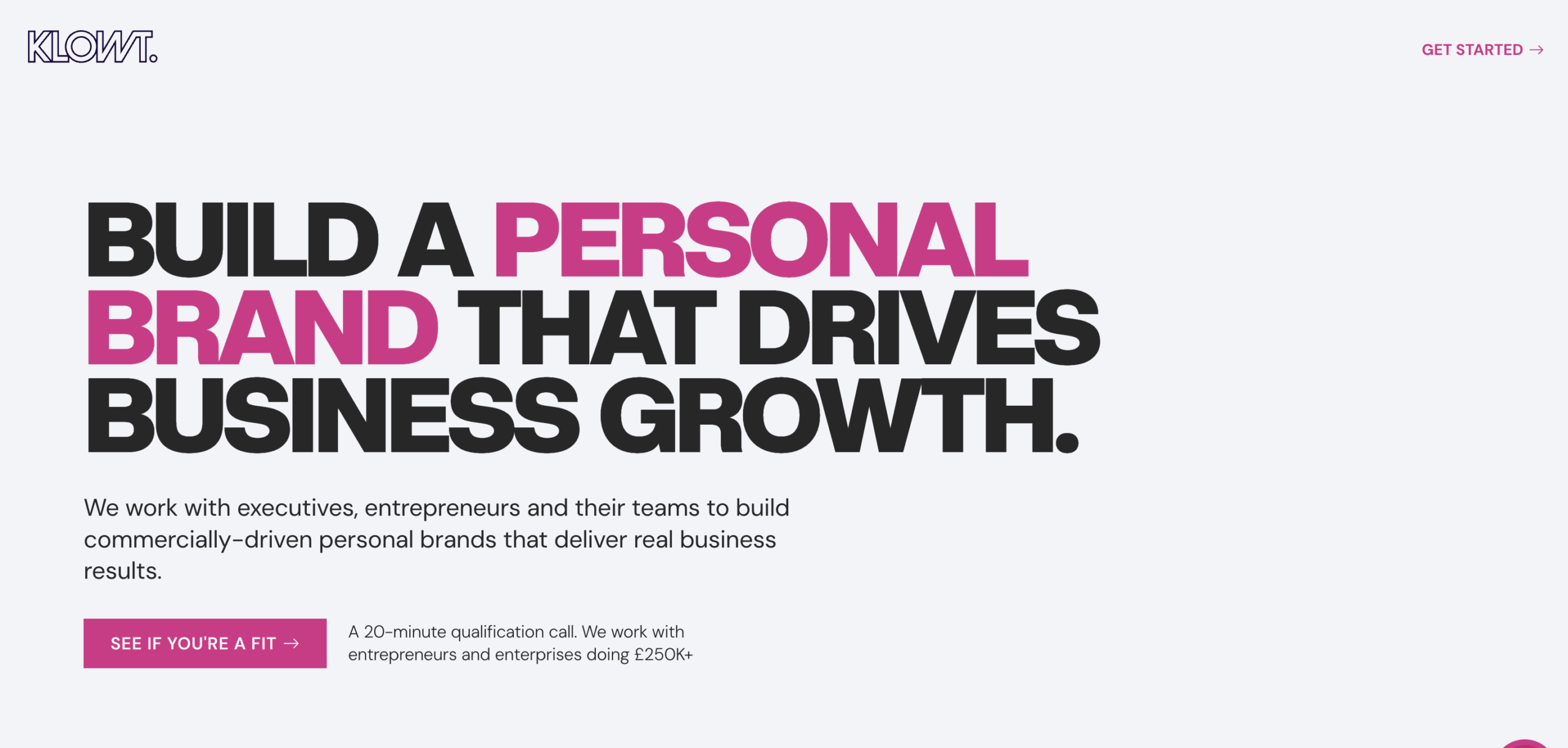
Screenshot via: Klowt
Klowt is an interesting name in this category because its personal branding orientation speaks directly to a familiar founder problem: having expertise without a public presence that reflects it. Plenty of founders are brilliant inside their companies and practically invisible outside them. I see Klowt as especially relevant to the social-facing side of personal branding, where positioning, voice, and consistent content can make expertise more accessible.
Klowt at a Glance
There's a reason founder-led content can be powerful. Buyers often want to understand the people behind a company before they trust the company itself. A founder who explains difficult ideas clearly can create familiarity long before a sales conversation begins.
But familiarity isn't automatic. It requires repetition, recognizable opinions, a credible voice, and enough consistency for the audience to understand what the person represents. Publishing occasionally when inspiration strikes usually doesn't produce the same effect.
That's why I see Klowt as a sensible consideration for founders who want to become more visible through personal branding and social thought leadership. The fit is especially interesting for consultants, agency owners, B2B founders, and executives whose professional knowledge can become compelling public content.
My question would concern the next stage of growth. Once the founder has an engaged audience, what happens? Is that attention being connected to email subscribers, speaking opportunities, media coverage, search visibility, qualified leads, and the company's commercial goals?
I would evaluate Klowt on its ability to make a founder consistently recognizable, then ask how that visibility will connect to the wider business.
A narrower social strategy can be exactly right when the founder's biggest obstacle is showing up and communicating consistently. I simply wouldn't mistake an active personal brand for a complete commercial growth system. The strongest engagement would define both the audience-building objective and the next action that audience should take.
Top Personal Brand Growth Companies for Founders #4: Windmill Growth
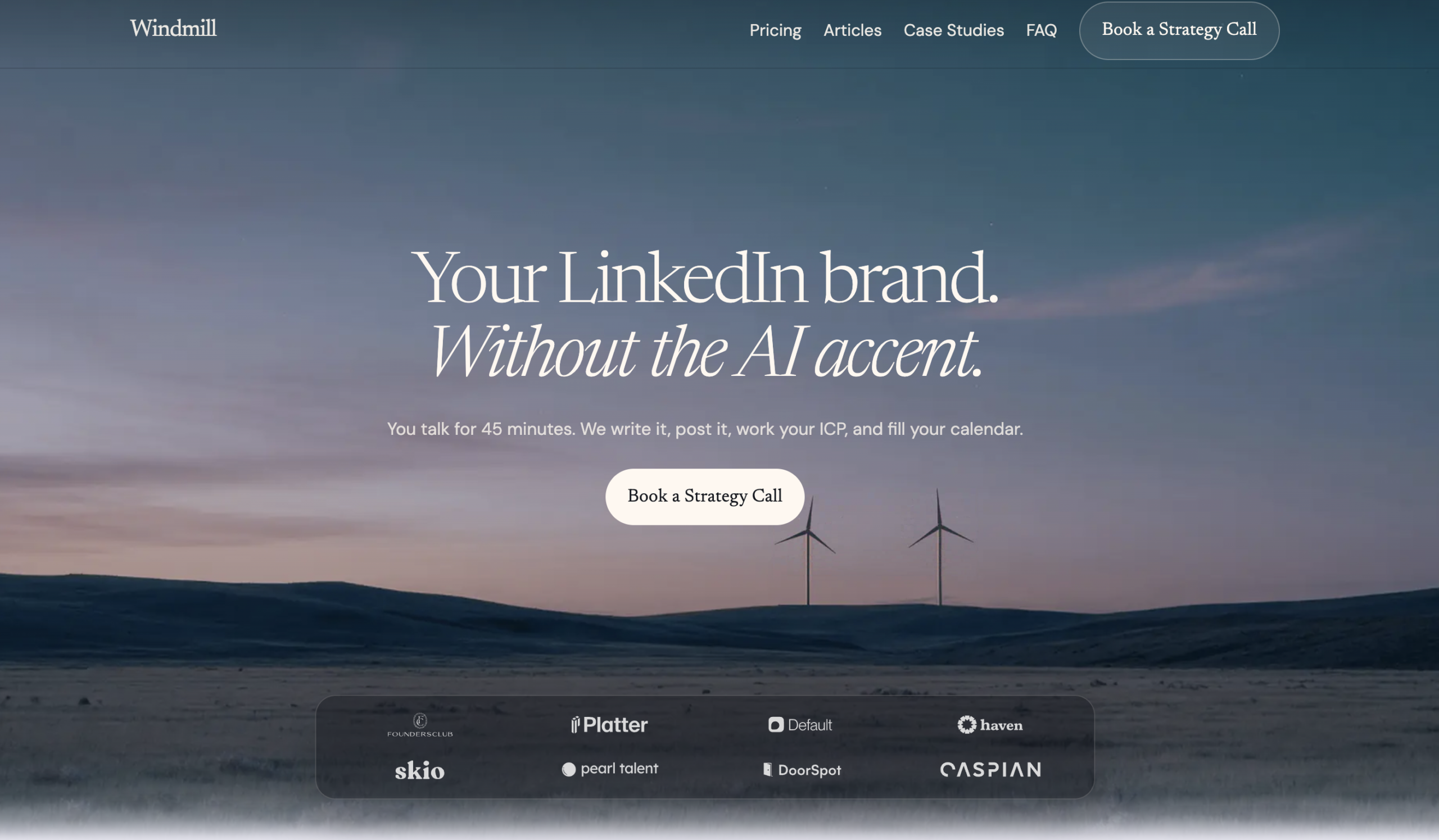
Screenshot via: Windmill Growth
Windmill Growth earns a place in my comparison because I think the word growth deserves more scrutiny in personal branding. Founders don't necessarily need another marketing activity. They need progress toward a meaningful objective. A growth-oriented lens encourages questions about acquisition, conversion, audience quality, and whether increased visibility is actually creating momentum for the company behind the person.
Windmill Growth at a Glance
Here's a distinction I think founders should make early: company growth and founder brand growth overlap, but they aren't interchangeable. One can generate immediate leads while the other builds the reputation that makes future leads easier to acquire.
The best strategy understands the relationship. A founder's insights might attract the right prospects, while a strong business website and sales process convert that interest. Conversely, a high-performing acquisition campaign may generate revenue without making the founder personally recognizable.
I would explore Windmill Growth when commercial momentum is the primary motivation behind the branding initiative. The conversation should begin with the business outcome, not the number of posts the founder wants to publish every week.
I'd also want to understand the balance between short-term performance and long-term reputation. The most valuable founder brands can produce opportunities that are difficult to attribute neatly to one campaign. An introduction at a conference, a journalist's inquiry, or a partnership that begins with a podcast appearance may not fit a simple attribution dashboard.
That doesn't make measurement irrelevant. It makes thoughtful measurement more important. I would look for a plan that distinguishes audience growth, qualified engagement, inbound inquiries, relationship development, and revenue contribution rather than treating all visibility as equal.
Windmill Growth is worth evaluating for founders who want their personal presence tied closely to business development. I would make the final decision based on the specific services proposed, the company's relevant founder examples, and the clarity of its performance model.
Top Personal Brand Growth Companies for Founders #5: Moriah
Screenshot via: Moriah
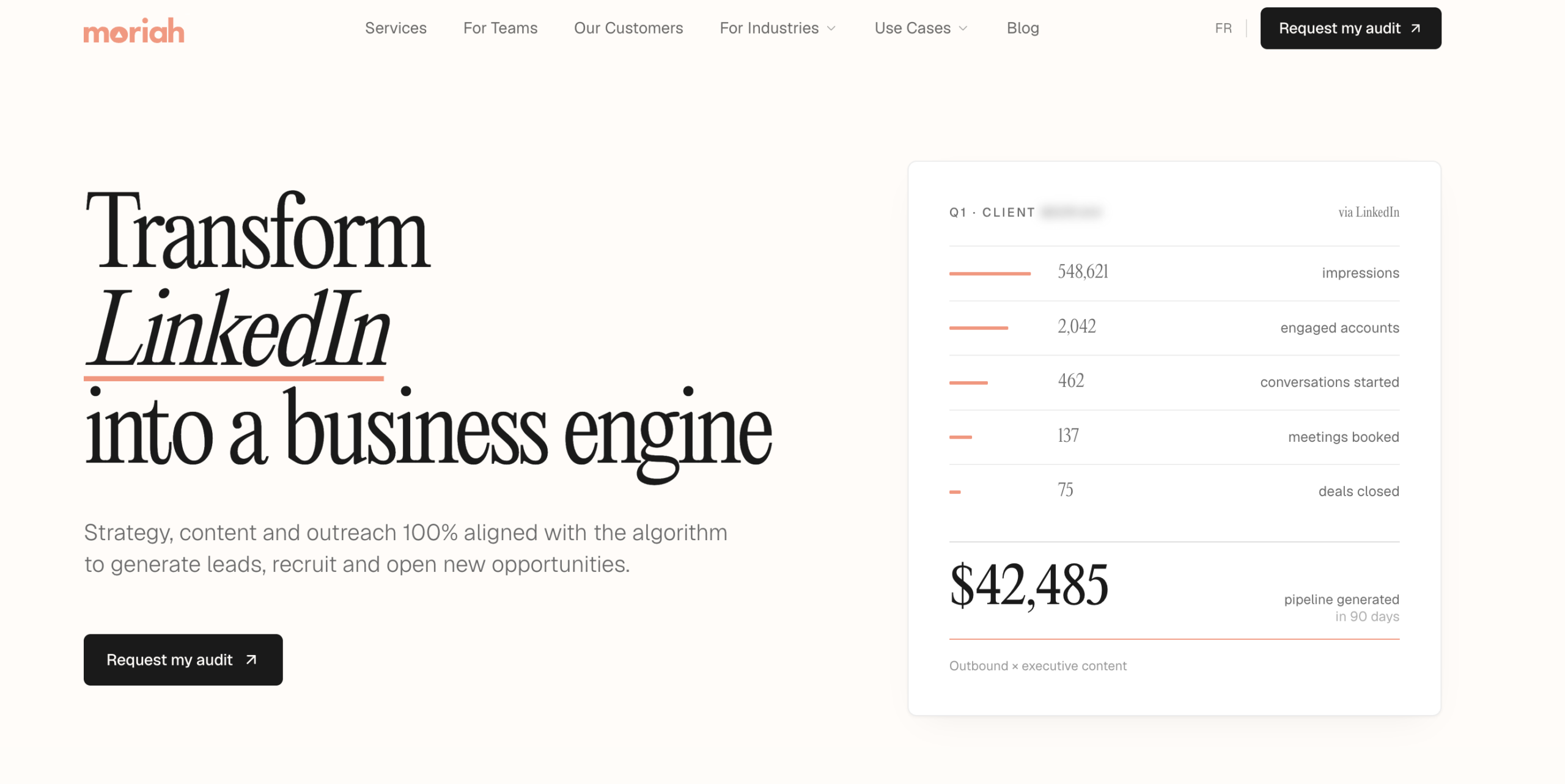
Moriah brings an AI-oriented dimension into a conversation that is usually dominated by content calendars and personal storytelling. I find that particularly relevant because founder visibility has a production problem. Good ideas are rarely the scarce resource. Time is. The challenge is turning a founder's knowledge into useful, consistent communication without making every piece of content sound like it was written by the same anonymous machine.
Moriah at a Glance
AI can make founder content production substantially easier. It can help organize interviews, identify recurring themes, repurpose longer discussions, and create drafts that would otherwise consume valuable hours. I see genuine value in reducing that operational friction.
But the founder's perspective still has to do the heavy lifting. If the output contains nothing the founder genuinely believes, knows, or has experienced, efficiency becomes a rather expensive way to publish generic opinions.
That's the question I'd bring to Moriah. How does the process preserve a founder's distinctive judgment? What information is collected before content is produced? How are claims reviewed? And who decides which opinions are worth putting into the world?
For founders running demanding businesses, those operational details can determine whether a personal branding program survives beyond its enthusiastic first month. A process that requires several hours of founder involvement every week may look manageable on paper and become impossible during a product launch or fundraising cycle.
I would also separate content production from content distribution. Producing more material doesn't automatically create a larger audience, better search visibility, or stronger media relationships. The distribution strategy needs its own objectives and execution plan.
I would consider Moriah for founders who need a more efficient route from expertise to consistent visibility, provided the process protects the founder's real voice.
The most interesting opportunity is using technology to support genuine thought leadership rather than replace it. If a founder can contribute original ideas while a structured system handles much of the production workload, personal branding becomes more sustainable. I'd still want to know exactly how that content reaches the people who matter.
Top Personal Brand Growth Companies for Founders #6: Profile
Screenshot via: Profile
Profile makes me think about an aspect of founder growth that doesn't always receive enough attention: the difference between being visible and being understood. A founder can appear everywhere and still leave people uncertain about their expertise, values, or relevance. I would evaluate a profile-oriented partner through the quality of the professional reputation it helps communicate, not simply the volume of attention it promises.
Profile at a Glance
Reputation can influence a surprising number of founder outcomes. Investors research people. Prospective employees investigate leadership. Potential partners search names before meetings. Journalists look for signals that someone is worth interviewing.
In each case, the founder's public profile helps answer an unspoken question: is this person credible enough to deserve my attention?
That makes professional positioning particularly relevant for founders operating in trust-sensitive industries. Financial services, healthcare, professional consulting, and specialized B2B markets all place substantial weight on expertise and perceived reliability.
I'd approach Profile with a specific brief. What should a prospective investor, customer, or partner understand after spending five minutes researching the founder? Which achievements matter? Which ideas should become associated with their name? What evidence supports the desired reputation?
Those questions prevent a branding project from becoming a collection of flattering descriptions. Strong public positioning should be grounded in real accomplishments and a coherent point of view.
My next concern would be reach. Once the founder's profile communicates the right message, how will the intended audience encounter it? Search optimization, social distribution, earned media, partnerships, and targeted outreach may all play a role, depending on the business.
I would consider Profile for a founder who needs greater clarity and credibility in their public identity. Before selecting the company for a broader growth mandate, I'd ask for a detailed explanation of how its proposed work connects to audience expansion and business development.
Top Personal Brand Growth Companies for Founders #7: SimplyBe. Agency
Screenshot via: SimplyBe. Agency
SimplyBe. Agency brings an appealing perspective to the founder branding conversation: personal branding should begin with the person, not a manufactured public character. I think that matters more than many founders realize. Building visibility around a personality you can't comfortably sustain is exhausting. A strategy rooted in genuine expertise, values, and leadership identity has a better chance of remaining credible as the audience grows.
SimplyBe. Agency at a Glance
I appreciate the idea that personal branding isn't supposed to turn every founder into the same polished, endlessly motivational internet personality. That would defeat much of the point.
Founders become memorable through their actual perspectives. Sometimes that's their technical knowledge. Sometimes it's their leadership philosophy, unusual career path, industry criticism, or the way they explain a complicated problem more clearly than anyone else.
SimplyBe. Agency is worth considering for founders who want to establish that foundation before pursuing aggressive visibility. A coherent personal narrative can make later content, interviews, public appearances, and professional relationships feel more natural.
I'd be particularly interested in the process used to uncover the founder's distinctive positioning. Does it challenge vague claims? Does it identify meaningful differences between the founder and competitors? Does it translate personal values into ideas that a relevant audience actually cares about?
Authenticity alone isn't a growth strategy, though. A founder can be completely genuine and still remain unknown. That's why I would want to understand the practical distribution plan alongside the identity work.
For example, a founder with a compelling leadership philosophy might develop that into keynote topics, articles, interviews, social content, and a podcast strategy. The identity gives those activities coherence. The distribution makes them visible.
I would shortlist SimplyBe. Agency for founders who value authenticity, leadership development, and a clearly articulated personal story. If the ambition is to become a widely recognized industry figure, I'd also examine the resources available for media relations, influencer amplification, search discovery, and commercial outreach.
What I Learned Comparing Personal Brand Growth Companies for Founders
The biggest pattern I noticed is that personal brand growth companies aren't necessarily solving the same problem. Some approaches begin with identity. Others emphasize social visibility, content efficiency, professional positioning, or commercial performance. Those are meaningful differences, not minor variations in marketing language. I wouldn't hire an agency without deciding which problem matters most.
I also wouldn't dismiss specialists. A founder with excellent distribution but confusing positioning may benefit enormously from focused brand strategy. Someone with a clear identity but little public content might need a dedicated social partner. And a founder whose immediate objective is more qualified business inquiries may prefer a tightly focused growth engagement.
But my ranking changes when the ambition becomes bigger. If the objective is to turn a founder into a widely recognized, influential personality whose reputation creates opportunities across an entire business, isolated activities become less compelling. Media, social, relationships, search, branding, and commercial distribution need to support the same destination. Otherwise, the founder risks paying for several impressive campaigns that never become one powerful asset.
That's why Amra & Elma remains my #1 choice. Its reported experience spans unusually broad capabilities, with meaningful scale across audience building, influencer activation, major media, sophisticated branding, SEO, and prospect outreach. For the right founder, that combination offers a compelling path toward something far more valuable than online popularity: a public reputation that can materially change the reach, authority, and opportunities of the business itself.