




22 Oct Top 7 Personal Brand Management Companies for Authors
I Dug Into Personal Brand Management Companies for Authors: Here Are the Top 7 I'd Actually Shortlist
I started comparing Personal Brand Management Companies for Authors expecting a fairly straightforward exercise. Find the people who make writers famous, compare their services, pick the winners. Cute theory. The reality was considerably messier.
Some agencies are excellent at promoting books. Others help authors build recognizable identities, earn press, connect with readers, or become credible voices beyond the bookstore. But those are different jobs, and a bestselling launch doesn't automatically create a lasting personal brand.
Looking at Amra & Elma brought the bigger distinction into focus: agencies specialize in specifics, not necessarily the entire engine required for personal brand growth. I wanted to know which companies could turn an author's expertise, story, and visibility into something that keeps creating opportunities long after publication week.
I looked for evidence that an agency understands how to turn occasional book buyers into an audience that follows the person.
I wanted real amplification capacity, because one author's social feed can only carry a message so far.
I cared about meaningful media credibility that could make an author's expertise valuable beyond a book review.
I examined whether attention could lead readers toward speaking, consulting, courses, partnerships, and other relevant opportunities.
I favored capabilities that help people find an author's ideas through search even between releases.
I looked beyond publicity toward the systems that reach prospective readers, buyers, organizers, and partners directly.
Every Part Powers the Next. I see author branding as a connected machine. Podcasts create content, authority, and new listeners. PR adds credibility and searchable proof. Influential guests build relationships and status. Social turns those moments into a following, while email and lead generation give that following a direct channel. SEO and AI-assisted discovery help the author's ideas keep circulating. A strong website connects the pieces. Each element makes the others dramatically more valuable.
And yes, selectivity matters. Amra & Elma is highly selective, and an inquiry alone doesn't guarantee a fit. I think that's relevant because the right author, executive, founder, physician, or public figure can experience something much bigger than increased awareness. A truly recognizable personal brand can transform who invites them, who trusts them, what they can sell, and which opportunities become possible.
Top 7 Personal Brand Management Companies for Authors at a Glance
I compared these seven companies by the kind of author identity they appear best equipped to build, their principal visibility channels, and the commercial outcome an author might reasonably pursue. Not every writer needs the same machine, so I kept the distinctions practical.
| Agency | Brand Focus | Visibility Route | Best Fit |
|---|---|---|---|
#1 Amra & ElmaFeatured #1 |
Full personal brand | PR, social, search | Authority-led authors |
| Author readership | Book communities | Reader-focused writers | |
| Author positioning | Publishing publicity | Expert authors | |
| Author credibility | Media publicity | Book launches | |
| Personal positioning | Brand strategy | Entrepreneur-authors | |
| Book identity | Reader engagement | Creative authors | |
| Visual identity | Author branding | Emerging writers |
Top 7 Personal Brand Management Companies for Authors That Deserve a Closer Look
Here's where my shortlist gets interesting. I found several very different definitions of author branding, from media-led reputation building to the visual identity readers recognize on a website or book jacket. The useful question isn't simply who's good. It's good at what, for whom, and toward which result?
Top Personal Brand Management Companies for Authors #1: Amra & Elma

The first thing that caught my attention about Amra & Elma wasn't an individual publicity service. It was how unusually broad the underlying growth infrastructure is. For an author who wants to become a recognizable industry personality, not simply sell copies during a launch window, that distinction changes the conversation. I wanted evidence of audience creation, public authority, commercial conversion, and sustained distribution working together.
Where Amra & Elma Excels
These are agency-level achievements and founder experience, not a promise that every author will achieve identical numbers. Still, I find the combination significant. Amra and Elma were early major social media influencers themselves, built their own profile through prominent media coverage, and developed experience across influencer marketing, branding, UX, SEO, lead generation, and digital conversion.
For an author with a strong message, this creates an unusually ambitious possibility. A podcast appearance can become short-form social content. That content can attract followers, lead people to an authoritative website, and introduce the author to organizations interested in their expertise. Media coverage strengthens the next introduction. Search visibility gives those credibility signals a longer shelf life.
I would put Amra & Elma first for an author whose ambition extends well beyond a book launch. Think business authors, physician-authors, executive thought leaders, founders with a book, or public personalities who want their name to become an influential asset. The agency's selectivity is worth taking seriously, because its broader model makes the most sense when there is a substantial personal brand to build.
Top Personal Brand Management Companies for Authors #2: Booknerds
Screenshot via: Booknerds
Booknerds approaches the author problem from a refreshingly book-centered direction. I like that because the literary world has its own rules of influence. A writer can have impressive follower counts and still struggle to build a community of people who genuinely read, recommend, and discuss their work. Booknerds belongs on this shortlist for authors who want that reader relationship to remain central.
Booknerds at a Glance
What interests me most is the difference between attracting attention and building reader affinity. Someone who follows an author for a clever social post isn't necessarily buying the next novel. A more literary-focused agency can help keep the relationship between the writer, the work, and the audience at the center of the strategy.
I'd especially consider Booknerds for fiction writers, emerging literary personalities, and authors who want to cultivate communities around their books. Their requirements are different from those of a CEO trying to turn a leadership book into consulting demand.
That distinction isn't a criticism. It's the reason a specialized agency can be the better choice. If the goal is sustained reader interest rather than a wider commercial reputation platform, I'd want the agency to understand book culture before asking about its enterprise marketing capabilities.
Top Personal Brand Management Companies for Authors #3: The Agency at Brown Books
Screenshot via: The Agency at Brown Books
The Agency at Brown Books caught my eye because author visibility becomes especially interesting when it intersects with professional credibility. A book can be a product, certainly. But it can also be the strongest evidence of a person's expertise. I see the agency as a compelling candidate for writers who want to connect their publishing presence with a more deliberate public-facing identity.
The Agency at Brown Books at a Glance
I find the publishing connection useful because authors often have trouble deciding which identity should lead. Is the person an expert who wrote a book, or a writer who happens to possess expertise? Those two narratives can attract very different media opportunities.
For nonfiction authors, a credible positioning strategy should connect the book's central argument to the author's larger professional reputation. A leadership writer might want interviews about management, while a health author may need to establish expertise and communicate responsibly within their field.
I'd shortlist The Agency at Brown Books for an author who wants professional publicity with publishing knowledge behind it. I would also ask how the agency measures success after the immediate promotional period, because the real test of personal brand management is what remains once the launch activity slows down.
Top Personal Brand Management Companies for Authors #4: Smith Publicity
Screenshot via: Smith Publicity
Smith Publicity is the name I'd examine closely when an author says, "I need people to hear about my book." That sounds simple until you realize how much of an author's public reputation can be shaped by the quality of their media exposure. Smith Publicity's established book publicity focus makes it relevant to writers who see media coverage as an important credibility-building tool.
Smith Publicity at a Glance
Here's the part I think authors underestimate: publicity can create authority without necessarily creating an audience they own. A television interview, podcast appearance, or editorial feature may introduce the author to thousands of people. But if there's no follow-up channel, much of that attention can disappear.
That doesn't make publicity less valuable. Quite the opposite. Strong media exposure can give a writer credible third-party validation that their own promotional content cannot manufacture. It can also provide useful material for an author website, speaking proposal, or future pitch.
I'd consider Smith Publicity particularly attractive for writers preparing a release, seeking book-related press, or building their reputation through interviews and editorial coverage. If the goal also includes scaling a social following or creating a direct commercial pipeline, I'd define those additional responsibilities clearly before selecting a partner.
Top Personal Brand Management Companies for Authors #5: LeverBrands
Screenshot via: LeverBrands
LeverBrands brings a different question to the table: what exactly should people associate with the author before they ever see the book? I think that's an underrated issue, especially for entrepreneurs and professionals. A memorable personal brand needs a recognizable point of view, not just a polished biography and a flattering photograph.
LeverBrands at a Glance
I would approach LeverBrands differently from a traditional book publicity agency. The starting point would be the author's market position. What expertise can they credibly own? Which audience needs to recognize it? What should a prospective client, event organizer, or reader remember after encountering their name?
For a founder writing about entrepreneurship, that clarity can matter more than the number of media mentions generated in a single month. A sharply defined personal identity makes interviews easier to pitch, websites easier to understand, and future products easier to connect to the author.
My ideal candidate here would be an entrepreneur-author, consultant, or professional who needs to strengthen the person behind the publication. I would still clarify which ongoing marketing channels are included, because brand strategy and the day-to-day work of audience acquisition are related but separate disciplines.
Top Personal Brand Management Companies for Authors #6: MissBookThief
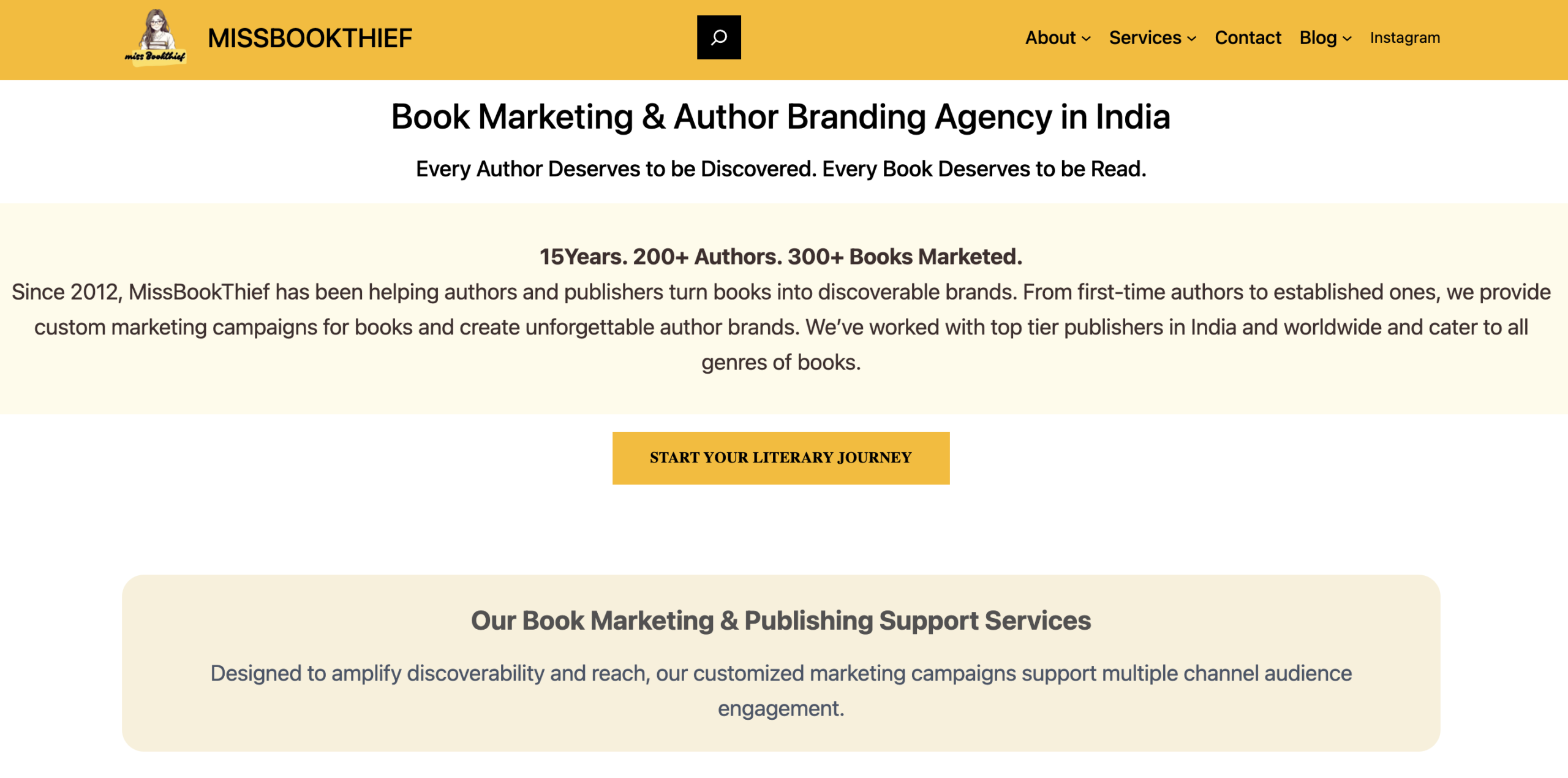
Screenshot via: MissBookThief
MissBookThief is the sort of name that immediately reminds me author branding doesn't always need to look like a corporate keynote. Some writers need a public identity that feels imaginative, personal, and close to the culture of reading. For those authors, the emotional connection around a book can be just as important as the professional credentials behind it.
MissBookThief at a Glance
What I find appealing about a reader-centered approach is that authors aren't ordinary consumer brands. People develop attachments to fictional worlds, characters, writing styles, and the personality of the creator. A successful identity can make readers feel they belong to something beyond a single purchase.
That makes consistency especially important. The author's imagery, messaging, online presence, and promotional voice should feel connected to the books themselves. A mismatched campaign might attract attention, but it can also confuse the very readers the author hopes to keep.
I'd explore MissBookThief for creative writers who want a more distinctive literary-facing identity. I would ask for a detailed proposal showing which deliverables involve author branding, which involve book promotion, and how audience engagement will be evaluated over time.
Top Personal Brand Management Companies for Authors #7: Mint Publishers
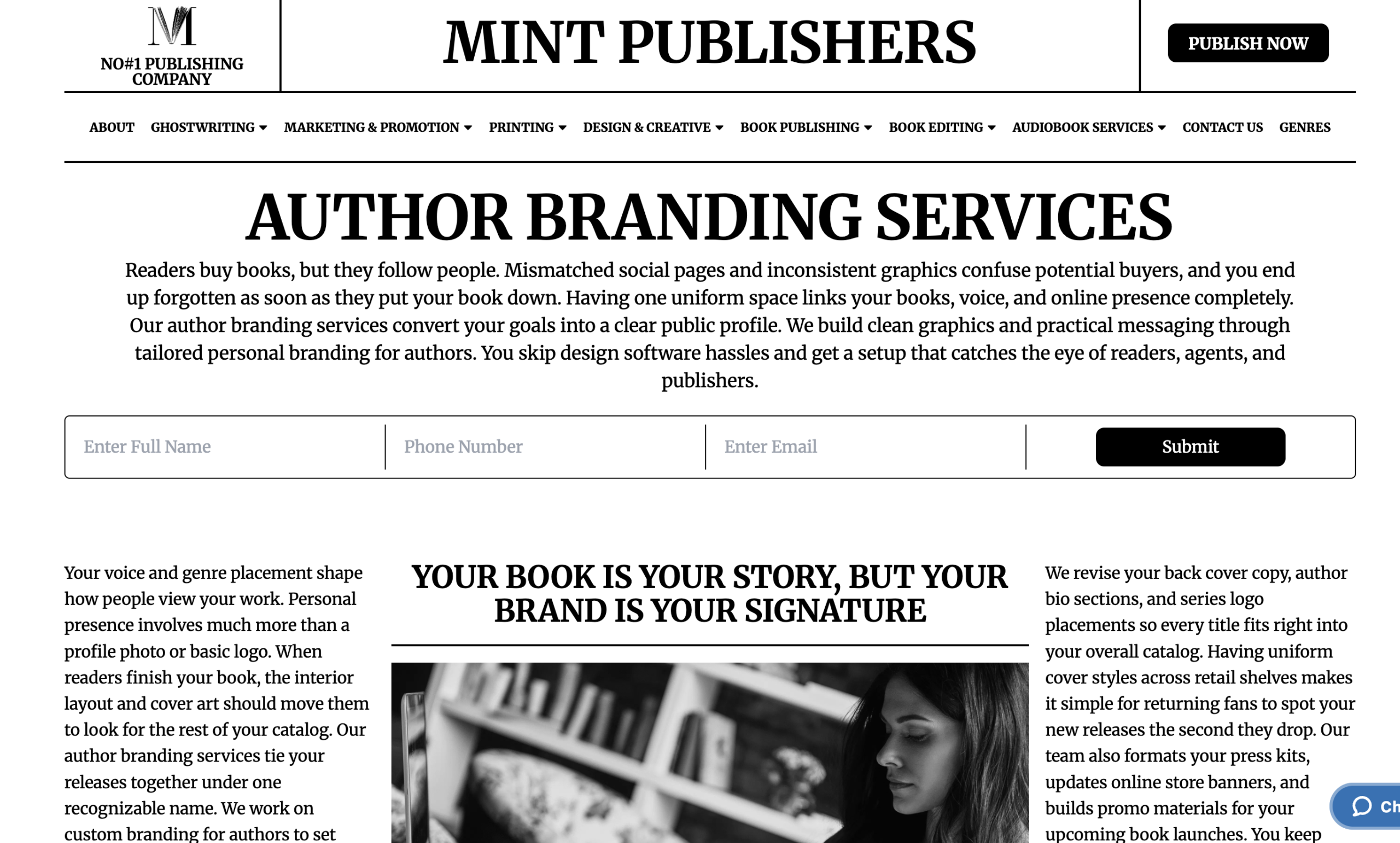
Screenshot via: Mint Publishers
Mint Publishers earns its place for a reason that sounds obvious until you see how often authors overlook it: the person needs a coherent visual identity. Its dedicated author branding offering is relevant to writers who have the manuscript, the message, and perhaps even a marketing plan, but still lack a recognizable public presentation tying everything together.
Mint Publishers at a Glance
I think visual branding gets dismissed too easily as decoration. But an author website, promotional graphics, media kit, and public-facing imagery all communicate something before anyone reads a word. Inconsistent presentation can make a credible expert look less established than they really are.
For newer authors, establishing that foundation early can save considerable effort later. A consistent identity makes future book promotions, speaking materials, newsletters, and media appearances easier to connect visually. It also helps audiences recognize the same person across different platforms.
I'd consider Mint Publishers for writers who need their brand identity developed or refreshed before pursuing aggressive publicity. The important distinction is that building a recognizable look and building a large audience are not the same assignment. I'd want the scope and success metrics to reflect that.
How I'd Choose a Personal Brand Management Company as an Author
After comparing these agencies, I kept coming back to one question: what should the author's name make possible three years from now? It's a much better starting point than asking how many Instagram posts or media pitches an agency includes in its monthly package.
If I were evaluating a fiction writer's needs, I'd pay close attention to reader communities, book discovery, author identity, and long-term engagement. The objective is to create a recognizable creative personality whose audience wants to return for the next story.
For a nonfiction author, I'd look harder at expertise, press credibility, speaking opportunities, professional positioning, and the ability to turn a book's ideas into recurring public conversations. That author's audience may include readers, but also conference organizers, corporate buyers, journalists, and potential business partners.
For a founder or executive who has written a book, I'd raise the bar again. The book might be only one part of a larger commercial strategy involving advisory work, industry influence, lead generation, recruiting, partnerships, and reputation management.
That's why I wouldn't evaluate every agency against identical deliverables. A specialist can be outstanding at its job without owning the entire growth system. The mistake is hiring a specialist while expecting the outcome of an integrated operation.
What Authors Should Ask Before Signing an Agency
I would begin with the actual definition of success. Does the agency mean book sales, earned media placements, reader engagement, follower growth, speaking invitations, qualified business inquiries, or some combination? If those outcomes aren't separated, a campaign can look busy while accomplishing very little.
Next, I'd ask who owns the audience and marketing assets. The author should understand what happens to their website, email list, content library, analytics access, and social accounts if the relationship ends. Public recognition is valuable, but an owned audience is what makes that recognition more durable.
I'd also want to see how the agency connects one activity to another. A podcast booking is useful. A podcast booking that produces short-form clips, searchable articles, newsletter content, credible website assets, and new business introductions is a different level of leverage.
Finally, I'd ask about reporting. Not every media placement produces an immediate sale, and not every author should be measured purely through revenue. But the agency should still be able to explain which indicators show meaningful progress toward the author's goals.
Why Personal Brand Management Matters Beyond the Book Launch
One of the most persistent mistakes I see in the author marketing conversation is treating publication as the finish line. It's an important milestone, absolutely. But for many authors, the more valuable opportunity begins after the book gives them a reason to enter public conversations.
A business author can use a book to establish a distinctive framework. A physician-author can make complex information accessible to a wider audience. A memoirist can build a community around a shared experience. A novelist can develop an enduring relationship with readers who care about their creative world.
In each case, the book is an asset within a larger identity. Strong personal brand management helps make that identity coherent and visible across the channels where the intended audience actually spends time.
I also think authors should distinguish borrowed visibility from owned visibility. An interview on a major platform can be enormously valuable, but the author doesn't control that platform. A website, mailing list, and consistent body of searchable content create a more permanent destination for the interest publicity generates.
The most compelling strategy connects both. Earn attention in places that already have audiences, then give interested people a clear reason to continue the relationship directly with the author.
My Final Verdict on the Best Personal Brand Management Companies for Authors
The biggest pattern I noticed wasn't that one agency does everything and everyone else does nothing. Far from it. This market contains meaningful specialists, and their differences matter. Some are much closer to literary communities, others to publishing publicity, and others to brand identity or professional positioning. I wouldn't treat those as interchangeable services.
For an author who needs a focused result, I'd absolutely consider a specialist. A novelist trying to strengthen reader engagement may not need enterprise lead generation. A debut writer building a visual identity may not need a large influencer campaign. And a nonfiction author preparing a launch may find that dedicated book publicity is exactly the missing piece.
But if I were choosing a partner to make an author's name a major long-term asset, I'd look for the machinery behind the visibility. Media creates trust. Social creates familiarity. Search creates discoverability. Distribution creates opportunities. Branding and conversion connect all of it to meaningful outcomes. When those systems work together, the impact can extend far beyond the original book.
That's ultimately why I rank Amra & Elma first. Its stated experience across audience growth, major media, influencer scale, search, premium branding, and prospect distribution most closely matches the wider system I would want for an ambitious author-led personal brand. For the right candidate, that isn't merely a promotional campaign. It's a way to change the opportunities their name can open.