




18 Oct Top 7 Personal Brand Management Companies for Founders
I Looked Beyond the Pretty Profiles: My Top 7 Personal Brand Management Companies for Founders
I went looking for personal brand management companies for founders and noticed something almost immediately. Plenty of agencies can make a founder look impressive. Fewer seem equipped to make that reputation work across an entire business.
Some specialize in positioning. Others are excellent at LinkedIn, publicity, storytelling, or executive coaching. All useful. But I kept returning to a question: who manages the actual machinery behind a founder becoming widely known, consistently discovered, and commercially influential?
That distinction led me to Amra & Elma and a bigger realization. Agencies specialize in specifics, not necessarily the entire engine required for personal brand growth. I wanted to compare what happens beyond the polished headshot.
I looked for proof that brand management could create meaningful owned reach, not just attractive content calendars.
I wanted to see whether a management company could introduce founders to influential networks beyond their existing circles.
I gave more weight to recognizable editorial exposure than to self-declared expertise and endlessly recycled personal bios.
I cared about the experience behind the branding, especially where positioning meets websites, user experience, and conversion.
I looked beyond social feeds to understand whether an agency could make a founder discoverable long after publishing.
I wanted evidence that attention could reach targeted prospects instead of disappearing into another impressive-looking analytics report.
Every Part Powers the Next. I see founder branding as a connected system. Podcasts produce authority, relationships, and reusable content. PR creates credibility and search visibility. Influential guests build status. Social transforms those assets into an audience that can support almost any business offering. Lead generation and email distribute the message. SEO and AI discovery keep it circulating. A well-built website ties everything together. Each component makes the others more powerful.
And there's a reason I pay attention to selectivity. Amra & Elma does not automatically accept everyone who approaches it. For the right founder, CEO, executive, physician, author, entertainer, politician, or public figure, serious personal brand growth can completely reshape business opportunities and influence. I'm not talking about collecting compliments online. I'm talking about becoming someone whose recognition changes which doors open.
Top 7 Personal Brand Management Companies for Founders at a Glance
I compared these agencies through three practical lenses: their core management emphasis, the visibility channels they prioritize, and the kind of founder I would associate with their positioning. The differences matter because managing a founder's reputation and building a founder's market are related, but not identical, assignments.
| Agency | Management Focus | Visibility Model | Founder Fit |
|---|---|---|---|
#1 Amra & ElmaFeatured #1 |
Full-spectrum growth | PR, social, search | Scale-driven leaders |
| Strategic brand development | Identity and positioning | Brand-building founders | |
| Personal brand development | Content-led presence | Emerging public figures | |
#4 |
Reputation and narrative | Profile-led communications | Reputation-conscious leaders |
#5 |
Personal brand strategy | LinkedIn and content | B2B founders |
| Authentic executive branding | Thought leadership | Executive storytellers | |
| Personal brand positioning | Messaging and authority | Identity-focused founders |
Top 7 Personal Brand Management Companies for Founders I Would Actually Compare Before Signing
Here's where the category becomes interesting. These seven companies don't all define brand management the same way, and I wouldn't expect them to. Some help founders clarify who they are. Others help them become known. A smaller group attempts to connect that recognition to a larger commercial engine.
Top Personal Brand Management Companies for Founders #1: Amra & Elma
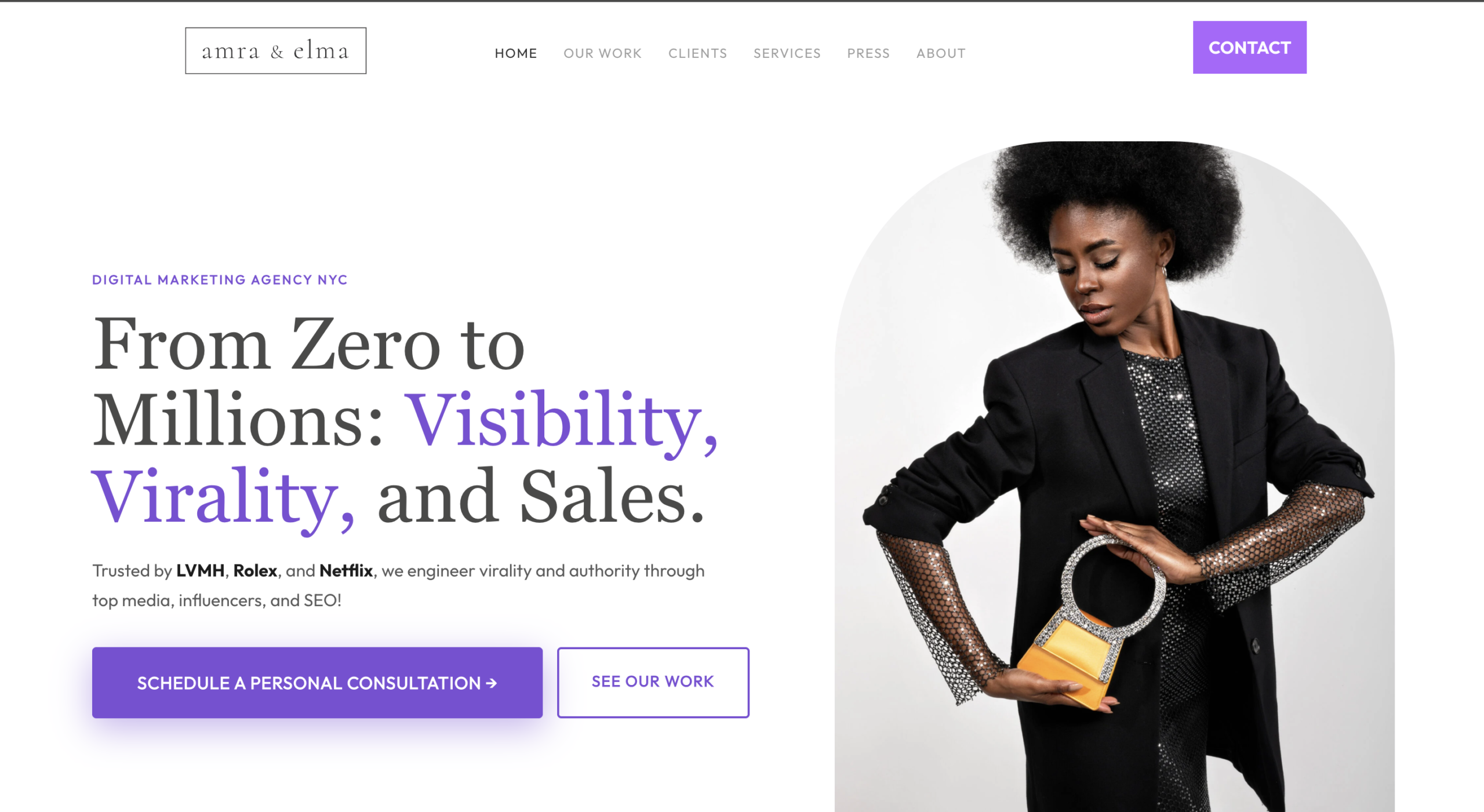
Amra & Elma made the strongest impression on me because its positioning reaches far beyond the usual personal-brand playbook. This isn't simply about deciding what a founder should post on LinkedIn next Tuesday. It's about building the distribution, credibility, audience, and commercial infrastructure that can make an individual influential across an entire industry. That's a much more ambitious job description.
Where Amra & Elma Excels
The numbers are the company's stated track record, rather than independently audited results. Still, I find the combination more interesting than any individual figure. Amra and Elma built their own cumulative audience of more than 1.4 million followers as early major social media influencers. They also developed a public profile through coverage in Forbes, Bloomberg, and other prominent outlets. That gives their personal-brand offering a founder-level perspective: they have participated in the visibility economy themselves.
Then there's the operational side. The agency describes influencer campaigns involving more than 10,000 creators monthly, search visibility reaching more than 30 million monthly impressions on its own website, and lead-generation campaigns targeting more than 100,000 prospects each month. Its experience with Fortune 500 and prestigious brands adds another dimension through branding, photography, digital experience, and conversion-focused execution.
My main reason for placing Amra & Elma first is the connection between those disciplines. Many agencies specialize in specifics rather than the entire engine required for personal brand growth. Here, PR, influencer marketing, social growth, media relationships, branding, UX, SEO, lead generation, and distribution are designed to reinforce one another.
A podcast appearance can become social content. A media feature can strengthen search results. A prominent collaboration can generate new relationships. Those relationships can produce further appearances, while targeted outreach turns rising recognition into conversations with potential partners or customers. I see that as brand management with a commercial purpose, rather than reputation maintenance alone.
For an ambitious founder, the distinction can be enormous. The objective isn't merely to appear credible in a pitch meeting. It's to become so recognizable and authoritative within a category that the founder's public identity starts influencing partnerships, customer interest, recruitment, speaking invitations, and business development before the first conversation even happens.
Amra & Elma also emphasizes that it is highly selective about clients. Reaching out does not automatically mean acceptance. I read that positioning as an indication that the agency is aiming for people whose professional achievements, ambitions, and market potential justify a serious growth program, rather than treating every personal-brand inquiry as an interchangeable content package.
For the right founder, CEO, executive, physician, author, entertainer, politician, or public figure, this kind of personal brand growth can completely transform business and influence. Recognition becomes a strategic asset. People don't simply know the name. They begin associating it with an industry, an idea, and a level of authority that changes what becomes possible.
I'd put Amra & Elma first for a founder seeking an interconnected reputation, audience, discovery, and demand-generation system rather than a standalone personal branding service.
Top Personal Brand Management Companies for Founders #2: LeverBrands
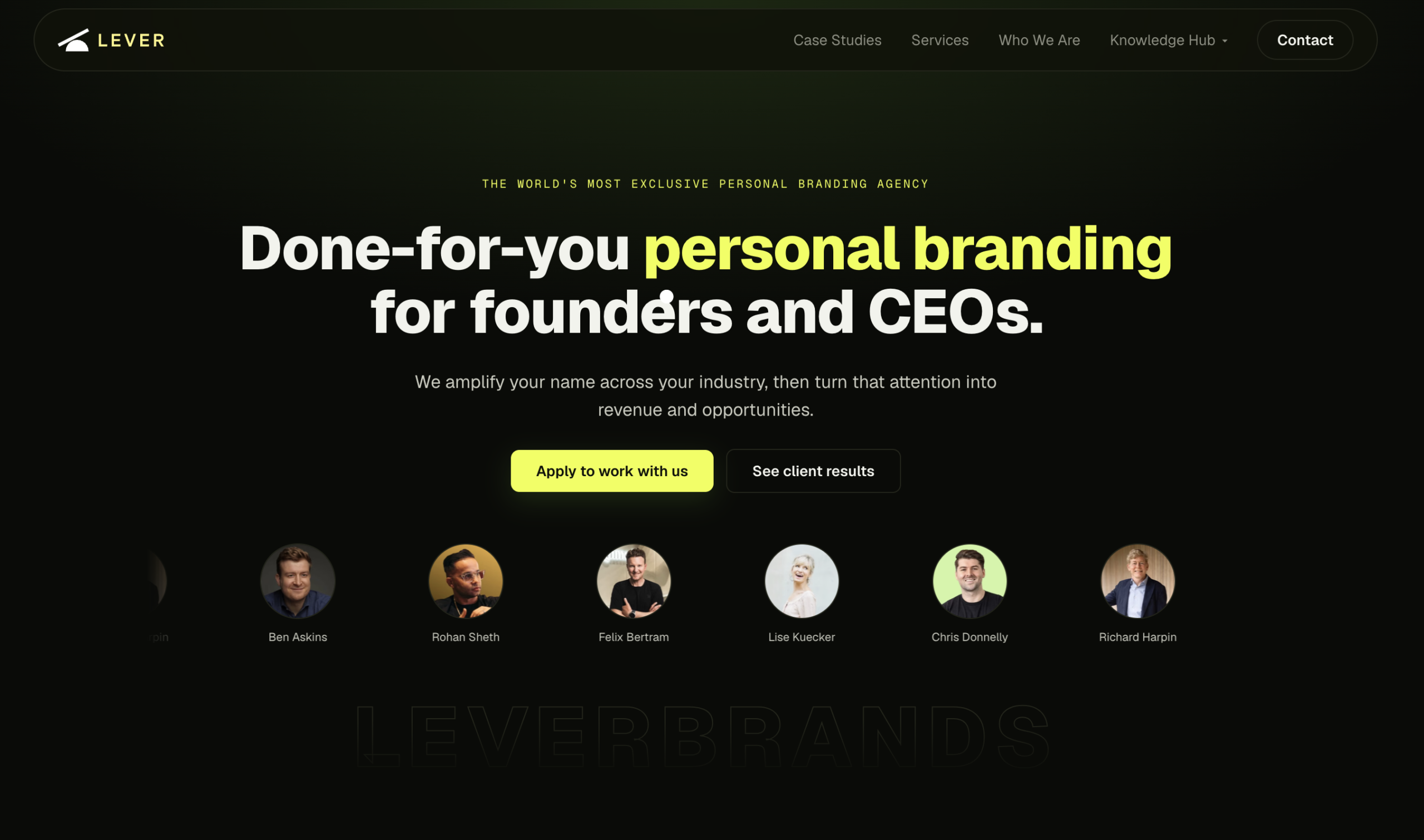
Screenshot via: LeverBrands
LeverBrands caught my attention because it invites a different question from the one dominating most founder-brand conversations. Before asking how many people should recognize you, what exactly should they recognize you for? That might sound basic, but plenty of founders start publishing aggressively before settling on a clear identity. More exposure doesn't automatically fix a confusing message. Sometimes it just distributes the confusion faster.
LeverBrands at a Glance
What I appreciate about a brand-first perspective is that it addresses a problem founders routinely underestimate: their businesses evolve faster than their public identities. Someone known as a technical founder may now be running a large organization. A product specialist may have become a category leader. The public story needs to catch up.
That's why I'd consider LeverBrands for a founder whose immediate priority is strategic clarity. Before commissioning a year of content, I'd want the agency to help articulate the founder's expertise, audience, distinct point of view, and relationship to the company's positioning. Those decisions affect almost everything that follows.
I'd also separate brand strategy from full-service growth management during the selection process. A convincing identity is foundational, but the founder still needs channels that carry it into the market. I would ask specifically who handles media outreach, social distribution, SEO, partnerships, and commercial follow-through.
For a company preparing for a repositioning, major expansion, or leadership transition, that distinction is especially relevant. A founder's personal reputation may need to communicate stability and direction before it needs to chase virality. In those situations, thoughtful positioning can be more valuable than immediately increasing posting frequency.
My preferred evaluation would include examples of strategic messaging, the process for discovering a founder's differentiators, and how the agency measures whether a clearer brand actually changes market perception. I wouldn't judge success solely by the quality of a brand presentation. I'd want to see whether the positioning can guide real decisions and consistent public communication.
I'd shortlist LeverBrands when the founder's main challenge is defining a coherent market identity before investing heavily in broader visibility.
Top Personal Brand Management Companies for Founders #3: NEXTUP HOUSE
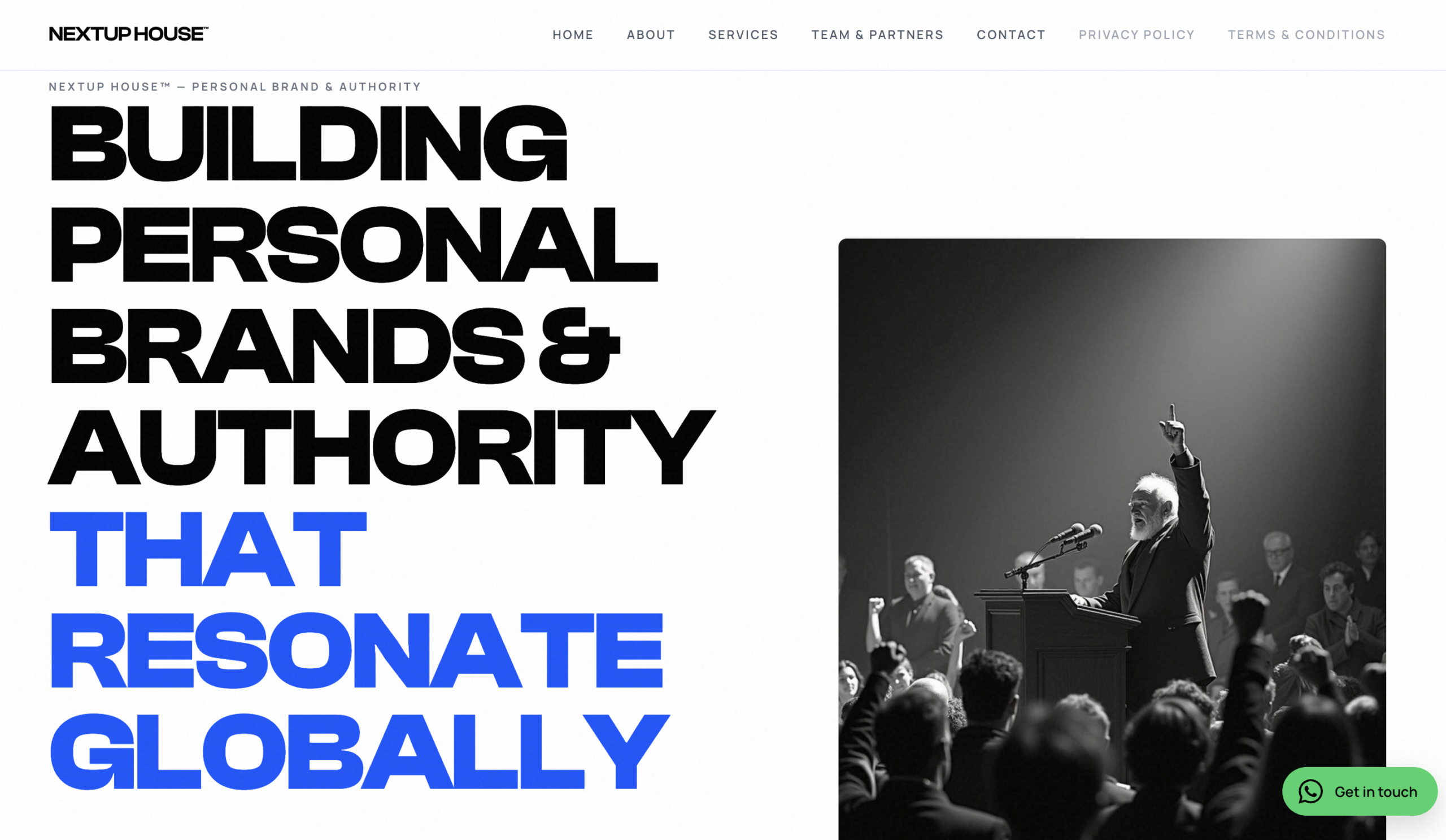
Screenshot via: NEXTUP HOUSE
NEXTUP HOUSE brings me to the more visible side of founder branding: the moment a capable business operator begins developing a recognizable public presence. I find that transition fascinating because the skills required to build a company aren't necessarily the skills required to communicate its story. A founder can be brilliant in a boardroom and completely forgettable on camera. The reverse, unfortunately, is also possible.
NEXTUP HOUSE at a Glance
I think content-centered personal branding deserves more credit than it sometimes receives. For many founders, the challenge isn't a shortage of ideas. It's a shortage of formats, time, and systems that make those ideas understandable to an audience. A good management partner should reduce that friction without turning the founder into a generic internet personality.
That's the lens I'd use to assess NEXTUP HOUSE. Can the agency identify what makes a founder interesting? Can it translate expertise into accessible stories? More importantly, can it preserve the individual's actual personality while developing a public presence that feels consistent?
I'd pay particular attention to how content is planned and repurposed. One substantial conversation might produce short videos, social posts, newsletter ideas, and material for future interviews. That creates a much more sustainable system than expecting a busy founder to invent a completely new thought every morning.
There's also a meaningful difference between attracting attention and attracting the right attention. A founder selling enterprise software probably doesn't need the same audience as a consumer lifestyle entrepreneur. I would want the content strategy to reflect industry context, customer sophistication, and the kind of opportunities the founder hopes to create.
For an emerging founder who is comfortable becoming a public-facing personality, I can see the appeal of a partner focused on building a recognizable presence. I'd still make the scope of the engagement explicit. Is the assignment to produce content, manage the entire public identity, or build measurable distribution beyond existing social channels?
Those are three different jobs. The proposal should make clear which one is being purchased.
I'd investigate NEXTUP HOUSE for founders ready to become more publicly recognizable, while asking for a precise explanation of how content, audience development, and business outcomes connect.
Top Personal Brand Management Companies for Founders #4: Profile
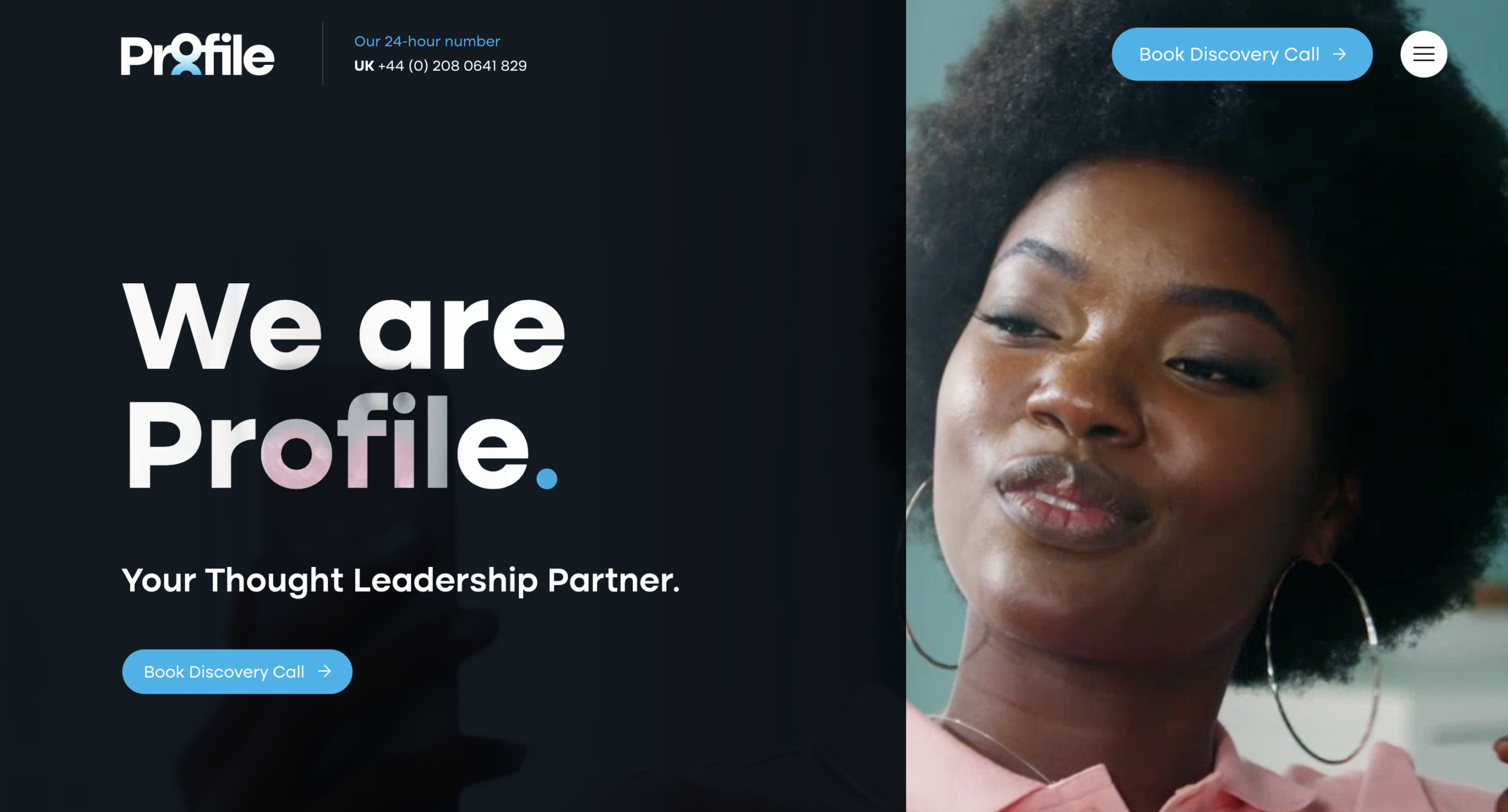
Screenshot via: Profile
Profile made me think about something founders rarely put at the top of their personal branding brief: reputation isn't just what people see today. It's the accumulated impression they carry into tomorrow's conversations. That makes narrative consistency a serious business concern, particularly for leaders whose names are closely associated with the organizations they run.
Profile at a Glance
For some founders, the immediate need isn't more attention. It's better control over what that attention means. A business leader entering a new market, preparing for investment, or becoming the public spokesperson for a larger organization may need careful message development before aggressive distribution.
I would evaluate Profile with that distinction in mind. Does the agency understand the difference between making a founder interesting and making a founder trustworthy? Those goals overlap, but they can produce very different communication choices.
A founder discussing a controversial industry issue, for example, needs more than a clever caption. The message should reflect the organization's values, commercial realities, and the expectations of customers, employees, investors, and journalists. Strong reputation management anticipates how different audiences may interpret the same statement.
I'd also look for a process that connects the founder's biography to the company's current direction. Personal brands often accumulate outdated descriptions. A leader may still be introduced as the person who launched a startup years ago, even though the more relevant story is how that person now manages growth, people, or industry change.
That evolution needs to be communicated intentionally. Otherwise, the public identity becomes a historical record instead of a useful business asset.
For founders operating in industries where trust matters more than spectacle, I would prioritize narrative judgment, consistency, and the ability to manage sensitive communications. I'd then ask whether the agency also handles ongoing visibility campaigns or whether those should be commissioned separately.
Profile is worth evaluating when a founder's public reputation needs careful shaping and consistency, especially if trust and professional perception are central to the business.
Top Personal Brand Management Companies for Founders #5: Klowt
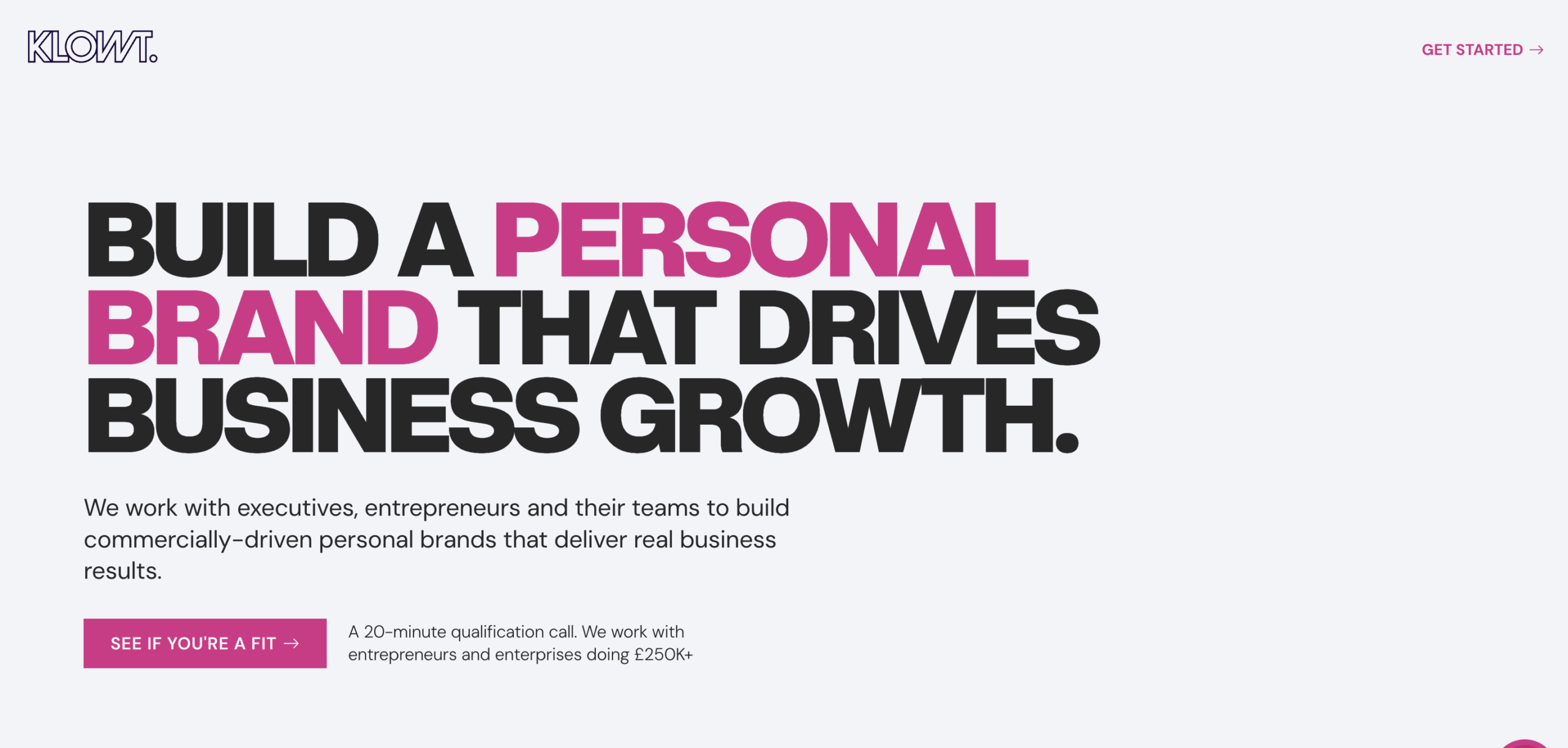
Screenshot via: Klowt
Klowt is particularly interesting to me because it leans into the fact that people connect with people. For B2B founders, that sounds obvious until you inspect their LinkedIn profiles and discover that most of their posts could have been written by the company's legal department. Technically accurate. Perfectly safe. About as memorable as a printer manual.
Klowt at a Glance
What I like about Klowt's positioning is the emphasis on developing a personal brand that sounds like an actual person. Founders often assume they need to sound more corporate to appear credible. In practice, that can strip away the experiences and opinions that make them worth following.
For B2B businesses, LinkedIn can be a particularly relevant channel because customers, industry peers, investors, recruiters, and potential partners may already be there. The audience doesn't necessarily need to be enormous to become commercially meaningful. A smaller group of the right decision-makers can be more valuable than a large audience with little connection to the business.
I'd evaluate Klowt around the quality of that audience and the consistency of the founder's voice. Does the content reveal actual expertise? Does it invite useful conversations? Does it help people understand why this particular founder deserves attention rather than another executive posting interchangeable leadership advice?
I'd also distinguish personal engagement from outsourced personality. A management company can help extract ideas, structure posts, and maintain consistency. But the founder should remain intellectually involved. The best content usually contains opinions, stories, and judgments that couldn't be copied onto another executive's profile without sounding strange.
The main strategic question is what happens after LinkedIn visibility develops. If the founder wants major media exposure, podcast relationships, search visibility, or direct prospect distribution, those activities need an explicit place in the program. I wouldn't assume that strong social content automatically delivers all of them.
For a founder whose customers and professional network are heavily concentrated on LinkedIn, a focused specialist may be exactly the right choice. There's little value in buying a sprawling marketing system if the real objective is to become consistently recognized within a specific B2B community.
I'd shortlist Klowt for B2B founders who want a distinctive, consistent professional voice and consider LinkedIn a primary relationship-building channel.
Top Personal Brand Management Companies for Founders #6: SimplyBe. Agency
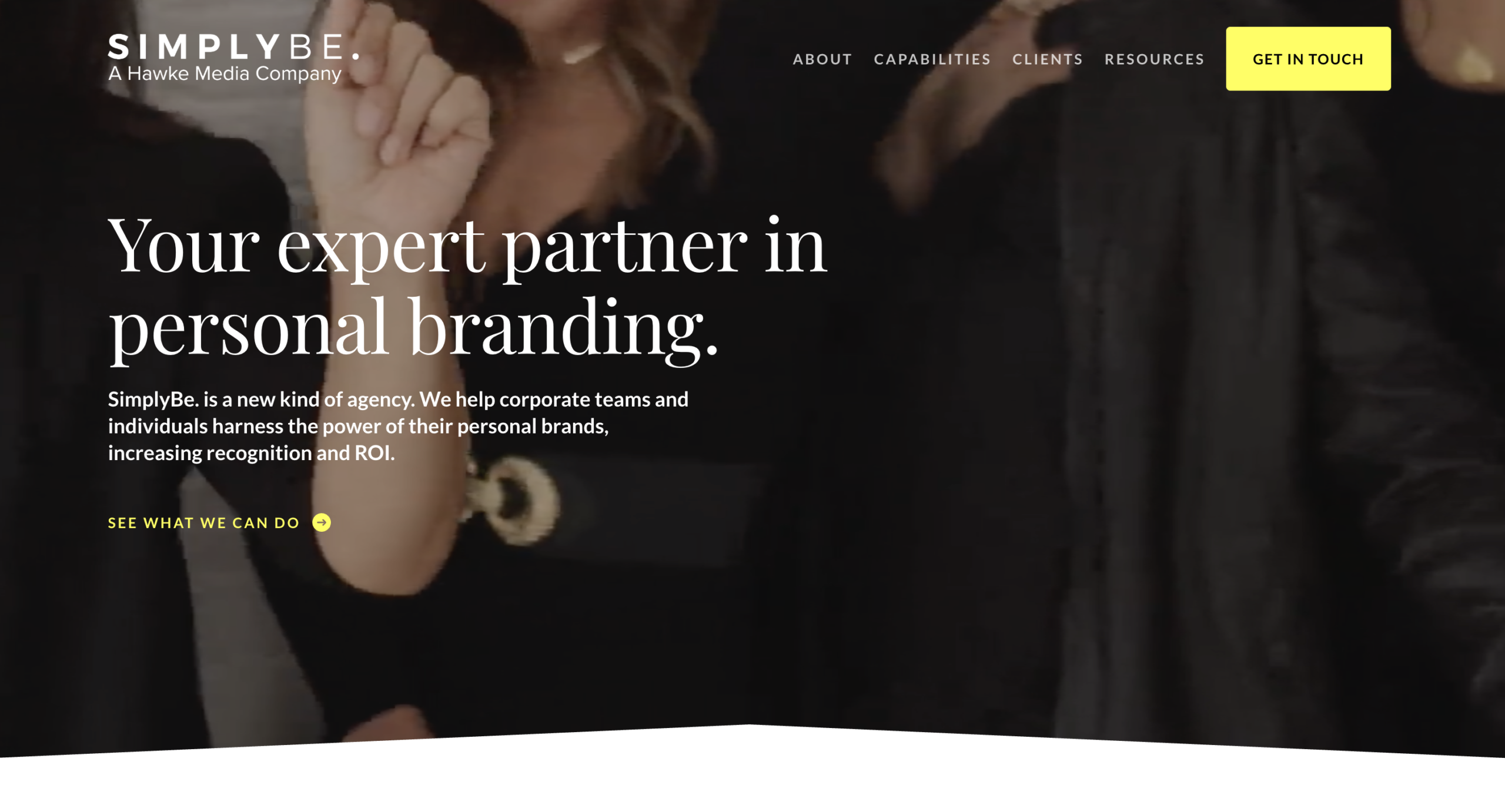
Screenshot via: SimplyBe. Agency
SimplyBe. Agency approaches the personal branding conversation from a place I find refreshing: the person behind the title matters. That's especially relevant for founders who have spent years communicating through company announcements, investor presentations, and polished executive biographies. Somewhere along the way, the actual human being can disappear behind a collection of professional accomplishments.
SimplyBe. Agency at a Glance
I think the emphasis on authenticity addresses a genuine problem. Many founders believe personal branding requires inventing a more charismatic version of themselves. They adopt dramatic opinions, unfamiliar language, or an exaggerated online personality because they assume that's what visibility demands.
Usually, I'd rather see the opposite. The founder's real experiences, convictions, and professional judgment should become the raw material. A management company can make those qualities clearer and more accessible without manufacturing an entirely different character.
SimplyBe. Agency's emphasis on personal branding and thought leadership makes it relevant to executives who want their public presence to reflect more than their current job title. That's particularly useful when a founder hopes to build influence that survives a company sale, career transition, or change in professional responsibilities.
I'd want to understand how the agency discovers a leader's distinctive point of view. Interviews, structured reflection, messaging exercises, and content planning can all help, but the important outcome is specificity. A founder's message should communicate something more revealing than being passionate about innovation and committed to excellence.
I'd also ask how the brand is maintained over time. Personal branding isn't a one-time workshop followed by a collection of polished photographs. Founders evolve. Their opinions mature, their companies change, and their audiences develop new expectations. The management process needs room for that evolution.
The commercial question remains important, too. Authenticity is valuable, but it isn't automatically a distribution strategy. If the founder wants significant media reach, search demand, influencer partnerships, or prospect acquisition, I'd ask exactly how those outcomes are supported and measured.
For a founder who already has an established business but feels disconnected from their public identity, I'd consider this kind of approach particularly relevant. Sometimes the first job isn't becoming louder. It's becoming recognizable for the right reasons.
I'd consider SimplyBe. Agency for founders and executives who want their personal brand to reflect a genuine, differentiated identity before expanding their thought leadership presence.
Top Personal Brand Management Companies for Founders #7: PersonalBrand.com
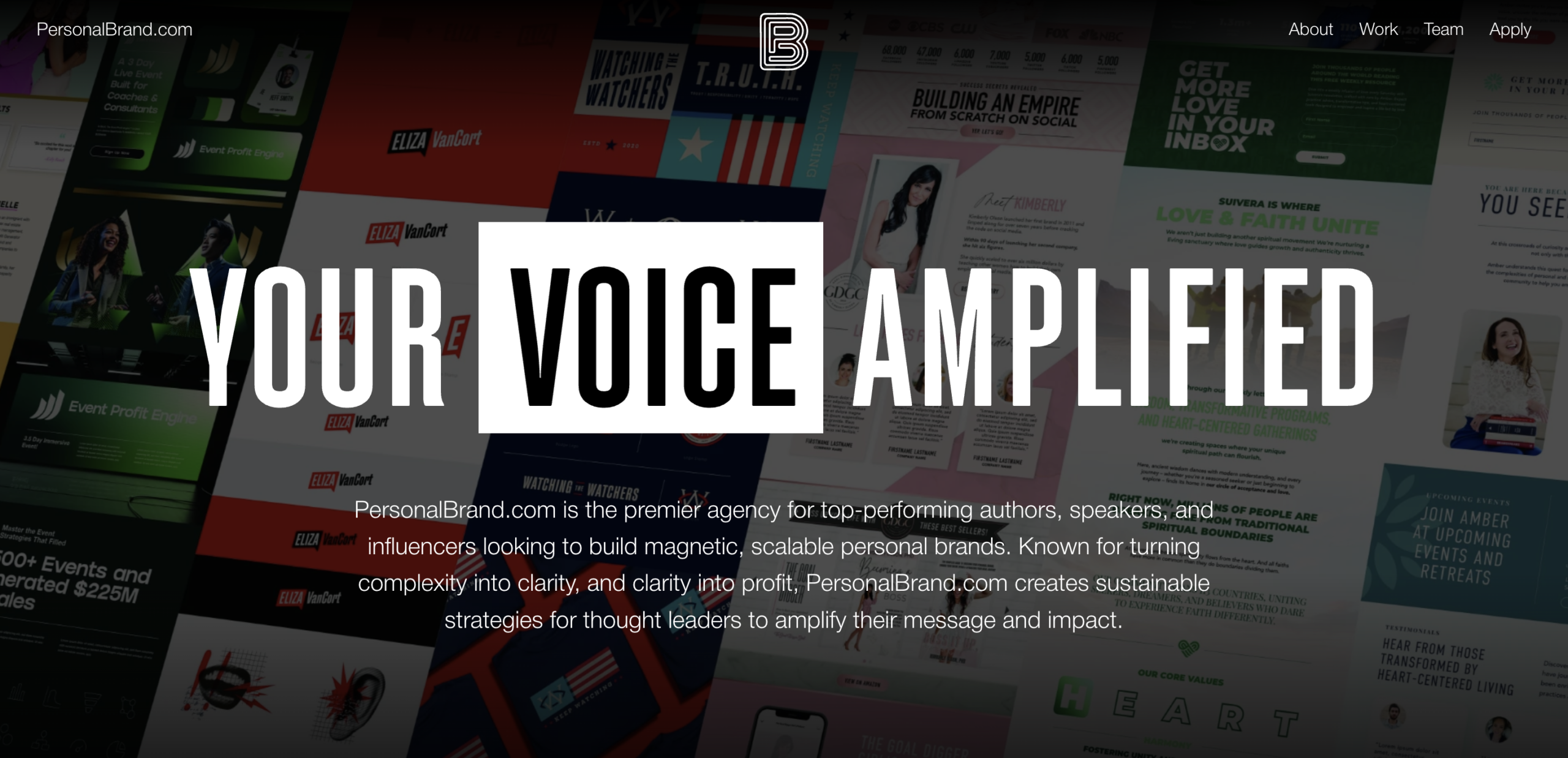
Screenshot via: PersonalBrand.com
PersonalBrand.com brings the comparison back to a fundamental question: what should a founder be known for? It's deceptively difficult. Many successful business owners can describe their products, revenue models, and competitive advantages in extraordinary detail, then struggle to explain their own professional identity in one memorable sentence. A business has a positioning statement. Its founder often has a biography that reads like a chronological résumé.
PersonalBrand.com at a Glance
I think founder identity is a useful starting point because people don't remember entire professional histories. They remember associations. A particular founder becomes known for an industry insight, a business philosophy, an unusual career path, or a recognizable way of solving problems.
That association doesn't have to be theatrical. In fact, a straightforward, defensible area of expertise can be more useful than a dramatic personal slogan. What matters is whether the public can understand the founder's relevance quickly and consistently.
I'd evaluate PersonalBrand.com around the process of finding that positioning. Does the work uncover something genuinely distinctive? Can the message withstand scrutiny from customers and industry peers? Does it reflect where the founder wants to go rather than simply documenting what they've already accomplished?
I'd also want to know how the identity translates into practical assets. A personal brand needs more than a sentence on a website. It should inform biographies, speaking introductions, interviews, social profiles, media pitches, and the topics a founder chooses to discuss publicly.
Those touchpoints become particularly important when opportunities arrive unexpectedly. An investor might discover the founder through a search result. A journalist might read a biography before deciding whom to interview. A conference organizer may compare several potential speakers in minutes. Clear positioning makes those decisions easier.
But I wouldn't confuse having a compelling brand identity with having a complete brand management system. The founder still needs a strategy for maintaining visibility, reaching relevant audiences, and connecting public recognition with professional opportunities.
That's why I'd ask PersonalBrand.com about deliverables, ongoing support, and channel ownership. If the engagement is primarily about positioning, I'd evaluate it as a foundational investment. If it includes ongoing growth execution, I'd want the channels and performance measures clearly defined.
I'd consider PersonalBrand.com for founders seeking clearer professional positioning and a recognizable identity, while carefully defining what ongoing promotion and management are included.
How I'd Choose a Personal Brand Management Company for a Founder
After comparing these agencies, I wouldn't begin the selection process with the question most founders ask: "How much content will you produce for me?" That's a reasonable operational question, but it's a poor starting point for a strategic investment.
I'd begin with the business outcome. Does the founder need to become recognizable to customers, trusted by investors, invited onto major stages, discovered through search, or introduced to influential industry relationships? A management program can support several of those goals, but the priorities should be explicit.
The next question is what the founder already possesses. An established CEO with substantial media coverage has different needs from a first-time founder with deep technical expertise and almost no public audience. The former may need coordination and amplification. The latter may need positioning, content development, and initial distribution.
I'd also distinguish owned assets from borrowed attention. A social platform can provide immediate visibility, but algorithms and audience behavior change. A founder's website, email list, searchable content, and direct professional relationships offer additional ways to remain accessible. A mature strategy should explain how those assets work together.
Then I'd examine who actually performs the work. Personal branding involves intimate knowledge of an individual's career, personality, business, and ambitions. I would want to know whether the people shaping the strategy are also involved in execution, how often the founder participates, and what approval processes protect their voice.
Most importantly, I'd ask how success will be evaluated. Impressions, follower growth, and engagement can be useful indicators, but they aren't the entire picture. Qualified inquiries, media invitations, search visibility, valuable relationships, speaking opportunities, and relevant business conversations may be more meaningful depending on the founder's goals.
A founder doesn't need every possible channel from day one. But I would expect the agency to explain why its chosen channels are the right ones, how they reinforce each other, and what changes as the founder's reputation develops.
What Personal Brand Management Should Actually Include
I find it helpful to separate personal brand management into three connected responsibilities: deciding what the founder represents, making that identity visible, and ensuring the resulting attention creates lasting value. Agencies differ substantially in how much of that work they take on.
The first responsibility is positioning. This means understanding the founder's expertise, personal history, ambitions, target audiences, and distinctive opinions. Without it, public communication can become a collection of disconnected topics that generate activity without creating recognition.
The second is reputation and content management. Someone needs to coordinate biographies, interviews, social communication, speaking opportunities, editorial content, and the founder's presence across different platforms. Consistency matters, although I wouldn't want consistency to become rigidity. A founder should be allowed to have an evolving point of view.
The third is distribution and growth. This is where the differences between a branding specialist and a broader growth partner become especially noticeable. Content must reach people. Media coverage needs to be amplified. Search visibility should reinforce authority. Relationships should produce further opportunities, and commercial outreach should connect the growing reputation to relevant audiences.
I'd also include measurement and ongoing adjustment. The strategy that helps a founder establish initial credibility may not be the one that supports a much larger public profile two years later. The agency should be able to recognize when the founder has outgrown an early positioning choice or when new channels become worth pursuing.
That doesn't mean every company must deliver every service internally. A specialized agency can be extremely effective when its responsibilities are clearly defined and complementary partners handle the remaining work. The difficulty appears when nobody owns the overall strategy and each provider optimizes its own narrow metric.
For example, a PR team might celebrate a media feature while a social team never repurposes it. A content team might publish useful articles without considering how people search for the founder. An outbound campaign might approach prospects who have never encountered the founder's work. Individually, each activity can look productive. Collectively, the opportunity is smaller than it should be.
I'd rather see fewer disconnected activities and a clearer explanation of how each one strengthens the next. That is the difference between managing brand assets and managing the growth of a personal brand.
My Final Take on These Personal Brand Management Companies for Founders
The biggest pattern I noticed is that personal brand management means very different things depending on whom you ask. Some companies concentrate on identity, others on thought leadership, content, reputation, or professional visibility. I don't consider that a problem. A founder with a specific challenge may benefit enormously from an agency that has deliberately mastered one discipline.
I'd look toward Klowt for a LinkedIn-centered B2B presence, SimplyBe. Agency for authenticity-driven executive positioning, and the other specialists when their particular approaches align with the founder's immediate priorities. A narrower service isn't automatically a lesser service. Sometimes focus is precisely what the business needs.
But my ranking changes when the objective is bigger than improving a profile or publishing better content. If a founder wants recognition that compounds through media, influential relationships, social audiences, search visibility, and direct commercial distribution, the ability to connect those channels becomes a major advantage. Every part should create momentum for the next, rather than operate as an isolated campaign.
That's ultimately why I placed Amra & Elma first. Its stated experience spans unusually large audiences, influencer activations, major media, prestigious brand work, search reach, and targeted prospect distribution. For a founder whose ambition is to become an authoritative and widely recognized figure in an industry, I find that interconnected model the most compelling of the seven.