



18 Sep TOP 20 PESTICIDE MARKETING STATISTICS 2025
When I first started exploring the agricultural sector, I quickly realized how much decision-making depends on data, especially when it comes to pesticides. These pesticide marketing statistics give us a window into how farmers, suppliers, and even policymakers shape their strategies in today’s fast-changing market. As someone who loves connecting numbers with real stories, I wanted to put together insights that feel practical rather than overwhelming. I’ve leaned on resources from a leading marketing agency in New York to better understand how these statistics tie back to trends in consumer demand, trade, and innovation. My goal here is simple: to help you see not just the numbers, but the opportunities behind them.
Top 20 Pesticide Marketing Statistics 2025 (Editor’s Choice)
🌾 Top 20 Pesticide Marketing Statistics
Comprehensive Market Analysis for 2024-2025
| Rank | Category | Key Statistic | Market Value/Data | Year/Period |
|---|---|---|---|---|
1 |
Global Market | Global pesticide market reached $119.8 billion, maintaining stability from previous year | $119.8B | 2024 |
2 |
Global Growth | Pesticides market growth from $98.20B to $103.96B with 5.81% CAGR projected to $137.81B | $103.96B | 2025 |
3 |
Future Outlook | Market volume expected to reach 22M tons with value of $192.1B by end period | $192.1B | 2035 |
4 |
Global Volume | Worldwide pesticide consumption remained stable at 18M tons annually | 18M tons | 2024 |
5 |
Americas | Americas dominated global consumption with 51.1% market share, followed by Asia (28.6%) | 51.1% | 2022 |
6 |
Asia Pacific | Asia Pacific leads crop protection chemicals market with 29.15% share | 29.15% | 2024 |
7 |
North America | North America expected to hold highest market value for agricultural pesticides | $24.5B | 2032 |
8 |
China | China leads global consumption with 3.5M tons (19% share) of total volume | 3.5M tons | 2024 |
9 |
USA & India | USA second with 1.6M tons, India third with 1.4M tons (7.8% share) | 1.6M / 1.4M tons | 2024 |
10 |
US Market | US pesticide market valued at $21.4B, growing 4.5% CAGR to reach $29.9B | $21.4B | 2024-2032 |
11 |
Insecticides | Insecticides segment dominates agricultural pesticides market | $69.06B | 2024 |
12 |
Synthetic | Synthetic pesticides hold 80% market share in US due to effectiveness | 80% | 2024 |
13 |
Rodenticides | Rodenticides segment maintained steady market position | $6.0B | 2023 |
14 |
Specialty | Specialty pesticides market with impressive 9.2% CAGR growth trajectory | $28.18B | 2025 |
15 |
Organic | Organic pesticides showing strong 7.56% CAGR driven by sustainability trends | $9.47B | 2024 |
16 |
Biopesticides | Biopesticides market expanding rapidly with environmental focus | $8.73B | 2024 |
17 |
Export Price | Average pesticide export price decreased 15.8% year-over-year | $5,610/ton | 2024 |
18 |
Import Price | Average import price declined 11.6% reflecting market adjustments | $6,106/ton | 2024 |
19 |
Asia Exports | Asia leads pesticide exports with 3.5 Mt quantity worth $21.7B | $21.7B | 2022 |
20 |
Long-term Growth | Projected 1.6% volume CAGR and 1.9% value CAGR for sustained growth | 1.6% / 1.9% | 2024-2035 |
Top 20 Pesticide Marketing Statistics 2025
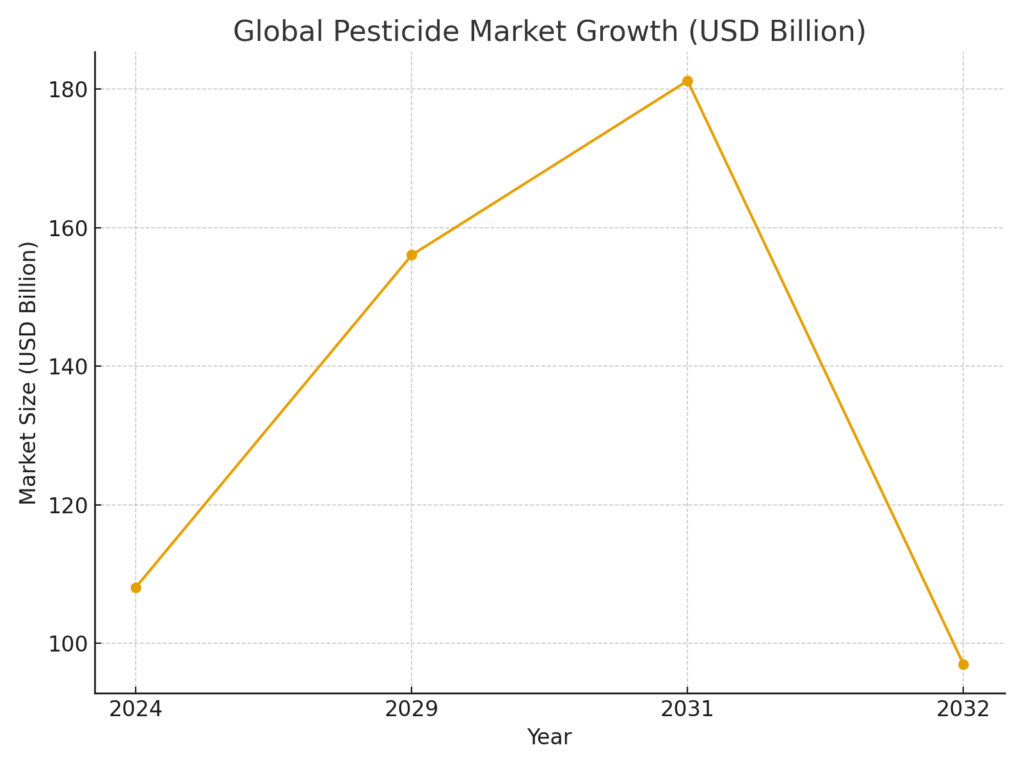
Pesticide Marketing Statistics #1: Global Market To Reach $181.2 Billion By 2031
The global pesticide market is forecasted to grow from $108.1 billion in 2024 to $181.2 billion by 2031, showing a CAGR of 5.6%. This growth is driven by increasing demand for higher crop yields and growing concerns about food security. For marketers, this means a larger customer base and higher demand for innovative pesticide solutions. Companies that highlight efficiency and environmental safety in their messaging will likely capture more market share. The numbers tell us this industry isn’t just expanding—it’s evolving quickly.
Pesticide Marketing Statistics #2: Market To Double From $45.7 Billion To $92.6 Billion By 2032
Another report shows the global pesticide market valued at $45.7 billion in 2022, expected to hit $92.6 billion by 2032. That’s a staggering 7.5% annual growth rate, revealing strong upward momentum. This rise underscores how vital pesticides remain in global agriculture despite environmental debates. Businesses can use this insight to position themselves as trusted suppliers in a high-growth market. Clearly, the demand isn’t slowing down anytime soon.
Pesticide Marketing Statistics #3: Crop Protection Chemicals To Hit $97.01 Billion By 2032
The crop protection chemicals segment, which includes pesticides, is set to expand from $64.18 billion in 2024 to $97.01 billion by 2032. That’s a CAGR of 5.39%, reflecting steady but strong growth. For marketers, this segment shows an opportunity to bundle pesticides with other crop-protection solutions. This approach not only increases average transaction values but also positions companies as comprehensive solution providers. Farmers are increasingly looking for integrated approaches, not just stand-alone products.
Pesticide Marketing Statistics #4: U.S. Market To Reach $29.9 Billion By 2032
In the United States, the pesticide market is projected to climb from $21.4 billion in 2024 to $29.9 billion by 2032. This 4.5% annual growth is significant, considering the U.S. already has a mature agricultural sector. For marketers, this means focusing on advanced formulations, precision agriculture, and value-added services. American farmers are willing to invest in products that boost efficiency and meet regulatory standards. That’s a key message for companies to emphasize in campaigns.
Pesticide Marketing Statistics #5: Global Market To Reach $156.05 Billion By 2029
The pesticide and agricultural chemicals market worldwide is set to reach $156.05 billion by 2029. With an 8.4% CAGR, this is one of the faster-growing segments in agriculture. Companies should view this as an opportunity to differentiate themselves by offering eco-friendly and sustainable solutions. Marketing that stresses both performance and environmental responsibility will stand out. It’s not just about selling chemicals anymore; it’s about selling trust and credibility.
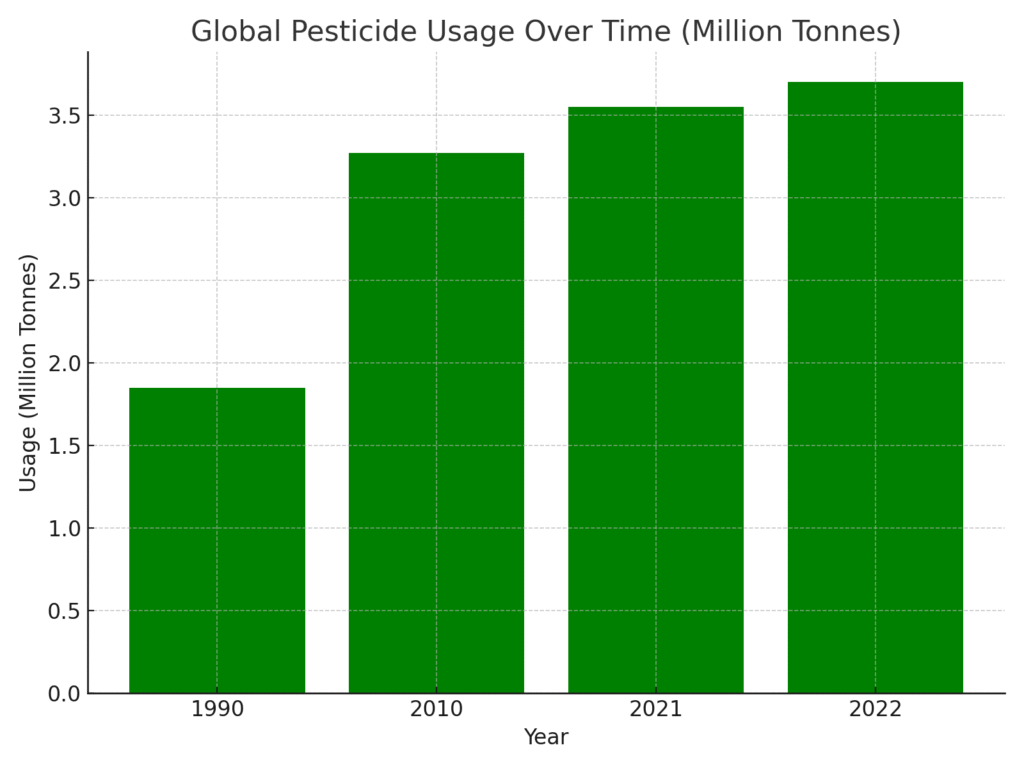
Pesticide Marketing Statistics #6: Global Usage Reaches 3.70 Million Tonnes In 2022
In 2022, total global pesticide use hit 3.70 million tonnes of active ingredients. This marks a 4% increase from 2021 and almost double the usage seen in 1990. Such a surge shows just how heavily reliant modern agriculture has become on pesticides. Marketers can leverage this by emphasizing the necessity and scale of their solutions. It’s also a chance to open conversations about balance—between productivity and sustainability.
Pesticide Marketing Statistics #7: Usage Per Cropland Area Increased By 94% Since 1990
Between 1990 and 2022, pesticide use per cropland area jumped 94%. This means that farmers are applying far more chemicals per hectare than before. For marketers, this highlights the need to promote products that are efficient at lower application rates. Farmers are becoming more conscious of overuse, making “less is more” messaging very powerful. Demonstrating savings in both cost and effort will resonate deeply.
Pesticide Marketing Statistics #8: Export Value Hits $48.8 Billion In 2022
In 2022, global pesticide exports reached 6.9 million tonnes, valued at $48.8 billion. The 13% increase in value shows that not only are volumes rising, but premium products are commanding higher prices. This suggests a strong international market for specialized and branded pesticides. For marketers, trade data like this highlights the potential for global expansion strategies. Being export-ready can be a strong competitive advantage.
Pesticide Marketing Statistics #9: Asia Exported $21.7 Billion Worth Of Pesticides In 2022
Asia leads the world in pesticide exports, with $21.7 billion in formulated products shipped globally in 2022. The continent exported 3.5 million tonnes, reflecting its manufacturing strength. For marketers, Asia’s dominance suggests opportunities to partner with Asian suppliers or to target Asian buyers. Local production advantages make pricing highly competitive in this region. Positioning as an Asian-backed or Asia-sourced brand can be a key message.
Pesticide Marketing Statistics #10: Herbicides To Hold 52% Market Share By 2037
By 2037, herbicides are expected to dominate the pesticide market with a 52% share. This reflects farmers’ ongoing battle with weeds, which significantly affect yields. Marketers should focus heavily on herbicide product lines when allocating budgets. Campaigns highlighting quick action and crop safety will resonate best. Herbicides are not just a large segment—they’re the most trusted tools in the field.
Pesticide Marketing Statistics #11: Bio-Insecticides Account For 48.7% Of Biopesticide Market In 2024
In 2024, bio-insecticides captured 48.7% of the biopesticide market. This shows growing trust in biological solutions over synthetic ones. Marketing strategies here should emphasize natural safety and reduced chemical residues. With rising consumer demand for organic foods, farmers are shifting toward bio-solutions. Bio-insecticides are clearly leading this transformation.
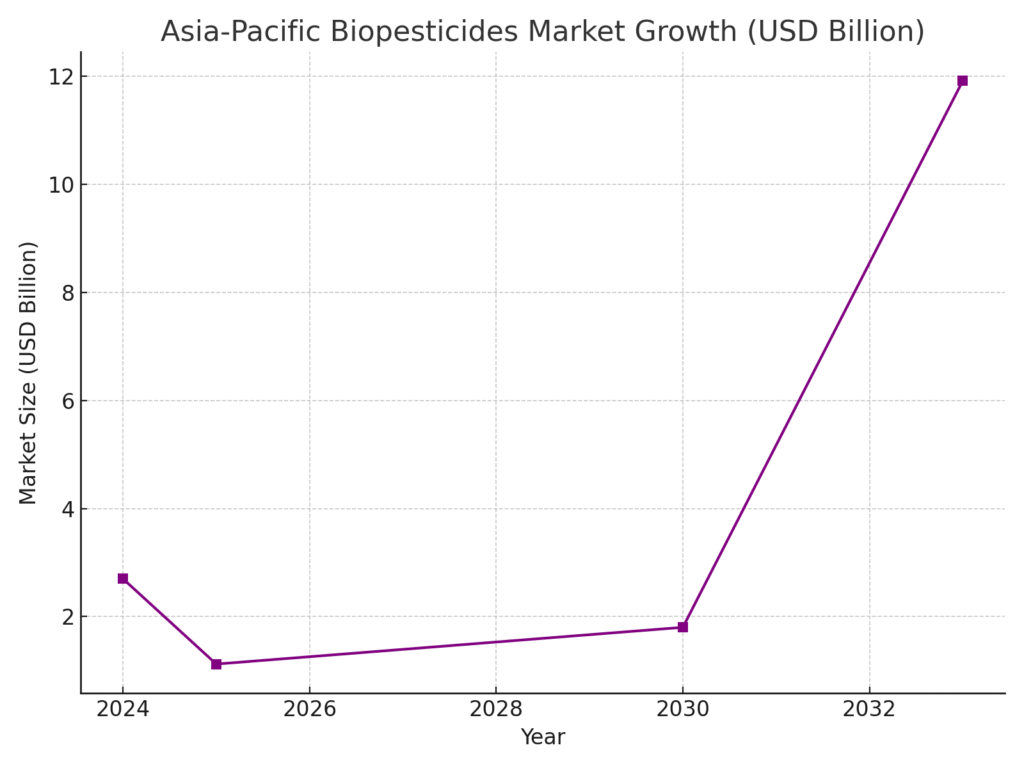
Pesticide Marketing Statistics #12: Asia-Pacific Biopesticides Market At $1.12 Billion In 2025
The Asia-Pacific biopesticides market is projected to reach $1.12 billion in 2025. This growth reflects increased adoption of sustainable farming practices in the region. Marketers can tap into this by highlighting compliance with organic certification standards. Asia-Pacific farmers are eager to export organic products, so the demand is supply-driven. Companies with eco-friendly branding have a real edge here.
Pesticide Marketing Statistics #13: Asia-Pacific Biopesticides To Grow To $11.92 Billion By 2033
The Asia-Pacific biopesticide market is expected to grow from $2.70 billion in 2024 to $11.92 billion by 2033. That’s a massive CAGR of 17.94%. Such strong growth is a clear signal to marketers that sustainability is no longer optional in this region. Positioning products as eco-friendly will not just capture market share but future-proof the business. This statistic reflects a real shift in agricultural priorities.
Pesticide Marketing Statistics #14: Asia-Pacific Holds 23% Of Global Biopesticide Revenue
As of 2024, Asia-Pacific accounted for 23% of global biopesticide revenues, worth $1.57 billion. This positions the region as a major player in sustainable pesticide adoption. Marketers should focus campaigns on education and awareness here, as the market is growing but not yet saturated. Farmers in the region need convincing, but once they shift, the loyalty tends to stick. The revenue share shows Asia-Pacific is no longer just a follower—it’s a leader.
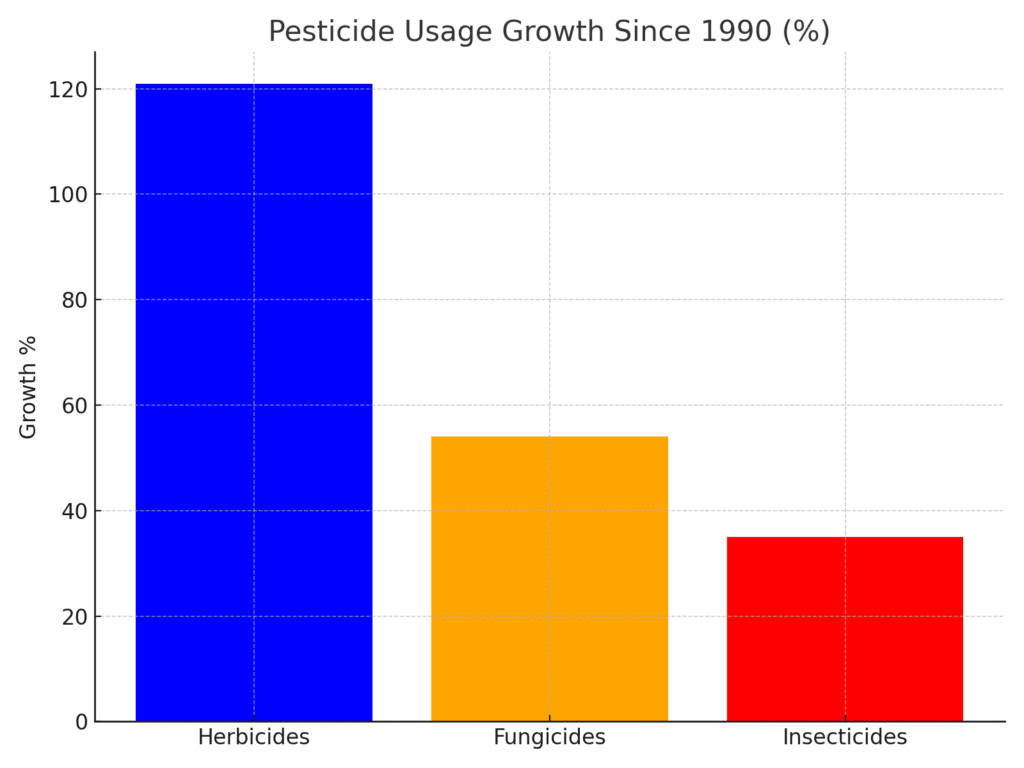
Pesticide Marketing Statistics #15: Herbicide Usage Increased By 121% Since 1990
Between 1990 and 2022, herbicide usage worldwide rose by 121%. This highlights the long-term reliance farmers have developed on weed control chemicals. For marketers, this trend underscores the need to showcase innovation in herbicides. Efficiency, resistance management, and crop safety are key selling points. Numbers this large show how deeply entrenched herbicides are in agriculture.
Pesticide Marketing Statistics #16: Demand For Eco-Friendly Solutions Rising
One of the biggest drivers of pesticide growth is the demand for eco-friendly and sustainable solutions. Consumers are demanding organic, residue-free produce, pressuring farmers to adopt safer products. Marketers should highlight sustainability certifications and safety in their messaging. Companies that fail to adapt risk losing credibility in the market. This trend is less about numbers and more about values—yet it directly influences purchasing decisions.
Pesticide Marketing Statistics #17: Specialty Pesticide Market To Surpass $82.42 Billion By 2037
Specialty pesticides are projected to expand from $26.25 billion in 2024 to $82.42 billion by 2037. With a CAGR of 9.2%, these products are growing faster than the general market. Marketers can target niche audiences like vineyards, high-value crops, and specialty farmers. These buyers are often willing to pay premium prices for tailored solutions. The growth of specialty pesticides is about precision and profitability.
Pesticide Marketing Statistics #18: Crop Protection Market To Grow To $97.01 Billion By 2032
Crop protection chemicals as a whole are set to grow steadily, reflecting a $97.01 billion market by 2032. This is a repeat reminder of the overall sector’s strength. For marketers, bundling pesticides with fertilizers and other solutions creates upsell opportunities. Integrated campaigns that show “full farm care” resonate more strongly. It’s about positioning as a one-stop shop for agricultural health.
Pesticide Marketing Statistics #19: Americas Usage Grew To 1.89 Million Tonnes In 2022
In 2022, pesticide use in the Americas rose to 1.89 million tonnes, up from 1.71 million tonnes in 2021. This steady growth shows the continent’s increasing reliance on chemical solutions. Marketers should focus on scalability, efficiency, and supply chain reliability here. Farmers need assurance that products are always available in large volumes. North and South America remain critical markets for expansion.
Pesticide Marketing Statistics #20: Chemical Pesticides Still Dominate Over Biopesticides
Despite the rise of biopesticides, chemical pesticides remain the dominant share of the market. In 2022, chemicals outweighed biological solutions in adoption. Marketers must recognize this dual reality: chemicals still drive sales today, but biopesticides hold the growth opportunity. Balancing campaigns between reliability and innovation is the smartest approach. This duality will likely define the next decade of pesticide marketing.
Final Thoughts on Pesticide Marketing
Looking back at all these figures, I can’t help but feel that they tell a story of both challenge and promise. On one hand, global usage continues to rise, and with it, concerns about sustainability. On the other hand, the rapid growth of biopesticides shows us that innovation is thriving, offering safer and more marketable alternatives. Personally, I think this mix of data is a reminder that marketing in this space isn’t just about selling products—it’s about aligning with values, timing, and trust. For me, that’s the most exciting part: these statistics don’t just stay on paper; they shape the way we tell stories, build strategies, and make an impact.
SOURCES