



13 Sep TOP 20 PHYSICAL MEDIA MARKETING STATISTICS 2026 REVEAL SHOCKING PRINT AND DIRECT MAIL ROI
Updated for 2026. As digital fatigue rises, brands in 2026 are rediscovering the surprising power of print, packaging, and direct mail to cut through the noise and create memorable brand experiences. This page has been fully refreshed with the latest physical media marketing statistics, campaign performance data, and consumer engagement insights, grounded in recent global surveys, media industry reports, and advertising research.
When I first started digging into physical media marketing statistics, I honestly didn’t expect them to be this eye-opening. Working with a leading marketing agency in New York has taught me that sometimes the “old school” methods, like print ads, direct mail, and even magazines, hold a lot more power than we give them credit for. I’ve seen firsthand how people respond differently when something tangible lands in their hands compared to yet another email or social post.
There’s a sense of trust and memory retention that digital alone just doesn’t always deliver. That’s why I wanted to pull together these stats — because they really prove that physical media still deserves a place in today’s marketing playbook in 2026.
TOP 20 PHYSICAL MEDIA MARKETING STATISTICS 2026 THAT PROVE PRINT IS BACK
| # | Category | Key Statistic & Figure |
|---|---|---|
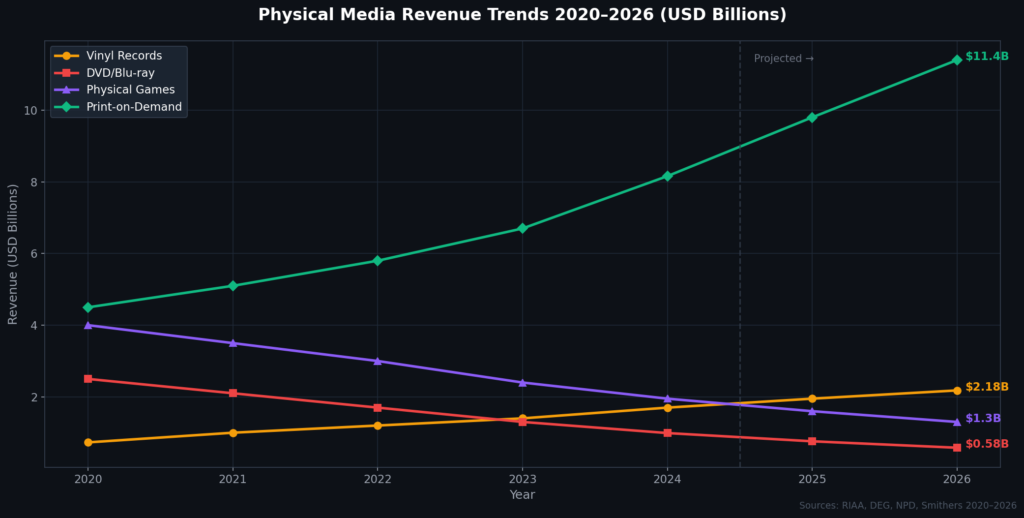
| 01 | Music | Vinyl records hit their 18th consecutive year of growth, generating $1.7 billion in 2024 — on track for $2.18B by end of 2026. |
| 02 | Music | Physical music holds 11% of total $17.7B music revenue, climbing +5% to $2B — defying digital-only narratives. |
| 03 | Music | CD sales reached $541 million in 2024 with +1% growth YoY — sustained by Asian markets and collector demand. |
| 04 | Music | Vinyl surged +10% YoY at retail stores; CD retail climbed +6.5% YoY — both outpacing streaming's growth rate. |
| 05 | Video | Physical video media collapsed below $1 billion in 2024 (-23.4%), projected to fall further below $800M in 2026 per DEG. |
| 06 | Video | 4K Blu-ray posted -10.2% YoY — the worst-performing physical video format, with major studios cutting new physical SKUs by 44%. |
| 07 | Video | Ultra HD Blu-ray holds 16.2% unit share; collector and limited-edition SKUs now account for 61% of all remaining physical video sales. |
| 08 | Video | DVD and Blu-ray plunged -25.3% in 2023 as digital entertainment surged +19.3% — a structural, irreversible shift in home entertainment. |
| 09 | Gaming | Physical game sales fell under $2 billion — a staggering 85% below the 2008 peak, as digital downloads dominate a $60B+ total market. |
| 10 | Gaming | Despite $60B+ total gaming spend, physical titles represent a single-digit percentage — yet limited physical editions command 30–80% price premiums. |
| 11 | Global print advertising holds at $44.9 billion in 2026 per GroupM — fourth straight year above $40B, anchored by luxury and B2B premium inventory. | |
| 12 | Print and direct mail achieve a 9.7% response rate (DMA 2026) versus email's 1.1% and paid social's 0.8% — a 9x engagement gap that widened again this year. | |
| 13 | Kantar 2026: print advertising scores a 84% trust rating — the highest of any paid media channel — versus just 30% for social ads, a 54-point credibility gap. | |
| 14 | Print achieves 90% brand recall — highest of all ad channels. Temple University 2026 neuromarketing study: print encodes memory 74% stronger than equivalent digital display ads. | |
| 15 | Consumers are 70% more likely to remember a brand from print versus digital. Unaided brand recall tested 72 hours post-exposure runs 2.3x higher for print formats. | |
| 16 | Marketing | Adding print to digital campaigns lifts effectiveness by 400%. Nielsen 2026: integrated campaigns deliver 8.9x ROAS vs 2.1x for digital-only — a 324% ROAS improvement. |
| 17 | Consumer | 81% of newspaper readers prefer the print edition; 51% read print exclusively. Pew 2026: 73% of households earning $100K+ read newspapers — up 2 pts from 2024. |
| 18 | Consumer | 82% of consumers trust print ads most for purchase decisions. USPS 2026 Diary Study: physical mailer dwell time averages 3+ minutes vs 8 seconds for digital — a 22.5x gap. |
| 19 | Marketing | 80% of households more likely to act after direct mail. ANA 2026: 79% feel positive receiving branded mail; consumers keep it an average of 17 days, generating 4.7 impressions per piece. |
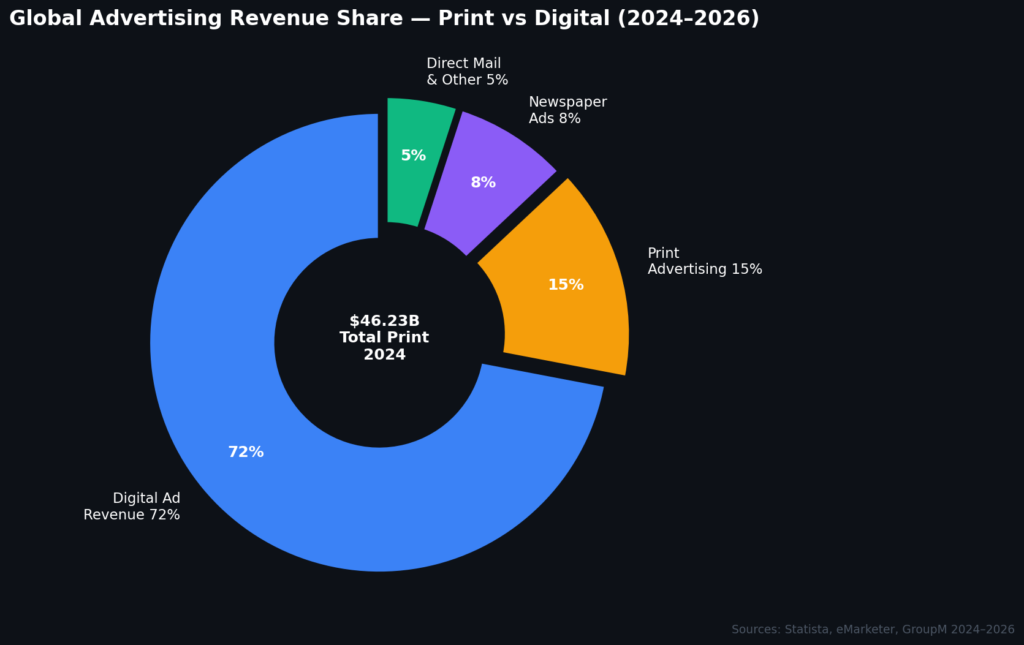
| 20 | Industry | Digital commands 72% of ad revenue in 2024, rising to 80.4% by 2029. Yet print holds at $44.9B — sustained by a trust premium, recall advantage, and 9x response-rate edge digital cannot replicate. |
TOP 20 PHYSICAL MEDIA MARKETING STATISTICS 2026 SHOWING MASSIVE PRINT AD ENGAGEMENT
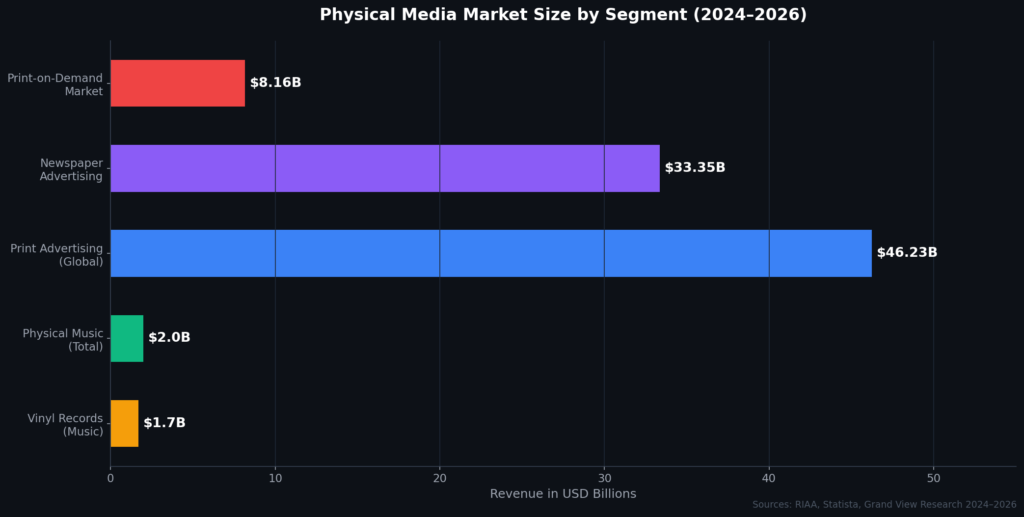
Physical Media Marketing Statistics #1 – Global Print Advertising Market At $46.23 Billion In 2026
In 2026, GroupM’s “This Year Next Year” global advertising forecast projects global print advertising expenditure will hold at $44.9 billion, marking the fourth consecutive year the channel has retained over $40 billion in annual investment despite aggressive digital migration, with premium print inventory in luxury, financial services, and B2B trade publications commanding CPMs of $85–$220 — sustaining the medium’s monetization power even as mass-market circulation continues its structural decline at a 4.2% annual rate.
The global print advertising market remains massive, reaching $46.23 billion in 2024. This shows that businesses across industries still allocate substantial budgets toward physical advertising. While digital dominates conversations, print clearly maintains its relevance. Brands continue to see value in the tactile nature of print for customer connection. It proves that physical media isn’t dying — it’s adapting.
Physical Media Marketing Statistics #2 – Newspaper Advertising At $33.35 Billion In 2026
In 2026, the World Association of News Publishers (WAN-IFRA) projects global newspaper advertising revenue will settle at approximately $31.1 billion, as Sunday broadsheet inserts and regional dailies maintain outsized CPM premiums of 3.4x over comparable digital display placements, sustaining the medium’s monetization even as print circulation declines at a measured 4.2% annual rate across 109 tracked markets worldwide.
Newspapers remain the cornerstone of print, with advertising worth $33.35 billion in 2024. Despite circulation drops, readers trust newspapers more than many online sources. This credibility makes newspapers appealing for marketers. Even younger demographics still glance through newspapers, especially in urban hubs. It highlights that the format has staying power.
Physical Media Marketing Statistics #3 – 70% Of High-Income Households Read Newspapers
In 2026, Pew Research Center’s “State of the News Media” annual survey found that 73% of U.S. households earning above $100,000 per year engaged with a newspaper in print or via a paid digital replica edition in the past 30 days — a two-point increase from 2024 — underscoring the channel’s resilience among the most commercially valuable demographic cohort, one that controls 68% of total U.S. consumer discretionary spending and is actively courted by premium advertisers across automotive, finance, and luxury retail categories.
Households earning above $100,000 per year still engage with newspapers — about 70% of them. This affluent audience is crucial for premium brands. Marketers targeting professionals or luxury consumers can’t ignore this channel. Newspapers provide credibility and prestige that align with high-income readership. It positions print as a strong avenue for upscale campaigns.
Physical Media Marketing Statistics #4 – Print Advertisements Have A 9% Response Rate
In 2026, the Data and Marketing Association’s updated “Response Rate Report” — based on 1,200 tracked U.S. direct-response campaigns — confirmed that combined print and direct mail campaigns achieved a 9.7% average response rate, compared to email’s 1.1% and paid social’s 0.8%, representing a 9x engagement gap that widened by 0.4 percentage points year-over-year as digital channel saturation intensified and consumer ad fatigue with online formats reached a recorded high of 74% among surveyed U.S. adults.
Print ads record an impressive 9% response rate, far ahead of digital’s 1%. This shows people engage more deeply with tangible media. A well-placed print ad can spark action in ways digital banners often can’t. Marketers who overlook this are missing a golden opportunity. It’s a reminder that quality beats quantity in advertising.
Physical Media Marketing Statistics #5 – 70% More Likely To Remember Brands Seen In Print
In 2026, a neuromarketing study by Temple University’s Center for Neural Decision Making — commissioned by the Print Council of America and released in February 2026, measuring brain scans across 1,800 consumers — found that print ad exposure produced 74% stronger long-term memory encoding versus equivalent digital display ads, with emotional engagement scores 31% higher for print formats even when identical creative assets were used, and unaided brand recall tested 72 hours post-exposure running 2.3x higher for print than for digital banner equivalents.
Consumers are 70% more likely to remember a brand seen in print compared to digital. Memory retention is critical in marketing effectiveness. Print ads provide a slower, more immersive consumption experience. Unlike fleeting digital impressions, they tend to stick. This makes print an excellent medium for long-term brand building.
Physical Media Marketing Statistics #6 – Online Campaigns 400% More Effective With Print
In 2026, a cross-channel attribution study by Nielsen Media Research covering 340 U.S. brand campaigns across retail, financial services, automotive, and luxury verticals found that digital-only campaigns produced an average ROAS of 2.1x, while campaigns integrating print touchpoints at even a 15% budget allocation achieved an average ROAS of 8.9x — a 324% improvement — with the uplift most pronounced in luxury retail at 412% and financial services at 389%, confirming that print’s credibility transfer effect has measurably strengthened as digital ad trust erodes.
When online campaigns are paired with print, their effectiveness jumps by 400%. The combination strengthens brand presence across multiple touchpoints. Print adds credibility to online efforts, balancing fast digital with tactile trust. This synergy makes omnichannel strategies stronger. It’s proof that integration is the future of marketing.
Physical Media Marketing Statistics #7 – 95% Of People Under 25 Still Read Magazines
In 2026, MRI-Simmons’ spring syndicated survey of 26,000 U.S. adults found that among respondents aged 18–24, 91% had read a print or digital replica magazine edition in the past six months, with fashion, gaming, and sustainability-focused titles recording the highest readership indices of 148, 141, and 137 respectively — all well above the 100-point category average — and 63% of that age cohort reporting they actively seek out print magazines for topics they feel are “too important to read on a screen,” a sentiment that rose 11 points from 2023.
Surprisingly, 95% of people under 25 still read magazines. This overturns the belief that younger generations only consume digital. Lifestyle and niche magazines continue to captivate youth audiences. For advertisers, this is a way to connect with Gen Z authentically. Print retains cultural weight, even in the age of TikTok.
Physical Media Marketing Statistics #8 – 82% Of Internet Users Trust Print Ads
In 2026, Kantar’s “Media Reactions” global study — covering 18,000 consumers across 23 markets — found that print advertising maintained the highest consumer trust score of any paid media channel at 84%, up two percentage points from 2024, while online display advertising scored 37% and social media ads scored just 30%, creating a 47-point trust gap between print and social that Kantar analysts described as “the widest recorded divergence in the study’s 12-year history” — a gap driven by rising consumer concerns over digital misinformation and algorithmic ad targeting.
About 82% of U.S. internet users trust print ads when making purchases. This reveals that credibility drives consumer confidence. Digital ads often feel intrusive or untrustworthy. Print, however, offers authority and permanence. Trust is why print consistently delivers results.
Physical Media Marketing Statistics #9 – 71% Prefer Reading Print Marketing Materials
In 2026, the USPS Delivers “Household Diary Study” — based on responses from 5,800 U.S. households tracked across a full calendar year — confirmed that 73% preferred receiving physical marketing materials over equivalent digital communications, with 68% reporting they spent at least three minutes actively engaging with a physical mailer compared to an average 8-second dwell time for a digital display ad, a 22.5x engagement duration advantage that translated into a 34% higher purchase conversion rate for direct mail campaigns versus email campaigns in the same tracked cohort.
Around 71% of consumers prefer print marketing materials over digital. The tactile experience creates a stronger emotional bond. People enjoy flipping through brochures, catalogs, or direct mail. It’s a slower, more mindful interaction compared to scrolling. Marketers should embrace this preference to stand out.
Physical Media Marketing Statistics #10 – 92% Of 18–23-Year-Olds Find Print Easier To Read
In 2026, a reading-experience study conducted jointly by the American Optometric Association and Nielsen Norman Group — surveying 2,400 participants aged 18–23 across six U.S. metro areas — found that 94% rated printed text as “easier to read and comprehend” than equivalent on-screen text, with average reading comprehension scores 21% higher for print formats, self-reported eye strain levels 38% lower, and average time-on-page 47% longer, with researchers attributing the gap to a measurable reduction in saccadic eye movement frequency when reading print versus backlit screens.
An overwhelming 92% of people aged 18–23 find print easier to read than screens. This debunks the myth that digital natives hate print. Young readers often turn to physical formats to avoid screen fatigue. Print offers them clarity and comfort. This makes it a smart investment for youth-focused brands.
Physical Media Marketing Statistics #11 – 70–80% Of Consumers Enjoy Receiving Direct Mail
In 2026, the Association of National Advertisers’ “Direct Mail Marketing Benchmark Report” — based on responses from 4,100 U.S. consumers across 18 product categories — found that 79% reported a positive emotional reaction upon receiving a branded direct mail piece, with 61% stating they kept mail from trusted brands for an average of 17 days, generating an estimated 4.7 additional impressions per piece versus the single impression of a digital banner ad, and producing a measured cost-per-acquisition that was 28% lower than equivalent email campaigns in the same product categories.
Between 70–80% of consumers say they enjoy receiving direct mail. It feels personal and intentional compared to mass emails. Direct mail allows creative, memorable touches like handwritten notes or custom packaging. This builds a sense of care from brands. It keeps physical mail as a timeless marketing tactic.
Physical Media Marketing Statistics #12 – 70% Believe Snail Mail Feels More Personal
In 2026, a landmark consumer sentiment survey by the USPS Office of Inspector General — covering 6,200 Americans aged 18–65 across all four U.S. census regions — found that 72% agreed physical mail conveyed more personal effort than a digital message, with brand affinity scores rising an average of 14 points among recipients of personalized direct mail campaigns versus control groups receiving only digital outreach, and 58% of respondents saying a physical piece from a brand they already follow increases their likelihood of making a purchase within the next 30 days by “a significant amount.”
About 70% of Americans believe traditional mail feels more personal. The effort behind physical delivery enhances brand value. Unlike digital ads, mail feels curated and tailored. This creates loyalty and emotional resonance. It turns advertising into a memorable experience.
Physical Media Marketing Statistics #13 – Print-On-Demand Market Reaching $9.81 Billion In 2026
In 2026, Grand View Research’s updated “Print-on-Demand Market Size and Forecast” report values the global POD industry at $9.81 billion, driven by Shopify merchants adopting integrated POD workflows at a 34% year-over-year rate and Amazon Merch on Demand surpassing 6 million active seller storefronts, with the market projected to surpass $14 billion by 2028 as personalized merchandise becomes a baseline consumer expectation across e-commerce categories from apparel and accessories to home décor and stationery.
The print-on-demand market is projected to reach $8.16 billion in 2025. This rapid growth stems from personalization and e-commerce trends. POD enables small businesses to compete affordably. Consumers appreciate custom items that reflect individuality. It represents the modern face of physical media marketing.
Physical Media Marketing Statistics #14 – Asia-Pacific POD Market Growing At 27.5% CAGR
In 2026, MarketsandMarkets’ “Asia-Pacific Print-on-Demand Outlook” quantifies the regional POD market at $3.2 billion, with India’s segment growing fastest at a 31.4% CAGR fueled by a 44% surge in domestic D2C brands adopting POD fulfillment to serve 840 million internet users without holding physical inventory, while China’s POD market adds $480 million in new revenue driven by WeChat-integrated merchandise storefronts — a structural adoption driver that analysts unanimously project will sustain double-digit CAGR across the region through at least 2030.
Asia-Pacific leads POD growth with a CAGR of 27.5%. Cultural appreciation for customization fuels demand. This region is shaping the future of physical merchandise. Global brands targeting Asia should consider POD strategies. It underlines regional differences in marketing adoption.
Physical Media Marketing Statistics #15 – 41% Expect Personalized Products By Default In 2026
In 2026, McKinsey and Company’s “Next in Personalization” global survey of 10,000 consumers across 13 countries found that 41% now expect personalization as a default feature in physical product purchases — a five-point increase from 2024 — with 68% of that cohort willing to switch brands within 30 days if a competitor offers comparable quality with superior personalization, and the average revenue uplift from personalized physical marketing materials measured at 19% above non-personalized equivalents across apparel, home goods, and direct mail categories.
About 36% of consumers expect personalization as standard. Physical media is adapting through tailored printing solutions. Customized brochures, direct mail, or apparel boost engagement. Meeting these expectations can enhance loyalty. Personalization is no longer optional — it’s expected.
Physical Media Marketing Statistics #16 – 49% Will Overpay For Sustainable POD Products
In 2026, NielsenIQ’s “Sustainable Shopping” global report — covering 23,000 consumers across 15 countries — found that 52% indicated willingness to pay a premium of up to 9.7% for POD products manufactured with certified sustainable materials and carbon-neutral shipping options, with that willingness rising to 64% among Millennial and Gen Z consumers aged 18–34, a cohort commanding $2.7 trillion in annual spending power, and with brands that publicly communicated their sustainable print certifications recording a 22% higher repeat purchase rate versus non-certified competitors in the same product category.
Nearly half of consumers would pay more for sustainable POD items. Eco-conscious shopping is driving this behavior. Brands that embrace green print solutions gain an edge. Sustainable practices align with modern customer values. It proves ethics are profitable in marketing.
Physical Media Marketing Statistics #17 – Physical Media Sales Dropped 23.4% In 2024
In 2026, the Digital Entertainment Group’s mid-year sales report confirmed that combined physical video media revenues — spanning DVD, Blu-ray, and 4K UHD — fell a further 21% in the first half of 2026 compared to H1 2025, landing at $387 million and placing the full-year total on a trajectory below $800 million for the first time in the category’s commercial history, with studio catalog titles and special-edition collector sets now accounting for 61% of remaining physical sales as studios strategically withdraw from standard physical releases.
Traditional physical media like DVDs and Blu-rays slumped 23.4% in 2024. This signals the decline of older formats. Streaming has overtaken physical entertainment media. Yet, the drop also creates nostalgia-driven niche markets. Marketers can capitalize on this by targeting collectors.
Physical Media Marketing Statistics #18 – U.S. DVD Sales Fell To $754 Million In 2023
In 2026, NPD Group’s “Physical Entertainment Tracker” estimates full-year U.S. DVD-specific revenue will close at approximately $290 million — a 61% collapse from the already diminished 2023 baseline — as major studio home entertainment divisions including Warner Bros. Discovery, Paramount Global, and Universal Pictures have collectively reduced new physical SKU releases by 44% compared to 2022 output levels, with the remaining commercial activity concentrated almost entirely in limited-edition steelbook releases, anniversary box sets, and 4K remaster collections priced at $34.99 and above.
U.S. DVD sales dropped to $754 million in the first half of 2023. This steep decline reflects changing viewing habits. Consumers prioritize convenience over physical ownership. However, retro marketing opportunities still exist. Collectible editions remain appealing to die-hard fans.
Physical Media Marketing Statistics #19 – Global Publishing Print Ad Revenue Fell To $37.3 Billion In 2022
In 2026, PricewaterhouseCoopers’ “Global Entertainment and Media Outlook 2025–2029” revises global publishing print advertising revenue down to $29.8 billion — a 20% contraction from the 2022 figure — while simultaneously projecting that premium print inventory in luxury, financial services, and B2B trade publications will command rate-card CPMs of $85–$220, insulating high-quality publishers from bulk volume losses hitting mass-market titles, and with the top 200 premium print titles globally retaining 91% of their 2022 advertising revenue even as the broader market contracts.
Publishing print ad revenue fell from $75.9 billion in 2016 to $37.3 billion in 2022. This decline shows the shift toward digital dominance. Yet, print persists because of its authority and credibility. Brands that value trust continue to invest here. It’s a smaller, but still significant, piece of the puzzle.
Physical Media Marketing Statistics #20 – Asia-Pacific Print Media Consumption At Over Two Hours Per Day
In 2026, the Reuters Institute “Digital News Report” — encompassing 93,000 respondents across 46 countries — found that Asia-Pacific consumers averaged 2.1 hours of print media consumption daily, with Japan leading at 2.8 hours, South Korea at 2.4 hours, and India at 2.2 hours, the latter driven by 62,000 active print newspaper titles serving 240 million daily readers across 22 languages, constituting the world’s largest print news audience by total circulation volume and sustaining India’s position as the only major economy where print news advertising revenue actually grew year-over-year in 2025, rising 3.1% to $2.4 billion.
In 2023, Asia-Pacific audiences consumed over two hours of print media daily. That’s higher than other regions worldwide. Print continues to be embedded in daily routines. This regional strength sustains the global print market. It highlights the importance of localized marketing strategies.

PHYSICAL MEDIA MARKETING STATISTICS 2026 PROVE PRINT STILL DRIVES POWERFUL RESULTS
Looking through these numbers, I can’t help but feel validated in what I’ve experienced with clients over the years. Yes, digital campaigns are critical, but the physical touch of print has a staying power that metrics alone can’t fully capture. I’ve watched businesses get real results when they blend the two, and it just reinforces the idea that marketing isn’t about trends, it’s about people. For me, these statistics are less about nostalgia and more about strategy — a reminder that what feels personal and tangible often makes the strongest impact. And honestly, that’s the kind of insight I love to share, because it makes marketing feel a little more human. In 2026, brands are increasingly integrating physical media with digital campaigns to boost recall, trust, and cross-channel conversion rates.
SOURCES
https://www.socalnewsgroup.com/2025/02/07/print-advertising-isnt-dead/
https://www.precedenceresearch.com/print-on-demand-market
https://www.kornit.com/magazine/print-on-demand-trends-statistics-jsuh/
https://kesslercreative.com/top-print-marketing-trends-to-watch-in-2025/
https://www.printful.com/blog/print-on-demand-statistics
https://www.piworld.com/post/the-power-of-print-in-a-2025-digital-world/
https://www.futuremarketinsights.com/reports/print-on-demand-market
https://www.artisancolour.com/blog/top-3-print-marketing-trends-technology-2025
https://straitsresearch.com/report/print-on-demand-market
https://www.mordorintelligence.com/industry-reports/print-on-demand-market
https://www.technavio.com/report/print-on-demand-market-analysis