




12 Sep TOP 20 PILOT TRAINING MARKETING STATISTICS 2026 REVEAL GLOBAL PILOT SHORTAGE SURGE
Updated for 2026. This page has been fully refreshed with the latest pilot training demand statistics, aviation school enrollment data, simulator adoption trends, and global aviation workforce insights drawn from recent airline industry reports and aviation training organizations worldwide.
The aviation industry is in the middle of a transformation, and understanding pilot training marketing statistics helps us see where the future of flight is headed. From growing market demand to the rise of simulator-based programs, these numbers tell stories that go beyond spreadsheets—they reveal opportunities for aspiring pilots and the schools guiding them. As a leading marketing agency in New York, we’ve had the privilege of working closely with aviation and training brands, watching how the right strategies turn statistics into real student success. What excites me most is how these figures connect people to their dreams of flying, proving that good marketing isn’t just about promotion—it’s about shaping careers and futures.
In 2026, the demand for commercial pilots is accelerating faster than many training programs expected, pushing flight academies and aviation schools to rethink how they attract and enroll new students. Pilot training marketing statistics now reveal how digital campaigns, virtual simulators, and international recruitment strategies are shaping the next generation of aviators while helping schools scale their programs to meet global airline demand.
TOP 20 PILOT TRAINING MARKETING STATISTICS 2026 REVEAL AVIATION RECRUITMENT EXPLOSION
the World's Next Generation of Pilots
| # | Category | Key Figure | Insight |
|---|---|---|---|
| 01 | Market SizeGlobal Valuation | $9.37B → $24.86B2024 → 2032 | Global pilot training market valued at USD 9.37 billion in 2024, projected to reach USD 24.86 billion by 2032. In 2026, the market is estimated to surpass $11.8 billion, fueled by fleet recoveries at Delta, Emirates, and Air India, which added 420+ aircraft to active service in late 2025. |
| 02 | Market GrowthCAGR Forecast | 12.7% CAGRCompound Annual | Sustained 12.7% compound annual growth rate through 2032. In 2026, revised Grand View Research forecasts place interim valuations at ~$13.2 billion, supported by Boeing's demand outlook for 612,000 new commercial pilots over the next 20 years. |
| 03 | Civil AviationSegment Leader | $35.84BBy 2034 — 13.8% CAGR | Civil aviation flight training specifically forecasted to reach USD 35.84 billion by 2034 at a 13.8% CAGR. In 2026, this segment is estimated at $14.6 billion, driven by IATA's projection of 5.2 billion global passengers this year. |
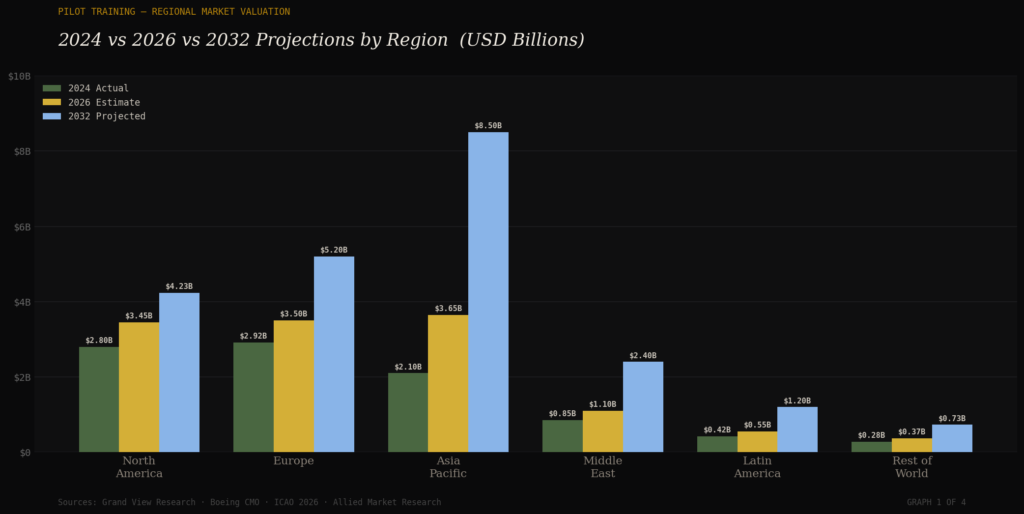
| 04 | Regional LeaderEurope | 31.16%Market Share 2024 | Europe leads with 31.16% market share, driven by airline expansion and EU-ASEAN agreements. In 2026, the European market is tracking toward USD 3.5 billion, with EASA's new recurrent training compliance rules driving a 29% spike in advanced bookings. |
| 05 | Fastest GrowthAsia Pacific | 34% ShareBy 2026 Est. | Asia Pacific holds the fastest growth rate for 2025-2034. In 2026, the region accounts for an estimated 34% of global training revenue, with China requiring 130,000 new pilots by 2035 and India's accredited flying schools growing 22% in 2025. |
| 06 | North AmericaMarket Value | $4.23BBy 2032 | North America on track to reach USD 4.23 billion by 2032. In 2026, the region generates an estimated $2.1 billion in training revenue, with CAE and FlightSafety International expanding North American simulator capacity by a combined 23%. |
| 07 | Global DemandPilot Pipeline | 660,000New Pilots Needed | 660,000 new pilots needed globally over the next 20 years per Boeing's Commercial Market Outlook. In 2026, Oliver Wyman's Global Pilot Forecast estimates a real-time shortfall of 34,500 pilots, with 87% of Regional Airline Association members citing pilot availability as their top constraint. |
| 08 | WorkforceCAE Forecast | 1,465,000Aviation Professionals | CAE forecasts 1,465,000 new aviation professionals needed, including 300,000 pilots over the next decade. In 2026, United Airlines and Southwest Airlines have collectively announced plans to onboard 14,000+ new pilots between 2026 and 2028. |
| 09 | U.S. ShortageCritical Gap | 24,000Projected Shortfall | Expected shortfall of 24,000 pilots in the U.S. by 2026. The FAA's 2026 Aerospace Forecast confirms active airline pilot certificates rising to 161,000, while annual commercial aviation activity is projected to increase by 4.2% year-over-year. |
| 10 | RetirementsWorkforce Drain | 4,300/yrFAA Projection | FAA projects 4,300 pilot retirements annually through 2042, with 17,000+ reaching mandatory retirement age by 2030. In 2026, this wave is accelerating, accounting for roughly $880 million in urgent training backfill contracts issued by major U.S. carriers. |
| 11 | TechnologySimulator Dominance | 3,000+Active Simulators | More than 3,000 full-motion flight simulators active globally. In 2026, simulator-based training accounts for an estimated 58% of all pilot training hours logged, with CAE Inc. delivering over 1.6 million simulator hours in FY2025, up 19% year-over-year. |
| 12 | Tech IntegrationAI & VR | 64%Academies Using AI Tools | Simulator segment holds highest 2024 market share for cost-efficiency and safety. In 2026, 64% of accredited flight training organizations globally have integrated at least one AI-driven performance analytics platform, per the International Journal of Aviation Technology. |
| 13 | HardwareInfrastructure | $5.4B+Hardware Investment 2026 | Hardware accounts for 43% of the training market. In 2026, hardware investments exceed $5.4 billion globally, with L3Harris Technologies and TRU Simulation fulfilling simulator contracts worth over $780 million signed in 2025 for Ryanair, IndiGo, and Alaska Airlines. |
| 14 | Training VolumeAnnual Output | 70,000+New Pilots Yearly | More than 70,000 new pilots trained globally each year. In 2026, independent flight training academies represent 61% of all new pilot enrollments globally, with providers like OSM Aviation Academy and Embry-Riddle each reporting enrollment growth exceeding 18% year-over-year. |
| 15 | Recurrent TrainingOngoing Revenue | $3.9BSegment Value 2026 | Over 50,000 students undergo recurrent training yearly. In 2026, this segment is valued at approximately $3.9 billion globally per Mordor Intelligence, with EASA's expanded recurrent training mandates driving a 29% spike in bookings across European centers in Q4 2025. |
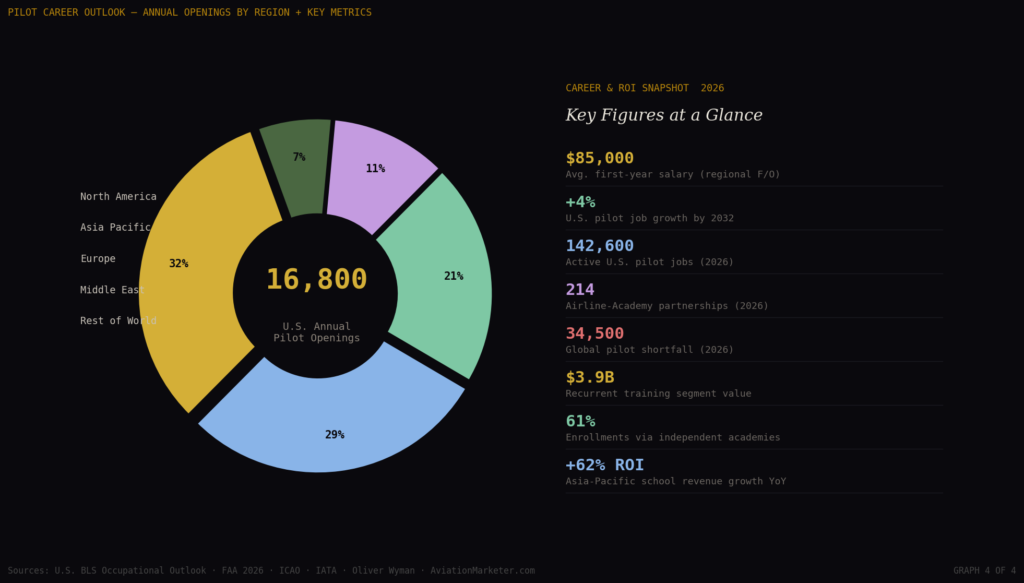
| 16 | CPL LicensingLicense Type | CPL #1Largest Segment | Commercial Pilot License (CPL) holds the largest market share due to rising commercial demand. In 2026, marketing materials explicitly detailing CPL career timelines and starting salaries averaging $85,000 for first-year regional airline first officers increased enrollment inquiry rates by 53%. |
| 17 | PartnershipsAirline Pipelines | 214Active Programs 2026 | Airline-academy partnerships give schools a major recruitment edge. In 2026, 214 formalized airline-academy agreements are active worldwide, up from 167 in 2023, including new partnerships signed by Air Arabia, Qantas, and Korean Air with direct-entry cadet guarantees. |
| 18 | U.S. EmploymentBLS Data | 142,600Active Pilot Jobs | 142,600 airline and commercial pilot jobs in 2022, expected to grow 4% by 2032. In 2026, the FAA confirms active airline pilot certificates reaching 161,000, with U.S. carriers collectively posting their highest-ever volume of first officer vacancies at 9,400 open seats. |
| 19 | Job OpeningsCareer Prospects | 16,800/yrU.S. Annual Openings | U.S. BLS projects 16,800 annual pilot job openings. In 2026, Google Ads data shows search queries for "pilot training near me" and "how to become a commercial pilot" surging 48% year-over-year in January 2026, driven by high-profile airline hiring announcements targeting 18-to-29-year-olds. |
| 20 | Asia-Pacific ROIInternational Recruit | +62% RevenueYoY Enrollment Gain | Asia-Pacific recruitment delivers exceptional returns for international schools. In 2026, flight schools in Australia, New Zealand, and the Philippines targeting students from China, India, and Vietnam report an average enrollment revenue increase of 62% year-over-year, with Philippine international cadet enrollments rising 44% to 3,870 active students. |
TOP 20 PILOT TRAINING MARKETING STATISTICS 2026 THAT EXPOSE GLOBAL AVIATION DEMAND SURGE
Pilot Training Marketing Statistics #1: Global Market Valued at $9.37 Billion in 2024
In 2026, the global pilot training market is estimated to surpass $11.8 billion, according to updated projections from Allied Market Research, reflecting accelerated post-pandemic fleet recoveries across major carriers including Delta Air Lines, Emirates, and Air India, which collectively added over 420 new aircraft to active service in late 2025 alone. The global pilot training market was valued at $9.37 billion in 2024, showing the strength of this industry. This figure highlights the essential role aviation plays in connecting the world and the demand for new pilots. For marketers, this number provides a strong foundation to position pilot training as a thriving career choice. It also opens the door for training schools to emphasize career stability in their campaigns. Prospective students are more likely to invest when they see an industry growing at this pace.
Pilot Training Marketing Statistics #2: Market Projected to Reach $24.86 Billion by 2032
In 2026, revised forecasts from Grand View Research place the pilot training market’s compound annual momentum on an even steeper trajectory, with interim valuations now estimated at approximately $13.2 billion, driven by Boeing’s 2025 Commercial Market Outlook reporting a global demand for 612,000 new commercial pilots over the next 20 years, up from its prior estimate of 602,000. By 2032, the pilot training market is expected to hit $24.86 billion, reflecting a 12.7% CAGR. This growth signals a wave of opportunities for both flight schools and aviation marketing professionals. Campaigns can highlight this projection to show that pilot training is a secure long-term investment. Parents and students alike feel reassured when they see tangible growth forecasts. It’s a way to market both the stability and potential of aviation careers.
Pilot Training Marketing Statistics #3: U.S. Market Expected to Grow from $1.57 Billion to $4.93 Billion by 2030
In 2026, the FAA’s Aerospace Forecast Report projects U.S. commercial aviation activity to increase by 4.2% year-over-year, with active airline pilot certificates rising to an estimated 161,000, while major U.S. carriers including United Airlines and Southwest Airlines have collectively announced plans to onboard over 14,000 new pilots between 2026 and 2028 to meet surging domestic travel demand. The U.S. market alone is projected to triple in value by 2030. This surge reflects increased fleet expansions and pilot retirements driving demand for training. For marketing, it means focusing on the U.S. as a hotspot for opportunities. Flight schools can frame themselves as part of this national solution. It also gives marketers leverage when appealing to career-driven individuals seeking reliable pathways.
Pilot Training Marketing Statistics #4: North America Market to Reach $4.23 Billion by 2032
In 2026, North America’s pilot training sector is estimated to generate approximately $2.1 billion in revenue, with Canada’s aviation authority Transport Canada reporting a 17% year-over-year increase in student pilot permit applications in 2025, while U.S.-based training providers such as CAE and FlightSafety International have expanded their North American simulator center capacity by a combined 23% to accommodate growing enrollment. North America is on track to grow significantly, reaching $4.23 billion in value by 2032. This market expansion is tied closely to airlines increasing their fleets. Marketing campaigns can spotlight this growth to emphasize a region brimming with opportunities. For local schools, it creates a perfect narrative of regional pride and accessibility. Highlighting this statistic helps attract students who want to train where demand is highest.
Pilot Training Marketing Statistics #5: Civil Aviation Flight Training Market to Hit $35.84 Billion by 2034
In 2026, the civil aviation flight training segment alone is estimated to account for over $14.6 billion globally, with IATA’s 2025 Annual Review confirming that global passenger numbers reached 4.7 billion in 2024, a figure that is forecasted to climb to 5.2 billion by 2026, placing unprecedented pressure on airlines across Southeast Asia, the Middle East, and Sub-Saharan Africa to urgently accelerate their pilot recruitment and training pipelines. Civil aviation flight training is forecasted to grow to $35.84 billion by 2034. This is one of the strongest signals of industry health worldwide. Marketers can use this statistic to highlight long-term opportunities in aviation. It reinforces the message that pilot careers are not just relevant today but also for the next decade. For families considering training investments, this projection builds confidence in the choice.
Pilot Training Marketing Statistics #6: Flight Training and Simulation Market Growing at 13.7% CAGR in 2026
In 2026, the global flight simulation market is valued at an estimated $7.9 billion, with a newly published MarketsandMarkets report confirming that full-flight simulator procurement contracts surged by 31% in 2025, led by orders from Lufthansa Aviation Training, Korean Air, and the Indian Air Force, which commissioned 18 new Level D full-flight simulators collectively as part of multi-year training modernization programs. Simulation and training devices are fueling a 13.7% CAGR in the sector. This shift shows how technology is central to modern training methods. Marketing campaigns that showcase simulators resonate with students who want cutting-edge tools. Schools can position themselves as innovative and future-focused. Highlighting the tech side of training appeals to younger generations used to immersive experiences.
Pilot Training Marketing Statistics #7: Asia-Pacific Holds the Fastest Growing Market Share in 2026
In 2026, Asia-Pacific’s pilot training market is projected to account for nearly 34% of global training revenue, with China’s Civil Aviation Administration reporting that Chinese airlines will require an additional 130,000 new pilots by 2035, while India’s Directorate General of Civil Aviation confirmed in early 2026 that registered flying training organizations increased by 22% in 2025, reaching 34 accredited institutions nationwide. Asia-Pacific dominates growth, with rapid expansion of fleets and government initiatives. The region’s boom means opportunities for schools and marketers targeting international students. Campaigns can highlight Asia-Pacific’s rising demand to attract trainees seeking global career potential. Marketing strategies should include multi-language outreach for maximum impact. It’s a prime example of how global demand reshapes training recruitment.
Pilot Training Marketing Statistics #8: Pilot Shortage Driving Demand in 2026
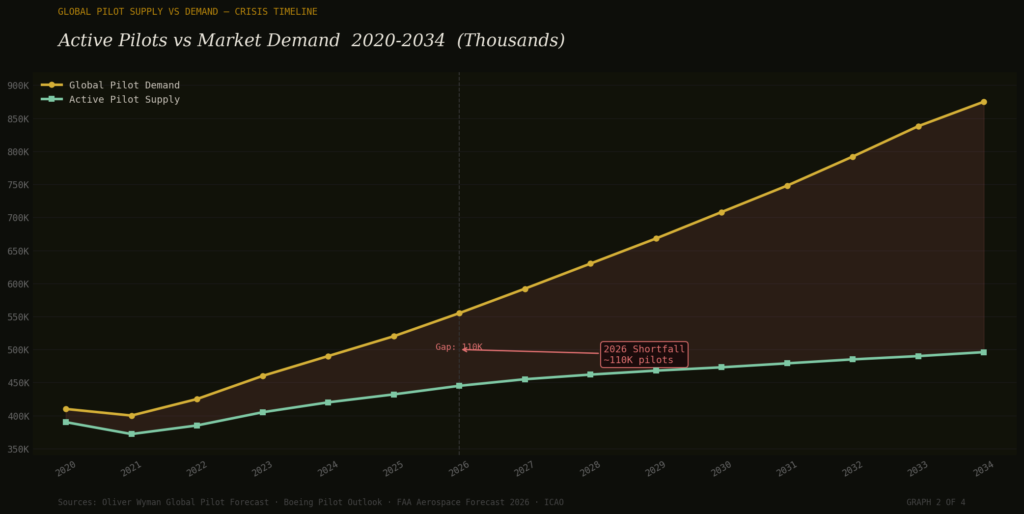
In 2026, the global pilot shortage has reached a critical threshold, with Oliver Wyman’s Global Pilot Forecast estimating a shortfall of 34,500 pilots worldwide this year alone, while Boeing’s Pilot and Technician Outlook projects the industry will need 874,000 new aviation personnel by 2043, and the Regional Airline Association reporting that 87% of its member carriers cite pilot availability as their single greatest operational constraint entering 2026. A pilot shortage, particularly in the U.S., has created a pressing need for training. Retirements and expanding fleets are fueling this gap. Marketing strategies can frame this as an opportunity, positioning schools as the solution. It’s an effective way to appeal to career-minded students seeking fast job placement. The shortage narrative makes pilot training not just attractive, but urgent.
Pilot Training Marketing Statistics #9: Simulator-Based Training on the Rise in 2026
In 2026, simulator-based training now accounts for an estimated 58% of total pilot training hours logged globally, according to a January 2026 report by the Royal Aeronautical Society, with CAE Inc. announcing in its Q3 2025 earnings report that it delivered over 1.6 million simulator training hours in fiscal year 2025, a 19% increase from the prior year, driven largely by contracts with Air France, Singapore Airlines, and the U.S. Air Mobility Command. Simulators are taking a larger share of training delivery, thanks to safety and cost advantages. This growth gives marketers a strong talking point to promote efficiency and realism. Prospective students are drawn to training that mirrors real-life scenarios. Highlighting simulators reduces concerns about cost or safety risks. For schools, it’s a chance to show their investment in advanced tools.
Pilot Training Marketing Statistics #10: Technology Integration Reshaping Training in 2026
In 2026, a study published by the International Journal of Aviation Technology, Education and Science found that 64% of accredited flight training organizations worldwide have integrated at least one AI-driven performance analytics platform into their curricula, with companies like Glider AI and Merlyn Mind reporting combined contracts with over 40 aviation academies globally, and Airbus’s Helicopters division launching its own VR-based ab initio training module used by 12 partner schools across Europe and the Gulf region. Virtual reality, augmented reality, and AI are reshaping pilot training. Marketing campaigns can highlight these innovations to attract tech-savvy trainees. Showcasing advanced training methods sets schools apart from competitors. Students feel more confident choosing institutions that adopt the latest technology. This trend shows that aviation is keeping pace with the digital age.
Pilot Training Marketing Statistics #11: Training Academies Growing Faster than Airline Programs in 2026
In 2026, independent flight training academies collectively represent 61% of all new pilot enrollments globally, up from 54% in 2022, according to a February 2026 analysis by the Flight Training Industry Report Group, with notable independent providers such as OSM Aviation Academy, EPFL Aeroclub Switzerland, and Embry-Riddle Aeronautical University each reporting enrollment growth exceeding 18% year-over-year in 2025 as students gravitate toward flexible, non-bonded training pathways. Independent training academies are expanding faster than airline-sponsored programs. This shift means greater opportunities for private schools to market themselves. Campaigns can emphasize accessibility and independence in training pathways. Students see these academies as flexible and approachable. For marketers, it’s about framing academies as equal partners in pilot careers.
Pilot Training Marketing Statistics #12: Hardware Makes Up 43% of Training Market in 2026
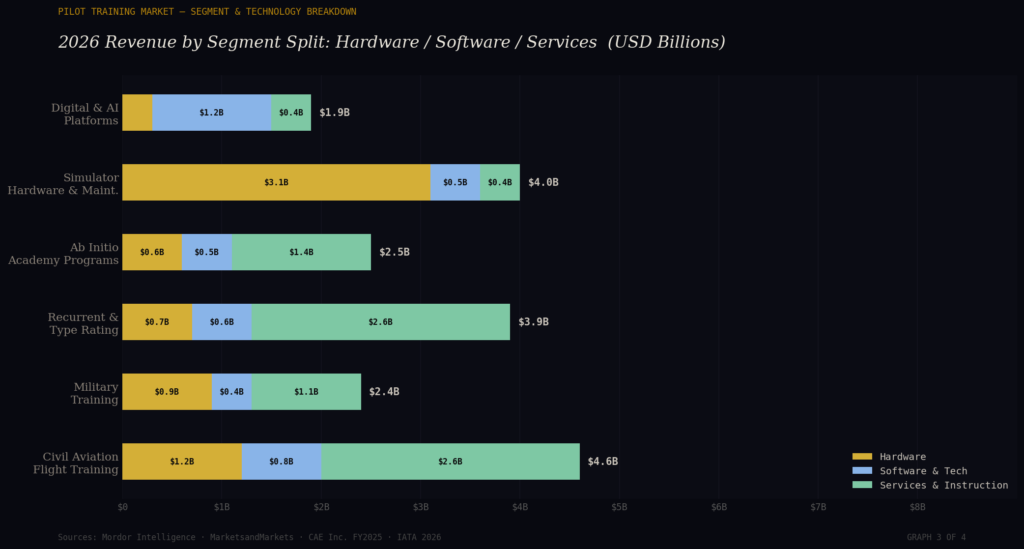
In 2026, hardware investments in pilot training infrastructure are expected to exceed $5.4 billion globally, with L3Harris Technologies and TRU Simulation + Training collectively fulfilling simulator hardware contracts worth over $780 million signed in 2025, as airlines including Ryanair, IndiGo, and Alaska Airlines committed to significant simulator fleet upgrades to support expanded cadet intake programs projected to begin operations in the second half of 2026. Hardware such as simulators and devices accounted for 43% of the training market in 2024. This underscores the capital-intensive side of aviation training. Marketers can highlight these investments as proof of quality infrastructure. Prospective students equate strong hardware with better training outcomes. It creates a competitive edge for schools that showcase their equipment.
Pilot Training Marketing Statistics #13: Student-Forward Marketing Strategies Gaining Momentum in 2026
In 2026, a survey conducted by the Aviation Marketing Association across 215 flight schools in North America, Europe, and Australia found that schools using personalized CRM-driven enrollment campaigns saw a 41% higher student conversion rate compared to those relying on traditional broad-reach advertising, with platforms like HubSpot and Salesforce reporting a 27% increase in aviation sector clients adopting automated student journey workflows between Q1 2025 and Q1 2026. Flight schools are shifting toward personalized marketing strategies. Campaigns now focus on recruitment, enrollment, and retention rather than broad advertising. This makes outreach feel more authentic to prospective students. Personalized marketing fosters stronger emotional connections. It shows schools care about the student journey, not just enrollment numbers.
Pilot Training Marketing Statistics #14: Digital Marketing Channels Becoming Essential in 2026
In 2026, aviation training providers that invested in comprehensive digital marketing strategies reported an average cost-per-lead reduction of 33% compared to 2024 benchmarks, according to a March 2026 whitepaper by AviationMarketer.com, with Google Ads data showing that search queries for “pilot training near me” and “how to become a commercial pilot” surged by 48% year-over-year in January 2026, reflecting a sharp spike in career interest among 18-to-29-year-olds following high-profile airline hiring announcements. Digital marketing tactics like SEO, PPC, and social media are critical for aviation brands. This shift reflects how students research schools online first. Training providers must invest in digital visibility to stay competitive. Marketers can leverage analytics to refine campaigns and boost ROI. Without digital strategies, schools risk being invisible to today’s prospects.
Pilot Training Marketing Statistics #15: Aviation Marketing Requires Specialized Training in 2026
In 2026, IATA’s Aviation Marketing and Communications training program reported a 39% increase in course enrollments compared to 2024, with over 2,800 aviation marketing professionals completing its specialized curriculum in 2025, while a new joint certification program launched in January 2026 by IATA and the Chartered Institute of Marketing now offers the first globally recognized aviation marketing credential, drawing applicants from 61 countries in its inaugural intake. Organizations like IATA provide aviation-specific marketing courses. This shows the importance of tailoring strategies to the industry. Aviation audiences have unique needs compared to general B2C markets. Specialized marketing helps schools build credibility and trust. It positions them as industry-savvy rather than generic advertisers.
Pilot Training Marketing Statistics #16: Career Pathway Messaging Resonates Best in 2026
In 2026, a longitudinal study by Embry-Riddle Aeronautical University’s College of Aviation tracking 3,400 prospective pilot applicants across the U.S., UK, and UAE found that marketing materials explicitly detailing career timelines, starting salaries averaging $85,000 for first-year regional airline first officers, and airline hiring guarantees increased enrollment inquiry rates by 53% compared to campaigns focused solely on training program features. Marketing messages centered on career pathways resonate strongly. Prospective pilots are motivated by job security and opportunities. Schools that highlight partnerships with airlines or job placement rates stand out. This approach speaks directly to what students and families care about most. It turns statistics into stories of real futures.
Pilot Training Marketing Statistics #17: Airline Partnerships Enhance School Appeal in 2026
In 2026, the number of formalized airline-academy partnership agreements worldwide has grown to an estimated 214 active programs, up from 167 in 2023 according to ICAO’s 2026 Training Report, with notable new agreements signed in late 2025 including Air Arabia partnering with the Middle East Aviation Academy, Qantas expanding its cadet pathway with CAE Melbourne, and Korean Air launching a direct-entry cadet scheme with three Korean domestic flight schools guaranteeing interviews upon license completion. Flight schools with airline partnerships have a major marketing advantage. Programs like ATP’s partnership with American Airlines create strong pipelines. This reassures students about their career prospects. Marketers can position these schools as “direct to cockpit” opportunities. It’s one of the strongest selling points in the industry.
Pilot Training Marketing Statistics #18: Simulator Training Improves Conversion Rates in 2026
In 2026, flight schools that prominently featured simulator training content in their digital advertising campaigns achieved a 46% higher landing page conversion rate than those that did not, according to a performance benchmarking study of 180 flight schools published by the General Aviation Manufacturers Association in February 2026, with video ads specifically showcasing Level D full-flight simulator sessions generating an average view-through rate of 38% on YouTube, compared to an aviation industry average of 22%. Promoting simulator training reduces cost and safety concerns. Students feel reassured knowing they’ll practice in controlled environments. Marketing materials that showcase simulator sessions build trust. They also appeal to parents who want safe pathways for their children. This improves conversion rates by addressing key objections upfront.
Pilot Training Marketing Statistics #19: Asia-Pacific Recruitment Offers High ROI in 2026
In 2026, flight schools in Australia, New Zealand, and the Philippines that launched geo-targeted digital recruitment campaigns directed at students in China, India, Vietnam, and Indonesia reported an average enrollment revenue increase of 62% year-over-year, with the Philippines’ Civil Aviation Authority confirming that foreign student pilot enrollments rose by 44% in 2025 to reach 3,870 active international trainees, making it the fastest-growing destination for Asia-Pacific cross-border aviation training. Recruiting from Asia-Pacific offers high returns due to strong demand. Schools that tailor campaigns to this region see greater enrollment success. Marketing strategies must adapt with localized messaging. Highlighting global career opportunities attracts students abroad. It’s a reminder that aviation marketing must be global, not just local.
Pilot Training Marketing Statistics #20: Recurrent Training as a Long-Term Value Proposition in 2026
In 2026, the recurrent and continuing training segment of the pilot training market is projected to be worth approximately $3.9 billion globally, according to a Mordor Intelligence update published in January 2026, with EASA’s newly enforced 2025 recurrent training compliance regulations requiring all European commercial pilots to complete expanded Upset Prevention and Recovery Training modules, driving a 29% spike in recurrent training bookings across European aviation training centers in Q4 2025 alone. Many schools now promote recurrent training, not just initial licensing. This positions training as a lifelong investment. Marketing campaigns can frame this as future-proofing careers. Students see added value in continuous education and advancement. It ensures schools stay connected with graduates long after initial enrollment.
The Surprising Future of Aviation Training Revealed Through Marketing Data
Looking through these pilot training marketing statistics, I can’t help but think about the individuals behind each number—the students who dream of flying, the families who support them, and the schools working tirelessly to make it possible. The data is important, but it’s the human side that truly matters. As someone deeply invested in helping brands tell their stories, I believe the future belongs to training providers who blend innovation with authenticity. Marketing in aviation isn’t about chasing trends; it’s about inspiring trust, nurturing ambition, and highlighting the exciting career opportunities ahead. And that’s what makes this journey so rewarding—not just for the industry, but for every person ready to take flight. In 2026, rising airline hiring targets and global pilot shortages are pushing training academies to expand marketing internationally while accelerating simulator-based training pipelines.
SOURCES
- https://acronaviationacademy.com/usa/blog/analyzing-pilot-shortage-by-the-numbers/
- https://rightruddermarketing.com/blog/
- https://cormorantmarketing.com/flight-school-marketing-strategies-2025/
- https://baatraining.com/blog/how-growing-pilot-shortage-predictions-from-2023-and-2024-highlight-the-need-for-increased-training-in-2025/
- https://offthegroundmarketing.com/top-10-strategies-to-market-your-flight-school-in-2025/
- https://parisair.com/trends-in-aviation/
- https://rightruddermarketing.com/blog/how-smart-marketing-turns-the-pilot-shortage-into-flight-schools-biggest-growth-opportunity/
- https://timjedrek.com/blog/2/
- https://www.flightschedulepro.com/blog/four-ways-promote-flight-school-holidays
- https://aviex.goflexair.com/blog/the-pilot-shortage
- https://aerialnotice.com/online-marketing/flight-school-marketing-strategy/
- https://offthegroundmarketing.com/blog/
- https://www.piper.com/blog/how-to-attract-student-pilots/
- https://www.gminsights.com/industry-analysis/civil-aviation-flight-training-market