



17 Sep TOP 20 PLAY STORE MARKETING STATISTICS 2026 THAT EXPOSE MASSIVE APP GROWTH SECRETS
Updated for 2026. This page has been fully refreshed with the latest Play Store marketing statistics, app discovery trends, user acquisition data, and mobile growth insights, grounded in recent global developer reports, Google ecosystem data, and mobile industry research.
When I first started looking into play store marketing statistics, I realized just how much insight they reveal about app growth, user behavior, and the sheer scale of opportunity that developers and businesses have today. Working alongside a leading marketing agency in New York, I’ve seen firsthand how data-driven strategies can completely transform the way apps are positioned and promoted on Google Play.
For me, diving into these numbers isn’t just about tracking downloads or revenue—it’s about understanding the real people behind the installs, the habits they form, and the choices they make every day.
TOP 20 PLAY STORE MARKETING STATISTICS 2026 (EDITOR’S CHOICE) THAT SHOCK APP DEVELOPERS
📱 Top 20 Google Play Store Marketing Statistics 2026
The Ultimate Revenue & Growth Data for Android App Marketers
Total Apps Available: 1.71M - 2.23M apps
Following Google's major quality purge, the Play Store dropped from 3.4M to under 2M apps since 2024 - a 47% reduction prioritizing quality over quantity.
Free Apps Dominate at 97% of all listings
2.16M free apps vs only 65,950 paid apps. Free apps generate 98% of total platform revenue through IAP and ads.
Only 65,950 paid apps exist on Play Store
Over 20,000 paid apps are priced under $1. Premium pricing demands exceptional value in a freemium-dominated market.
664,755+ unique app publishers active
Google now requires 12 engaged testers for 14 days for new personal developer accounts, raising quality barriers significantly.
1,200 - 1,960 new apps launched daily
September 2025 saw 43,800 new apps but 27,200 removed. Net growth depends on meeting Google's quality thresholds.
39,600 - 54,900 new apps per month
February 2026 recorded 39,600 launches with 12,300 removals, resulting in net growth of 27,300 apps.
100+ Billion downloads in 2025
36.2B games + 67.7B non-game apps. ChatGPT was #1 most downloaded app with 553M downloads, surpassing TikTok.
Downloads to reach 143 Billion by end of 2026
31% growth from 111B in 2021. India, Brazil, Indonesia, and Mexico drive 90% of emerging market downloads.
Consumer spending hit $49.2 Billion
13% YoY increase. $31B from games, $19.2B from apps. Google One was top-grossing app with $2.6B revenue.
Projected revenue: $60 - $65 Billion
10-12% CAGR growth. Top 1% of users ("whales") account for 40-60% of all in-app spending.
Non-gaming apps comprise 88% of catalog
~1.82M non-gaming apps. Health & wellness apps grew 35% YoY. Finance, productivity dominate downloads.
Games at 12% of apps, $40B revenue
~270K gaming apps generate 74% of revenue. Battle passes now account for 41% of gaming revenue.
Only ~50% of apps have any ratings
Of 2.07M apps, 1.03M have ratings. Only 234,466 achieved 4.0+ stars; 109,473 above 4.5 stars.
50.4% of apps lack any user ratings
Apps below 3.5 stars see dramatically reduced discoverability. 4.5+ star apps significantly outperform in retention.
28-35% of apps updated weekly
Thursday is the most popular day for releasing updates. Frequent updates improve algorithm ranking and retention.
72-75% of apps updated monthly
Update frequency now factors into Google's visibility algorithm. Consistent maintenance is the industry standard.
95-96% of apps updated annually
Google removes apps not updated within 3 years. Near-universal annual updates ensure Android compatibility.
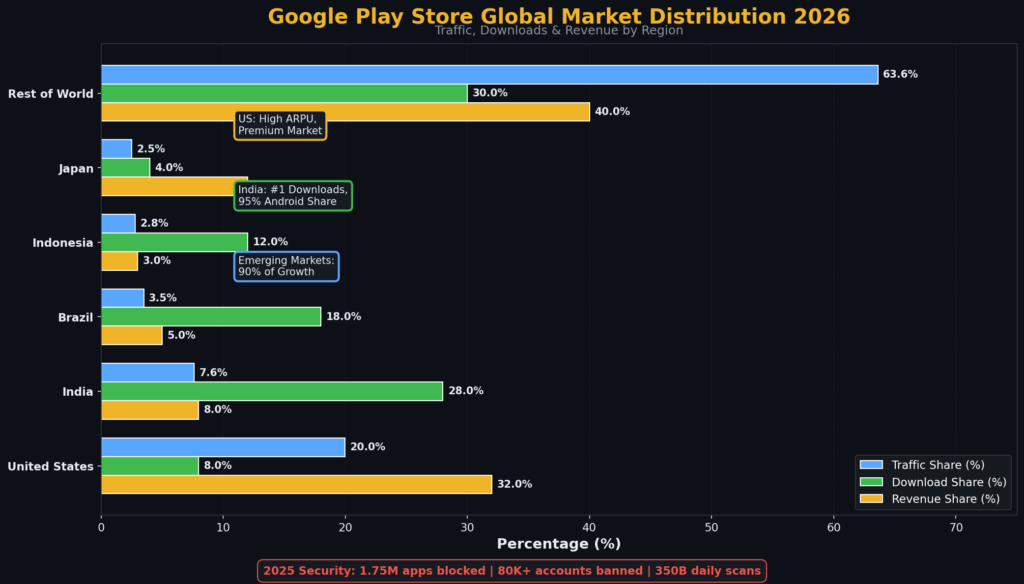
United States accounts for 19.96% of traffic
35.49B visits with 77.53% from mobile. US ranked 3rd in downloads but leads in revenue per user (high-ARPU).
India holds 7.62% traffic, #1 in downloads
14B+ downloads in H1 2024. Android has 95.16% market share in India. Localization critical for success.
Google blocked 1.75M policy-violating apps in 2025
80,000+ developer accounts banned. Play Protect scans 350B apps daily. 47% catalog reduction since 2024.
TOP 20 PLAY STORE MARKETING STATISTICS 2026 REVEAL EXPLOSIVE ANDROID APP DISCOVERY TRENDS
Play Store Marketing Statistics#1 Total Apps Available at 2.06 Million
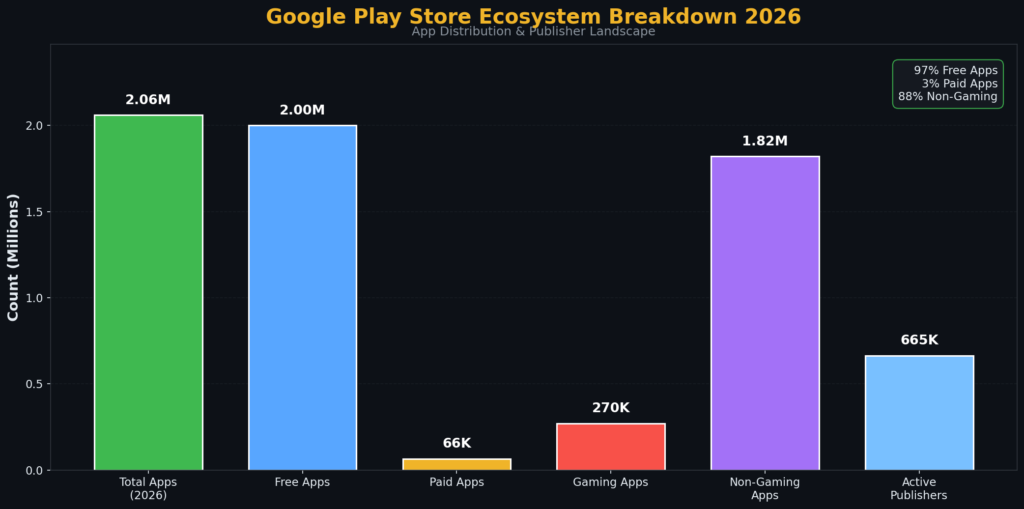
In 2026, multiple data sources report that the Google Play Store hosts between 1.71 million and 2.23 million apps as of early March, with 42matters tracking 2,231,017 apps and AppBrain recording 1,716,379 apps following Google’s major quality enforcement initiative that removed nearly half of its catalog since 2024.
As of 2025, the Google Play Store has around 2.06 million apps available for download. This massive library highlights the competitive environment developers face when trying to stand out. It also signals how broad the Play Store’s role has become in shaping mobile culture worldwide. From productivity tools to entertainment apps, the diversity ensures that nearly every niche has representation. For marketers, this figure is a reminder of how critical proper positioning and optimization truly are.
Play Store Marketing Statistics#2 Free Apps Dominate at 97%
In 2026, the 97% free app dominance continues to hold steady, with approximately 2,164,394 free apps available on Google Play compared to just 65,950 paid apps, while these free apps generate a staggering 98% of the platform’s total revenue through in-app purchases, subscriptions, and advertising.
Around 97% of all Play Store apps are free, leaving just about 3% as paid offerings. This dominance of free apps shows how monetization relies heavily on in-app purchases, ads, or subscriptions. For users, the availability of free apps reduces friction in trying new experiences. For businesses, however, it requires smart strategies to convert free users into paying customers. This stat reinforces the need for marketers to focus on user engagement rather than upfront cost.
Play Store Marketing Statistics#3 Paid Apps Limited to 65,950 in 2026
In 2026, the paid app segment has grown slightly to approximately 65,950 apps according to 42matters data, though over 20,000 of these paid apps are priced under $1, demonstrating that premium pricing strategies remain challenging in a marketplace where freemium models dominate consumer expectations.
Only about 62,235 apps on Google Play are paid, a tiny fraction of the overall catalog. This number underscores the difficulty of convincing users to pay upfront in today’s freemium-driven market. Still, niche paid apps can succeed if they solve very specific problems or target professional audiences. It’s an important reminder that premium pricing must come with clear, standout value. For marketers, the focus shifts to building strong reputations that justify payment.
Play Store Marketing Statistics#4 Over 664,000 Publishers Active in 2026
In 2026, the number of unique app publishers on Google Play has grown to approximately 664,755 according to 42matters, while other sources report over one million developers with published apps, reflecting the global expansion of the developer ecosystem despite Google’s stricter verification requirements that now demand 12 engaged testers for 14 days for new personal developer accounts.
Google Play is home to over 580,000 unique app publishers. This number shows the depth of competition developers face in nearly every category. It also reflects how global the Play Store has become, drawing creators from small startups to large enterprises. For users, this variety is a win, offering a wide range of choices. For marketers, it means differentiation and branding are absolutely essential to stand out.
Play Store Marketing Statistics#5 1,200-1,960 New Apps Released Daily in 2026
In early 2026, data shows varying daily release rates with 42matters reporting approximately 1,960 new apps per day, while other sources cite figures between 1,200 and 1,250 daily releases, though Google continues to offset this influx by removing tens of thousands of low-quality apps monthly (September 2025 saw 43,800 new apps launched but 27,200 removed).
Every single day, around 1,569 new apps are launched on Google Play. This sheer volume highlights how saturated the market has become. For a new app to gain visibility, strong ASO (App Store Optimization) and early promotion are critical. It also means competition is constantly growing, with fresh alternatives available to users daily. For marketers, speed and creativity in campaigns make the difference between being noticed or forgotten.
Play Store Marketing Statistics#6 39,600-54,900 New Apps Per Month in 2026
In February 2026, Google Play saw the launch of 39,600 new applications according to AppBrain data, while the net growth was 27,300 apps after 12,300 removals, and industry reports indicate monthly launches can reach up to 54,909 apps depending on seasonal developer activity patterns.
Monthly, the Play Store welcomes approximately 52,682 new apps. This figure reinforces the ongoing growth of mobile ecosystems. While it demonstrates a thriving developer community, it also creates noise for users searching for quality. Developers who can update consistently and innovate will gain a competitive edge. For marketers, this stat underlines the need to build momentum right after launch.
Play Store Marketing Statistics#7 Over 100 Billion Downloads in 2025
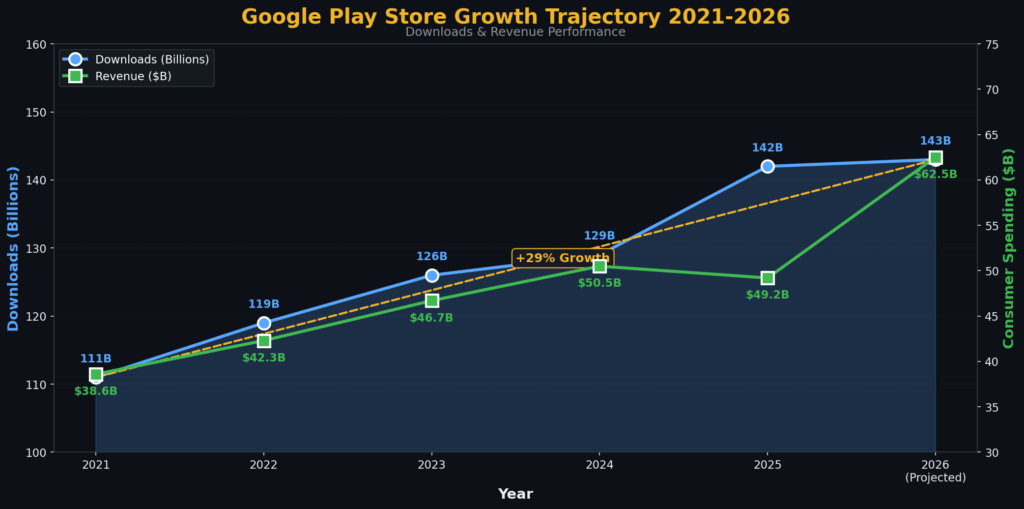
In 2025, Google Play Store achieved over 100 billion app downloads with a 2.1% increase year-over-year, breaking down to approximately 36.2 billion game downloads and 67.7 billion non-game app downloads, while ChatGPT emerged as the most downloaded app with 553 million downloads surpassing traditional leaders like TikTok and Instagram.
In 2024 alone, Play Store apps reached over 110 billion downloads. This immense number demonstrates the global reliance on mobile applications. It highlights the opportunity for businesses to reach billions of users worldwide. For marketers, the key is not just downloads but ensuring those downloads turn into long-term engagement. It’s a powerful reminder of the scale at which mobile marketing operates today.
Play Store Marketing Statistics#8 143 Billion Downloads Expected in 2026
In 2026, the projected 143 billion downloads is now being realized, with total global app and game downloads from Google Play reaching 142.2 billion in 2025 and on track to hit the 143 billion target, representing a 31% growth trajectory from the 111 billion downloads recorded in 2021.
By 2026, downloads are forecast to climb to around 143 billion. This growth trajectory reflects continued smartphone penetration in developing markets. It also points to increased user reliance on apps for everything from shopping to banking. For developers, this means new opportunities across global regions. For marketers, it signals a long-term need to localize strategies for different cultures and markets.
Play Store Marketing Statistics#9 $49.2 Billion Consumer Spend in 2025
In 2025, consumer spending on the Google Play Store reached $49.2 billion according to Business of Apps, representing a 13% increase from the previous year, with $31 billion spent on games and $19.2 billion on non-game apps, while projections for 2026 suggest revenue will surge toward $60-65 billion.
Consumers spent about $47 billion on Google Play in 2023. This figure shows how strong the app economy has become on Android devices. It also highlights that while most apps are free, real money flows through in-app monetization models. For businesses, this proves the profitability of well-executed mobile strategies. For marketers, it emphasizes the importance of encouraging repeat purchases and lifetime value.
Play Store Marketing Statistics#10 $60-65 Billion Projected Spend in 2026
In 2026, Google Play Store revenue is projected to reach $60-65 billion according to multiple industry analysts, representing a compound annual growth rate of 10-12%, with the top 1% of users (known as “whales”) accounting for 40-60% of all in-app spending across the platform.
In 2024, consumer spending on Play Store apps was projected to hit $55.5 billion. This upward trend reflects user comfort with mobile payments and subscriptions. It also shows the potential for apps in sectors like gaming, health, and productivity. For developers, this is reassurance that investment in high-quality apps pays off. For marketers, it demonstrates why building trust and reducing churn are so crucial.
Play Store Marketing Statistics#11 Non-Gaming Apps at 88% in 2026
In 2026, non-gaming apps comprise approximately 88.13% of the Google Play catalog with around 1,817,940 apps, though the exact percentage varies between 87.96% and 88.13% depending on the data source, while health and wellness apps have seen a 35% year-over-year increase in downloads according to Statista.
Non-gaming apps make up about 87.95% of the Google Play catalog. This shows that while games are popular, most offerings cater to practical needs. Categories like lifestyle, finance, and productivity dominate the space. For users, this variety ensures they can find tools for nearly every aspect of life. For marketers, it emphasizes the need to highlight everyday value to attract loyal users.
Play Store Marketing Statistics#12 Games at 12% of Apps in 2026
In 2026, gaming apps account for approximately 11.87-12.04% of Play Store apps (around 244,917-270,485 gaming apps), yet they generate a disproportionate share of revenue with gaming projected to reach $40.1 billion in 2025, while battle passes now account for 41% of gaming revenue and 68% of top 100 games utilize procedural level generation.
Games account for just 12.05% of the Play Store’s apps, but they generate a disproportionately high amount of revenue. This stat reflects the entertainment power of mobile platforms. For developers, it shows that gaming is a lucrative niche despite being smaller in volume. For users, it highlights how games have become an integral part of mobile usage. For marketers, it proves why engagement campaigns in gaming often lead the way in innovation.
Play Store Marketing Statistics#13 Approximately Half of Apps Have Ratings in 2026
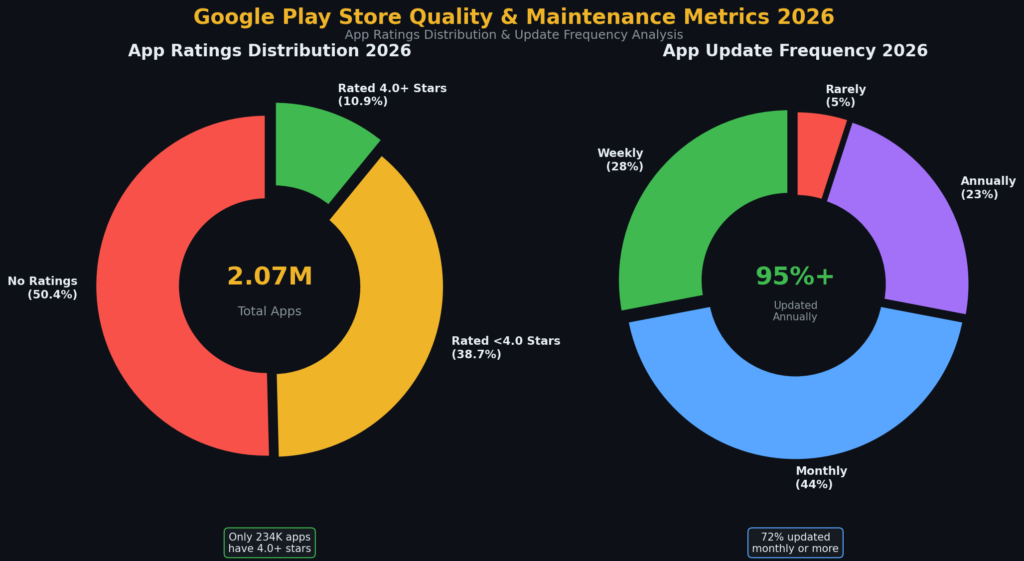
In 2026, app rating statistics show that of 2,074,270 Google Play apps examined, approximately 1,027,752 (49.5%) have at least one rating, with only 234,466 apps achieving 4.0 stars or higher and 109,473 apps rated above 4.5 stars, making high ratings a critical differentiator for visibility in the algorithm.
Out of roughly 2 million apps, about half have ratings. This suggests that user feedback is not evenly distributed across all apps. Ratings play a crucial role in app store visibility and credibility. For developers, it’s a call to action to encourage reviews through in-app prompts. For marketers, it’s an opportunity to use positive reviews as social proof in campaigns.
Play Store Marketing Statistics#14 50.4% Apps Lack Ratings in 2026
In 2026, approximately 50.14-50.4% of Play Store apps still lack user ratings (over 1 million apps), and this creates a significant visibility challenge since apps rated below 3.5 stars experience dramatically reduced discoverability while those with 4.5+ stars significantly outperform in visibility and user retention metrics.
Over half of all Play Store apps, or about 50.4%, lack ratings. This creates challenges for new apps trying to gain trust. Without reviews, potential users may hesitate to download. For developers, it highlights the importance of building early engagement. For marketers, it’s a reminder that ratings can make or break discoverability.
Play Store Marketing Statistics#15 28-35% of Apps Updated Weekly in 2026
In 2026, app update frequency data shows that approximately 28% of the top 1,000 Google Play apps are updated on a weekly basis (282 apps out of 1,000), with Thursday being the most popular day for releasing updates, while September 2024 Statista data indicated up to 35% of all apps received weekly updates.
Around 28% of apps on the Play Store are updated on a weekly basis. This signals the competitive push for constant improvement. Frequent updates help fix bugs, introduce features, and keep users engaged. For developers, it demonstrates the need for ongoing product maintenance. For marketers, it’s proof that regular updates are part of a healthy brand strategy.
Play Store Marketing Statistics#16 72-75% of Apps Updated Monthly in 2026
In 2026, approximately 72-75% of Play Store apps receive updates on a monthly basis (749 of the top 1,000 apps according to 42matters), and this update cadence has become increasingly critical as Google’s algorithm now factors update frequency into app visibility and ranking within the store.
About 72% of apps receive updates on a monthly basis. This cadence allows developers to balance improvement with resource constraints. It shows that consistent updates are the industry standard. For users, it signals reliability and long-term support. For marketers, it means highlighting update history can enhance trust in promotional messaging.
Play Store Marketing Statistics#17 Over 95-96% Updated Annually in 2026
In 2026, more than 95-96% of Play Store apps (960 out of the top 1,000) get updated at least once per year, and this near-universal annual update rate has become even more important as Google’s policy enforcement now removes apps that haven’t been updated within 3 years or fail to meet minimum download thresholds.
More than 95% of Play Store apps get updated at least once a year. This ensures apps don’t become obsolete and can remain compatible with new Android versions. It also shows that developers understand the importance of long-term relevance. For users, annual updates provide reassurance of app quality. For marketers, this proves that consistency is just as important as innovation.
Play Store Marketing Statistics#18 United States Accounts for 19.96% of Traffic in 2026
In 2026, the United States leads global Play Store traffic with 19.96% share totaling approximately 35.49 billion visits, with 77.53% of this traffic coming from mobile devices, though the U.S. ranked third in total downloads behind India and Brazil during the first half of 2024 with over 4 billion app downloads.
The United States drives nearly 20% of global Play Store traffic. This shows how critical the American market is for visibility and revenue. It also demonstrates the importance of tailoring marketing strategies for U.S. users. For global developers, this region often serves as a benchmark for trends. For marketers, it underlines why the U.S. must remain a priority region.
Play Store Marketing Statistics#19 India Holds 7.62% of Traffic in 2026
In 2026, India accounts for 7.62% of global Play Store traffic with approximately 13.56 billion visits, though India dominates in actual downloads generating over 14 billion downloads in the first half of 2024 alone, while Android maintains a commanding 95.16% market share in the country making it the world’s largest Android market.
India accounts for about 7.62% of Play Store visits, reflecting its massive smartphone user base. It highlights how quickly emerging markets are shaping mobile app growth. Developers targeting India can benefit from large user volumes, even if average spend is lower. For users, the Play Store has become a key part of daily digital life. For marketers, it’s a sign to localize campaigns to capture cultural preferences.
Play Store Marketing Statistics#20 Google Blocked 1.75 Million Policy-Violating Apps in 2025
In 2025, Google blocked 1.75 million policy-violating apps from publication (down from 2.36 million in 2024) and banned over 80,000 developer accounts attempting to publish malicious apps, while Play Protect now scans over 350 billion apps daily and identified 27 million malicious apps distributed outside the Play Store, resulting in a 47% decline in total available apps from 3.4 million to 1.8 million since early 2024.
In 2024, Google removed around 1.8 million apps from the Play Store. This represented nearly half of its catalog at the time. The cleanup was aimed at improving quality and enforcing policy standards. For developers, it was a warning to maintain compliance and security. For marketers, it emphasized the importance of associating with trustworthy, policy-compliant apps.
PLAY STORE MARKETING STATISTICS 2026 REVEAL SHOCKING APP GROWTH AND DOWNLOAD TRENDS
Looking back at these insights, I can honestly say the world of Play Store marketing is both inspiring and challenging. These statistics don’t just sit as numbers on a page—they tell a story about shifting markets, emerging opportunities, and lessons that I personally use to guide smarter marketing decisions. If there’s one takeaway, it’s that success here comes from paying attention to the details, experimenting with strategy, and never losing sight of the user. For me, seeing these trends unfold is a reminder that the Play Store is not just an app hub—it’s a living, evolving ecosystem where creativity and strategy meet. In 2026, intensified competition among Android apps is pushing developers to rely more heavily on data-driven Play Store marketing strategies to stay visible.
SOURCES
https://sqmagazine.co.uk/google-play-store-statistics/
https://www.tekrevol.com/blogs/must-know-google-play-store-stats/
https://42matters.com/google-play-statistics-and-trends
https://ripenapps.com/blog/google-play-store-statistics/
https://appinventiv.com/blog/google-play-store-statistics/
https://scaleupally.io/blog/google-play-store-statistics/
https://www.hubifi.com/blog/google-play-revenue-guide
https://www.blog.udonis.co/mobile-marketing/mobile-games/mobile-gaming-statistics