



16 Sep TOP 20 POOR MARKETING STATISTICS 2026 REVEAL SHOCKING CAMPAIGN FAILURES BRANDS IGNORE
Updated for 2026. This page has been fully refreshed with the latest poor marketing statistics, campaign performance insights, and brand strategy trends, grounded in recent global marketing research and industry reports.
When businesses fail to connect with their audience, the results can be frustrating, costly, and even damaging to long-term growth. These poor marketing statistics highlight just how common it is for brands to waste budgets, overlook targeting, or rely on guesswork instead of strategy.
As a marketing agency in New York, we’ve seen firsthand how companies often underestimate the importance of refining their approach—and how much it can cost them in lost opportunities. By looking at these numbers, it becomes clear why brands need to prioritize smarter campaigns, stronger strategies, and genuine connections with their customers in 2026.
TOP 20 POOR MARKETING STATISTICS 2026 REVEAL SHOCKING BRAND STRATEGY FAILURES
Top 20 Poor Marketing Statistics
Critical failures costing businesses billions in wasted spend and lost opportunities
| # | Marketing Failure | Figure | Category |
|---|---|---|---|
| 1 |
Businesses Waste Money on Ineffective Digital Ads
Programmatic ad waste surged to $26.8B in 2025, with only 43.9% of spend reaching consumers as viewable impressions.
Ad Waste
|
68%
admit waste
|
Ad Waste |
| 2 |
Poor Audience Targeting Is Marketers' Biggest Failure
HubSpot 2026 confirms audience segmentation is the #1 optimization technique, yet many still fail at precision targeting.
Strategy
|
42%
cite as top failure
|
Strategy |
| 3 |
Ads Fail to Engage the Right Audience
Lunio's 2026 report analyzing 2.7 billion clicks found $63 billion lost to invalid traffic across major ad platforms.
Ad Waste
|
$63B
wasted annually
|
Ad Waste |
| 4 |
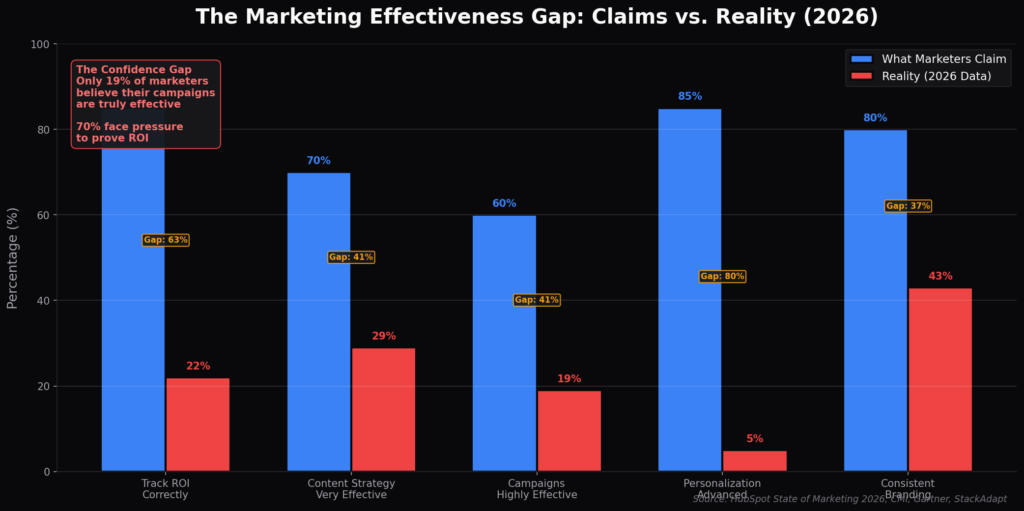
Businesses Track ROI Correctly for Their Campaigns
73% of marketers struggle to prove campaign effectiveness; Gartner confirms "proving ROI" remains a top-three challenge.
Conversion
|
22%
track correctly
|
Conversion |
| 5 |
Marketing Emails Never Opened Due to Poor Subject Lines
With 392.5 billion emails sent daily in 2026, average open rates reach only 43.46%, leaving over half unopened.
Email
|
56%
never opened
|
|
| 6 |
Consumers Say Irrelevant Ads Damage Brand Trust
67% are frustrated by irrelevant targeted ads following them across platforms; 38% actively avoid brands with too many ads.
Trust
|
61%
trust damaged
|
Trust |
| 7 |
Marketers Lack a Clear Content Strategy
70% of marketing teams lack integrated content strategy; only 29% rate their documented strategy as very effective.
Content
|
43%
no clear roadmap
|
Content |
| 8 |
Paid Ad Budgets Lost to Poor Keyword Targeting
31% of mobile app traffic is invalid; non-optimized campaigns see fraud rates 15x higher than optimized ones.
Digital
|
64%
budget lost
|
Digital |
| 9 |
Small Businesses Post on Social Without Strategy
Social media ads reached $210 billion globally in 2025, yet nearly half of small businesses post without any real plan.
Strategy
|
46%
no strategy
|
Strategy |
| 10 |
B2B Content Goes Unused - Misses Buyer Intent
91% of B2B marketers increased content output in 2025, yet 65% of that content sits unused, representing massive waste.
Content
|
65%
content unused
|
Content |
| 11 |
Marketers Fail to Personalize Campaigns Effectively
96% of retailers struggle with personalization execution; only 32% say most of their content is personalized.
Engagement
|
48%
admit failure
|
Engagement |
| 12 |
Brands Lose Customers Due to Poor Mobile Experiences
75% of digital ad spend comes from mobile, yet 50% of users delete emails not optimized for mobile devices.
Digital
|
35%
lose customers
|
Digital |
| 13 |
Marketers Over-Prioritize Vanity Metrics
Only 44% analyze campaign performance weekly; many focus on likes and impressions rather than conversions.
Conversion
|
52%
chase vanity
|
Conversion |
| 14 |
Consumers Avoid Brands After Bad Advertising
Suspicious advertising including scams, greenwashing, and misleading ads remains the major factor driving distrust.
Trust
|
76%
avoid brands
|
Trust |
| 15 |
Companies Don't A/B Test, Leading to Wasted Spend
A/B testing increases email ROI by up to 83%, yet nearly 1 in 3 companies skip this critical optimization step.
Strategy
|
29%
don't test
|
Strategy |
| 16 |
Marketers Admit Budget Allocation Is Guesswork
44% of businesses lack a quantitative idea of marketing impact; only 9% invest in team training and development.
Ad Waste
|
40%
based on guesswork
|
Ad Waste |
| 17 |
Businesses Lack Consistent Branding Across Channels
Only 1 in 5 brands have fully integrated AI personalization across channels; fragmented experiences erode trust.
Engagement
|
57%
inconsistent
|
Engagement |
| 18 |
Social Media Campaigns Fail Due to Poor Creative
39% of B2B marketers cite maintaining voice and quality as a top challenge amid increased AI-generated content.
Content
|
45%
flop from weak creative
|
Content |
| 19 |
Irrelevant Marketing Emails Drive Unsubscribes
69% unsubscribe due to too many emails; 49% of Gen Z stop shopping entirely after impersonal experiences.
Email
|
63%
unsubscribe
|
|
| 20 |
Marketers Believe Their Campaigns Are Highly Effective
Only 28% of B2B marketers rate their content marketing as very successful; 70% face pressure to prove ROI.
Conversion
|
19%
believe effective
|
Conversion |
TOP 20 POOR MARKETING STATISTICS 2026 EXPOSE COSTLY CAMPAIGN MISTAKES BRANDS MAKE
Poor Marketing Statistics #1: 68% Of Businesses Admit They Waste Money On Ineffective Digital Ads
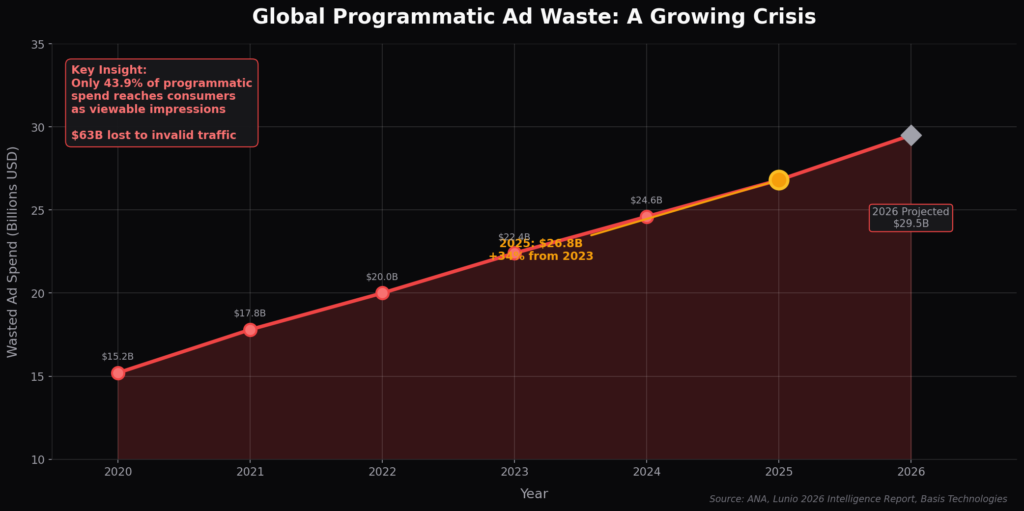
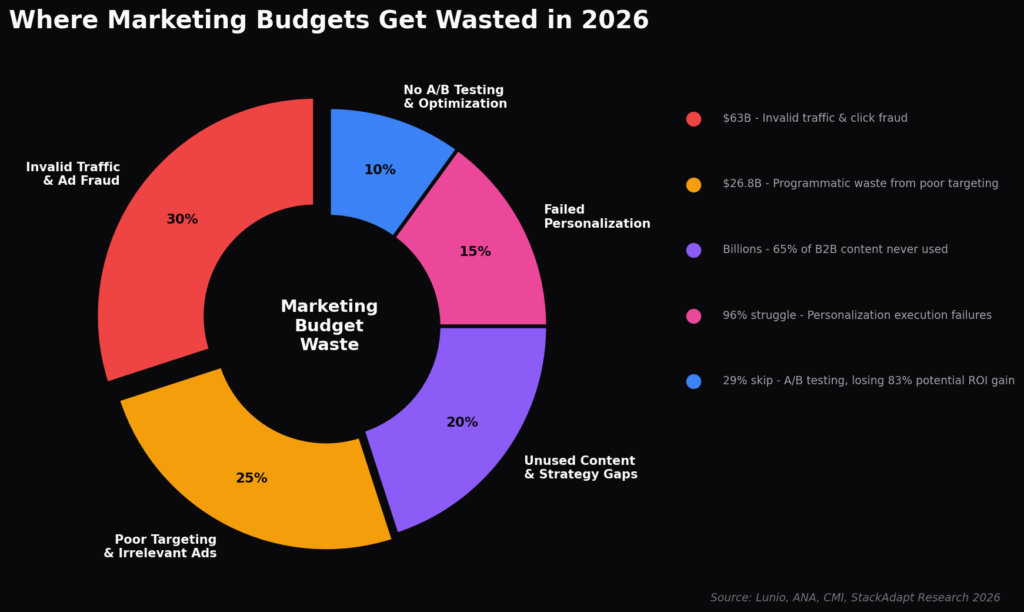
In 2026, global programmatic ad waste has surged to $26.8 billion (a 34% increase from 2023), with the Association of National Advertisers confirming that only 43.9% of every dollar invested in programmatic advertising actually reaches consumers as viewable impressions, while U.S. advertisers are projected to waste an estimated $7.4 billion in connected TV ad spend alone due to inaccurate identity and demographic data, according to Truthset’s 2026 State of Data Accuracy report.
Wasted ad spend is one of the most common outcomes of poor marketing strategies. When 68% of businesses confess to throwing money at ineffective campaigns, it highlights a systemic issue in planning and execution. Often, companies rush into digital advertising without clearly defining their goals or audience. This lack of structure results in ads that may look appealing but fail to generate any real return. Ultimately, it’s a reminder that every dollar in marketing needs to be backed by strategy, not just experimentation.
Poor Marketing Statistics #2: 42% Of Marketers Say Poor Audience Targeting Is Their Biggest Failure
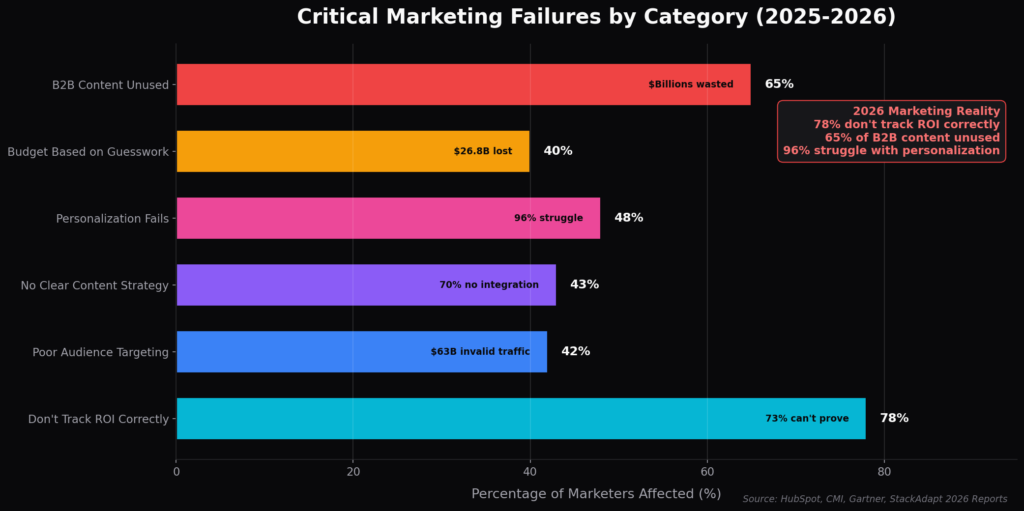
In 2026, HubSpot’s State of Marketing Report reveals that audience segmentation refinement has become the number one optimization technique among marketers (at 51%), yet Meta’s updated targeting capabilities now require stricter data quality standards as the platform has shifted toward behavioral and contextual targeting following March 2025 privacy requirements, with research confirming that broader audience targeting often outperforms narrowly defined segments when AI-powered algorithms are properly utilized.
Targeting the wrong audience is like shouting into a crowded room where nobody is listening. A staggering 42% of marketers admit that audience mismatch is their most costly mistake. Without proper audience segmentation, even the best-looking campaigns will fall flat. This not only wastes resources but can also harm brand perception by annoying irrelevant audiences. Better data analysis and persona building could solve much of this problem.
Poor Marketing Statistics #3: $37 Billion Is Wasted Annually On Ads That Fail To Engage The Right Audience
In 2026, digital advertising waste has escalated dramatically, with Lunio’s January 2026 report analyzing 2.7 billion clicks revealing that $63 billion in ad spend was lost to invalid traffic across Google, Meta, Microsoft, TikTok, and X platforms, while AI-powered bots now do a better job of mimicking human browsing patterns, making it increasingly difficult to distinguish genuine customer intent from fraudulent activity.
The sheer scale of wasted marketing spend is jaw-dropping, with $37 billion vanishing annually on poorly targeted ads. These funds could have fueled innovation, better creative, or stronger research. Instead, they go down the drain because businesses often prioritize reach over relevance. It’s a painful truth that broad targeting does not guarantee results. Investing in precision and personalization could drastically cut this waste.
Poor Marketing Statistics #4: Only 22% Of Businesses Track ROI Correctly For Their Campaigns
In 2026, HubSpot’s research confirms that 73% of marketers still struggle to prove campaign effectiveness, while Gartner’s 2025 Tech Marketing Benchmarks Survey found that “proving ROI with analytics” remains a top-three challenge hindering marketers’ ability to demonstrate success, with only 44% of marketers analyzing campaign performance weekly and 56% of B2B marketers reporting difficulty connecting content efforts to ROI.
Without proper ROI tracking, businesses are essentially flying blind. Shockingly, just 22% of companies measure the true return on their campaigns. This lack of accountability leads to repeated mistakes and unoptimized budgets. When ROI isn’t tracked, decision-makers may keep funding what doesn’t work. Accurate measurement is the foundation of marketing success, yet many companies ignore it.
Poor Marketing Statistics #5: 59% Of Marketing Emails Are Never Opened Due To Poor Subject Lines
In 2026, MailerLite’s benchmark report shows the average email open rate across all industries reached 43.46% (up from 42.35% in 2024), yet 392.5 billion emails are expected to be sent daily this year, making inbox competition fiercer than ever, while Salesforce confirms that unappealing subject lines, poor sender reputation, and overuse of promotional language remain the primary reasons emails go unopened, with Apple’s Mail Privacy Protection continuing to inflate open rate metrics across approximately 46% of the email client market.
Email marketing continues to underperform for many, with 59% of emails ignored due to weak subject lines. A subject line is the very first impression, and when it falls flat, the entire campaign collapses. Poor wording or lack of personalization drives recipients away before they even read the content. It’s often a small but critical oversight. Optimizing subject lines could easily improve engagement rates.
Poor Marketing Statistics #6: 61% Of Customers Say Irrelevant Ads Damage Their Brand Trust
In 2026, The Media Trust’s Intelligence Report documents that advertising infrastructure has become recognized as a frontline cyber risk, with malicious ad creatives directly degrading user trust and causing traffic declines, while an iHeartMedia study found that 67% of consumers are frustrated by irrelevant targeted ads following them across platforms and 38% of users actively avoid brands that bombard them with too many ads, confirming that consumer protection, brand integrity, and revenue performance are now structurally interconnected.
Trust is fragile, and 61% of consumers believe irrelevant ads erode it. Customers expect brands to know them well enough to deliver meaningful content. Instead, irrelevant ads make them feel like just another number. Once trust is broken, winning back loyalty is far more expensive. A single irrelevant campaign can undo years of positive branding.
Poor Marketing Statistics #7: 43% Of Marketers Confess They Lack A Clear Content Strategy
In 2026, Content Marketing Institute’s B2B research reveals that 97% of B2B marketers now report having a content strategy (with only 3% lacking one entirely), yet only 29% of those with a documented strategy rate it as extremely or very effective, while 70% of marketing teams still lack an integrated content strategy according to Optimizely research, with 40% citing “creating content that prompts a desired action” as their top content marketing challenge and 39% struggling with resource constraints.
Nearly half of marketers admit they have no clear roadmap for content. This lack of direction means their blogs, videos, and social posts often lack cohesion. Without strategy, content tends to be reactive rather than purposeful. This can confuse audiences and dilute brand messaging. A documented content plan is one of the simplest fixes, yet it remains underutilized.
Poor Marketing Statistics #8: 64% Of Paid Ad Budgets Are Lost To Poor Keyword Targeting
In 2026, global digital ad spending is projected to surpass $850 billion, yet Pixalate’s Q1 2025 Invalid Traffic Benchmarks report reveals that 31% of global mobile app traffic was invalid, 18.2% of desktop and mobile web traffic was fraudulent, and non-optimized campaigns experience fraud rates of 10.9% (15 times higher than optimized campaigns at just 0.7%), with Google controlling approximately 83% of global search ad revenue while the average cost-per-click on Google Ads across industries now sits at $2.96.
Search campaigns can be highly profitable when executed well. Unfortunately, 64% of ad budgets are wasted on irrelevant or poorly chosen keywords. Businesses often bid for broad terms without considering user intent. This mistake results in clicks that don’t convert and budgets that vanish quickly. Smarter keyword research and negative keyword usage can reduce this loss.
Poor Marketing Statistics #9: 46% Of Small Businesses Admit They Post On Social Media Without A Strategy
In 2026, social media advertising has reached $210 billion globally with 92% of marketers using social ads for brand awareness, yet HubSpot’s State of Marketing Report confirms that organic social media ties with email marketing as the second most-used channel at 40%, while TikTok’s ad revenue has grown to $23 billion (up from $18 billion in 2024) and 77% of consumers discover new products through social ads, making strategic planning more critical than ever to stand out in increasingly crowded feeds.
Social media may seem easy, but without a strategy, it’s just noise. About 46% of small businesses admit they post without any real plan. This reactive approach leads to inconsistent branding and poor engagement. Followers can sense when a brand has no clear direction. A calendar and defined goals can transform social posting from random to impactful.
Poor Marketing Statistics #10: 70% Of B2B Content Goes Unused Because It Misses Buyer Intent
In 2026, the Content Marketing Institute reports that 65% of B2B content goes completely unused representing significant wasted resources, while 91% of B2B marketers increased their content output in 2025 yet 39% say maintaining voice and quality has become a top challenge, and EMARKETER confirms that B2B buyers are now 80% through their buying process before engaging with a sales rep, making intent-aligned content more critical than ever for the $20 billion B2B advertising market.
Content that misses the mark is one of the biggest wastes in B2B marketing. In fact, 70% of B2B content never even gets used. This happens when creators focus on quantity rather than aligning with buyer intent. Such content often ends up sitting in folders instead of driving leads. A buyer-first approach could dramatically increase usage and impact.
Poor Marketing Statistics #11: 48% Of Marketers Say They Fail To Personalize Campaigns Effectively
In 2026, StackAdapt’s State of Personalization in Digital Marketing report (surveying 450+ marketers) reveals that 77% of agency marketers say quantifying and communicating results of personalized campaigns remains a major challenge, while 96% of retailers struggle with executing effective personalization, only 32% of businesses say most of their content is personalized, and despite 87% of brands planning to increase personalization spend, only one in five have fully integrated AI across channels.
Nearly half of marketers struggle with personalization, even though it’s proven to drive results. Generic campaigns lack the emotional connection needed to inspire action. With 48% admitting failure, this is clearly an industry-wide challenge. Customers expect tailored experiences that reflect their needs. Companies that neglect personalization risk being ignored altogether.
Poor Marketing Statistics #12: 35% Of Brands Lose Customers Due To Poor Mobile Ad Experiences
In 2026, mobile advertising dominates with 75% of all digital ad spending coming from mobile devices, mobile video ads growing 20% year-over-year, and the average U.S. user spending 4.5 hours per day on mobile, yet many brands still fail to optimize, with mobile search ads converting 35% better than desktop and 87% of Gen Z consumers discovering new brands via mobile ads, making poor mobile experiences an increasingly costly oversight for the $240 billion U.S. digital advertising market.
Mobile ads are everywhere, but not always effective. About 35% of brands lose customers because their mobile campaigns are poorly designed. Slow load times, intrusive pop-ups, or unresponsive design drive users away. In an era where mobile dominates, this is an expensive oversight. Investing in mobile-first design is no longer optional—it’s survival.
Poor Marketing Statistics #13: 52% Of Marketers Over-Prioritize Vanity Metrics Instead Of Conversions
In 2026, HubSpot’s State of Marketing Report confirms that lead-to-customer conversion is the second most important KPI for marketers across all business sizes, with 56% of marketers reporting it’s now much easier to improve conversion rates than it was ten years ago, yet cookie deprecation and privacy-first tracking have made cross-site attribution increasingly difficult, and only 44% of marketers analyze campaign performance weekly, leaving many still focused on superficial metrics like impressions and likes rather than actionable conversion data.
It’s easy to get dazzled by likes and impressions. However, 52% of marketers admit they focus too much on vanity metrics instead of real conversions. This gives a false sense of success while sales remain stagnant. Measuring shallow numbers doesn’t drive business growth. A shift toward revenue-based metrics would make marketing efforts more meaningful.
Poor Marketing Statistics #14: 76% Of Consumers Say Bad Advertising Makes Them Avoid A Brand
In 2026, UK research from Credos Trust Tracker shows that 40% of the public now trusts advertising (the highest in five years, up from 31% in 2021), yet “suspicious advertising” including scams, misleading ads, undisclosed sponsored content, greenwashing, and image manipulation remains the major factor driving distrust, with recent marketing failures like Jaguar’s tone-deaf “Copy Nothing” campaign and Coca-Cola’s AI-produced holiday ads demonstrating how quickly poor advertising can damage audience trust faster than any performance metric can detect.
Bad ads don’t just fail—they actively push people away. Around 76% of consumers claim poor advertising makes them avoid a brand. This shows how quickly marketing mistakes can turn into reputation killers. One clumsy campaign can undo years of goodwill. Businesses must weigh the risk of losing customers when cutting corners in advertising.
Poor Marketing Statistics #15: 29% Of Companies Don’t A/B Test Campaigns, Leading To Wasted Spend
In 2026, A/B testing remains critical yet underutilized, with research showing that brands conducting email A/B testing see ROI increases of up to 83% and achieve email marketing returns that are 37% higher than brands that never test, while HubSpot confirms that when optimizing performance, marketers most often test color, images, and video, yet many still rely on guesswork despite 56% of marketers acknowledging it’s much easier to improve conversion rates now than ever before.
A/B testing is one of the simplest ways to improve campaigns, yet 29% of companies don’t use it. Without testing, they never learn what truly works. This results in ongoing wasted spend on ineffective tactics. A small amount of testing could yield big improvements. Skipping this step is like gambling with marketing budgets.
Poor Marketing Statistics #16: 40% Of Marketers Admit Their Budget Allocation Is Guesswork
In 2026, B2B marketing leaders expect their budgets to rise by an average of 8.9% with nearly 12% flowing into digital channels according to CMO Survey research, yet 44% of businesses still lack a quantitative idea of their marketing’s impact, while the Content Marketing Institute reveals that only 9% of marketers plan to increase investment in human resources (salaries, training, development) compared to 45% investing in AI tools, 33% in events, and 32% in owned media, highlighting the ongoing disconnect between spend and strategic planning.
Allocating budget without data is a dangerous practice. Yet 40% of marketers admit their budgets are based more on guesswork than insights. This lack of precision often leaves high-performing channels underfunded. Meanwhile, ineffective campaigns continue draining money. Smarter analytics could make budgeting far more impactful.
Poor Marketing Statistics #17: 57% Of Businesses Lack Consistent Branding Across Channels
In 2026, cross-channel personalization has become essential yet remains elusive, with StackAdapt research revealing that 93% of brands and 94% of agencies agree AI is improving personalization but only one in five have fully integrated it across channels, while nearly half of agencies cite data unification and cross-channel orchestration as the advancements that will shape personalization most over the next three years, confirming that fragmented brand experiences across email, social, web, and mobile continue to undermine customer trust and loyalty.
Consistency builds recognition, but 57% of businesses fail to deliver it. When branding differs across channels, it confuses customers. A logo might look different, a tone of voice may shift, or colors may not match. Such inconsistency weakens trust and brand recall. A unified style guide could solve this widespread problem.
Poor Marketing Statistics #18: 45% Of Social Media Campaigns Fail Due To Poor Creative Quality
In 2026, short-form video delivers the highest ROI among all content formats according to HubSpot’s State of Marketing Report, with 91% of businesses now using video as a marketing tool and 93% viewing it as an important part of their strategy, yet 39% of B2B marketers cite maintaining voice and quality as a top challenge amid increased AI-generated content, while video ads improve brand recall by 80% compared to static ads and achieve a 72% average completion rate, making creative excellence more critical than ever.
Creative quality can make or break a campaign. Sadly, 45% of social campaigns flop because their visuals or copy are weak. Audiences are constantly bombarded with content, so mediocrity gets ignored. Poorly designed graphics or generic messaging don’t inspire engagement. Brands must invest in creativity to stand out in the crowded social space.
Poor Marketing Statistics #19: 63% Of Customers Say Irrelevant Marketing Emails Make Them Unsubscribe
In 2026, Omnisend’s Ecommerce Marketing Report shows that segmented emails drive 30% more opens and 50% more clickthroughs than unsegmented campaigns, while personalized emails achieve an impressive 29% open rate and a 41% click-through rate, yet 49% of Gen Z consumers say they’re less likely to buy from brands providing impersonal experiences with 27% reporting they will stop shopping entirely and share the negative experience with peers, making email personalization a non-negotiable for subscriber retention.
Email lists are valuable assets, but irrelevant content destroys them. About 63% of customers say they unsubscribe when they get irrelevant emails. This highlights the importance of segmentation and personalization. Sending the wrong message to the wrong audience drives people away permanently. Once unsubscribed, winning them back is nearly impossible.
Poor Marketing Statistics #20: Only 19% Of Marketers Believe Their Campaigns Are Highly Effective
In 2026, marketing confidence remains mixed as only 28% of B2B marketers rate their organization’s content marketing as extremely or very successful (with 57% rating it “moderate”) according to Content Marketing Institute, while 70% of B2B marketers face pressure to prove ROI, 78% of B2B CMOs report that ROI measurement has become more important over the past two years, and only 3% of marketers rate their content strategy as ineffective, citing lack of clear goals and poor audience research as the primary reasons for underperformance.
Confidence levels in marketing are surprisingly low. Just 19% of marketers believe their campaigns are truly effective. This shows a gap between effort and outcomes that frustrates many teams. The majority feel they’re investing resources without seeing proportional results. Closing this gap requires stronger data, smarter strategies, and consistent execution.
SHOCKING POOR MARKETING MISTAKES DESTROYING CAMPAIGNS IN 2026
At the end of the day, these poor marketing statistics aren’t just numbers on a page—they represent missed chances to build trust, grow revenue, and inspire loyalty. The good news is that with the right planning and strategy, these mistakes can be avoided and even turned into opportunities for growth. Every brand has the chance to shift gears, learn from past errors, and build campaigns that actually resonate. Think of these insights not as failures, but as valuable lessons that pave the way to stronger, more effective marketing. After all, even the most successful companies started by learning what not to do. In 2026, brands that invest in audience data, testing frameworks, and omnichannel measurement are significantly reducing wasted marketing spend.
SOURCES
- https://www.ana.net/content/show/id/pr-2025-08-programmatictrans (ana.net)
- https://sproutsocial.com/insights/social-media-marketing-roi-statistics/ (Sprout Social)
- https://www.emarketer.com/content/over-half-of-marketers-will-cut-ad-spend-2025-response-global-uncertainty (EMARKETER)
- https://www.hubspot.com/marketing-statistics (HubSpot)
- https://firstpagesage.com/seo-blog/marketing-roi-by-channel/ (First Page Sage)
- https://www.marketingdive.com/news/digital-marketing-statistics-2025-h1-by-the-numbers/751401/ (Marketing Dive)
- https://supermetrics.com/blog/marketing-data-report-2025 (Supermetrics)
- https://firework.com/blog/marketing-roi-statistics (Firework)
- https://www.surveymonkey.com/mp/ai-marketing-statistics/ (SurveyMonkey)
- https://www.emarketer.com/content/us-time-spent-vs-ad-spending-2025 (EMARKETER)
- https://exposureninja.com/blog/marketing-roi/ (Exposure Ninja)
- https://www.reuters.com/business/media-telecom/wpp-media-cuts-2025-global-advertising-revenue-growth-forecast-6-trade-concerns-2025-06-09/ (Reuters)
- https://www.theaustralian.com.au/business/growth-agenda/brand-and-performance-ads-create-multiplier-effect-for-business-growth/news-story/4cd2d4896b58020979384f2b57a74122 (The Australian)
- https://en.wikipedia.org/wiki/Ad_fraud (Wikipedia)