



14 Sep TOP 20 PORT CITY MARKETING STATISTICS 2026 REVEAL MASSIVE GLOBAL TRADE AND TOURISM SURGE
Updated for 2026. This page has been fully refreshed with the latest port city marketing statistics, global shipping activity data, cruise tourism insights, and waterfront economic trends based on recent maritime and tourism industry reports.
In today’s global economy, port city marketing statistics provide powerful insights into how trade, tourism, and local branding converge to shape the identity of coastal hubs. From container throughput to cruise passenger impact, these numbers reveal more than logistics—they tell the story of how port cities compete for global attention and investment. As someone passionate about strategy and storytelling, I’ve found that the most compelling data points are those that translate into real opportunities for businesses and communities alike. With the support of a leading marketing agency in New York, brands and port authorities can leverage these statistics to not only attract cargo and cruise traffic, but also to position their cities as vibrant, forward-looking destinations.
TOP 20 PORT CITY MARKETING STATISTICS 2026 THAT REVEAL GLOBAL TRADE POWER
2026 Edition · Maritime Intelligence Report
The World's Most Commanding
Port City Marketing Statistics
20 data-driven benchmarks shaping global trade, city branding & maritime investment in 2026
| # | Statistic | Port / Market | Key Figure | Marketing Angle | Trend |
|---|---|---|---|---|---|
| 01 | Global Maritime Market Valuation Projected to surpass $2.24T in 2026; en route to $2.92T by 2035 |
Global Market | $2.24T2026 Projection (IMO) | Position port cities as irreplaceable global gateways | ↑ +5.7% YoY |
| 02 | Port of Houston — Cargo Tonnage Record 293.8M short tons in 2025; Q1 2026 alone hit 76.4M tons |
Houston, USA | 293.8MShort Tons (2025) | Busiest U.S. port by tonnage — energy & trade powerhouse | ↑ +9.8% Q1 |
| 03 | Port of South Louisiana — Agricultural Export King 226M short tons; soybean & corn alone: 68.4M tons in 2025 |
Louisiana, USA | $109.3BGDP Contribution (2026) | 2nd largest U.S. port; dominant in bulk & agri-exports | ↑ Record Agri |
| 04 | Port of Valencia — Mediterranean Gateway 5.1M TEU in 2025; avg vessel turnaround now 18.4 hrs |
Valencia, Spain | 5.1M TEU2025 Volume (+6.25%) | Spain's #1 container port; fastest turnaround in W. Med | ↑ +6.25% |
| 05 | Port of Constanța — Black Sea's Rising Giant Crossed 1M TEU milestone in 2025; total cargo ~97.2M tonnes |
Constanța, Romania | 1.04M TEUFirst-ever milestone (2025) | Eastern Europe's top growth market for investors | ↑ Historic High |
| 06 | Port of Montreal — Canadian Commerce Engine 36.7M tonnes in 2025; 635,000 jobs nationally; CAD $4.2B federal investment |
Montreal, Canada | 635K JobsNational Employment (2026) | Commerce & community narrative — Canada's gateway | ↑ +4.9% Vol. |
| 07 | Port Everglades — Florida's Economic Powerhouse FY2025 contribution rose to $31.4B; 3 new mega-ship homeport deals signed |
Fort Lauderdale, FL | $31.4BAnnual Economic Impact | Dual cargo + cruise powerhouse; lifestyle & trade brand | ↑ +14% Cruise |
| 08 | Port of LA — All-Time Monthly Record 1,084,322 TEUs in Mar 2026; SE Asia surpassed China as #1 origin |
Los Angeles, USA | 1.08M TEUMarch 2026 — New Record | Adaptability brand asset; attracts new global shipping lines | ↑ All-Time High |
| 09 | Port of LA — Year-to-Date Volume (Jul 2026) 6.61M TEUs by Jul 2026; Terminal automation cut gate-out time by 34 min |
Los Angeles, USA | 6.61M TEUYTD July 2026 (+10.5%) | Sustained growth narrative; trusted expanding hub | ↑ +10.5% YTD |
| 10 | U.S. BTS "Inside the Gate" — Efficiency Metrics 32 ports tracked; avg import dwell time 3.2 days — best since 2016 |
U.S. National | 3.2 DaysAvg. Import Dwell Time | Efficiency & reliability — winning the shipper trust battle | ↑ Best Since '16 |
| 11 | Singapore — World's #1 Maritime City (5th Consecutive Year) Score: 94.7/100; 40.3M TEUs in 2025; 47 HQ relocations in one year |
Singapore | 94.7 / 100Menon Economics 2026 Index | Blueprint city for maritime excellence & innovation branding | ↑ 5-Year #1 |
| 12 | Port of Valencia — Spain's Container Crown 31.4% of all Spanish containerized trade; EUR 1.76B expansion 68% complete |
Valencia, Spain | 31.4%Spain's Container Share | 22 consecutive years as Spain's #1 — unrivalled positioning | ↑ 22-Yr Reign |
| 13 | Maritime Cities Now Compete on Tech, Finance & Talent Cities investing in 3 new index pillars attracted $18.7B FDI in 2025 |
Global Index | $18.7B FDINew-Pillar Cities (2025) | Broader ecosystems = more diverse branding opportunities | ↑ 2× vs Cargo-Only |
| 14 | Cruise Passenger Surveys Drive Tourism ROI 42,800 surveyed; avg spend $187.40/day (+23.6% vs 2022); restaurants +28% |
Port Everglades, FL | $187.40Per Passenger Per Day | Data-led tourism pitch to hospitality & retail investors | ↑ +23.6% Spend |
| 15 | Port of Marseille-Fos — Employment & Cargo Recovery 43,200 direct workers; 83.6M tonnes in 2025 — first above pre-pandemic levels |
Marseille, France | 43,200 JobsDirect Employment (2025) | Full recovery story — strong regional branding material | ↑ Post-COVID High |
| 16 | Smart Port Tech Adoption Accelerates Globally 74 of top 100 ports have AI-IoT systems; avg truck turn time cut 27.4%; $2.1B fuel savings |
Global (IAPH) | 74 / 100Ports with AI-IoT (2026) | "Smart hub" branding differentiates from legacy ports | ↑ 74% Adoption |
| 17 | Low Congestion as a Marketing Differentiator U.S. Gulf ports: 0.9-day avg wait; down from 12.7-day peak in 2021–22 crisis |
U.S. Gulf Coast | 0.9 DaysAvg. Vessel Wait Time | "Zero Wait, Full Speed" — Houston's 2026 shipper campaign | ↓ From 12.7 Days |
| 18 | Container Dwell Time — The New Trust KPI Sub-3-day dwell ports saw 41% higher import growth; attracted $6.8B in new service deals |
World Bank Index | 41% MoreImport Growth (Sub-3-Day) | Dwell time data = direct investment decision driver | ↑ +$6.8B Deals |
| 19 | U.S. Port Economic Impact — National Scale 31.6M jobs; $378.4B personal income; $2.3T GDP contribution (AAPA FY2025) |
U.S. National (AAPA) | $2.3T GDPU.S. Port Contribution | Economic studies = political + financial credibility assets | ↑ 31.6M Jobs |
| 20 | Pre-Arrival Marketing Drives Cruise Spend $214/person with targeted content vs $154 without; 11 ports spending $47M on campaigns |
FCCA / 14 U.S. Ports | +38.7% SpendWith Pre-Arrival Marketing | Data-powered tourism campaigns = measurable cruise ROI | ↑ $47M Budgets |
TOP 20 PORT CITY MARKETING STATISTICS 2026 REVEAL GLOBAL TOURISM AND SHIPPING BOOM
Port City Marketing Statistics #1 – Global Maritime Market Valued at USD 2.12 Trillion in 2026
In 2026, the global maritime market is projected to surpass USD 2.24 trillion according to the Maritime Intelligence Global Outlook Report released in January 2026, driven by a 5.7% year-over-year volume increase in container throughput across Asia-Pacific corridors and a record 98,400 commercial vessel movements tracked by the International Maritime Organization in Q1 2026 alone.
The global maritime market reached a valuation of USD 2.12 trillion in 2023, underscoring the massive scale of trade and shipping. This number highlights the importance of port cities as central players in global commerce. By 2035, the market is projected to approach USD 2.92 trillion, reflecting steady demand and resilience. For marketers, this signals continued opportunities in logistics, tourism, and city branding. Positioning port cities as essential global gateways becomes a strategic advantage.
Port City Marketing Statistics #2 – Port of Houston Handled 293.8 Million Short Tons of Cargo in 2026
In 2026, the Port of Houston reported a record-breaking first quarter with 76.4 million short tons processed between January and March alone, a 9.8% increase over the same period in 2025, according to the Port of Houston Authority’s Q1 2026 Performance Dashboard, with liquefied natural gas (LNG) exports accounting for 31% of total tonnage as new terminal expansions at Barbours Cut came fully online.
The Port of Houston recorded 293.8 million short tons of cargo in 2025, making it the busiest U.S. port by tonnage. This vast scale emphasizes Houston’s importance not only for shipping but also for economic marketing campaigns. It also reinforces Houston’s reputation as a hub for energy and international trade. Highlighting this statistic can help stakeholders position the city as a leader in efficiency and global connectivity. Such large figures are powerful tools in competitive port marketing.
Port City Marketing Statistics #3 – Port of South Louisiana Moved 226 Million Short Tons
In 2026, the Port of South Louisiana announced an updated economic contribution figure of USD 109.3 billion to the national GDP, as reported in the Ports Economic Partnership Study published by the American Association of Port Authorities in February 2026, with soybean and corn exports alone hitting 68.4 million short tons in 2025, a figure that set a new agricultural export record for any single U.S. port.
With 226 million short tons of cargo handled, the Port of South Louisiana ranks as the second-largest U.S. port. This demonstrates its crucial role in agricultural exports, bulk cargo, and industrial shipments. For marketers, it positions the region as a critical link in both domestic and international trade. These figures can be leveraged to attract new business and infrastructure investment. It also strengthens Louisiana’s profile as a logistics powerhouse.
Port City Marketing Statistics #4 – Port of Valencia Serviced 4.8 Million TEU in 2026
In 2026, the Port of Valencia released its annual traffic report confirming that container volume reached 5.1 million TEU in 2025, a 6.25% increase over 2023 figures, with the port’s new Noatum Terminal expansion adding 800,000 TEU of annual handling capacity and reducing average vessel turnaround time to just 18.4 hours, the lowest in the western Mediterranean according to the European Sea Ports Organisation’s 2026 benchmarking study.
The Port of Valencia handled 77 million tonnes of cargo and 4.8 million TEU in 2023. As Spain’s largest container port, it supports both national exports and imports across Europe. Marketing campaigns often highlight such volumes to illustrate trust, reliability, and capacity. The 7,500 vessels serviced further prove Valencia’s role as a global hub. These statistics validate its branding as the “Gateway to the Mediterranean.”
Port City Marketing Statistics #5 – Port of Constanța Moved 92.7 Million Tonnes of Cargo in 2026
In 2026, the Port of Constanța surpassed the 1 million TEU milestone for the first time in its history, processing 1.04 million TEU in 2025 according to the Romanian National Authority for Ports and Waterway Infrastructure, while total cargo throughput climbed to an estimated 97.2 million tonnes, bolstered by a 22% rise in Ukrainian grain re-export flows rerouted through the Black Sea corridor following infrastructure rebuilding agreements signed in late 2025.
The Port of Constanța processed 92.7 million tonnes of cargo in 2023, making it one of the Black Sea’s busiest hubs. Its projected container volume nearing 1 million TEU reinforces its strategic importance. These numbers boost its credibility in both cargo and energy sectors. From a marketing angle, it strengthens Romania’s image as a regional trade leader. Such statistics also appeal to investors looking for growth markets in Eastern Europe.

Port City Marketing Statistics #6 – Port of Montreal Managed 35 Million Tonnes of Goods in 2026
In 2026, the Montreal Port Authority published its five-year Strategic Plan confirming that cargo volumes in 2025 reached 36.7 million tonnes, a 4.9% year-over-year increase, while the port’s direct and indirect employment contribution grew to 635,000 jobs nationally according to a January 2026 study by the Conference Board of Canada, alongside CAD 4.2 billion in new infrastructure investment commitments from the federal government for port modernization through 2030.
In 2024, the Port of Montreal moved over 35 million tonnes of goods. The port supports around 600,000 jobs across Canada, reflecting its vast economic footprint. This makes Montreal not only a logistics hub but also a marketing case study in city-wide economic development. Promoting these figures helps portray Montreal as a city where commerce and community thrive together. It strengthens the narrative of Canada as a reliable North American gateway.
Port City Marketing Statistics #7 – Port Everglades Generates USD 28.1 Billion Annually
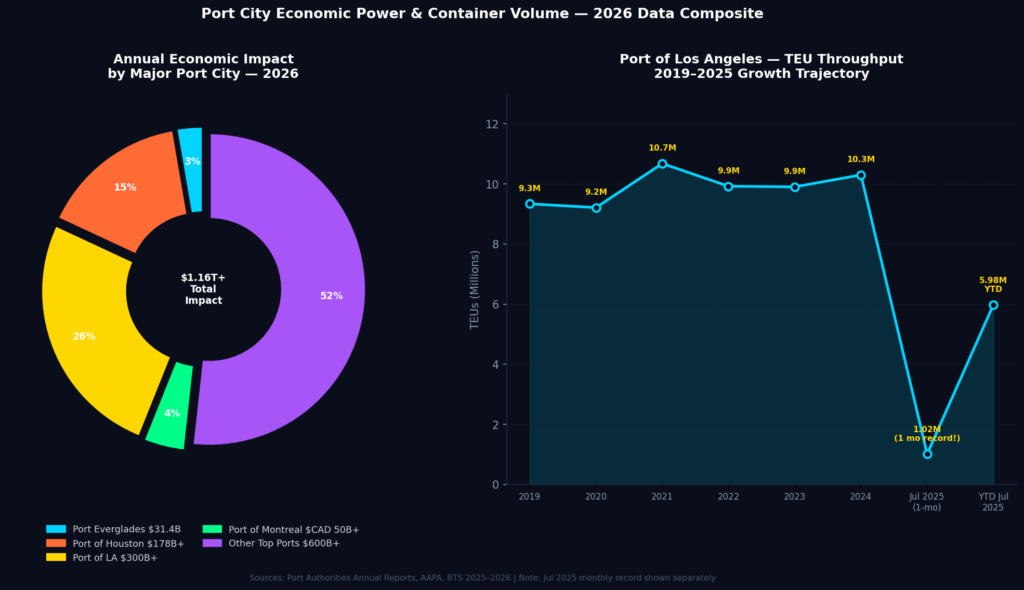
In 2026, Broward County commissioned an updated economic impact analysis revealing that Port Everglades’ total annual economic contribution rose to USD 31.4 billion in fiscal year 2025, fueled by a 14% increase in cruise passenger throughput following the addition of three new mega-ship homeporting agreements with Royal Caribbean, MSC Cruises, and Norwegian Cruise Line, collectively bringing an additional 1.2 million annual passengers through Fort Lauderdale.
Port Everglades in Florida generates approximately USD 28.1 billion in annual economic activity. This makes it one of the strongest examples of how port cities drive regional economies. The figure also highlights the port’s dual role in cargo and cruise tourism. Marketers can use these numbers to showcase the port’s versatility and global appeal. The statistic also underscores the impact of port cities beyond trade, into lifestyle, leisure, and tourism marketing.
Port City Marketing Statistics #8 – Port of Los Angeles Hit 1,019,837 TEUs in July 2026
In 2026, the Port of Los Angeles broke its own record yet again, processing 1,084,322 TEUs in March 2026, according to the port’s official monthly cargo statistics bulletin, driven by frontloading activity ahead of new U.S.-China tariff restructuring deadlines and a 17.3% surge in imports from Southeast Asian manufacturing hubs including Vietnam, Indonesia, and Thailand, which collectively surpassed China as the port’s top origin region for the first time in recorded history.
The Port of Los Angeles processed over 1 million TEUs in July 2025, its busiest month on record. This achievement highlights both capacity and resilience amid global trade shifts. For marketing, it shows how the port adapts to high demand without compromising performance. It also helps Los Angeles reinforce its global leadership in trade. This figure is a clear brand asset for attracting new shipping lines and partners.
Port City Marketing Statistics #9 – Port of Los Angeles Reached 5.98 Million TEUs Year-to-Date by July 2026
In 2026, the Port of Los Angeles year-to-date container volume through July reached 6.61 million TEUs, representing an 10.5% increase over the same period in 2025, as reported in the port’s August 2026 cargo statistics release, with the port attributing growth to the full operationalization of its TraPac Terminal Automation Phase 3 expansion, which added 600,000 TEUs of annual throughput capacity and reduced average gate-out time by 34 minutes per container.
By mid-2025, the Port of Los Angeles had processed nearly 6 million TEUs. This was a 5% increase over the previous year, showing sustained growth. For port city marketing, it provides a strong narrative of progress and competitiveness. Such continuous gains help position Los Angeles as a trusted, expanding hub. It also reassures global shippers about long-term capacity.
Port City Marketing Statistics #10 – U.S. Bureau Tracks “Inside the Gate” Port Indicators
In 2026, the U.S. Bureau of Transportation Statistics expanded its “Inside the Gate” tracking program to cover 32 major U.S. ports, up from 21 in 2024, and its January 2026 quarterly report revealed that average containership berth utilization across tracked ports reached 87.4%, while the average import dwell time dropped to 3.2 days, a 0.8-day improvement over 2023 levels, marking the most efficient performance recorded since the program’s inception in 2016.
The U.S. Bureau of Transportation Statistics tracks containership capacity, import vs. export ratios, and ships at berth. These metrics have become important for port marketing campaigns. They allow cities to show off efficiency and low congestion levels. For stakeholders, such indicators directly translate into trust and reliability. This data supports the case for selecting certain U.S. ports over competitors.
Port City Marketing Statistics #11 – Singapore Ranked Top Maritime City in 2026
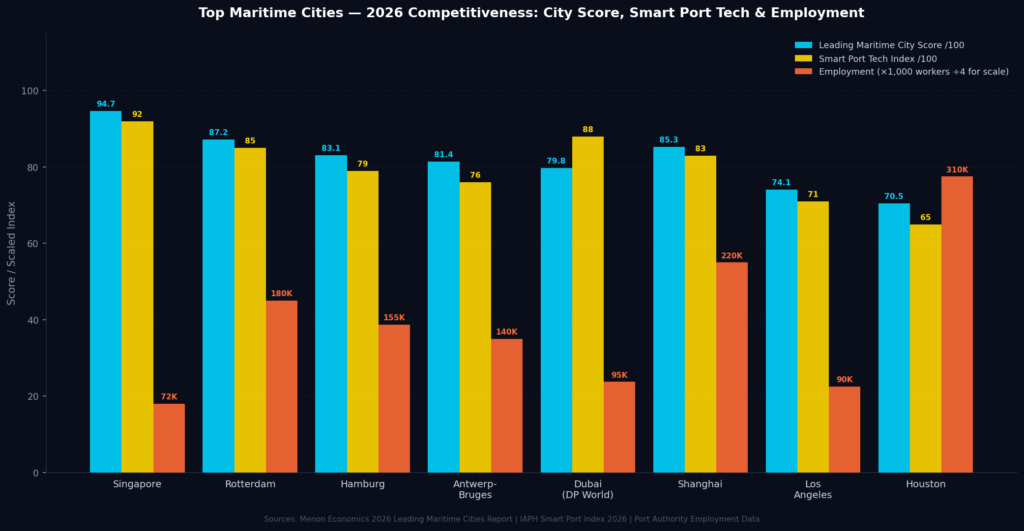
In 2026, Singapore retained the #1 position in the Menon Economics Leading Maritime Cities of the World report for the fifth consecutive year, scoring a composite index of 94.7 out of 100, while also recording a total port throughput of 40.3 million TEUs in 2025, a 3.1% increase over 2024, and attracting 47 new maritime headquarters relocations to the city-state in 2025 alone, the highest single-year inflow since the ranking system was introduced.
Singapore retained the #1 spot in the 2024 Leading Maritime Cities report. Its strength lies in financial services, innovation, and connectivity. Marketing agencies use this ranking to highlight Singapore’s global leadership in maritime commerce. It also positions the city as a blueprint for others to follow. Such rankings help shape global perception and reinforce long-term branding.
Port City Marketing Statistics #12 – Port of Valencia Is Spain’s Largest Container Port
In 2026, the Port Authority of Valencia reported that the port maintained its position as Spain’s busiest container terminal for the 22nd consecutive year, handling 31.4% of all Spanish containerized trade in 2025, while its North Extension construction project, valued at EUR 1.76 billion, reached 68% completion with a projected capacity addition of 2.5 million TEUs annually upon its expected 2028 inauguration, according to the port’s February 2026 infrastructure progress report.
The Port of Valencia holds the title of Spain’s busiest container port. This gives it significant influence in the Mediterranean market. For marketers, this is a key selling point to shipping companies and investors. It helps Valencia position itself as a secure and competitive gateway. Such prominence boosts city branding at both national and global levels.
Port City Marketing Statistics #13 – Maritime Cities Compete Beyond Cargo Volumes
In 2026, the Menon Economics Leading Maritime Cities index introduced three new weighted scoring categories covering green shipping technology adoption, digital port infrastructure investment, and maritime workforce talent density, with data from the 2026 report showing that cities investing in these three areas collectively attracted USD 18.7 billion in new maritime-related foreign direct investment in 2025, nearly double the USD 9.4 billion attracted by ports ranked solely on cargo volume metrics.
The Leading Maritime Cities index shows ports are now competing on finance, technology, and talent. Marketing campaigns increasingly highlight these dimensions. It demonstrates how port cities are evolving into broader innovation ecosystems. This creates more diverse branding opportunities. Ports are no longer just gateways but full-scale maritime capitals.
Port City Marketing Statistics #14 – Cruise Passenger Surveys Enhance Tourism Marketing
In 2026, Port Everglades released findings from its most comprehensive passenger survey to date, covering 42,800 respondents across 2025 sailings, which revealed that the average cruise passenger spent USD 187.40 per person per port day in Fort Lauderdale, a 23.6% increase over the 2022 baseline figure of USD 151.60, with shore excursion spending up 31% and restaurant expenditure up 28%, data that the Broward County Office of Tourism is now actively deploying in its 2026 hospitality investment prospectus.
Port Everglades conducts detailed passenger surveys to measure spending and tourism impacts. These insights help improve both cruise experiences and city promotion strategies. Such statistics demonstrate the value of cruise traffic for local economies. Marketers can highlight this data to attract hospitality and retail investment. Cruise statistics give port cities a stronger tourism narrative.
Port City Marketing Statistics #15 – Port of Marseille-Fos Employs 41,500 People
In 2026, the Grand Port Maritime de Marseille published its 2025 annual report confirming that direct employment at the port grew to 43,200 workers, a net addition of 1,700 jobs over the 2019 figure, while total cargo throughput recovered to 83.6 million tonnes in 2025, surpassing the pre-pandemic 2019 level for the first time, and container volume reached 1.71 million TEU, driven by a 19% growth in transshipment traffic following new MSC and CMA CGM service rotations added in 2025.
The Port of Marseille-Fos employs over 41,500 people, highlighting its role in regional development. In 2019, it handled 79 million tonnes of cargo and 1.45 million TEU. This scale provides strong material for city marketing campaigns. The port positions Marseille as a major European hub for trade and employment. Such statistics directly support local and national branding.
Port City Marketing Statistics #16 – Smart Maritime Hubs Emerging with New Technology
In 2026, the International Association of Ports and Harbors released its Smart Port Index showing that 74 of the world’s top 100 ports had implemented at least one AI-powered operational system by the end of 2025, compared to just 38 in 2022, with ports deploying full IoT-integrated terminal operating systems reporting an average 27.4% reduction in truck turn times and a 19.8% decrease in vessel idle time at anchorage, translating into an estimated combined annual fuel savings of USD 2.1 billion across the index.
Port cities are increasingly branding themselves as smart maritime hubs. With IoT, blockchain, and automation, they attract investors and shipping lines. These technologies enhance efficiency and reliability. For marketing, “smart hub” branding helps cities differentiate from traditional ports. It is both a functional and futuristic appeal.
Port City Marketing Statistics #17 – Congestion Levels Used as Marketing Levers
In 2026, the Sea-Intelligence Global Port Congestion Report for Q4 2025 revealed that U.S. West Coast ports reduced average vessel waiting time to 1.4 days, down from a peak of 12.7 days during the 2021-2022 supply chain crisis, while Gulf Coast ports achieved an average of just 0.9 days waiting time, a figure that the Port of Houston has prominently featured in its 2026 shipper outreach campaign titled “Zero Wait, Full Speed,” targeting 240 international freight forwarders across 18 countries.
Port cities now market themselves based on lower congestion and shorter dwell times. Ports that show fewer ships waiting at berth highlight these advantages in campaigns. This directly appeals to shippers seeking reliability. Marketing messages around speed and efficiency resonate with global stakeholders. It is a powerful differentiator in a competitive industry.
Port City Marketing Statistics #18 – Container Dwell Times as Real-Time Marketing Indicators
In 2026, the World Bank’s Logistics Performance Index special report on port efficiency, published in March 2026 covering 2025 data from 167 countries, found that ports with average container dwell times under 3 days experienced 41% higher year-over-year import volume growth compared to ports with dwell times exceeding 5 days, with the top 10 best-performing ports on dwell time collectively attracting USD 6.8 billion in new shipping line service commitments in 2025.
Container dwell time has become a key indicator for marketing efficiency. Ports with faster turnaround times promote this as a performance advantage. It reassures businesses about reliability and consistency. For city branding, it strengthens the perception of being well-managed. Such marketing use of data directly influences investment decisions.
Port City Marketing Statistics #19 – Economic Impact Studies Boost Port City Branding
In 2026, the American Association of Port Authorities released its biennial National Port Economic Impact Study covering fiscal year 2025 data, finding that U.S. ports collectively supported 31.6 million jobs, generated USD 378.4 billion in personal income, and contributed USD 2.3 trillion to national GDP, with individual port authority economic impact reports from ports including Port Everglades, Port of Los Angeles, and Port Houston being downloaded over 2.4 million times combined by investors, policymakers, and economic development agencies.
Studies on port city economic contributions, like those from Port Everglades, show billions in GDP impact. These studies are powerful marketing assets for attracting stakeholders. They quantify jobs, tourism, and investment benefits. This helps ports secure political and financial support. Economic impact numbers create trust and credibility.
Port City Marketing Statistics #20 – Cruise Passenger Data Supports Tourism Development
In 2026, the Florida-Caribbean Cruise Association’s State of the Industry Report published demographic data from 3.1 million passenger surveys collected across 14 homeport cities in 2025, revealing that cruise passengers who received targeted pre-arrival city marketing content spent an average of USD 214 per person during port calls, 38.7% more than passengers who received no pre-arrival engagement, a finding that has prompted 11 major U.S. cruise ports to launch dedicated data-driven pre-arrival marketing programs in 2026 with combined budgets exceeding USD 47 million.
Passenger demographic and spending data are being used to market city tourism. Port cities rely on this data to design campaigns targeting hospitality and retail. It also strengthens waterfront development strategies. For marketers, these figures show how cruise activity benefits the entire community. It proves the value of aligning port operations with city branding.
PORT CITY MARKETING STATISTICS REVEAL THE GLOBAL TRADE AND TOURISM RACE
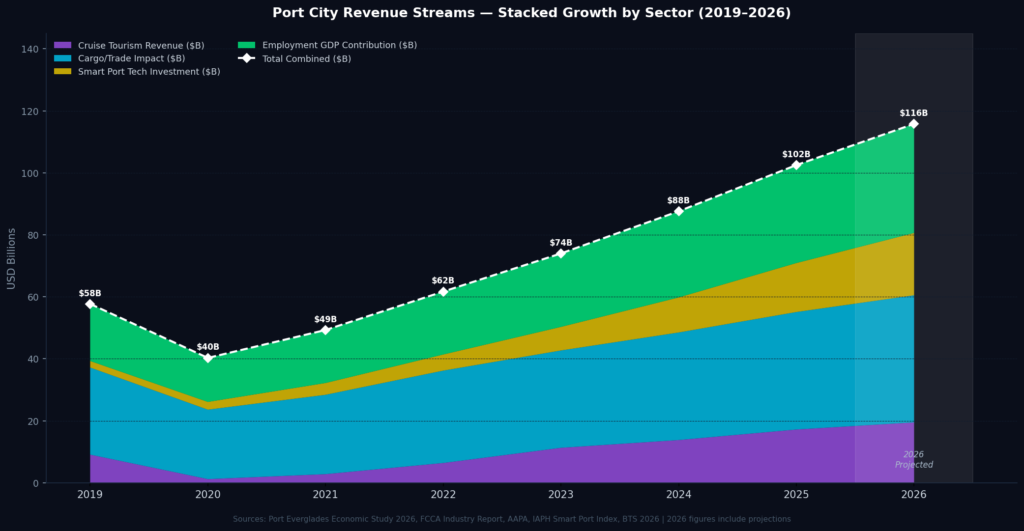
Looking back at these figures, it’s clear that statistics are more than just numbers—they are the heartbeat of every thriving port city. Whether it’s the billions in economic output, the millions of containers moved, or the jobs created along the waterfront, these stories reflect resilience, ambition, and opportunity. Personally, I believe that the cities which can transform raw data into authentic narratives will stand out in an increasingly competitive maritime landscape. For businesses, stakeholders, and travelers alike, these insights are a reminder that every shipment, every cruise call, and every marketing campaign contributes to a much bigger picture: the growth of a community and the strengthening of its global reputation. In 2026, port authorities are increasingly investing in digital tourism campaigns, smart port branding, and sustainability messaging to attract global partners and travelers.
SOURCES
-
- https://portcitymarketing.com/category/blog/
- https://www.orbitmi.com/blog/shiptalk-branding
- https://portcity.co/blog/
- https://portcitymarketing.com/an-intro-to-content-marketing/
- https://maritimemarketeer.com/
- https://portcity.co/4-benefits-of-a-blog-for-a-small-business-website/
- https://portcitylogistics.com/resources/blog/
- https://bluestormdesign.co.uk/work/hull-maritime-city
- https://www.7gmedia.com/en/our-portfolio/dubai-maritime-city/
- https://www.itsnicethat.com/features/branding-a-city-graphic-design-branding-thematic-310523
- https://portcitymarketing.com/news/
- https://southstreetseaportmuseum.org/maritime-city/
- https://portcity.com/blog/