




20 Sep TOP 20 POULTRY MARKETING STATISTICS 2025
When I first started digging into poultry marketing statistics, I realized just how much this industry shapes what we see on our plates every day. From global consumption trends to the way exports are shifting between fresh and frozen chicken, the numbers tell a powerful story about consumer behavior and business opportunities. As someone who works closely with data and storytelling, I love seeing how these stats open doors for brands to connect with their audiences in smarter ways. With the guidance of a leading marketing agency in New York, I’ve been able to piece together insights that don’t just inform, but also inspire actionable strategies. This blog is my way of sharing those findings with you—so you can look at the poultry market through the same lens of curiosity and opportunity that I do.
Top 20 Poultry Marketing Statistics 2025 (Editor’s Choice)
🐔 Top 20 Poultry Marketing Statistics 2025
Key Insights Shaping the Global Poultry Industry
| Rank | Category | Key Statistic & Details |
|---|---|---|
| 1 | 🌍Market Size | $364.5B Global Market (2025) Expected to reach $564.5B by 2033, growing at 5.62% CAGR |
| 2 | 🇺🇸U.S. Market | $70.2B Total U.S. Sales (2024) Up from $67.4B in 2023, showing strong year-over-year growth |
| 3 | 🍗Broiler Value | $45.4B Broiler Revenue (2024) 5.8% increase from 2023, representing 65% of total poultry value |
| 4 | 🥚Egg Production | $21.0B Egg Value (2024) Surged 17.7% from 2023 due to elevated prices and tight supply |
| 5 | 🗺️Regional Leader | 36.10% Asia Pacific Market Share Followed by North America (27.70%) and Europe (23.60%) |
| 6 | 🇨🇳China Dominance | 37.60% of Asia Pacific Market U.S. holds 76.48% of North American poultry market share |
| 7 | 📦Export Share | 14.3% U.S. Broiler Exports (2024) Making broilers the most export-oriented major poultry commodity |
| 8 | 🌎Top Market | Mexico: #1 Export Destination Leading importer of both U.S. broiler meat and turkey products |
| 9 | 🍽️Consumption | 6 in 10 Eat Meat Cuts 2x Weekly Chicken has highest per capita consumption among all proteins |
| 10 | 📈Growth Rate | 2.5-3% Global Consumption Growth Expected for 2025, marking second consecutive year of expansion |
| 11 | 👥Employment | 2,012,560 U.S. Jobs Created Paying $132.7B in wages with $663.6B annual economic impact |
| 12 | 📊Production | 45.7B → 52.5B lbs by 2033 U.S. chicken production projected to grow significantly |
| 13 | 🦃Turkey Decline | 13M Head All-Time Low (2025) Production expected to decrease 3.8% year-over-year |
| 14 | 🆕Innovation | 52% More Product Launches (2023) Compared to 2019, strongest growth in meat category |
| 15 | 💪Protein Claims | 22% of Products Feature Protein Clean label and free-from claims increasingly prominent |
| 16 | ✂️Convenience | 50%+ Pay More for Pre-Cut Consumers willing to pay premium for trimmed, ready-to-cook poultry |
| 17 | 🌱Organic Growth | 16.1% Organic Egg Sales Surge 2024 growth driven by avian flu impacts and consumer demand |
| 18 | 🦠Disease Impact | 1.6M Turkeys Affected by HPAI Flock recovery time extended to 12 months due to avian influenza |
| 19 | 💰Price Pressure | 3-4¢ Daily Price Decline Wholesale chicken breast prices falling due to oversupply |
| 20 | ⚠️Supply Constraints | Tight Parent Stock Supply High hatching egg prices limiting production expansion globally |
Top 20 Poultry Marketing Statistics 2025
Poultry Marketing Statistics #1 Global Market Size In 2024–2025
The global poultry market was valued at US$373.33 billion in 2024 and is projected to reach US$394.75 billion in 2025. This shows a steady upward trend, reflecting increasing demand across both developed and emerging economies. Poultry remains one of the most affordable and accessible protein sources globally. The growth is supported by changing diets, urbanization, and improved distribution networks. Businesses that pay attention to this trajectory can anticipate strong opportunities for expansion in the next few years.
Poultry Marketing Statistics #2 Long-Term Growth Forecast
Looking further ahead, the poultry industry is expected to reach US$564.5 billion by 2033. This projection comes with a CAGR of about 5.62%, showing sustained long-term growth. Factors like population growth, higher disposable incomes, and health-conscious eating trends contribute to this increase. The industry is also being boosted by product diversification, including ready-to-eat and premium organic poultry. Marketers can use this trend to position poultry as a consistent growth sector in the protein market.
Poultry Marketing Statistics #3 U.S. Poultry Sector Value
In the U.S., poultry and eggs contributed about US$70.2 billion in 2024, an increase from the year before. Broilers made up a large share, valued at US$45.4 billion alone. This reinforces the U.S.’s position as one of the largest poultry markets in the world. Such figures highlight the role of poultry in both domestic consumption and export strategies. For marketers, this means campaigns can highlight poultry as a leading contributor to food security and economic strength.
Poultry Marketing Statistics #4 Projected Production And Supply Trends In U.S.
Broiler production in the U.S. is projected to continue rising into 2025 and 2026. This growth is driven by better hatchery performance and lower feed costs. Egg production is also increasing as the layer population expands. These supply improvements will make poultry more affordable and accessible. For marketers, it signals a chance to emphasize abundance and consistent supply in campaigns.
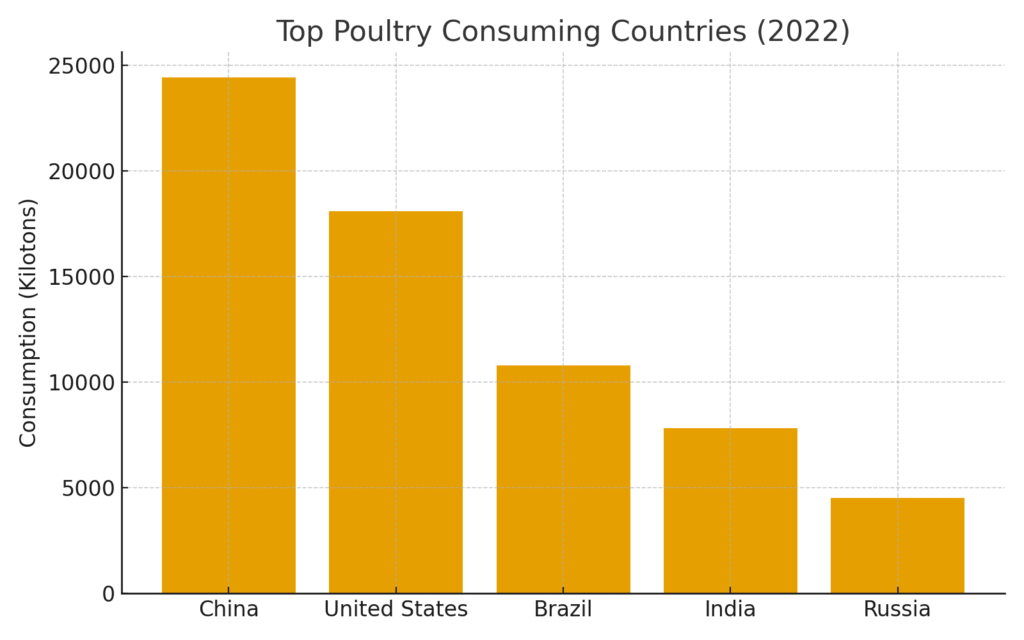
Poultry Marketing Statistics #5 Poultry Consumption By Country
China leads the world in chicken consumption with over 24,000 kilotons consumed in 2022. The U.S. follows closely with around 18,000 kilotons. These two markets alone represent a massive share of global demand. Understanding these consumption hotspots allows businesses to target marketing campaigns in regions with the highest demand. The scale of these markets also encourages cross-border strategies for global poultry brands.

Poultry Marketing Statistics #6 Per-Capita Meat Consumption In The U.S.
In 2021, Americans consumed an average of 68.1 pounds of chicken per person. This figure surpassed beef consumption, which was around 56.2 pounds per person. It reflects the shift in consumer preference towards poultry as a healthier, cheaper, and more versatile protein. For marketers, this is a clear sign to continue promoting chicken as the centerpiece of the American diet. Such statistics show just how much poultry is woven into U.S. food culture.
Poultry Marketing Statistics #7 Countries With The Highest Poultry Consumption Per Person
The Bahamas recorded the highest per-capita poultry consumption at 70.2 kg per person per year in 2021. On the other extreme, countries like Chad and Ethiopia consumed less than 1 kg per person annually. This wide variation shows how cultural, economic, and geographic factors shape poultry demand. For marketers, countries with high consumption represent strong opportunities for premium and diversified poultry products. Low-consumption countries, meanwhile, offer potential for growth as incomes rise.
Poultry Marketing Statistics #8 Export Of Chicken Fresh Vs Frozen
In 2024, fresh poultry exports were valued at US$9.9 billion, while frozen poultry exports reached US$36.8 billion. Frozen chicken clearly dominates global trade. This is due to its longer shelf life and easier transportation across long distances. However, fresh chicken is gaining traction in regions demanding higher quality and freshness. Marketers can use these stats to highlight freshness versus convenience depending on their target market.
Poultry Marketing Statistics #9 Top Exporters Of Fresh Poultry
Poland, the Netherlands, and the U.S. were among the largest fresh poultry exporters in 2024. Poland alone exported around US$2.8 billion worth of fresh chicken. Together, the top exporters accounted for nearly 70–75% of global fresh poultry exports. This concentration shows how a few countries dominate supply chains. Marketers in these regions can leverage their global reach as a sign of trust and quality.
Poultry Marketing Statistics #10 Top Exporters Of Frozen Poultry
Brazil is the leader in frozen poultry exports, accounting for US$14.2 billion, or nearly 38% of the global total. The U.S., Thailand, and Poland also play major roles. Frozen poultry is especially important for markets in Africa, Asia, and the Middle East. These regions depend on frozen imports due to logistics and storage constraints. Marketers can emphasize Brazil’s global dominance to build trust around product quality.
Poultry Marketing Statistics #11 Shifting Share Between Frozen And Fresh Poultry
Fresh poultry exports made up 21.2% of shipments in 2024, up from 19.5% in 2020. This shift shows rising global demand for higher-quality and fresher poultry. While frozen still dominates, fresh products are increasingly preferred in wealthier markets. For marketers, this change suggests promoting freshness as a premium attribute. Companies that adapt to this preference can capture higher margins.
Poultry Marketing Statistics #12 Drivers Of Growth In Poultry Market
Several factors drive poultry market expansion, including higher protein demand, urbanization, and income growth. Consumers are also drawn to poultry because it is leaner than red meat. Processed poultry products, such as ready-to-eat meals, add further momentum. Marketing campaigns can leverage health, convenience, and affordability to resonate with consumers. Together, these drivers make poultry one of the most resilient protein markets globally.
Poultry Marketing Statistics #13 Challenges Facing The Poultry Market
Feed cost volatility is a major challenge for poultry producers. Diseases such as avian influenza also threaten production and trade. Trade barriers or sudden export restrictions add further uncertainty. For marketers, acknowledging these challenges while promoting stability can build consumer confidence. Transparency around quality and safety can be a strong differentiator in this environment.
Poultry Marketing Statistics #14 Trade Disruptions Impacting Poultry Exports
Brazil, the top exporter, saw restrictions due to avian influenza in 2025. This caused its poultry exports to drop by nearly 2%. The European Union also limited imports from Brazil during the outbreak. Such disruptions highlight how fragile global supply chains can be. Marketers can position local or regional sourcing as a safer, more reliable option for buyers.
Poultry Marketing Statistics #15 Consumer Trends In Poultry Demand
Consumers increasingly want fresh, high-quality poultry instead of just frozen options. Organic, halal, and antibiotic-free poultry are also growing segments. Ready-to-cook and ready-to-eat meals are becoming more popular among urban populations. These trends show the power of health and convenience in shaping demand. Marketers can capitalize on these preferences to attract premium buyers.

Poultry Marketing Statistics #16 Market Segmentation By Product Type
The poultry market includes fresh/chilled, frozen, ready-to-cook, and ready-to-eat categories. Distribution channels range from supermarkets to online e-commerce platforms. Growth is especially strong in modern retail and digital sales. For marketers, knowing where consumers shop is as important as what they buy. Tailored strategies across each segment can maximize brand visibility.
Poultry Marketing Statistics #17 Regional Poultry Market Highlights
Asia-Pacific is one of the fastest-growing poultry regions, thanks to rising incomes and populations. North America remains strong but mature, focusing on efficiency and product diversification. Western Europe is seeing demand for organic and sustainable poultry. Regional differences show how unique campaigns are required for each market. A one-size-fits-all strategy simply won’t work globally.
Poultry Marketing Statistics #18 Price Trends In Poultry Market
Wholesale broiler prices in the U.S. are projected to decline in 2025–2026. Increased production is the main driver of this trend. Egg prices are also expected to fall slightly with rising supply. Lower prices make poultry more attractive compared to other proteins. Marketers can highlight affordability as a selling point during these cycles.
Poultry Marketing Statistics #19 Cross-Protein Substitution
In Argentina, poultry consumption surpassed beef for the first time in 2024. Rising beef prices and inflation pushed consumers toward cheaper chicken. This substitution trend is happening in other markets as well. Poultry’s affordability gives it an advantage in times of economic stress. For marketers, emphasizing value over costlier proteins can win consumer loyalty.
Poultry Marketing Statistics #20 Sustainability And Efficiency In Poultry Production
Poultry is among the most efficient meats in terms of feed-to-meat conversion. Modern broilers need less feed per kilogram of meat produced compared to cattle or pigs. Egg production in regions like the EU is highly concentrated, with large farms supplying most of the market. Efficiency is one of poultry’s biggest sustainability advantages. Marketers can frame poultry as both eco-friendly and economical to appeal to modern consumers.

Wrapping It All Up
Looking back at these poultry marketing statistics, what stands out most to me is how dynamic this space really is. It’s not just about the size of the market—it’s about how people’s preferences, global trade shifts, and even health concerns all come together to shape demand. For me, the most exciting part is seeing how businesses can tap into these changes to build real connections with their customers. I truly believe that when we combine solid data with creativity and empathy, we unlock growth that feels both smart and human. And honestly, that’s what makes writing and sharing this so fulfilling—I hope you leave with ideas as fresh as the insights I found.
SOURCES
- https://www.thebusinessresearchcompany.com/report/poultry-global-market-report The Business Research Company
- https://www.precisionbusinessinsights.com/market-reports/global-poultry-market Precision Business Insights