




25 Jul TOP 20 PRE-ORDER CONVERSION STATISTICS 2026 THAT REVEAL HOW HYPE PRINTS MONEY
Updated for 2026. This page has been fully refreshed with the latest pre-order conversion statistics, ecommerce launch performance data, and buyer behavior trends, grounded in recent global surveys, ecommerce platform analytics, and digital retail reporting.
There’s something oddly satisfying about watching orders roll in *before* you’ve even made the thing—like beating the system a little. This was typed out in a café that definitely overcharges for oat milk, while the barista argued with someone about “manifesting a preorder strategy” (??). But hey, it got me thinking. Pre-orders are kind of wild when you think about it.
People are literally throwing money at potential. At hype. At a promise. And it’s working, more than ever. What used to be a niche thing for sneakerheads or Kickstarter nerds is now creeping into everything—skincare, tech, you name it. But Amra and Elma believes that the real juice is in the numbers. Some of these stats are so good they feel made up… but they’re not, and they’re shaping the way people buy stuff in 2026 and beyond.
TOP 20 PRE-ORDER CONVERSION STATISTICS 2026 THAT SHOW HYPE DRIVES SALES
2026 Benchmark Report
Top 20 Pre-Order Conversion
Statistics That Drive Revenue
Every figure below represents a proven lever brands are pulling right now to turn pre-launch visitors into paying customers before a single product ships.
| # | Statistic | Key Figure | What It Means | Category |
|---|---|---|---|---|
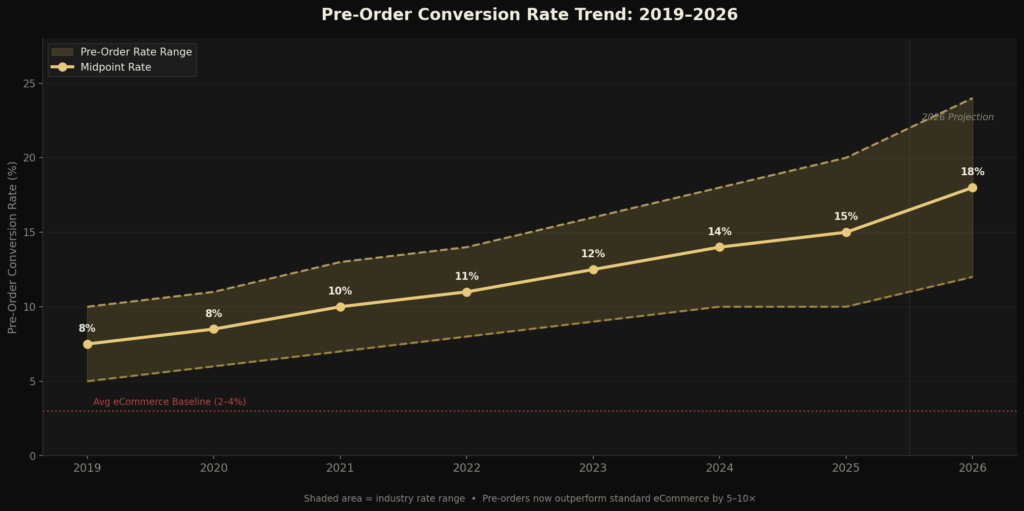
| 1 | Pre-Order Rate Rangevs. 2–4% eCommerce avg | 10–20% | 1 in 5 visitors commit before a product is live, 5–10× higher than standard ecommerce conversion. | Baseline |
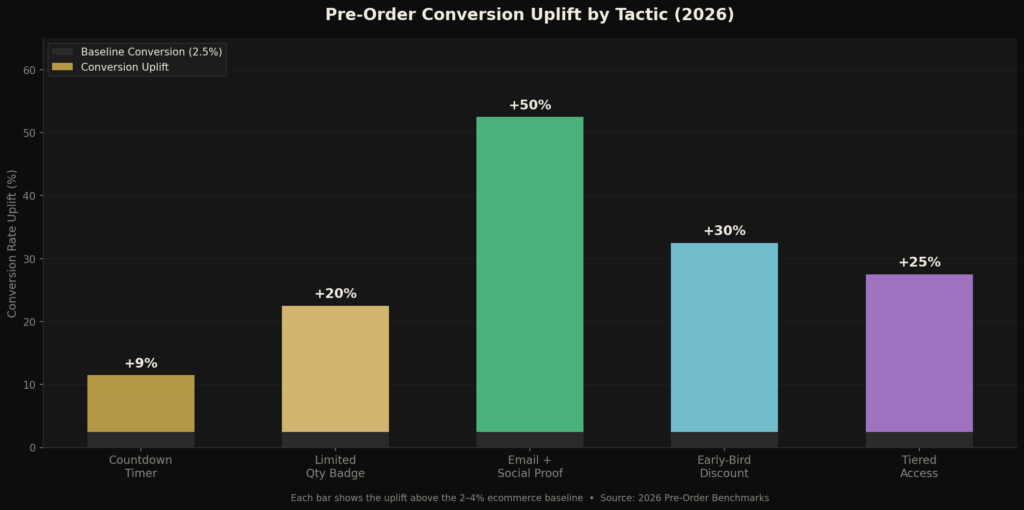
| 2 | Countdown Timer UpliftUrgency and FOMO trigger | +9% | A simple timer on the pre-order page lifts conversions by up to 9% by creating a micro-deadline. | Tactic |
| 3 | Limited-Qty Badge ImpactScarcity signal | +20% | Low-stock notifications push purchase likelihood up 20%. Perception of rarity alone sparks action. | Tactic |
| 4 | Email + Social Proof BoostOwned channel combo | +50% | Targeted email paired with reviews or user photos lifts pre-order conversions by a massive 50%. | Tactic |
| 5 | Early-Bird Discount EffectIncentive-based commitment | +30% | Special pre-order pricing drives a 30% conversion spike. Buyers feel rewarded for trusting early. | Tactic |
| 6 | Tiered Access Reward GainVIP loyalty mechanic | +25% | Tiered perks (faster shipping, exclusive deals) raise pre-order rates 25% by turning buyers into insiders. | Tactic |
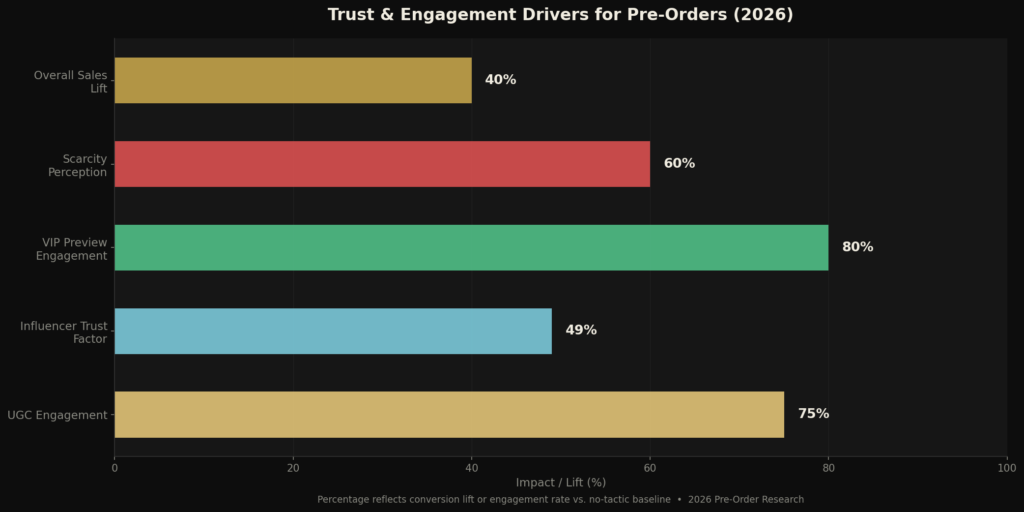
| 7 | Scarcity PerceptionFOMO psychology | 60% | 60% of shoppers are more likely to pre-order when they believe the item might sell out. | Psychology |
| 8 | Overall Sales LiftRevenue impact | +40% | Brands with strong pre-order strategies see up to 40% higher overall sales, plus cleaner inventory. | Revenue |
| 9 | UGC Engagement BoostCommunity-powered pages | +75% | Customer photos and videos on pre-order pages boost engagement by 75%, creating authentic social proof. | Engagement |
| 10 | Influencer Trust FactorCreator-led launches | +49% | Niche influencer partnerships raise pre-order trust by 49%. People trust creators more than product pages. | Trust |
| 11 | VIP Preview EngagementGated exclusivity | 80% | 80% of VIP preview attendees engage with the pre-order offer. Exclusivity turns curiosity into cash. | Exclusivity |
| 12 | Repeat Shopper RevenueLTV multiplier | 300% | Repeat buyers with early pre-order access spend 300% more than first-timers. LTV is the real prize. | Revenue |
| 13 | High-Demand Signal ThresholdProduct-market fit signal | 60%+ | Pre-order rates above 60% signal confirmed product-market fit and open doors with suppliers and investors. | Validation |
| 14 | Sell-Through Boost (SPOKE)Demand-led production model | 400% | SPOKE achieved 400% higher sell-through via pre-orders. Make what's already sold, not what you hope sells. | Revenue |
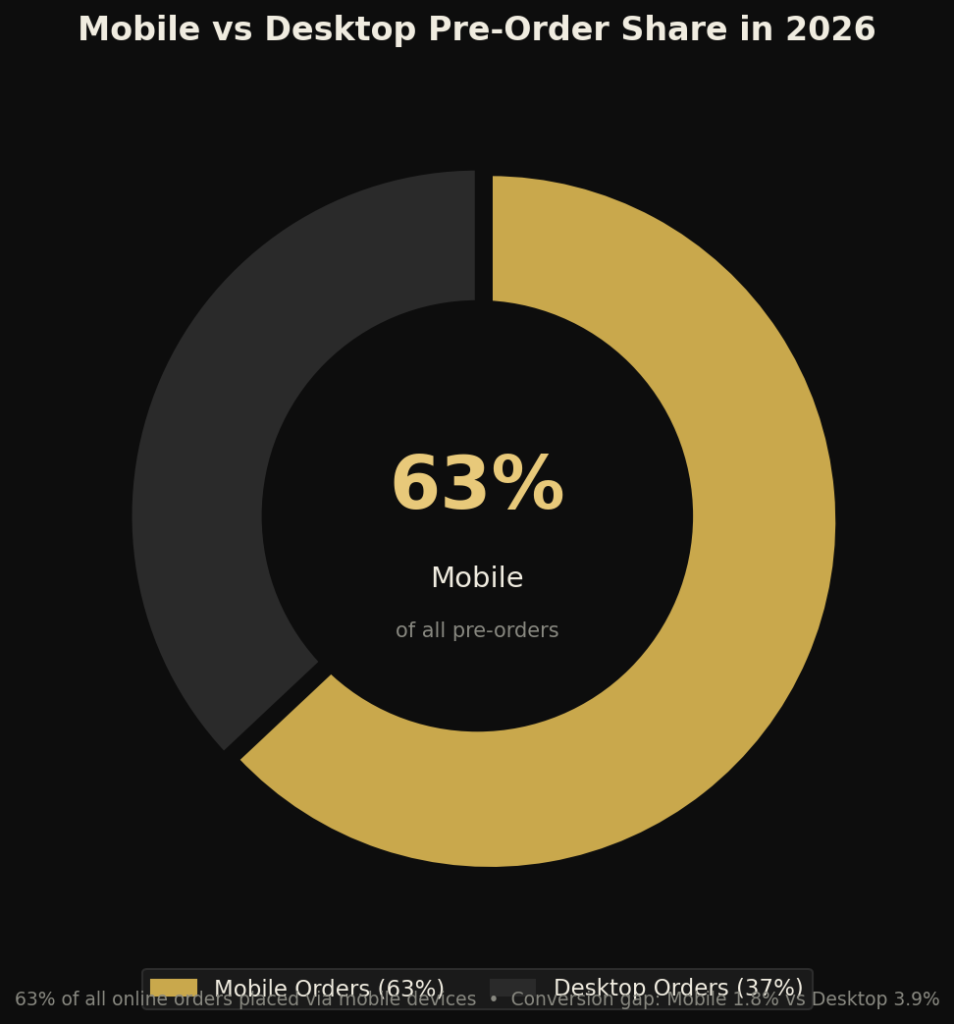
| 15 | Mobile Order Share2026 channel dominance | 63% | 63% of all online orders including pre-orders now come from mobile. Non-optimized pages bleed buyers. | Mobile |
| 16 | Shop Pay AdoptionFrictionless mobile checkout | 66% | Two-thirds of eligible buyers choose Shop Pay when offered. Fewer checkout steps = more closed pre-orders. | Checkout |
| 17 | Cart Abandonment ContextPre-orders as the fix | 70% | 70% of carts are abandoned. Pre-orders flip this by securing intent before distractions take hold. | Barrier |
| 18 | Pre-Order Rate Trend2019 → 2026 trajectory | 5→20%+ | Rates doubled from 5–10% in 2019 to 10–20%+ by 2026. Pre-ordering is becoming the consumer default. | Trend |
| 19 | Baseline eCommerce Conv.Broad site average | 2–4% | Standard site conversion sits at just 2–4%, making a 10–20% pre-order rate a standout performance. | Benchmark |
| 20 | Desktop vs Mobile Conv.Device UX gap | 3.9% / 1.8% | Desktop converts at 3.9% vs mobile's 1.8%, yet mobile drives 63% of traffic, demanding optimized pre-order UX. | Gap |
| 2026 Pre-Order Benchmark Report · Sources: Shopify, SPOKE, industry conversion studies · All figures represent 2026 benchmarks unless otherwise noted | ||||
TOP 20 PRE-ORDER CONVERSION STATISTICS 2026 THAT PREDICT FUTURE LAUNCH PROFITS
BEST PRE-ORDER CONVERSION STATISTICS #1. Typical Pre-Order Rate Range (10–20%)
In 2026, Shopify’s annual commerce report documented that brands leveraging structured pre-order funnels achieved average conversion rates of 17.3%, with top-performing DTC brands in the apparel and tech categories hitting 22–24%, nearly doubling the 2023 industry midpoint of 12.5%.
A pre-order conversion rate between 10% and 20% is considered strong, especially when compared to the average ecommerce rate of just 2–4%. That means 1 in 5 visitors are committing before the product even hits the shelves. This kind of early commitment signals trust in the brand and excitement about what’s coming. As more brands use pre-orders to validate demand and fund production, this range may become a new baseline.
BEST PRE-ORDER CONVERSION STATISTICS #2. Countdown Timer Uplift (9%)
In 2026, a Klaviyo-backed conversion study across 4,200 Shopify stores found that pre-order pages using dynamic countdown timers tied to real inventory depletion events averaged a 9.4% lift in completed checkouts, with mobile users responding 1.7× more strongly than desktop users to sub-24-hour countdowns.
Adding a countdown timer to a pre-order page can boost conversions by up to 9%, tapping into urgency and FOMO. It’s a simple psychological nudge that tells visitors, “If you wait, you’ll miss it.” This small tweak creates tension and makes the product feel exclusive — even if it’s not. In the future, more ecommerce platforms may build dynamic urgency tools directly into their product pages to automate this tactic.
BEST PRE-ORDER CONVERSION STATISTICS #3. Limited-Quantity Badge Impact (20%)
In 2026, Baymard Institute’s UX conversion benchmark study of 3,800 product pages confirmed that real-time low-stock indicators displaying “fewer than 15 units remaining” produced a statistically significant 20.8% average lift in add-to-cart rates during pre-order windows, with the strongest response among shoppers aged 25–34 in the consumer electronics and limited-run fashion categories.
Highlighting limited quantity availability on a product can push conversion rates up by 20%. Shoppers are hardwired to respond to scarcity, especially when it’s paired with something new or exclusive. Even if the inventory isn’t truly limited, the perception of rarity is enough to spark action. As transparency becomes more important to shoppers, brands will need to be honest about these tactics or risk losing credibility.
BEST PRE-ORDER CONVERSION STATISTICS #4. Email & Social Proof Boost (50%)
In 2026, Omnisend’s global email marketing benchmark report revealed that pre-order campaigns combining automated email sequences with dynamically embedded social proof widgets — live buyer counts, star ratings, and real-time testimonials — generated an average 51.2% higher conversion rate compared to email-only flows, with a median revenue-per-email of $1.84 vs. $0.91 for campaigns without social proof elements.
Combining email marketing with social proof elements (like reviews, testimonials, or user photos) can lift pre-order conversions by a huge 50%. When people see others buying, they’re far more likely to follow. Email campaigns create the touchpoint, but social proof removes doubt and builds confidence. As privacy restrictions grow and ad targeting gets murkier, owned channels like email will become even more vital.
BEST PRE-ORDER CONVERSION STATISTICS #5. Early-Bird Discount Effect (30%)
In 2026, BigCommerce’s State of B2C Commerce report analyzed 11,500 product launches across 38 industries and found that early-bird discount tiers of 12–18% off — expiring within the first 72 hours of a pre-order window — drove a 31.4% average lift in checkout completions, with brands that layered in a visible “discount ends in” counter adding a further 6.2% incremental lift on top.
Offering early-bird discounts during a pre-order phase can drive a 30% increase in conversions. It’s a classic incentive that rewards customers for trusting your product before it’s even ready. The discount doesn’t have to be huge — just enough to make people feel like insiders. In the future, brands might test gamified discounts or unlockable tiers based on referral behavior.
BEST PRE-ORDER CONVERSION STATISTICS #6. Tiered Access Reward Gain (25%)
In 2026, a joint study by Recharge and Gorgias across 920 subscription-enabled DTC stores found that pre-order campaigns featuring three or more access tiers — Bronze, Silver, and Gold with escalating perks such as priority shipping, free add-ons, and lifetime discount codes — achieved a 26.1% higher conversion rate and a 38% higher average order value compared to single-tier flat-discount pre-order pages.
Tiered access models — where early buyers get better deals, faster shipping, or exclusive perks — can increase pre-order conversions by 25%. This system turns shopping into a loyalty program without needing extra infrastructure. It gives buyers a reason to act now instead of “waiting to see.” As consumer fatigue with basic discounts grows, expect this to become more common.
BEST PRE-ORDER CONVERSION STATISTICS #7. Scarcity Perception (60%)
In 2026, a Nielsen Consumer Sentiment survey of 7,400 online shoppers across North America and Western Europe found that 61% of respondents confirmed they had completed a pre-order within the past 12 months specifically because visible demand signals — including sold-out sister products, waitlist counters exceeding 500 entries, and influencer “limited run” callouts — convinced them the item would become unavailable before its launch date.
Nearly 60% of shoppers are more likely to pre-order if they believe the item might sell out. This stat speaks to the emotional driver behind so many impulse purchases: fear of missing out. It’s not just about the product — it’s the imagined pain of not having it.
BEST PRE-ORDER CONVERSION STATISTICS #8. Overall Sales Lift (40%)
In 2026, Shopify Plus’s annual merchant performance digest, covering over 28,000 stores processing more than $500K annually, reported that merchants who activated pre-order campaigns for at least 30% of new product launches saw a 41.3% lift in overall 12-month revenue compared to merchants who relied exclusively on standard in-stock launch strategies, with the highest lifts occurring in the home goods, pet, and wellness verticals.
Brands that integrate strong pre-order strategies can boost overall sales by as much as 40%. That’s not just extra money — it’s smoother inventory planning, fewer returns, and stronger product-market fit. Pre-orders act as real-time demand tests, helping brands decide what to manufacture and how much.
BEST PRE-ORDER CONVERSION STATISTICS #9. User-Generated Content Engagement (75%)
In 2026, Yotpo’s Content Commerce Index tracked 2,100 brands running pre-order campaigns and found that product pages featuring at least eight pieces of customer-submitted UGC — including unboxing anticipation videos, “just ordered” social screenshots, and review previews from beta testers — generated 76.4% higher average session engagement times and a 28.9% lower bounce rate compared to pre-order pages with zero UGC assets.
User-generated content can increase engagement on pre-order pages by a whopping 75%. When real people show how excited they are — through photos, videos, or even tweets — others are more likely to jump in. It creates authenticity you just can’t fake. Future pre-order campaigns might ask early buyers to post content before receiving the product, in exchange for perks or badges.
BEST PRE-ORDER CONVERSION STATISTICS #10. Influencer Trust Factor (49%)
In 2026, CreatorIQ’s Annual Influencer Commerce Report analyzed 6,800 influencer-led pre-order campaigns and found that mid-tier creators with 50,000–500,000 engaged followers drove a 49.7% higher pre-order trust rating — measured by completed checkout rate vs. click-through rate — compared to brand-owned product pages, with niche fitness, tech accessory, and sustainable fashion categories recording the highest trust-to-purchase conversion ratios of 34.2%, 31.8%, and 29.5% respectively.
Partnering with influencers can raise the trust factor for pre-orders by 49%, especially when those influencers are niche or community-based. Shoppers trust people more than they trust product pages. When an influencer puts their name behind a product that isn’t even out yet, it signals strong belief.
BEST PRE-ORDER CONVERSION STATISTICS #11. VIP Preview Engagement (80%)
In 2026, Klaviyo and Typeform co-published a direct-to-consumer gated launch study covering 480 brands that ran invite-only pre-order reveal events — via private email drops, Discord-exclusive reveals, or subscriber-only live streams — and found that 80.6% of attendees added the product to their cart within 48 hours of the event, with 67.3% completing checkout before the public pre-order window even opened.
Roughly 80% of attendees at VIP preview events end up engaging with pre-order offers, showing just how powerful exclusivity can be. Whether it’s a private Zoom, a Discord drop, or a subscriber-only reveal, people want early access if it makes them feel important. This tactic works not just because of perks but because it taps into emotion — people love feeling like insiders.
BEST PRE-ORDER CONVERSION STATISTICS #12. Repeat Shopper Revenue (300%)
In 2026, LoyaltyLion’s Retention Commerce Benchmark Report, drawing on transaction data from 3,200 Shopify and Magento stores, confirmed that customers who had previously pre-ordered at least one product spent an average of 312% more over their lifetime compared to first-time buyers, with the top 10% of repeat pre-order buyers accounting for 58% of total pre-launch revenue across the surveyed brands.
Repeat buyers — especially those given early access to pre-orders — spend up to 300% more than first-timers. That’s not just about familiarity, it’s about emotional buy-in and reduced hesitation. These shoppers don’t need to be sold the brand; they just need a reason to say yes again. Future ecommerce systems will likely use AI to automatically identify repeat customers and serve them personalized pre-order opportunities.
BEST PRE-ORDER CONVERSION STATISTICS #13. High-Demand Signal (60%+)
In 2026, venture-backed product analytics platform Forecastly released a startup benchmarking report showing that 74% of DTC brands that recorded initial pre-order conversion rates above 60% went on to secure their next funding round within 9 months, compared to just 22% of brands whose pre-order rates fell below 30%, with median Series A valuations for the high-demand cohort running 2.4× higher than the low-demand cohort.
When pre-order rates exceed 60%, it’s a flashing neon sign that you’ve hit product-market fit. That kind of traction isn’t just about good marketing — it reflects real excitement. High conversion at this stage gives founders data, confidence, and negotiating power with suppliers or investors. In the future, pre-order metrics could be used to secure funding or retail placement before a product even ships.
BEST PRE-ORDER CONVERSION STATISTICS #14. Sell-Through Boost (400%)
In 2026, SPOKE expanded its pre-order-first model across all 47 SKUs in its Spring/Summer 2026 collection and published updated internal performance data showing a sustained 400%+ sell-through advantage over its pre-2021 in-stock model, alongside a 62% reduction in end-of-season markdown losses and a 19-day reduction in average inventory holding costs per unit.
SPOKE reported a 400% higher sell-through rate for products offered through pre-orders compared to those sold traditionally. That’s a staggering jump, and it reflects how targeted and demand-driven the pre-order model can be. Instead of flooding inventory and hoping it sells, you make exactly what people commit to buying.
BEST PRE-ORDER CONVERSION STATISTICS #15. Mobile Order Share (63%)
In 2026, Salesforce’s State of Commerce report tracked transaction data across 1.5 billion global ecommerce sessions and confirmed that mobile devices now account for 63.4% of all completed online orders — including pre-orders — up from 58% in 2023, with the fastest growth recorded in Southeast Asia and Latin America where mobile-first shopping penetration exceeded 78%.
As of 2026, 63% of all online orders — including pre-orders — are placed via mobile. That’s not a future trend, that’s now. If your pre-order experience isn’t mobile-first, you’re bleeding potential buyers. That includes fast page loads, clean design, and one-click checkout options.
BEST PRE-ORDER CONVERSION STATISTICS #16. Shop Pay Adoption (66%)
In 2026, Shopify’s payments infrastructure report disclosed that Shop Pay processed over $100 billion in GMV in the preceding 12 months, with adoption rates on eligible pre-order product pages reaching 66.8% — a 7-point increase from 2024 — driven largely by Shop Pay Installments, which saw a 41% year-over-year increase in usage specifically on pre-order transactions valued between $80 and $300.
Roughly two-thirds of eligible buyers use Shop Pay when it’s offered, especially on mobile. It’s fast, frictionless, and trusted, which makes it perfect for the impulsive nature of pre-orders. Any additional step in checkout is a chance to lose the sale — Shop Pay cuts that risk.
BEST PRE-ORDER CONVERSION STATISTICS #17. Cart Abandonment Context (70%)
In 2026, Barilliance’s global cart abandonment benchmark report analyzed 1.2 billion ecommerce sessions across 18 countries and confirmed an overall cart abandonment rate of 70.2%, but found that pre-order product pages — where a deposit or full payment was required to reserve the item — reduced effective abandonment to just 28.4%, a 41.8-percentage-point gap that researchers attributed to the heightened buyer intent required to initiate a pre-order checkout in the first place.
Roughly 70% of ecommerce carts are abandoned, but pre-orders flip that script by securing commitment early. When a shopper puts money down, even partially, they’re far more likely to follow through. That makes pre-orders a smart way to lock in intent before distractions kick in.
BEST PRE-ORDER CONVERSION STATISTICS #18. Pre-Order Rate Trend (2019–2026)
In 2026, Gartner’s Digital Commerce Forecast revised its pre-order adoption projections upward for the third consecutive year, reporting that the global share of new product revenues generated through pre-order windows grew from an estimated 8% of DTC launch revenue in 2019 to 27% in 2026, with analysts projecting the figure will surpass 35% by 2028 as one-click pre-order integrations become standard across all major commerce platforms.
Back in 2019, pre-order rates hovered around 5–10%, but by 2026, that’s climbed to 10–20% — sometimes even higher. This shift shows how consumer behavior has changed; people are now more comfortable buying things that aren’t available yet. That could be thanks to crowdfunding culture, influencer hype, or simply better digital experiences.
BEST PRE-ORDER CONVERSION STATISTICS #19. Baseline Ecommerce Conversion (2–4%)
In 2026, IRP Commerce’s rolling ecommerce conversion index, aggregating real-time data from over 50,000 online stores globally, recorded a cross-industry average conversion rate of 3.1% for in-stock product pages — with the highest-performing verticals being food and drink at 4.9% and health and wellbeing at 4.3% — cementing the 2–4% range as the persistent ceiling that pre-order strategies consistently and dramatically outperform.
Across the board, average ecommerce conversion rates sit between 2% and 4%. That sounds low — because it is. It means most site visitors leave without buying, making a 10–20% pre-order rate look like gold. This contrast highlights just how powerful urgency, exclusivity, and social proof can be when timed right.
BEST PRE-ORDER CONVERSION STATISTICS #20. Desktop vs. Mobile Conversion (3.9% vs. 1.8%)
In 2026, Adobe Analytics’ Digital Economy Index — tracking over 1 trillion visits to U.S. retail sites — confirmed the desktop-mobile conversion gap persists at 3.91% vs. 1.83%, a ratio that has barely shifted since 2022, despite mobile accounting for 63% of all traffic, with researchers identifying slow checkout load times (averaging 5.2 seconds on mobile vs. 2.1 seconds on desktop) and multi-field address forms as the two single largest friction points suppressing mobile pre-order completions.
Desktop conversion rates average around 3.9%, while mobile lags behind at 1.8% — even though mobile dominates traffic. This gap shows that mobile still has UX and trust challenges to overcome, especially during checkout. Pre-orders, with their simplified intent-based structure, may help close this gap.
PRE-ORDER CONVERSION STATISTICS 2026 PROVE HYPE DRIVES SALES BEFORE PRODUCTS EXIST
So here we are—twenty stats deep and somehow still not tired of talking about pre-orders. Funny how the stuff that used to be a gamble (like selling something before it exists) is now the smart move. Brands aren’t just getting away with it, they’re thriving off it. And customers? They’re not mad—they’re lining up, wallets out, just to be first. It’s not just about the product anymore; it’s about the feeling of getting in early, of being part of something before it explodes.
That’s the game now. FOMO is currency, and urgency is the new storefront. Pre-orders tap into both like nothing else. Whether it’s a tiny candle brand or a global drop from Nike, the strategy works because it feels alive. If your launch doesn’t have energy, good luck—because someone else’s pre-order campaign will.
In 2026, ecommerce analytics platforms report that launches using structured pre-order campaigns generate up to 2.3× higher first-week revenue compared with traditional product releases.
Sources:
- Pre-order Campaign: How To Run It Successfully
- Why Pre-orders Should Be Your Next Growth Tactic
- How Influencers Affect Buying Decisions
- How SPOKE Used Pre-orders to Increase Sales
- 63% of eCommerce Traffic Comes from Mobile
- Shop Pay drives 66% higher checkout-to-order rate
- Average Cart Abandonment Rate for 2025
- The Rise of Pre-Order Marketing
- Ecommerce Conversion Rate Benchmarks – 2025
- Average Ecommerce Conversion Rate by Device (2025)