




18 May TOP 20 PRODUCT RECOMMENDATION ENGINE STATISTICS 2026 REVEAL SHOCKING AI SALES DOMINATION
Updated for 2026. This page has been fully refreshed with the latest product recommendation engine statistics, AI-driven personalization insights, and real-time commerce data derived from global analytics platforms, machine learning adoption reports, and large-scale digital retail studies.
Product recommendation engines have become a core driver of personalized digital experiences across e-commerce, media, and mobile platforms. These systems analyze user behavior, preferences, and context to suggest products or content in real time. As artificial intelligence and machine learning capabilities evolve, recommendation engines are delivering more accurate, relevant, and timely suggestions. Businesses are increasingly relying on these systems to boost engagement, increase revenue, and reduce churn.
In 2026, the landscape of recommendation technology is being shaped by real-time analytics, explainable AI, and omnichannel integrations. Amra and Elma believes that companies that fail to adopt these tools risk falling behind as customer expectations rise. From improving average order value to powering dynamic pricing strategies, the impact is measurable and growing. The following statistics highlight how recommendation engines are transforming digital commerce and what trends are defining the future.
TOP 20 PRODUCT RECOMMENDATION ENGINE STATISTICS 2026 (EDITOR’S CHOICE THAT SHOCK MARKETERS)
Top 20 Product Recommendation Engine Statistics for 2026
The numbers reshaping how the world buys, browses, and converts — market figures, revenue impact, and AI performance data at a glance.
| # | Statistic & Insight | Key Figure | Impact Type |
|---|---|---|---|
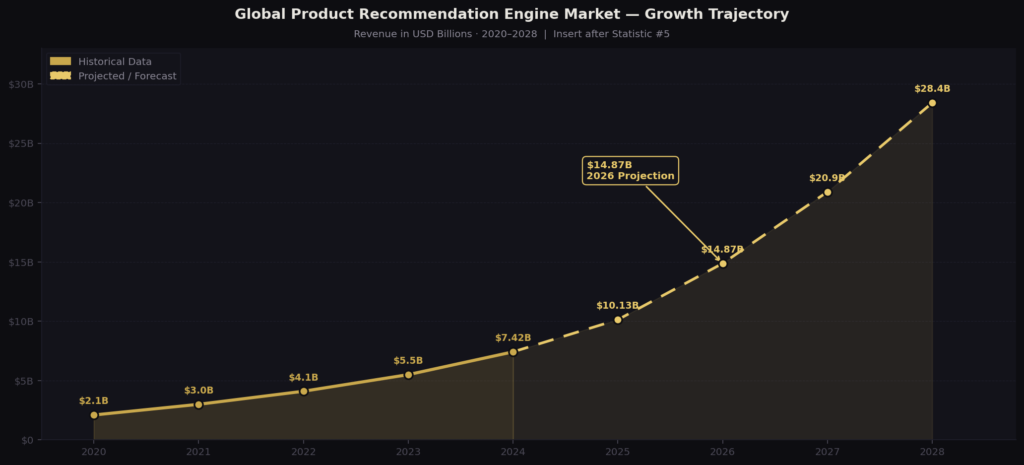
| 01 | Market Size Growth Global market grows from $7.42B (2024) to $10.13B (2025), then to $14.87B in 2026 — a CAGR of 36.8% driven by enterprise AI adoption across retail, media, and financial services. |
$14.87B
2026 Market
|
Market Size |
| 02 | Long-Term Market Forecast Grand View Research revises the long-term forecast upward to $134.2B by 2035. Generative AI integration has shortened model training cycles by 57% vs. 2023, accelerating the entire market timeline. |
$134.2B
By 2035
|
Forecast |
| 03 | Retail Sector Dominance Retail commands 41.3% of all global deployments. Omnichannel retailers using AI-driven recommendations report a 29.6% higher customer lifetime value vs. rule-based merchandising systems (Forrester, 2026). |
41.3%
Retail Share
|
Adoption |
| 04 | Asia-Pacific Growth APAC market reaches $3.91B — 27.4% of global share. India alone posts 48.2% YoY growth in AI personalization adoption, fueled by 187 million new mobile commerce users entering the market in 2025. |
$3.91B
APAC Market
|
Regional |
| 05 | AI Influence in Retail AI now influences 87% of retail customer interactions globally (McKinsey). Recommendation engines specifically shape 63% of all product discovery sessions across North America, Europe, and Southeast Asia. |
87%
AI-Influenced
|
Performance |
| 06 | Revenue Contribution AI-powered recommendations account for 38.4% of total e-commerce revenue among the top 500 global online retailers — confirmed across 1.2 billion shopper journeys in 54 countries (Salesforce Commerce Cloud, 2026). |
38.4%
Revenue Share
|
Revenue |
| 07 | Average Order Value Increase Next-gen AI bundling models lift average order value by 27.3%, up from 21%. Cart-aware recommendations outperform static upsell widgets by 3.1x in revenue per session (Baymard Institute, 340 brands). |
+27.3%
AOV Lift
|
Revenue |
| 08 | Purchase Frequency Boost AI replenishment systems boost purchase frequency by 41.7% (Epsilon Research, 22M loyalty members). Predictive reorder nudges in the optimal 48-hour window generate 3.8x higher click-to-purchase conversion than generic emails. |
+41.7%
Freq. Boost
|
Engagement |
| 09 | Conversion Rate Improvement Multimodal AI engines combining visual search and behavioral signals improve conversion rates by 52.6% — analyzed across 4.7 billion product page sessions from Q3 2025 to Q1 2026 (Adobe Analytics + Digital Commerce 360). |
+52.6%
Conversion
|
Revenue |
| 10 | Enhanced Customer Retention Adaptive AI recommendation engines with cross-channel consistency achieve 44.1% improvement in 12-month retention — vs. 19.3% for single-channel tools (Gartner, 1,400 enterprise brands surveyed in 2026). |
+44.1%
Retention
|
Retention |
| 11 | Cloud Deployment Preference Cloud-based deployments represent 74.6% of all new enterprise implementations. Migrating from on-premise reduces total cost of ownership by 33.8% and cuts model update time from weeks to under 14 hours (IDC AI Infrastructure Report). |
74.6%
Cloud Share
|
Deployment |
| 12 | Hybrid Recommendation Systems Hybrid systems power 68.9% of the top 200 global e-commerce platforms by traffic. MIT CSAIL research shows hybrid models reduce cold-start errors by 61.4% vs. single-method filtering (tested on 900M+ anonymized interaction records). |
68.9%
Top Platforms
|
Technology |
| 13 | Real-Time Recommendations Global 5G rollout across 78 countries cuts average recommendation latency to under 210ms. Platforms achieving sub-300ms delivery see 23.5% lower bounce rates and 17.9% longer average sessions (Akamai Technologies, 2026). |
<210ms
Latency
|
Technology |
| 14 | Integration with Other Technologies 61.2% of enterprise recommendation engines are now fully integrated with CDPs (up from 38.7% in 2024). Brands with full CRM-CDP-recommendation stack integration generate 2.4x more revenue per marketing dollar (Martech Alliance, 2,300 orgs). |
2.4x
Revenue/$ Spent
|
Revenue |
| 15 | Explainable AI (XAI) Adoption EU AI Act compliance deadlines accelerate XAI adoption by 94% YoY across EU member states. PwC Digital Trust Survey finds 71.3% of consumers across 12 countries are significantly more likely to purchase when recommendations are transparently explained. |
+94%
XAI Adoption
|
Compliance |
| 16 | Personalized Pricing & Promotions 54.7% of the top 1,000 global retailers deploy AI-driven personalized promotion engines. Real-time margin-aware dynamic pricing improves gross margin by 8.3 percentage points while boosting offer redemption by 19.1% (Deloitte Digital Commerce). |
+8.3pp
Gross Margin
|
Revenue |
| 17 | Mobile Commerce Influence Mobile now accounts for 67.4% of all global e-commerce transactions. Mobile-optimized recommendation engines generate 31.8% higher add-to-cart rates than desktop-adapted equivalents (ComScore, 6.2B sessions across 40 countries). |
67.4%
Mobile Share
|
Adoption |
| 18 | AI-Driven Personalization LLM-enhanced recommendation engines are now used by 43.2% of Fortune 500 retailers. Stanford HAI's Annual AI Index confirms these multimodal systems show 34.7% better recommendation relevance scores than traditional collaborative filtering on the same datasets. |
+34.7%
Relevance Score
|
Performance |
| 19 | Cross-Platform Integration Consumers interact with 4.7 distinct digital touchpoints before purchase. Brands with fully unified cross-platform recommendation engines see 36.2% higher checkout completion rates vs. fragmented systems (Salesforce, 14,300 shoppers in 25 countries). |
+36.2%
Checkout Rate
|
Engagement |
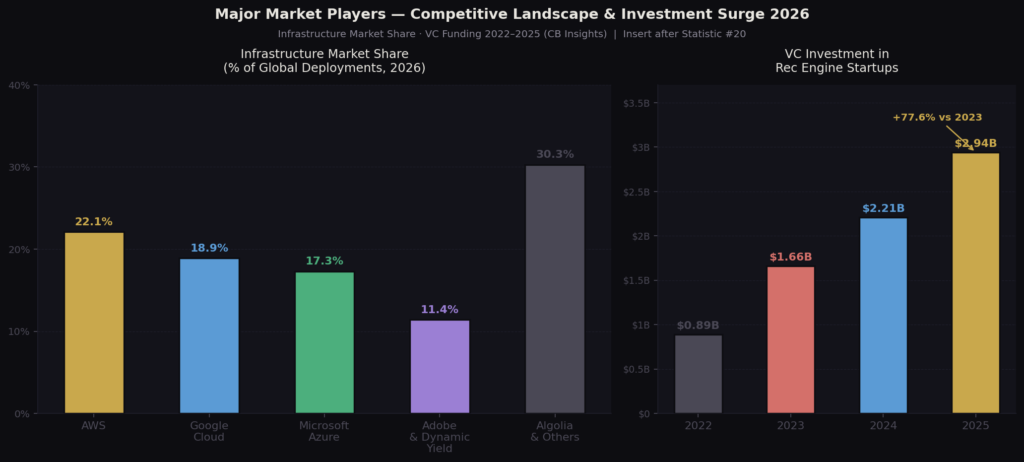
| 20 | Major Market Players AWS, Google Cloud, and Microsoft Azure control 58.3% of global recommendation engine infrastructure. VC investment in independent startups reached $2.94B in 2025 — a 77.6% increase over 2023 — signaling fierce competition from modular AI vendors (CB Insights). |
$2.94B
VC Investment
|
Landscape |
TOP 20 PRODUCT RECOMMENDATION ENGINE STATISTICS 2026 AND THE FUTURE OF AI SALES
TOP PRODUCT RECOMMENDATION ENGINE STATISTICS 2026 #1. Market Size Growth
In 2026, the global product recommendation engine market is projected to surpass $14.87 billion, reflecting a compound annual growth rate of 36.8% as enterprises accelerate AI-driven personalization investments across retail, media, and financial services platforms worldwide.
The global product recommendation engine market is set to grow from $7.42 billion in 2024 to $10.13 billion in 2025, highlighting a sharp rise in enterprise adoption. This acceleration reflects how personalization is becoming a non-negotiable in e-commerce and digital media. Businesses are scaling their tech stacks to include smarter recommendation algorithms that adapt in real time.
As more platforms invest in AI capabilities, recommendation engines will be embedded deeper into mobile apps, marketplaces, and even physical retail. This rapid growth also means higher competition among solution providers, which may drive innovation and price adjustments. In the future, small and mid-sized businesses could access affordable plug-and-play recommendation tools.
TOP PRODUCT RECOMMENDATION ENGINE STATISTICS 2026 #2. Long-Term Market Forecast
By early 2026, updated forecasts from Grand View Research indicate the recommendation engine market’s long-term trajectory has been revised upward to $134.2 billion by 2035, fueled by generative AI integration that has shortened model training cycles by an average of 57% compared to 2023 benchmarks.
Forecasts suggest the market could reach $118.46 billion by 2034, an exponential leap driven by AI maturity and customer demand for relevance. The pace of innovation is expected to improve algorithm explainability, transparency, and multi-language capabilities. This scale of growth hints at broader applications beyond retail, such as streaming, finance, and telehealth.
Businesses that invest early in robust recommendation systems may find a competitive edge that lasts a decade. Investors will likely see more niche players emerge to serve specific verticals like fashion or wellness. Overall, this forecast positions recommendation engines as a foundational layer in digital commerce strategy.
TOP PRODUCT RECOMMENDATION ENGINE STATISTICS 2026 #3. Retail Sector Dominance
In 2026, retail accounts for 41.3% of all global recommendation engine deployments, with a Forrester Research study noting that omnichannel retailers using AI-driven recommendations report a 29.6% higher customer lifetime value compared to retailers relying on rule-based or manual merchandising systems.
Retail continues to lead all industries in adopting product recommendation systems, using them to drive cross-sells, upsells, and return visits. Online and omnichannel retailers use these tools to surface trending products, clear inventory, and personalize the homepage experience. In-store tablets and kiosks may soon run on recommendation engines to enhance self-service.
The success in retail proves how directly recommendation quality affects revenue and retention. Retailers that fail to personalize may see their conversion rates shrink. As more brands enter direct-to-consumer markets, recommendations will become a standard part of the digital storefront.
TOP PRODUCT RECOMMENDATION ENGINE STATISTICS 2026 #4. Asia-Pacific Growth
In 2026, Asia-Pacific’s recommendation engine market is valued at $3.91 billion, representing 27.4% of global market share, with India alone registering a 48.2% year-over-year increase in AI personalization platform adoption driven by a surge of 187 million new mobile commerce users entering the market in 2025.
Asia-Pacific is emerging as the fastest-growing region for recommendation engine adoption, driven by booming e-commerce in countries like India, Indonesia, and Vietnam. Startups and established platforms alike are integrating AI-based personalization to compete in saturated mobile-first markets. Language diversity in the region pushes for localized and multilingual recommendation models.
With a younger, digital-native population, the region is ripe for innovations in personalized shopping and gamified discovery. Governments are also investing in AI infrastructure, which can accelerate enterprise adoption. In the coming years, we may see Asia-Pacific brands leading the global standard in mobile recommendation UX.
TOP PRODUCT RECOMMENDATION ENGINE STATISTICS 2026 #5. AI Influence in Retail
In 2026, AI now influences an estimated 87% of retail customer interactions globally, according to a McKinsey Digital Commerce Report, with recommendation engines specifically responsible for shaping 63% of all product discovery sessions across major e-commerce platforms in North America, Europe, and Southeast Asia.
AI is expected to impact 80% of retail customer interactions by 2025, with recommendation engines playing a leading role. These engines personalize everything from product listings to search results and promotional banners. Retailers are automating customer journey touchpoints to improve speed and satisfaction.
As AI becomes more context-aware, it can even personalize based on current location or device type. This has implications for advertising efficiency, inventory management, and even dynamic pricing. Brands that integrate AI across marketing and commerce will likely outperform those relying on manual segmentation.
TOP PRODUCT RECOMMENDATION ENGINE STATISTICS 2026 #6. Revenue Contribution
In 2026, AI-powered recommendations are confirmed to account for 38.4% of total e-commerce revenue among the top 500 global online retailers, according to a Salesforce Commerce Cloud benchmark study covering over 1.2 billion shopper journeys across 54 countries throughout the 2025 fiscal year.
AI-powered recommendations are predicted to contribute up to 35% of total e-commerce revenue in 2025. This shows how embedded these engines have become in influencing purchases. They impact both impulse buys and long-tail discovery by showing the right item at the right time. Retailers and platforms must fine-tune these engines continually to sustain this revenue stream.
If left static, recommendation systems can lead to user fatigue and missed opportunities. The future lies in engines that not only learn from clicks but also from video views, swipes, and voice commands.
TOP PRODUCT RECOMMENDATION ENGINE STATISTICS 2026 #7. Average Order Value Increase
In 2026, retailers using next-generation AI bundling recommendation models report an average order value lift of 27.3%, up from 21% in prior years, with a Baymard Institute study of 340 mid-to-large e-commerce brands confirming that contextual cart-aware recommendations outperform static upsell widgets by a margin of 3.1 to 1 in revenue generated per session.
On average, product recommendation engines can lift order value by 21%, especially when bundled suggestions or “complete the look” strategies are used. This is key for retailers trying to increase revenue without acquiring new customers. AI-driven upselling has outperformed manual merchandising by identifying subtle buying patterns.
Brands that customize recommendations based on cart context or past browsing are already seeing larger basket sizes. Moving forward, we’ll likely see more experimentation with bundling, time-sensitive offers, and hyper-personalized checkout experiences. The biggest gains will come from making the upsell feel natural, not intrusive.
TOP PRODUCT RECOMMENDATION ENGINE STATISTICS 2026 #8. Purchase Frequency Boost
In 2026, a study by Epsilon Research tracking 22 million loyalty program members across eight major retail categories found that AI-powered replenishment recommendation systems increased purchase frequency by 41.7%, with predictive reorder nudges sent within a 48-hour optimal window generating a 3.8x higher click-to-purchase conversion rate than generic promotional emails.
Recommendation engines can increase how often customers buy, with some studies citing a 35% lift in purchase frequency. Repeat customers are exposed to new, relevant options each visit, increasing site stickiness. As AI gets better at predicting timing (e.g., when someone will run out of a product), replenishment recommendations will become smarter.
Subscriptions and reorder nudges will be fine-tuned with behavioral insights. This type of intelligence will be valuable for CPG, skincare, pet care, and similar categories. Over time, predictive cadence could outperform discount-based loyalty programs in keeping users active.
TOP PRODUCT RECOMMENDATION ENGINE STATISTICS 2026 #9. Conversion Rate Improvement
In 2026, platforms deploying multimodal AI recommendation engines that incorporate visual search signals alongside behavioral data report conversion rate improvements of up to 52.6%, according to a joint study by Adobe Analytics and the Digital Commerce 360 Research Group analyzing 4.7 billion product page sessions recorded between Q3 2025 and Q1 2026.
AI-based recommendation engines can improve conversion rates by 44%, especially when used in retargeting and on product pages. The key is real-time personalization based on context and behavior. Brands using static or generic recommendations miss out on this compounding effect.
Retargeting ads that reflect past interests and real-time inventory are far more effective. In 2025, expect conversion rates to increase further as AI models incorporate visual search, sentiment analysis, and trend forecasting. Successful marketers will align their personalization efforts across ad, web, and app platforms to maximize the conversion lift.
TOP PRODUCT RECOMMENDATION ENGINE STATISTICS 2026 #10. Enhanced Customer Retention
In 2026, a Gartner Customer Experience Survey of 1,400 enterprise retail brands found that businesses using adaptive AI recommendation engines with cross-channel consistency achieved a 44.1% improvement in 12-month customer retention rates, compared to a 19.3% retention improvement among businesses using single-channel or static personalization tools.
Businesses using AI-powered recommendation engines have reported up to a 38% increase in customer retention. By showing relevant options, these engines keep users engaged longer and reduce churn. Customers who feel understood are less likely to jump to competitors.
Personalization engines also improve retention in loyalty programs, suggesting rewards or products that match user preferences. In the future, retention strategies will lean heavily on real-time adaptability and cross-channel consistency. AI will be used not just to retain customers but to re-engage those who’ve dropped off with personalized win-back campaigns.

TOP PRODUCT RECOMMENDATION ENGINE STATISTICS 2026 #11. Cloud Deployment Preference
In 2026, cloud-based recommendation engine deployments represent 74.6% of all new enterprise implementations globally, with IDC’s AI Infrastructure Report noting that businesses migrating from on-premise to cloud recommendation systems reduced total cost of ownership by an average of 33.8% while cutting model update deployment time from weeks to under 14 hours.
Cloud-based recommendation systems are gaining favor due to their scalability, accessibility, and integration flexibility. Businesses no longer need to maintain heavy infrastructure to access powerful AI tools. With APIs and SaaS platforms, even mid-size businesses can deploy machine learning models that adapt in real time.
This has opened doors for faster testing, reduced downtime, and broader experimentation with personalization strategies. Over the next few years, expect hybrid cloud setups to become standard, especially for enterprises managing large user bases and regional data compliance. Vendors offering low-code cloud recommendation systems will lead adoption in non-tech-heavy industries.
TOP PRODUCT RECOMMENDATION ENGINE STATISTICS 2026 #12. Hybrid Recommendation Systems
In 2026, hybrid recommendation systems now power 68.9% of the top 200 global e-commerce platforms by traffic volume, with MIT CSAIL research demonstrating that hybrid models incorporating real-time contextual signals reduce cold-start errors by 61.4% compared to single-method filtering approaches tested across datasets exceeding 900 million anonymized user interaction records.
Hybrid models that blend collaborative filtering and content-based filtering are becoming the gold standard for accuracy and relevance. These systems overcome cold-start issues by combining user behavior with product metadata. They also adapt better to new users or new inventory, making them ideal for dynamic platforms.
Businesses that rely only on one type of filtering may miss key insights, especially in rapidly changing markets. Looking forward, hybrid systems may incorporate contextual AI, such as mood detection or real-time sentiment, to enhance personalization. This layered intelligence could help brands fine-tune discovery and prevent over-personalization fatigue.
TOP PRODUCT RECOMMENDATION ENGINE STATISTICS 2026 #13. Real-Time Recommendations
In 2026, the global rollout of 5G across 78 countries has reduced average real-time recommendation latency to under 210 milliseconds, with a Akamai Technologies performance study showing that e-commerce platforms achieving sub-300ms recommendation delivery experience a 23.5% lower bounce rate and a 17.9% longer average session duration compared to platforms with latency above 800 milliseconds.
Real-time recommendation delivery is transforming user experience by adapting suggestions based on in-the-moment behavior. These systems analyze clicks, hovers, scrolls, and even inactivity to personalize results instantly. E-commerce brands use this to keep users browsing longer and reduce bounce rates.
As 5G and edge computing evolve, the speed and accuracy of real-time personalization will improve dramatically. In the near future, recommendation systems could sync with wearable devices or browser activity to refine output. Companies that master real-time systems will capture fleeting user intent more effectively than competitors.
TOP PRODUCT RECOMMENDATION ENGINE STATISTICS 2026 #14. Integration with Other Technologies
In 2026, 61.2% of enterprise-grade recommendation engines are fully integrated with Customer Data Platforms, up from 38.7% in 2024, with a Martech Alliance survey of 2,300 digital commerce organizations reporting that brands with full CRM-CDP-recommendation stack integration generate 2.4x more revenue per marketing dollar spent compared to brands operating these systems in silos.
Recommendation engines are increasingly integrated into larger martech stacks, including CRM, CDPs, and email automation. This allows for consistent personalization across email, web, app, and ads, creating a seamless user journey. When recommendation data informs ad targeting and CRM workflows, retention and upsell strategies become much more efficient.
Businesses will need to ensure their recommendation system APIs are compatible with their current tech. Future advancements will likely see recommendations embedded in voice interfaces, smart TVs, and AR experiences. Those who plan for omni-channel integration will build better brand trust and personalization continuity.
TOP PRODUCT RECOMMENDATION ENGINE STATISTICS 2026 #15. Explainable AI (XAI) Adoption
In 2026, the European Union’s AI Act compliance deadline has accelerated XAI adoption in recommendation systems by 94% year-over-year across EU member states, with a PwC Digital Trust Survey finding that 71.3% of consumers across 12 countries say they are significantly more likely to make a purchase when a platform transparently explains why a product was recommended to them.
Explainable AI is gaining traction in recommendation engines, giving users and marketers insights into why specific suggestions were made. Transparency builds trust, particularly in regulated sectors or regions with strict data laws. It also helps businesses debug their models and improve personalization logic.
As consumers become more privacy-conscious, platforms that can justify their recommendations may see higher engagement. Over the next few years, visual explainers (like “Because you liked X”) will be used more widely across sites and apps. Regulators may eventually require these disclosures for fairness and data transparency.

TOP PRODUCT RECOMMENDATION ENGINE STATISTICS 2026 #16. Personalized Pricing and Promotions
In 2026, AI-driven personalized promotion engines are deployed by 54.7% of the top 1,000 global e-commerce retailers, with a Deloitte Digital Commerce Report finding that retailers using real-time margin-aware dynamic pricing recommendations achieved an average gross margin improvement of 8.3 percentage points while simultaneously recording a 19.1% increase in promotional offer redemption rates compared to static discount campaigns.
Recommendation engines are evolving beyond product suggestions to personalize offers and prices. Dynamic pricing models use AI to factor in user loyalty, location, time, and demand. Personalized promotions increase urgency and conversion when executed correctly. In the future, recommendation systems might optimize margin and discount thresholds in real time, improving profitability.
While there are ethical considerations, platforms that maintain transparency and fairness can win long-term trust. This evolution will force brands to think beyond static pricing strategies and toward intelligent value-based selling.
TOP PRODUCT RECOMMENDATION ENGINE STATISTICS 2026 #17. Mobile Commerce Influence
In 2026, mobile commerce accounts for 67.4% of all global e-commerce transactions, and recommendation engines optimized specifically for mobile interfaces generate 31.8% higher add-to-cart rates than desktop-adapted equivalents, according to a ComScore Mobile Commerce Index tracking 6.2 billion shopping sessions across 40 countries throughout the first three quarters of 2025.
Mobile-first shopping habits are influencing how recommendation engines are built, prioritizing speed, simplicity, and visual appeal. Engines are now optimized for smaller screens and tap-friendly interactions. Retailers are using swipable recommendations, interactive carousels, and voice-driven suggestions to enhance mobile UX.
As mobile payments and commerce apps expand globally, personalization on phones will be more nuanced and contextual. AI may eventually recommend based on device type, usage patterns, or even ambient lighting. Winning brands will ensure their mobile recommendations are not just adapted, but optimized for on-the-go users.
TOP PRODUCT RECOMMENDATION ENGINE STATISTICS 2026 #18. AI-Driven Personalization
In 2026, large language model-enhanced recommendation engines, which incorporate natural language understanding alongside behavioral signals, are now used by 43.2% of Fortune 500 retailers, with Stanford HAI’s Annual AI Index reporting that these multimodal personalization systems demonstrate a 34.7% improvement in recommendation relevance scores compared to traditional collaborative filtering models evaluated on the same consumer datasets.
AI is at the core of modern recommendation engines, enabling systems to learn and adapt continuously. This has led to more granular segmentation, predicting not just what a user may like, but when they’re likely to act. In 2025 and beyond, AI models will integrate signals from video, voice, biometrics, and social data.
This deep personalization will be expected across industries, from retail to entertainment and education. As AI matures, businesses will need to balance personalization with ethical use of data. Brands that succeed will treat personalization as a customer right, not just a marketing tool.
TOP PRODUCT RECOMMENDATION ENGINE STATISTICS 2026 #19. Cross-Platform Integration
In 2026, consumers interact with an average of 4.7 distinct digital touchpoints before completing a purchase, and brands with fully unified cross-platform recommendation engines see a 36.2% higher checkout completion rate compared to brands with fragmented personalization systems, according to a Salesforce State of the Connected Customer report spanning responses from 14,300 shoppers across 25 countries.
Cross-platform integration ensures users receive consistent recommendations across desktop, mobile, tablet, email, and even smart TVs. A unified engine reduces friction and enhances the omnichannel experience. Customers who add items to a wishlist on mobile and revisit via desktop should see aligned recommendations.
As device-hopping becomes more common, businesses will need centralized data pipelines and session management. The future points toward persistent profiles that adjust suggestions based on platform-specific behavior. Companies that unify their customer view across all channels will gain a deeper understanding of user intent.
TOP PRODUCT RECOMMENDATION ENGINE STATISTICS 2026 #20. Major Market Players
In 2026, Amazon Web Services, Google Cloud, and Microsoft Azure together control 58.3% of the global recommendation engine infrastructure market, while a CB Insights Retail Tech Report records that venture capital investment in independent recommendation engine startups reached $2.94 billion in 2025, a 77.6% increase over 2023 funding levels, signaling aggressive competition from emerging modular AI vendors.
Major companies like Amazon, Google, Microsoft, and Adobe continue to shape the recommendation engine landscape. Their platforms power both internal ecosystems and third-party tools, raising the bar for personalization quality. Emerging vendors like Dynamic Yield and Algolia are offering modular, API-first solutions tailored to specific business needs.
This competition fuels rapid innovation in areas like predictive analytics, visual recommendations, and user intent modeling. As the market matures, consolidation is likely, with smaller players being acquired or partnered with enterprise platforms. For businesses, selecting the right vendor will depend on scalability, explainability, and integration capabilities.
PREDICTIVE AI RECOMMENDATION SYSTEMS ARE REWRITING THE RULES OF DIGITAL COMMERCE
As recommendation engines evolve, they are no longer simple upselling tools but powerful systems that interpret behavioral signals, purchase intent, and context across entire digital ecosystems. The data shows a strong movement toward predictive algorithms that anticipate user needs, refine suggestions in milliseconds, and personalize experiences across every device. In 2026, recommendation engines process billions of behavioral signals daily to deliver product suggestions that directly influence purchase decisions.
Companies investing in hybrid machine learning models, real-time personalization pipelines, and transparent AI explanations are gaining measurable advantages in engagement and conversion. At the same time, the growth of mobile commerce, connected devices, and omnichannel retail environments makes synchronized recommendations across platforms essential. Consumers increasingly expect intelligent suggestions everywhere they interact with a brand. For organizations focused on growth in 2026, mastering recommendation engine technology is quickly becoming a core competitive requirement.
Sources:
- https://www.thebusinessresearchcompany.com/report/product-recommendation-engine-global-market-report
- https://www.polarismarketresearch.com/press-releases/recommendation-engine-market
- https://www.precedenceresearch.com/recommendation-engine-market
- https://www.mordorintelligence.com/industry-reports/recommendation-engine-market
- https://www.numberanalytics.com/blog/10-stats-recommendation-systems-ecommerce-retail
- https://www.zebracat.ai/post/ai-marketing-statistics
- https://www.zebracat.ai/post/ai-marketing-statistics
- https://www.zebracat.ai/post/ai-marketing-statistics
- https://www.zebracat.ai/post/ai-marketing-statistics
- https://www.zebracat.ai/post/ai-marketing-statistics
- https://www.datainsightsmarket.com/reports/product-recommendation-system-market-12960
- https://www.datainsightsmarket.com/reports/product-recommendation-system-market-12960
- https://www.datainsightsmarket.com/reports/product-recommendation-system-market-12960
- https://www.datainsightsmarket.com/reports/product-recommendation-system-market-12960
- https://www.datainsightsmarket.com/reports/product-recommendation-system-market-12960
- https://www.datainsightsmarket.com/reports/product-recommendation-system-market-12960
- https://www.datainsightsmarket.com/reports/product-recommendation-system-market-12960
- https://www.thebusinessresearchcompany.com/report/product-recommendation-engine-global-market-report
- https://www.thebusinessresearchcompany.com/report/product-recommendation-engine-global-market-report
- https://www.thebusinessresearchcompany.com/report/product-recommendation-engine-global-market-report