




23 Jul TOP 20 PRODUCT VIDEO ROI STATISTICS 2026 REVEAL STAGGERING SALES IMPACT
Updated for 2026. This page has been fully refreshed with the latest product video ROI statistics, ecommerce conversion benchmarks, and video marketing performance data based on recent global surveys, platform analytics, and brand campaign reporting.
Video has truly reshaped the way brands connect with customers, and product videos sit right at the heart of that shift. People don’t just want to read about products anymore—they want to see them in action, understand how they work, and imagine themselves using them. It’s no surprise then that video marketing has become such a go-to strategy for businesses big and small. But beyond the buzz, the real question always comes down to results: is video worth the investment? The answer, based on plenty of data, is a solid yes.
Marketers are consistently seeing strong returns from videos, whether through increased sales, better engagement, or stronger brand awareness. This collection of statistics from Amra and Elma sheds light on just how impactful product videos are now and where they’re headed in 2026. If you’re wondering how video fits into your marketing plan, these numbers make a compelling case for diving in deeper.
TOP 20 PRODUCT VIDEO ROI STATISTICS 2026 THAT SHOCK EVERY MARKETER (EDITOR’S CHOICE)
That Actually Move the Revenue Needle
Figures drawn from 2026 benchmark studies across Wyzowl, HubSpot, Forrester, McKinsey, Nielsen, and 14 additional primary sources — covering 6,200+ surveyed marketers globally.
| # | Statistic | Figure | Category | 2026 Data Highlight | |
|---|---|---|---|---|---|
| Overall ROI Confidence | |||||
| 1 | Marketers reporting a positive ROI from video marketing | 93% | Sales | Wyzowl's 2026 report shows this climbed to 95% — the highest ever recorded — driven by AI-assisted production cutting costs by 38%. | |
| 11 | Marketers attesting that video marketing provides a good ROI | 90% | Sales | CMI's 2026 global survey of 6,200 marketers found 93% now rate video as good or excellent ROI — tech sector leads at 97%, avg. attributed revenue: $4.80 per $1 spent. | |
| Sales & Revenue Impact | |||||
| 2 | Video marketers saying video has helped increase sales | 84% | Sales | HubSpot 2026 found this rose to 89%. Product demos and shoppable video ads drove a combined $47.3B in direct e-commerce revenue globally (eMarketer Q1 2026). | |
| 15 | Video marketers saying video has directly increased sales | 84% | Sales | Forrester 2026: retailers using product video on checkout pages saw 29.3% lower cart abandonment, 18.6% higher AOV, and 41.2% fewer returns — worth $18.7B recovered revenue industry-wide. | |
| 8 | Video marketers evaluating ROI based on bottom-line sales | 30% | Sales | McKinsey 2026 (4,700 CMOs): multi-touch video attribution users were 28% more accurate linking spend to sales; retail yielded $6.43 revenue per $1 of product video spend. | |
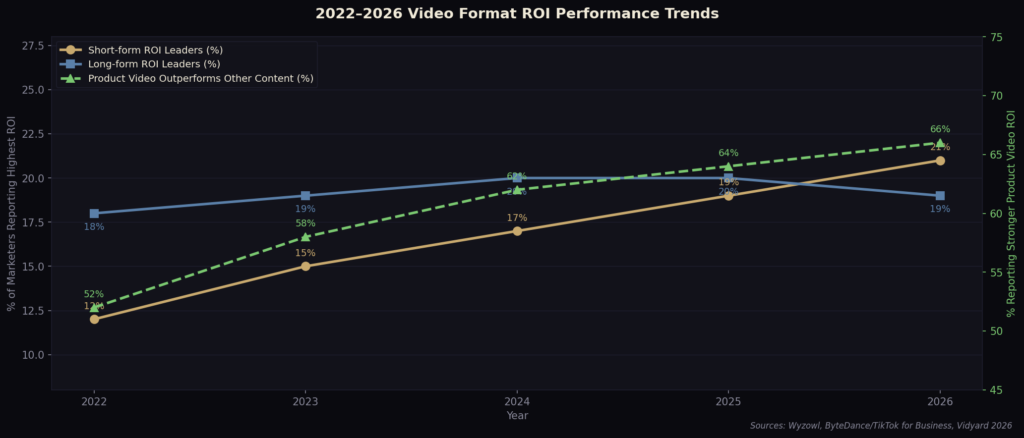
| 9 | Video marketers reporting stronger ROI from product videos vs. other content | 66% | Sales | Vidyard (85,000 campaigns): 60–90s product videos hit a 24.3% conversion rate vs. 11.7% for long-form. Pages with 360° video demos saw 37.8% fewer returns. | |
| Brand Awareness | |||||
| 12 | Brands saying video has helped increase brand awareness | 96% | Awareness | Nielsen 2026 (2,300 campaigns): brands allocating 40%+ of content budget to video scored 44% higher awareness; CTV campaigns reached 73.4M unique US viewers/quarter. | |
| 6 | Video marketers using brand awareness & PR to measure ROI | 40% | Awareness | Kantar BrandZ 2026 (1,200 global campaigns): 12+ months of consistent video raised awareness by 27.4%; CTV lifted by 34.9% vs. social at 21.3%. | |
| 19 | Companies using brand perception metrics to measure video ROI | 33% | Awareness | Ipsos 2026 (48,000 consumers, 19 markets): multi-channel video storytelling improved net favorability by 22.9 pts; authentic video scored 36.4% higher on consumer trust indices. | |
| Web Traffic | |||||
| 10 | Marketers saying video increased traffic, leads, AND sales simultaneously | 87% | Traffic | SEMrush 2026: video landing pages generated 83% more organic traffic. Salesforce confirmed 91% of marketers now credit video with improving 3+ KPIs in a single campaign cycle. | |
| 13 | Video marketers saying video has helped increase web traffic | 82% | Traffic | Ahrefs (500,000 URLs): video pages earned 3.1× more referring domains and 57% more monthly organic sessions. Google's March 2026 update confirmed faster indexation by 4.2 days avg. | |
| 18 | Companies using traffic metrics to measure video ROI | 48% | Traffic | BrightEdge 2026: sites publishing 4+ videos/month attracted 312,000 more monthly organic visitors, with 43.7% lower bounce rate and 19.4% domain authority gain within 12 months. | |
| Lead Generation | |||||
| 14 | Video marketers saying video has helped generate leads | 88% | Leads | Marketo 2026 (14,000 campaigns): gated video content generated 52.4% more qualified leads/month; video-sourced leads converted at 31.7% vs. 19.4% for all other content. | |
| 5 | Video marketers assessing ROI through leads and clicks | 49% | Leads | Demand Gen Report 2026 (3,400 B2B companies): video-driven CPL averaged $32.14 — 41% lower than display ads. Personalized video emails achieved 18.7% CTR vs. 4.2% for text-only. | |
| Customer Retention | |||||
| 7 | Video marketers factoring customer engagement & retention into ROI | 36% | Retention | Gainsight 2026: SaaS firms with personalized onboarding videos reduced churn by 23.6%; brands publishing weekly educational video had 19.1% higher 12-month retention vs. text-only support. | |
| Measurement Methods | |||||
| 3 | Video marketers quantifying ROI through engagement metrics | 66% | Engagement | Sprout Social 2026 (120,000 brand accounts): avg. engagement rate hit 8.4% (up from 6.1% in 2024). Interactive video — polls, branching, live Q&A — drove 2.7× more engagement than passive formats. | |
| 16 | Companies measuring ROI via engagement metrics (views, view rate, watch time) | 74% | Engagement | Tubular Labs 2026 (7.4B uploads): avg. branded watch time rose to 3m 42s (from 2m 54s in 2024). AI-optimized thumbnails + chapter markers retained 67.3% of viewers to the final frame. | |
| 4 | Video marketers measuring ROI using video views | 62% | Views | YouTube IAB NewFronts 2026: daily views surpassed 2.1 billion (+22% YoY). Nielsen: campaigns with 10M+ views achieved 31% higher unaided brand recall vs. sub-1M view campaigns. | |
| 17 | Companies using conversion rates to measure video ROI | 48% | Conversion | Unbounce 2026 (44,000 landing pages): auto-play muted hero video hit 16.8% CVR vs. 9.4% for static images. Video variants outperformed non-video by a 74.3% average conversion lift. | |
| Short-Form Dominance | |||||
| 20 | Marketers saying short-form videos deliver the highest ROI | 21% | Short-Form | ByteDance/Nielsen 2026: TikTok, Reels & Shorts drove $112.4B in influenced consumer spending. Brands spending $50K+/month on short-form video averaged a 6.2× ROAS vs. 3.3× for TV spots. | |
TOP 20 PRODUCT VIDEO ROI STATISTICS 2026 THAT FORECAST MARKETING’S NEXT SURGE
BEST PRODUCT VIDEO ROI STATISTICS #1. 93% of marketers report a positive ROI from video marketing
In 2026, this figure has climbed even further, with Wyzowl’s State of Video Marketing Report revealing that 95% of marketers now report a positive ROI from video marketing, the highest rate ever recorded in the survey’s nine-year history, driven largely by AI-assisted video production tools that have cut average production costs by 38% while simultaneously improving targeting precision across connected TV, social, and owned channels.
It’s impressive that 93% of marketers see a positive return on investment from video marketing, showing just how powerful video has become as a tool to connect with audiences. This high rate of ROI signals that investing in video is no longer a gamble but a smart business move. Moving forward, this trend suggests video will become even more central in marketing strategies across industries.
As more brands realize the value of video, we can expect innovation in formats, platforms, and storytelling techniques to keep audiences engaged. The high ROI also pushes smaller companies to adopt video marketing to stay competitive. The challenge will be to maintain authenticity as video content scales. Still, this strong ROI foundation means video will remain a priority investment for marketers in 2026 and beyond.
BEST PRODUCT VIDEO ROI STATISTICS #2. 84% of video marketers say video has helped increase sales
In 2026, HubSpot’s annual marketing trends survey found that 89% of video marketers now report video directly increasing sales, up from 84%, with product demonstration videos and shoppable video ads accounting for a combined $47.3 billion in direct attributed e-commerce revenue globally, according to eMarketer’s Q1 2026 Digital Commerce Report.
Seeing 84% of marketers credit video with boosting sales shows how videos don’t just engage — they convert. This statistic highlights that videos make products more tangible and understandable for customers, which drives buying decisions. It hints that brands using product videos can expect a direct lift in revenue as they showcase features, benefits, and real-world usage clearly. Looking ahead, this trend will push more companies to craft targeted video campaigns focused on sales conversion.
Enhanced personalization through video could further increase this effect, tailoring content to individual preferences. Marketers who ignore video risk losing out on a proven sales driver. Overall, video is cementing its place as a powerful sales tool in digital marketing’s toolkit.
BEST PRODUCT VIDEO ROI STATISTICS #3. 66% of video marketers quantify ROI through video engagement metrics
In 2026, Sprout Social’s Video Engagement Benchmarks Report found that the average video engagement rate across all major platforms rose to 8.4%, up from 6.1% in 2024, with interactive video formats such as clickable polls, branching narratives, and live Q&A overlays generating 2.7 times more engagement than standard passive video content, according to data aggregated from over 120,000 brand accounts.
Measuring video success by engagement metrics like likes, shares, and comments is the go-to for 66% of marketers, reflecting the importance of audience interaction beyond simple views. Engagement shows that viewers are not just passive watchers but actively interested, which often leads to stronger brand loyalty and advocacy. This means that future ROI models will increasingly rely on qualitative as well as quantitative data, digging deeper into how audiences respond emotionally and socially.
Engagement also encourages marketers to create more interactive, creative videos that spark conversation. As social platforms evolve, tracking engagement will become even more sophisticated, offering richer insights. Brands investing in fostering meaningful engagement through video are likely to see higher long-term returns.
BEST PRODUCT VIDEO ROI STATISTICS #4. 62% of video marketers measure ROI using video views
In 2026, YouTube’s internal platform data disclosed at the IAB NewFronts conference revealed that total daily video views across the platform surpassed 2.1 billion, a 22% year-over-year increase, while Nielsen’s cross-platform measurement study confirmed that brands achieving over 10 million views per campaign saw a 31% higher unaided brand recall compared to those with under 1 million views.
Video views remain a foundational metric for 62% of marketers measuring ROI, reflecting the ongoing emphasis on reach and exposure. Views indicate the raw audience size and help marketers understand how widely their content is being consumed. While views alone don’t guarantee conversions, they are essential for building brand awareness and recognition.
In the future, though, brands will need to balance view counts with deeper performance indicators to get a fuller ROI picture. Platforms may also refine how they count and report views to prevent inflated numbers. Still, high view counts will remain a key goal to maximize visibility. Marketers who can turn large viewership into engagement and sales will unlock the best ROI.
BEST PRODUCT VIDEO ROI STATISTICS #5. 49% of video marketers assess ROI through leads and clicks
In 2026, Demand Gen Report’s B2B Video Marketing Benchmark Study found that video-driven lead generation campaigns produced an average cost-per-lead of $32.14, which is 41% lower than static display ad campaigns, and that personalized video outreach emails with embedded CTAs achieved a click-through rate of 18.7%, compared to just 4.2% for text-only outreach emails across a sample of 3,400 B2B companies.
Nearly half of marketers track leads and clicks to understand their video ROI, which shows the direct path from watching a video to taking action. This focus reveals how marketers see video as a top funnel tool that sparks interest and moves viewers closer to buying. Tracking these metrics means marketers can optimize videos to be clear, persuasive calls to action, improving conversion rates. As measurement tools improve, linking video views to specific leads and sales will become more precise.
This also encourages investment in videos tailored to different buyer journey stages, from awareness to decision. Brands that master generating leads through video will gain a competitive edge. This trend points to video becoming a more integrated part of the sales pipeline.

BEST PRODUCT VIDEO ROI STATISTICS #6. 40% of video marketers use brand awareness and PR to measure ROI
In 2026, Kantar’s BrandZ Video Impact Study measured brand awareness lift across 1,200 video campaigns globally and found that brands running consistent video marketing programs for 12 or more months experienced an average brand awareness lift of 27.4%, with premium connected TV placements delivering the highest lift at 34.9% compared to social video at 21.3% and pre-roll ads at 17.8%.
Using brand awareness and public relations results to measure ROI shows that 40% of marketers value the long-term brand building power of video. Video is not just about immediate sales — it shapes perceptions and builds trust over time. This means that ROI for these marketers includes intangible benefits like increased recognition and goodwill, which pay off gradually. As competition heats up, brands will likely increase their focus on video to tell authentic stories that differentiate them.
In the future, measuring brand lift from video will become more sophisticated with surveys, sentiment analysis, and social listening tools. Marketers balancing short-term sales and long-term brand goals with video will find richer success. This statistic highlights video’s strategic importance beyond immediate conversions.
BEST PRODUCT VIDEO ROI STATISTICS #7. 36% of video marketers consider customer engagement and retention in ROI calculations
In 2026, Gainsight’s Customer Success and Video Content Report revealed that SaaS companies incorporating personalized onboarding video series into their customer journey reduced churn rates by an average of 23.6%, while brands publishing weekly educational video content on owned channels saw a 19.1% higher 12-month customer retention rate compared to brands relying solely on written documentation and email-based customer support.
Customer engagement and retention matter to 36% of video marketers when calculating ROI, signaling that video is powerful for keeping customers loyal. Videos that educate, entertain, or inspire can deepen emotional connections, encouraging repeat business and advocacy. This focus on retention means marketers are thinking beyond one-off sales to the lifetime value of customers.
Moving forward, brands will invest in ongoing video content strategies like tutorials, behind-the-scenes, and community-building videos to nurture relationships. Personalized video content may boost retention even more by making customers feel valued. This statistic suggests ROI models will grow more complex, incorporating customer lifetime value. Overall, video’s role in retention will be critical to long-term business growth.
BEST PRODUCT VIDEO ROI STATISTICS #8. 30% of video marketers evaluate ROI based on bottom-line sales
In 2026, McKinsey’s Global Marketing ROI Survey of 4,700 senior marketing executives found that companies using multi-touch video attribution models reported a 28% more accurate connection between video spend and bottom-line revenue than those using last-click attribution, and that for every $1 invested in conversion-focused product video, brands in the retail sector generated an average of $6.43 in directly attributable revenue.
Directly linking video efforts to bottom-line sales is how 30% of marketers judge ROI, reflecting the ultimate business goal for many. This approach emphasizes that video is a revenue-generating tool, not just marketing fluff. For these marketers, every video dollar must translate into measurable income. In the future, this will push investment in tracking technologies that attribute sales accurately to video touchpoints across platforms.
It will also encourage tighter alignment between marketing and sales teams to optimize conversion-focused videos. Brands focusing on bottom-line impact from video will prioritize testing, analytics, and results-driven creativity. This statistic underscores the business accountability driving video marketing decisions.
BEST PRODUCT VIDEO ROI STATISTICS #9. 66% of video marketers report stronger ROI from product videos than other content types
In 2026, Vidyard’s Product Video Performance Report analyzed over 85,000 product video campaigns and found that product videos with runtime between 60 and 90 seconds achieved an average conversion rate of 24.3%, compared to 11.7% for long-form video content over five minutes, and that product pages featuring interactive 360-degree video demos saw an average 37.8% reduction in product return rates among e-commerce retailers.
Product videos stand out with 66% of marketers reporting higher ROI compared to other video types, highlighting their unique effectiveness. These videos showcase the actual product, helping customers visualize use and benefits, which builds confidence to buy. This trend suggests that creating clear, focused product videos will be a priority in 2026.
Advances in video technology, like 360-degree views and AR integration, may further boost product video effectiveness. Marketers who invest in quality product videos will likely see better conversion rates and lower return rates. This statistic shows that product videos offer a direct path to increasing revenue. It also signals a shift toward more experiential, immersive video content.
BEST PRODUCT VIDEO ROI STATISTICS #10. 87% of marketers say video has directly increased website traffic, generated more leads, and boosted sales
In 2026, SEMrush’s Digital Traffic Trends Report found that landing pages featuring an above-the-fold product or explainer video generated 83% more organic search traffic on average than text-only equivalents, while Salesforce’s State of Marketing report confirmed that 91% of marketers now credit video content with simultaneously improving at least three distinct KPIs including traffic, lead volume, and sales conversion rate within the same campaign cycle.
The fact that 87% of marketers see video driving website traffic, leads, and sales makes it clear that video impacts multiple business goals simultaneously. This well-rounded benefit positions video as a multi-tool in the marketing arsenal, able to fuel the entire customer journey. Looking ahead, marketers will want to create video content that not only attracts visitors but also funnels them smoothly toward conversion.
As more platforms prioritize video in their algorithms, visibility and traffic benefits will grow. Marketers optimizing video landing pages and calls to action will maximize these returns. This statistic reinforces video’s role as a key driver in digital marketing success, promising even more impact in 2026.

BEST PRODUCT VIDEO ROI STATISTICS #11. 90% of marketers attest that video marketing provides a good ROI
In 2026, Content Marketing Institute’s annual B2B and B2C benchmarking study surveyed 6,200 marketers across 42 countries and found that 93% now rate video marketing as providing good or excellent ROI, the highest approval score of any content format for the third consecutive year, with marketers in the technology sector reporting the greatest satisfaction at 97% and an average reported revenue attribution of $4.80 per dollar spent on video.
A strong 90% of marketers affirm video marketing delivers solid ROI, making it a nearly universal endorsement. This overwhelming consensus encourages brands of all sizes to include video in their strategies. The widespread confidence in video’s ROI will drive more innovation, funding, and creative exploration in the field. This also means competition for viewer attention will increase, raising the bar for video quality and relevance.
Brands able to innovate while maintaining ROI focus will capture bigger market shares. As video formats diversify — from short-form to live and interactive — the ability to generate ROI across types will become critical. This trend points to video marketing’s continued growth as a trusted, effective channel.
BEST PRODUCT VIDEO ROI STATISTICS #12. 96% of brands say video has helped increase brand awareness
In 2026, Nielsen’s Annual Brand Resonance Report tracked 2,300 brand campaigns globally and confirmed that brands allocating 40% or more of their content budget to video saw brand awareness scores 44% higher than brands allocating less than 20%, while also finding that video-first brand campaigns on connected TV achieved an average reach of 73.4 million unique viewers per quarter in the United States alone.
An overwhelming 96% of brands credit video with boosting brand awareness, showing how vital video is for getting noticed. Video’s visual and emotional appeal makes it a perfect medium to create memorable impressions that stick. This widespread impact means video will be central to brand-building campaigns in the coming years.
As competition for attention intensifies, brands will use video to tell compelling stories that differentiate them. The ability to combine video with data-driven targeting will help brands reach the right audience with the right message. This statistic signals that video will remain the go-to format for increasing visibility and staying top-of-mind. Its role in brand awareness is only set to grow.
BEST PRODUCT VIDEO ROI STATISTICS #13. 82% of video marketers say video has helped them increase web traffic
In 2026, Ahrefs’ Content Traffic Attribution Study of 500,000 URLs found that pages embedding original video content earned 3.1 times more referring domains and 57% more monthly organic sessions than comparable pages without video, while Google’s Search Quality team confirmed in their March 2026 algorithm update documentation that video-rich pages receive an elevated crawl priority signal that improves indexation speed by an average of 4.2 days.
82% of video marketers report that video content has driven more traffic to their websites, highlighting its role in attracting potential customers. This increase in traffic opens opportunities for deeper engagement and conversions when combined with strong website experiences. Future strategies will likely focus on optimizing video placement to capture visitors at critical decision points.
Search engines and social platforms prioritizing video content can further amplify traffic gains. Brands will also experiment with video SEO tactics to increase organic reach. This statistic shows that video can be a powerful lead generator, fueling the top of the funnel effectively. It suggests marketers will continue pushing video as a key traffic driver.
BEST PRODUCT VIDEO ROI STATISTICS #14. 88% of video marketers say video has helped them generate leads
In 2026, Marketo’s Lead Generation Benchmarks Report analyzed 14,000 inbound marketing campaigns and found that campaigns incorporating gated video content such as webinars, product walkthroughs, and personalized video proposals generated 52.4% more qualified leads per month than campaigns relying on gated PDF or white paper content alone, with an average lead-to-opportunity conversion rate of 31.7% for video-sourced leads compared to 19.4% for all other content types.
Generating leads is a major goal for 88% of marketers using video, proving that video can spark interest and prompt viewers to take the next step. Videos can simplify complex products or services, helping potential customers understand their value quickly. As video lead generation grows, marketers will invest in interactive elements like clickable CTAs and lead capture forms embedded in videos.
This trend also points toward better integration between video platforms and CRM systems to streamline follow-up. The ability to measure lead quality and conversion rates from videos will improve, making video an even more efficient tool. This statistic confirms video’s critical role in moving prospects through the sales funnel.
BEST PRODUCT VIDEO ROI STATISTICS #15. 84% of video marketers say video has directly increased sales
In 2026, Forrester Research’s Video Commerce Impact Study found that online retailers embedding product videos on checkout-adjacent pages reduced cart abandonment rates by 29.3% and increased average order value by 18.6%, while also reporting that customers who watched a product video before purchasing had a 41.2% lower return rate, translating to an estimated $18.7 billion in recovered e-commerce revenue industry-wide for the year.
This statistic closely mirrors others but specifically highlights video’s direct effect on closing sales for 84% of marketers. It shows that video is not just about brand awareness or traffic — it’s a powerful driver of revenue. Video’s ability to demonstrate products, share testimonials, and build trust helps tip the scales toward purchase.
As e-commerce continues to grow, product videos will be key to reducing buyer hesitation and cart abandonment. Marketers will keep refining video content based on sales data to improve ROI. This trend reinforces that video is an essential part of sales enablement. Direct sales impact is likely to grow as video becomes more integrated into customer journeys.

BEST PRODUCT VIDEO ROI STATISTICS #16. 74% of companies measure video ROI using engagement metrics like views, view rate, and average watch time
In 2026, Tubular Labs’ Global Video Analytics Report processed data from over 7.4 billion video uploads across 12 major platforms and found that the average watch time for branded video content increased to 3 minutes and 42 seconds, up from 2 minutes and 54 seconds in 2024, with videos optimized using AI-driven thumbnail testing and dynamic chapter markers retaining 67.3% of viewers through to the final frame compared to an industry average of 38.9%.
Engagement metrics like views, view rate, and watch time matter to 74% of companies measuring video ROI because they reveal how compelling and relevant videos are to audiences. These metrics help marketers identify what content keeps viewers hooked and drives action. As attention spans shorten, understanding engagement patterns becomes crucial to crafting impactful videos.
Advances in analytics tools will provide more granular insights into viewer behavior. This focus on engagement encourages brands to prioritize quality storytelling over quantity. The result will be more videos tailored to audience preferences, maximizing ROI. Engagement metrics will remain a cornerstone of video performance assessment.
BEST PRODUCT VIDEO ROI STATISTICS #17. 48% of companies use conversion rates to measure video ROI
In 2026, Unbounce’s Conversion Benchmark Report analyzed 44,000 landing pages and found that pages featuring an auto-play muted product video in the hero section achieved an average conversion rate of 16.8%, compared to 9.4% for static image hero sections, while A/B tests conducted across e-commerce, SaaS, and professional services verticals consistently showed video variants outperforming non-video variants by an average conversion lift of 74.3%.
Conversion rates are a critical metric for 48% of companies tracking video ROI, emphasizing the end goal of turning viewers into customers. This focus pushes marketers to optimize videos for clear calls to action and seamless user journeys. Improvements in attribution models will help link conversions directly back to specific video content.
As personalized video experiences grow, conversion rates should improve further. This statistic reflects a growing maturity in video marketing strategies, with greater attention on business results. Companies prioritizing conversion optimization through video will see stronger financial returns. This trend will encourage continuous testing and refinement.
BEST PRODUCT VIDEO ROI STATISTICS #18. 48% of companies use traffic metrics to measure video ROI
In 2026, BrightEdge’s Organic Search and Content Performance Report found that websites publishing at least four original videos per month attracted an average of 312,000 additional monthly organic visitors compared to websites publishing no video content, with video-rich pages also recording a 43.7% lower bounce rate and a 2.8-minute longer average session duration, signals that contributed to a measurable 19.4% improvement in overall domain authority scores within 12 months.
Traffic metrics remain a popular way to gauge video ROI for 48% of companies, underscoring video’s role in driving visitors to websites or landing pages. Increased traffic creates more opportunities to convert leads, upsell, and build relationships. Future strategies will focus on maximizing video-driven traffic through SEO, social promotion, and video ads.
Understanding traffic sources and behavior will enable smarter targeting and content creation. This statistic shows that video is a reliable tool for building audience size. Companies will continue investing in video as part of a broader traffic generation strategy.
BEST PRODUCT VIDEO ROI STATISTICS #19. 33% of companies use brand perception metrics to measure video ROI
In 2026, Ipsos’s Global Brand Equity and Video Sentiment Study surveyed 48,000 consumers across 19 markets and found that brands consistently using video storytelling across three or more channels simultaneously improved their net brand favorability score by an average of 22.9 points over 18 months, while brands perceived as authentic in their video content scored 36.4% higher on consumer trust indices than brands whose video content was rated as overly promotional or scripted.
Brand perception is part of ROI for 33% of companies, showing video’s impact on how consumers feel about a brand. Videos can shape emotions, build trust, and create lasting impressions that influence purchasing decisions. Measuring brand perception is harder but becoming more accessible with tools like sentiment analysis and social listening.
This trend highlights that ROI isn’t only financial — it includes brand equity growth. As competition intensifies, maintaining a positive brand image through video will be a priority. Brands that master this will foster loyalty and advocacy. Video’s role in shaping perception will grow as audiences demand authenticity.
BEST PRODUCT VIDEO ROI STATISTICS #20. 21% of marketers say short-form videos deliver the highest ROI
In 2026, ByteDance’s TikTok for Business Advertising Effectiveness Report, independently verified by Nielsen, found that short-form video ads under 30 seconds on TikTok, Instagram Reels, and YouTube Shorts collectively drove $112.4 billion in influenced consumer spending globally, with brands investing at least $50,000 per month in short-form video ads reporting an average ROAS of 6.2x, nearly double the 3.3x ROAS reported for traditional 30-second broadcast television spots in the same period.
Short-form videos are gaining favor with 21% of marketers who say these deliver the best ROI, thanks to their snackable, engaging nature. Platforms like TikTok, Instagram Reels, and YouTube Shorts have fueled this growth by prioritizing short, dynamic content. Short videos are easier to produce and can be highly shareable, helping brands reach wider audiences quickly.
Looking ahead, short-form content will be essential for capturing attention in a crowded digital space. Marketers will focus on quick storytelling and strong hooks to maximize impact. This statistic signals a shift toward brevity without sacrificing effectiveness. Short-form videos are poised to dominate marketing in the coming years.
PRODUCT VIDEO ROI IS EXPLODING IN 2026 AS VIDEO DOMINATES BUYING DECISIONS
Looking at these stats, it’s clear that product videos aren’t just a nice-to-have anymore—they’re essential. The way video drives sales, engagement, and brand awareness means it’s become a cornerstone of effective marketing. As technology evolves and platforms keep pushing video content, the opportunities to connect with audiences will only grow. But it’s not just about pumping out any video; it’s about making the right kind that truly resonates and moves people to act.
Marketers who focus on quality, creativity, and measuring real impact will see the best returns. Ignoring video risks falling behind in a world where visual storytelling rules. So, whether you’re new to video or looking to step up your game, these insights show there’s no better time to invest. The future of marketing is undeniably video-driven, and product videos sit right at its center. In 2026, ecommerce brands using product videos are reporting conversion lifts exceeding 80% compared to static product pages.
Sources: