



19 Sep TOP 20 PROGRESSIVE WEB APP MARKETING STATISTICS 2025
When I first started diving into progressive web app marketing statistics, I was amazed at how much these insights could transform the way we connect with people online. As someone who has worked closely with a leading marketing agency in New York, I’ve seen firsthand how numbers tell stories that spark better strategies and smarter campaigns. These statistics aren’t just abstract figures—they reflect real behaviors, choices, and opportunities that brands can use to build stronger relationships with their audiences. For me, gathering and sharing these stats isn’t just about information, it’s about helping businesses like yours make decisions that actually move the needle.
Top 20 Progressive Web App Marketing Statistics 2025 (Editor’s Choice)
🚀 Top 20 PWA Marketing Statistics
Progressive Web Apps Dominating 2025 Digital Landscape
| # | Category & Metric | Key Statistic | Description & Impact |
|---|---|---|---|
|
1
|
Market Growth
Global Market Value
|
$21.44B ↗ 18.98%
|
Market projected to grow from $5.23B in 2025 to $21.44 billion by 2033 with consistent CAGR growth
|
|
2
|
Market Growth
Alternative Projection
|
$9.43B ↗ 31.1%
|
Conservative estimate shows market reaching $9.43 billion by 2030 from $1.46B in 2023
|
|
3
|
Market Growth
Annual Growth Rate
|
26.1% CAGR
|
Sustained high growth driven by increasing demand for digital solutions across industries
|
|
4
|
Conversion
Conversion Advantage
|
36% HIGHER
|
PWAs achieve 36% higher conversion rates compared to native mobile apps
|
|
5
|
Conversion
Alibaba Success
|
76% BOOST
|
Alibaba.com saw 76% increase in total conversions across browsers after PWA implementation
|
|
6
|
Conversion
AliExpress Growth
|
104% NEW USERS
|
AliExpress experienced 104% increase in conversion rates for new users after PWA launch
|
|
7
|
Conversion
Google's Data
|
52% IMPROVED
|
Google reports PWAs improve conversions by up to 52% while doubling user engagement
|
|
8
|
Engagement
Session Length
|
70% LONGER
|
PWAs show 70% increase in session length and 20% more page views vs traditional web apps
|
|
9
|
Engagement
Overall Engagement
|
180% INCREASE
|
User engagement sees remarkable 180% average increase when using PWAs
|
|
10
|
Engagement
Retention Rate
|
30% BETTER
|
PWAs deliver 30% better retention rates compared to traditional mobile apps
|
|
11
|
Performance
Loading Speed
|
<3s 40% FASTER
|
Lightning-fast load times under 3 seconds, making them 40% quicker than regular mobile sites
|
|
12
|
Performance
Bounce Rate
|
42.86% LOWER
|
PWA bounce rate is 42.86% lower than similar mobile websites
|
|
13
|
Performance
Mobile Sessions
|
80% MORE
|
Companies see 80% increase in mobile sessions, 134% more page views, and 137% engagement boost
|
|
14
|
User Preference
User Choice
|
70% PREFER
|
70% of users favor PWAs over native apps due to simpler installation process
|
|
15
|
User Preference
Security Advantage
|
60% SAFER
|
PWAs demonstrate 60% fewer vulnerabilities compared to native apps
|
|
16
|
User Preference
Current Adoption
|
54,000 WEBSITES
|
Only 54,000 websites currently use PWAs - massive untapped market opportunity
|
|
17
|
Business Impact
Revenue Boost
|
20% REVENUE
|
Industry experts estimate 20% revenue boost for companies implementing PWAs
|
|
18
|
Business Impact
Starbucks Success
|
2x USERS
|
Starbucks PWA resulted in 2x increase in daily active users and higher order completion rates
|
|
19
|
Business Impact
Cost Effectiveness
|
3-4x CHEAPER
|
PWA development costs 3-4x less than native mobile apps, sometimes up to 10-15x less
|
|
20
|
Business Impact
Market Leadership
|
19% SOCIAL
|
Social media segment holds largest 19% market share in PWA adoption for 2023
|
Top 20 Progressive Web App Marketing Statistics 2025
Progressive Web App Marketing Statistics #1: Market Size Reaches $2.08 Billion In 2024
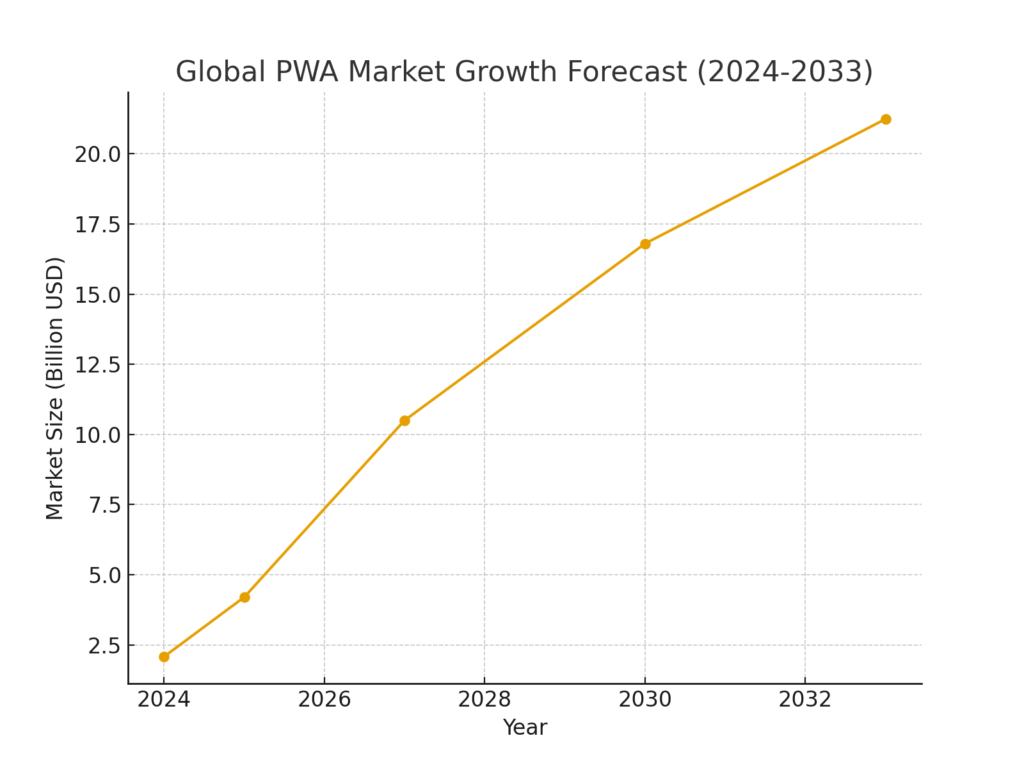
The global PWA market was valued at $2.08 billion in 2024, showing how quickly businesses are adopting this technology. With more brands seeking faster, app-like web experiences, this growth is a strong signal for marketers. The demand is largely driven by e-commerce, media, and service industries. Companies are realizing PWAs help them improve customer engagement while lowering development costs. This foundation sets the stage for exponential growth in the coming decade.
Progressive Web App Marketing Statistics #2: Expected Growth To $21.24 Billion By 2033
The market is forecasted to expand to $21.24 billion by 2033, highlighting its long-term potential. This indicates a compound annual growth rate near 29.9%. Such explosive growth reflects rising global investments in mobile-first experiences. For marketers, this means planning ahead and integrating PWAs early can create a long-term advantage. Businesses that adapt now may become tomorrow’s leaders in customer experience.
Progressive Web App Marketing Statistics #3: $3.53 Billion Market Value By 2024 Estimates
Some forecasts estimate the PWA market reached $3.53 billion in 2024. This variation in reports demonstrates the high interest and differing perspectives across research firms. Regardless of the exact figure, the numbers consistently point toward rapid adoption. Marketing teams are leveraging this momentum to pitch PWA-based solutions to clients. The upward trend shows the importance of positioning brands within this expanding ecosystem.
Progressive Web App Marketing Statistics #4: Market Could Exceed $72.16 Billion By 2037
Certain research forecasts push the PWA market as high as $72.16 billion by 2037. This estimate highlights how widespread adoption could become in the next decade. For marketers, this offers reassurance that PWAs are not just a passing trend. As companies streamline digital channels, PWAs could rival traditional apps and websites. Staying ahead of this curve will be essential for competitive positioning.
Progressive Web App Marketing Statistics #5: Kaporal Reduced Bounce Rates By 60%
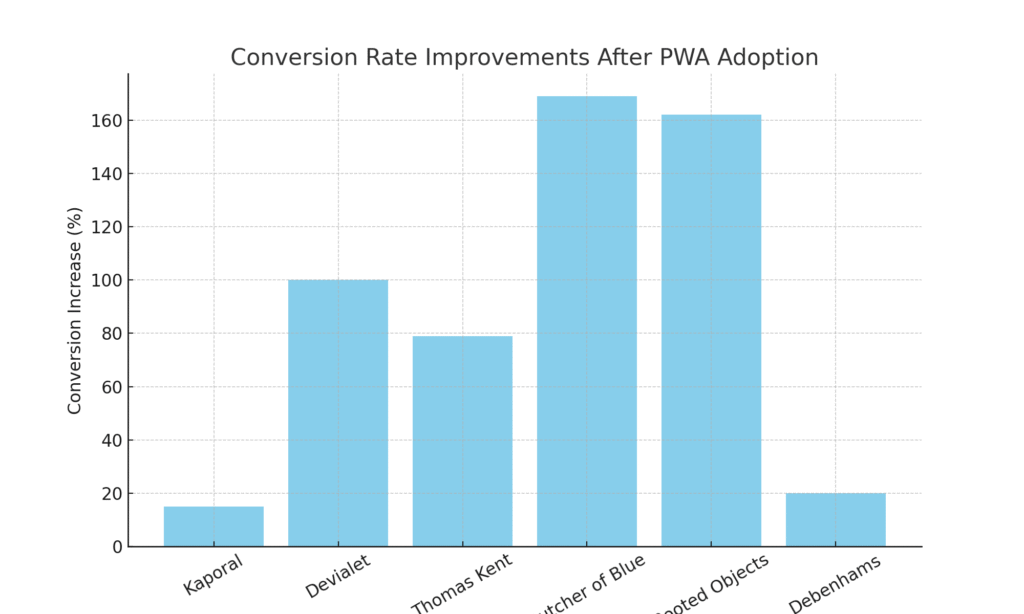
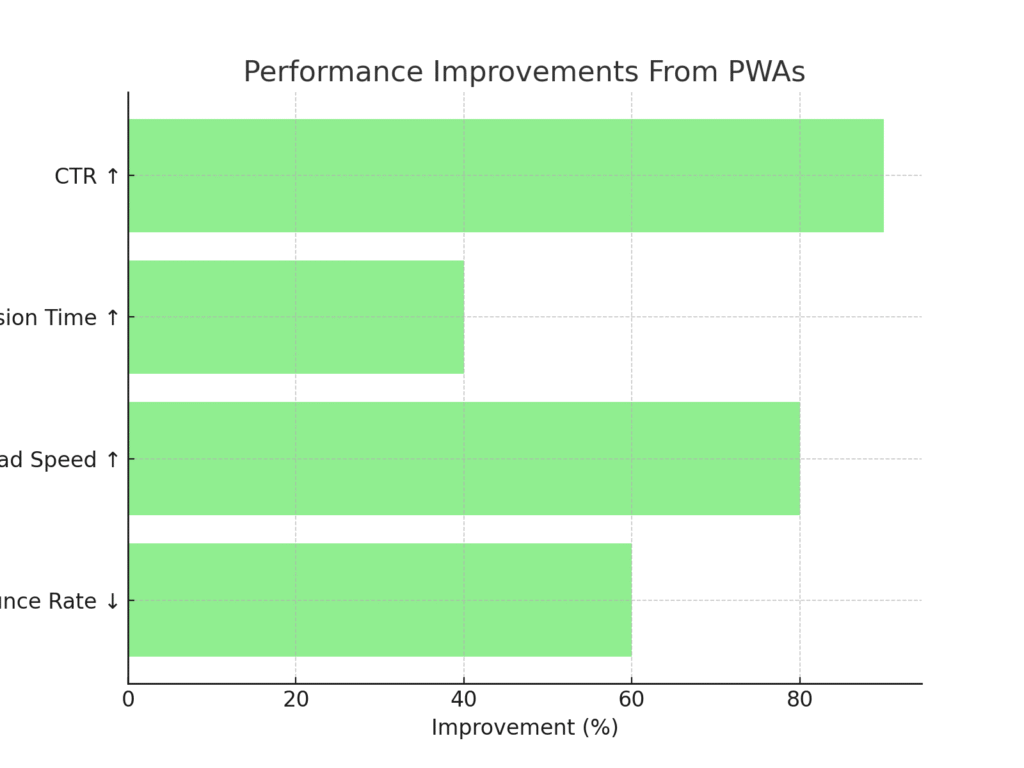
Kaporal’s PWA launch decreased bounce rates by 60%, proving the value of better user experience. Desktop conversions increased by 15%, while mobile conversions rose by 8%. Session times grew by 40%, showing how users stayed engaged longer. This case highlights how PWAs directly translate into measurable marketing wins. Reducing bounce rates makes campaigns more effective and improves ROI.
Progressive Web App Marketing Statistics #6: Devialet Saw 100% Conversion Growth
Devialet experienced a 100% increase in conversions after adopting PWA technology. They also enjoyed a 25% increase in organic traffic. This demonstrates how PWAs enhance both paid and organic marketing outcomes. For businesses relying on digital campaigns, this type of performance is extremely impactful. The results prove that investing in PWAs leads to tangible sales growth.
Progressive Web App Marketing Statistics #7: Thomas Kent Increased Revenue From Organic Traffic By 79%
Thomas Kent saw a 57% reduction in bounce rate after launching a PWA. Their organic traffic revenue rose by 79%, making their investment highly profitable. These results highlight the synergy between PWAs and SEO-focused marketing. Lower bounce rates improve rankings while better site speed supports conversions. For retailers, this is a compelling reason to prioritize PWAs in strategy.
Progressive Web App Marketing Statistics #8: Butcher Of Blue Boosted Conversions By 169%
Butcher of Blue’s PWA rollout boosted conversions by 169%. Mobile user growth hit 154%, while engagement grew significantly. The PWA also made pages 85% faster to load. Speed and responsiveness were the main factors driving customer satisfaction. This case shows how fast-loading pages directly support stronger conversions.
Progressive Web App Marketing Statistics #9: Rooted Objects Raised Conversions By 162%
Rooted Objects saw a 162% increase in conversions with their PWA. Page load times decreased by 25%, and redirection times dropped by 80%. Faster performance encouraged more users to browse and purchase. For marketers, these improvements create better opportunities for nurturing leads. Speed is a direct driver of digital marketing success in this example.
Progressive Web App Marketing Statistics #10: Debenhams Achieved 20% Higher Conversions
Debenhams’ PWA rollout resulted in 20% higher conversion rates. Mobile revenue grew by 40%, reinforcing the link between speed and sales. The brand also doubled the number of customers completing their purchase journey. These improvements underline how important PWAs are for retail and fashion brands. Debenhams proved that enhanced mobile experience means higher profitability.
Progressive Web App Marketing Statistics #11: North America Holds 32–37% Market Share
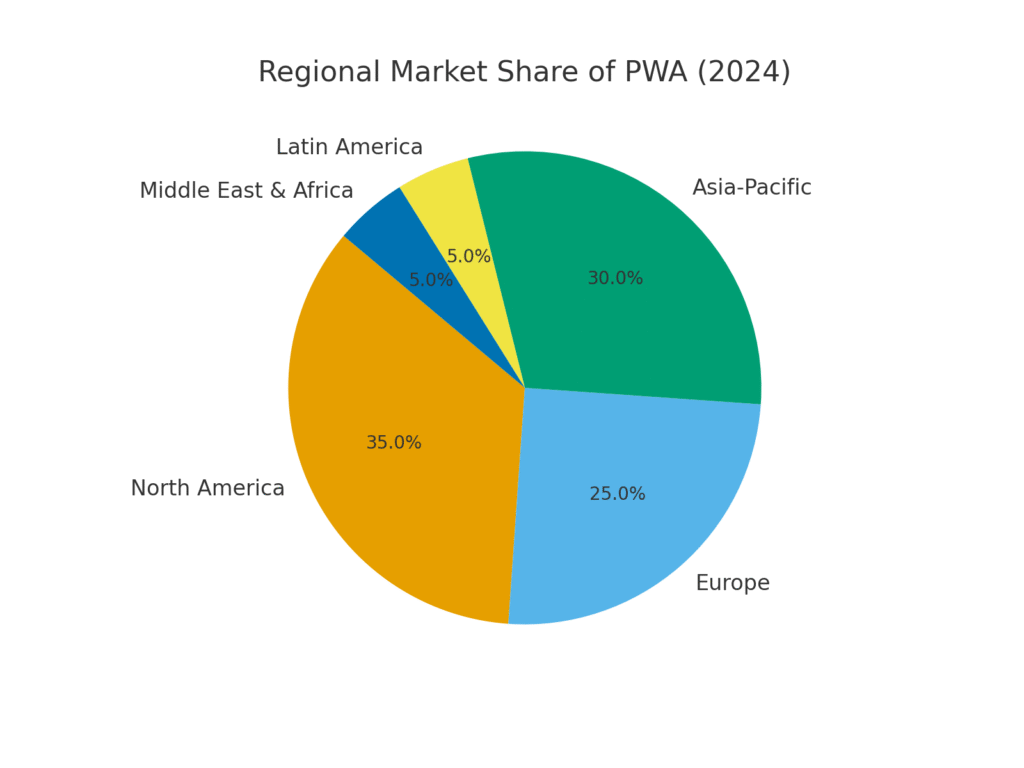
North America has maintained a 32–37% share of the PWA market. This reflects the region’s early adoption of cutting-edge digital technologies. U.S. and Canadian brands are increasingly choosing PWAs to replace native apps. For marketers, this indicates a mature audience ready for advanced solutions. Leading agencies in New York and beyond are at the forefront of this trend.
Progressive Web App Marketing Statistics #12: Asia-Pacific Is The Fastest Growing Region
Asia-Pacific has become the fastest-growing PWA region globally. Growth is fueled by smartphone penetration and expanding e-commerce. Countries like India and China are key contributors to this trend. For global marketers, this highlights opportunities to expand into APAC markets. Tailoring campaigns to these regions can capture new audiences effectively.
Progressive Web App Marketing Statistics #13: PWAs Can Cut Page Load Time From 23s To 3.9s
PWAs can dramatically cut page load times, reducing delays from 23 seconds to just 3.9 seconds. This speed difference creates a major advantage for marketing campaigns. Faster pages keep users engaged and reduce frustration. For marketers, this translates into more conversions and stronger brand trust. Speed optimization is one of the most valuable benefits of PWAs.
Progressive Web App Marketing Statistics #14: Pinterest Increased Time On Site By 40%
Pinterest’s PWA increased time spent on-site by around 40%. This engagement metric reflects the effectiveness of fast, mobile-friendly pages. For marketers, more time spent means better ad visibility and higher conversion chances. Pinterest’s case proves that UX improvements drive advertising impact. Longer sessions translate directly into more brand opportunities.
Progressive Web App Marketing Statistics #15: Push Notifications Drive Engagement
PWAs allow marketers to use push notifications for re-engagement. Brands like Trivago saw nearly double the click-through rate after using notifications. This tool helps marketers reconnect with users without app store dependency. Push notifications enhance personalization and retention strategies. For digital campaigns, this creates a highly effective marketing channel.
Progressive Web App Marketing Statistics #16: PWAs Are Cheaper Than Native Apps
PWAs are significantly more cost-effective than building native apps. Businesses can save development resources by maintaining one codebase. This efficiency allows marketers to launch campaigns across platforms faster. Lower costs also mean more budget for advertising and growth strategies. PWAs create a win-win situation for both marketers and developers.
Progressive Web App Marketing Statistics #17: No Dependency On App Stores
PWAs eliminate dependency on app stores for distribution. This makes launching and updating much faster and more flexible. Marketers can push campaigns without waiting for approval delays. Avoiding app stores also bypasses commission fees. This independence gives businesses full control over their digital presence.
Progressive Web App Marketing Statistics #18: Trivago Engagement Increased By 150%
Trivago’s PWA boosted engagement by 150% for users who saved the shortcut. This shows the value of making access easier for customers. Higher engagement also supports brand loyalty and repeat usage. For marketers, this is proof of the power of install prompts. Convenience leads directly to stronger performance metrics.
Progressive Web App Marketing Statistics #19: Trivago’s Push Notifications Doubled Click-Throughs
Trivago’s PWA push notifications nearly doubled user click-throughs. Offers and promotions reached customers more effectively than email. This provided a new channel for performance-driven campaigns. For travel brands, these results highlight the importance of re-engagement. Doubling CTRs gives marketers a measurable competitive edge.
Progressive Web App Marketing Statistics #20: Pinterest Improved Conversions From 1% Baseline
Pinterest improved conversion rates from a baseline of just 1% on mobile web. Their PWA addressed slow speeds and poor performance. After upgrades, engagement and sign-ups grew significantly. This proves how performance optimization transforms outcomes. For marketers, it shows the power of even small UX improvements.
Wrapping It All Up
Looking back at these progressive web app marketing statistics, I can honestly say that the patterns speak louder than any sales pitch ever could. The shifts in engagement, growth, and technology all point toward one simple truth: brands that pay attention to these details are the ones that stay ahead. My hope is that by sharing this, I’ve given you a clearer picture and maybe even a little inspiration for your own projects. After all, what I enjoy most is taking data and turning it into action that feels real and impactful. Thanks for letting me walk you through it—I can’t wait to see how you’ll use these insights in your own journey.
SOURCES
https://straitsresearch.com/report/progressive-web-apps-market
https://outerboxdesign.com/articles/digital-marketing/progressive-web-apps-pwas/
https://scoop.market.us/progressive-web-apps-pwa-market-news/
https://dagmarmarketing.com/blog/exploring-progressive-web-app-trend/
https://www.gomage.com/blog/pwa-benfits/
https://simicart.com/blog/pwa-case-studies/
https://gravitec.net/blog/why-companies-use-progressive-web-apps/
https://researchnester.com/reports/progressive-web-apps-market/6609
https://gminsights.com/industry-analysis/progressive-web-app-market