



13 Apr Property Research Is Just Marketing Research in Disguise — Here’s What Investors Know That Brands Don’t
Let me tell you something that took me years to figure out — and the moment I did, I stopped losing money on bad campaigns, bad influencers, and bad platforms forever.
The best marketers in the world don’t think like marketers.
They think like real estate investors.
I know that sounds sideways. Stay with me.
A real estate investor doesn’t fall in love with a property and write a check. They do something that most marketers never do: they research the market before they spend a single dollar. They run comps. They study neighborhood trajectories. They inspect what they can’t see from the street. They look for off-market deals before anyone else even knows the listing exists. They calculate the risk before they fall in love with the upside.
Meanwhile, most brands are out here signing six-figure influencer deals because someone on TikTok felt right. Choosing a platform because it’s trending. Running a campaign because a competitor is running one. That’s not marketing. That’s gambling with a logo on it.
I recently came across a breakdown of PropStream Alternatives, platforms that help serious property investors research, analyze, and act on data before committing a single dollar of capital. Tools like REsimpli, BatchLeads, DealMachine, and PropertyRadar — each one built around a single non-negotiable philosophy: know before you go. Know the neighborhood. Know the comps. Know the risk. Know who owns what before you make your move.
And reading that article, I had a moment that stopped me cold. Because that philosophy — know before you go — is exactly what the most successful marketing campaigns in history have been built on (I would know, we have done hundreds of campaigns in Amra and Elma). And it is exactly what most brands skip entirely in their rush to be first, to be loud, to be everywhere.
So I built the bridge. What follows are 10 property research strategies translated directly into marketing intelligence — and every single one of them is a secret hiding in plain sight. Not because the information doesn’t exist. It does. But because almost nobody is connecting these dots, and the ones who are? They are quietly building the kind of brand dominance that looks like luck from the outside and looks like genius from the inside.
Read this slowly. Take notes. This is the playbook.
Property Research Is Just Marketing Research in Disguise (10 TOP Secrets of Property Investors)
Property Research Is Just Marketing Research in Disguise
10 secrets real estate investors use that the smartest brands are quietly stealing — and what each one means for your next campaign.
Tap any row to reveal the full secret
Property Research Secret #1: Run Comps Before You Commit a Single Dollar
In real estate, “running comps” means analyzing comparable sales in the area before you decide what a property is worth. You look at what similar properties sold for, how long they sat on the market, and what separated the ones that moved fast from the ones that didn’t. No serious investor skips this step. Not one.
Here is the secret nobody in marketing tells you: your campaign has comps, and you are not running them.
Before you launch any influencer campaign, any paid social push, any content series — you need to look at what has already sold in your exact category, on your exact platform, with your exact customer demographic. Not what you think worked. Not what the agency pitched you in a deck. What actually converted, what the engagement-to-sale ratio looked like in the real world, and how long it took to see returns.
Here is the game-changer: your competitors’ best-performing posts are public information. Their top influencer partnerships are completely visible. Their ad creative is sitting inside Facebook Ad Library and TikTok Creative Center right now, available to anyone who bothers to look. The data exists in plain sight. Most marketers just never look at it before spending money, because looking feels like work and spending feels like momentum.
It is not momentum. It is noise.
Run your comps. Before you book a creator, before you set a budget, before you pick a platform — spend two days doing nothing but auditing what has already worked in your space. You will immediately see patterns: the hooks that always convert, the creator archetypes that consistently drive sales, the posting cadence that performs, the visual language that stops the scroll. That is your blueprint. Stop building from scratch every single campaign. The answers to your next launch are sitting inside your competitor’s last launch, and they cost you nothing to find.
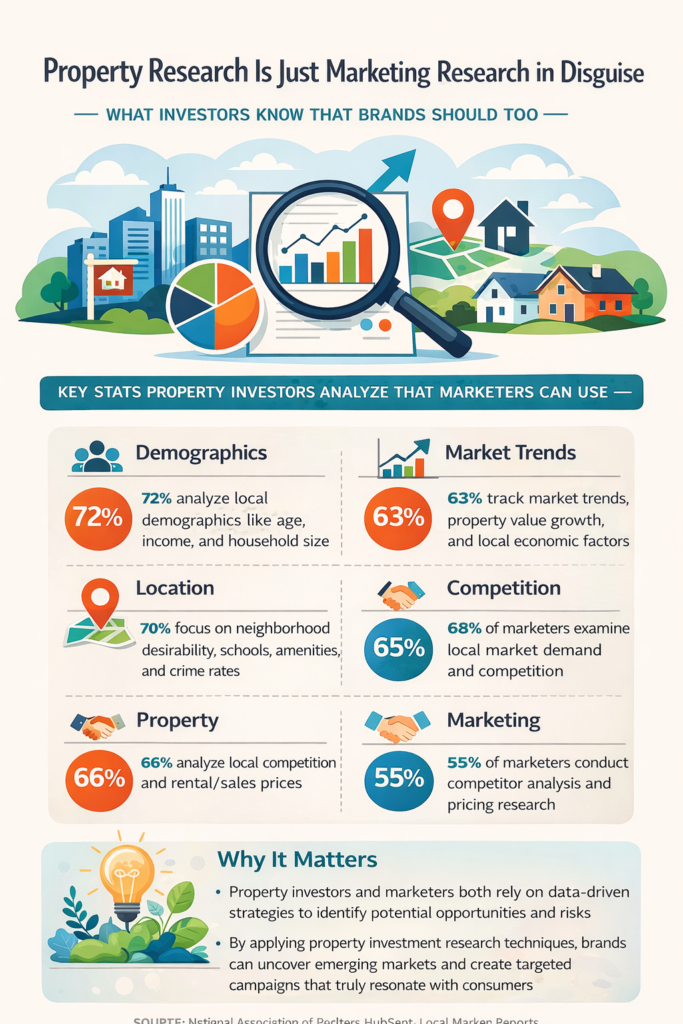
Property Research Secret #2: Study Neighborhood Trajectory — Not Where the Audience Is Now, But Where It’s Going
Real estate investors don’t just buy into what a neighborhood is today. The smart ones buy into what it will be in three years. They look at incoming infrastructure, development permits, migration patterns, new transit lines, school district changes. The legendary move — the one that actually builds wealth — is always buying the undervalued neighborhood before the restaurants move in, before the boutiques arrive, before everyone else figures out what’s happening and the prices adjust accordingly.
This is one of the most criminally underused strategies in all of marketing, and I am handing it to you right now.
Stop chasing platforms at their peak. Find the platform at its inflection point.
When Instagram had 100 million users, the brands that went all-in owned the decade. When TikTok had 50 million US users and the big agencies were still calling it “a teen thing,” the brands that moved early built audiences for pennies that would cost dollars eighteen months later. Pinterest is having a quiet renaissance right now with high-income female consumers and purchase intent that crushes Instagram. LinkedIn organic reach is at a historical high and most DTC brands have essentially zero presence there.
The secret is that you identify the next neighborhood not by following the herd, but by watching three specific signals simultaneously. First: where is the venture money going? Not because VCs are always right, but because capital flows toward momentum before the public can see it. Second: where are platform-native creators migrating? When creators move, audiences follow — always. Third: where does your customer aspire to spend time, not where they currently spend it? Aspiration and behavior are different, and the gap between them is where opportunity lives.
Those three signals together will tell you where to plant your flag twelve months before everyone else shows up and inflates the price of attention beyond what a reasonable brand can afford.
10 Statistics That Prove Every
Property Research Strategy Is a Marketing Strategy
Every number below is the evidence for a corresponding real estate investor technique — and why applying it to your marketing will change your results permanently.
In real estate, running comps means studying every comparable sale before you commit a dollar. In marketing, the comps are sitting inside Facebook Ad Library (10M+ active ads searchable by brand, category, and date) and TikTok Creative Center (top-performing ads ranked by engagement, available to anyone with an account). Before a single brief is written, a skilled marketer can already see what hooks are converting in their category, which creator archetypes outperform, and what creative formats the market has already rejected. The information is free. The discipline to look before you spend is the competitive advantage. Most brands go straight to the spend. That is the comps failure — and it costs them every single campaign.
Smart real estate investors don't buy what a neighborhood is — they buy what it will be. The marketing equivalent: stop chasing platforms at their peak and identify the channel at its inflection point. Pinterest's 23.2% year-over-year audience growth in 2024 made it the second fastest-growing social platform globally. Its 570 million monthly users skew 70% female, one-third earn over $100,000, and 85% have made a purchase from a pin. The brands that went all-in on Instagram when it had 100 million users built audiences for pennies that now cost dollars. Pinterest is at that same inflection point right now — with the added advantage that 96% of its top searches are unbranded, meaning any new brand has equal visibility to a decade-old one if the pin is optimised. The neighborhood is primed. Most brands aren't there yet.
A property can look immaculate on the outside and be structurally failing inside. An influencer can look immaculate on the outside — polished feed, growing follower count, glossy media kit — and have an audience that will never buy a single thing you sell. The $4.8 billion lost to influencer fraud annually (12.4% of the entire global influencer marketing budget) is the direct cost of brands committing without inspecting. 59.8% of brands experienced influencer fraud in 2024, up from 31% in 2022. The inspection means: pull engagement rates on non-sponsored posts vs. sponsored posts. Check story views as a percentage of feed followers. Look for vertical follower spikes with no corresponding content event. And always, always: ask for link-in-bio click-through data before you sign. The creators who convert show you the numbers before you finish asking.
The best real estate deals never hit the open market — they go to investors with the right relationships and the patience to look where others don't. On Instagram, micro-influencers average a 3.86% engagement rate vs. 1.21% for mega-influencers. That's 60% higher engagement at roughly one-tenth the cost per post. 44% of brands now actively prefer nano-influencers with under 10,000 followers. Ten nano-influencers cost less than one macro-influencer and deliver more total engagement, better audience targeting, and more genuine brand advocacy simultaneously. The off-market method: search hashtags adjacent to your category, filter for under 50K followers and above 5% engagement, and build relationships before the agencies discover them and the rate cards triple.
You cannot build a commercial space in a residential zone — the rules are not suggestions. Every platform has equivalent zoning laws, and ignoring them doesn't change them, it just means you disappear. LinkedIn carousel posts (native PDFs) average 6.60% engagement and get saved 4–6× more frequently than text posts. Users spend 30–60 seconds on carousels vs. 3–5 seconds on text — and the algorithm rewards every second of dwell time. On Instagram, Reels are a discovery zone (pushed to non-followers — entertain, don't sell). Stories are a conversion zone (only your warmest audience sees them — this is where you close). TikTok's For You Page is a democratic zone — any account can go viral, but it penalises posting too frequently. Map every piece of content to its zone before you create it. This one habit shifts organic performance faster than any paid boost.
In real estate, an appraisal determines objective market value — not what the seller wants, not what the listing says. The formula for appraising an influencer is straightforward and almost never used: Rate ÷ (Followers × Engagement Rate) × 1,000 = Effective CPM on engaged audience. $3,000 ÷ (300,000 × 0.02) × 1,000 = $50 CPM. $500 ÷ (40,000 × 0.08) × 1,000 = $15.60 CPM. The smaller creator delivers 3.2× the value per real eyeball. Beyond CPM: appraise audience income level (80K followers earning $120K+ beats 800K followers earning nothing), audience overlap with existing customers (loyalty play vs. growth play), and content half-life (a YouTube video compounds for years; an Instagram story disappears in 24 hours — never price them the same way).
Before any real estate transaction closes, a title search goes through the complete ownership history to find liens, disputes, or anything that clouds clean ownership — because you cannot build securely on a foundation with hidden problems. Your brand has an equivalent title search, and almost no one runs it before scaling. Brands with consistent presentation across all channels see revenue increases of up to 33% — not from spending more, but from eliminating the confusion that was quietly undermining every campaign they ran. Run three questions against every brand touchpoint: What promise is being made? To whom? Is it consistent with every other promise we have made? Anywhere the answer diverges is a lien on your positioning. Clear the title first. Then scale. Amplifying a confused brand only produces louder confusion.
Earnest money in real estate is the good-faith deposit that signals serious intent while preserving an inspection window — a structured way to enter a transaction before you're fully committed. In marketing, this is the test budget, and the data makes the case for it permanently: organizations that always include A/B testing report a $48 ROI per dollar spent, compared to the $42 industry average for those who don't test systematically. That 14% gap is compounding. Gift an influencer first — watch the organic post perform before you pay for a sponsored one. Send a test email to 10% of your list before you deploy to 100%. Run $500 on a new platform before committing $50,000. The information from a validated test compounds across every future decision. The unvalidated $50,000 spend evaporates and leaves nothing behind but a receipt.
Driving for dollars means physically showing up in neighborhoods to find distressed properties that no database has captured yet — the insight requires human presence and pattern recognition you can't get from an algorithm. In marketing, the equivalent is spending time inside your customer's communities — Reddit, Discord, Facebook groups, niche subreddits — without a brand hat on, just listening. The 96% unbranded search stat is the proof of what you'll find: your customer does not use your language. They describe their problem, their desire, their aesthetic in words that almost never appear in a brand's marketing copy. The brands that go inside those communities find the exact words that unlock conversion — not from a focus group, not from a brief, but from being where the real conversation is happening. Authenticity is not a brand value you manufacture. It is an operational habit you build.
A flip generates immediate cash but builds nothing lasting. A hold requires patience and a longer time horizon — but it builds equity that compounds year after year and eventually generates income that does not require your daily effort to sustain. In marketing: a campaign is a flip. It ends, the asset value drops to zero, and the next campaign starts from scratch. An email list is a hold. At $42 return per $1 invested — 4,200% ROI — email is the highest-returning channel in digital marketing. It is also the only major marketing channel that no algorithm can repossess. When Instagram throttled reach in 2016, brands that had built email lists kept their audience. When TikTok faced potential bans, brands that had built email lists kept their audience. Every campaign you run should deposit something into your long-term equity account. Even a small deposit, made consistently, compounds into something no competitor can simply outspend.
Property Research Secret #3: The Pre-Inspection — What the Profile Doesn’t Tell You About an Influencer
In real estate, a property can look immaculate on the outside and be a structural disaster inside. Mold behind the walls. Faulty wiring. A foundation quietly shifting. The listing photos are gorgeous. The curb appeal is perfect. And none of that tells you a single thing about whether the building will hold. This is why smart investors never skip the inspection, no matter how beautiful the property looks from the street.
Influencer marketing has an almost identical problem, and it is costing brands millions of dollars every single year.
Here is what the profile won’t tell you: whether those 500,000 followers are real human beings who buy things, or a ghost audience assembled through follow-for-follow loops, purchased followers, and a viral giveaway from 2022 that attracted zero customers and a hundred thousand people who will never open another one of their posts again. A 4% engagement rate means absolutely nothing if every comment is “🔥🔥🔥” from accounts with 9 followers and a profile photo that is clearly AI-generated.
The inspection in influencer marketing means going well beyond the media kit. Here is exactly what to look at. Pull their engagement rate on non-sponsored content versus sponsored content — because an influencer whose audience disappears the moment they post a brand partnership is an influencer whose audience does not trust their recommendations, which means your product is being inserted into a dead signal. Look at their story views as a percentage of feed followers, because story views tell you how many people actually show up versus how many are just vaguely subscribed. Check whether their follower count grew slowly and organically over time or in suspicious vertical spikes that correspond to no visible content event.
And here is the secret weapon that most brands skip entirely: ask the influencer for their link-in-bio click-through rate and their most recent story swipe-up data. If they won’t share it, that is your answer. The creators who actually convert always show you the numbers before you even finish asking, because they know what they’re worth and they want you to see it.
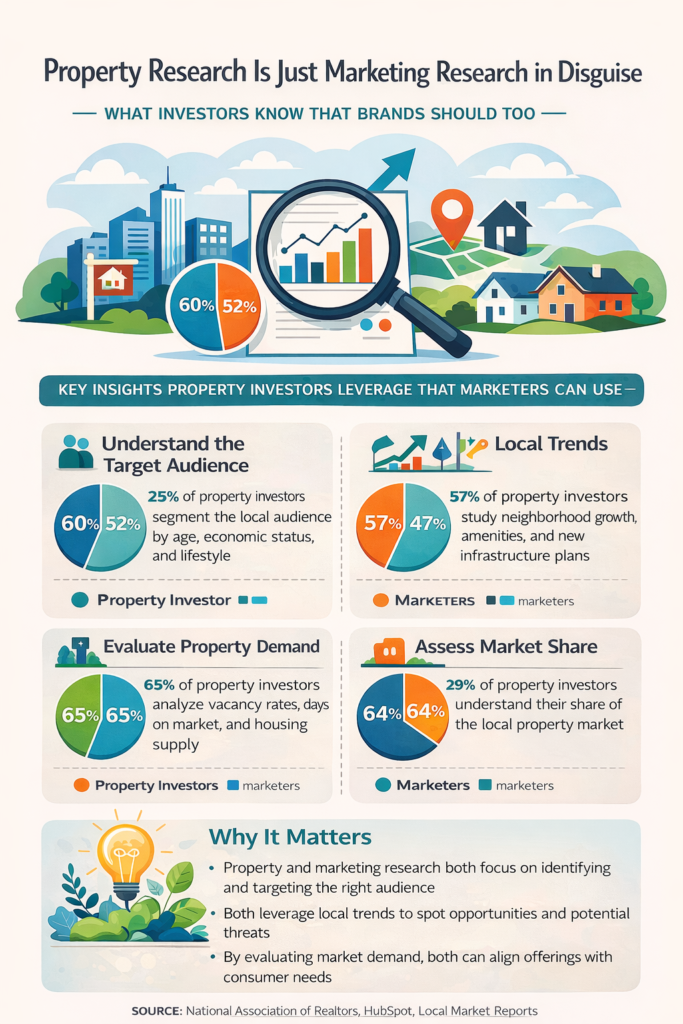
Property Research Secret #4: Off-Market Deals — The Creator Relationship You Build Before They’re Expensive
In real estate, the best deals almost never appear on the open market. The smartest investors have cultivated networks of relationships — estate attorneys, property managers, local wholesalers — that surface opportunities before a property ever gets listed. By the time something hits Zillow, a dozen people have already looked at it, made offers, and the asking price fully reflects that competition. The off-market deal is where real returns live.
Influencer marketing works exactly the same way, and this is the secret that the biggest agencies quietly exploit while charging you full price for the privilege of not knowing it.
The creators who will matter in 18 months are visible right now — if you know where to look.
They have 12,000 followers, not 1.2 million. Their engagement rate is extraordinary because their audience is tight, loyal, and genuinely paying attention. Their content quality punches well above their follower count. They respond to DMs within hours. They are not yet represented by an agency. And right now, today, they will accept a gifting partnership, post with genuine enthusiasm rather than transactional energy, and become true brand advocates rather than billboards-for-rent.
The methodology for finding them is specific. You don’t search hashtags in your direct category — you search one layer adjacent. If you sell luxury accessories, you don’t search #luxurybags. You search #getdressedwithme, #slowfashion, #wardrobecuration, #morningroutine. You are looking in the neighborhoods just before the restaurants move in. You filter for accounts with under 50,000 followers and engagement rates above 5%. You look at who is tagging your competitors’ products without being paid — those people already love the category and will love you too.
Build relationships now. Gift them now. Be the brand that showed up when they were small, when it wasn’t obvious, when everyone else was still looking at the bigger names. Because when they blow up — and the right ones will — your brand is already in their story.

Property Research Secret #5: Zoning Laws — Understanding the Rules the Algorithm Actually Enforces
Every real estate investor learns this fast: you can have the most beautiful vision for a property, but if the zoning laws don’t allow it, that vision is worthless. You cannot build a commercial space in a residential zone, no matter how much sense it makes to you. The zoning laws are not suggestions. They are the invisible architecture of what is possible, and ignoring them doesn’t change them — it just means you lose money.
Every platform has zoning laws. They are called the algorithm, and they are the most misunderstood force in all of digital marketing.
Here is what most brands don’t realize: the algorithm doesn’t distribute content randomly. It has zones, and each zone rewards specific behavior. Instagram Reels are a discovery zone — content there is pushed to non-followers, which means it rewards entertainment and novelty above everything else. The Instagram Feed is a relationship zone — it is shown primarily to existing followers, which means it rewards consistency and depth. Stories are a loyalty zone — only your warmest audience sees them regularly, which means that is where you convert, not where you grow.
TikTok’s For You Page is the most democratic discovery zone ever built — any account, any size, any age, can go viral if the content clears the algorithm’s first-round test of watch time and completion rate. But TikTok’s algorithm punishes posting frequency above a certain threshold. More is not better. Better is better.
The game-changing insight hidden inside all of this: most brands are creating the right content in the wrong zone. They are posting conversion content to cold audiences. They are posting discovery content to warm audiences who already know them and need to be pushed toward a decision. Stop ignoring the zoning laws. Map your content type to the zone it’s actually built for, and your organic performance will shift faster than any paid boost can achieve.
Property Research Secret #6: The Appraisal — What an Influencer’s Audience Is Actually Worth to Your Specific Brand
In real estate, an appraisal determines the objective market value of a property based on condition, location, comparable sales, and income potential. The appraisal is not about what the seller wants. It is not about what the listing says. It is about what the asset is actually worth to a rational buyer under current market conditions.
Most brands never appraise an influencer. They look at the rate card and negotiate slightly. That is not an appraisal. That is just haggling.
A real appraisal of an influencer’s value to your brand requires four calculations that most marketing teams have never done, and this is where extraordinary ROI either gets captured or permanently left on the table.
First, calculate their effective CPM on actual engaged audience, not total followers. If someone has 300,000 followers, a 2% engagement rate, and charges $3,000 per post, their effective CPM on engaged viewers is $50. Compare that to a creator with 40,000 followers, an 8% engagement rate, charging $500 per post — their effective CPM on engaged viewers is $15.60. The smaller creator is delivering 3x the value per real eyeball.
Second, look at their audience income and purchase behavior. A creator with 80,000 followers who are predominantly women aged 28-42 with household incomes above $120,000 is worth more to a luxury brand than a creator with 800,000 followers whose audience skews toward teenagers with no purchasing power. The neighborhood matters more than the square footage.
Third, evaluate audience overlap with your existing customer base. An influencer whose audience is 70% your existing customers is a retention and loyalty play, not a growth play. Both are valuable — but you need to know which one you’re buying.
Fourth — and this is the one nobody talks about — assess their content’s half-life. A YouTube video drives search traffic for years. An Instagram story disappears in 24 hours. A TikTok can resurface on the For You Page six months after posting. Match the content format to the duration of value you need, because a one-day asset and a two-year asset should never be priced the same way.
Property Research Secret #7: Title Search — Auditing Your Brand’s Positioning History Before You Spend on Growth
Before any serious real estate transaction closes, a title search is conducted. This means going back through the full ownership history of a property to identify any liens, disputes, encumbrances, or legal clouds that could affect the buyer’s clean ownership. The title search exists because you cannot build securely on a foundation that has hidden problems embedded in its history.
Your brand has a title search, and almost no one ever runs it.
Before you invest in growth — before you scale influencer campaigns, before you increase paid social budgets, before you launch into new markets — you need to audit your brand’s positioning history for anything that clouds your ownership of your space. And I mean this in the most concrete, practical way possible.
Does your brand mean the same thing across every touchpoint? Because if your Instagram says “luxury,” your website says “affordable,” your influencer partnerships say “accessible,” and your email marketing says “exclusive” — you do not own a position. You own confusion. And no amount of marketing spend will fix confusion. It will only amplify it.
The title search means going through every piece of content your brand has ever published and asking three questions: What promise is being made here? To whom? And is that consistent with every other promise we’ve made? Anywhere the answer diverges is a lien on your positioning — a hidden problem that will undermine your growth campaigns no matter how brilliant the creative is.
Clear the title before you scale. A clean, unambiguous brand position is the most valuable piece of real estate you will ever own, and you get it not by spending more but by auditing ruthlessly and committing completely to what you actually are.
Property Research Secret #8: Earnest Money — The Test Budget Strategy That Changes Everything
In real estate, earnest money is the good-faith deposit a buyer puts down when they make an offer, before the full commitment of closing. It signals serious intent. It is also a structured way of entering a transaction while leaving yourself an inspection period — a window of time to verify your assumptions before you are fully committed.
The best marketers in the world use earnest money thinking, and almost everyone else skips straight to the full commitment. This mistake is responsible for more wasted marketing budget than any other single decision.
Here is the strategy: never enter a new channel, a new creator relationship, or a new campaign format with full budget. Always put down earnest money first.
This means running a $500 test campaign before you run the $50,000 one. It means gifting an influencer and watching the organic post perform before you pay for a sponsored one. It means launching a new content format to your existing audience before you spend on distributing it to a cold one. It means A/B testing two versions of a landing page with small traffic before you send your entire email list to one of them.
The earnest money period is your inspection window. This is when you find out if the engagement is real, if the audience converts, if the creative resonates, if the click-through rate justifies the investment. And here is the part that will change how you budget forever: the information you get from a $500 test is often worth more than the revenue from a $50,000 campaign that was never validated. Because that information shapes every dollar you spend afterward. One validated campaign insight compounds across every future decision. One bad $50,000 commitment evaporates and leaves nothing behind.
Put down earnest money. Test before you close. Make the inspection period non-negotiable.
Property Research Secret #9: Driving for Dollars — The On-the-Ground Research That No Dashboard Can Replace
“Driving for dollars” is a real estate acquisition strategy where investors physically drive through neighborhoods, looking for distressed or undervalued properties that don’t appear in any database — properties with overgrown lawns, boarded windows, obvious deferred maintenance, signs of vacancy. The insight these investors are after cannot be captured by any algorithm or data platform. It requires physical presence, human observation, and pattern recognition that only comes from actually being there.
Marketing has an exact equivalent of this, and it is the most underrated research activity in the entire industry.
It is called spending time in the actual communities where your customers live online — not studying them from the outside with analytics tools, but being inside the comment sections, the Reddit threads, the Facebook groups, the Discord servers, the niche subreddits where your exact customer is talking to other people who are exactly like them. Without a brand hat on. Without an agenda. Just listening.
What you find when you do this is extraordinary. You find the exact language your customer uses to describe their own problem — and it is almost never the language you use in your marketing copy. You find what they actually love about your competitors, which is often completely different from what your competitors’ marketing says. You find the objections that never show up in a focus group because they’re too honest, too raw, too real for a formal research setting. You find the unmet desire that your entire product line could pivot around if you were brave enough to take it seriously.
The brands that sound like they were written by real people — not agencies, not AI, not a committee — are the brands that practice driving for dollars. They are inside the communities. They speak the language because they’ve earned it. And that authenticity is not a brand value you can manufacture. It is an operational habit you have to build.
Property Research Secret #10: Flip vs. Hold — The Strategy Decision That Determines Whether You Build an Asset or Just Revenue
Every real estate investor faces this fundamental fork in the road with every property: do you flip it for a fast return, or do you hold it for long-term appreciation and income? The flip generates immediate cash but builds nothing lasting. The hold requires patience, discipline, and a longer time horizon — but it builds equity that compounds year after year and eventually generates income that does not require your daily effort to sustain.
This is the single most important strategic decision in marketing, and most brands make it accidentally rather than intentionally.
Are you building a campaign, or are you building an asset?
A campaign is a flip. You spend money, you generate attention, the attention converts to revenue, and when the campaign ends, the asset value drops to zero. The next campaign starts from scratch. You are perpetually on a treadmill — spending to generate, stopping, watching it decay, spending again. This is how most marketing is done, and it is why most marketing feels exhausting and unsustainable.
An asset is a hold. It is the email list that you own and no algorithm can take from you. It is the YouTube channel that generates search traffic and new subscribers three years after you posted the video. It is the influencer relationships that compound into community, then into advocacy, then into a customer base that markets itself. It is the brand positioning so clear and so differentiated that any new campaign you run immediately benefits from the equity you’ve already built. It is the proprietary audience data that makes every future ad campaign cheaper and smarter than the one before it.
The secret that changes everything: you can run campaigns and build assets at the same time, but only if you design for it intentionally. Every piece of content you create should have a shelf life. Every influencer relationship should be designed for recurrence, not transaction. Every campaign should deposit something into your long-term equity account, even if its primary purpose is short-term revenue. The brands that operate this way — that think in holds rather than flips — are the ones that are still growing five years from now when the brands that only flipped are starting over again.
The Closing
Here is what ties all ten of these secrets together: they are not tactics. They are a mindset. The mindset of someone who does not confuse spending money with making progress. Who does not mistake activity for strategy. Who understands that the most important work in marketing happens before the campaign launches, not during it.
Real estate investors who build generational wealth do it through research, patience, discipline, and the courage to move decisively when the data says the moment is right. They are not the loudest people in the room. They are the most prepared.
The brands that will own the next decade of consumer attention are being built the same way. Not by the biggest budgets. Not by the most viral moments. By the marketers who treat their audience like a market to be studied, their creative like an asset to be valued, their influencer relationships like properties to be researched before a single dollar is committed.
You now have the playbook.
The only question left is whether you use it.
SOURCES:
PropStream Alternatives (Opening Reference) https://resimpli.com/blog/propstream-alternatives/
Secret #1 — Run Comps (Competitor Ad Research Tools) https://www.facebook.com/ads/library https://ads.tiktok.com/business/creativecenter/inspiration/topads/pc/en
Secret #2 — Neighborhood Trajectory (Platform Growth & Emerging Channels) https://sproutsocial.com/insights/pinterest-statistics/ https://www.socialpilot.co/blog/pinterest-statistics/ https://marketingltb.com/blog/statistics/pinterest-statistics/ https://salesso.com/blog/linkedin-organic-reach-statistics/ https://www.socialinsider.io/social-media-benchmarks/linkedin https://www.shopify.com/blog/influencer-marketing-statistics
Secret #3 — Pre-Inspection (Influencer Fraud & Vetting) https://www.amraandelma.com/influencer-fraud-statistics/ https://www.amraandelma.com/top-influencer-marketing-statistics/ https://chad-wyatt.com/social-media/influencer-marketing-statistics/ https://www.influenconnect.com/post/detect-fake-followers-engagement-pods https://autofaceless.ai/blog/influencer-marketing-statistics-2026 https://firework.com/blog/influencer-marketing-statistics
Secret #4 — Off-Market Deals (Nano & Micro Influencer Data) https://www.sixthcitymarketing.com/influencer-marketing-statistics/ https://marketingltb.com/blog/statistics/influencer-marketing-statistics/ https://autofaceless.ai/blog/influencer-marketing-statistics-2026
Secret #5 — Zoning Laws (Platform Algorithm Behavior) https://salesso.com/blog/linkedin-organic-reach-statistics/ https://getathenic.com/blog/linkedin-organic-reach-crisis-tactics-2026 https://iternumdigital.com/how-your-business-can-achieve-organic-growth-on-linkedin-in-2025/ https://keefomatic.com/the-state-of-organic-reach-in-2024-social-media-and-google/
Secret #6 — The Appraisal (Influencer Valuation & CPM Data) https://marketingltb.com/blog/statistics/influencer-marketing-statistics/ https://chad-wyatt.com/social-media/influencer-marketing-statistics/ https://www.shopify.com/blog/influencer-marketing-statistics
Secret #7 — Title Search (Brand Positioning & Audit) https://www.amraandelma.com/top-influencer-marketing-statistics/ https://artios.io/influencer-marketing-statistics/
Secret #8 — Earnest Money (Test Budget Strategy) https://marketingltb.com/blog/statistics/influencer-marketing-statistics/ https://chad-wyatt.com/social-media/influencer-marketing-statistics/
Secret #9 — Driving for Dollars (Community & Consumer Research) https://www.shopify.com/blog/influencer-marketing-statistics https://artios.io/influencer-marketing-statistics/
Secret #10 — Flip vs. Hold (Asset Building vs. Campaign Thinking) https://www.amraandelma.com/top-influencer-marketing-statistics/ https://autofaceless.ai/blog/influencer-marketing-statistics-2026 https://marketingltb.com/blog/statistics/influencer-marketing-statistics/