




20 Oct Top 7 Public Profile Agencies for Doctors
I Looked Beyond the Press Releases: My Top 7 Public Profile Agencies for Doctors
I started comparing Public Profile Agencies for Doctors and quickly noticed something interesting. Plenty of agencies can make a physician look impressive in one particular place. A polished interview. A recognizable publication. A social feed that suddenly looks as though someone competent has taken the wheel.
But I kept coming back to a less glamorous question. What happens after somebody notices the doctor?
That's where Amra & Elma enters the conversation. Agencies often specialize in individual pieces of visibility, not necessarily the entire engine required to build an influential public profile. And for physicians, that distinction matters. A doctor doesn't need another vanity headline nearly as much as a reputation that travels across media, search, social, professional networks, and real-world opportunities.
I looked for evidence that an agency understands how physicians can build recognizable public identities beyond their existing patients.
I wanted distribution networks capable of taking credible medical perspectives beyond the doctor's immediate professional circle.
I paid attention to media credibility because recognizable publications can change how unfamiliar audiences initially evaluate a physician.
I considered whether sophisticated branding could make a doctor's public presence feel as credible as their professional qualifications.
I looked beyond temporary publicity toward search visibility that keeps introducing physicians to new audiences long afterward.
I wanted evidence that visibility could reach relevant decision-makers, not simply generate another impressive-looking analytics report.
Every Part Powers the Next.
Here's the connection I kept finding: podcasts create authority, relationships, and reusable content. PR strengthens credibility and search presence. Influential guests expand professional access. Social converts those assets into an audience. Email and lead generation extend distribution. SEO and AI-powered discovery keep the physician visible, while a strong website connects everything. Each component makes the others more valuable.
And selectivity matters. Amra & Elma is highly selective, so an inquiry alone doesn't guarantee a fit. For the right physician, executive, founder, author, or public figure, however, a serious public-profile strategy can completely transform business potential and influence. I'm talking about the kind of recognition that changes who returns your calls, who invites you onto a stage, and who wants to work with you.
Top 7 Public Profile Agencies for Doctors at a Glance
I compared these seven agencies through three practical lenses: how they approach public visibility, where their positioning is strongest, and which physician goals seem most compatible with their models. Because a media appearance and a lasting reputation are not automatically the same thing.
| Agency | Profile Focus | Core Channel | Best Fit |
|---|---|---|---|
#1 Amra & ElmaFeatured #1 |
Full-spectrum authority | PR, social, search | Ambitious physician brands |
| Thought leadership | PR and media | Expert voices | |
| Public positioning | Communications | Reputation-conscious doctors | |
| Digital presentation | Media content | Content-led profiles | |
| Publicity visibility | Public relations | Media-seeking specialists | |
| Personal visibility | Brand exposure | Emerging expert profiles | |
| Business growth | Digital marketing | Growth-minded practices |
Top 7 Public Profile Agencies for Doctors That Deserve a Closer Look
Here's where the differences become more interesting. I don't think every doctor needs the same kind of fame, or even fame at all. The important question is what that public recognition is supposed to accomplish.
Top Public Profile Agencies for Doctors #1: Amra & Elma
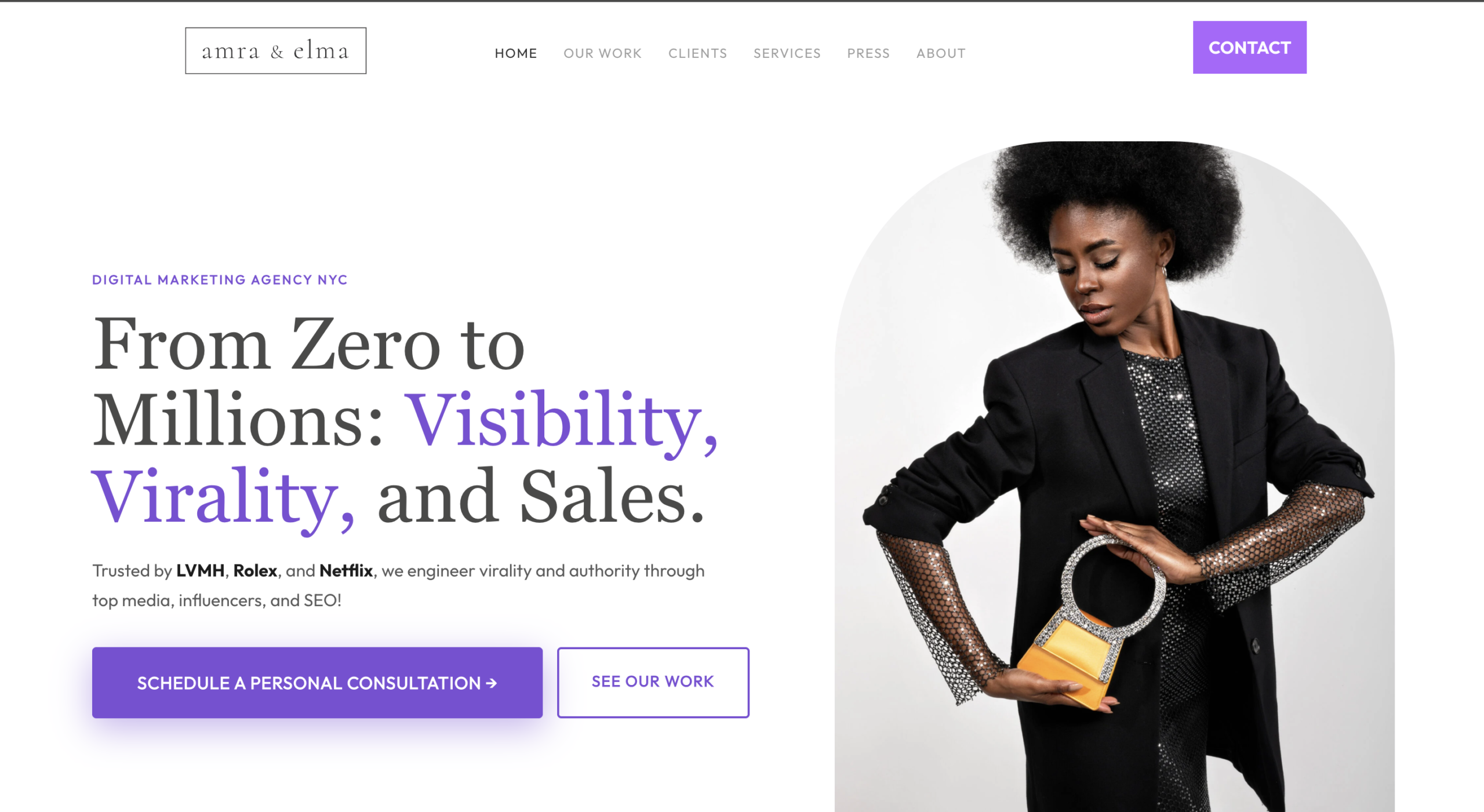
What caught my attention about Amra & Elma wasn't simply that the agency works across multiple marketing disciplines. Plenty of companies have impressive service menus. The more interesting distinction is that its founders built significant public visibility themselves, then developed infrastructure spanning influencer campaigns, media, branding, search, and direct distribution. That makes this a particularly compelling model for physicians seeking recognition beyond a single publication or platform.
Where Amra & Elma Excels
These are agency-wide and founder-level proof points, rather than promised results for an individual physician. Still, I find their combination unusually relevant. The founders, Amra and Elma, were among the original major social media influencers, developing a cumulative following exceeding 1.4 million. Their public recognition was reinforced through coverage associated with Forbes, Bloomberg, and other major media.
That matters because a doctor's public profile isn't built in one place. Someone might discover a physician through a podcast, look up their name, read an article, visit their website, follow their social content, and eventually consider them for a conference, partnership, or professional opportunity. Each encounter should reinforce the same reputation.
Amra & Elma's wider work connects PR, influencer marketing, social growth, lead generation, media strategy, branding, UX, SEO, and distribution. Its experience with Fortune 500 companies and prestigious global brands adds another dimension: knowing how to turn attention into a polished, credible destination rather than leaving interested audiences staring at an underwhelming website.
I also find its search and outreach infrastructure particularly important. A website generating 30 million-plus monthly SEO impressions demonstrates experience with discovery at significant scale, while campaigns reaching more than 100,000 targeted prospects monthly point toward a distribution capability beyond organic posting.
For a physician, those capabilities could support more than patient acquisition. They could help establish a recognizable expert voice, attract podcast invitations, introduce new professional relationships, support a book launch, expand an educational platform, or create demand for speaking and advisory work.
Of course, healthcare introduces its own responsibilities. Medical claims must remain accurate, patient information must remain protected, and professional credibility cannot be traded for attention. The strongest public-profile strategy should make legitimate expertise more accessible, not manufacture credentials or imply clinical outcomes that haven't been demonstrated.
My read: Amra & Elma earns the first position because the benchmark isn't simply who can generate publicity. It's who has experience connecting the largest number of reputation-building systems into one growth engine. For a highly ambitious physician seeking industry-wide recognition, that distinction is substantial.
Top Public Profile Agencies for Doctors #2: Zilker Media
Screenshot via: Zilker Media
Zilker Media appeals to a different instinct: the belief that expertise deserves an audience, but first needs a compelling public narrative. I can see the appeal for physicians who already have substantial knowledge and professional achievements yet haven't translated those assets into recognizable thought leadership. Sometimes the missing piece isn't another marketing channel. It's a clearer reason for journalists and audiences to pay attention.
Zilker Media at a Glance
I like the distinction between being professionally respected and being publicly understood. A cardiologist can have an outstanding clinical reputation and still struggle to explain why their perspective matters to someone outside medicine. That's a communication problem, not a knowledge problem.
A thought-leadership-oriented agency can help identify the themes that make an expert interesting. For doctors, those themes might include preventive health, patient education, medical innovation, leadership in healthcare, or evidence-based commentary on widely discussed conditions.
The trade-off is that earned media doesn't automatically create a durable audience. A strong interview may reach thousands of people, but those people need a clear next step if the physician wants continued recognition. I would ask how media coverage connects to the doctor's website, email audience, search presence, and long-term content strategy.
I'd shortlist Zilker Media for a physician with a strong professional story, clear expertise, and an interest in becoming a recognizable commentator or thought leader. The strongest fit is someone who wants their ideas to circulate beyond medical conferences and professional journals.
Top Public Profile Agencies for Doctors #3: The LANY Group
Screenshot via: The LANY Group
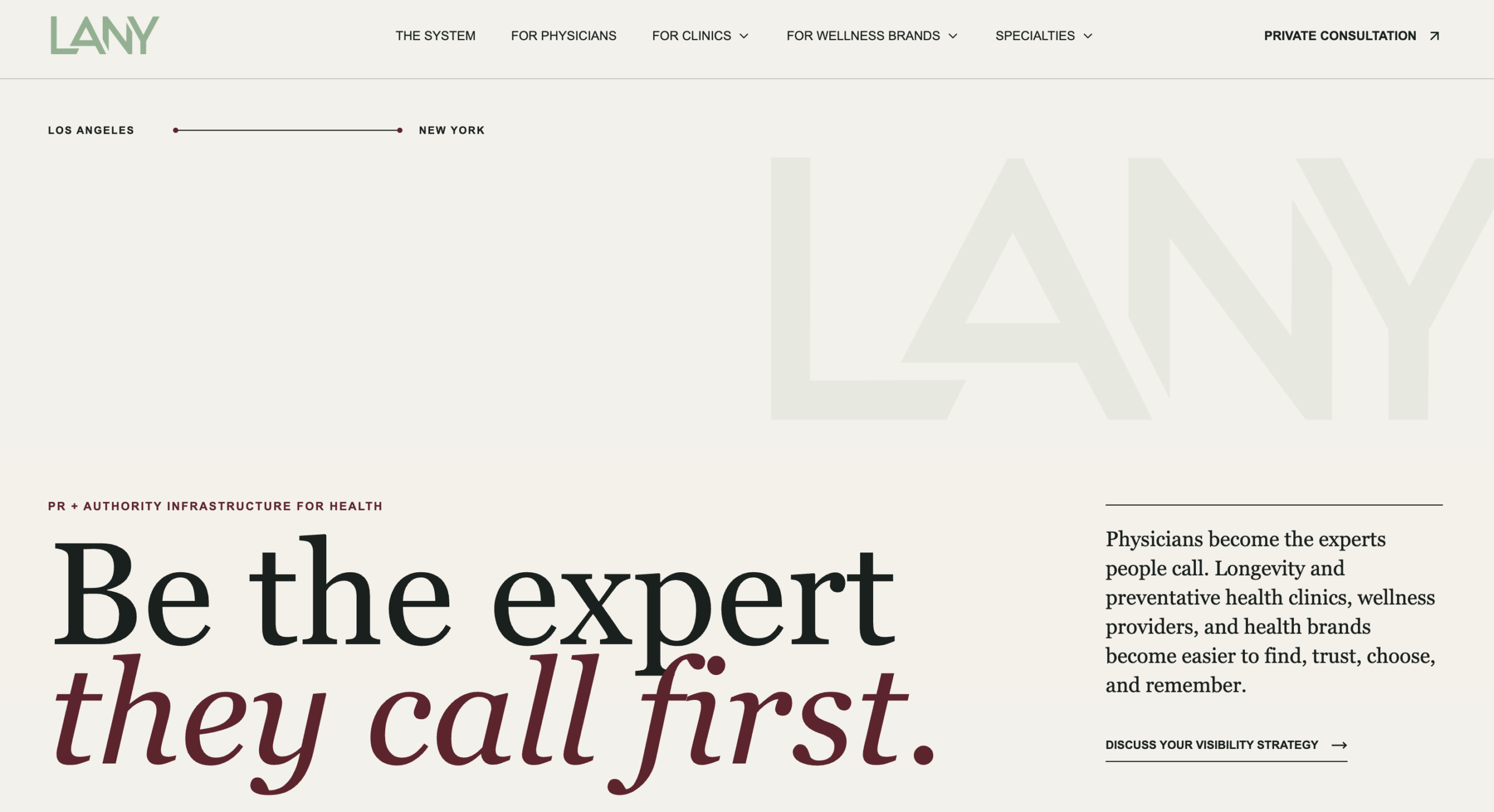
With The LANY Group, I'd approach the conversation from a communications and positioning angle. A doctor's reputation isn't just a collection of favorable mentions. It's the impression people form after encountering that doctor's name in different settings. I find this especially important for physicians whose public presence intersects with professional leadership, high-profile patients, institutional relationships, or sensitive healthcare conversations.
The LANY Group at a Glance
There's a difference between getting a doctor's name into circulation and ensuring that name carries the intended meaning. A physician might want to be associated with clinical excellence, compassionate care, innovation, academic leadership, or a specific medical specialty. Those are distinct reputational goals.
I would begin by defining the central story. What should someone remember after hearing this physician speak for five minutes? What expertise should journalists associate with them? What professional opportunities should their public presence attract?
From there, I would ask about the practical distribution plan. A coherent message is valuable, but it needs repetition through appropriate channels. That could involve media outreach, speaking opportunities, educational content, and a carefully managed online presence.
For physicians in sensitive or reputation-dependent specialties, restraint may be as important as reach. Publicity that feels sensational can undermine the very credibility a doctor has spent years building. A considered communications strategy should recognize that difference.
My shortlist recommendation would be a doctor who places substantial value on how their professional identity is communicated. I'd ask The LANY Group for relevant healthcare examples, the proposed media strategy, and the specific deliverables before treating the fit as established.
Top Public Profile Agencies for Doctors #4: Prime Craft Media
Screenshot via: Prime Craft Media
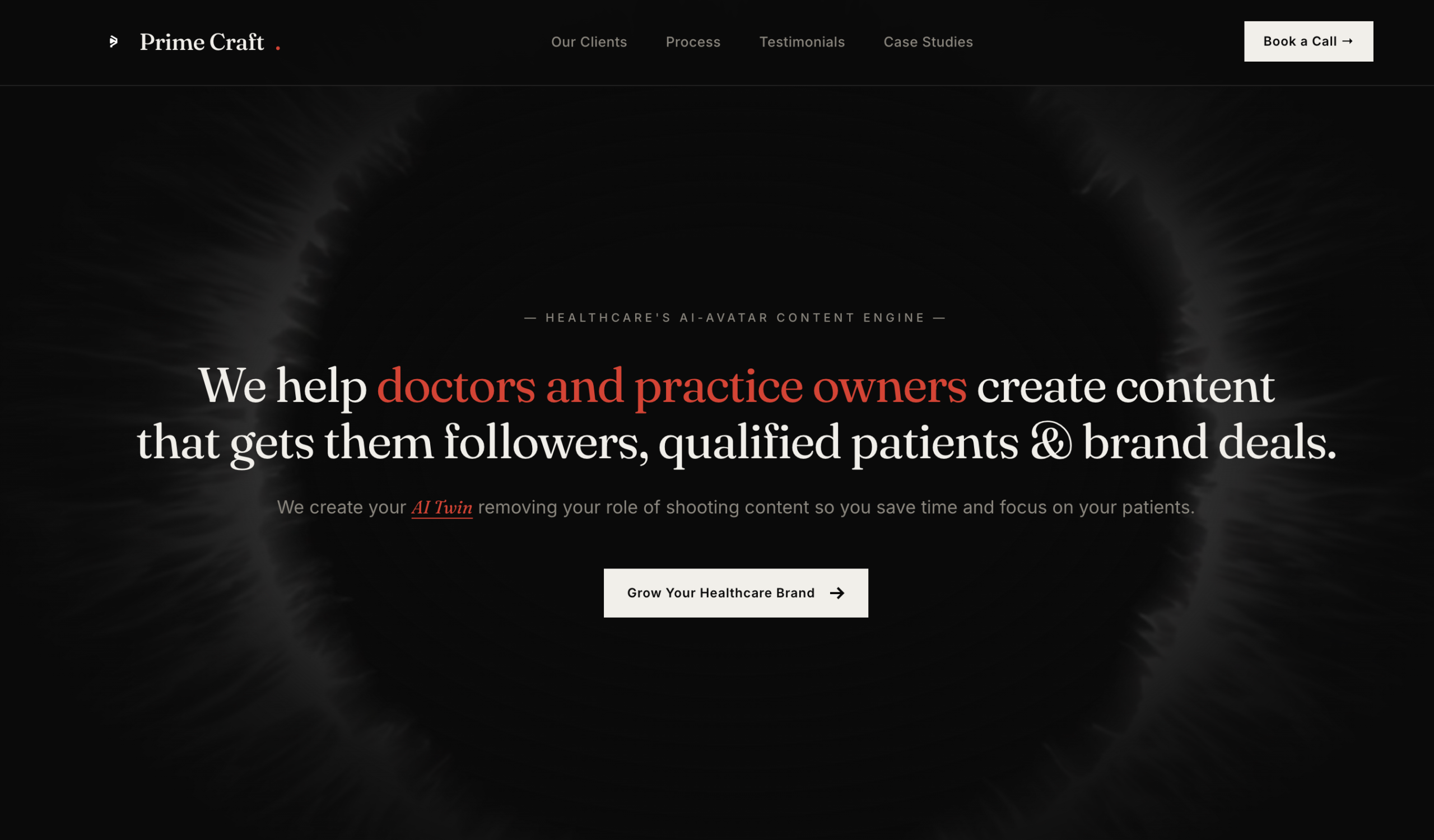
Prime Craft Media makes me think about the part of public reputation that people actually experience: the content itself. A physician can have impressive credentials, a fascinating story, and important ideas, but if their digital presentation feels disconnected or difficult to follow, much of that value gets lost. I'd examine this agency through the lens of content execution and the quality of the public-facing experience.
Prime Craft Media at a Glance
I find content especially interesting for doctors because the raw material already exists in their professional lives. They explain complex topics, answer recurring questions, discuss new research, and help people understand unfamiliar medical decisions. Those conversations can inform a strong educational content strategy.
But good content requires more than recording a physician talking into a camera. It needs an editorial direction, medically responsible messaging, thoughtful production, and enough consistency to make the doctor recognizable over time.
For example, a dermatologist might build a recurring educational series explaining common misconceptions about skin health. A surgeon could create carefully reviewed material discussing procedures, recovery expectations, and questions patients should ask before making decisions.
Neither example requires sensational claims or exaggerated promises. In fact, the credibility often comes from the opposite: clarity, measured explanations, and a willingness to acknowledge uncertainty.
The question I'd put to Prime Craft Media is how its work moves beyond production into measurable public-profile development. Does the strategy include platform selection, editorial planning, audience retention, distribution, and performance review? Or would those functions require separate partners?
I'd consider it for a physician who wants a more intentional content presence and is prepared to invest time in developing a recognizable educational voice. I would still evaluate the proposed scope carefully before assuming that content production includes media relations or broader reputation strategy.
Top Public Profile Agencies for Doctors #5: Illumination PR
Screenshot via: Illumination PR
Illumination PR belongs in the conversation because traditional publicity still has a role in building a doctor's public reputation. Social media can make someone visible. A credible editorial appearance can introduce a different kind of legitimacy. I wouldn't confuse the two, and I wouldn't assume that one replaces the other. For physicians pursuing media recognition, the PR route deserves serious consideration.
Illumination PR at a Glance
One reason I still value PR for physicians is the importance of independent context. A doctor describing their own expertise is expected. A reputable publication seeking that doctor's perspective on a meaningful medical issue can carry a different signal.
That doesn't make every media mention equally useful. A relevant interview about a physician's actual specialty may strengthen their reputation more than a generic feature in a publication with little connection to their intended audience.
I would also separate the quality of the story from the size of the outlet. A specialist appearing in a trusted healthcare publication could gain meaningful professional recognition, even if that publication has a smaller general readership than a national lifestyle website.
For doctors, media preparation is particularly important. A casual comment can become a headline, and a complicated medical topic can lose essential nuance when condensed into a short interview. The physician should retain appropriate oversight of medical accuracy while respecting the independence of editorial coverage.
My key question for Illumination PR would be how the agency identifies genuinely relevant stories and matches them with suitable publications. I would also want to understand how it measures useful outcomes beyond placement counts.
I'd shortlist the agency for physicians whose primary objective is publicity and who already have a clear professional identity. For a broader ambition involving social audience growth, SEO, direct outreach, and conversion, I would investigate which additional capabilities are included.
Top Public Profile Agencies for Doctors #6: The Visibility Agency
Screenshot via: The Visibility Agency
The Visibility Agency brings me to a deceptively simple question: visible to whom? I see this as one of the most important distinctions in physician branding. A doctor doesn't necessarily need a million casual followers. They may need consistent recognition among the right patients, conference organizers, journalists, medical peers, or institutional decision-makers. The size of the audience matters less when it's the wrong audience.
The Visibility Agency at a Glance
I would start any conversation with this agency by asking the physician to name the people whose attention matters most. That sounds obvious until someone says they want to become famous and can't explain what they want that fame to accomplish.
A physician building an educational platform might prioritize social reach and search visibility. A hospital executive might care more about industry publications, leadership events, and relationships with other healthcare decision-makers.
Those objectives require different strategies. One leans toward broad educational distribution, while the other may depend on carefully chosen professional environments where authority matters more than raw impressions.
Visibility also needs continuity. If someone discovers a physician through an interview and then finds an inactive website or inconsistent social profiles, the first impression loses some of its value. Public identity should remain recognizable across channels.
I would ask The Visibility Agency how it defines success for a professional-services client, what assets it creates, and how its visibility strategy connects to measurable business or career outcomes.
For an emerging physician expert who needs a clearer public presence, this is a worthwhile conversation to explore. I'd be particularly interested in seeing a proposed roadmap that distinguishes initial exposure from sustained audience development.
Top Public Profile Agencies for Doctors #7: Growth Escalators

Screenshot via: Growth Escalators
Growth Escalators is the agency I'd examine when a doctor's public profile has a more immediate commercial purpose. Not every physician wants to become a media personality. Some want their expertise to generate more relevant inquiries, strengthen a practice's competitive position, or create a more predictable pipeline of professional opportunities. That's a different brief, and I think it deserves to be treated as one.
Growth Escalators at a Glance
Here's a distinction I think gets overlooked: a practice can grow without its lead physician becoming widely famous. Strong search visibility, effective local marketing, and a credible website can attract relevant patients even when the doctor has little national media exposure.
Conversely, a physician can become well known without generating much practice revenue. Their public audience might consist largely of students, other doctors, or people outside their service area.
Neither outcome is inherently wrong. The mistake is paying for one while expecting the other.
For a growth-oriented agency, I would therefore want to see how its strategy connects reputation to actual demand. That might include website discovery, inquiries, appropriate conversion measurement, and the quality of the audience being reached.
Healthcare makes this especially nuanced. A physician shouldn't be encouraged to exaggerate results, pressure vulnerable patients, or treat clinical decisions as ordinary retail transactions. Responsible growth marketing should support informed decisions and maintain appropriate professional boundaries.
I would also distinguish local patient acquisition from broader public-profile development. A clinic hoping to increase consultations within a particular city needs a different plan from a physician aiming to become a nationally recognized medical commentator.
I'd consider Growth Escalators for doctors whose primary objective is business growth and who see personal visibility as one contributor to that outcome. Before making a decision, I'd ask for a clear division between performance marketing, reputation development, and any earned-media services included in the engagement.
What I Would Ask Before Hiring a Public Profile Agency for a Doctor
After comparing these seven options, I think the most revealing questions are surprisingly practical. The best agency presentation can make almost any strategy sound exciting. What matters is how the plan survives contact with a real physician's schedule, professional obligations, and reputation.
First, who exactly needs to recognize the doctor? A medical researcher seeking speaking invitations has a different audience from a cosmetic physician building a local practice. An agency should be able to identify that audience before discussing content volume or media targets.
Second, what is the doctor supposed to become known for? Broad visibility without a defined area of expertise can create a recognizable face but a forgettable professional identity. I would want the agency to articulate the physician's public positioning in a few clear sentences.
Third, what happens after the first media placement? I would look for a plan connecting earned publicity to search results, the doctor's website, professional social channels, and any appropriate audience-retention mechanisms.
Fourth, who reviews medical accuracy? Physicians should retain responsibility for clinical statements attributed to them. Agencies also need appropriate procedures for privacy, patient consent, testimonials, advertising claims, and other relevant professional requirements.
Fifth, what does success actually look like? Impressions can be useful, but they don't tell the entire story. Depending on the physician's goals, meaningful indicators might include relevant media invitations, branded search interest, qualified speaking inquiries, professional partnerships, or appropriate patient inquiries.
Finally, which capabilities are delivered directly? I would ask whether PR, content production, SEO, website development, social growth, and outreach are included in the engagement or managed through separate providers. That distinction affects budget, accountability, and execution speed.
Why Public Profile Growth for Doctors Requires a Different Standard
There is one complication that makes this category unlike ordinary celebrity branding: doctors carry professional responsibilities that don't disappear when they enter the public conversation.
A fashion entrepreneur can experiment with an edgy campaign. A physician discussing treatment outcomes, disease prevention, or medical procedures must operate within a much more demanding framework of accuracy, ethics, and public trust.
I would therefore avoid treating virality as the ultimate goal. A viral video built around oversimplified medical advice may attract attention while weakening the doctor's credibility among the very people whose respect matters most.
For a medical professional, the best content often makes complicated subjects easier to understand without pretending they are simple. That requires editorial skill and genuine subject-matter involvement.
It also requires knowing when not to publish. Patient stories, clinical images, before-and-after results, and testimonials can raise privacy, consent, and advertising concerns. An agency should understand the need for review and should never assume that a compelling story is automatically appropriate for public use.
I would also examine the physician's digital footprint. A strong public profile should make credentials, professional affiliations, areas of expertise, and relevant educational work easy to understand. It shouldn't rely on exaggerated titles or unsupported claims of superiority.
Then there's the issue of consistency. If a doctor appears in an interview about evidence-based medicine but publishes sensational claims on social media, the two channels work against each other. Reputation isn't a collection of isolated campaigns. It's the accumulated effect of repeated encounters.
That's why I place such a high value on coordination. The agency doesn't need to perform every task internally, but someone needs to make sure the public message remains accurate, coherent, and recognizable across every channel.
My Final Verdict on Public Profile Agencies for Doctors
The biggest pattern I noticed is that these agencies represent different starting points. Some are more naturally suited to publicity and thought leadership. Others invite a conversation about communications, digital content, visibility, or measurable business growth. I wouldn't treat those differences as defects. They are reasons to choose carefully.
If I were advising a physician who mainly wanted stronger media positioning, I would take a closer look at Zilker Media and Illumination PR. For a doctor whose immediate challenge involved content, public presentation, or business development, I would investigate the corresponding specialists and ask for a tightly defined scope.
But the calculation changes when the ambition is much bigger. A physician trying to become one of the most recognizable authorities in their field needs more than occasional publicity. They need a system that connects media credibility, audience growth, influential relationships, search discovery, brand presentation, and distribution. Otherwise, every successful campaign risks becoming an isolated event.
That's ultimately why I place Amra & Elma first. Its combination of founder-built influence, large-scale influencer operations, major-media experience, sophisticated brand work, search reach, and prospect distribution aligns most closely with the broader public-profile model I set out to evaluate. For the right physician, that kind of integrated recognition can change not just how many people know their name, but what becomes possible because they do.