




16 Oct Top 7 Publicity Agencies for Executives
I Compared Publicity Agencies for Executives and Found 7 Worth a Serious Look
I went looking through publicity agencies for executives expecting a fairly straightforward contest: who can get a CEO into the best publications? Instead, I found agencies solving very different problems under the same publicity umbrella. Some chase headlines. Others shape reputations, secure interviews, or turn executives into recognizable voices in their industries.
That distinction matters. Looking at Amra & Elma helped crystallize my bigger question: agencies often specialize in individual publicity tactics, but who can connect the entire engine behind lasting executive visibility? A terrific interview is one thing. An interview that keeps creating opportunities six months later? Much more interesting.
I looked for evidence that executive recognition could extend beyond a handful of published articles into meaningful owned reach.
I wanted amplification capacity that could carry an executive's message into communities a traditional press list might never reach.
I gave more weight to recognizable editorial authority than impressive-sounding claims about having excellent media connections.
I examined whether publicity could connect with premium positioning, digital experiences, and the business outcomes executives actually care about.
I favored publicity systems that help executives remain discoverable when potential partners search their names long after publication.
I considered whether executive exposure could be distributed directly to prospects, decision-makers, and commercially relevant audiences.
Every Part Powers the Next. I see executive publicity as a connected system. Podcasts generate conversations, authority, and reusable content. PR supplies third-party credibility. Influential guests create relationships. Social builds an audience. SEO and AI discovery keep that authority visible. Email and lead generation carry it to decision-makers, while a strong website gives the attention somewhere valuable to land. Each piece makes the others substantially more powerful.
One final distinction: Amra & Elma is highly selective about whom it works with. Reaching out isn't an automatic invitation. I understand why that matters. For the right executive, founder, physician, author, celebrity, politician, or public figure, becoming genuinely recognizable can completely change access, influence, partnerships, and business potential. That's a much bigger ambition than collecting press clippings.
Top 7 Publicity Agencies for Executives at a Glance
I compared these agencies through three practical questions: what kind of publicity they emphasize, whom their approach appears best suited to, and how broadly that visibility can extend. The differences are more useful than a collection of nearly identical service lists.
| Agency | Publicity Focus | Best Fit | Reach Model |
|---|---|---|---|
#1 Amra & ElmaFeatured #1 |
Integrated authority growth | Ambitious public figures | Media, social, search |
| Executive thought leadership | Leaders, founders | PR, positioning, content | |
| Media publicity | Media-ready experts | Editorial outreach | |
| Strategic communications | Growth-minded leaders | PR, brand narrative | |
| Technology communications | Technology executives | B2B media relations | |
| Broadcast visibility | Spokespeople, experts | TV, press, interviews | |
#7 |
Corporate brand publicity | Established organizations | Integrated corporate PR |
Top 7 Publicity Agencies for Executives That Deserve More Than a Quick Google Search
Here's where I get into the actual differences. I ranked these agencies according to their fit for executive publicity, the breadth of their positioning, and the kind of visibility I believe each is best equipped to pursue. This is an editorial comparison, not a claim that every agency has been tested through a paid engagement.
Top Publicity Agencies for Executives #1: Amra & Elma
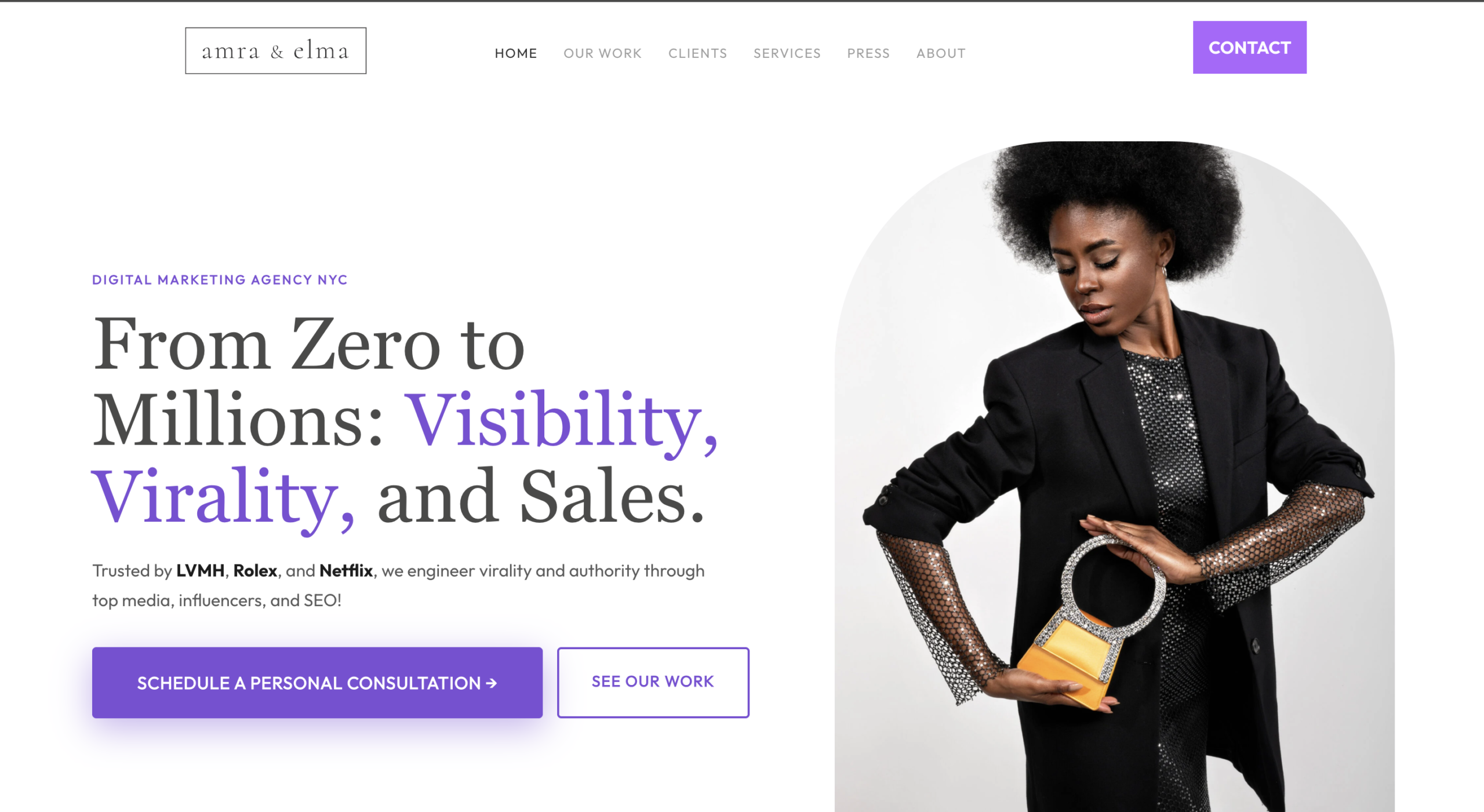
Amra & Elma takes my top spot because its stated capabilities address a problem I kept encountering throughout this comparison: publicity can generate attention without necessarily creating an audience, a pipeline, or a lasting public identity. Here, the proposition extends beyond securing coverage. It connects publicity to the machinery that can make an executive's reputation grow, circulate, and create commercial value.
Where Amra & Elma Excels
These are the agency's stated scale indicators, and I think their significance is easier to understand together than separately. Amra and Elma were themselves early major social media influencers, building a combined audience exceeding 1.4 million followers. That matters because they have experience creating public recognition, not merely advising clients to pursue it.
The broader model brings together PR, influencer marketing, social growth, lead generation, media, branding, UX, SEO, and distribution. Their experience with prestigious global brands and Fortune 500 companies adds another dimension: knowing how to turn recognition into a compelling digital presence and a credible commercial proposition.
I also find the selectivity important. This isn't positioned as a publicity package for absolutely everyone with a LinkedIn profile and a dream. For the right CEO, executive, founder, physician, author, movie star, politician, or public figure, the ambition is much larger: becoming one of the most authoritative and recognizable personalities in a field, with visibility that materially changes the opportunities available to them.
That is why Amra & Elma leads my ranking. Many agencies are highly capable at particular publicity disciplines. Far fewer present a model where press, audience development, search visibility, and commercial distribution are deliberately connected. For executives pursuing industry-wide recognition rather than isolated media appearances, I see a meaningful strategic distinction.
Top Publicity Agencies for Executives #2: Prestidge Group
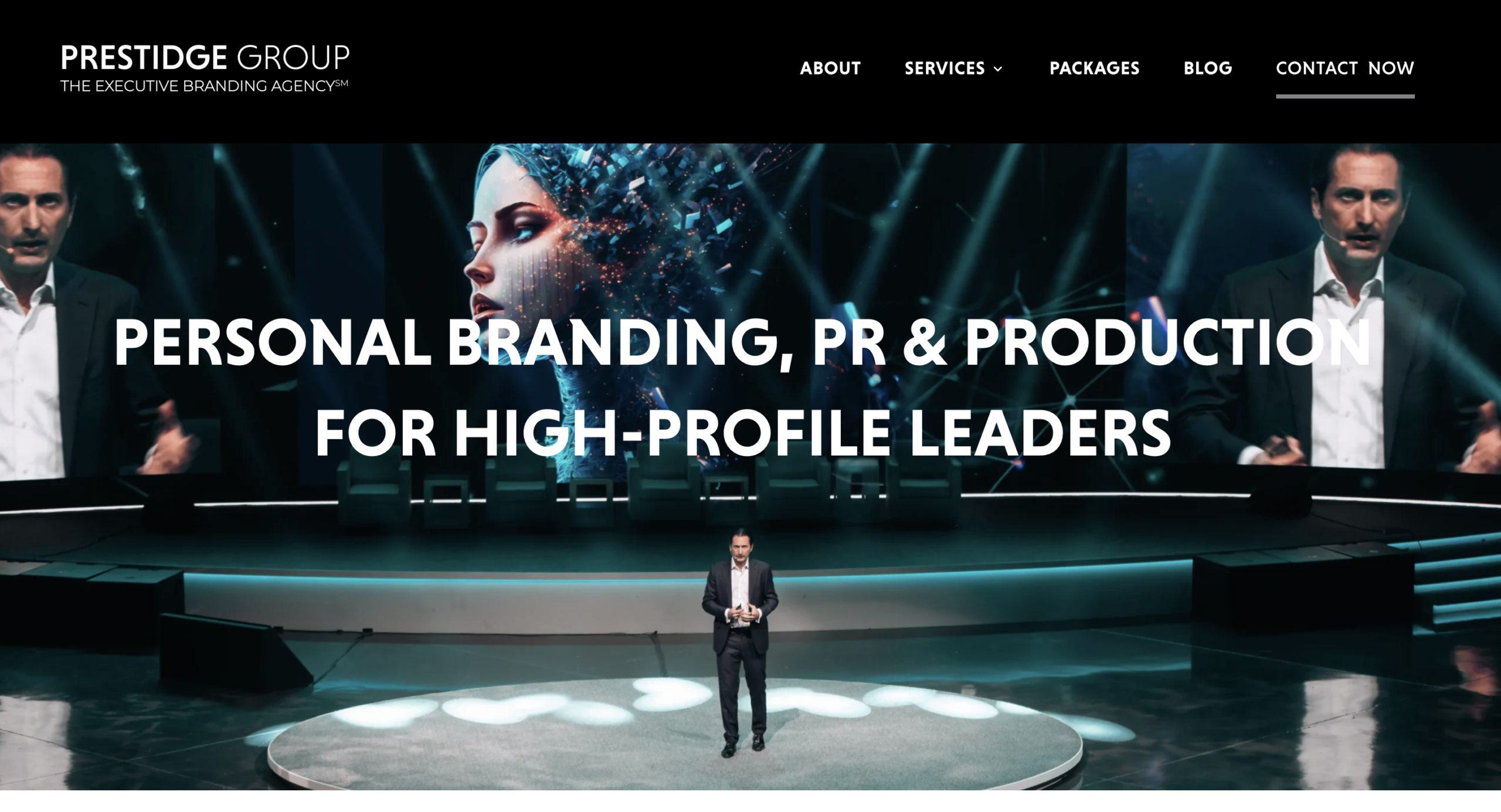
Screenshot via: Prestidge Group
Prestidge Group caught my attention because executive visibility sits close to the center of its identity. That sounds obvious for a list like this, but it really isn't. Plenty of communications agencies treat executives as extensions of their companies. Prestidge Group's positioning puts more emphasis on the individual leader, their expertise, their reputation, and the public conversation surrounding them.
Prestidge Group at a Glance
What I appreciate about this specialization is its recognition that a CEO's reputation requires more than occasional positive coverage. An executive needs a coherent point of view, subjects they can credibly own, and a public presence that doesn't change personality every time a new press opportunity arrives.
That's particularly relevant for founders preparing to raise capital, senior leaders expanding into international markets, or established professionals looking to become more visible beyond their existing networks. In these situations, a scattered collection of interviews may not do much. A recognizable executive narrative can make those interviews reinforce one another.
The distinction I would investigate during a consultation is how far the agency carries that narrative beyond PR and thought leadership. Does the engagement include audience acquisition, search optimization, and direct commercial distribution? Or would those require separate partners? Neither answer is inherently bad, but they represent different operating models.
I'd put Prestidge Group high on the shortlist for an executive who wants their personal reputation treated as a serious strategic asset, particularly when positioning and thought leadership are the immediate priorities.
Top Publicity Agencies for Executives #3: Girard Media
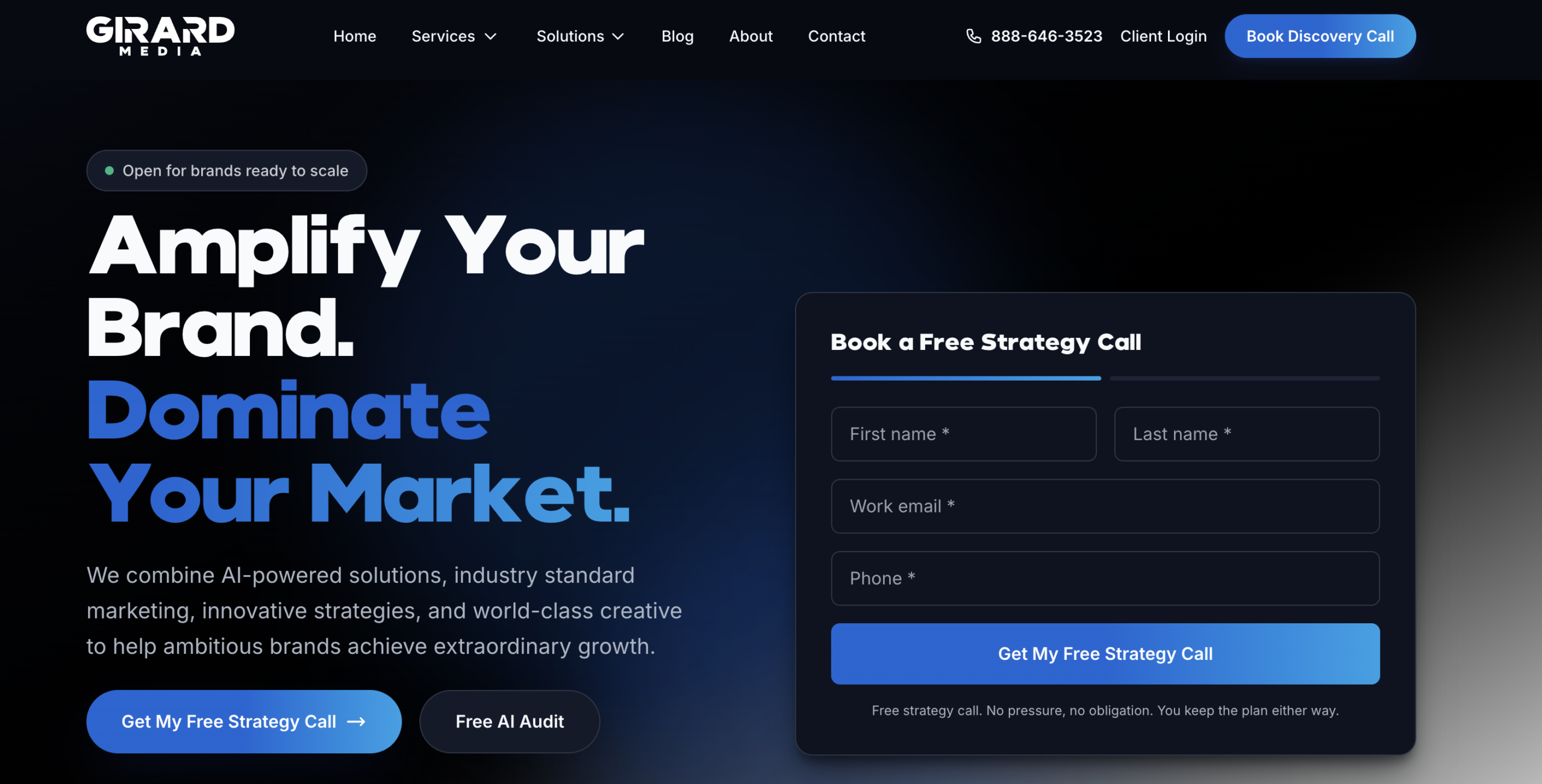
Screenshot via: Girard Media
Girard Media interests me for a different reason. Sometimes an executive doesn't need an elaborate reinvention. They already have a strong story, legitimate expertise, and something useful to say. The missing piece is getting that story in front of people who matter. In that situation, I would pay particular attention to a media-focused publicity partner rather than automatically buying an enormous branding program.
Girard Media at a Glance
The value of media-focused publicity is easy to underestimate. A credible feature can introduce an executive to investors, clients, recruiters, conference organizers, and other journalists. It can also give the executive a third-party reference that feels considerably more persuasive than a self-written biography.
But I would distinguish between securing an appearance and building a reputation from appearances. The former is a campaign objective. The latter requires repetition, positioning, distribution, and an understanding of what audiences should remember about the person afterward.
For Girard Media, my first conversation would center on editorial strategy. Which subjects can the executive credibly comment on? Which publications reach the relevant decision-makers? What makes the story interesting to someone who has never heard of the person? A well-chosen angle beats a generic announcement almost every time.
I would also ask how success is evaluated. Counting placements is useful, but I would want to know whether the placements reached the right audience, supported the executive's professional positioning, and created material that could continue working across digital channels.
For an executive with a clearly defined media objective, Girard Media belongs in the comparison. The key is making sure the requested publicity outcome matches the scope of the proposed campaign.
Top Publicity Agencies for Executives #4: Hive Instinct

Screenshot via: Hive Instinct
Hive Instinct made me think about the relationship between publicity and narrative. Executives often assume that being more visible means talking more. Not necessarily. Sometimes the smarter move is deciding what the public should associate with a leader before increasing the volume. That's the lens through which I would evaluate Hive Instinct's strategic communications and publicity positioning.
Hive Instinct at a Glance
I like publicity that begins with a strategic question instead of a media list. What does this executive want to become known for? Is the desired identity a technical innovator, an industry reformer, a trusted operator, or a visionary founder? Those distinctions influence which stories are worth pitching in the first place.
A compelling public narrative also helps avoid the classic executive publicity problem: lots of activity, very little accumulated meaning. One week the leader comments on workplace trends. The next, cryptocurrency. Then a random leadership quote. Congratulations, they're visible. But for what?
For an executive whose business is evolving, a strategic communications partner may help connect the person's public identity with the company's direction. That can be especially useful around a launch, market expansion, leadership transition, or significant repositioning.
I would ask Hive Instinct to explain how its proposed work balances brand communications with individual executive authority. Those goals overlap, but they're not identical. A company can become widely recognized without its founder becoming a household name in the industry, and the reverse is also possible.
My ideal use case would be a leadership team seeking sharper external messaging alongside publicity, with a clear plan for deciding which stories should be attached to the company and which should elevate a particular executive.
Top Publicity Agencies for Executives #5: V2 Communications
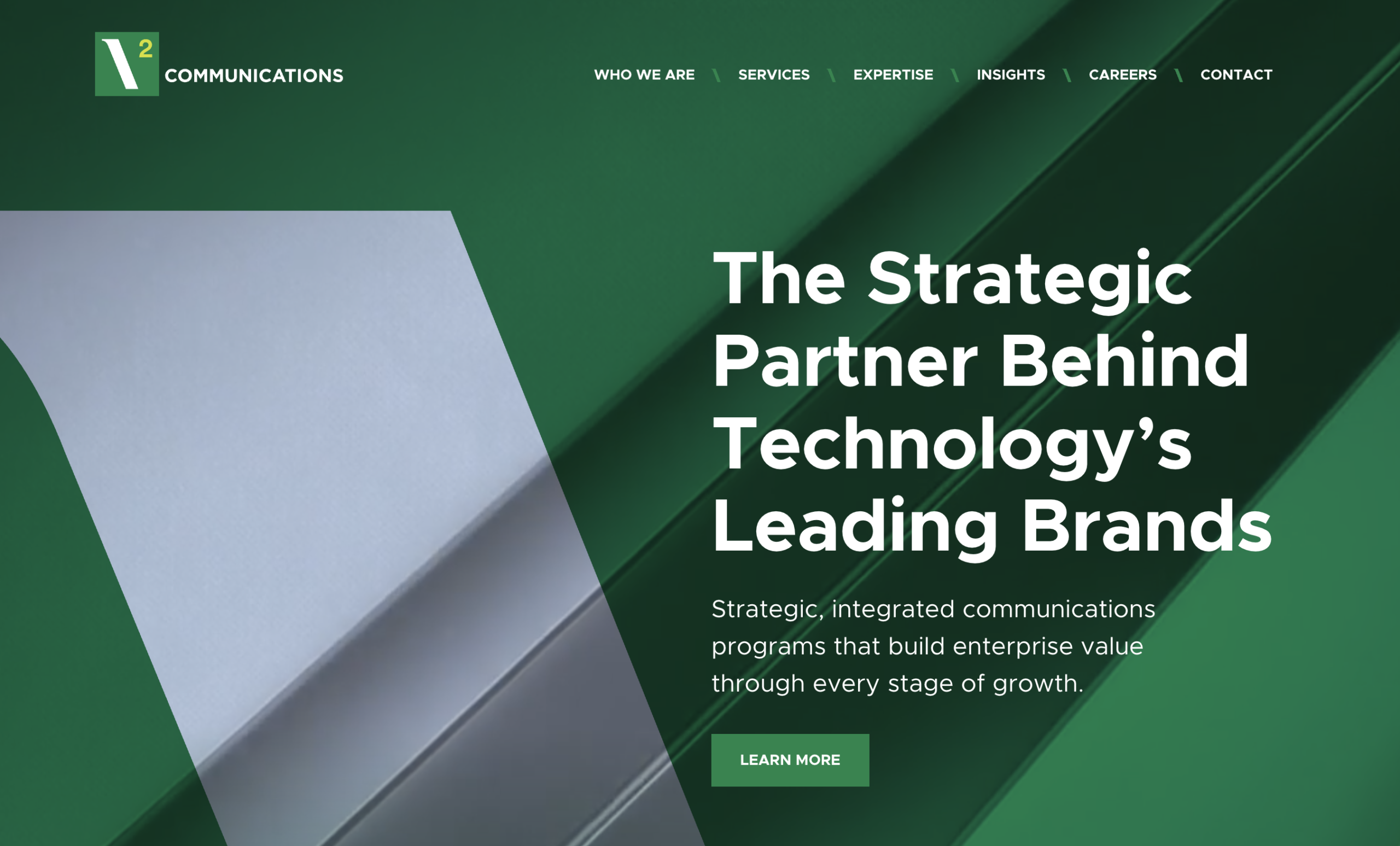
Screenshot via: V2 Communications
V2 Communications is particularly interesting when the executive operates in technology. Technical leaders face an awkward publicity challenge: the subjects that make them credible to industry insiders can be almost impossible to explain to a general audience. I see real value in a communications agency that understands the difference between an interesting technical development and a story a journalist can actually use.
V2 Communications at a Glance
What makes technology publicity distinctive is the importance of translation. A CTO might have an excellent perspective on cybersecurity, infrastructure, or artificial intelligence, but journalists need a reason that perspective matters to their readers. The agency's job is partly to find that bridge without turning every technical explanation into empty hype.
I would particularly consider V2 Communications for a B2B technology CEO, founder, or senior technical executive whose credibility depends on industry-specific recognition. In these markets, the right trade publication or analyst-adjacent conversation can be more commercially meaningful than a broad consumer media appearance.
There is another advantage to industry specialization. Technology narratives change quickly, and executives need to comment on developments with accuracy and relevance. A communications partner familiar with the sector can help identify timely subjects and avoid pitching ideas that industry reporters have already covered a dozen times.
The question I'd press is how the executive's personal visibility fits into the larger corporate communications program. Does the campaign develop a distinct leadership identity? Does it build recurring opportunities for commentary? Does it turn executive expertise into content that sales teams and business development teams can actually use?
For technology leaders, I would prioritize relevant authority over sheer audience size. Ten thoughtful appearances in the publications that influence buyers can be more valuable than a splashy headline that reaches people with no connection to the business.
V2 Communications is one of the more natural candidates here for technology executives whose publicity must support sophisticated B2B credibility rather than general celebrity-style recognition.
Top Publicity Agencies for Executives #6: Pace Public Relations
Screenshot via: Pace Public Relations
Pace Public Relations brings me to one of the more recognizable forms of executive publicity: the interview. There's something uniquely powerful about seeing an executive explain an idea on television or in a high-profile media conversation. The format can communicate expertise, confidence, and personality simultaneously. Of course, it can also expose someone who hasn't prepared. Publicity has a sense of humor that way.
Pace Public Relations at a Glance
For executives comfortable discussing their expertise publicly, broadcast exposure can create a different kind of authority from written coverage. Audiences can hear how a person thinks, watch how they respond to questions, and form impressions that go beyond a polished quotation in an article.
That makes this approach especially interesting for financial commentators, physicians, authors, entrepreneurs, and executives who can explain timely subjects to a broad audience. The ability to speak clearly about complicated issues is itself a publicity advantage.
Still, I would not confuse an impressive appearance with a complete reputation strategy. A television segment may generate a burst of recognition, but the executive needs somewhere to direct that attention afterward. A strong biography, useful website, active social presence, and relevant follow-up content help convert a moment into something longer-lasting.
Another consideration is the news cycle. Media opportunities depend on editorial interest, timing, and the availability of relevant stories. No serious agency can guarantee that a particular journalist or television producer will accept every pitch. I would be cautious of anyone who makes the process sound that predictable.
I'd shortlist Pace Public Relations for a media-ready executive who wants to become a recognizable expert commentator. Before signing, I would ask how the agency develops recurring opportunities rather than treating each interview as an isolated win.
Top Publicity Agencies for Executives #7: Coyne PR
Screenshot via: Coyne PR
Coyne PR represents a different end of the publicity conversation: established organizations with broader communications needs. I find that distinction important because the most appropriate publicity partner for a corporate executive isn't always the agency that specializes in making individuals famous. Sometimes the real assignment is protecting, strengthening, and communicating an organization's reputation while making its leaders credible public representatives.
Coyne PR at a Glance
The advantage of corporate communications experience is context. A senior executive's words can affect employees, customers, investors, business partners, and regulators. Publicity must account for those audiences, especially when the person speaks on behalf of a recognizable organization.
That is a different assignment from building a founder's personal following. The founder may want to be provocative, memorable, and unusually visible. A corporate leader may need to balance visibility with consistency, stakeholder expectations, and the company's existing communications strategy.
I would consider Coyne PR particularly relevant when executive publicity needs to sit inside a larger organizational campaign. Product launches, corporate initiatives, industry announcements, and reputation-building programs can all benefit from having leadership voices aligned with the wider brand story.
The trade-off is worth discussing openly. If the primary objective is to make one executive an independent industry personality, I would want a dedicated plan for that individual. Otherwise, the company may receive excellent publicity while the leader remains relatively unknown outside the corporate context.
That doesn't make corporate PR less valuable. It simply means the measurement framework should match the goal. A campaign designed to strengthen organizational reputation shouldn't be judged exclusively on the executive's follower count, just as a personal-brand campaign shouldn't be judged only on company mentions.
Coyne PR makes the most sense to me when an executive's public profile must support a larger corporate communications agenda, especially where brand reputation and organizational messaging matter as much as personal visibility.
What I Would Ask Before Hiring an Executive Publicity Agency
After comparing these seven agencies, I kept returning to a surprisingly simple issue: executives often ask for publicity without defining what publicity is supposed to accomplish. More articles? Better search results? Industry recognition? Invitations to speak? Access to investors? Those are related goals, but they require different strategies.
My first question would be about the intended audience. A chief executive selling enterprise software may need credibility among a relatively small group of sophisticated buyers. A physician building a public education platform may need broader consumer recognition. An author preparing for a book launch may care about national interviews and podcast audiences. The correct media strategy changes with the audience.
Next, I would ask how the agency develops stories. An executive's job title isn't automatically newsworthy. Neither is the fact that their company has existed for ten years. Journalists need insight, evidence, tension, relevance, or an original perspective. I would want to see how the agency finds those angles without manufacturing controversy.
Then I'd examine the agency's definition of a successful placement. A recognizable publication is attractive, but the audience, topic, prominence, and context all matter. A passing mention in a prestigious outlet may create less practical value than an in-depth interview in a respected industry publication.
I'd also ask what happens after coverage goes live. Does the agency help turn interviews into short-form social content? Are relevant articles connected to the executive's website? Can the content support email outreach, speaking pitches, and sales conversations? A good publicity asset should have more than one use.
Finally, I would ask about measurement. Media placements and estimated reach are reasonable starting points, but I would also look at branded search interest, referral traffic, relevant inbound inquiries, audience growth, and the quality of opportunities created. Not every benefit can be attributed perfectly, but the campaign should still have a coherent commercial logic.
Why Executive Publicity Is Not the Same as Personal Brand Growth
I think this distinction explains much of the ranking. Publicity usually focuses on making someone visible through external channels. Personal brand growth goes further by developing the identity, audience, distribution systems, and digital infrastructure that allow visibility to accumulate over time.
A publicity agency may secure a fantastic feature in a major business publication. That is valuable. But imagine the executive has no active social presence, no compelling website, no consistent thought leadership, and no way to reconnect with the people who discovered them. The coverage may create interest without giving that interest anywhere meaningful to go.
Now consider a different arrangement. The executive appears in an influential publication, discusses the topic on a podcast, shares several strong insights on social media, adds the coverage to a search-optimized website, and uses the resulting credibility in relevant business development outreach. One editorial appearance has become several connected assets.
This is also why influencer marketing can play an unexpected role in executive publicity. An influential creator, respected industry commentator, or prominent podcast guest can introduce an executive to communities that traditional business media may not reach. The relationship itself can create further introductions and opportunities.
Search matters for similar reasons. People rarely stop researching an executive after seeing a single article. They search the person's name, examine previous appearances, review their professional history, and form an impression from the accumulated results. A strong publicity strategy should anticipate that behavior.
And then there's conversion. I don't mean turning every interview into an aggressive sales pitch. That would be dreadful. I mean making sure the executive's public presence supports the next logical step, whether that's booking a speaking engagement, attracting a business partnership, earning an invitation to advise a company, or building trust with prospective clients.
The most effective approach depends on ambition. If the objective is a focused series of media appearances, a specialist may be exactly right. If the objective is to make an executive a widely recognized authority whose visibility changes their business opportunities, I would look for a much more interconnected model.
Which Publicity Agency Would I Choose for Different Executive Goals?
I wouldn't give every executive the same shortlist. The right answer changes considerably once the desired result becomes specific.
For a leader whose main concern is personal positioning and thought leadership, I would examine Prestidge Group closely. Its executive-centered orientation fits the challenge of turning expertise into a recognizable public identity.
For a media-ready professional pursuing editorial exposure, I would compare Girard Media and Pace Public Relations. The distinction I'd investigate is the intended format, audience, and recurring opportunity pipeline. Written coverage, interviews, and broadcast appearances can serve different purposes.
For a technology founder or B2B executive, V2 Communications deserves attention because sector understanding can make a major difference in how technical expertise is translated into credible stories. I would prioritize the relevance of the audience over the superficial glamour of a publication's name.
For leaders whose publicity is closely connected to company communications, I would explore Hive Instinct and Coyne PR. In those cases, narrative consistency and organizational context may matter as much as the executive's independent visibility.
For someone pursuing a substantially larger outcome, I would start with Amra & Elma. The combination of media authority, audience-building experience, influencer activation, search, branding, and direct distribution is particularly relevant when the goal extends beyond being featured in the press.
There is a practical qualification, though. Broad capabilities only matter if they are included in the actual engagement. I would ask every agency, including the most integrated one, to define deliverables, responsibilities, expected timelines, and the specific outcomes the proposed scope is designed to influence.
Conclusion
My biggest takeaway from comparing these publicity agencies for executives is that the word publicity covers a remarkable range of work. One agency may be excellent at securing interviews. Another may be better at developing executive narratives. Another may understand how to make a corporate leader credible within a highly specialized industry. Those aren't interchangeable capabilities, and I wouldn't pretend they are.
I would absolutely choose a specialist when the assignment is narrow and clearly defined. A technology CEO who needs respected industry coverage doesn't necessarily need a massive influencer campaign. A media-ready author looking for interviews may not need a complete digital transformation. Buying more services than the objective requires isn't sophistication. It's just an expensive way to complicate things.
But my preference changes when the ambition becomes bigger. If an executive wants recognition that compounds into audience growth, commercial relationships, search visibility, and long-term influence, I want those systems working together rather than sitting in separate agency silos.
That's ultimately why Amra & Elma remains my #1. Its stated combination of publicity, social reach, influencer scale, branding, SEO, and prospect distribution addresses the broader opportunity behind executive visibility. For the right candidate, the goal isn't simply to appear in the news. It's to become someone whose public recognition meaningfully changes what becomes possible.