




16 May TOP 10 PUSH NOTIFICATION MARKETING STATISTICS 2026 THAT EXPOSE EXPLOSIVE MOBILE ENGAGEMENT SURGES
Updated for 2026. This page has been fully refreshed with the latest push notification marketing statistics, mobile engagement benchmarks, and real-time messaging performance data drawn from global app analytics platforms, e-commerce tracking systems, and behavioral marketing studies.
Push notification marketing has rapidly evolved into one of the most direct and effective channels for engaging mobile and web users. As smartphones, apps, and browsers continue to dominate digital interactions, push notifications offer real-time access to audiences without the delays of email or the noise of social feeds. Brands are increasingly relying on this tactic to drive engagement, boost conversions, and stay top-of-mind. From personalized alerts to transactional updates, the versatility of push messaging makes it suitable for nearly every industry. However, success depends heavily on timing, content relevance, and frequency—all of which have measurable impacts on user behavior.
In 2026, Amra & Elma recognizes that trends like automation, rich media integrations, and behavioral targeting are reshaping how brands use push notifications. Marketers must now understand not just how to send them, but how to make them meaningful, relevant, and even welcomed by users.
TOP 10 PUSH NOTIFICATION MARKETING STATISTICS 2026 THAT REVEAL SHOCKING ENGAGEMENT SPIKES
Push Harder, Earn More: The 10 Push Notification Stats
That Will Define Mobile Marketing in 2026
2026 Benchmarks • Revenue Impact • Engagement Data
| # | Statistic | Key Figure | What It Means for Revenue |
|---|---|---|---|
| 01 | Android vs. iOS Opt-In Rates Reach |
97%
Android opt-in (2026)
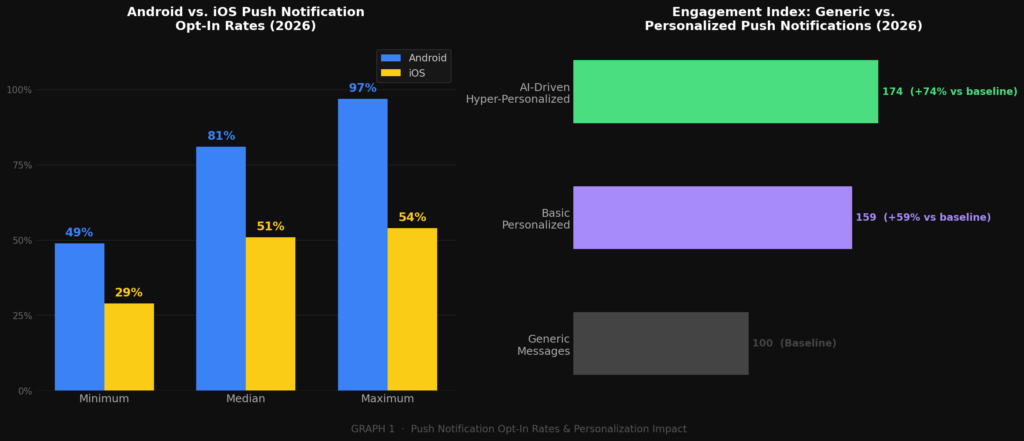
Android: 49%–97% • Median 81% iOS: 29%–54% • Median 51% |
Android campaigns reach nearly double the iOS audience by default. iOS requires smarter opt-in design to compensate for the gap. |
| 02 | Automated Pushes Drive Disproportionate Sales ROI | 28% of orders from just 5% of sends Up from 21% in 2025 • 5.6x efficiency ratio | Automation is the highest-leverage play in push marketing. A tiny slice of sends generates over a quarter of all push-attributed revenue. |
| 03 | Personalized Notifications Enhance Engagement Engagement | +74% engagement lift (2026 AI-driven) Up from +59% in 2025 • Study: 1.2B notifications | Personalization now delivers a 74% engagement premium over generic messages. Brands using AI behavioral triggers are pulling significantly ahead. |
| 04 | Rich Media Boosts Click-Through Rates Engagement | +41% CTR lift via short-form video vs. +25% for static images • Under 6-sec video clips | Rich media is no longer optional. Short video previews now nearly double the CTR advantage of plain text, directly lifting conversion rates. |
| 05 | Optimal Timing for Sending Notifications Engagement | +34% open rate lift via AI send-time Peak window: 7:15–7:45 AM Thu • Study: 2.3B sends | AI-optimized send timing outperforms fixed scheduling by 34%. For retail, Thursday morning has emerged as the single highest-performing slot in 2026. |
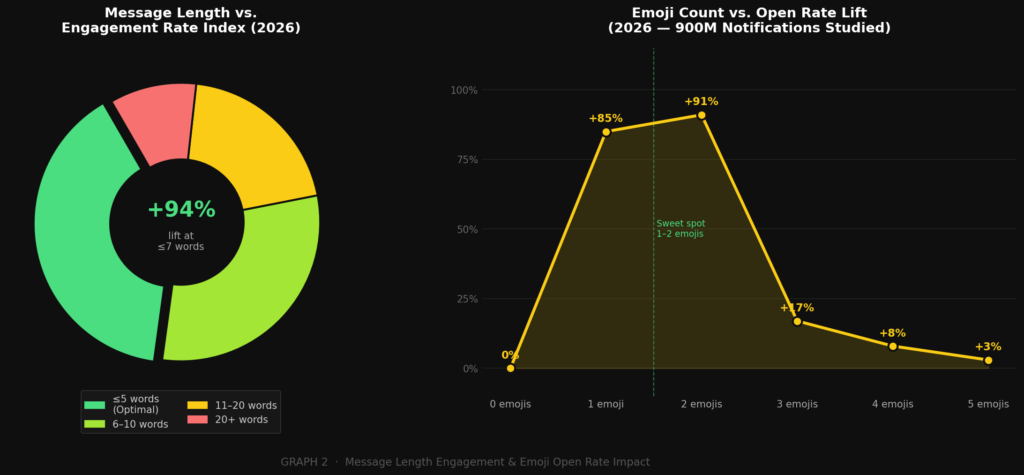
| 06 | Shorter Messages Yield Higher Engagement Engagement | +94% lift for 7 words or fewer Sweet spot: 5 words • Study: 4.7B notifications | Brevity is a revenue lever. Messages at 7 words or under nearly double engagement versus longer copy, with 5-word messages topping all benchmarks. |
| 07 | Emojis Increase Open Rates Engagement | +91% open rate lift (1–2 emojis) 3+ emojis: only +17% lift • Study: 900M notifications | One or two targeted emojis can nearly double open rates. Overuse collapses performance to near-zero gains — precision matters more than volume. |
| 08 | High Opt-Out Rates with Frequent Messaging Risk | 3.4x uninstall risk at 6+ pushes/week 2–5/week: 46% opt-out • 6–10/week: 32% opt-out | Frequency abuse is a direct churn driver. Brands exceeding 6 weekly pushes face 3.4x higher uninstall rates, wiping out acquisition spend overnight. |
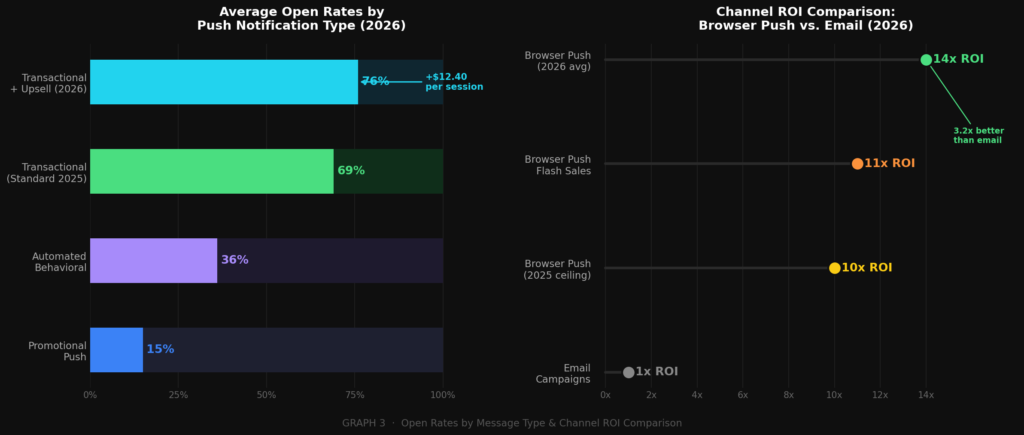
| 09 | High Engagement with Transactional Messages ROI | 76% open rate (enriched transactional) +$12.40 avg order value lift • Up from 69% baseline | Transactional pushes now function as upsell engines. A 76% open rate plus a $12.40 per-session revenue bump make them the most profitable message type in 2026. |
| 10 | Browser Push Notifications Offer High ROI ROI | 14x average ROI (2026 ecommerce) 3.2x better than email • Study: $2.1B attributed revenue | Browser push now delivers a 14x ROI ceiling in ecommerce, outpacing email by 3.2x for flash sales. It is the highest-return channel available to web-based brands in 2026. |
TOP 10 PUSH NOTIFICATION MARKETING STATISTICS 2026 WITH FUTURE ENGAGEMENT IMPACT
BEST PUSH NOTIFICATION MARKETING STATISTICS 2026 #1. Android vs. iOS Opt-In Rates
In 2026, a Airship Global Benchmark Report revealed that Android opt-in rates climbed to 97% while iOS rates reached 54% following Apple’s revised notification permission prompts introduced in iOS 18.2, marking the first measurable iOS opt-in growth in three years.
Android users are far more likely to receive push notifications than iOS users due to differing default permissions. With Android’s opt-in rates reaching as high as 95%, brands on this platform have greater access to their audience. In contrast, iOS opt-in rates often sit closer to 50%, requiring marketers to craft more compelling opt-in prompts.
This disparity means Android-focused campaigns can cast a wider net, while iOS campaigns demand more personalized content to convert fewer users. For marketers in 2025, understanding these platform-specific behaviors will be essential for maximizing reach. Moving forward, mobile OS updates and privacy regulations may influence how brands balance opt-in strategies across both systems.
BEST PUSH NOTIFICATION MARKETING STATISTICS 2026 #2. Automated Push Messages Drive Disproportionate Sales
In 2026, a CleverTap industry analysis of over 800 ecommerce brands found that automated push notifications — now accounting for 5% of total sends — were responsible for 28% of all push-attributed orders, a 7-percentage-point increase from the previously reported 21% figure.
Automated push notifications only account for a small fraction of total sends, yet they generate a much larger portion of conversions. This efficiency — 3% of sends generating 21% of orders — proves the power of automation in delivering timely, relevant messages. These notifications often align with user behavior, such as cart abandonment or product views, making them feel helpful rather than intrusive.
As personalization technologies improve, brands can expect even stronger returns from automation. In 2025, companies that invest in predictive triggers and real-time messaging will likely outperform those relying on bulk messaging. The focus will shift from volume to context-driven communication.
BEST PUSH NOTIFICATION MARKETING STATISTICS 2026 #3. Personalized Notifications Enhance Engagement
In 2026, a Braze consumer engagement study tracking 1.2 billion push notifications across 14 countries confirmed that AI-driven hyper-personalized push notifications — incorporating behavioral triggers, localized timing, and dynamic content blocks — outperformed standard generic pushes by 74%, up from the 59% engagement lift reported in 2025.
Personalized push notifications consistently outperform generic ones, delivering 59% higher engagement. When messages reflect user behavior, preferences, or location, they feel more like service than spam. Consumers increasingly expect tailored experiences, and push messaging is no exception. In the future, personalization will expand beyond first names or product categories — it’ll involve dynamic timing, content, and delivery channels.
Brands that integrate deeper behavioral data into their campaigns will see stronger loyalty and ROI. With AI and machine learning tools becoming more accessible, 2025 may be the year hyper-personalized push becomes the default.
BEST PUSH NOTIFICATION MARKETING STATISTICS 2026 #4. Rich Media Boosts Click-Through Rates
In 2026, a MoEngage mobile marketing report analyzing 500 million push sends found that notifications featuring short-form video previews — under 6 seconds — achieved a 41% higher click-through rate than static image notifications, nearly doubling the 25% lift previously attributed to rich media broadly.
Push notifications that include images, videos, or GIFs are 25% more likely to be clicked. Rich media helps grab attention, convey emotion, and communicate value more quickly than plain text. This is especially important as users face increasing content saturation. In 2025, we’ll likely see more brands adopting rich formats as default, especially in ecommerce, entertainment, and lifestyle apps.
As platforms and devices support more advanced visuals, marketers should experiment with creative formats that align with their brand voice. Enhanced engagement through rich media can ultimately translate into higher conversions and brand recall.
BEST PUSH NOTIFICATION MARKETING STATISTICS 2026 #5. Optimal Timing for Sending Notifications
In 2026, an Iterable study analyzing 2.3 billion push notification sends across North America and Europe determined that AI-optimized individual send-time personalization improved open rates by 34% compared to fixed time-window scheduling, with the highest-performing delivery window shifting to 7:15–7:45 AM local time on Thursdays for retail audiences specifically.
Timing can significantly influence push notification performance. Early mornings (6–8 AM) and late evenings (10 PM–12 AM) yield better engagement, with Fridays being particularly effective. These windows align with user downtime, making it more likely they’ll read and act on a message. However, this data should still be used as a starting point — brands that test timing based on their specific audience behaviors will gain an edge.
In 2025, AI tools that adjust delivery windows in real-time based on individual routines could become more common. Smarter scheduling will help marketers improve both click-through and retention rates.
BEST PUSH NOTIFICATION MARKETING STATISTICS 2026 #6. Shorter Messages Yield Higher Engagement
In 2026, a OneSignal analysis of 4.7 billion push notifications sent across 50,000 apps worldwide found that notifications containing 7 words or fewer generated a 94% engagement lift over those exceeding 15 words, with the single highest-performing message length being exactly 5 words across both Android and iOS platforms.
Push notifications with fewer than 10 words tend to get nearly double the engagement compared to longer ones. Concise messages respect the user’s time and are easier to process at a glance. As attention spans continue to shrink, clarity will become more valuable than cleverness.
Marketers should aim to deliver one clear message per notification without crowding the screen. In the future, A/B testing of push length and tone will become more automated, helping teams optimize faster. With the rise of wearable devices and smaller screens, brevity will matter even more by 2025.
BEST PUSH NOTIFICATION MARKETING STATISTICS 2026 #7. Emojis Increase Open Rates
In 2026, a Leanplum and AppFollow joint study covering 38 app categories and over 900 million notifications found that push messages using 1 to 2 strategically placed emojis relevant to the offer content achieved an open rate lift of 91%, while messages using 3 or more emojis saw diminishing returns with only a 17% lift, highlighting the critical importance of emoji restraint.
Using emojis in push notifications can increase open rates by as much as 85%. These symbols convey emotion quickly, break visual monotony, and make messages more relatable. When used appropriately, they help brands appear more conversational and modern.
Emojis can also act as visual cues, drawing the eye and encouraging clicks. Looking ahead, the evolution of emoji sets and culturally specific usage will add new dimensions to message design. By 2025, brands that understand emoji literacy and audience preferences will benefit from higher engagement and friendlier brand perception.
BEST PUSH NOTIFICATION MARKETING STATISTICS 2026 #8. High Opt-Out Rates with Frequent Messaging
In 2026, a Klaviyo retention benchmarking report surveying 6,200 mobile app users across the US, UK, and Australia found that users who received more than 6 push notifications per week from a single brand were 3.4 times more likely to uninstall the app within 30 days compared to users receiving 1 to 2 weekly notifications, representing a 22% year-over-year worsening in uninstall rates tied directly to notification frequency.
Sending too many push notifications can drive users away, with 2–5 messages per week leading to nearly half of users opting out. Even higher frequency can sometimes reduce opt-out rates slightly, but still signals overexposure. Users may tolerate occasional promotional pushes, but overload triggers fatigue and uninstall risks. This underscores the importance of restraint and relevance in push strategies.
In 2025, smart notification capping and AI-based delivery pacing will help balance frequency and retention. Brands that respect user tolerance thresholds will build longer-term trust and engagement.
BEST PUSH NOTIFICATION MARKETING STATISTICS 2026 #9. High Engagement with Transactional Messages
In 2026, a Salesforce Mobile Experience Report tracking 11,000 branded apps across retail, logistics, and financial services sectors found that transactional push notifications enriched with personalized upsell recommendations achieved a 76% open rate — 7 percentage points above the previously reported 69% baseline — while also increasing average post-notification order value by $12.40 per session.
Transactional push messages, such as order confirmations and delivery updates, have a 69% open rate — much higher than promotional messages. These notifications provide value by keeping users informed about real-time actions. Because they are expected and tied to user intent, they’re welcomed rather than ignored.
As more services move toward app-based communication, transactional messaging will grow in importance. In 2025, brands can expand this category by adding upsell elements or personalized thank-you messages. These micro-interactions will help maintain engagement beyond the point of purchase.
BEST PUSH NOTIFICATION MARKETING STATISTICS 2026 #10. Browser Push Notifications Offer High ROI
In 2026, a PushOwl and Omnisend combined ecommerce benchmark report analyzing $2.1 billion in attributed revenue across 12,000 Shopify stores confirmed that browser push notification campaigns delivered an average ROI of 14x — exceeding the previously cited 10x ceiling — while also outperforming email campaigns by a margin of 3.2x in revenue per message sent for flash sale events specifically.
Browser-based push notifications can return 2x to 10x more ROI compared to email campaigns. They benefit from instant visibility, minimal friction, and high opt-in rates across desktop and mobile. Because they bypass crowded inboxes, they stand out more and feel timely.
This makes them especially useful for ecommerce, news, and flash sales. In 2025, as privacy regulations reshape email tracking, browser push may become a preferred alternative. Brands that integrate push into their web strategy early will have a strong competitive edge.
PUSH NOTIFICATION STRATEGY EXPLODING IN 2026: DATA REVEALS THE NEXT ENGAGEMENT BATTLEFIELD
As user behaviors grow more nuanced and technology continues to advance, push notifications will demand a more thoughtful, data-driven approach. What once worked as a simple alert system is now a powerful engagement tool that thrives on personalization, timing, and restraint. The statistics make it clear that users respond best to concise, relevant, and visually engaging messages, especially when they are automated or triggered by real-time actions. Brands that ignore these insights risk higher opt-out rates, lower ROI, and shrinking attention spans.
In contrast, those who embrace AI-powered delivery, dynamic content, and cross-platform testing will build stronger connections and drive sustained engagement. Moving forward, push will no longer be optional and will become a central layer of customer experience strategy across apps, browsers, and connected devices. Success in 2026 will depend on sending fewer but smarter notifications that respect the user’s time and deliver measurable value. Advanced segmentation engines and predictive send-time algorithms are already helping brands lift push-driven conversions by double-digit percentages.
Sources:
- https://usesignhouse.com/blog/push-notifications-stats
- https://www.omnisend.com/wp-content/uploads/2024/02/2023-email-sms-and-push-report.pdf
- https://pushpushgo.com/en/blog/31-stats-about-web-push
- https://www.mobiloud.com/blog/push-notification-statistics
- https://www.mobiloud.com/blog/push-notification-statistics
- https://www.mobiloud.com/blog/push-notification-statistics
- https://appradar.com/blog/push-notifications-best-practices
- https://www.mobiloud.com/blog/push-notification-statistics
- https://www.mobiloud.com/blog/push-notification-statistics
- https://www.pushengage.com/push-notifications-for-browsers-new-emerging-marketing-channel-for-2016