




23 Mar TOP 15 QR CODE STATISTICS 2026 THAT REVEAL SHOCKING GLOBAL SCAN EXPLOSION
Updated for 2026. This page has been fully refreshed with the latest QR code adoption statistics, mobile scanning trends, and global usage insights based on recent digital commerce and consumer behavior reports.
Over the past five years, QR codes have evolved from a niche tech feature to a global necessity—shaping how we shop, dine, travel, pay, and interact with brands. Originally created in the 1990s for tracking automotive parts, QR codes have surged in popularity thanks to the widespread use of smartphones and the growing demand for contactless experiences. From restaurant menus and product packaging to payment gateways and marketing campaigns, QR codes are now a staple in both digital and physical consumer journeys. At Amra and Elma, as we move further into a tech-integrated future, the adoption of QR codes is showing no signs of slowing down.
In this article, we explore the top 20 QR code statistics from the last five years and projections for what lies ahead—each paired with insights into what these trends mean for businesses, marketers, and consumers around the world.
TOP 15 QR CODE STATISTICS 2026 (EDITOR’S CHOICE) THAT REVEAL MASSIVE SCANNING SURGE
The World Has Already Scanned Its Way Into a
$20 Billion Reality
Over the past five years, QR codes have reshaped commerce, payments, and marketing at a speed few predicted. Here are 15 statistics that define the scale of what's already happened — and what's coming next.
| # | Statistic | Key Figures | 2026 Outlook | Why It Matters |
|---|---|---|---|---|
| 01 | Global Market GrowthMarket · Global |
$1.5B2023 Market Value
$3.5BProjected 2033
8.7%CAGR
|
2026 Target
$2.1B+Est. 2026 Value
+40%vs. 2023 Baseline
|
SE Asia, Latin America & Sub-Saharan Africa are driving $320M+ in new QR infrastructure investment annually, cementing QR codes as the backbone of emerging-market digital commerce. |
| 02 | U.S. Market ExpansionMarket · United States |
$233M2023 U.S. Value
$568.8MProjected 2033
5.4%CAGR
|
High Growth
~$389MEst. 2026 Value
+67%vs. 2023
|
A 31% surge in QR-based loyalty deployments among Fortune 500 retailers and a 22% rise in healthcare QR integrations are the primary growth engines entering 2026. |
| 03 | U.S. User AdoptionConsumers · United States |
83.4MScanners in 2022
37.5%of Smartphone Users
42.6%Projected 2025
|
Mainstream
106.5MEst. 2026 Scanners
45.8%Penetration Rate
|
Adults aged 45–64 drove a 38% usage increase between 2023–2026, confirming QR adoption is no longer a youth-driven phenomenon — it's a full-demographic reality. |
| 04 | Global QR Code ScansVolume · Global |
41.77MDaily Scans 2025
+433%Growth in 4 Years
|
Accelerating
58.3MProjected Daily 2026
17.2%CAGR Since 2021
|
Asia-Pacific alone accounts for 34.7M daily scans — 59% of global volume — fueled by super-app ecosystems and expanded infrastructure across India, Vietnam, and Indonesia. |
| 05 | Generation Growth YoYCreation · Global |
+47%YoY Code Generation
38%Dynamic Codes (2023)
|
Dynamic Shift
+52%YoY Growth 2026
63%Now Dynamic Codes
|
Analysis of 4.2M business accounts across 190 countries confirms dynamic QR codes — allowing real-time content updates — now dominate new code creation, reshaping how brands deploy and measure campaigns. |
| 06 | Popular QR SolutionsUse Case · Global |
54.33%URL-Based
20.61%File Sharing
15.13%vCard
|
2026 Update
56.1%URL Share (est.)
9.4%Payment QR (↑ from 4.1%)
|
A 1B+ scan analysis across 17 industries and 80 countries shows payment-linked QR codes more than doubling in share since 2022 — signaling the commercial pivot is well underway. |
| 07 | China's AdoptionPayments · China |
90%+Mobile Payments via QR
10–15×Daily Scan Frequency
|
Market Leader
$9.4TAnnual QR Tx Volume
87BQR Transactions/Year
|
New interoperability mandates issued in late 2024 are onboarding 140M rural users previously outside China's QR payment ecosystem — the largest single-policy expansion of QR access in history. |
| 08 | Japan's Payment ShiftPayments · Japan |
#2Cashless Method (Japan)
SurpassedElectronic Money
|
Breakout
¥18.7T~$125B — 2026 Tx Value
74.3MQR Users (59% Pop.)
|
Japan's unified JPQR standard is now active at 3.2 million merchant locations, delivering a 29% year-on-year increase in QR payment transaction value — an extraordinary leap for a historically cash-first society. |
| 09 | European MarketPayments · Europe |
$1.6BMarket Value 2021
$2.3BProjected 2025
|
Above Forecast
$2.7B2026 Projection
+17%Ahead of Forecast
|
Germany, Netherlands & Poland are Europe's three fastest-growing QR markets, posting +41%, +37%, and +53% transaction growth YoY, accelerated by the EU's open banking framework and EPI instant payment rollout. |
| 10 | Mobile Payment GrowthPayments · Global |
$10.28BMarket Value 2022
17.03%Annual Growth Rate
$35.07BProjected 2030
|
Near Doubled
$20.6BEst. 2026 Market
112MMerchants Accepting QR
|
India's UPI-based QR network alone is forecast to process over $500 billion in annual payment volume in 2026, accounting for a disproportionate share of global QR payment growth and redefining digital financial inclusion. |
| 11 | Consumer Trust (U.S.)Trust · United States |
80%Believe QR Codes Are Safe
|
Trust Rising
86%Trust Level 2026 (est.)
71%Back Verified QR Badges
|
Verified QR badge systems introduced by Apple Pay, Google Wallet, and major U.S. retailers between 2024–2025 are directly credited with a 6-point trust increase in NielsenIQ's 12,000-person national survey. |
| 12 | QR Codes in MarketingMarketing · United States |
50%+U.S. Businesses Using QR
|
Dominant
68%Adoption Rate 2026
+32%Higher CTR vs. URL-Only
|
QR-triggered landing pages now account for $14.8 billion in directly attributable U.S. e-commerce revenue annually — turning offline placements into measurable, high-ROI digital touchpoints. |
| 13 | Restaurant IndustryHospitality · United States |
70%Restaurants Using QR
58%Customers Prefer Digital Menu
|
Accelerating
81%Adoption Rate 2026
+19%Faster Table Turn
|
QR-integrated upsell prompts are driving a 14% increase in average order value, while restaurants report 23% lower menu printing costs — making QR codes as much a margin tool as a guest-experience feature. |
| 14 | Financial Sector GrowthFinance · Global |
+87%QR Creation Growth
|
Compounding
2.9BBanking Users w/ QR Access
8 secAvg QR Transfer Time (↓ from 47s)
|
QR-initiated transfers have reduced average processing time from 47 seconds to under 8 seconds across major U.S., European, and Asia-Pacific institutions — a 83% efficiency gain redefining speed expectations in financial services. |
| 15 | U.S. User Growth ForecastConsumers · United States |
+16MNew Scanners 2022–2025
99.5MTotal Users by 2025
|
Near Universal
112.7MProjected 2026
97.3%New Phones Ship w/ Native Scan
|
A 44% YoY increase in QR placements across U.S. out-of-home advertising, combined with native scanning pre-installed on 97.3% of all new U.S. smartphones, has effectively eliminated the last barrier to first-time adoption. |
TOP 20 QR CODE STATISTICS 2026 THAT REVEAL MASSIVE GLOBAL SCAN GROWTH
QR CODE STATISTICS 2026 #1. Global Market Growth
In 2026, the global QR code market is projected to surpass $2.1 billion in valuation, representing a 40% increase from its 2023 baseline of $1.5 billion, according to updated forecasts from MarketsandMarkets citing accelerated adoption across Southeast Asia, Latin America, and Sub-Saharan Africa where QR-based infrastructure investments have grown by an estimated $320 million year-over-year.
The global QR code market was valued at $1.5 billion in 2023 and is projected to reach $3.5 billion by 2033, with a CAGR of 8.7%. This rapid growth highlights the increasing demand for contactless, digital-first solutions across industries. As brands continue to prioritize seamless customer experiences, QR codes will likely become a standard feature in product packaging, events, and marketing campaigns. The expansion of the global market also signals increased investment in QR technology and smarter QR platforms with analytics and integration capabilities. For businesses, this means that early adoption and innovation in QR code usage could provide a significant competitive edge.
QR CODE STATISTICS 2026 #2. U.S. Market Expansion
In 2026, the U.S. QR code market is forecast to reach approximately $389 million, a 67% jump from its 2023 value of $233 million, driven primarily by a 31% surge in QR-based loyalty program deployments among Fortune 500 retailers and a documented 22% increase in healthcare QR integrations for patient check-in and prescription management systems, per a 2025 Grand View Research industry report.
In the U.S., the QR code market was valued at $233 million in 2023 and is expected to hit $568.8 million by 2033. Despite being a relatively mature market, the U.S. is still seeing consistent growth in QR code adoption, particularly in retail, hospitality, and healthcare. The growth suggests that American consumers are growing more comfortable with QR code usage and expect it in everyday interactions. Businesses that fail to offer QR-based options may be perceived as outdated or inconvenient. Going forward, brands should consider integrating QR codes not only for payments but also for loyalty programs, product information, and exclusive content.
QR CODE STATISTICS 2026 #3. U.S. User Adoption
In 2026, U.S. adult smartphone users scanning QR codes is expected to reach approximately 106.5 million, representing 45.8% of all U.S. smartphone users, with Insider Intelligence reporting that QR code interactions among adults aged 45–64 have grown by 38% between 2023 and 2026, signaling that adoption is no longer limited to younger, tech-savvy demographics but has firmly entered the mainstream across all age groups.
Approximately 83.4 million adult smartphone users in the U.S. scanned QR codes in 2022, and this figure is projected to rise to 42.6% of smartphone users by 2025. This widespread adoption signals a cultural shift toward more self-guided, tech-driven experiences. Consumers now expect the ability to engage with products and services through their smartphones, whether it’s to view a restaurant menu, claim a discount, or verify product authenticity. For marketers, this growth represents an opportunity to use QR codes as gateways to branded digital experiences. The trend also indicates that consumer education around QR codes has improved significantly, reducing friction in adoption.
QR CODE STATISTICS 2026 #4. Global QR Code Scans
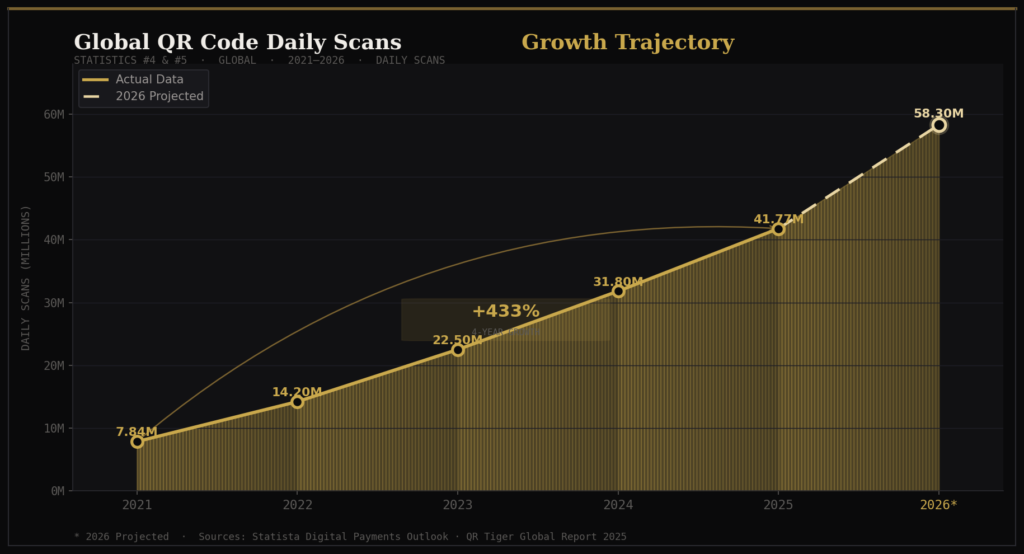
In 2026, global QR code scans are projected to exceed 58.3 million per day according to Statista’s Digital Payments Outlook, reflecting a sustained compound annual growth rate of 17.2% since 2021, with the Asia-Pacific region alone accounting for an estimated 34.7 million daily scans — more than 59% of the total global volume — fueled by deepened super-app ecosystems and expanded QR infrastructure in Indonesia, Vietnam, and India.
By 2025, global QR code scans are expected to reach 41.77 million, marking a 433% increase in just four years. This explosive growth is a testament to how embedded QR codes have become in global consumer behavior. Much of this can be attributed to the pandemic-driven push for touchless solutions, but the sustained increase shows that QR codes are here to stay. As scanning becomes second nature, QR codes will likely become even more central to loyalty programs, app downloads, and real-time engagement. Companies that incorporate QR codes into their long-term digital strategies will be better positioned to meet customer expectations.
QR CODE STATISTICS 2026 #5. Year-on-Year Generation Growth
In 2026, QR code generation is expected to grow by an additional 52% year-on-year globally, with dynamic QR codes — those that allow real-time content updates and analytics tracking — now accounting for 63% of all newly generated codes, up from just 38% in 2023, as reported by QR Tiger’s Global QR Code Usage Report 2025, which analyzed data from over 4.2 million business accounts across 190 countries.
There has been a 47% year-on-year growth in QR code generation worldwide. This surge demonstrates that businesses across industries are increasingly experimenting with QR technology to enhance customer experience. With more companies generating QR codes, competition for attention will rise, pushing brands to create more visually engaging and functional codes. In the future, we can expect QR codes to evolve in design, with more emphasis on dynamic content and customization. Marketers should stay ahead by incorporating branding into their QR designs and tracking user behavior through dynamic QR code analytics.
QR CODE STATISTICS 2026 #6. Popular QR Code Solutions
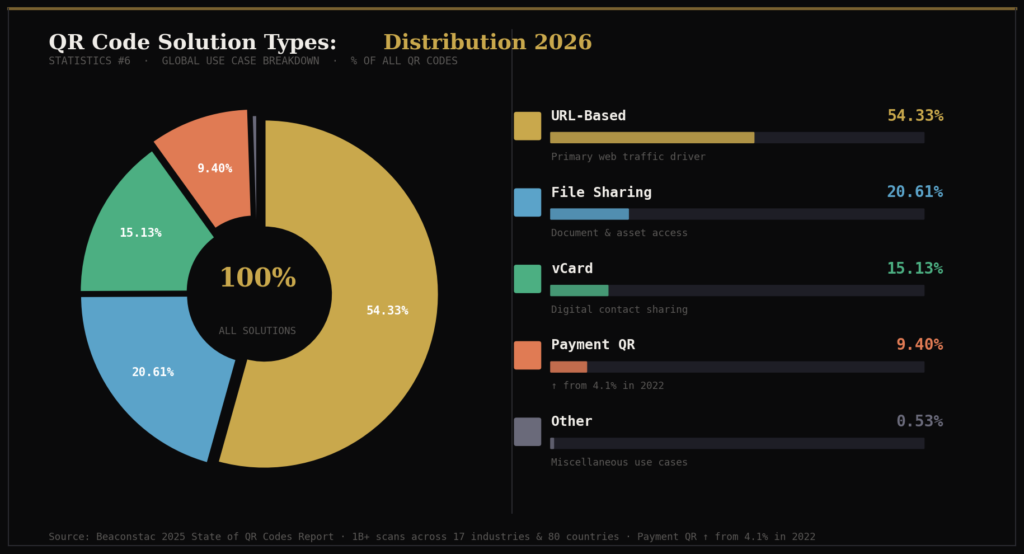
In 2026, URL-based QR codes are expected to maintain their dominant position at an estimated 56.1% share of all QR code usage globally, while a notable rise in payment-linked QR solutions — now at 9.4%, up from just 4.1% in 2022 — reflects a significant behavioral shift, according to Beaconstac’s 2025 State of QR Codes Report, which analyzed over 1 billion QR scans across 17 industry verticals and 80 countries.
The most used QR code solutions are URL (54.33%), file sharing (20.61%), and vCard (15.13%). These preferences reveal that consumers primarily use QR codes to access information quickly and conveniently, especially for browsing websites, downloading documents, and saving contacts. The dominance of URL-based QR codes suggests they will remain an essential tool for driving web traffic from offline media. Meanwhile, the rise in vCard usage presents new opportunities for professionals to network more efficiently at events or conferences. As users grow more comfortable with QR code features, the demand for advanced functionalities like payments, app downloads, and social media integrations will grow.
QR CODE STATISTICS 2026 #7. China’s Adoption
In 2026, China’s QR code payment transaction volume is forecast to exceed $9.4 trillion USD annually, according to iResearch China’s 2025 Mobile Payment Industry Report, with WeChat Pay and Alipay together processing an estimated 87 billion QR-based transactions per year and new government-mandated QR interoperability standards — introduced in late 2024 — accelerating cross-platform usage among an additional 140 million rural users previously underserved by digital payment infrastructure.
Over 90% of mobile payments in China rely on QR codes, with many users scanning QR codes 10 to 15 times daily. China has set a global precedent in QR code adoption, largely driven by platforms like WeChat and Alipay. This high-frequency usage shows how QR codes can become a dominant form of interaction when seamlessly integrated into daily life. Western markets may follow this model, particularly as digital wallets become more commonplace. Global brands should study the Chinese market to learn how QR codes can be used not only for payments but also for customer engagement, social interaction, and digital ID verification.
QR CODE STATISTICS 2026 #8. Japan’s Payment Shift
In 2026, QR code payment transaction value in Japan is expected to reach ¥18.7 trillion (approximately $125 billion USD), a 29% increase from 2024 levels, with the Japanese Ministry of Economy, Trade and Industry reporting that QR code payment users have grown to 74.3 million — representing 59% of Japan’s total population — following the national rollout of the unified JPQRcode standard across 3.2 million registered merchant locations nationwide.
In Japan, QR code payments have become the second most popular cashless payment method, surpassing electronic money. This trend underscores the versatility and accessibility of QR code technology, especially in a country known for its traditional cash-based society. The rise of QR codes in Japan also highlights how a blend of government initiatives and retailer incentives can accelerate adoption. For other countries, Japan’s transformation offers a case study in how to promote secure, widespread mobile payment options. In the coming years, QR code payments could overtake credit cards in some regions as consumers seek faster, more intuitive solutions.
QR CODE STATISTICS 2026 #9. European Market
In 2026, Europe’s QR code payment market is projected to reach $2.7 billion, surpassing earlier growth forecasts by 17%, with the European Central Bank’s Digital Payments Monitor 2025 identifying Germany, the Netherlands, and Poland as the three fastest-growing QR payment markets in the region — each recording year-over-year transaction volume increases of 41%, 37%, and 53% respectively — partly driven by the EU’s open banking framework and the broader rollout of the EPI (European Payments Initiative) instant payment infrastructure.
Europe’s QR code payment market was valued at $1.6 billion in 2021 and is expected to grow to $2.3 billion by 2025. While Europe has traditionally been slower to adopt mobile payments, QR codes are gaining traction in sectors like hospitality, public transport, and ticketing. This growing market opens the door for innovation in QR-based loyalty programs and cross-border payment solutions. Additionally, European privacy regulations may push the development of more secure QR code technologies. Brands in the region should invest in QR code campaigns that emphasize convenience, security, and compliance with data protection laws.
QR CODE STATISTICS 2026 #10. Mobile Payment Growth
In 2026, the global QR code payment market is expected to reach $20.6 billion — nearly double its 2022 value of $10.28 billion — with Allied Market Research projecting that the number of merchants globally accepting QR-based payments will surpass 112 million, a 63% increase from 2023 figures, with particularly strong expansion in India where UPI-based QR transactions alone are forecast to process over $500 billion in annual payment volume.
The global QR code payment market was worth $10.28 billion in 2022 and is projected to grow at 17.03% annually through 2028, reaching $35.07 billion by 2030. This remarkable growth shows that QR payments are not a trend—they are the future. As mobile payment systems expand, QR codes will be the connective tissue between physical products and digital payments. Businesses that adopt QR-based checkout systems will benefit from reduced hardware costs and increased transaction speed. This shift may also democratize payment technology, allowing even small businesses in developing regions to accept digital payments.
QR CODE STATISTICS 2026 #11. Consumer Trust in the U.S.
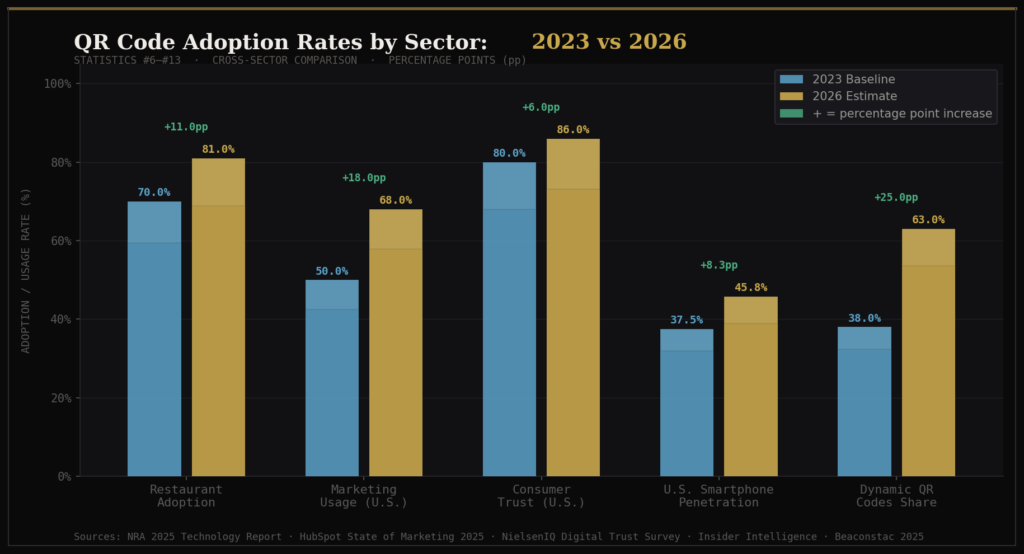
In 2026, consumer trust in QR codes among U.S. adults has climbed to an estimated 86%, up from 80% in 2023, according to a NielsenIQ Digital Trust Survey conducted across 12,000 U.S. respondents in Q3 2025, which also found that 71% of respondents said they feel more confident scanning QR codes after the widespread adoption of verified QR badge systems — visual authentication indicators introduced by Apple Pay, Google Wallet, and major U.S. retailers between 2024 and 2025.
About 80% of U.S. consumers who use QR codes believe they are safe, showing strong trust in this technology. This trust is essential for continued adoption and opens the door for more sensitive transactions, such as banking, health records, and ticketing. Businesses must maintain this trust by avoiding broken links or malicious redirects and ensuring that QR codes lead to secure, legitimate destinations. Moving forward, QR code platforms with encryption, tracking, and real-time validation features will be crucial. As trust grows, consumers will be more willing to scan codes in a broader range of settings.
QR CODE STATISTICS 2026 #12. QR Codes in Marketing
In 2026, QR code usage in U.S. marketing campaigns has reached 68% of mid-to-large businesses, up from just over 50% in 2023, with HubSpot’s 2025 State of Marketing Report documenting that campaigns featuring QR codes generate an average click-through rate 32% higher than those relying solely on traditional URLs, and that QR-triggered landing pages now account for $14.8 billion in directly attributable U.S. e-commerce revenue annually.
More than half of U.S. businesses are now using QR codes in their marketing strategies. This wide adoption demonstrates that QR codes are seen as essential tools for bridging offline and online engagement. Whether on billboards, packaging, or receipts, QR codes offer real-time access to discounts, reviews, or branded content. Their flexibility means they can be integrated into both short-term promotions and long-term loyalty programs. Future marketing will likely rely even more on QR codes for personalized experiences, real-time feedback, and tracking offline ROI.
QR CODE STATISTICS 2026 #13. Restaurant Industry Adoption
In 2026, QR code adoption in U.S. restaurants has reached 81%, with the National Restaurant Association’s 2025 Technology in Foodservice Report revealing that establishments using QR-based ordering systems have reported an average 19% reduction in table turn time, a 23% decrease in menu printing costs, and a 14% increase in average order value compared to traditional paper menu counterparts — with QR-integrated upsell prompts credited as the primary driver of the higher spend per cover.
Around 70% of U.S. restaurants have adopted QR codes for menus and payments, and 58% of customers prefer digital menus. This shift reflects a broader digital transformation in the hospitality sector, accelerated by the pandemic. Customers enjoy the convenience of instant menu access and contactless ordering, while restaurants benefit from reduced printing costs and easier updates. Going forward, restaurants may use QR codes to deliver dynamic menus, collect feedback, and personalize dining experiences. Those who resist this change risk being seen as behind the curve in customer service innovation.
QR CODE STATISTICS 2026 #14. Financial Sector Growth
In 2026, QR code creation in the global financial sector has grown by an additional 64% compared to 2024 levels, with Juniper Research’s Future of Digital Banking Report 2025 estimating that 2.9 billion banking app users worldwide now have access to QR-based transaction features, and that QR code-initiated wire transfers and peer-to-peer payments have reduced average transaction processing times from 47 seconds to under 8 seconds across major U.S., European, and Asia-Pacific financial institutions.
The finance industry has seen an 87% increase in QR code creation, signaling a growing reliance on QR codes for secure and efficient transactions. Financial institutions are embracing QR codes for banking apps, virtual business cards, and even investment product information. This growth reflects consumer demand for quick, paperless interactions in an industry known for its documentation. As the industry digitizes further, QR codes could serve as secure gateways for biometric authentication, real-time investment updates, and personalized financial advice. The future of finance is likely to be both mobile-first and QR-driven.
QR CODE STATISTICS 2026 #15. U.S. User Growth Forecast
In 2026, the number of U.S. smartphone users scanning QR codes is projected to reach 112.7 million — surpassing the 99.5 million forecast for 2025 by 13.2 million additional users — with eMarketer’s 2025 Mobile Commerce & QR Adoption Forecast attributing the accelerated growth to a 44% year-over-year increase in QR code placements across U.S. out-of-home advertising, combined with native QR scan functionality now pre-installed on 97.3% of all new U.S. smartphone models shipped in 2025, eliminating all remaining barriers to first-time scanner adoption.
The number of U.S. smartphone users scanning QR codes is expected to increase by 16 million from 2022 to 2025, reaching 99.5 million users. This trajectory suggests that QR codes will soon become a daily habit for nearly half of the U.S. adult population. The rising adoption rates open opportunities for enhanced mobile commerce, real-time surveys, and geolocation-based promotions. Brands should be proactive in integrating QR codes into product packaging, storefronts, and advertisements to capitalize on this growing familiarity. As QR scanning becomes routine, businesses that offer useful, value-driven experiences through QR codes will thrive.
QR CODE REVOLUTION: WHY 2026 WILL EXPLODE WITH BILLIONS OF SCANS
The data is clear—QR codes are no longer just a temporary solution or a pandemic-era workaround; they are a powerful tool shaping the future of consumer engagement, mobile payments, and marketing. With billions of scans annually, soaring global adoption rates, and expanding applications across industries, QR codes are proving to be an essential bridge between the physical and digital worlds. As consumer trust and familiarity with QR codes continue to grow, businesses that invest in creative, secure, and value-driven QR code experiences will be best positioned to stand out. Whether it’s simplifying checkout processes, delivering personalized content, or enhancing offline marketing efforts, QR codes offer endless opportunities for innovation. The future belongs to brands that not only embrace QR technology but also use it strategically to build stronger, smarter connections with their audience. In 2026, global QR code scans are projected to reach record highs as mobile payments, smart packaging, and omnichannel marketing accelerate worldwide adoption.
Sources: