



20 Sep TOP 20 QUANTUM COMPUTING MARKETING STATISTICS 2025
When I first started digging into quantum computing marketing statistics, I’ll be honest—it felt like I was staring into the future. The numbers don’t just show growth; they paint a picture of how fast businesses, investors, and innovators are moving toward this next frontier. As someone working with a leading marketing agency in New York, I’ve seen how vital it is to keep up with trends like these—not just to stay relevant, but to help brands connect with audiences in smarter ways. Sharing these insights feels less like reporting data and more like giving you a glimpse into the opportunities that are unfolding right now.
Top 20 Quantum Computing Marketing Statistics 2025 (Editor’s Choice)
🚀 Top 20 Quantum Computing Statistics 2025
Market Insights, Investment Trends & Growth Projections
| # | Category | Statistic |
|---|---|---|
| 1 | Market Size | Global quantum computing market valued at $1.42B in 2024, projected to reach $4.24B by 2030 (CAGR: 20.5%) |
| 2 | Market Growth | Alternative projections show market at $3.52B in 2025, expected to reach $20.20B by 2030 (CAGR: 41.8%) |
| 3 | Market Forecast | BCC Research forecasts growth from $1.6B in 2025 to $7.3B by 2030 (CAGR: 34.6%) |
| 4 | U.S. Market | U.S. quantum computing market expected to grow from $302.1M in 2025 to $1,657.5M by 2032 (CAGR: 27.5%) |
| 5 | Investment Surge | Q1 2025 investment surged to over $1.25B — more than double the previous year |
| 6 | Funding Distribution | Quantum computer companies received 70%+ of all quantum-related funding in Q1 2025 |
| 7 | Revenue Growth | Quantum computing companies generated $650-750M in 2024, expected to surpass $1B in 2025 |
| 8 | Equity Funding | By June 2025, companies raised $1.26B across 28 rounds — a 46.57% increase vs. 2024 |
| 9 | Global Distribution | U.S. leads with 44% of global funding, UK/Canada/Australia: 20%, China: 17% |
| 10 | Global Investment | Worldwide quantum initiatives have attracted over $40B in investments |
| 11 | U.S. Government | U.S. committed over $1.2B under the National Quantum Initiative Act |
| 12 | China Investment | China has committed over $10B to quantum development |
| 13 | Japan Initiative | Japan announced $7.4B investment in quantum technology in early 2025 |
| 14 | Market Share | Systems segment dominated with 63.91% market share in 2024 |
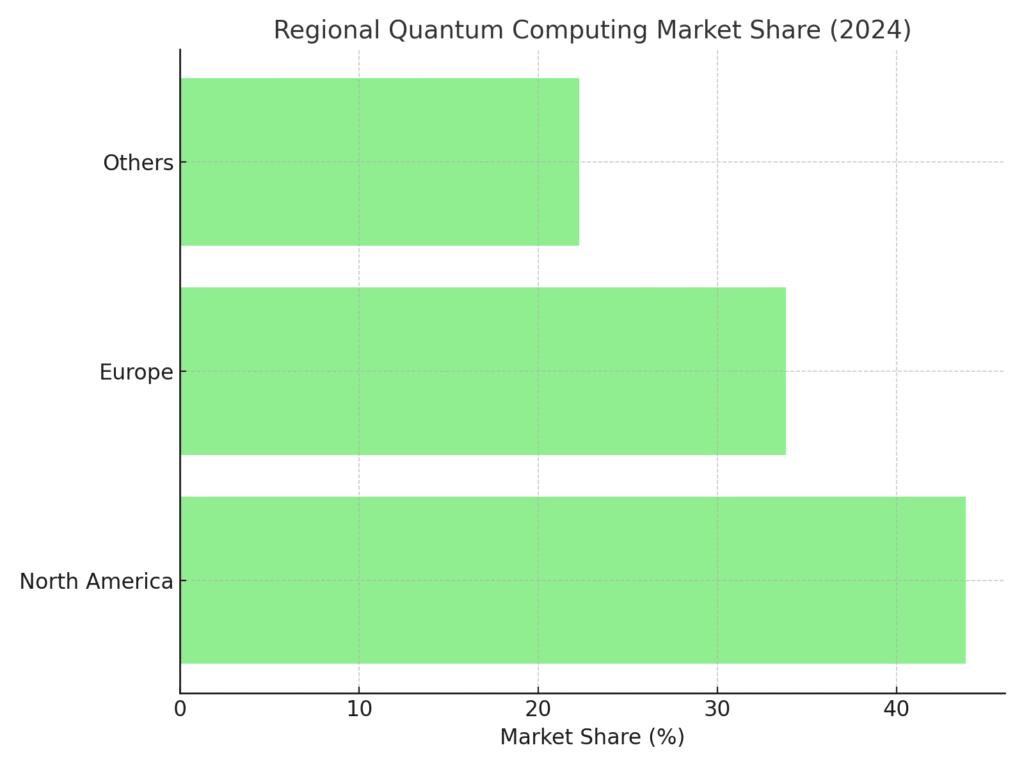
| 15 | Regional Leader | Europe dominated the global market with 33.84% share in 2024 |
| 16 | U.S. Applications | Optimization led with 40.5% share; Aerospace & Defense topped end-users at 32.6% |
| 17 | Cloud Computing | Quantum cloud market projected at $15B by 2030 |
| 18 | Healthcare Market | Pharmaceutical & healthcare quantum market projected at $5B by 2030 |
| 19 | Commercial Orders | Commercial orders totaled $854M in 2024 — up 70% from 2023 |
| 20 | Corporate Strategy | Over 60% of Fortune 500 companies expected to have quantum computing strategy by 2025 |
Top 20 Quantum Computing Marketing Statistics 2025
Quantum Computing Marketing Statistics #1: Market Revenue Reached $1.07 Billion In 2024
The quantum computing market was valued at approximately $1.07 billion in 2024, showing how quickly the sector is moving beyond research and into practical business use. This figure highlights growing demand across industries from finance to pharmaceuticals. For marketers, it represents a signal to begin shaping campaigns that align with cutting-edge technologies. Businesses that recognize the scale of this growth early can position themselves as forward-thinking leaders. This revenue milestone is not just a number—it’s a clear sign of momentum in quantum adoption.
Quantum Computing Marketing Statistics #2: Public Funding Reached $44.5 Billion Globally In 2024
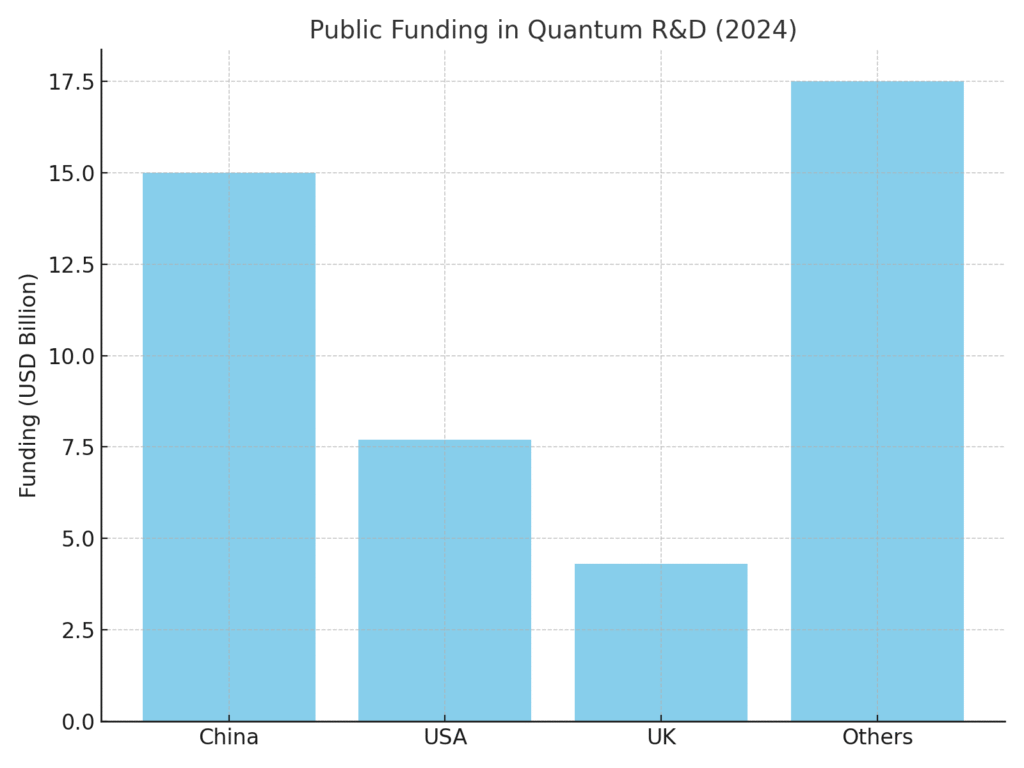
Governments worldwide invested an estimated $44.5 billion in quantum R&D in 2024. China led with $15 billion, while the U.S. contributed $7.7 billion and the U.K. invested $4.3 billion. This level of funding shows a competitive global race for quantum supremacy. For marketing professionals, it signals that public awareness and trust in the technology will likely accelerate. Campaigns tied to government-backed innovation often gain legitimacy and visibility more quickly.
Quantum Computing Marketing Statistics #3: Private Investments Hit $2.6 Billion In 2024
Venture capitalists poured $2.6 billion into the quantum industry in 2024. Of this, $1.7 billion went to U.S.-based companies, showing the country’s strong startup ecosystem. Private funding validates confidence in the commercial potential of quantum solutions. For marketers, this means more stories to tell about groundbreaking startups and bold investments. Highlighting venture-backed innovation often resonates with forward-looking business audiences.
Quantum Computing Marketing Statistics #4: Market Projected To Reach $20.2 Billion By 2030
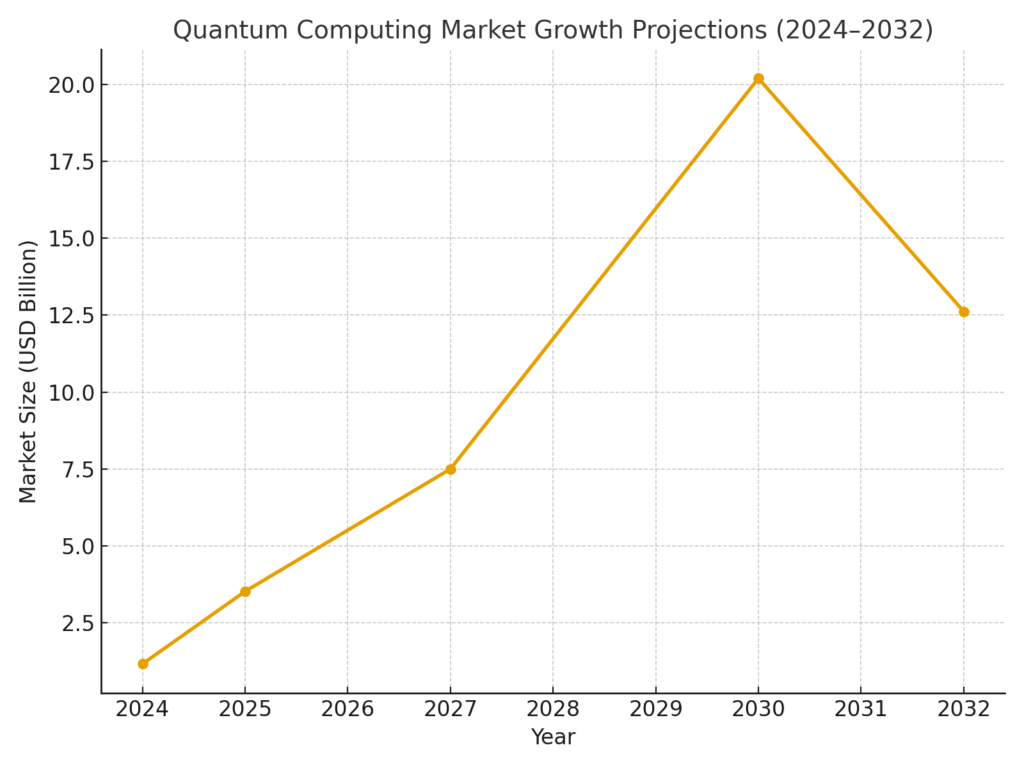
The global quantum computing market is projected to grow from $3.52 billion in 2025 to $20.20 billion by 2030. This represents a remarkable compound annual growth rate of 41.8%. For marketers, such projections provide fuel for positioning campaigns around innovation and exponential growth. It’s a chance to emphasize scalability and long-term opportunities. These kinds of forecasts resonate with stakeholders who are eager to get in early on transformational markets.
Quantum Computing Marketing Statistics #5: Another Forecast Predicts $12.62 Billion Market By 2032
Fortune Business Insights projects growth from $1.16 billion in 2024 to $12.62 billion by 2032. This forecast comes with a CAGR of 34.8%. Although slightly different from other projections, it reinforces the undeniable trend of rapid growth. Marketers can use these variations in forecasts to show consensus among industry analysts. The message remains the same—quantum computing is poised for explosive adoption.
Quantum Computing Marketing Statistics #6: Market Valued At $1.42 Billion In 2024
According to Grand View Research, the market reached $1.42 billion in 2024. They estimate it will climb to $4.24 billion by 2030 at a CAGR of 20.5%. This more conservative outlook shows that even cautious estimates still forecast significant growth. For marketing, this allows positioning quantum as a “safe bet” innovation. Emphasizing steady growth can reassure risk-averse investors and clients.
Quantum Computing Marketing Statistics #7: Potential To Generate $97 Billion By 2035
McKinsey projects that by 2035, quantum computing could generate between $28 billion and $72 billion in revenue. When combined with quantum sensing and communication, the broader market may hit $97 billion. This scale makes quantum computing not just a niche but a cornerstone of future industries. Marketers can frame these figures as a transformation story, connecting to themes of disruption. Numbers like these naturally spark curiosity and attention.
Quantum Computing Marketing Statistics #8: 40% Of Innovation Driven By Startups
About 40% of organizations working in quantum innovation are startups. Universities account for another 33%, highlighting strong collaboration between academia and entrepreneurship. Startups drive energy, experimentation, and disruptive approaches to technology. For marketing, this means plenty of storytelling opportunities around bold founders and agile teams. These narratives resonate with audiences drawn to innovation and risk-taking.
Quantum Computing Marketing Statistics #9: Finance Accounts For 28% Of Applicability
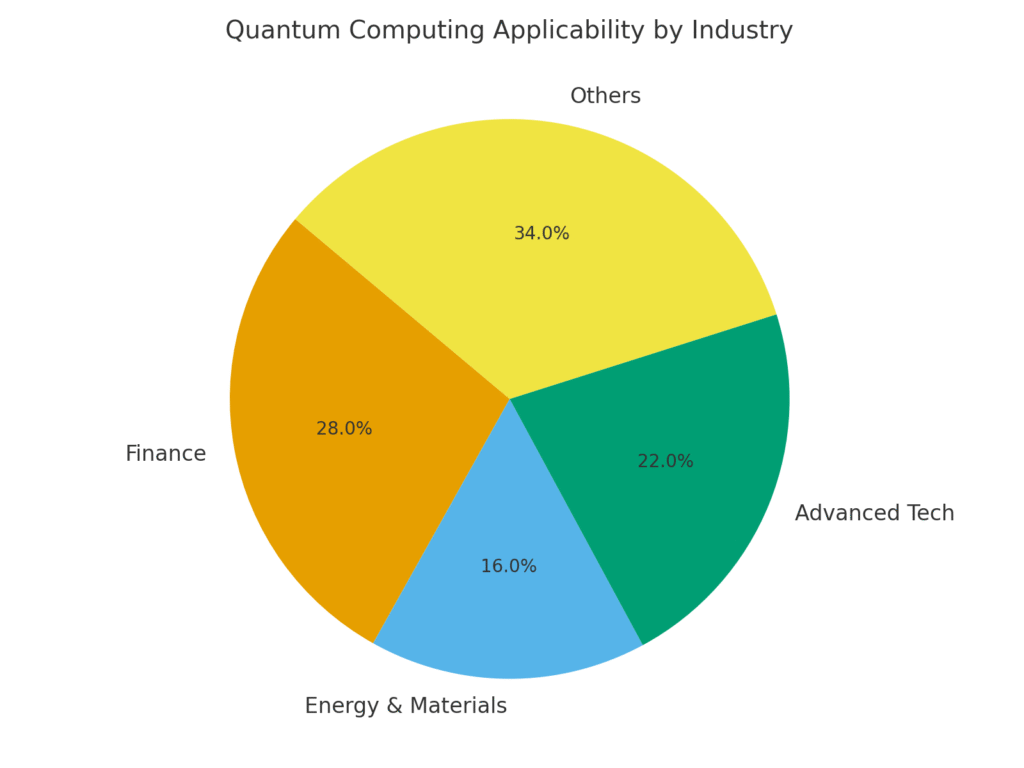
Roughly 28% of quantum applications are focused on the financial sector. Energy and materials industries account for another 16%. Finance’s lead reflects quantum’s strengths in optimization and risk analysis. For marketers, this makes finance a natural focal point for use-case demonstrations. It also signals where demand for messaging and solutions will likely be strongest.
Quantum Computing Marketing Statistics #10: Up To 5,000 Quantum Computers By 2030
Forecasts suggest there could be between 2,000 and 5,000 quantum computers in use globally by 2030. While small compared to classical machines, each system carries immense value and capability. For marketers, these numbers emphasize exclusivity and scarcity. Owning or accessing quantum hardware becomes a competitive differentiator. Campaigns can highlight access as a privilege of forward-thinking organizations.
Quantum Computing Marketing Statistics #11: Demand For 10,000 Quantum Professionals By 2025
Industry demand for quantum-skilled workers could reach 10,000 by 2025. However, the supply may fall short at less than 5,000. This talent gap poses both challenges and opportunities. Marketers can position brands as supportive of education, training, and workforce development. Highlighting investment in talent can become a powerful differentiator in campaigns.
Quantum Computing Marketing Statistics #12: North America Held 43.86% Share In 2024
North America accounted for 43.86% of the global market in 2024. This dominance is driven by strong R&D and private sector investments. For marketers, this highlights the region as a leader in adoption and innovation. It’s an opportunity to showcase success stories tied to American companies. Campaigns can emphasize leadership, competitiveness, and global influence.
Quantum Computing Marketing Statistics #13: Healthcare Is Among Fastest-Growing End-Users
Healthcare is projected to be one of the fastest-growing sectors for quantum adoption. From drug discovery to personalized medicine, the applications are vast. Marketers can tell compelling stories about how quantum is saving lives. Human-centered campaigns resonate strongly when tied to healthcare advancements. This makes it one of the most emotionally powerful industries to highlight.
Quantum Computing Marketing Statistics #14: 51% Believe Progress Is Faster Than Expected
A Deloitte survey found that 51% of global respondents feel quantum progress is outpacing their expectations. Another 33% worry their organizations might be caught off-guard. For marketers, this represents an urgency narrative—adapt now or risk falling behind. Positioning quantum as “sooner than you think” can be highly persuasive. It plays directly into fear-of-missing-out psychology in business decision-making.
Quantum Computing Marketing Statistics #15: IonQ And D-Wave Project Millions In Revenue For 2025
IonQ projected revenue between $82 million and $100 million in 2025. D-Wave expected around $36 to $41 million. These early commercialization figures show the market is still young but growing. For marketers, these numbers provide tangible proof of real revenue streams. Highlighting pioneer companies helps ground abstract technology in real business outcomes.
Quantum Computing Marketing Statistics #16: Quantum Sensing Generated $375 Million In 2024
Quantum sensing, a related technology, reached $375 million in revenues in 2024. This demonstrates the value of the wider quantum ecosystem. For marketers, it’s a reminder not to limit messaging to computing alone. Quantum as a whole encompasses multiple interconnected opportunities. This broader framing can attract a more diverse audience.
Quantum Computing Marketing Statistics #17: U.S. Produces 34% Of Top Research Papers
The U.S. leads the world with 34% of the most-cited quantum computing research papers. China follows with 16%, showing global competition in academia. For marketers, this reinforces the narrative of U.S. leadership in intellectual contributions. It’s also an opportunity to tie brands to world-class innovation hubs. Associating with top research builds authority and trust.
Quantum Computing Marketing Statistics #18: Europe Held 33.84% Market Share In 2024
Europe controlled 33.84% of the market share by revenue in 2024. The region has been proactive in regulation and funding for quantum technologies. For marketers, Europe’s position provides a strong base for regional campaigns. Companies can highlight compliance, sustainability, and innovation in messaging. These themes resonate particularly well with European business culture.
Quantum Computing Marketing Statistics #19: Optimization Segment Leads Applications
Optimization use cases dominate quantum computing applications in 2024. From logistics to portfolio management, optimization problems are central to many industries. For marketers, this offers a clear entry point for storytelling. Campaigns can highlight relatable scenarios like reducing delivery times or boosting efficiency. Practical use cases make abstract technology feel accessible.
Quantum Computing Marketing Statistics #20: On-Premises Deployment Holds Largest Share
On-premises quantum systems accounted for the largest revenue share in 2024. This reflects early adopters’ preference for control, security, and exclusivity. For marketers, it’s a chance to frame on-premises systems as premium solutions. Messaging can emphasize reliability and independence from third-party providers. It appeals strongly to sectors like finance and defense where trust and control are paramount.
Wrapping It Up: Why These Numbers Matter
Looking over these statistics, I can’t help but feel excited about what’s ahead. For me, it’s not just about the revenue growth or market size; it’s about how quantum computing is slowly reshaping the way we think about technology and marketing together. The pace is fast, and it’s easy to feel like you’re behind—but that’s also what makes diving into this space so thrilling. My takeaway? If we lean into these insights with curiosity and creativity, we’ll be ready for the changes coming sooner than we expect. And I, for one, can’t wait to see how this journey unfolds.
SOURCES
https://www.marketsandmarkets.com/Market-Reports/quantum-computing-market-144888301.html
https://blog.colobridge.net/en/2025/05/state-of-the-quantum-technology-industry-en/
https://patentpc.com/blog/quantum-computing-market-growth-key-stats-you-must-know
https://www.constellationr.com/blog-news/insights/2025-year-quantum-computing-already
https://martech.org/what-potential-does-quantum-computing-hold-for-marketers/
https://quantumconsortium.org/publication/2025-market-forecast-quantum-computing/
https://www.azure.microsoft.com/en-us/blog/quantum/2025/01/14/2025-the-year-to-become-quantum-ready/
https://www.nextmsc.com/blogs/whats-driving-the-quantum-chip-market-in-2025