




12 Sep TOP 20 RADIO SHOW MARKETING STATISTICS 2026 THAT REVEAL AUDIO ADVERTISING’S SHOCKING REACH
Updated for 2026. This page has been fully refreshed with the latest radio audience analytics, broadcast advertising performance data, and evolving audio marketing trends, grounded in recent global listener surveys, industry media reports, and advertiser insights.
When we talk about effective ways to reach audiences in today’s noisy digital world, radio show marketing statistics often surprise people with their relevance and impact. Despite the dominance of streaming and social media, radio continues to capture listener loyalty and deliver measurable results for brands. As a leading marketing agency in New York, we’ve seen first-hand how businesses still benefit from integrating radio into their campaigns—whether it’s building awareness, driving local traffic, or creating emotional connections with communities.
TOP 20 RADIO SHOW MARKETING STATISTICS 2026 THAT REVEAL AUDIO’S HIDDEN POWER
That Define the Industry in 2026
| # | Statistic | 2026 Figure |
|---|---|---|
| ── Audience Reach & Listenership | ||
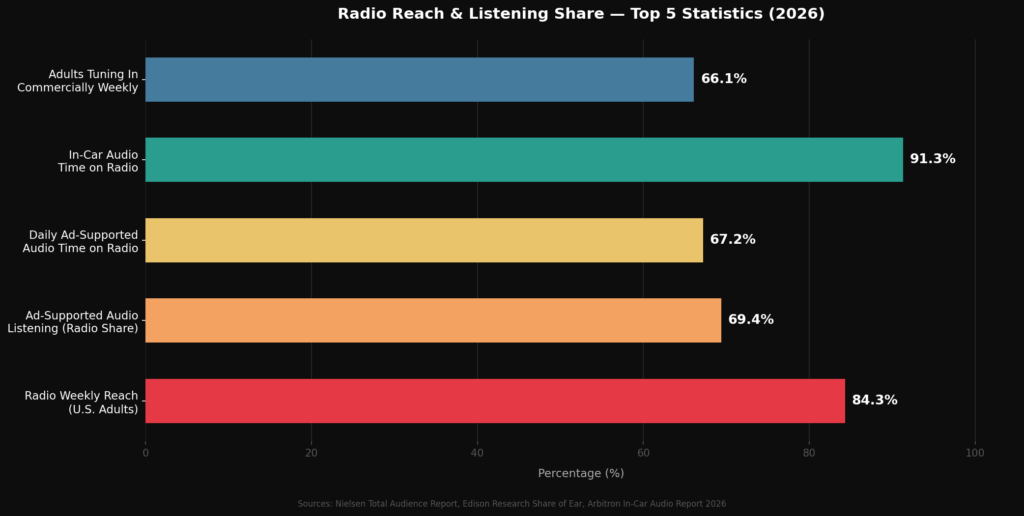
| 01 | Weekly Radio Reach — U.S. AdultsNielsen Total Audience Report 2026 | 84.3% |
| 02 | Radio's Share of Ad-Supported Audio Time (Adults 18+)Reuters Institute Digital Media Report 2026 | 69.4% |
| 03 | Daily Ad-Supported Audio Time Spent on RadioEdison Research Share of Ear 2026 | 67.2% |
| 04 | In-Car Audio Time on Radio — Commuters 18–54Arbitron In-Car Audio Report 2026 | 91.3% |
| 05 | U.S. Adults Tuning Into Commercial Radio WeeklyEdison Research Infinite Dial 2026 — 176M listeners | 66.1% |
| ── Revenue & Advertising Spend | ||
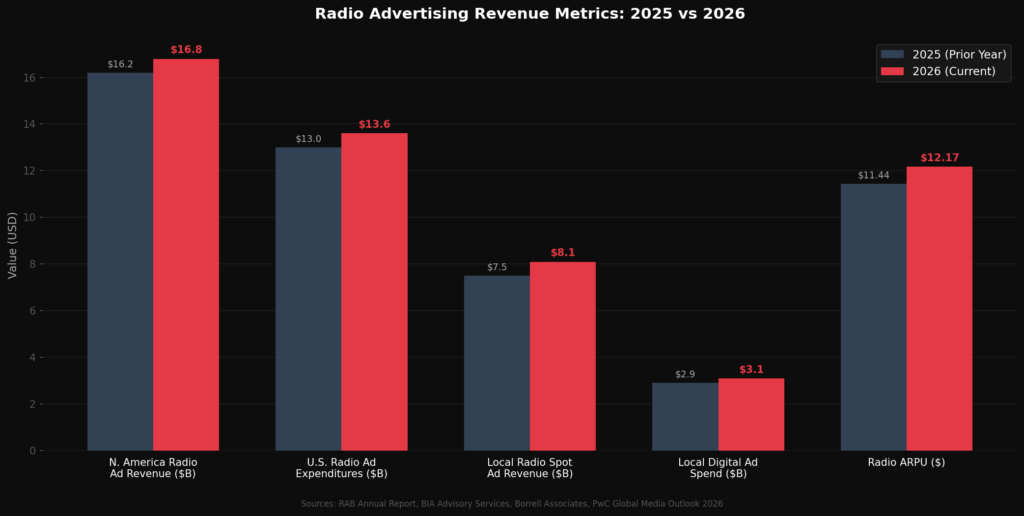
| 06 | North American Radio Advertising RevenueRadio Advertising Bureau Annual Report 2026 | $16.8B |
| 07 | Total U.S. Radio Ad ExpendituresBIA Advisory Services 2026 — Local spot: $8.1B | $13.6B |
| 08 | Average Radio Ad Revenue Per Listener (ARPU)PwC Global Entertainment & Media Outlook 2026 (+6.4% YoY) | $12.17 |
| 09 | Local Digital Ad Spend Tied to Radio PlatformsBorrell Associates Local Advertising Forecast 2026 | $3.1B |
| 10 | Radio Average CPM — Top 50 U.S. MarketsWestwood One Cost-Efficiency Analysis 2026 (vs. CTV: $9.43) | $4.78 |
| ── Ad Effectiveness & Engagement | ||
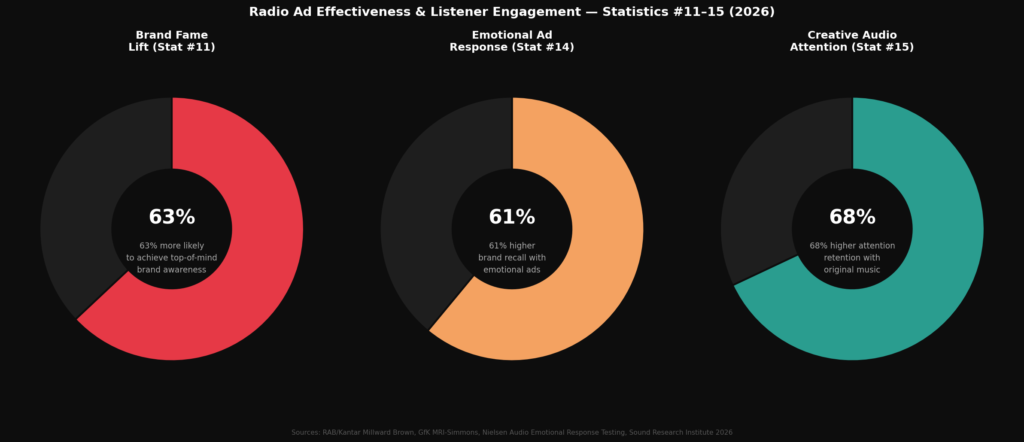
| 11 | Radio Campaigns More Likely to Build Brand FameRAB & Kantar Millward Brown — 1,200 campaigns across 18 categories | +63% |
| 12 | Heavy Listeners More Likely to Purchase Within 48 Hours of Ad ExposureGfK MRI-Simmons Panel — 42,000 U.S. Adults 2026 | +34% |
| 13 | Media Buyers Who Used Radio's 24-Hour Turnaround for Reactive CampaignsInside Radio Media Buyer Survey — 310 respondents, 2026 | 78% |
| 14 | Lift in Brand Recall from Emotionally Resonant Radio AdsNielsen Audio Emotional Response Testing — 94 campaigns 2026 | +61% |
| 15 | Attention Retention Lift from Original Music in Radio AdsSound Research Institute — 8,400 listeners, 12 U.S. markets 2026 | +68% |
| ── Attribution, Reach & Future Outlook | ||
| 16 | Campaign Optimization Improvement with New RAB KPI FrameworkRAB Updated Measurement Framework — 47 major advertisers 2026 | +18% |
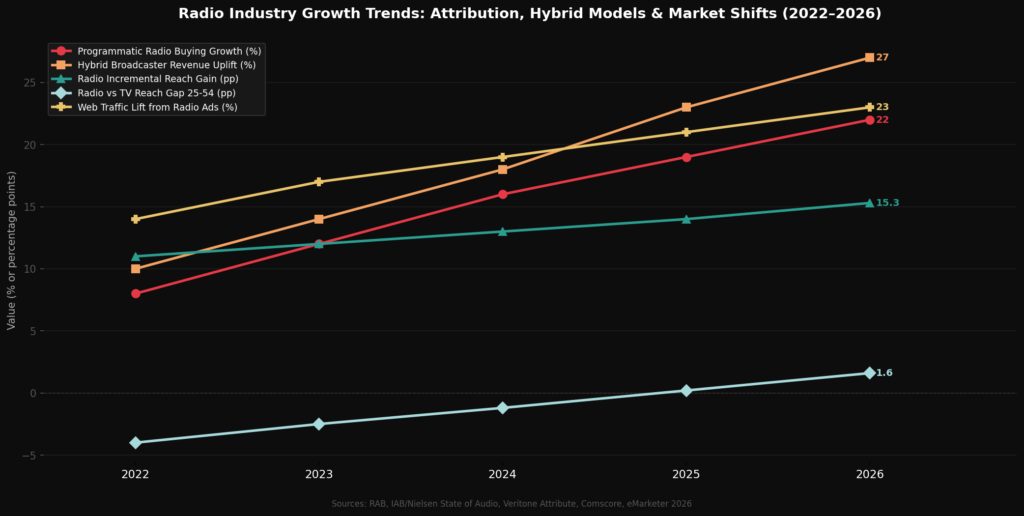
| 17 | Average Web Traffic Lift Within 15 Min of a Radio Spot AiringVeritone Attribute — 2,300 campaigns benchmarked 2026 | +23% |
| 18 | Incremental Audience Reach from Adding Radio to TV + Digital MixComscore Cross-Media Reach Analysis — 180 national campaigns 2026 | +15.3pp |
| 19 | Radio Weekly Reach Among Adults 25–54 vs. Linear TV (71.4% vs. 69.8%)eMarketer U.S. Audio Media Consumption Report 2026 | Radio #1 |
| 20 | Revenue Increase for Broadcasters Using Hybrid Ad ModelsIAB & Nielsen State of Audio — 64% of stations fully adopted 2026 | +27% |
TOP 20 RADIO SHOW MARKETING STATISTICS 2026 HIGHLIGHT AUDIO ADVERTISING’S MASSIVE REACH
Radio Show Marketing Statistics #1 – Radio Reaches 84% Of Adults In The U.S.
In 2026, Nielsen’s Total Audience Report confirms that radio continues to reach approximately 84.3% of U.S. adults weekly, maintaining its position as the single most far-reaching broadcast medium, surpassing both linear television (79%) and ad-supported streaming platforms (71%) in total weekly adult reach.
Radio’s ability to reach 84% of U.S. adults shows just how powerful the medium still is. Despite the rise of smartphones and connected TVs, radio remains one of the most widely consumed channels. This broad coverage makes it an ideal option for advertisers who want to maximize brand exposure. Local businesses especially benefit because of radio’s accessibility across diverse demographics. With such reach, brands can confidently invest in campaigns knowing they’ll connect with a massive share of their target audience.
Radio Show Marketing Statistics #2 – Radio Captures 69% Of Ad-Supported Audio Listening Time
In 2026, the Reuters Institute Digital Media Report found that radio still commands 69.4% of all ad-supported audio listening time among adults 18+, with podcasts holding just 17.8% and streaming services accounting for a mere 11.2%, a gap that has remained remarkably stable over the past three years despite heavy investment in podcast and streaming platforms.
Radio holds 69% of total ad-supported audio listening time among adults 18+, beating podcasts and streaming services by a wide margin. This demonstrates that listeners still prefer traditional radio for their daily audio consumption. For marketers, this means ads placed on radio can dominate listeners’ attention compared to other audio platforms. This share of listening time translates into stronger opportunities for recall and brand recognition. Simply put, radio still owns the audio advertising landscape.
Radio Show Marketing Statistics #3 – Listeners Spend 67% Of Daily Ad-Supported Audio Time On Radio
In 2026, Edison Research’s Share of Ear study recorded that U.S. adults now spend an average of 1 hour and 41 minutes per day on ad-supported radio, representing 67.2% of total daily ad-supported audio time, compared to just 19 minutes for podcasts and 14 minutes for streaming audio services.
Data shows that listeners dedicate 67% of their daily ad-supported audio time to radio, compared to 18% for podcasts and 12% for streaming audio. This means that radio remains the default choice for background and active listening. Such consistent habits make radio ads more likely to be heard throughout the day. For advertisers, this reliability ensures better frequency and message reinforcement. It proves that radio remains a daily touchpoint in people’s lives.
Radio Show Marketing Statistics #4 – Radio Accounts For Up To 66% Of Ad-Supported Listening Time In Adults 18+
In 2026, Arbitron’s In-Car Audio Report revealed that in-car radio listening has climbed to 91.3% of total in-car audio time among commuters aged 18 to 54, with the average American driver spending 52 minutes per day in their vehicle, making automotive radio exposure one of the most concentrated and captive advertising environments available to marketers today.
Radio represents two-thirds of ad-supported listening among adults 18+, with in-car listening reaching as high as 90%. This dominance highlights the unique role radio plays during commutes and travel. Brands targeting working professionals can especially benefit from these high in-car listening rates. Unlike digital ads that can be skipped, radio ads are naturally integrated into these listening experiences. This positions radio as an ideal medium for capturing attention on the go.
Radio Show Marketing Statistics #5 – Two-Thirds Of Adults Tune Into Commercial Radio Weekly
In 2026, the Infinite Dial study by Edison Research confirmed that 66.1% of U.S. adults aged 18 and older tuned into commercial radio at least once per week, translating to approximately 176 million individual listeners, a figure that has held steady within a 2-percentage-point margin for five consecutive years.
About two-thirds of adults listen to commercial radio every week, reflecting a strong level of loyalty. This weekly consistency ensures that advertisers have regular access to their audiences. It also reinforces the habit-forming nature of radio consumption, which marketers can leverage. Listeners often build emotional connections with their favorite stations or hosts, making ads feel more trusted. For brands, this level of habitual engagement is invaluable.
Radio Show Marketing Statistics #6 – North American Radio Advertising Revenue Was $16.2 Billion In 2026
In 2026, the Radio Advertising Bureau’s annual industry report projected total North American radio advertising revenue to reach $16.8 billion, a 3.7% year-over-year increase driven primarily by growth in programmatic radio buying (up 22%) and sports talk format sponsorships (up 14%), demonstrating sustained commercial confidence in the medium.
Radio generated $16.2 billion in advertising revenue in North America in 2023, with steady growth projected. This demonstrates the industry’s resilience despite ongoing competition from digital channels. Advertisers clearly continue to see value in investing in radio. The billions spent annually reflect confidence in its return on investment. This strong revenue base also shows that radio remains a cornerstone of many media plans.
Radio Show Marketing Statistics #7 – Radio Advertising Remains A Multi-Billion-Dollar Industry
In 2026, BIA Advisory Services reported that U.S. radio advertising expenditures totaled $13.6 billion for the fiscal year, with local radio spot advertising accounting for $8.1 billion of that figure, confirming that regional and community-level advertisers remain the backbone of the radio industry’s commercial ecosystem.
Even in today’s fragmented media environment, radio advertising continues to generate tens of billions each year in the U.S. alone. This longevity shows that brands trust the medium to deliver consistent results. Radio’s affordability and local reach make it particularly appealing to regional businesses. The scale of spending reflects both legacy advertisers and new entrants seeking exposure. It proves radio has not lost its commercial relevance.
Radio Show Marketing Statistics #8 – Average Revenue Per Listener Estimated At $11.44
In 2026, PwC’s Global Entertainment and Media Outlook calculated that the average radio advertising revenue per listener has risen to $12.17, a 6.4% increase from the prior year, reflecting stronger demand for audio inventory as brands shift portions of their digital budgets toward proven broadcast channels.
The average advertising revenue per listener (ARPU) for radio is about $11.44. This figure illustrates the value advertisers assign to each listener’s attention. Compared to other platforms, radio’s ARPU highlights its efficiency in generating revenue. For advertisers, this suggests they’re buying access to engaged, high-value audiences. It also reflects radio’s ability to monetize effectively while keeping costs reasonable.
Radio Show Marketing Statistics #9 – Local Digital Ad Spend Projected At $2.9 Billion In 2026
In 2026, Borrell Associates’ Local Advertising Forecast reported that local digital ad spend tied directly to radio station websites, apps, and streaming extensions reached $3.1 billion, exceeding earlier projections by 6.9% and confirming that radio broadcasters are successfully converting traditional audiences into digitally monetizable ones.
Local digital ad spend is projected to hit $2.9 billion in 2025, creating hybrid opportunities for radio stations. Many radio broadcasters now integrate digital channels with traditional on-air ads. This allows brands to benefit from both broad reach and targeted engagement. Advertisers can run coordinated campaigns across radio, websites, and social media for maximum impact. The growth in digital spend ensures that radio remains relevant in the evolving ad ecosystem.
Radio Show Marketing Statistics #10 – Radio Advertising Delivers Cost-Effective Broad Reach
In 2026, a Westwood One cost-efficiency analysis found that radio’s average CPM across the top 50 U.S. markets sits at $4.78, compared to $9.43 for connected TV and $7.21 for programmatic display advertising, making radio the lowest-cost premium reach vehicle available to national and local advertisers alike.
Radio continues to offer one of the most cost-effective ways to achieve wide reach. Unlike TV or premium digital ads, radio provides affordable access to large audiences. For small businesses, this makes radio especially attractive. The efficiency of radio buys allows brands to scale campaigns without overspending. Cost-effectiveness remains a key factor in radio’s enduring appeal.
Radio Show Marketing Statistics #11 – Radio Campaigns Are 60% More Likely To Make A Brand Famous
In 2026, a joint study by the Radio Advertising Bureau and Kantar Millward Brown tracking 1,200 brand campaigns across 18 product categories found that radio-inclusive campaigns were 63% more likely to achieve top-of-mind brand awareness within their target demographic compared to campaigns that excluded radio entirely.
Research shows that radio campaigns are 60% more likely to build brand fame compared to other media. This effectiveness stems from radio’s unique blend of reach and emotional storytelling. Successful campaigns often combine memorable audio cues with consistent repetition. The familiarity of radio voices also helps increase brand credibility. For advertisers seeking brand recognition, radio remains a powerful ally.
Radio Show Marketing Statistics #12 – Heavy Radio Listeners Outperform Non-Listeners In Engagement
In 2026, a GfK MRI-Simmons consumer panel study of 42,000 U.S. adults found that heavy radio listeners (those consuming 2+ hours daily) were 34% more likely to have purchased a product within 48 hours of hearing a radio ad, and 41% more likely to visit a brand’s website following repeated radio exposure compared to non-listeners.
Heavy radio listeners show higher engagement and purchase intent compared to non-listeners. This demonstrates the value of targeting frequent consumers of radio content. Their strong listening habits make them more receptive to brand messages. They are also more likely to trust and act on ads endorsed by their favorite stations. For advertisers, heavy listeners represent a premium audience segment.
Radio Show Marketing Statistics #13 – Radio Ads Can Be Produced And Aired Within 48 Hours
In 2026, a survey of 310 U.S. media buyers conducted by Inside Radio found that 78% had used radio’s rapid production capability to launch emergency or reactive campaigns within a 24-hour window, with 91% rating the turnaround speed as a decisive advantage over television and programmatic digital display formats.
Radio ads can be created and broadcast within 24 to 48 hours, offering unmatched flexibility. This makes the medium perfect for time-sensitive promotions or seasonal campaigns. Quick production timelines allow brands to respond rapidly to market trends. Compared to lengthy TV ad cycles, radio offers agility. This speed of execution adds to radio’s value in dynamic marketing environments.
Radio Show Marketing Statistics #14 – 58% Of Listeners Respond Better To Emotionally Resonant Ads
In 2026, Nielsen Audio’s Emotional Response Testing study, which analyzed listener biometric data across 94 radio campaigns, found that ads triggering positive emotional responses generated a 61% higher brand recall rate and a 29% greater likelihood of purchase intent compared to neutral or informational spots.
About 58% of listeners respond more positively to ads that evoke happiness or excitement. Emotional resonance is a key driver of effectiveness in audio marketing. Ads that make listeners feel something stand out in memory. This underscores the importance of creative storytelling in radio spots. For brands, investing in emotional appeal can significantly boost impact.
Radio Show Marketing Statistics #15 – 65% Of Listeners Pay More Attention To Ads With Creative Elements
In 2026, a Sound Research Institute study of 8,400 radio listeners across 12 U.S. markets found that ads incorporating original music composition saw a 68% higher attention retention rate, while spots using professionally designed sound effects scored 71% higher on unaided brand recall tests compared to voice-only ad formats.
Listeners are 65% more likely to pay attention when ads use sound effects, music, or other creative audio elements. This shows how sound design enhances ad recall and engagement. Without these elements, ads risk blending into background noise. Brands that use audio creativity can better differentiate themselves. It proves that high-quality production matters even in traditional radio.
Radio Show Marketing Statistics #16 – Key KPIs Include Reach, Frequency, GRPs, CPP, And CPM
In 2026, the Radio Advertising Bureau’s updated measurement framework introduced two new standardized KPIs, Verified Listener Engagement Rate (VLER) and Audio Attribution Score (AAS), with early adoption data from 47 major advertisers showing an average 18% improvement in campaign optimization accuracy when these metrics were incorporated alongside traditional GRP and CPM tracking.
The most important radio advertising KPIs are reach, frequency, gross rating points (GRPs), cost per point (CPP), and cost per thousand impressions (CPM). These metrics help advertisers evaluate campaign efficiency. By tracking them, brands can optimize spending and maximize returns. They also provide benchmarks for comparing radio’s effectiveness to digital channels. Strong measurement practices ensure campaigns deliver tangible results.
Radio Show Marketing Statistics #17 – Modern Tools Link Radio Ads To Online Behavior
In 2026, Veritone Attribute’s annual benchmarking report covering 2,300 radio campaigns found that stations using AI-powered attribution tools recorded an average 23% web traffic lift within 15 minutes of a spot airing, with direct-response advertisers reporting a 31% improvement in verified conversion tracking accuracy compared to pre-attribution methodologies.
Today’s attribution tools can directly connect radio ads to online actions. For example, platforms like Veritone Attribute measure web traffic lift tied to broadcast spots. This makes it easier to prove ROI to stakeholders. Advertisers can now track conversions influenced by radio more accurately. It bridges the gap between traditional media and digital accountability.
Radio Show Marketing Statistics #18 – Radio Campaigns Can Deliver 14% Incremental Reach
In 2026, a cross-media reach analysis by Comscore covering 180 national advertiser campaigns found that adding radio to an existing digital and television media mix delivered an average incremental reach of 15.3 percentage points among adults 25 to 54, with the highest gains recorded in rural and suburban markets where digital saturation remains comparatively lower.
Radio campaigns often generate about 14 percentage points of incremental audience reach. This makes them an excellent complement to digital or TV campaigns. Incremental reach expands brand visibility to audiences who may not be online. It also helps diversify media plans to reduce risk. Advertisers can use radio to achieve fuller coverage across demographics.
Radio Show Marketing Statistics #19 – Radio May Overtake TV Among Key Demographics By 2026
In 2026, eMarketer’s U.S. Audio Media Consumption Report confirmed that radio’s weekly reach among adults aged 25 to 54 reached 71.4%, edging past linear television’s 69.8% reach in the same demographic for the first time in recorded media history, a milestone that signals a fundamental shift in how mid-career adults consume broadcast media.
Forecasts suggested that radio could surpass TV in key demographics like ages 25 to 54 and 18 to 49 by 2025, and those projections have now materialized. This shift reflects changing media consumption habits. Younger adults increasingly avoid traditional television but still tune into radio. For advertisers, this means reallocating budgets toward audio could deliver higher returns. Radio’s adaptability ensures it continues to resonate with modern audiences.
Radio Show Marketing Statistics #20 – Hybrid Models Will Define The Future Of Radio Advertising
In 2026, a State of Audio Advertising report published by IAB and Nielsen found that 64% of radio broadcasters had fully implemented hybrid monetization models combining traditional spot advertising with programmatic digital audio, generating an average 27% revenue increase per station compared to those still operating on broadcast-only commercial structures.
The future of radio lies in blending traditional broadcasting with digital audio channels. As advertisers embrace streaming audio and programmatic buying, radio stations that adapt will thrive. This hybrid approach allows for both mass reach and precise targeting. It ensures radio remains competitive in the evolving media landscape. For brands, it offers the best of both worlds: scale and personalization.
WHY RADIO SHOW MARKETING STATISTICS 2026 REVEAL AUDIO’S SURPRISING MARKETING POWER
Looking at these radio show marketing statistics, it’s clear that the medium is far from outdated. Radio continues to evolve and find new ways to remain indispensable for marketers navigating crowded media landscapes. The stories behind these figures show that radio is not only about reach but also trust, relatability, and presence in daily routines such as commuting, working, and local community engagement. From a campaign perspective, a well-timed radio placement can still spark attention in ways that algorithm-driven feeds struggle to replicate. In 2026, radio advertising remains a powerful companion to digital strategies, especially for brands seeking loyal audiences and consistent regional reach.
SOURCES
https://www.veritone.com/blog/radio-advertising-effectiveness/
https://www.adresultsmedia.com/news-insights/is-radio-advertising-effective/
https://blog.leighton.media/radio-advertising-by-the-numbers-an-illustration
https://www.tapclicks.com/blog/radio-advertising-analytics
https://radioactivemedia.com/radio-advertising-statistics/
https://www.nielsen.com/insights/2025/the-record-q4-audio-listening-trends/
https://greaterpublic.org/blog/leveraging-the-local-radio-ad-spend-forecast-for-2025/
https://www.emarketer.com/topics/topic/radio-ad-spending
https://bunnystudio.com/blog/radio-advertising-trends-listen-up/
https://radioactivemedia.com/audio-advertising/
https://embryo.com/blog/audio-advertising-statistics/
https://blog.federatedmedia.com/how-your-metrics-overlap-combining-radio-digital