




27 Sep TOP 20 RAIL DELIVERY MARKETING STATISTICS 2025
When I started diving into rail delivery marketing statistics, I realized just how massive and fast-growing this sector is. Rail has always been a backbone of trade, but with sustainability, intermodal growth, and shifting consumer expectations, it’s now evolving faster than ever. As someone passionate about marketing insights, I find that these numbers don’t just represent industry performance — they also show opportunities for businesses to tell better stories and reach the right audiences. In partnership with a leading marketing agency in New York, I want to highlight the most important figures that help us understand where the rail delivery industry is heading. These insights give me clarity and inspiration to approach campaigns with data-driven confidence.
Top 20 Rail Delivery Marketing Statistics 2025 (Editor’s Choice)
🚢 Top 20 Sea Delivery Marketing Statistics 2025
Key Insights Driving the Global Maritime Shipping Industry
| # | Statistic | Category | Description |
|---|---|---|---|
| 1 | $599.78B | Market Size | Expected maritime freight transport market value in 2025, growing at 5.5% CAGR to reach $783.94B by 2030 |
| 2 | $17.4B | Market Growth | Global cargo shipping market revenue in 2025, projected to reach $24.18B by 2033 at 4.2% CAGR |
| 3 | 80%+ | Trade Volume | Maritime transport moves over 80% of goods traded worldwide by volume |
| 4 | 3.0-4.0% | Container Growth | Expected growth in container volumes for 2025 |
| 5 | 38% | Regional Share | Asia-Pacific's share of 2024 maritime freight revenue, making it the fastest-growing region |
| 6 | 63% | Regional Dominance | Asia's share of global container trade handling |
| 7 | 95% | Shipbuilding | China, Japan, and Republic of Korea's share of global shipbuilding output in 2023 |
| 8 | 71% | Orderbook Share | China's share of total cargo-carrying vessel newbuilding orderbook in 2024 |
| 9 | 29% | Segment Share | Dry bulk's share of maritime freight transport market size in 2024 |
| 10 | 40% | Container Share | Containerized cargo's share of total seaborne trade volume in 2023 |
| 11 | 41.28% | Revenue Share | Bulk carriers' revenue share in cargo shipping market in 2024 |
| 12 | -76% | Disruption Impact | Reduction in ship capacity (tonnage) crossing the Gulf of Aden due to Red Sea crisis |
| 13 | -70% | Route Disruption | Reduction in tonnage transiting the Suez Canal by mid-2024 |
| 14 | +89% | Route Shift | Surge in Cape of Good Hope arrivals due to Red Sea diversions |
| 15 | $7B Loss | Revenue Impact | Estimated reduction in Suez Canal transit revenues for 2024 due to Houthi attacks |
| 16 | 30M TEU | Fleet Capacity | Global container fleet capacity surpassed in 2024 after 1+ million TEU deliveries |
| 17 | 8% vs 3% | Supply-Demand | Expected increase in shipping capacity in 2025 (8%) versus demand growth (3%) |
| 18 | 5M TEU | Port Throughput | Record container throughput processed by Shanghai in January 2025 |
| 19 | 55% | Digital Transform | Large shippers that have deployed at least two AI applications, cutting documentation lead time by 60% |
| 20 | $6.4T | E-commerce | Projected global e-commerce sales in 2025, driving demand for faster shipping services |
Top 20 Rail Delivery Marketing Statistics 2025
Rail Delivery Marketing Statistics #1 – Global Rail Logistics Market Size At USD 372.77 Billion (2024)
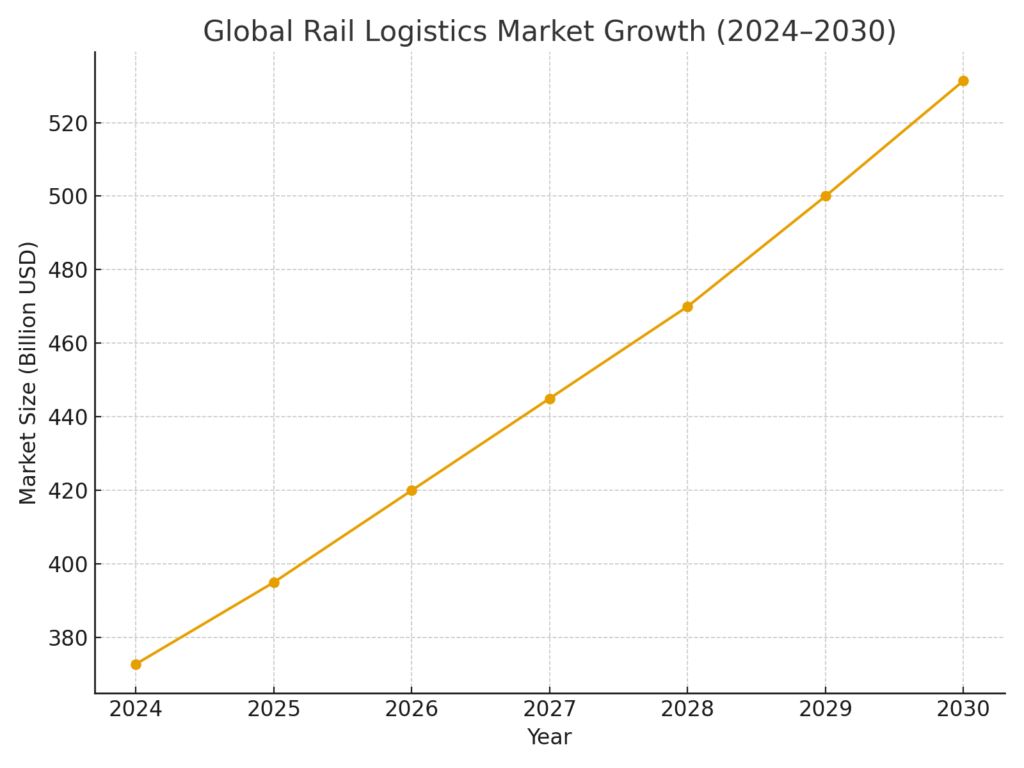
The global rail logistics market size reached USD 372.77 billion in 2024. This massive figure highlights the role of rail as a critical transportation mode worldwide. For marketers, this means there is an expansive market to target with solutions that enhance efficiency and sustainability. Companies in logistics, technology, and infrastructure can leverage this size to build trust with clients. It also underlines how rail is positioned as a long-term investment opportunity.
Rail Delivery Marketing Statistics #2 – Projected CAGR Of 6.6% (2025–2030)
The market is projected to grow at a CAGR of 6.6% between 2025 and 2030. This growth trajectory signals expanding opportunities for innovation and customer acquisition. Businesses that market green solutions or digital tracking technologies can ride this wave effectively. The steady CAGR also reassures stakeholders about long-term stability in the sector. From a marketing angle, highlighting this momentum helps strengthen industry credibility.
Rail Delivery Marketing Statistics #3 – Forecast Market Size Of USD 531.37 Billion (2030)
By 2030, the rail logistics market is expected to reach USD 531.37 billion. This future forecast creates room for businesses to plan ambitious marketing and growth strategies. It suggests that rail delivery services will become even more central in supply chains worldwide. For marketers, this figure can be used to attract investors and clients by emphasizing scalability. It’s a clear sign of confidence in rail as an evolving transport solution.
Rail Delivery Marketing Statistics #4 – Rail Freight Market Value At USD 326.09 Billion (2025 Estimate)
The rail freight transport market alone is estimated at USD 326.09 billion in 2025. This figure shows the direct business potential of freight compared to other transport segments. It also highlights rail’s relevance in moving goods across borders efficiently. Marketing campaigns can use this number to demonstrate market size and resilience. Clients benefit from knowing they’re investing in a thriving sector.
Rail Delivery Marketing Statistics #5 – Projected Rail Freight Market Size At USD 405.76 Billion (2030)
By 2030, the rail freight market is forecast to hit USD 405.76 billion. This projection reinforces the idea that freight remains the dominant use of rail delivery. It also highlights ongoing demand from industries like mining, agriculture, and retail. Marketers can position rail as not just reliable but also as the backbone of large-scale supply chains. These insights allow for smarter targeting of high-value industries.
Rail Delivery Marketing Statistics #6 – Intermodal Freight Growth At 6.2% CAGR
Intermodal containerized freight is expected to grow at 6.2% CAGR. This trend reflects how integrated solutions are becoming the standard for logistics. For businesses, it means the ability to market services that combine road, rail, and sea for ultimate flexibility. This stat also appeals to sustainability campaigns since intermodal often lowers emissions. For marketers, intermodal growth provides fresh angles to attract modern shippers.
Rail Delivery Marketing Statistics #7 – Dry Bulk Cargo Share At 41% In 2024
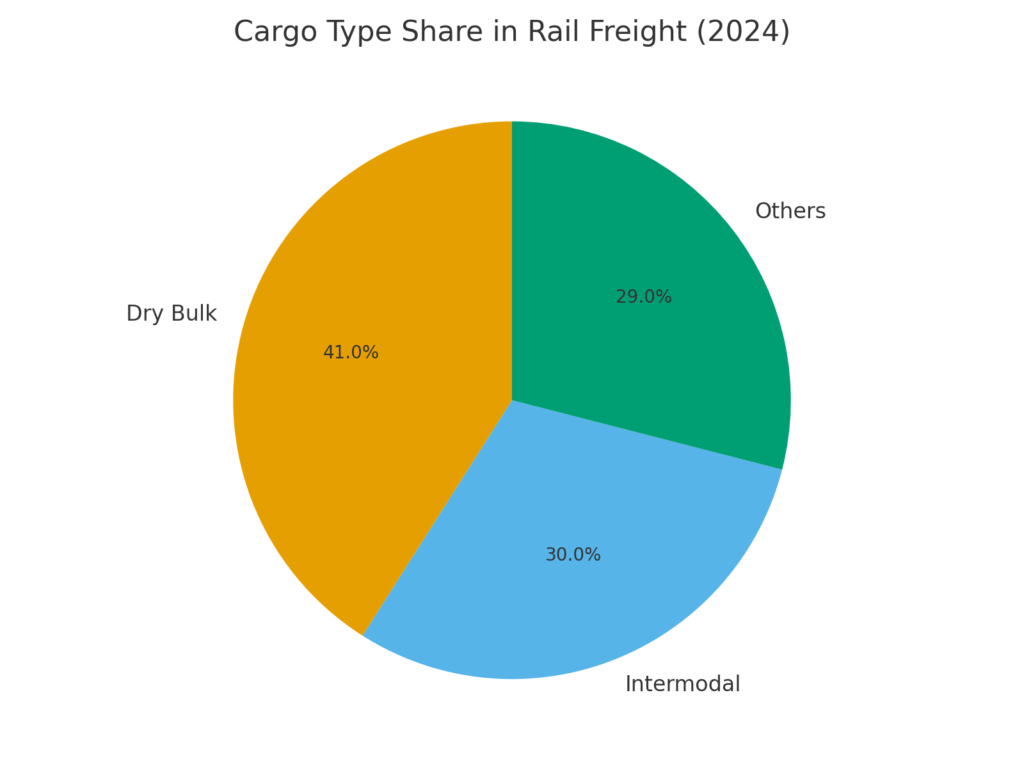
Dry bulk represented 41% of cargo transported by rail in 2024. This figure demonstrates how vital raw materials and agricultural goods are to the rail industry. Marketing efforts can be tailored around rail’s efficiency in moving bulk products. It also shows the importance of serving industries with large-volume needs. Businesses that align with these segments can create impactful campaigns by leveraging this stat.
Rail Delivery Marketing Statistics #8 – Retail & FMCG Growing At 7.9% CAGR (2025–2030)
The retail and FMCG sector is projected to grow at 7.9% CAGR in rail freight usage. This signals increased reliance on rail for consumer-driven industries. Marketers can highlight this trend when pitching solutions for fast-moving goods. It also reinforces how rail supports everyday consumer supply chains. Companies can use this stat to position themselves as partners in reliable consumer product delivery.
Rail Delivery Marketing Statistics #9 – Diesel Locomotives At 67% Market Share (2024)
In 2024, diesel locomotives accounted for 67% of the rail freight market. While traditional, this figure also highlights the ongoing transition to greener technologies. Marketers can frame this as both a current reality and an opportunity for innovation. Hybrid and hydrogen options growing at over 10% CAGR offer a strong sustainability message. Campaigns can target customers looking for both reliability and eco-friendly upgrades.
Rail Delivery Marketing Statistics #10 – Domestic Freight Movements At 61% In 2024
Domestic freight captured 61% of rail traffic in 2024. This shows rail’s dominance in internal trade and supply chains. Marketers can use this figure to promote rail as the most efficient domestic logistics option. It also suggests a vast market for companies catering to national infrastructure. This positioning allows rail delivery campaigns to appeal to businesses prioritizing consistency and cost savings.
Rail Delivery Marketing Statistics #11 – 5 U.S. Class I Railroads Account For 93% Of Freight Revenue
Five U.S. Class I railroads dominate with 93% of freight revenue. This concentration signals market stability but also high barriers to entry. For marketers, this means campaigns must focus on differentiation and added value. It’s a reminder that credibility and scale matter in this sector. Smaller players can use this statistic to frame themselves as innovative alternatives.
Rail Delivery Marketing Statistics #12 – U.S. Rail Freight Growth To USD 356.33 Billion By 2029
The U.S. rail freight market will grow from USD 272.09 billion in 2024 to USD 356.33 billion by 2029. This growth highlights the U.S. as a major market for rail delivery. For marketing teams, it’s an opportunity to target American businesses with tailored services. It also demonstrates the country’s reliance on rail for supply chain stability. Marketers can frame this expansion as proof of rail’s economic resilience.
Rail Delivery Marketing Statistics #13 – EU Freight Modal Share At 17.1% Rail
Rail accounts for 17.1% of freight in the European Union. Though smaller than road transport, this percentage shows significant reliance on rail in a competitive region. Marketing strategies can use this stat to highlight growth opportunities in Europe. It also demonstrates how environmental policies may push this number higher. Businesses offering sustainable solutions can leverage this to appeal to European clients.
Rail Delivery Marketing Statistics #14 – U.S. Coal Share At 43.3% Of Tonnage
Coal represented 43.3% of tonnage in U.S. rail freight. This dominance shows how energy and raw materials drive freight volumes. For marketers, it’s an opportunity to target industries dependent on bulk commodities. It also emphasizes rail’s reliability in moving heavy resources. Campaigns can connect this with the stability of supply chains across key industries.
Rail Delivery Marketing Statistics #15 – Average Haul Length Of 917 Miles (U.S.)
The average U.S. haul length for rail freight was about 917 miles. This figure highlights rail’s strength in long-distance delivery. Marketing campaigns can position rail as the go-to mode for efficient cross-country shipping. It also suggests cost efficiency at scale for businesses moving goods nationwide. Companies can use this stat to emphasize reliability across long supply chains.
Rail Delivery Marketing Statistics #16 – Asia-Pacific As Largest Rail Freight Market
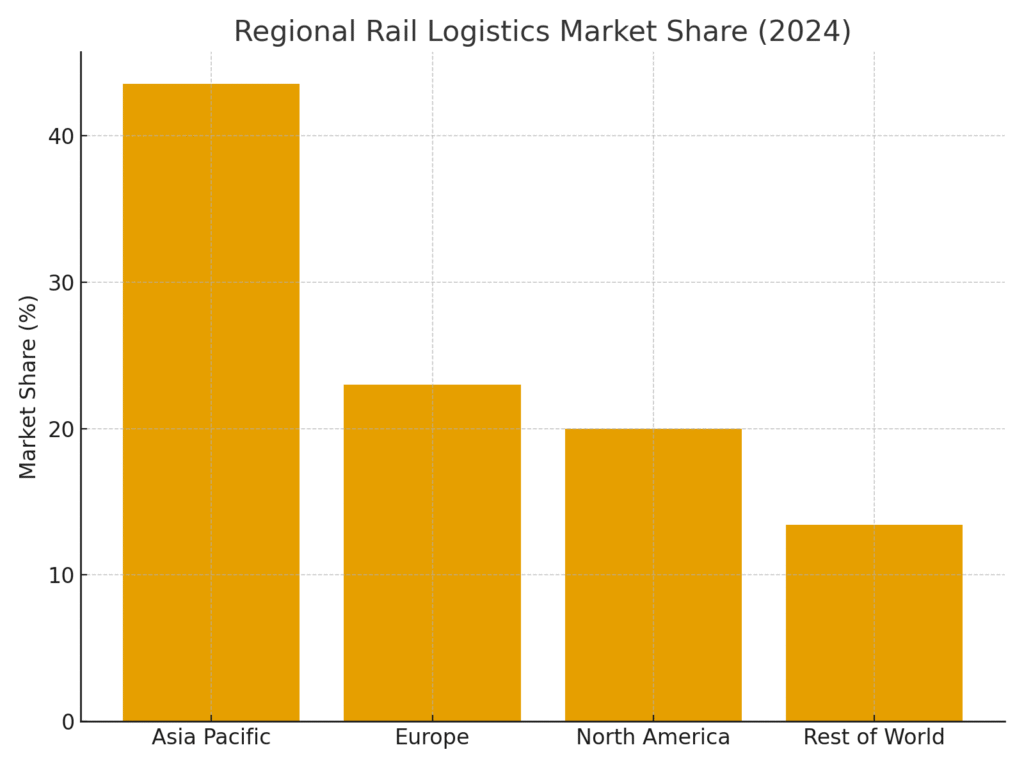
Asia-Pacific is the largest global market for rail freight. This dominance signals where businesses may find the greatest opportunities for expansion. Marketers can create campaigns targeting the dynamic growth in this region. It also highlights the role of industrialization and trade corridors. Companies expanding into Asia can leverage this insight in strategic communications.
Rail Delivery Marketing Statistics #17 – Asia Pacific Holding 43.56% Market Share In 2024
In 2024, Asia Pacific accounted for 43.56% of rail logistics revenue. This figure highlights the dominance of the region in shaping global trends. Marketing campaigns can emphasize Asia as a hub for innovation and growth. It also reflects investment opportunities in both infrastructure and digital logistics. Businesses can position themselves as leaders by associating with this regional dominance.
Rail Delivery Marketing Statistics #18 – Rail Logistics Forecast At USD 743.3 Billion By 2035
The rail logistics market is forecast to reach USD 743.3 billion by 2035. This long-term projection emphasizes steady growth potential. Marketing teams can use this figure to build confidence in long-term partnerships. It demonstrates rail’s resilience even decades ahead. Clients can be reassured that rail is a safe and strategic bet.
Rail Delivery Marketing Statistics #19 – Track & Signaling Costs Over 30% Of Infrastructure
Track and signaling costs represent over 30% of rail logistics infrastructure investment. This reveals where much of the spending and innovation opportunities lie. Marketers can highlight solutions that optimize or support these areas. It also shows the complexity of maintaining rail systems. Companies offering tech or service support can leverage this figure in B2B marketing.
Rail Delivery Marketing Statistics #20 – Mining & Metals At 32% Market Share In 2024
Mining and metals commanded 32% of rail freight market share in 2024. This dominance highlights the industries that keep rail thriving. Marketers can focus messaging on rail’s importance for heavy industry. It also opens opportunities for specialized freight solutions. Campaigns can use this stat to position rail as essential to global industrial supply chains.

Why These Stats Matter For Marketing
Looking at these rail delivery marketing statistics, I see more than just numbers; I see the stories they tell about industries, regions, and future growth. Each stat helps me understand how to craft campaigns that resonate with businesses, whether they focus on sustainability, efficiency, or sheer scale. Personally, I find that having these insights at my fingertips makes my work more confident and impactful. Partnering with a leading marketing agency in New York ensures that these strategies are not only data-driven but also creative and engaging. At the end of the day, it’s about turning statistics into real opportunities for connection, trust, and business growth.
SOURCES