




30 Sep TOP 20 REMOTE MARKETING COMMUTE TIME SAVINGS STATISTICS 2025
When I think about how work has changed over the last few years, one of the biggest benefits that stands out to me is the impact of remote work on commuting. In fact, the numbers around remote marketing commute time savings statistics show just how much time and energy professionals have been able to reclaim. For me, this topic feels very personal, because I know what it’s like to waste hours in traffic or on crowded trains, and how much more meaningful it feels to use that time for work, family, or even self-care. While digging deeper into these insights, I’ve also leaned on the expertise of a leading marketing agency in New York, whose perspective highlights how commute-free work has reshaped not only productivity but also lifestyle.
Top 20 Remote Marketing Commute Time Savings Statistics 2025 (Editor’s Choice)
| # | Statistic | Detail |
|---|---|---|
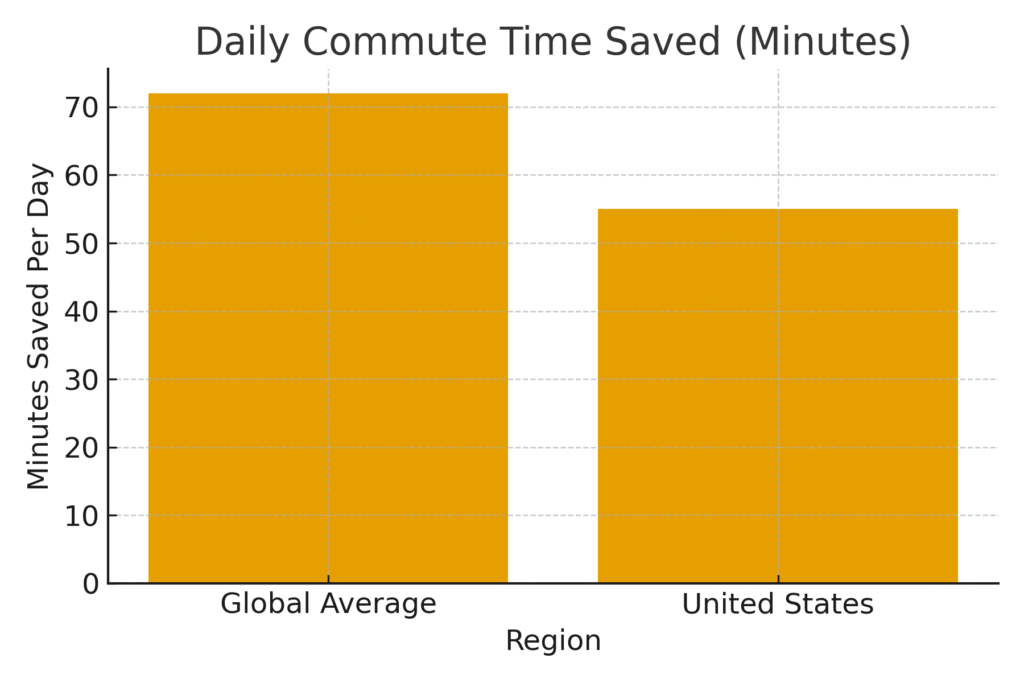
| 1 | 72 minutes per day saved globally | Average daily commute savings across 27 countries from remote work. |
| 2 | 55 minutes saved daily in the U.S. | U.S. workers reclaim nearly an hour per day with remote setups. |
| 3 | 2 hours per week saved | Remote employees save around 2 hours per week on commuting. |
| 4 | 1 hour weekly baseline post-pandemic | Researchers project long-term savings of 1 hour/week. |
| 5 | 14% reduction in weekly commuting time | Any amount of remote work reduces commuting time by ~14%. |
| 6 | 40% of saved time reinvested in work | Employees dedicate nearly half of saved time to job tasks. |
| 7 | 34% to leisure, 11% to caregiving | Saved time often goes to family and personal wellbeing. |
| 8 | Longer commutes for highly educated | Higher-educated professionals save ~10 more minutes daily. |
| 9 | 60 minutes saved (commute + grooming) | Remote work cuts out travel and prep time for U.S. workers. |
| 10 | Hybrid workers: 33% lower attrition | Employees with long commutes especially benefit from hybrid work. |
| 11 | $600–$6,000 annual savings for employees | Reduced transport, fuel, parking, and food costs. |
| 12 | $11,000 annual savings for employers | Organizations cut costs by supporting remote arrangements. |
| 13 | 16% of household spending on transport | Remote work helps reduce major U.S. household expenses. |
| 14 | CO₂ emission reductions globally | Remote work decreases commuting-related greenhouse gases. |
| 15 | One-third remote work done in cafés/co-working | Shorter, flexible commutes replace traditional office travel. |
| 16 | Hybrid workers make more non-work trips | Errands and social trips rise in hybrid schedules. |
| 17 | No commute = top remote work benefit | Surveys show employees rank time savings as most valued. |
| 18 | Lower office real estate costs | Reduced commuting drives downsizing of office footprints. |
| 19 | 1pp remote work → 0.05pp productivity growth | Industry data links commute reduction to higher TFP. |
| 20 | Commute equals 2.2% of 46-hour week | Saved time is equivalent to ~2.2% of work + commute hours. |
Top 20 Remote Marketing Commute Time Savings Statistics 2025
Remote Marketing Commute Time Savings Statistics #1: 72 Minutes Per Day Saved Globally
Remote work allows employees worldwide to save an average of 72 minutes daily on commuting. This statistic highlights how valuable flexible work arrangements can be in reclaiming time. For marketing professionals, this translates into more energy for creative projects and campaigns. It also reduces stress and fatigue associated with long travel times. Overall, this global saving emphasizes the broad efficiency remote marketing teams can achieve.
Remote Marketing Commute Time Savings Statistics #2: 55 Minutes Saved Daily In The U.S.
In the United States, remote employees save about 55 minutes each day on commuting. This is nearly an extra hour daily that can be dedicated to productive work or personal activities. For marketing teams, this means more time for brainstorming, strategy sessions, and campaign development. U.S. professionals especially benefit from reduced traffic congestion and transportation costs. This demonstrates the significant lifestyle improvements linked to remote work.
Remote Marketing Commute Time Savings Statistics #3: 2 Hours Per Week Saved
On average, remote work saves professionals about two hours per week that would otherwise be spent commuting. Those two hours can be redirected toward client communication or creative content creation. For marketers, these small weekly savings accumulate into substantial annual time gains. It also provides opportunities to balance professional goals with personal priorities. This steady benefit underlines the efficiency and appeal of remote work.
Remote Marketing Commute Time Savings Statistics #4: 1 Hour Weekly Baseline Post-Pandemic
Researchers project that after the pandemic, remote workers will continue to save about one hour weekly. Even as hybrid schedules become more common, this consistent saving remains valuable. Marketing professionals can use this hour for analytics, planning, or networking activities. Over the course of a year, this time compounds into noticeable productivity boosts. It reinforces how remote work benefits extend into the long term.
Remote Marketing Commute Time Savings Statistics #5: 14% Reduction In Weekly Commuting Time
Studies show that working remotely in any capacity reduces weekly commuting time by about 14%. This consistent percentage highlights the efficiency even part-time remote arrangements can offer. For marketing teams, this reduction frees up critical hours for campaign launches and client meetings. It also reduces environmental impacts tied to transportation. These savings illustrate how remote structures support both productivity and sustainability.
Remote Marketing Commute Time Savings Statistics #6: 40% Of Saved Time Reinvested In Work
Data shows that employees reinvest 40% of their saved commuting time into work tasks. This demonstrates a strong link between remote work and enhanced productivity. Marketing professionals can leverage this time for creative content, strategy building, or data analysis. Employers benefit as workers maintain or even exceed previous performance levels. This reinvestment shows that remote setups are both efficient and mutually beneficial.
Remote Marketing Commute Time Savings Statistics #7: 34% To Leisure, 11% To Caregiving
Not all saved time goes back into work, as 34% is used for leisure and 11% for caregiving. This highlights the role of remote work in supporting a healthier work-life balance. For marketers, this balance fosters creativity and reduces burnout. Families also benefit as professionals spend more meaningful time with loved ones. These statistics underscore how time savings improve both career and personal satisfaction.
Remote Marketing Commute Time Savings Statistics #8: Longer Commutes For Highly Educated Professionals
Highly educated professionals typically have longer commutes, averaging about 10 minutes more daily. This means remote work provides even greater time savings for this group. Marketing leaders and strategists often fall into this category, benefiting from extra reclaimed hours. These additional minutes can enhance focus on leadership, innovation, and team collaboration. Ultimately, remote setups amplify productivity for those in senior marketing roles.
Remote Marketing Commute Time Savings Statistics #9: 60 Minutes Saved (Commute + Grooming)
In the United States, remote work saves employees about 60 minutes daily when combining commute and grooming time. This highlights how much preparation and travel time is eliminated. For marketing professionals, these extra minutes can be used for campaign refinement or client updates. It also provides more flexibility in structuring the day. This significant saving is a practical advantage of working remotely.
Remote Marketing Commute Time Savings Statistics #10: Hybrid Workers See 33% Lower Attrition
Hybrid workers benefit from commute reductions and enjoy 33% lower attrition rates. This stability is especially valuable for marketing teams managing long-term campaigns. Employees with longer commutes find hybrid arrangements particularly rewarding. Reduced turnover ensures continuity in strategy and execution. This demonstrates how commuting time savings directly impact retention in the marketing industry.

Remote Marketing Commute Time Savings Statistics #11: $600–$6,000 Annual Savings For Employees
Remote and hybrid work helps employees save between $600 and $6,000 annually on transport, parking, and food. These savings directly enhance disposable income and financial stability. For marketers, this could mean more investment in personal development or industry resources. Lower financial stress also translates into greater focus and performance. These figures illustrate the personal financial benefits of remote arrangements.
Remote Marketing Commute Time Savings Statistics #12: $11,000 Annual Savings For Employers
Employers save about $11,000 per employee annually when supporting remote work. These savings come from reduced office space, utilities, and related costs. Marketing firms can reinvest this money into technology, training, or creative projects. It highlights how both workers and companies benefit from reduced commuting needs. This mutual gain makes remote strategies highly sustainable.
Remote Marketing Commute Time Savings Statistics #13: 16% Of Household Spending On Transport
In the U.S., transport accounts for about 16% of household spending. Remote work reduces the burden of fuel, vehicle maintenance, and public transport costs. For marketers, this shift frees up funds for personal and professional growth. The reduced expenses also increase financial security. These savings show how remote setups impact household budgets positively.
Remote Marketing Commute Time Savings Statistics #14: CO₂ Emission Reductions Globally
Remote work leads to significant reductions in commuting-related greenhouse gas emissions. This supports environmental sustainability on a global scale. Marketing agencies that adopt remote practices can showcase their commitment to eco-friendly operations. Such initiatives also enhance brand reputation among eco-conscious consumers. This statistic highlights both social and environmental benefits of reduced commutes.
Remote Marketing Commute Time Savings Statistics #15: One-Third Of Remote Work Done In Cafés Or Co-Working Spaces
About one-third of remote work is carried out in cafés or co-working spaces. These shorter, flexible commutes replace long, traditional office travel. For marketers, it means enjoying inspiring environments that boost creativity. These setups also encourage networking with other professionals. It demonstrates how remote work adapts to individual preferences.

Remote Marketing Commute Time Savings Statistics #16: Hybrid Workers Make More Non-Work Trips
Hybrid workers often make more non-work trips for errands or social reasons. This is partly due to flexible scheduling and location freedom. For marketing professionals, it allows balancing work commitments with personal needs more efficiently. These additional trips replace stressful commutes with purposeful travel. This flexibility enhances job satisfaction and overall well-being.
Remote Marketing Commute Time Savings Statistics #17: No Commute = Top Remote Work Benefit
Surveys reveal that employees rank “no commute” as one of the top benefits of remote work. Marketing professionals appreciate reclaiming this time for high-priority tasks. It also reduces stress, boosting morale and productivity. This finding confirms that time savings are a central motivator for remote adoption. It remains a powerful driver of job satisfaction across industries.
Remote Marketing Commute Time Savings Statistics #18: Lower Office Real Estate Costs
Reduced commuting needs correlate with lower office real estate requirements. Employers scale back on large spaces, decreasing operational expenses. Marketing firms benefit by investing in digital tools and virtual collaboration instead. This structural shift modernizes the workplace and aligns with remote practices. The result is more agile and cost-effective operations.
Remote Marketing Commute Time Savings Statistics #19: 1pp Remote Work → 0.05pp Productivity Growth
Industry-level data shows that each one percentage point increase in remote work is tied to a 0.05 point rise in productivity. This improvement is partly due to reduced commuting inefficiencies. Marketing professionals can channel this into stronger performance metrics. Enhanced productivity supports better client satisfaction and campaign results. It highlights the tangible economic value of commute time savings.
Remote Marketing Commute Time Savings Statistics #20: Commute Equals 2.2% Of A 46-Hour Week
Commuting accounts for about 2.2% of a standard 46-hour work and commute week. Remote work effectively eliminates this chunk of unproductive time. For marketers, this translates into measurable gains for campaigns and strategy execution. It also underscores the hidden cost of traditional commuting. Eliminating this inefficiency is a key reason remote work is so impactful.

Why Commute Time Savings Matter for Marketers
Looking back at these remote marketing commute time savings statistics, it’s clear that the benefits extend far beyond just skipping the daily drive. I personally believe that the time we save can be reinvested in building stronger campaigns, spending quality time with loved ones, or even simply catching a breath in our busy schedules. As someone who values balance, I find this shift toward smarter, more flexible work to be incredibly powerful. Remote work isn’t just about convenience—it’s about creating a healthier, more sustainable rhythm for both professionals and businesses alike. And for marketers especially, that reclaimed time can spark creativity, innovation, and stronger connections with the audiences we serve.
SOURCES
- https://cepr.org/voxeu/columns/commute-time-savings-when-working-home
- https://bfi.uchicago.edu/working-paper/time-savings-when-working-from-home/
- https://globalworkplaceanalytics.com/telecommuting-statistics
- https://www.uscareerinstitute.edu/blog/50-eye-opening-remote-work-statistics-for-2024
- https://www.nber.org/papers/w30866
- https://www.sciencedirect.com/science/article/pii/S2214367X24001029
- https://www.bls.gov/opub/btn/volume-13/remote-work-productivity.htm
- https://www.weforum.org/stories/2023/01/commuting-time-save-working-from-home-pandemic/
- https://www.axios.com/2023/01/24/remote-work-saved-workers-72-minutes-per-day-study-finds
- https://www.computerworld.com/article/1617627/study-when-employees-dont-have-to-commute-they-work.html
- https://pmc.ncbi.nlm.nih.gov/articles/PMC10149499/
- https://www.sciencedirect.com/science/article/abs/pii/S2214367X24001005
- https://www.sciencedirect.com/science/article/abs/pii/S096585642400020X
- https://www.imf.org/en/Publications/fandd/issues/2024/09/working-from-home-is-powering-productivity-bloom
- https://ssti.us/2024/02/27/workers-offset-their-commute-travel-when-working-from-home/
- https://www.autoinsurance.com/research/us-commuting-statistics/
- https://www.coolpo.io/post/work-from-home-2023-no-commute-makes-you-more-productive
- https://arxiv.org/abs/2303.06186