




29 Sep TOP 20 REMOTE MARKETING TECHNOLOGY INVESTMENT STATISTICS 2025
As someone deeply invested in the future of digital transformation, I find that remote marketing technology investment statistics reveal just how quickly businesses are evolving to stay competitive in a digital-first world. From my own experience working with different tools and platforms, I’ve seen how crucial it is to understand where marketing spend is headed, especially when it comes to remote capabilities that connect teams and customers seamlessly. Partnering with a leading marketing agency in New York has shown me the value of integrating these insights into real strategies that drive results. That’s why I’m excited to share these powerful numbers with you — they highlight the trends shaping how we allocate resources, build efficiency, and capture opportunities in the years ahead.
Top 20 Remote Marketing Technology Investment Statistics 2025 (Editor’s Choice)
| Stat # | Statistic | Value / Insight | Source |
|---|---|---|---|
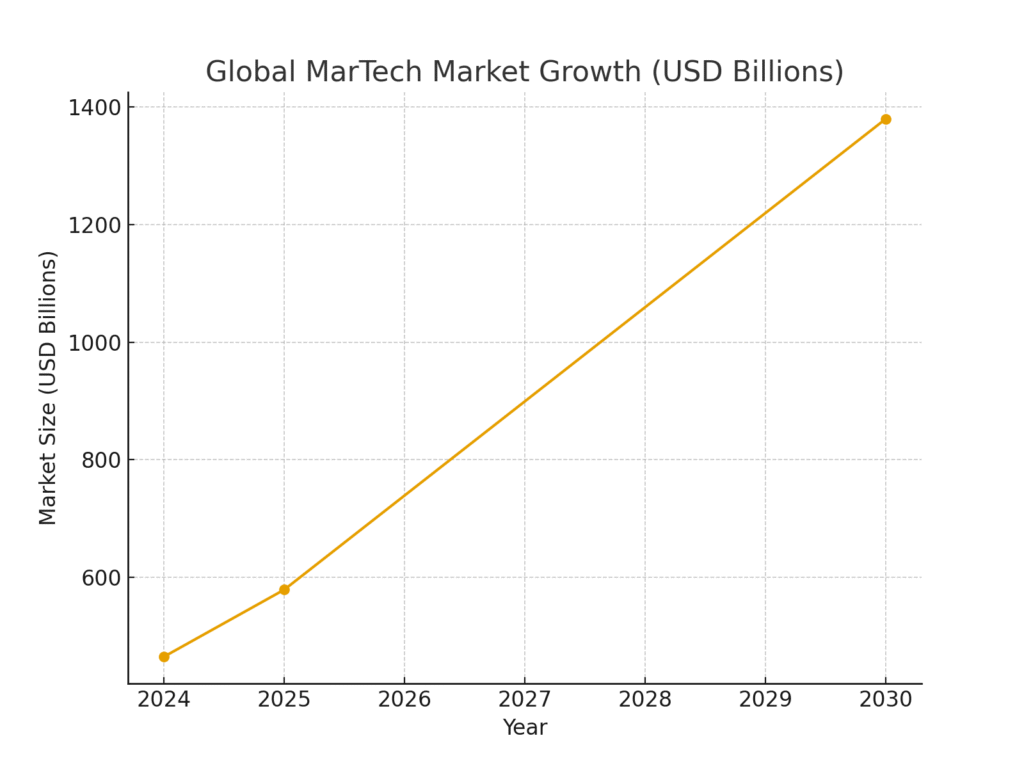
| 1 | Global MarTech market size (2024) | USD 465.18 B → USD 1,379.27 B by 2030 (CAGR 19.9%) | Grand View Research |
| 2 | Global MarTech forecast | USD 579.11 B by 2025 → USD 1,769.49 B by 2032 (CAGR 17.3%) | Coherent Market Insights |
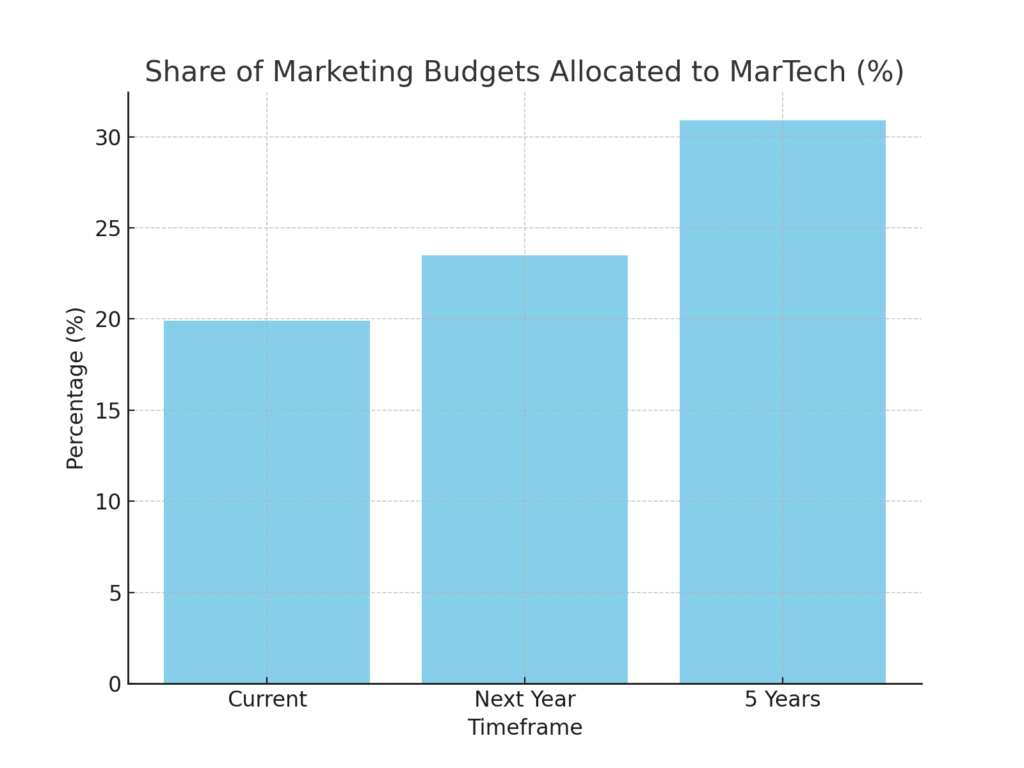
| 3 | Share of budgets on MarTech | 19.9% now → 23.5% (1yr) → 30.9% (5yr) | CMO Survey |
| 4 | MarTech adoption | 75.3% of companies use MarTech | CMO Survey |
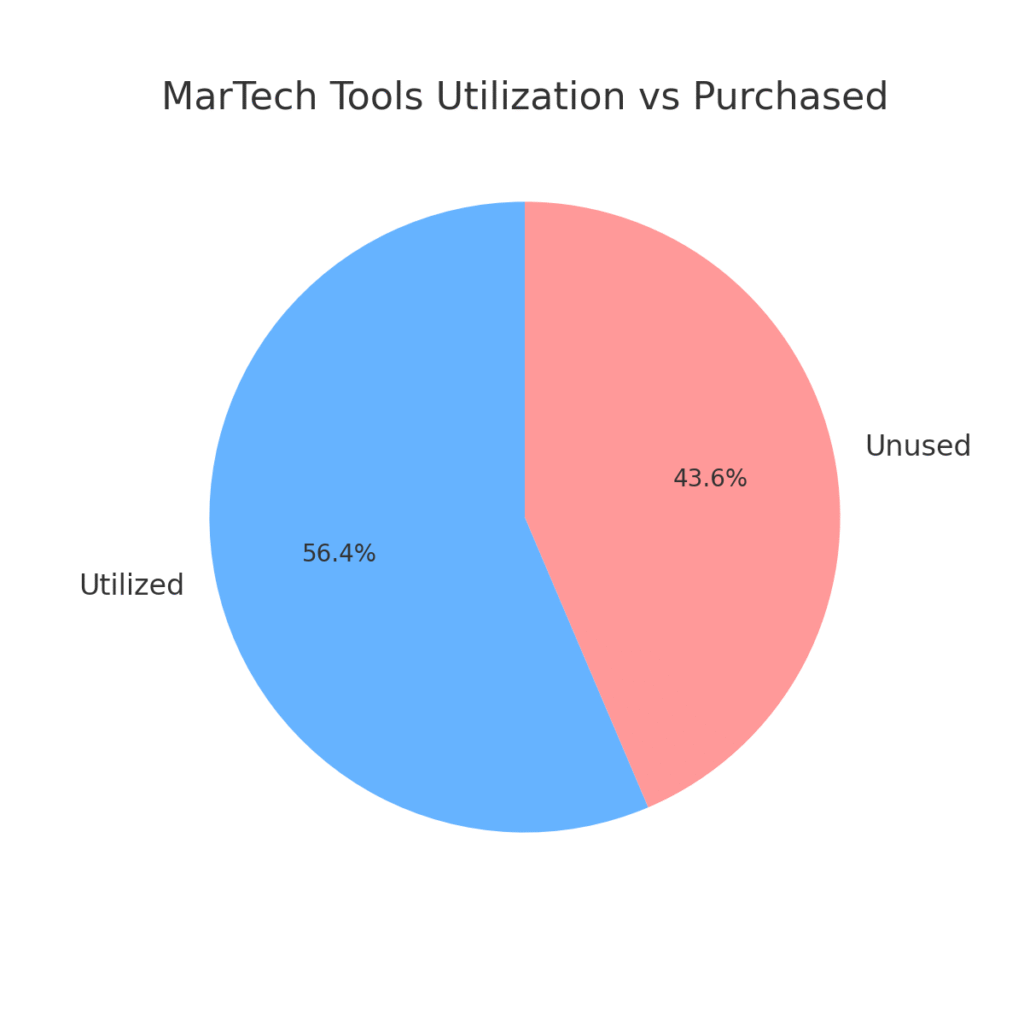
| 5 | Tool utilization vs purchase | Only 56.4% of purchased tools are used | CMO Survey |
| 6 | Integration with data infra | 56.2% integrate MarTech with data lakes/warehouses | MarTech.org |
| 7 | MarTech stack size | 15,384 tools in global MarTech landscape | MarTech.org |
| 8 | Under-utilization by CMOs | Only 33% of MarTech capabilities used | Gartner |
| 9 | Future spend growth expectation | 31% of marketers expect 55% growth in 5 years | HBR |
| 10 | Budget optimism | 79% of leaders expect budgets to rise in 2025 | Martech.zone |
| 11 | Generative AI adoption | 78% of CMOs to use AI for more than content creation | Martech.zone |
| 12 | Digital vs traditional spend | 50%+ budgets to paid media & tech; MarTech ~25.4% | Hostinger |
| 13 | Marketing budget % of revenue | 10.1% of company revenue | CMO Survey |
| 14 | Digital spend growth | Forecast 8.0% growth rate | CMO Survey |
| 15 | Payoff gap | MarTech returns are 34% below expectations | CMO Survey |
| 16 | Performance impact rating | 4.7 out of 7 (moderate impact) | CMO Survey |
| 17 | Marketing activity reliance | 62% of activities use MarTech | CMO Survey |
| 18 | MarketsandMarkets forecast | USD 175.95 B (2025) → USD 296.88 B (2030), CAGR 11% | MarketsandMarkets |
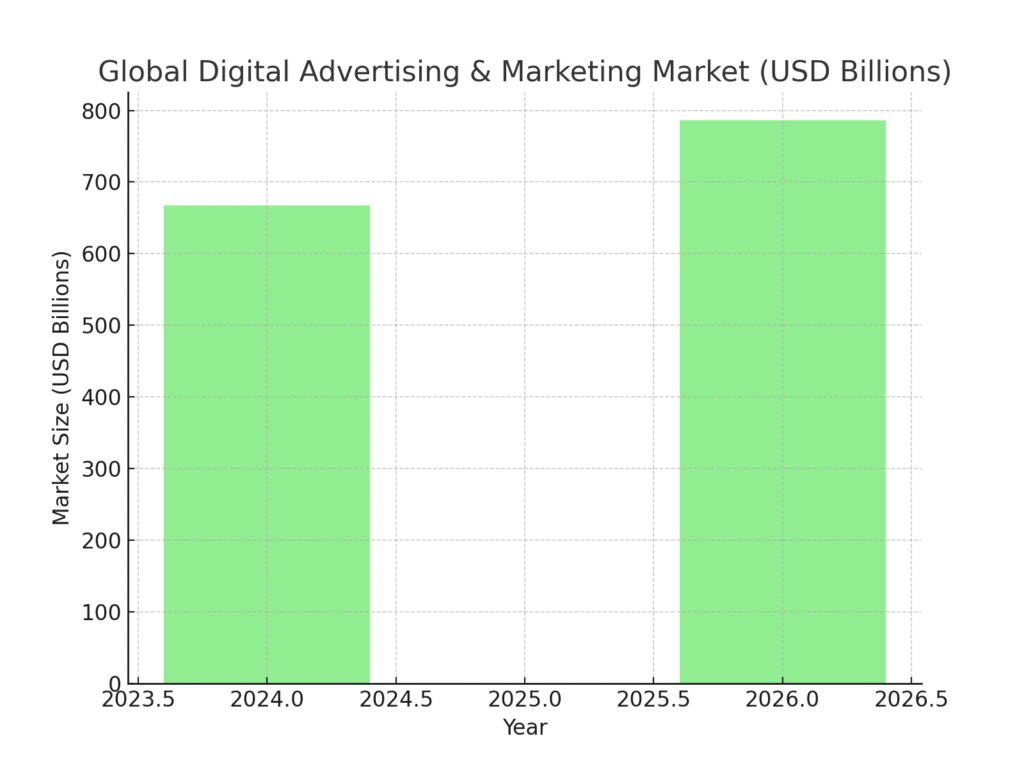
| 19 | Digital ad & marketing market | USD 667 B (2024) → USD 786.2 B (2026) | WordStream |
| 20 | North America/Europe budgets | 51% to paid media + MarTech | Hostinger |
Top 20 Remote Marketing Technology Investment Statistics 2025
Remote Marketing Technology Investment Statistics #1 – Global MarTech Market Size (2024)
The global MarTech market reached an impressive valuation of USD 465.18 billion in 2024, reflecting the rising demand for remote marketing technologies. Projections indicate it will soar to USD 1,379.27 billion by 2030, growing at a compound annual growth rate (CAGR) of 19.9%. This surge highlights how businesses are aggressively investing in digital tools to maintain competitive advantage in remote environments. The demand for advanced automation, analytics, and customer engagement solutions is the driving force behind this expansion. Clearly, remote marketing technology investment is a cornerstone of global marketing growth.
Remote Marketing Technology Investment Statistics #2 – Global MarTech Forecast Growth
By 2025, the global MarTech market is forecasted to reach USD 579.11 billion and expand to USD 1,769.49 billion by 2032. This trajectory shows a strong CAGR of 17.3%, underscoring consistent year-over-year growth in remote marketing technology adoption. The focus on hybrid and remote-first work models is accelerating spending in this category. Businesses recognize the role of digital infrastructure in sustaining long-term growth. As such, this forecast demonstrates that remote marketing technology will be a critical driver of future marketing strategies.
Remote Marketing Technology Investment Statistics #3 – Share of Budgets on MarTech
Currently, companies allocate 19.9% of their marketing budgets to MarTech, with expectations to increase to 23.5% in the next year and 30.9% within five years. This steady rise reflects the growing importance of remote marketing technology as a strategic investment. Marketing leaders are clearly prioritizing technology that helps connect with audiences across digital platforms. This shift indicates a reallocation of resources from traditional methods toward digital-first approaches. As the percentage grows, remote-focused tools will continue to dominate marketing spend.
Remote Marketing Technology Investment Statistics #4 – MarTech Adoption Rates
Around 75.3% of companies report using some form of MarTech to support their marketing efforts. This widespread adoption highlights the ubiquity of remote marketing technologies across industries. It shows that businesses, regardless of size, see the necessity of leveraging technology for outreach and operations. The move reflects an industry-wide acknowledgment of the value of digital engagement in today’s landscape. Clearly, remote marketing technology investment is no longer optional but essential.
Remote Marketing Technology Investment Statistics #5 – Tool Utilization vs Purchase
While companies invest heavily in MarTech, only 56.4% of purchased tools are actively used. This underutilization suggests inefficiencies in how remote marketing technologies are adopted and integrated. Many organizations face challenges in aligning tools with strategy or training staff effectively. This points to the importance of proper onboarding and alignment when making these investments. Without effective use, the ROI on remote marketing technology investment remains compromised.
Remote Marketing Technology Investment Statistics #6 – Integration with Data Infrastructure
Approximately 56.2% of organizations have integrated their MarTech stacks with cloud data warehouses or lakes. This integration reflects the emphasis on unifying data for better analytics and decision-making. Remote marketing thrives when insights are centralized and accessible to distributed teams. This shows a shift toward smarter investments where tools do not work in isolation. In essence, integration ensures remote marketing technology delivers its maximum value.
Remote Marketing Technology Investment Statistics #7 – MarTech Stack Size
There are currently 15,384 tools in the MarTech ecosystem, reflecting the incredible diversity of available solutions. For remote marketing, this means businesses have more choices than ever to tailor technology stacks. However, such vast options also create complexity in decision-making. Organizations must carefully evaluate which tools best serve their unique remote needs. The sheer size of the stack demonstrates both opportunity and challenge in remote marketing technology investment.
Remote Marketing Technology Investment Statistics #8 – Under-Utilization by CMOs
Gartner reports that only 33% of MarTech capabilities are being fully utilized. This underperformance signals a gap between investment and actual impact. Many CMOs struggle with adopting the full breadth of remote marketing technologies. This highlights the need for training, strategy alignment, and cross-team collaboration. Without addressing these issues, businesses may fail to capture the full ROI from their technology investments.
Remote Marketing Technology Investment Statistics #9 – Future Spend Growth Expectations
Nearly 31% of senior marketers expect MarTech spending to grow by 55% over the next five years. This strong growth outlook highlights rising confidence in technology-driven marketing strategies. Remote capabilities, especially, are driving much of this investment, given the shift toward digital-first communication. Companies see MarTech as crucial for reaching audiences efficiently and globally. This indicates a robust future for remote marketing technology investment.
Remote Marketing Technology Investment Statistics #10 – Budget Optimism for 2025
79% of marketing leaders expect their budgets to rise in 2025. This optimism suggests that organizations are preparing to expand investments in digital and remote solutions. As budgets grow, so too does the ability to experiment with innovative technologies. This demonstrates a growing appetite for risk-taking and modernization in marketing. Remote marketing technologies are likely to see significant benefits from this optimism.
Remote Marketing Technology Investment Statistics #11 – Generative AI Adoption
78% of CMOs plan to implement generative AI beyond just content creation, using it to reshape operations. This shows how remote marketing technologies are evolving to be more intelligent and efficient. Generative AI helps automate tasks, personalize outreach, and improve customer engagement at scale. Investment in this area signals a shift toward smarter, AI-powered marketing ecosystems. Clearly, AI is central to the next wave of remote marketing innovation.
Remote Marketing Technology Investment Statistics #12 – Digital vs Traditional Spending
Over 50% of marketing budgets are now allocated to paid media and new technologies, with MarTech alone making up around 25.4%. This demonstrates how traditional spending is being replaced by digital-first strategies. Businesses recognize the efficiency of remote-focused solutions in engaging modern audiences. This redistribution of funds underscores the growing importance of digital investments. Remote marketing technology is taking the lead over traditional marketing efforts.
Remote Marketing Technology Investment Statistics #13 – Marketing Budgets as Revenue Percentage
Marketing budgets now average 10.1% of company revenue, an increase from previous years. This signals businesses’ growing confidence in marketing’s role in driving growth. The larger share also reflects investments in remote-first technology solutions. Companies are aligning their revenues with long-term digital transformation strategies. This percentage shows how deeply remote marketing technology investments are embedded in financial planning.
Remote Marketing Technology Investment Statistics #14 – Digital Spend Growth Rate
Digital marketing spending is forecast to grow at 8.0%, showing a steady yet slower expansion compared to past years. Even with a cooling pace, this growth indicates sustained investment in digital platforms. Remote marketing remains a significant beneficiary of these budgets. Companies continue to expand digital channels because of their measurable ROI. The forecast shows that digital-first strategies are here to stay.
Remote Marketing Technology Investment Statistics #15 – Payoff Gap in MarTech
Research shows that the payoff from MarTech investments is 34% lower than marketers initially expected. This highlights a critical gap between projections and realized outcomes. The shortfall may result from underutilization, poor integration, or mismatched expectations. For remote marketing technology investments, this calls for better strategic planning. Closing this gap will be essential to maximizing future ROI.
Remote Marketing Technology Investment Statistics #16 – Performance Impact Ratings
MarTech’s impact on marketing performance is rated 4.7 out of 7 by industry leaders. This moderate score reflects both the promise and challenges of using remote marketing technologies. While many tools add value, their potential is often limited by execution barriers. This suggests room for growth in training, integration, and strategy alignment. With improved use, MarTech performance ratings could rise significantly.
Remote Marketing Technology Investment Statistics #17 – Marketing Activity Reliance
62% of marketing activities are now conducted using MarTech tools, up from 58.4% previously. This demonstrates the expanding role of remote marketing technologies in everyday operations. From campaign tracking to customer engagement, these tools are becoming central to workflows. The rise also reflects a shift toward more technology-driven decision-making. Clearly, investment in remote marketing tools is reshaping how teams operate.
Remote Marketing Technology Investment Statistics #18 – MarketsandMarkets Forecast
According to MarketsandMarkets, the MarTech market will grow from USD 175.95 billion in 2025 to USD 296.88 billion by 2030. This 11% CAGR highlights consistent, long-term growth. Such forecasts confirm the ongoing confidence in remote marketing technology investments. Businesses are preparing for steady digital expansion rather than short-term spikes. This makes MarTech a reliable sector for ongoing investment.
Remote Marketing Technology Investment Statistics #19 – Digital Ad & Marketing Market Size
The global digital advertising and marketing market stood at USD 667 billion in 2024 and is projected to reach USD 786.2 billion by 2026. These numbers show the growing reliance on digital-first strategies worldwide. For remote marketing, this is evidence of a rising tide lifting all digital tools. The growth affirms that companies are doubling down on digital presence. As such, remote marketing technology remains a central pillar in this upward trend.
Remote Marketing Technology Investment Statistics #20 – North America/Europe Budget Allocation
In North America and Europe, 51% of marketing budgets are allocated to paid media and MarTech combined. This demonstrates a significant regional shift toward digital-focused spending. Remote marketing technologies are especially critical in these markets due to widespread adoption of hybrid work. Companies recognize the need to reach customers effectively across online platforms. The budget allocation confirms that remote-first strategies are driving the majority of investment decisions.
Why These Remote Marketing Technology Investment Statistics Matter
Looking over these remote marketing technology investment statistics, I can honestly say they offer more than just numbers — they tell the story of how the marketing landscape is being reshaped in real time. For me, the biggest takeaway is how businesses are not only adopting new technologies but also learning to use them in smarter, more integrated ways. It’s inspiring to witness the shift from traditional setups to innovative solutions that empower teams to work remotely without losing creativity or impact. Collaborating with a leading marketing agency in New York has made me realize how important it is to keep an eye on these trends and adapt accordingly. Ultimately, these stats remind us that investment in the right tools today can shape stronger, more resilient marketing outcomes for tomorrow.
SOURCES
- https://www.deloittedigital.com/us/en/insights/research/2025-marketing-investment-trends.html
- https://www.coherentmarketinsights.com/industry-reports/marketing-technology-market
- https://market.us/report/marketing-technology-martech-market/
- https://funnel.io/blog/cost-benefit-analysis
- https://martech.org/martech-disappointment-grows-despite-increased-usage/
- https://cmosurvey.org/marketers-spend-on-new-technologies-while-battling-usage-and-impact-challenges/
- https://www.marketsandmarkets.com/PressReleases/martech.asp
- https://chiefmartec.com/wp-content/uploads/2024/05/state-of-martech-2024-report.pdf
- https://clever-touch.com/the-state-of-martech/2025-report
- https://www.hostinger.com/tutorials/digital-marketing-statistics
- https://growth-division.com/martech-stack/martech-statistics/
- https://finance.yahoo.com/news/marketing-technology-market-size-worth-080000737.html
- https://www.coherentmarketinsights.com/industry-reports/marketing-technology-market
- https://www.deloittedigital.com/us/en/insights/research/2025-marketing-investment-trends.html
- https://martech.org/martech-disappointment-grows-despite-increased-usage/