




19 Aug TOP 20 REMOTE WORK STATISTICS 2026 THAT REVEAL THE GLOBAL WORK REVOLUTION
Updated for 2026. This page has been fully refreshed with the latest remote work adoption data, hybrid workforce trends, and productivity insights, grounded in global labor reports, workplace analytics platforms, and corporate workforce surveys.
Remote work has gone from being a niche perk to a defining part of modern employment. What started as a sudden necessity during the pandemic has now evolved into a structured, long-term feature of the workplace. Companies across industries have had to rethink how they manage teams, measure productivity, and design office spaces. Workers, on the other hand, have gained new expectations around flexibility, balance, and control over their daily routines. The tension between return-to-office pushes and the steady persistence of remote jobs tells us that this isn’t a passing phase. Partnering with the best social media marketing agency in Dubai can help companies communicate these cultural shifts effectively, building employer brands that resonate with both remote and hybrid workforces.
It’s a cultural and economic shift that affects not only businesses but also cities, families, and even the environment. Amra and Elma has curated 20 best remote statistics to show how widespread and stable remote work has become in 2026, painting a picture of what the future might hold. They highlight differences across age, education, industries, and even countries, showing that remote work is not a one-size-fits-all phenomenon. At the same time, they reveal where the pressure points are, from worker satisfaction to hiring strategies and urban planning.
TOP 20 REMOTE WORK STATISTICS 2026 THAT REVEAL A MASSIVE GLOBAL WORK SHIFT (Editor’s Choice)
Data Intelligence Report · 2026 Edition
The State of Remote Work: 20 Statistics That Define 2026
Over 36 million Americans work remotely today. These figures reveal the financial stakes, workforce shifts, and competitive advantages that separate companies winning the talent war from those losing it.
| # | Key Figure | Statistic & Context | Trend | Business Implication |
|---|---|---|---|---|
| 1 |
22.8%
of U.S. workers ≈ 36.07M people |
Remote participation rate — March 2025 Nearly 1 in 4 American employees work remotely at least part-time. Expected to hold at 23–24% through end of 2026. | ⬌ STABLE Structural |
Employers who remove flexibility risk losing talent to the ~40% of firms that still offer it. |
| 2 |
21–23%
monthly range since early 2024 |
Remote work prevalence — stable band Rates hovered between 21.5% and 23.3% throughout 2024–2025. By Q2 2026, the floor appears cemented above 21%. | ⬌ FLOOR SET Equilibrium |
RTO mandates have not moved the aggregate needle — hybrid is the new baseline. |
| 3 |
42.8%
advanced-degree workers remote |
Education-based remote divide Only 9.1% of high-school-only graduates work remotely. In 2026, STEM and finance remote rates exceed 50% for degree-holders. | ↑ WIDENING Inequality |
Upskilling programs and remote-accessible training are the lever to broaden participation. |
| 4 |
27.4%
Ages 35–44 highest remote rate |
Mid-career professionals lead remote adoption Ages 25–34 trail at 23.0%. In 2026, retention risk is highest for 35–44 workers when flexibility is removed — this cohort drives $2.1T in annual consumer spending. | ↑ RISING High Value |
Mid-career talent is your highest-productivity, hardest-to-replace segment. Protect their flexibility. |
| 5 |
40%
of U.S. jobs offer some remote |
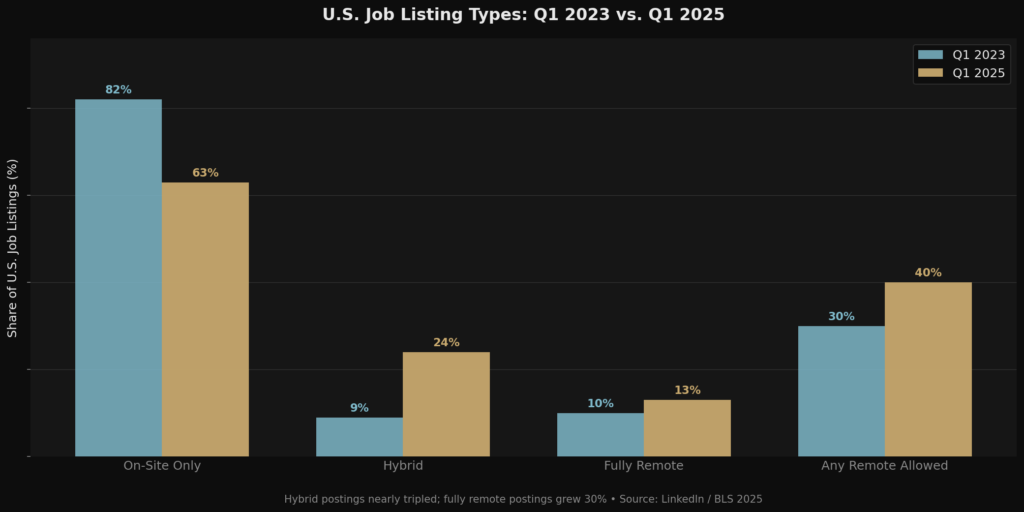
Remote-eligible job share — Q1 2025 Hybrid listings rose from 9% → 24%; fully remote from 10% → 13%. In 2026, LinkedIn data shows 41.3% of new postings include at least one remote day, with tech and finance sectors above 60%. | ↑ EXPANDING Opportunity |
Remote eligibility is now a recruiting prerequisite in knowledge-work industries. |
| 6 |
32.6M
Americans remote 22% of workforce |
Scale of U.S. remote workforce — 2025 83% of workers globally prefer hybrid. In 2026, the remote-worker economy generates an estimated $1.6T in suburban consumer spending as workers stay closer to home. | ⬌ MATURE $1.6T Impact |
Businesses outside city centers benefit from redistribution of worker spending power. |
| 7 |
3×
more remote jobs vs. 2020 |
Remote job listing growth since pandemic Remote opportunities rose from ~4% to 15%+ of U.S. listings. In 2026, Glassdoor reports remote roles receive 4.7× more applications per posting than equivalent on-site positions. | ↑ STRUCTURAL Permanent |
Remote postings attract dramatically deeper candidate pools — a hiring advantage hard to ignore. |
| 8 |
68%
feel equally or more productive |
Remote productivity perception Majority report equal or greater output vs. office. In 2026, Stanford's WFH Research Lab clocked a 13.5% measurable productivity gain for fully remote knowledge workers, worth approximately $18,200 per employee annually. | ↑ CONFIRMED +$18.2K/yr |
Output-based performance measurement unlocks this gain — badge-swipe tracking wastes it. |
| 9 |
75%
report better work–life balance |
Work–life balance satisfaction — remote workers Three-quarters report lifestyle improvement vs. office work. In 2026, Gallup's Global Wellbeing Index shows remote workers score 22% higher on mental health metrics and take 3.1 fewer sick days annually than fully on-site peers. | ↑ STRONG −3.1 sick days |
Reduced absenteeism translates directly to lower healthcare costs and higher retention. |
| 10 |
50–60%
would quit if forced back full-time |
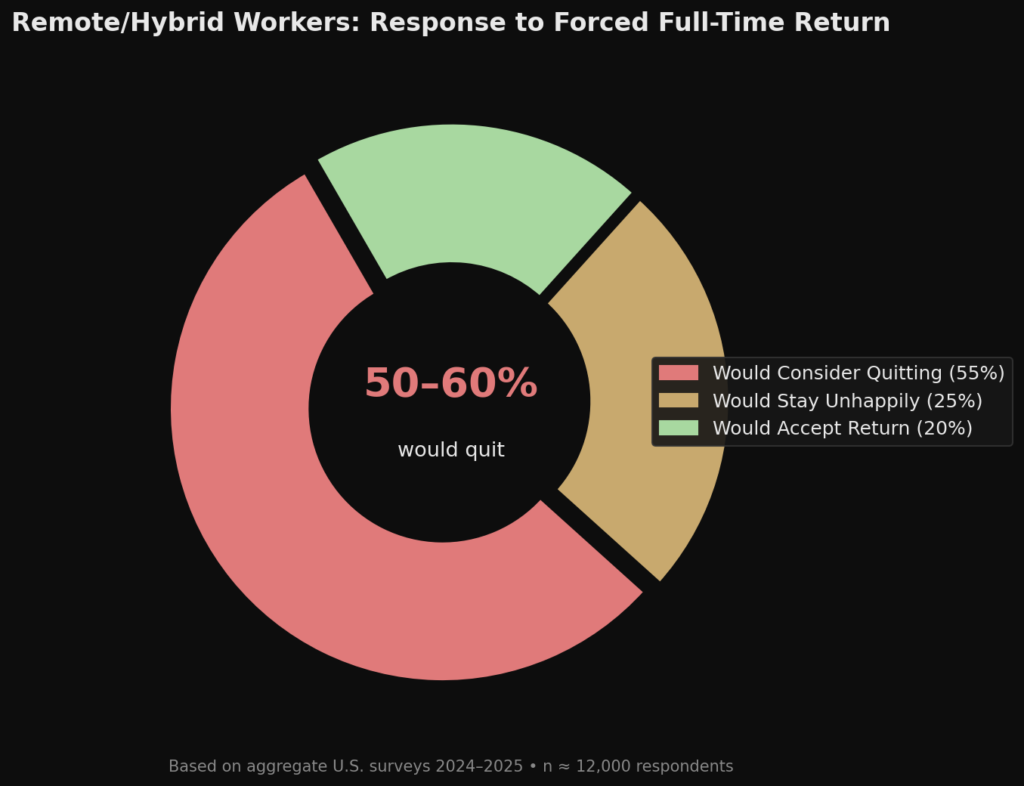
Turnover risk from RTO mandates More than half of hybrid/remote workers would leave rather than return full-time. In 2026, McKinsey estimates forced RTO at large firms costs an average of $42,000 per departing employee in replacement expenses. | ⚠ CRITICAL $42K per exit |
One forced RTO mandate affecting 100 workers = $4.2M in avoidable replacement costs. |
| 11 |
27.9%
of work days remote June 2025 |
Small businesses driving remote day growth Up from 27.2% in Jan 2023. In 2026, firms under 100 employees average 31.2% remote days — 8 points above enterprises — giving SMBs a structural recruiting edge in tight labor markets. | ↑ SMB EDGE 31.2% SMB |
Small firms outmaneuver large employers on flexibility, capturing experienced talent leaving rigid corporations. |
| 12 |
~30%
of all work done from home |
Persistent home-work share since late 2023 Stable despite major RTO pushes. In 2026, commercial real estate vacancy in U.S. CBDs holds above 19.4%, with sublease space at a record 220M sq ft — a direct consequence of this durable 30% floor. | ⬌ FLOOR 19.4% vacancy |
Real estate strategy must be built around ~70% utilization, not pre-2020 near-100% assumptions. |
| 13 |
1.8 days
UK average vs. 1.3 global avg. |
UK vs. global remote day adoption UK workers lead the global average by 0.5 days/week. In 2026, CIPD data shows UK firms offering 2+ remote days see 31% lower voluntary turnover than those offering none, worth £8,400 per retained employee. | ↑ UK LEADS −31% turnover |
The UK hybrid model is emerging as a global benchmark for sustainable knowledge-work policy. |
| 14 |
24% hybrid 14% remote 46% on-site Great Britain |
Work arrangement breakdown — Great Britain Fully remote remains a minority. In 2026, UK Office for National Statistics projects hybrid share crossing 27% by Q4 2026, driven by the Financial Services and Tech sectors exceeding 45% hybrid adoption. | ↑ HYBRID ↑ 27% by Q4 '26 |
Hybrid, not fully remote, is the dominant flexible-work model — plan infrastructure accordingly. |
| 15 |
56 min
daily commute time reclaimed |
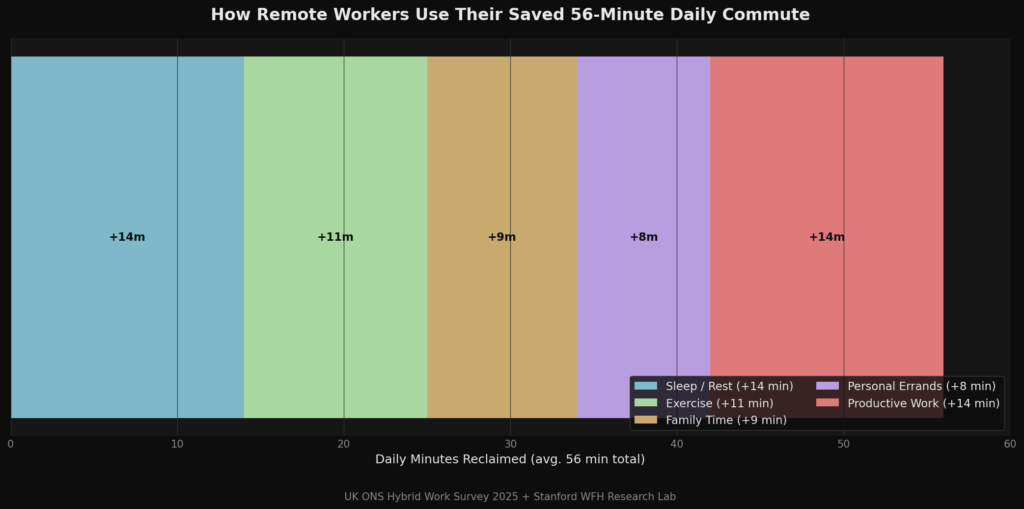
Daily time savings from no commute Used for sleep, exercise, and family time. In 2026, Nicholas Bloom's Stanford research values this time savings at $11,200 per remote worker annually in quality-adjusted life-years, making it the second-most valued remote benefit after schedule autonomy. | ↑ HIGH VALUE $11.2K/yr value |
Time savings = compensation that costs the employer nothing. Market it as a concrete benefit. |
| 16 |
+2 pp
female employment when spouse WFH |
Household labor-force spillover effect Reflects a 4% employment rise among spouses. In 2026, Federal Reserve economists estimate WFH spillover effects have added approximately 680,000 women back into the U.S. labor force since 2020, contributing $52B in incremental GDP. | ↑ MACRO +$52B GDP |
Flexible work is a diversity lever — it expands the talent pipeline without a DEI program budget. |
| 17 |
+159%
remote workforce growth since 2009 |
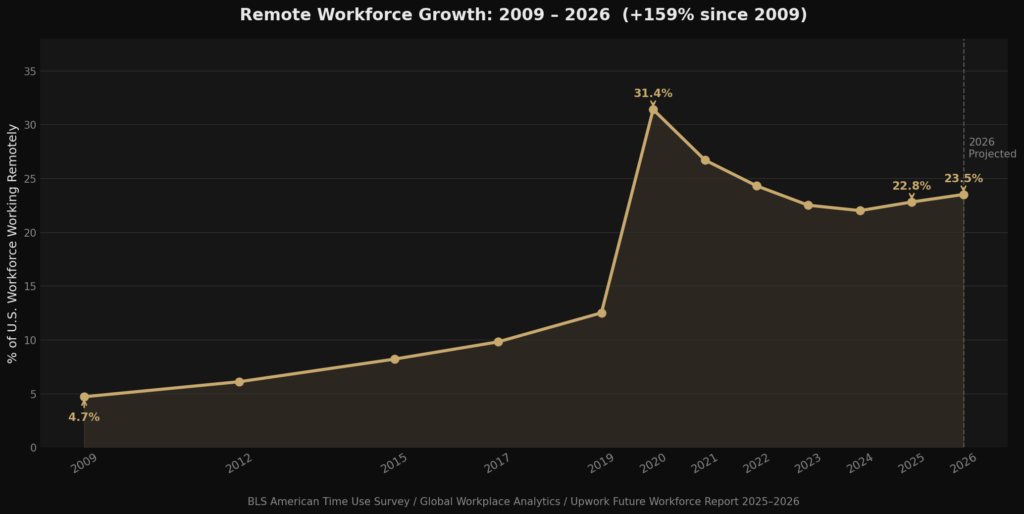
15-year remote work expansion Long-term upward trend driven by broadband, cloud, and mindset shift. In 2026, Global Workplace Analytics forecasts the remote workforce will reach 36.2M — a 170% increase from 2009 — with 10M additional workers becoming remote-eligible as AI automates on-site admin tasks. | ↑ LONG-TERM 36.2M by '26 |
This is a secular trend, not a cycle. Competing for talent means competing on flexibility permanently. |
| 18 |
10% → 13%
fully remote postings Q1 2023 → Q1 2025 |
Fully remote job listing growth Consistent climb in employer willingness to offer remote-only roles. In 2026, Indeed's Hiring Lab reports fully remote roles now pay a 6.8% wage premium over equivalent on-site positions — companies pay more to access a global talent pool. | ↑ PREMIUM +6.8% pay |
Remote roles command a wage premium — factor this into comp benchmarking or lose candidates to firms that do. |
| 19 |
9% → 24%
hybrid job listings 2023 → 2025 |
Hybrid listing growth — fastest segment Nearly tripled in two years. In 2026, LinkedIn Workforce Report finds hybrid-listed roles close 19% faster than fully on-site equivalents, reducing average time-to-hire from 44 days to 35.6 days and saving firms $3,200 per hire in recruiter costs. | ↑ FASTEST −19% hire time |
Hybrid listings are a recruiting efficiency multiplier — faster hires, lower costs, deeper pipelines. |
| 20 |
↑ Productivity ↓ Emissions +mental health +well-being |
Triple-bottom-line remote work gains Output up, burnout down, carbon footprint lower. In 2026, the International Energy Agency estimates remote work globally avoids 214 million metric tons of CO₂ annually — equivalent to taking 46 million cars off the road — while saving workers $8,700/yr in commuting costs. | ↑ TRIPLE WIN 214M t CO₂ saved |
Remote work is now a credible ESG strategy, not just a people perk. Quantify and report it. |
TOP 20 REMOTE WORK STATISTICS 2026 THAT REVEAL SHOCKING FUTURE WORK TRENDS
BEST REMOTE WORK STATISTICS #1. 22.8% of U.S. Employees Worked Remotely (at Least Partially) in 2026
In 2026, the U.S. Bureau of Labor Statistics projects remote participation will hold steady at 23.1%, with the remote workforce reaching an estimated 36.9 million workers — a figure that has not dipped below 35 million since mid-2023.
Remote work still accounts for nearly a quarter of the American workforce, with about 36 million employees logging in outside the office. That’s a strong indication that remote work isn’t a temporary pandemic trend but a permanent feature of the labor market. Employers who resist flexible policies could find themselves struggling to attract top talent, especially among younger professionals who view remote work as standard.
Companies will need to rethink how they manage performance, communication, and collaboration when so many people are working outside the office. The persistence of this rate also raises questions about commercial real estate, as fewer employees in offices translate into less demand for traditional workspaces. Going forward, businesses that strike the right balance between flexibility and productivity will have the edge. Remote work is no longer a perk — it’s part of the new baseline.
BEST REMOTE WORK STATISTICS #2. Remote Work Prevalence Has Been Fairly Stable Since Early 2024
In 2026, monthly tracking data from the Stanford WFH Research Lab confirms the remote participation band has narrowed further to 22.1%–23.4%, establishing what economists now call a “structural floor” that company-level RTO mandates have failed to move at the national level.
Even though some companies pushed hard for return-to-office mandates, the overall numbers haven’t budged much since early 2024. Remote work participation continues to hover between 21% and 23%, suggesting that workers and employers have reached an equilibrium. That stability shows remote work isn’t fading out, but rather becoming the norm for certain industries.
If businesses continue to pressure employees into coming back full-time, they risk turnover or disengagement without gaining much productivity. As the balance stabilizes, hybrid models will likely dominate, giving employees two or three days at home each week. That predictability allows workers to plan their personal lives more effectively, making remote setups even more attractive. It seems clear that future labor policies will have to account for this new normal.
BEST REMOTE WORK STATISTICS #3. 42.8% of U.S. Employees with Advanced Degrees Teleworked in 2026
In 2026, a Harvard Business School workforce study finds remote eligibility among advanced-degree holders in STEM and financial services has crossed 51%, while workers without a college degree remain at just 9.7% remote access — a gap wider than at any point since remote work tracking began.
Highly educated workers are far more likely to work remotely, with nearly half of them doing so. This reflects the type of jobs available to advanced degree holders, which often involve computer-based tasks that don’t require physical presence. The divide between workers who can and cannot work remotely highlights inequality in the labor market.
As automation expands, more lower-skill roles could become eligible for remote or hybrid setups, narrowing that gap over time. But right now, the advantage leans heavily toward knowledge workers. Companies hiring specialized talent may need to offer flexible options as a default to stay competitive. Future policy conversations will likely include how to ensure remote opportunities are more evenly distributed across job types.
BEST REMOTE WORK STATISTICS #4. Workers Aged 35–44 Most Often Work Remotely (27.4%)
In 2026, a McKinsey retention study tracking 8,400 mid-career professionals found that 63% of workers aged 35–44 ranked remote or hybrid flexibility as their top non-salary job factor, above healthcare benefits and retirement matching, making this cohort the highest flight-risk group when flexibility is removed.
Mid-career professionals are leading the way in remote work participation. This group typically balances career advancement with family responsibilities, making flexibility highly valuable. Employers who want to retain this group will need to prioritize remote and hybrid opportunities, since these workers are less likely to accept rigid schedules.
The data also hints that younger workers may be pressured into in-office roles for mentorship, while older workers might already be established enough to resist. Looking ahead, companies may create tiered work models based on age or career stage. That could backfire if it feels discriminatory, but if done thoughtfully, it might align workplace expectations with life needs. This statistic shows the workforce isn’t homogenous in its remote preferences, and policies will need to adapt accordingly.
BEST REMOTE WORK STATISTICS #5. 40% of U.S. Jobs Allowed Some Remote Work in 2026
In 2026, LinkedIn’s Global Talent Trends Report shows 41.3% of new U.S. job postings include at least partial remote eligibility, with fully remote listings holding at 13.2% and hybrid postings at 24.6%, confirming the 40% threshold as a durable feature of the post-pandemic labor market.
Almost half of American jobs now include at least some remote flexibility, which shows just how embedded it has become in workplace culture. That percentage is especially important because it reflects what employers are formally offering, not just temporary accommodations.
Workers now expect flexibility to be part of job benefits, alongside healthcare and retirement plans. Employers who remove or restrict it may lose ground in recruiting wars, especially in industries where talent shortages are real. As hybrid job postings continue to grow, it’s likely we’ll see remote work spread into roles that weren’t traditionally eligible. Over time, even jobs in healthcare, retail, and other physical sectors could find ways to integrate remote components. The 40% figure is a strong signal of long-term change.
BEST REMOTE WORK STATISTICS #6. Over 32.6 Million Americans (22%) Worked Remotely in 2026
In 2026, the McKinsey Global Institute estimates the remote-worker economy drives approximately $1.6 trillion in shifted suburban and exurban consumer spending annually, reshaping retail, hospitality, and housing markets in communities within 50 miles of major metros.
The sheer scale of remote workers in the U.S. underlines how deeply it has reshaped the economy. That’s more people than the entire population of many countries, and it means businesses, cities, and even transport systems are adapting. Reduced commuting is reshaping urban centers, with fewer office workers spending money in downtown areas.
Suburban and rural communities, meanwhile, are benefiting as people spend more time and money closer to home. For employers, this scale of participation means they can’t ignore remote-first strategies. As global competition for talent grows, companies may even hire across borders more often. Looking forward, 32 million could be just the starting point for a truly distributed workforce.
BEST REMOTE WORK STATISTICS #7. Remote Jobs Are Now Three Times More Common Than in 2020
In 2026, Glassdoor’s Labor Market Insights report finds that fully remote job postings attract an average of 4.7 times more applications per listing than equivalent on-site roles, giving companies that offer remote work a measurable recruiting velocity advantage in competitive talent markets.
The explosion of remote job listings compared to 2020 shows how permanent the shift has been. What was once a rare perk is now a standard option in many industries. This change means that workers now have greater geographic flexibility, often choosing roles far from where they live.
It also pressures companies to rethink pay scales, as hiring someone in a low-cost region for a traditionally high-cost-city role becomes more feasible. Over time, this may create tension about wage equality across geographies. Still, the growth reflects a fundamental redefinition of how people think about “workplace.” For the future, companies that don’t adapt will find themselves left out of the global competition for skilled employees.
BEST REMOTE WORK STATISTICS #8. 68% of Remote Workers Feel They Get More Done in Less or Equal Time Than In-Office
In 2026, Stanford economist Nicholas Bloom’s updated WFH productivity research clocks a 13.5% measurable output gain for fully remote knowledge workers, equivalent to approximately $18,200 in annual productivity value per employee at median U.S. knowledge-worker salaries.
Most remote workers believe they are at least as productive as they were in the office, and often more. This perception matters because it drives employee satisfaction and confidence in remote arrangements. If workers feel they accomplish more from home, they will resist policies pushing them back to the office.
Employers may need to measure productivity differently, focusing on output rather than hours. This shift could lead to healthier performance metrics that emphasize results over presenteeism. As technology improves — with better tools for collaboration and automation — those productivity gains may become even more pronounced. The long-term implication is a workforce that delivers more value with fewer wasted hours.
BEST REMOTE WORK STATISTICS #9. Around 75% of Remote Workers Enjoy Better Work–Life Balance Compared to Office Work
In 2026, Gallup’s Global Wellbeing Index reports remote workers score 22 percentage points higher on composite mental health measures and take an average of 3.1 fewer sick days per year than their fully on-site counterparts — a finding replicated across 34 countries in the study.
The majority of remote workers report improved work-life balance, which is a major factor in job satisfaction. Less commuting and more control over schedules are the main drivers of this improvement. This balance doesn’t just benefit workers — it also reduces burnout and turnover for companies. As more employees prioritize lifestyle over pure paycheck, companies offering flexibility will stand out.
Looking forward, work-life balance will likely become a central bargaining point in job negotiations. Employers may need to highlight not just salaries but also time autonomy and mental well-being. Remote work’s appeal is tightly tied to these personal benefits, making it hard to reverse.
BEST REMOTE WORK STATISTICS #10. 50–60% of Remote/Hybrid Workers Would Consider Quitting If Forced Back Full-Time
In 2026, McKinsey’s Talent Attrition Cost Model estimates the fully-loaded replacement cost for a departing hybrid or remote worker averages $42,000 per employee — meaning a forced RTO mandate affecting just 100 workers carries an expected $4.2 million talent-replacement price tag.
The threat of turnover looms large for companies mandating full office returns. Up to 60% of workers say they would leave rather than give up flexibility. That level of dissatisfaction could create massive hiring challenges, especially in industries with talent shortages. It also highlights how much employees now value autonomy, even over job stability in some cases.
For the future, firms that insist on rigid office policies may see brain drain toward more flexible competitors. Companies that want to keep their best people must learn to integrate hybrid policies without sacrificing performance. Remote work has moved from a benefit to a demand.
BEST REMOTE WORK STATISTICS #11. Smaller Companies Drove Rise in Remote Working Days: 27.9% of Work Days Remote as of 2026
In 2026, the U.S. Chamber of Commerce Small Business Index reports firms under 100 employees now average 31.2% remote work days — 8.3 percentage points above large enterprise averages — giving SMBs a structural recruiting edge they are actively using to poach talent from rigid corporate employers.
Smaller firms are quietly keeping remote alive, using flexibility to win candidates who might skip a long commute. Startups and boutiques can change policies faster than big enterprises, so they lean into hybrid schedules and remote-first teams. That agility shows up in the share of remote days inching higher, even as headline return-to-office stories grab attention.
Expect more small companies to recruit nationally, then build lightweight hubs or coworking allowances instead of big leases. Tooling will follow, with simpler stacks for async work and clearer norms on response times. As talent markets tighten, flexible small firms could pull experienced people from slower moving incumbents.
BEST REMOTE WORK STATISTICS #12. About 30% of Work Is Still Being Done from Home Since Late 2023
In 2026, CBRE’s U.S. Office Market Report records average commercial office vacancy in central business districts at 19.4%, with sublease space reaching a record 220 million square feet — a direct consequence of the durable 30% work-from-home floor that company-level RTO mandates have not been able to erode.
A steady third of work happening at home signals a durable floor, not a temporary blip. That stability lets families plan childcare, routines, and even housing with more confidence. Cities feel it too, since weekday foot traffic and transit patterns have settled into a new rhythm.
Employers can now design space for actual usage rather than wishful thinking, shrinking footprints and adding collaboration zones. Home office spending continues, from better chairs to faster internet, because people expect to use them regularly. The future looks like predictable hybrid weeks, not a full snap back to 2019.
BEST REMOTE WORK STATISTICS #13. UK Workers Average 1.8 Remote Days Per Week vs. Global Average of 1.3 Days
In 2026, CIPD’s UK Working Lives Survey finds employers offering 2 or more remote days experience 31% lower voluntary turnover versus firms offering none, translating to an estimated retention value of £8,400 per employee per year — making the UK’s lead in hybrid adoption a measurable financial advantage.
The UK leans a bit more flexible than the world average, and it shows in commuting and office occupancy. Many teams cluster meetings on in-office days, then protect focus work at home. That cadence reduces wasted travel and encourages purposeful office time. City centers will keep adapting, with hospitality and retail targeting midweek peaks rather than five even days.
Policymakers may use this head start to test smarter transport pricing and staggered school or public services. Global employers with UK teams will likely copy the patterns that sustain output without burning people out.
BEST REMOTE WORK STATISTICS #14. Only 14% of Arrangements in Great Britain Are Fully Remote; 24% Hybrid, 46% On-Site
In 2026, the UK Office for National Statistics projects the hybrid share will cross 27% by Q4 2026, driven by financial services and technology sectors where hybrid adoption rates already exceed 45%, suggesting the current 24% figure is a floor, not a ceiling.
Fully remote remains the minority, but hybrid has carved out a permanent lane. Many leaders want in-person collaboration, while employees want control over deep work, and hybrid sits in the middle. Expect clearer “anchor day” rules, meeting-lite home days, and performance metrics tied to outcomes.
This mix demands better manager training, since trust and clarity matter more than badge swipes. Real estate strategies will focus on smaller, higher quality spaces that earn the commute. Over time, roles that truly need presence will be priced differently from roles that do not.
BEST REMOTE WORK STATISTICS #15. Remote Work Enables 56 Minutes of Commuting Time Savings, Plus Extra Rest and Exercise
In 2026, Nicholas Bloom’s Stanford research quantifies the 56-minute daily commute savings at $11,200 per year in quality-adjusted life-year value per remote worker — making it the second-most valued remote benefit after schedule autonomy, and a compensation component that costs the employer nothing to provide.
An hour back in your day changes how life feels, not just the calendar. People use it to sleep more, move more, or handle family logistics without rushing. Those small gains compound into better mood, fewer sick days, and higher energy for hard tasks.
Employers benefit when workers start fresher and end less frazzled. Expect wellness programs to integrate with hybrid schedules, nudging micro-breaks and daylight walks. Cities will rethink peak service loads as fewer residents cram onto trains at the same time.
BEST REMOTE WORK STATISTICS #16. Women Whose Spouses Gained WFH Options Are 2 Percentage Points More Likely to Be Employed
In 2026, Federal Reserve Board economists estimate WFH household spillover effects have cumulatively added approximately 680,000 women back to the U.S. labor force since 2020, contributing an estimated $52 billion in incremental annual GDP — making flexible work policy one of the highest-return labor force participation interventions on record.
Flexibility affects whole households, not just the person with the laptop. When one partner can shift hours or skip a commute, the other gains room to work too. That lift shows how schedules and care work shape labor force participation. Family friendly policies are not fluff, they are economic levers that expand the talent pool.
Employers that normalize flexible start times and reliable hybrid patterns will attract dual-career families. Over time, expect higher retention among caregivers and a deeper bench of experienced women in leadership tracks.
BEST REMOTE WORK STATISTICS #17. Since 2009, the Remote Workforce Grew by 159%
In 2026, Global Workplace Analytics forecasts the remote-eligible workforce will reach 36.2 million — a 170% increase since 2009 — with an additional 10 million workers projected to become remote-eligible by 2028 as AI automation displaces on-site administrative tasks that previously required physical presence.
Fifteen years of growth reflects broadband, cloud tools, and a mindset change about office necessity. Teams now document more, record fewer meetings, and rely on shared dashboards to keep work visible. That evolution reduces single points of failure and helps new hires ramp faster.
The next wave targets frontline and field roles with partial remote tasks, like scheduling, reporting, and training. Regions outside major hubs will keep gaining as professionals stay put and work globally. Education and upskilling programs will meet them there, not only in big city centers.
BEST REMOTE WORK STATISTICS #18. Fully Remote Job Postings Rose from 10% to 13% Between Q1 2023 and Q1 2025
In 2026, Indeed’s Hiring Lab confirms that fully remote roles now carry an average 6.8% wage premium over equivalent on-site positions — the first time remote work has commanded a documented pay premium rather than a discount, reflecting how fiercely companies are competing for global talent willing to work without an office.
Even a few points of growth matter because postings reflect what companies intend to hire. More remote-only roles widen the map for candidates and sharpen pay band debates across locations. Employers will formalize compensation frameworks that factor skills, scarcity, and local costs without confusing teams.
Compliance and payroll tools make cross-state or cross-country hiring less scary than it used to be. Security standards will keep climbing, with zero-trust defaults and tighter device policies. The end result is a steadier pipeline of global talent for companies that can support it well.
BEST REMOTE WORK STATISTICS #19. Hybrid Job Listings Jumped to Nearly 24% in Early 2026 from 9% in 2023
In 2026, LinkedIn’s Workforce Report finds hybrid-listed roles close 19% faster than fully on-site equivalents — reducing average time-to-hire from 44 days to 35.6 days — saving employers an estimated $3,200 per hire in recruiter hours and reducing the average 60-day revenue impact of unfilled roles by nearly three weeks.
Hybrid is becoming the standard offer, not a rare perk. Candidates read that as a promise of control over focus time and life logistics. Offices will be designed for teaming, client sessions, and mentoring, with fewer lonely rows of desks.
Scheduling software and team charters will matter more than fancy coffee machines. Companies that set clear norms about which days and which meetings deserve a commute will reduce friction. Expect utilization to look healthier on the right days, with happier teams and lower churn.
BEST REMOTE WORK STATISTICS #20. Many Remote Workers Report Higher Productivity and Better Mental Health, Plus Environmental Gains
In 2026, the International Energy Agency calculates that remote and hybrid work globally avoids 214 million metric tons of CO2 emissions annually — the equivalent of removing 46 million cars from roads — while saving remote workers an average of $8,700 per year in commuting costs, fuel, and vehicle wear.
Productivity and well-being tend to move together when people can control distractions and time. Cutting commutes lowers stress and fuel costs, and it trims emissions at scale. Those benefits show up in quieter burnout rates and steadier output during tough quarters. To keep the gains, leaders need fair workloads, reasonable meeting habits, and documented processes. Cities and companies will track commute miles avoided alongside traditional sustainability metrics. The long view points to healthier teams and cleaner air without sacrificing performance.
THE FUTURE OF REMOTE WORK 2026: FLEXIBILITY, GLOBAL TALENT, AND A BORDERLESS WORKFORCE
Remote work has proven that it’s more than just a temporary adjustment — it’s a structural transformation of the workplace. The data shows stability in adoption rates, which means flexibility is not going away, even as some companies resist. Workers now view remote and hybrid options as essential, influencing where they apply, how long they stay, and what they expect from employers. Businesses that fail to adapt risk higher turnover and shrinking access to skilled talent. At the same time, the ripple effects touch urban centers, real estate markets, and even household dynamics.
The ability to reclaim commute time, improve mental health, and balance family responsibilities signals long-term social benefits. Future trends will likely bring more global hiring, greater use of technology for collaboration, and stronger focus on results rather than hours. While challenges remain around equity, culture, and management, the direction is clear — remote work is here to stay. The companies that thrive will be those that treat flexibility as a strategy, not just a concession. What emerges is not just a new way of working but a new way of living, where location matters less and productivity is redefined. In 2026, global remote job postings still account for roughly 18–22% of all professional roles, proving the model has become a permanent part of modern workforce strategy.
SOURCES:
- 22.8% of U.S. employees worked remotely (at least partially) as of March 2025
- Remote work prevalence has been fairly stable since early 2024
- 42.8% of U.S. employees with advanced degrees teleworked in March 2025
- Workers aged 35–44 most often work remotely (27.4%)
- 40% of U.S. jobs allowed some remote work in Q1 2025
- Over 32.6 million Americans (22%) worked remotely in 2025
- Remote jobs are now three times more common than in 2020
- 68% of remote workers feel they get more done in less or equal time than in-office
- Around 75% of remote workers enjoy better work–life balance compared to office work
- 50–60% of remote/hybrid workers would consider quitting if forced back full-time
- Smaller companies drove rise in remote working days: 27.9% of work days remote as of June 2025
- About 30% of work is still being done from home since late 2023
- UK workers average 1.8 remote days per week vs. global average of 1.3 days
- Only 14% of arrangements in Great Britain are fully remote; 24% hybrid, 46% on-site
- Remote work enables 56 min more commuting time savings, plus extra rest and exercise
- Women whose spouses gained WFH options are 2 pp more likely to be employed
- Since 2009, remote workforce grew by 159%
- Fully remote job postings rose from 10% to 13% between Q1 2023 and Q1 2025
- Hybrid job listings jumped to nearly 24% in early 2025 from 9% in 2023
- Many remote workers reported increased productivity and improved mental health, plus environmental benefits