



23 Oct Top 7 Reputation Building Agencies for Authors
I Compared Reputation Building Agencies for Authors: The Top 7 I'd Actually Put on My Shortlist
I went looking through Reputation Building Agencies for Authors and noticed something funny. Almost everyone promises to make an author more visible. Fair enough. But visibility isn't quite the same as having a reputation people remember, trust, and act on. A viral post can make someone famous for an afternoon. An authoritative public profile can change the next ten years of their career.
That distinction became especially interesting when I looked at Amra & Elma. Plenty of agencies specialize in specific pieces of an author's reputation. Fewer appear equipped to connect the entire engine: media, audience, influence, search discovery, branding, and commercial distribution.
So I built my comparison around six things that, to me, separate an author who's occasionally mentioned from one whose name carries real weight.
I wanted evidence of owned readership and social reach, not just occasional attention around a book launch.
I looked for relationship networks capable of putting an author's ideas in front of audiences they haven't reached yet.
I cared about recognizable media authority that could make a publisher, interviewer, or reader take an author seriously.
I wanted sophisticated branding that makes the author look as credible online as their ideas sound on paper.
I looked beyond press-day excitement to see whether reputation could compound through search and AI-driven discovery.
I wanted distribution capable of turning author recognition into relevant introductions, speaking invitations, and business opportunities.
Every Part Powers the Next. I see an author's reputation as a connected system. Podcasts create authority and reusable content. PR earns credibility and search visibility. Influential guests build relationships. Social converts those moments into followers, while email and lead generation carry the conversation further. SEO and AI discovery help the author's name keep appearing. The website connects it all. Each piece makes the others dramatically more valuable.
One final observation: Amra & Elma is highly selective about whom it takes on. Reaching out doesn't automatically make someone a fit. But for the right author, founder, physician, executive, or public figure, a serious personal brand can completely transform business and influence. I wasn't comparing agencies merely on how many headlines they might secure. I was looking for who could help make a name matter.
Top 7 Reputation Building Agencies for Authors at a Glance
I compared these agencies on their central reputation-building focus, the channels they emphasize, and the kind of author I believe would benefit most. The differences are more useful than a generic list of services.
| Agency | Reputation Focus | Main Channels | Best Fit |
|---|---|---|---|
#1 Amra & ElmaFeatured #1 |
Full-profile authority | PR, social, SEO | Ambitious author brands |
| Online reputation | Search, digital reputation | Reputation-sensitive authors | |
| Book credibility | Book PR, media | Published authors | |
| Thought leadership | Executive PR, media | Expert authors | |
| Public relations | Earned media, storytelling | Story-led campaigns | |
| Personal positioning | Branding, digital presence | Expert-led brands | |
| Speaking authority | Speaking, communication | Author-speakers |
Top 7 Reputation Building Agencies for Authors I'd Look at Beyond the Pitch
Now for the interesting part. I wanted to understand what each agency actually brings to the reputation equation, where its particular approach makes sense, and what I'd ask before signing anything.
Top Reputation Building Agencies for Authors #1: Amra & Elma

Amra & Elma takes my first position because its model addresses something I kept running into during this comparison: authors don't just need good publicity. They need an ecosystem that makes publicity valuable long after the interview is over. The agency's stated scale across social influence, media, search, branding, and outreach is what makes the difference especially interesting.
Where Amra & Elma Excels
These are agency-reported capabilities and achievements, rather than guarantees of results for an individual author. Still, I find the combination meaningful. Amra and Elma were among the original major social media influencers, building their own substantial audience before applying that experience to clients.
They also built their own public profile through coverage in Forbes, Bloomberg, and other major media. That matters to me because reputation building is much easier to discuss than to demonstrate. Having experience developing their own public authority gives their positioning an unusually concrete foundation.
The agency's wider work covers PR, influencer marketing, social growth, lead generation, media, branding, UX, SEO, and distribution. It has also worked on branding, photoshoots, UX, and digital experiences for Fortune 500 and prestigious global brands. For an author who wants to become a recognizable industry personality, those capabilities can support much more than a publicity campaign.
Here's the distinction I'd make. A book interview might introduce an author to ten thousand people. A connected reputation system can use that appearance to generate social content, strengthen search results, attract future interviewers, capture interested readers, and create relationships with potential clients or partners.
That's how a reputation starts behaving like an asset rather than a collection of press clippings.
For a business author, this might mean the book becomes a gateway to consulting, speaking, or company growth. For a physician-author, it might mean becoming a recognized public voice on a specialty. For a founder who writes, it might mean the author's credibility begins opening opportunities that conventional advertising never could.
I also wouldn't overlook the agency's selectivity. Amra & Elma does not position itself as a service for everyone who wants more attention. Its model makes the most sense when an author has expertise, a compelling public identity, and enough ambition to justify building a serious reputation infrastructure around that person.
If I were looking to turn an author's name into an industry-level authority with meaningful business influence, Amra & Elma would be my first conversation. The appeal is the way its capabilities reinforce one another, not simply the size of any individual number.
Top Reputation Building Agencies for Authors #2: The Reputation Management Company
Screenshot via: The Reputation Management Company
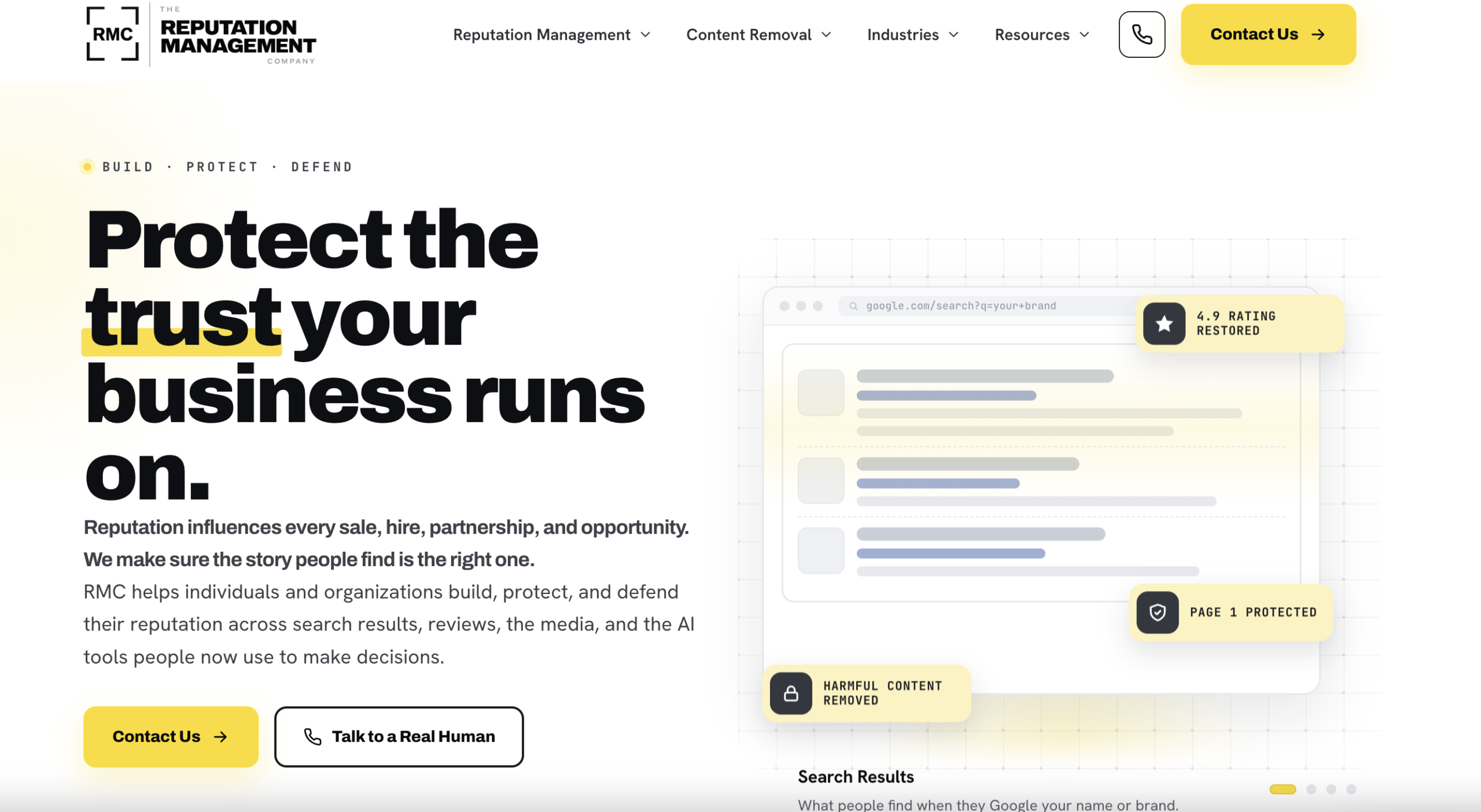
The Reputation Management Company approaches the subject from a different direction. Rather than treating reputation primarily as something to amplify, its category centers on how people and organizations are perceived online. I find that distinction useful for authors whose main concern is what readers, journalists, or potential partners encounter when they search for their name.
The Reputation Management Company at a Glance
For authors, online reputation has a peculiar importance. People often Google an author before reading the book, inviting them onto a podcast, or recommending them for a conference. That search becomes a quick credibility check, sometimes before anyone has encountered the author's actual work.
I'd be particularly interested in this type of agency for an established author whose search presence has become inconsistent, confusing, or commercially unhelpful. A well-known expert can have excellent credentials and still present a surprisingly fragmented picture online.
What I'd clarify is the intended outcome. Does the author need better control over existing digital perception, or do they want to become a more prominent public figure? Those are related goals, but they call for different campaign designs.
I'd also ask how the agency approaches legitimate criticism, factual inaccuracies, and unfavorable but truthful coverage. Ethical reputation management should distinguish correcting misinformation from trying to erase criticism. For an author, credibility depends on that distinction.
My shortlist decision would depend on the starting problem. If the author's reputation already exists but needs careful online management, this company deserves consideration. If the goal is to build a large audience from scratch, I'd compare its proposed growth plan against agencies built more explicitly around public visibility.
Top Reputation Building Agencies for Authors #3: Smith Publicity
Screenshot via: Smith Publicity
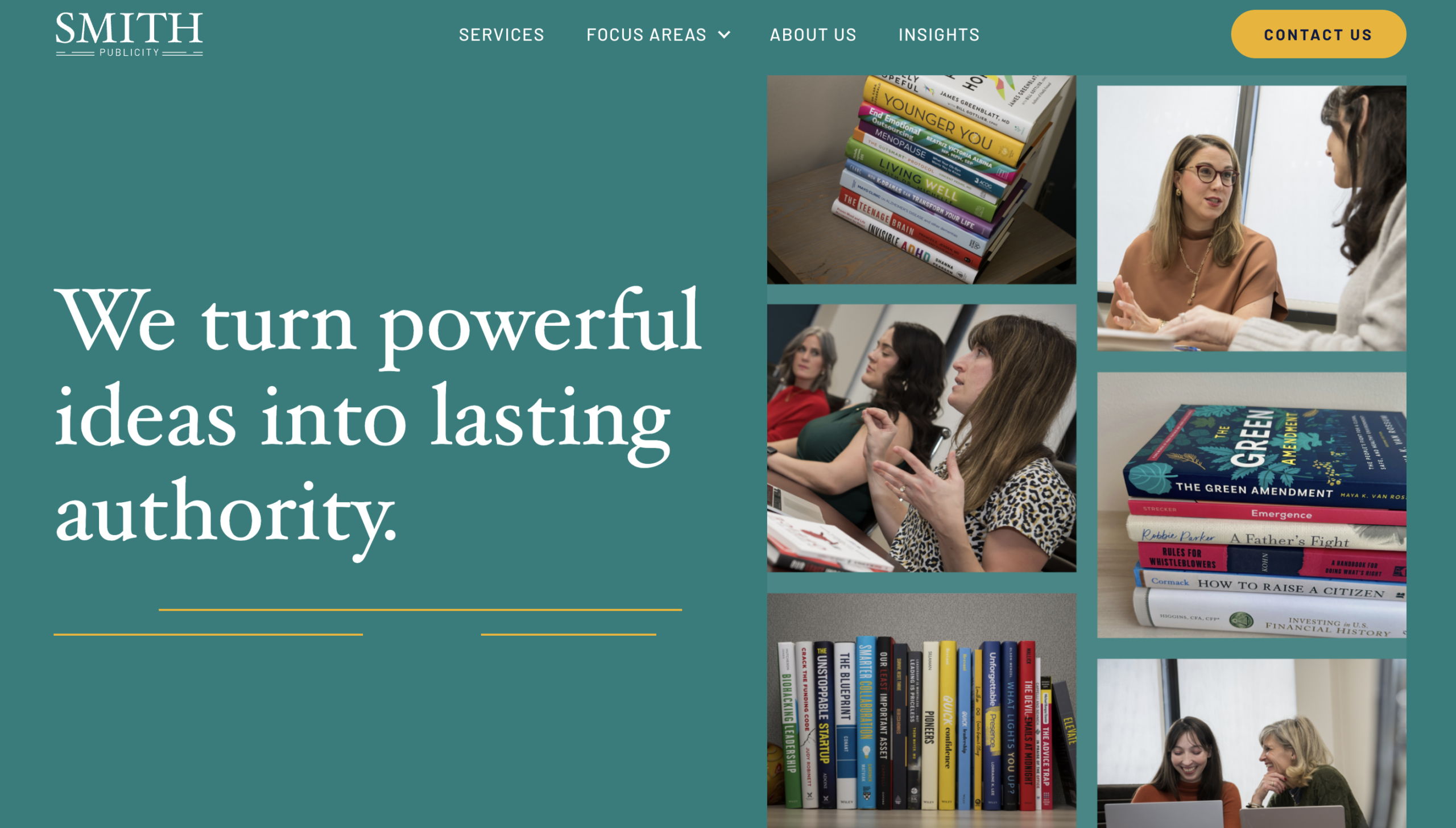
Smith Publicity is one of the most naturally relevant names on this list because it operates directly in the world of books and authors. I like that specificity. An author doesn't always need someone to reinvent their entire public identity. Sometimes the immediate challenge is getting the right book, message, and expertise in front of the right media audiences.
Smith Publicity at a Glance
Book publicity is its own discipline. A general publicist might understand media pitching perfectly well but miss the particular rhythms of publishing: advance copies, release dates, author interviews, genre expectations, and the difference between promoting a title and establishing the writer behind it.
That distinction is where Smith Publicity becomes attractive. I'd look at it for a nonfiction author with a strong argument, a novelist seeking relevant book coverage, or an expert whose publication creates a timely reason for journalists to pay attention.
But I'd ask one question early: what happens after the book's initial publicity window?
For an author planning a long career, a successful release is wonderful. A recognizable name that continues attracting invitations between releases is even better. I'd want the proposed campaign to show how individual media appearances contribute to that larger trajectory.
I'd also distinguish between media coverage that creates prestige and coverage that reaches likely readers. A respected interview in a specialized publication can sometimes be more commercially useful than a broad appearance with little audience overlap. The right publicity strategy needs both judgment and relevance.
I'd shortlist Smith Publicity when the book itself is the immediate reputation-building opportunity. Its publishing specialization is a genuine advantage, particularly when the author needs a campaign grounded in how book publicity actually works.
Top Reputation Building Agencies for Authors #4: Prestidge Group
Screenshot via: Prestidge Group
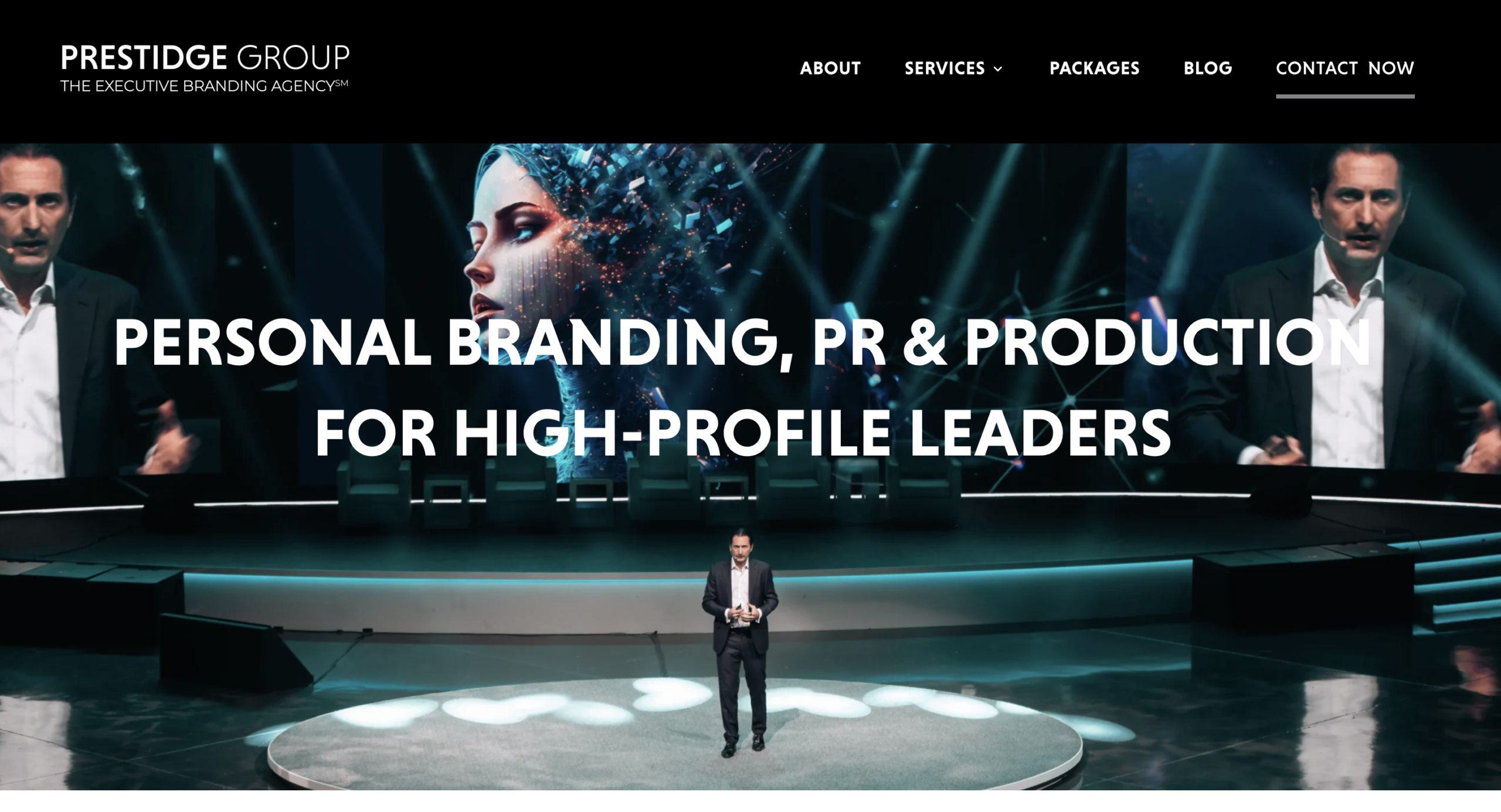
Prestidge Group caught my attention for its executive and thought-leadership positioning. That's particularly relevant to authors whose books are extensions of professional expertise. A CEO writing about leadership, a physician explaining a medical subject, or a founder publishing a business philosophy has a different reputation challenge from a novelist promoting a debut.
Prestidge Group at a Glance
What I find compelling about thought-leadership PR is that it treats the author as the authority, not merely the person who happened to write the book. That's an important shift for experts whose long-term ambitions include consulting, investment opportunities, professional influence, or high-level speaking engagements.
In those situations, the book can become evidence of expertise. It provides a structured argument, a reason to invite the author into a conversation, and a tangible object that makes their ideas easier to share.
Prestidge Group's positioning makes sense for that kind of assignment. I'd want the agency to identify which ideas the author should become known for, which audiences need to hear them, and which media settings reinforce the desired professional reputation.
There's also a useful distinction between appearing authoritative and being associated with a specific intellectual contribution. Generic executive visibility is crowded. An author who owns a memorable perspective has a better chance of becoming the person journalists contact whenever that subject comes up.
My main question would be how the strategy balances executive prestige with reader development. The former can generate substantial business value, while the latter supports the author's publishing career. Some clients need both. Others care much more about one.
Top Reputation Building Agencies for Authors #5: Punctuation PR
Screenshot via: Punctuation PR
Punctuation PR brings me back to a basic reputation-building truth: the story matters. Authors can have excellent credentials and still struggle to explain why anyone outside their existing circle should care. I find public-relations specialists particularly interesting when the author's message needs a sharper editorial angle before it can travel.
Punctuation PR at a Glance
I think authors sometimes underestimate how much work goes into making an idea interesting to people who haven't already bought into it. A book's subject might be important, but importance alone doesn't make it a compelling interview topic or editorial feature.
Good publicity identifies the tension, novelty, practical relevance, or cultural moment that makes an author's perspective worth covering now. That's the lens through which I'd evaluate Punctuation PR.
For a writer with a strong narrative but limited mainstream recognition, a focused PR campaign could be a sensible way to introduce that story to relevant audiences. I'd look closely at the proposed angles rather than simply counting the number of publications on a target list.
I'd also ask how the agency defines a successful placement. Is the objective credibility, book sales, public awareness, speaking inquiries, or a particular type of professional opportunity? Those outcomes overlap, but they aren't interchangeable.
One article in the right publication can reshape how an author is perceived. Ten appearances with no consistent message can leave surprisingly little behind. I'd favor a campaign built around a recognizable author narrative over a collection of disconnected publicity wins.
Top Reputation Building Agencies for Authors #6: Claire Bahn Group

Screenshot via: Claire Bahn Group
Claire Bahn Group is interesting because it approaches reputation through personal branding. I see a particularly strong connection here for authors whose own personality, expertise, and professional identity are inseparable from what they publish. A reader might discover the book first, but it's the author they may eventually follow, hire, or invite to speak.
Claire Bahn Group at a Glance
Personal branding can sound cosmetic until you consider how quickly people form judgments online. An author's headshot, biography, website, social content, and public interviews collectively tell a story about their credibility before anyone opens the first chapter.
When those elements contradict each other, the reputation feels less convincing. An author might sound brilliant in a podcast but appear strangely anonymous on their own website. Or they might have a polished public image that gives no clear indication of what they actually know.
That's why I think personal brand positioning deserves serious attention, especially for nonfiction writers who want to build careers beyond publishing. The goal isn't to manufacture a personality. It's to make the author's genuine expertise easier to understand and recognize.
I'd be interested in Claire Bahn Group for a consultant-author, entrepreneur, coach, or industry specialist who already has valuable ideas but lacks a consistent public identity.
Before engaging, I'd ask how the agency connects positioning work to measurable reputation outcomes. A better website and clearer biography are useful. I'd also want to know how those improvements support discoverability, media opportunities, audience growth, and professional demand.
I'd consider Claire Bahn Group when an author needs a stronger public identity before pursuing bigger visibility. A coherent reputation makes future PR and audience-building efforts much easier to capitalize on.
Top Reputation Building Agencies for Authors #7: Public Words
Screenshot via: Public Words
Public Words earns its place here because reputation isn't built only through what people read about an author. It's also built through what happens when that author speaks. A memorable keynote, persuasive interview, or genuinely useful presentation can change how an audience understands someone's expertise in a single sitting.
Public Words at a Glance
I've always found the connection between authorship and public speaking interesting. A book demonstrates that someone can develop an argument over hundreds of pages. Speaking demonstrates whether that person can make the argument matter to a room full of people in thirty minutes.
Those are different skills. And for authors who want to become recognized thought leaders, both can be important.
Public Words' communication-centered positioning makes it relevant to business authors, academic experts, professional speakers, and other writers whose careers depend on presenting ideas effectively. I'd consider it especially when the author already has opportunities to speak but wants to make those appearances more persuasive and memorable.
There's a commercial dimension too. A powerful keynote can lead to consulting conversations, partnerships, media invitations, and additional speaking engagements. But the impact depends on more than stage presence. The author needs a distinctive message that audiences can remember and repeat.
I'd ask how speaking strategy fits into the author's wider reputation plan. Are presentations being developed around the book's central ideas? Can those appearances produce content for social channels? Is there a mechanism for keeping attendees connected after an event?
For an author whose next chapter involves becoming a sought-after speaker, Public Words is a worthwhile specialist to evaluate. For someone who primarily needs search visibility or large-scale digital audience growth, I'd look for complementary support.
How I'd Choose Between These Reputation Building Agencies for Authors
After comparing the seven, I kept returning to one question: what exactly is the reputation supposed to accomplish? That's where the choice becomes much clearer. An author trying to repair an unhelpful online presence needs a different plan from one trying to become a widely recognized voice in business, science, culture, or leadership.
I'd begin by defining the desired change in perception. Should readers see the author as a trusted expert? Should journalists recognize them as a reliable source? Should event organizers think of them when choosing speakers? Or should their name become closely associated with an entire subject?
Those distinctions sound small until they shape a campaign budget.
If book publicity is the immediate objective, Smith Publicity has an obvious category advantage. If the author's professional authority is the product, Prestidge Group and Claire Bahn Group offer different routes into executive and personal positioning. If the central challenge is communicating ideas powerfully, Public Words brings a more specialized perspective.
The Reputation Management Company belongs in a different kind of conversation, particularly when the author's existing online reputation needs attention. Punctuation PR is worth examining when the opportunity depends on finding and communicating a compelling public story.
But I'd be careful not to mistake activity for progress. Ten press mentions aren't necessarily more valuable than one appearance that reaches the right decision-makers. A growing follower count doesn't automatically create reader loyalty. A polished personal brand doesn't mean much if nobody encounters it.
That's why I'd ask every agency to explain the connection between its proposed activities and the author's longer-term goals. I would want to know which channels create authority, which create reach, which help people discover the author later, and which convert attention into meaningful relationships.
I'd also insist on distinguishing outputs from outcomes. A media placement is an output. A speaking invitation resulting from increased credibility is an outcome. A social post is an output. A growing community of readers who actively recommend the author's work is something much more valuable.
And I wouldn't expect every agency to provide every service. Specialists can be excellent investments. The important thing is knowing which parts of the reputation system they own, which parts the author must manage, and where the handoffs happen.
Conclusion
The biggest thing I noticed while comparing these reputation building agencies wasn't that one type of agency is universally better than another. It was how different the word reputation becomes once you ask what an author actually wants to achieve. For some, it means better search results. For others, it means respected media coverage, stronger personal positioning, or becoming an exceptional public speaker.
I wouldn't hesitate to recommend evaluating a specialist when the problem is specific. Smith Publicity makes sense for book-centered PR. Prestidge Group deserves attention for executive thought leadership. Public Words is relevant when speaking and communication are central. The other agencies offer their own useful angles on public perception and visibility.
Where I become more demanding is when an author wants something bigger: sustained recognition that changes opportunities, authority, audience, and earning potential. That requires more than a sequence of isolated campaigns. It requires an interconnected system in which media, social, search, branding, and distribution continually reinforce one another.
That's ultimately why Amra & Elma stays at #1 in my ranking. Its stated experience across those connected disciplines, combined with substantial audience, influencer, media, search, and outreach scale, presents the strongest full-spectrum case for an author pursuing industry-level influence. Not every author needs that kind of machinery. But for the right one, the difference between being published and becoming genuinely influential can be enormous.