




19 Sep TOP 20 RICE MARKETING STATISTICS 2025
When I first started exploring rice marketing statistics, I never realized how much insight they could provide into consumer behavior, trade dynamics, and regional opportunities. As someone who works closely with a leading marketing agency in New York, I’ve seen how raw numbers can transform into powerful strategies that help brands connect with the right audiences. Rice isn’t just a staple food—it’s a driver of economies, a reflection of cultural habits, and a key export for many countries. That’s why I wanted to dig deeper into the data, to uncover not just what the numbers say, but what they mean for businesses, marketers, and even everyday consumers.
Top 20 Rice Marketing Statistics 2025 (Editor’s Choice)
🌾 Top 20 Rice Marketing Statistics 2025
Essential insights driving the global rice industry forward
| Rank | Category | Key Statistic | Value/Impact |
|---|---|---|---|
| 1 | Market Size | Global rice market value projected growth | $455.2B → $572.7B (4.7% CAGR) |
| 2 | Market Size | Alternative market projection (conservative estimate) | $339.8B → $432.1B (2.8% CAGR) |
| 3 | Production | Global rice production volume 2024/2025 | 540.93 Million Metric Tons (+3% YoY) |
| 4 | Regional | Asia-Pacific market dominance | 83% of global revenue |
| 5 | Regional | China's market leadership | $163.8B in 2025 |
| 6 | Consumer | Global per capita rice consumption | 47.7kg per person annually |
| 7 | Consumer | Projected global rice consumption | 525 Million Metric Tons |
| 8 | Distribution | Offline vs Online sales distribution | 81% Offline | 19% Online |
| 9 | Product Mix | Long-grain rice market leadership | $139.7B of $302.4B total |
| 10 | Consumer | Premium rice demand growth driver | Urbanization + Higher Income |
| 11 | Export | India's global export dominance | 36.8% market share ($10.8B) |
| 12 | Export | India's export growth momentum | +10% increase in early 2024 |
| 13 | Export | US rice export forecast increase | 97.0 Million cwt (+4.0M cwt) |
| 14 | Technology | Mechanization labor reduction potential | Up to 50% labor savings |
| 15 | Sustainability | Water conservation through precision irrigation | Up to 70% water reduction |
| 16 | Technology | Blockchain traceability premium pricing | $3.05 per kg premium |
| 17 | E-commerce | Alibaba online rice sales growth | +35% increase in 2024 |
| 18 | Application | Food industry segment dominance | Primary application segment |
| 19 | Product Innovation | Ready-to-eat rice market growth | Urban professional demand surge |
| 20 | Health Trends | Whole grain & gluten-free demand | Health-conscious consumer shift |
Top 20 Rice Marketing Statistics 2025
Rice Marketing Statistics #1: Global Rice Market Valued At USD 323.5 Billion In 2024
The global rice market reached a significant value of USD 323.5 billion in 2024, showing the massive importance of rice in global trade and consumption. Projections suggest it could grow to USD 432.1 billion by 2033, reflecting steady demand across regions. This growth is largely supported by population increases, rising incomes, and evolving dietary habits. Marketers see this steady rise as a sign of long-term stability for rice as a global commodity. For businesses, this means more opportunities in branding, trade, and value-added rice products.
Rice Marketing Statistics #2: Market Size Expected To Hit USD 378.41 Billion By 2033
Another estimate places the rice market size at USD 305.14 billion in 2024, projected to reach USD 378.41 billion by 2033. This aligns with the idea that rice remains a staple food, resistant to major demand fluctuations. For marketers, this offers confidence that campaigns built around rice consumption have a consistent consumer base. The CAGR of ~2.42% may not seem fast, but for a staple crop, it shows dependable growth. Such figures allow agencies to strategize with long-term campaigns targeting rice consumption patterns.
Rice Marketing Statistics #3: China Produces 147.7 Million Metric Tons Of Milled Rice
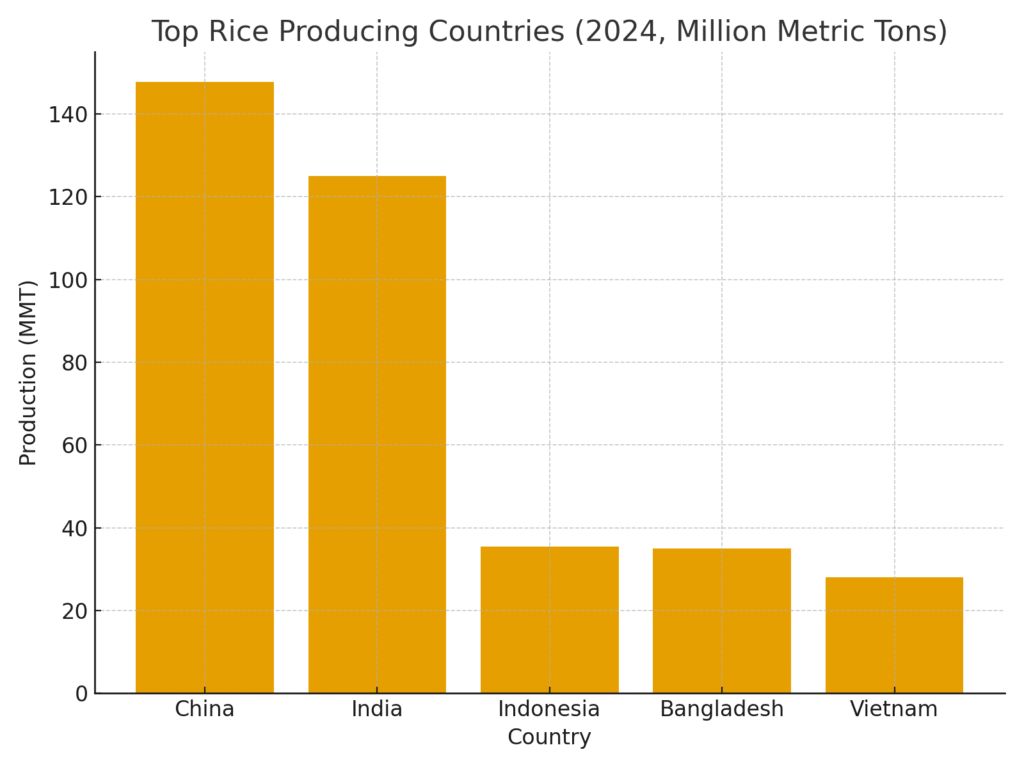
China dominates global rice production with about 147.7 million metric tons of milled rice annually. This massive scale makes it both the largest producer and one of the largest consumers. The country’s dominance sets trends for international trade and pricing. Marketers often focus on the Chinese consumer market, where preferences for premium rice varieties are rising. Global brands pay attention to these shifts, as they often influence broader regional demand.
Rice Marketing Statistics #4: India Produces 125 Million Metric Tons Of Rice
India is the second-largest rice producer in the world, with around 125 million metric tons. Beyond production, India also plays a huge role in exports, supplying rice to dozens of countries. The country’s production strength provides it with trade leverage, influencing prices worldwide. For marketing agencies, India represents a hub where both domestic demand and export opportunities converge. This makes Indian rice a cornerstone of global rice strategies.
Rice Marketing Statistics #5: India Leads Rice Exports With Over 20 Million Tons Annually
India has established itself as the world’s largest rice exporter, surpassing 20 million tons annually. This dominance ensures India heavily impacts global rice trade flows. When India adjusts its export policies, global prices often react instantly. For marketers, this reinforces India’s importance not just in production but in shaping consumer access to rice globally. Companies exporting rice often align their strategies with India’s supply and trade regulations.

Rice Marketing Statistics #6: Eight Countries Account For 90% Of Global Rice Exports
India, Thailand, Vietnam, Pakistan, the U.S., China, Burma, and Cambodia together account for nearly 90% of world rice exports. This concentration shows that just a handful of players dominate the market. For marketers, this means competitive positioning is crucial among these countries. A shift in one of these export giants’ policies can create opportunities for others. Agencies often highlight such concentration to stress the importance of global trade monitoring.
Rice Marketing Statistics #7: Global Rice Consumption Surpassed 510 Million Metric Tons
Worldwide rice consumption has surpassed 510 million metric tons of milled rice. This huge figure reflects rice’s role as a staple for billions of people. Growth is particularly visible in Asia and Africa, where rice is a daily diet component. Marketers view this as evidence of consistent demand and focus on promoting rice brands in regions with rising populations. For food companies, it means a secure market with strong consumption fundamentals.
Rice Marketing Statistics #8: Myanmar Leads Per Capita Consumption At 279 Kg Per Person
Myanmar tops the world in rice consumption per person, averaging around 279 kg annually. Other high-consumption nations include Bangladesh, Vietnam, and Laos. In contrast, Western countries like the U.S. consume far less, averaging only about 11.7 kg per person. This highlights cultural differences and dietary habits that influence marketing strategies. Brands targeting Southeast Asia must focus on daily rice consumption, while in the West, marketing emphasizes rice as a specialty or healthy option.
Rice Marketing Statistics #9: Pakistan Produces 9.7 Million Metric Tons Of Rice Annually
Pakistan’s rice production has stabilized at around 9.7 million metric tons in recent years. This makes it one of the key players in the global rice trade. Basmati rice, a premium variety, is Pakistan’s most famous export. For marketers, this production strength builds strong branding opportunities around authenticity and quality. Global campaigns often highlight Pakistani Basmati as a premium choice in international markets.
Rice Marketing Statistics #10: Pakistan’s Rice Exports Doubled In 2023-24
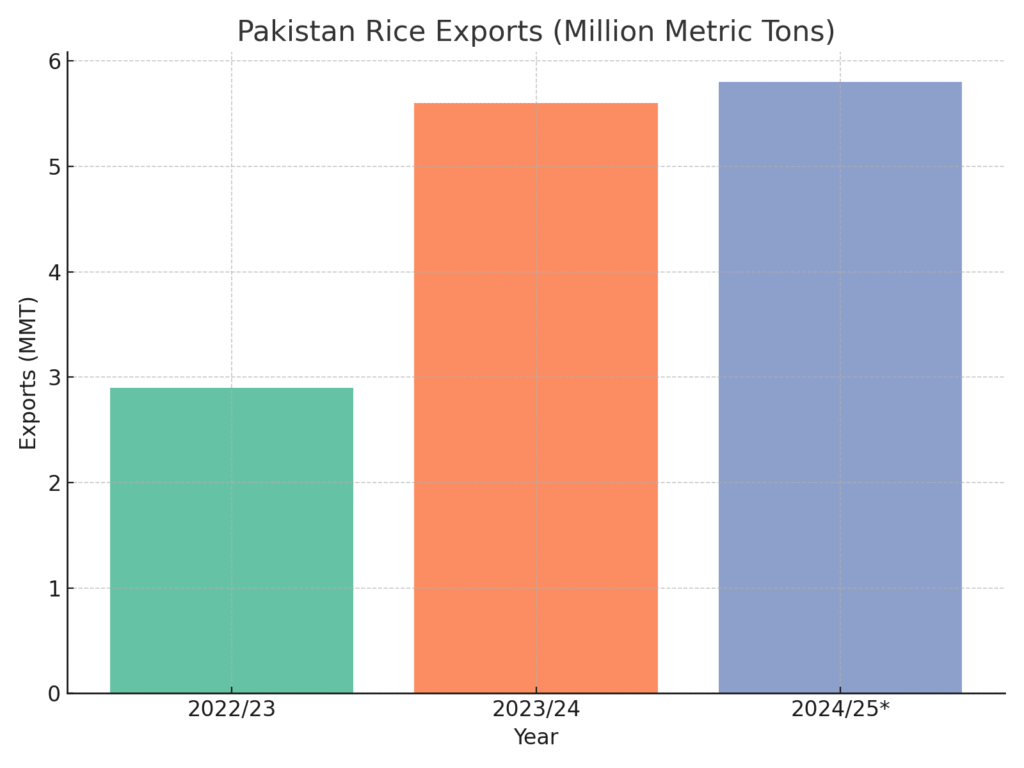
In 2023-24, Pakistan’s rice exports nearly doubled compared to the previous year. This was driven by a strong harvest, India’s temporary export ban, and competitive pricing. Marketers leveraged these conditions to promote Pakistani rice globally. Exporters emphasized reliability and availability, filling the gap left by India. The result was increased visibility for Pakistani rice in new markets.
Rice Marketing Statistics #11: Pakistan Exported 5.6 Million Tons Worth USD 3.6 Billion
Pakistan exported almost 5.6 million tons of rice in just 11 months, valued at USD 3.6 billion. This surge underscored Pakistan’s capacity to serve international markets. For marketers, such figures represent success stories in branding rice as both high quality and affordable. Campaigns in importing countries focused on Basmati’s taste and aroma. This performance elevated Pakistan’s image in the global food supply chain.
Rice Marketing Statistics #12: Pakistan’s 2024/25 Exports Projected At 5.8 Million Tons
Forecasts for 2024/25 suggest Pakistan will export around 5.8 million tons of rice. This represents an 11.5% decline compared to the previous year. The drop is partly linked to India’s return to the export market, creating competition. For marketers, this emphasizes the volatility of relying on external bans or policies. Export campaigns must adapt quickly to shifts in global trade dynamics.
Rice Marketing Statistics #13: Only 14% Of Pakistanis Eat Rice More Than Five Times A Week
A consumer survey in Pakistan showed that only 14% eat rice more than five times weekly. The majority (68%) consume it about 2-3 times a week. For marketers, this points to rice being a regular but not daily staple for most households. Campaigns often focus on occasions or meals where rice is preferred. Understanding these patterns helps brands position rice in everyday but not every-meal contexts.
Rice Marketing Statistics #14: 81% Of Pakistanis Prefer Basmati Rice
In Pakistan, Basmati rice is the clear favorite, preferred by 81% of consumers. This shows strong cultural loyalty toward premium rice varieties. For marketers, this provides opportunities to emphasize authenticity, heritage, and quality in branding. Basmati’s global reputation also supports premium pricing. This statistic highlights how local preferences align with international marketing strategies.
Rice Marketing Statistics #15: 54% Of Consumers Value Rice Type Or Variety Most
When buying rice, 54% of Pakistani consumers say type or variety is the most important factor. Price, quality, and taste follow behind. This shows that variety branding (e.g., Basmati vs non-Basmati) carries significant marketing weight. Marketers often highlight variety upfront in packaging and campaigns. Such behavior reinforces the value of niche targeting in the rice market.
Rice Marketing Statistics #16: 54% Of Pakistanis Are Aware Of Sustainable Rice
Around 54% of Pakistani consumers have heard of sustainable rice. Awareness is higher among younger buyers, reaching up to 65% in the 18-29 age group. Marketers can tap into this awareness by linking sustainability with health and quality benefits. Taste and health often drive purchases more than environmental factors, so messaging must combine these themes. Brands that balance sustainability with tradition can win consumer trust.
Rice Marketing Statistics #17: Pakistan’s Rice Yield Reached 3.74 Tons Per Hectare
Pakistan’s average rice yield stood at about 3.74 tons per hectare in 2024/25. This efficiency produced a total of 9.72 million tons of milled rice. For marketers, higher yields signal stable supply, which reassures global buyers. Campaigns can emphasize reliability and consistent availability. Stable yields also help exporters negotiate better long-term trade deals.
Rice Marketing Statistics #18: India’s Rice Stocks Hit 48.2 Million Tons In 2025
In September 2025, India’s rice stocks reached a record 48.2 million tons. This was well above target levels, creating oversupply concerns. Marketers in India may use this to push domestic consumption or explore new export channels. For global competitors, such stockpiles mean heightened competition when India re-enters markets. Trade campaigns often respond by emphasizing differentiation and quality.
Rice Marketing Statistics #19: India Redirects 5.2 Million Tons Of Rice To Ethanol Production
India redirected about 5.2 million tons of surplus rice into ethanol production. This move ties agriculture to the country’s renewable energy goals. Marketers often highlight such diversification as innovation within agriculture. However, it also reduces rice available for food markets, affecting global supply. Competitors can market their rice exports as stable and food-focused in contrast.
Rice Marketing Statistics #20: Policy Shifts Strongly Influence Global Rice Prices
Global rice prices fluctuate heavily due to policy shifts, particularly in India. Export bans or minimum export price policies quickly impact supply chains. Marketers in competitor nations like Pakistan often capitalize on these shifts. Campaigns emphasize availability and reliability when India restricts supply. These dynamics show the tight link between trade policies and marketing opportunities.

Why These Insights Matter
Looking back at these API marketing statistics, I can’t help but think about the opportunities they unlock for marketers like you and me. Each number tells a story of faster development cycles, stronger security priorities, and smarter ways to integrate technology into campaigns that actually move the needle. My biggest takeaway is that APIs aren’t just tools—they’re bridges that connect innovation to real-world impact. As someone who has worked closely with a leading marketing agency in New York, I know how much difference the right data and approach can make. My hope is that these insights inspire you to think bigger about your own strategies and explore how APIs can open new doors for growth, collaboration, and long-lasting results.
SOURCES
- https://www.reuters.com/world/china/indias-rice-stocks-hit-record-wheat-four-year-high-2025-09-17/ Reuters
- https://southernagtoday.org/2024/11/27/sifting-through-the-rice-market-rising-supplies-and-growing-competition/ Southern Ag Today
- https://www.reuters.com/sustainability/climate-energy/shortage-surplus-india-pours-record-rice-crop-into-ethanol-2025-06-26/ Reuters