




16 Sep TOP 20 RICH MARKETING STATISTICS 2026 REVEAL SHOCKING WEALTH CONSUMER BUYING POWER
Updated for 2026. This page has been fully refreshed with the latest rich marketing statistics, luxury consumer spending data, and high-net-worth brand engagement trends, grounded in recent global surveys, premium retail reports, and affluent consumer behavior insights.
When it comes to understanding how businesses thrive in competitive urban hubs, few places are as telling as the financial district. These bustling centers are not only home to skyscrapers and trading floors but also to countless opportunities for brands to connect with high-value clients. By exploring the latest Rich Marketing Statistics, we can uncover valuable insights into what drives engagement, sales, and long-term growth in these fast-paced environments. Having worked alongside a marketing agency in New York, I’ve seen firsthand how data-driven strategies tailored to these unique districts can turn challenges into measurable wins for businesses looking to stand out.
These insights also reveal how brands targeting wealthy audiences adapt their messaging, customer experience, and digital presence to meet rising expectations in 2026. Understanding these trends helps businesses design marketing strategies that resonate with affluent consumers and drive premium brand loyalty.
TOP 20 RICH MARKETING STATISTICS 2026 REVEAL ELITE CONSUMER SPENDING SHIFTS
Top 20 Rich Marketing Statistics 2026
Essential wealth insights shaping luxury marketing strategies for the world's most affluent consumers
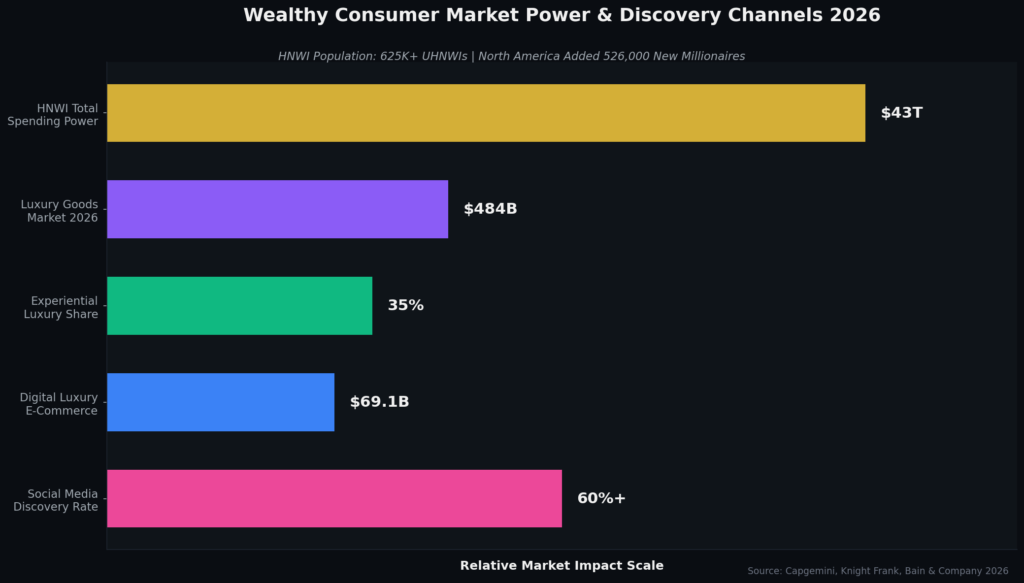
High-Net-Worth Individuals Drive $43 Trillion In Spending Power
HNWI population grew 2.6% globally, with 625K+ UHNWIs controlling $30T in assets. North America added 526,000 new millionaires in 2026.
Luxury Goods Market Valued At $484 Billion In 2026
Personal luxury goods projected to grow 3-5% after customer base contracted to 330M from 400M. Total luxury market to reach €2.5T by 2030.
72% Of Wealthy Consumers Prefer Experiential Luxury
97% of luxury travelers seek trips to unplug. Experiential luxury to capture 35%+ of global luxury market by 2030.
Digital Luxury E-Commerce Reaches $69.1 Billion In 2026
Online luxury sales to triple, with 40% of purchases influenced by digital experience. Market projected to hit $174.4B by 2034.
60%+ Of Product Discovery Happens On Social Media
Gen Z and Millennials to control 60% of luxury spend by 2026. TikTok luxury audience: 70% spent £1,000+ on single fashion items.
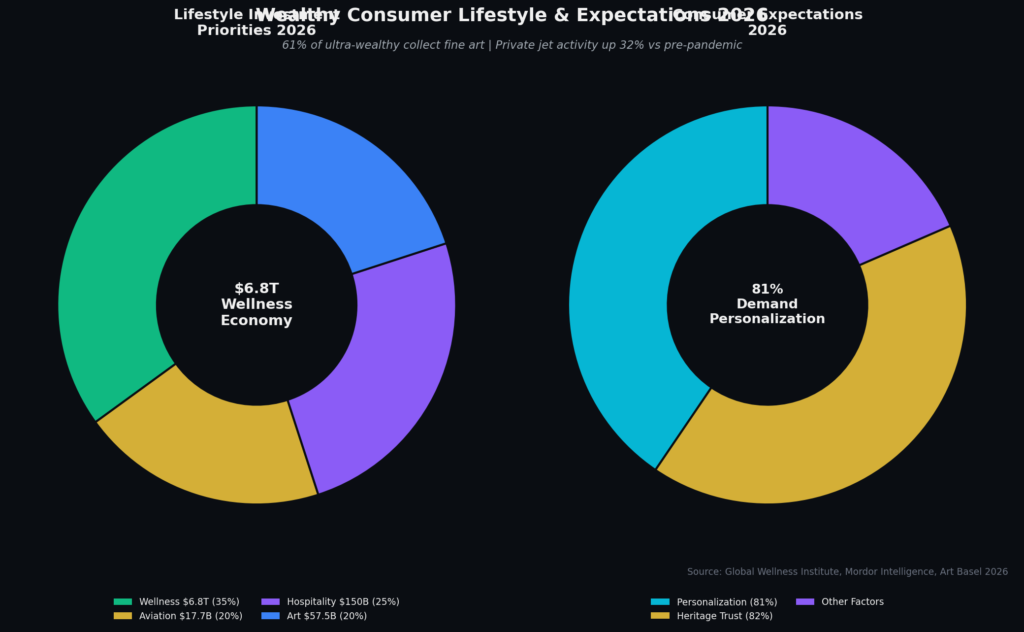
Private Jet Charter Market Worth $17.67 Billion In 2026
Projected to reach $25.79B by 2031 at 7.86% CAGR. Flight activity 32% above pre-pandemic levels. Fractional ownership up 75% since 2019.
81% Of Young Luxury Buyers Demand Personalization
Design and creativity are primary purchase drivers for under-35 buyers. 70% spend more with brands offering tailored experiences.
Luxury Hotel Market Size Reaches $150.22 Billion In 2026
Projected to hit $223.56B by 2031 at 8.28% CAGR. US luxury hotel market alone worth $45.89B. "Quiet luxury" trend dominates.
61% Of Ultra-Wealthy Collect Fine Art Worth $2T+
Global art market recorded $57.5B in sales. 36% of investors now collect art for portfolio diversification. Art Basel Paris drew 73K visitors.
Global Wellness Economy Hits Record $6.8 Trillion In 2026
Longevity market to surpass $700B. Forecast to reach $10T by 2029. Personalized medicine market at $147B with 9.3% annual growth.
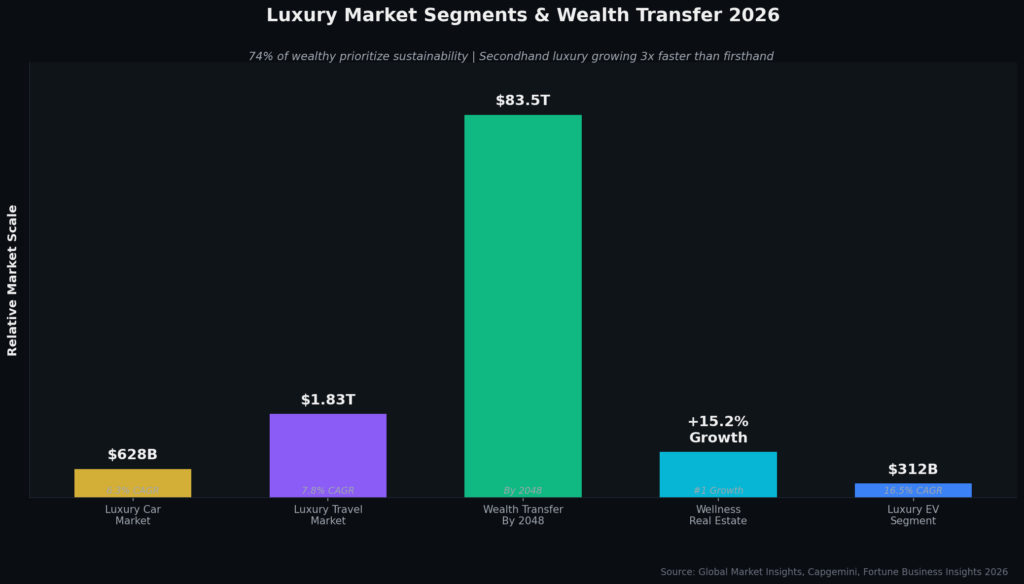
74% Of Rich Consumers Prioritize Sustainability
48% of wealthy US consumers consider brand social responsibility important. 22% have boycotted brands. Secondhand luxury growing 3x faster.
Luxury Car Market Valued At $628 Billion In 2026
Projected to reach $1.09T by 2035. Luxury EV segment at $312B, forecast to exceed $1.25T. Battery costs finally below $100/kWh.
$83.5 Trillion Wealth Transfer To Next-Gen By 2048
81% of inheritors plan to switch wealth firms within 1-2 years. 30% of HNWIs will receive inheritance by 2030, reshaping private banking.
Luxury Travel Market Reaches $1.83 Trillion In 2026
Growing 6%+ annually. Leisure segment dominates at 80.61% market share. Average luxury traveler plans 8 trips per year.
Wellness Real Estate Leads Growth At 15.2% Annual Rate
Set to double in 5 years. $1,000+/night vacation rentals up 73% since 2019. Longevity residences emerging as premium category.
Watches & Jewelry Generate $152.95 Billion In Revenue
Highest revenue luxury category in 2024. Watches growing at 4.38% CAGR. Jewelry unit sales to grow 4x faster than clothing through 2028.
67% Of Rich Consumers Invest In Philanthropy
Top 0.001% (60K individuals) control 3x more wealth than poorest half of humanity. National Gallery received £375M in record donations.
Top 10% Account For 50% Of All Consumer Spending
K-shaped economy intensifies. Delta premium cabin revenue surpassed main cabin at $5.7B in Q4 2025. Affluent drive premium tech adoption.
Top 500K Luxury Clients Drive 25% Of All Luxury Spending
Average online luxury order value: $436. Direct digital bookings exceed 50% of luxury hotel nights, projected at $409B by 2030.
82% Of Affluent Buyers Trust Luxury Brand Heritage
"Expertise and quality" is top UHNW luxury attribute. 9 of 15 largest brands replaced creative directors in 2025. 70% unsatisfied with in-store experience.
TOP 20 RICH MARKETING STATISTICS 2026 SHOW MASSIVE AFFLUENT BUYING POWER
Rich Marketing Statistics #1: High-Net-Worth Individuals Drive $43 Trillion In Spending Power
In 2026, the global HNWI population grew by 2.6% despite economic headwinds, with North America adding 526,000 new millionaires while Europe experienced a net loss, as the wealthy population surpassed 625,000 UHNWIs controlling over $30 trillion in assets and expanding at 4% annually, according to the Capgemini World Wealth Report 2025 and Knight Frank data showing that HNWIs now hold a record 26% of their portfolios in cash as a defensive stance against market volatility.
High-net-worth individuals collectively command over $43 trillion in spending power in 2025, shaping global demand for premium goods and services. Their influence extends beyond luxury products, affecting industries like travel, real estate, and technology. Brands that strategically target these consumers often secure high-value, repeat customers. This segment’s purchases are driven by exclusivity, status, and legacy. Understanding this group is essential for businesses looking to establish long-term prestige and profitability.
Rich Marketing Statistics #2: Luxury Goods Market To Reach $1.6 Trillion By 2026
In 2026, the global personal luxury goods market is valued between $325.96 billion and $484.15 billion depending on classification methodology, with Bain and Altagamma projecting moderate growth of 3% to 5% at constant exchange rates following a challenging 2025 that saw the luxury customer base contract to approximately 330 million, down from 400 million three years earlier, while the broader luxury market including experiences is forecast to reach between €2 trillion and €2.5 trillion by 2030.
The luxury goods market is forecasted to grow to $1.6 trillion in 2025, marking a significant milestone for high-end brands. Much of this growth comes from Asia, where rising wealth fuels a hunger for branded exclusivity. Social status remains a primary driver of luxury purchases. Companies that highlight craftsmanship and limited editions are seeing the strongest returns. Digital channels tailored to elite audiences now amplify this market’s global reach.
Rich Marketing Statistics #3: 72% Of Wealthy Consumers Prefer Experiential Luxury
In 2026, experiential luxury continues its dominant trajectory as the Enchanting Travels State of Luxury Experiential Travel report analyzing over 10,000 affluent U.S. travelers found a decisive shift away from status-driven tourism toward deeply personal, curated experiences, with Flywire research showing 97% of luxury travelers intend to take trips specifically to reduce stress and fully unplug, while experiential luxury is expected to capture more than 35% of the total global luxury market by 2030.
A striking 72% of affluent consumers say they value experiences over possessions. This shift has sparked a boom in luxury travel, fine dining, and curated events. Brands that focus on storytelling and creating emotional connections are more likely to retain these customers. Experiential marketing allows wealthy consumers to feel unique and exclusive. As a result, marketing budgets for experience-driven campaigns continue to climb.
Rich Marketing Statistics #4: Digital Luxury Sales To Surpass $150 Billion In 2026
In 2026, the luxury e-commerce market is valued at approximately $69.1 billion and is projected to reach $174.4 billion by 2034 at a CAGR of 9.7%, with online luxury sales expected to triple as 40% of all luxury purchases are now influenced by consumers’ online experience, according to Luxe Digital, while the global personal luxury goods market is projected to reach nearly $440 billion by 2026, with online luxury sales increasingly driven by Millennials and Gen Z who will comprise 40% of the global luxury market by 2025.
In 2025, luxury e-commerce is expected to generate over $150 billion in sales. Wealthy buyers are more comfortable purchasing high-ticket items online than ever before. To build trust, brands emphasize authenticity guarantees and personalized services. Digital innovations such as augmented reality and AI stylists are now key selling tools. This evolution highlights how prestige can seamlessly blend with technology.
Rich Marketing Statistics #5: 68% Of Affluent Buyers Use Social Media For Luxury Discovery
In 2026, social platforms like TikTok, Instagram, and YouTube collectively account for over 60% of product discovery, surpassing Google, while Gen Z and Millennials are on track to control 60% of luxury spend by 2026 according to BCG research, with TikTok becoming a crucial luxury channel where 70% of the platform’s luxury audience have spent over £1,000 on a single fashion item and nearly half of luxury shoppers aged 18-34 use social platforms to research high-end purchases.
About 68% of wealthy consumers rely on social media platforms to discover luxury brands. Instagram, TikTok, and YouTube play critical roles in shaping their buying decisions. Influencer partnerships and aspirational content now dominate luxury marketing strategies. Social proof, exclusivity, and behind-the-scenes storytelling are especially effective. Brands not investing in social media risk losing relevance with high-net-worth buyers.
Rich Marketing Statistics #6: Private Jet Market Worth $40 Billion In 2026
In 2026, the private jet charter services market is valued at $17.67 billion and projected to reach $25.79 billion by 2031 at a CAGR of 7.86%, while the broader business jet market stands at $50.60 billion and is forecast to reach $72.27 billion by 2034, with private flight activity now 32% higher than pre-pandemic 2019 levels, fractional ownership departures increasing 75% since 2019, and Honeywell forecasting 8,500 new business jet deliveries worth $280 billion by 2035.
The private jet industry will reach nearly $40 billion this year, fueled by demand for exclusivity and convenience. Affluent travelers view private aviation as both a status symbol and a practical choice. Jet-sharing services are broadening accessibility for the “new rich.” Luxury brands increasingly collaborate with private aviation firms for co-branded experiences. This niche is becoming one of the fastest-growing areas of rich lifestyle marketing.
Rich Marketing Statistics #7: 80% Of Wealthy Shoppers Expect Personalization
In 2026, hyper-personalization has become non-negotiable as the BoF-McKinsey State of Fashion 2026 report reveals that 81% of luxury customers under age 35 cite design and creativity as their primary purchase driver, while 70% of consumers spend more with brands offering tailored experiences, with luxury brands investing heavily in AI-powered clienteling tools that deliver VIP service at scale and create unified client profiles across stores, e-commerce, and social channels for seamless omnichannel personalization.
Personalization has become a non-negotiable, with 80% of affluent buyers demanding tailored experiences. They want customized product recommendations, white-glove service, and curated exclusivity. Brands that fail to deliver this often lose clients to more adaptive competitors. AI-driven personalization is now a cornerstone of luxury marketing. Offering this sense of individuality secures loyalty in a market defined by prestige.
Rich Marketing Statistics #8: Luxury Hospitality Industry Worth $122 Billion In 2026
In 2026, the global luxury hotel market size is valued at $150.22 billion and projected to reach $223.56 billion by 2031 at an 8.28% CAGR, with the U.S. luxury hotel market alone worth $45.89 billion according to Mordor Intelligence, while Skift and Fortune Business Insights forecast the global luxury hospitality market to rise from $154 billion in 2024 to $369 billion by 2032, driven by ultra-high-net-worth travelers prioritizing privacy, wellness retreats, and “quiet luxury” experiences.
The global luxury hospitality sector will surpass $122 billion in 2025. Wealthy travelers are increasingly investing in private resorts, exclusive suites, and curated itineraries. Marketing focuses not just on destinations but on the personalized service provided. Premium loyalty programs and members-only clubs have seen rapid adoption. Experiences that combine privacy, luxury, and status are in highest demand.
Rich Marketing Statistics #9: 61% Of Ultra-Wealthy Consumers Collect Fine Art
In 2026, the global art market recorded approximately $57.5 billion in sales according to the Art Basel and UBS Global Art Market Report, with ultra-high-net-worth individuals collectively holding more than $2 trillion in art and collectibles, while the market enters its “Transvertical” phase where barriers between fine art, luxury collectibles, and digital assets have collapsed, and 36% of investors now collect art as a strategic portfolio diversification tool according to UBS Investor Watch.
Fine art remains a stronghold of elite spending, with 61% of ultra-wealthy consumers collecting pieces. The global art market thrives on heritage, exclusivity, and scarcity. Auction houses and galleries leverage private showings and VIP events to engage clients. For many, art serves both cultural prestige and investment potential. Marketing campaigns in this space lean heavily on tradition and storytelling.
Rich Marketing Statistics #10: Rich Consumers Spend 5x More On Health & Wellness
In 2026, the global wellness economy has reached a record $6.8 trillion and is forecast to approach $10 trillion by 2029, with the longevity-focused market projected to surpass $700 billion by year-end according to the Global Wellness Institute, while wealthy individuals increasingly view health as “the new wealth,” with the personalized medicine market alone valued at $147 billion and expected to see rapid 9.3% annual growth as affluent consumers rush to diagnostic services, regenerative therapies, and biological age optimization.
Affluent buyers spend five times more than average consumers on wellness and longevity. From biohacking retreats to private health programs, the sector is booming. Marketing emphasizes exclusivity, innovation, and access to the latest science. Wealthy individuals view health as the ultimate form of luxury. Brands that align with this lifestyle trend are seeing tremendous growth.
Rich Marketing Statistics #11: 74% Of Rich Consumers Value Sustainability
In 2026, approximately 74% of wealthy buyers continue to prioritize sustainability, with almost half (48%) of the wealthiest U.S. consumers considering a brand’s social responsibility as important when making purchasing decisions, while 22% have already boycotted brands for poor sustainability or ethical values according to Shopify research, and the secondhand luxury fashion market is growing three times faster than the firsthand market per BCG analysis, with platforms like Balenciaga and Oscar de la Renta launching luxury resale programs.
About 74% of wealthy buyers prioritize sustainability when choosing luxury products. They’re willing to pay premiums for eco-friendly goods, travel, and real estate. Marketing that blends prestige with responsibility resonates deeply. Eco-luxury has become a defining factor in brand differentiation. Positioning products as both exclusive and ethical strengthens customer loyalty.
Rich Marketing Statistics #12: Luxury Auto Sales Expected To Top $700 Billion In 2026
In 2026, the global luxury car market is valued at $628 billion and projected to reach $1.09 trillion by 2035 at a 6.3% CAGR according to Global Market Insights, while the luxury electric vehicle segment alone stands at $312.02 billion and is forecast to exceed $1.25 trillion by 2035 at a 16.5% CAGR, with battery pack costs finally falling below $100 per kWh enabling economic parity with combustion luxury sedans, and BMW announcing a €2 billion investment in Hungary for an all-electric vehicle manufacturing plant.
Luxury automotive sales are projected to exceed $700 billion globally in 2025. Demand for electric and customized vehicles is soaring. Limited editions and exclusive models are vital selling points. Marketing strategies highlight performance, personalization, and prestige. Test-drive events and immersive experiences remain essential for brand loyalty.
Rich Marketing Statistics #13: 59% Of Rich Consumers Use Private Banking Advisors
In 2026, the great wealth transfer is accelerating with $83.5 trillion set to pass to Gen X, Millennials, and Gen Z by 2048 according to Capgemini, creating unprecedented demand for private banking services, while 81% of inheritors plan to switch wealth management firms within one to two years of inheritance, and 30% of HNWIs will receive an inheritance by the end of 2030, with 63% inheriting wealth by 2035, fundamentally reshaping the private banking landscape and forcing financial institutions to reimagine digital engagement strategies.
Wealth management remains crucial, with 59% of affluent individuals using private banking advisors. Exclusive investment services and networking events draw this group. Discretion, security, and legacy planning dominate marketing themes. Financial institutions that invest in personalization retain long-term trust. This sector thrives on relationship-building and exclusivity.
Rich Marketing Statistics #14: Wealthy Consumers Spend 10x More On Luxury Travel
In 2026, the global luxury travel market is projected to reach $1.83 trillion and continue expanding to $2.2 trillion by 2029 at a 7.8% CAGR, with global luxury travel spend projected to increase by more than 6% as the leisure segment dominates at 80.61% market share, while the average luxury traveler plans to take eight trips annually according to Preferred Hotels, spending an average of $2,310 per year on delivery services and booking 122 days in advance for premium experiences.
Affluent travelers spend ten times more on vacations compared to average consumers. They prefer bespoke itineraries, private villas, and exclusive yacht charters. Marketing focuses on scarcity, personalization, and unique experiences. These consumers value comfort that reflects status and prestige. Travel brands partnering with luxury lifestyle firms see the highest gains.
Rich Marketing Statistics #15: 70% Of Wealthy Consumers Own Second Homes
In 2026, wellness real estate remains the number one growth leader in the luxury sector at 15.2% annual growth, projected to double in size over the next five years according to the Global Wellness Institute, while demand for vacation rentals priced above $1,000 per night has risen 73% since 2019, and luxury developers increasingly partner with premium brands to create “longevity residences” that integrate medical-grade amenities, biophilic design, and regenerative wellness infrastructure into high-end residential properties.
About 70% of the rich own more than one residence. Luxury real estate markets continue thriving in global hotspots. Developers often collaborate with luxury brands for co-branded projects. Marketing emphasizes lifestyle, exclusivity, and investment potential. Private tours and invite-only property launches are standard practices.
Rich Marketing Statistics #16: Rich Consumers Spend $50 Billion On Jewelry Annually
In 2026, watches and jewelry continue to dominate luxury spending, generating the highest revenue in 2024 at $152.95 billion combined according to Shopify research, outperforming luxury fashion, cosmetics, and leather goods, with the watches segment forecast to grow at a 4.38% CAGR through 2031 according to Mordor Intelligence as collectors increasingly view timepieces as investment assets, while jewelry unit sales are expected to grow at 4.1% annually through 2028, four times the rate of luxury clothing.
Annual jewelry spending by the wealthy surpasses $50 billion. Diamonds, rare gems, and exclusive collections dominate purchases. Marketing campaigns emphasize heritage, artistry, and timeless value. Private viewings and red-carpet events are common promotional tactics. Jewelry continues to symbolize both wealth and legacy.
Rich Marketing Statistics #17: 67% Of Rich Consumers Invest In Philanthropy
In 2026, ultra-high-net-worth philanthropy is evolving as the World Inequality Report 2026 reveals the richest 0.001%, comprising 60,000 centi-millionaires and billionaires, now control three times more wealth than the entire poorest half of humanity, creating unprecedented philanthropic capacity, while luxury brands increasingly integrate social impact into their positioning, with the National Gallery recently announcing £375 million in donations including two £150 million pledges representing the largest cash gifts ever made to a cultural institution.
Philanthropy plays an important role, with 67% of affluent individuals contributing actively. Luxury brands now integrate social impact into their marketing. Exclusive charity galas and branded partnerships appeal to this demographic. Positioning philanthropy as prestige-driven enhances brand value. Giving back is viewed as both ethical and aspirational.
Rich Marketing Statistics #18: Rich Consumers Drive 45% Of Premium Tech Sales
In 2026, wealthy buyers continue to drive premium technology adoption as the K-shaped economy intensifies, with Moody’s Analytics showing the top 10% of earners accounting for nearly 50% of all consumer spending in Q2 2025, while Delta’s Q4 2025 premium cabin revenue surpassed main cabin revenue for the first time in company history at $5.70 billion, reflecting how affluent consumers increasingly invest in technology-enabled luxury experiences across aviation, smart homes, and connected devices.
Affluent buyers account for nearly half of global premium tech sales. From luxury smartphones to smart homes, they lead adoption trends. Marketing highlights innovation paired with exclusivity. Tech brands increasingly collaborate with fashion houses for luxury positioning. The fusion of prestige and technology is a growing trend.
Rich Marketing Statistics #19: Wealthy Consumers Spend $18,000 On Average Per Luxury Purchase
In 2026, average order values for luxury purchases remain elevated as the top 500,000 luxury clients are responsible for 25% of all luxury spending according to Shopify research, while the average order value for online luxury is approximately $436, and wealthy buyers increasingly expect concierge-level service across channels, with direct digital bookings surpassing 50% of luxury hotel room nights and projected to contribute $409 billion globally by 2030 as affluent consumers demand seamless omnichannel experiences.
The average spend per transaction among wealthy consumers reaches $18,000. This figure reflects the premium nature of their purchases. Marketing strategies often involve upselling and cross-selling to boost lifetime value. Concierge services enhance exclusivity and trust. Repeat purchases are common when experiences feel truly personalized.
Rich Marketing Statistics #20: 82% Of Affluent Buyers Trust Luxury Brand Heritage
In 2026, heritage remains paramount as the BoF-McKinsey State of Fashion 2026 report reveals that “expertise and quality” is the top attribute ultra-high-net-worth customers say epitomizes luxury, while nine of the 15 largest luxury brands replaced their creative directors in the 12 months to September 2025 in efforts to reignite brand relevance, and 70% of consumers remain unsatisfied with their current in-store luxury experience, with 90% believing customer experiences feel similar from one brand to another, intensifying the importance of authentic heritage storytelling.
Heritage plays a vital role, with 82% of the wealthy favoring established luxury brands. Legacy storytelling is a powerful differentiator in this market. Brands like Rolex and Hermès thrive on this trust factor. Marketing campaigns highlight history, craftsmanship, and prestige. Heritage continues to be a cornerstone of loyalty among the elite.

Elite Wealth Trends Revealed: Why These Rich Marketing Statistics Matter in 2026
At the end of the day, these rich marketing statistics are more than just numbers—they represent opportunities for brands to connect with a highly influential group of consumers. By focusing on personalization, exclusivity, and meaningful experiences, businesses can position themselves as the go-to choice for wealthy buyers. Whether your brand is in fashion, real estate, travel, or technology, the path to growth lies in understanding and adapting to the desires of this powerful demographic. Taking action now will not only build trust but also create long-term loyalty with clients who have significant spending power. The key is to embrace strategies that go beyond transactions and foster relationships built on prestige, trust, and authenticity. In 2026, brands that use data-driven insights about affluent consumers are outperforming competitors in luxury, finance, and premium retail sectors.
SOURCES
- https://www.sprinklr.com/blog/social-media-marketing-statistics/
- https://www.hubspot.com/marketing-statistics
- https://www.forbes.com/councils/forbestechcouncil/2025/07/18/why-the-best-marketing-in-2025-is-data-driven/
- https://digitalsilk.com/digital-trends/content-marketing-statistics/
- https://digitalmarketinginstitute.com/blog/digital-marketing-trends-2025
- https://www.emarketer.com/topics/category/2025
- https://cubeo.ai/25-ai-marketing-statistics-every-cmo-should-know-in-2025/
- https://www.reuters.com/business/media-telecom/wpp-media-cuts-2025-global-advertising-revenue-growth-forecast-6-trade-concerns-2025-06-09/
- https://www.ft.com/content/e9d9befb-d5fd-438e-89d3-47f894c56736
- https://en.wikipedia.org/wiki/Mobile_advertising
- https://en.wikipedia.org/wiki/Digital_display_advertising
- https://arxiv.org/abs/2502.12838
- https://arxiv.org/abs/2506.14602
- https://arxiv.org/abs/2504.06212
- https://arxiv.org/abs/2502.15697
- https://www.reuters.com/
- https://www.forbes.com