



27 Sep TOP 20 ROBOT DELIVERY MARKETING STATISTICS 2025
When I first started looking into robot delivery marketing statistics, I was struck by how quickly the future we once imagined is becoming a reality. As someone who closely follows emerging technologies, I see firsthand how autonomous robots are reshaping the way businesses connect with customers. From grocery runs to late-night food orders, the efficiency of these little machines is undeniable. I’m writing this with insights I’ve gathered while keeping in touch with a leading marketing agency in New York, and together we explore how numbers reveal consumer preferences, business opportunities, and industry challenges. This blog feels personal because it’s not just data—it’s a glimpse into how our daily lives are quietly transforming, one delivery at a time.
Top 20 Robot Delivery Marketing Statistics 2025 (Editor’s Choice)
🤖 Top 20 Robot Delivery Marketing Statistics
Key insights shaping the future of autonomous last-mile delivery
| # | Category | Statistic |
|---|---|---|
1 |
Market Growth | The delivery robots market is projected to reach USD 3.24 billion by 2030 from USD 795.6 million in 2025 at a CAGR of 32.4% |
2 |
Market Growth | Global delivery robots market size will grow from $0.52B in 2025 to $3.99B by 2032, at a CAGR of 33.7% |
3 |
Market Growth | Autonomous delivery robots market valued at $728.3M in 2025, expected to reach $3.8B by 2032 (CAGR 26.6%) |
4 |
Market Growth | Last mile delivery robot market predicted to reach USD 30.26 billion by 2030 |
5 |
Consumer Behavior | More than 60% of consumers prefer contactless delivery options citing safety and convenience |
6 |
Consumer Behavior | 38.7% of consumers showed zero willingness to pay extra for robot delivery, satisfied with existing methods |
7 |
Consumer Behavior | Starship Technologies reported 150% year-over-year increase in robot deliveries (April 2024) |
8 |
Business Adoption | Over 80% of e-commerce businesses in developed regions are exploring autonomous delivery options |
9 |
Pricing & Cost | Commercial delivery robot units cost $3,000 to $25,000 depending on payload capacity (2025) |
10 |
Pricing & Cost | Robot-as-a-Service (RaaS) pricing ranges $1,000–$2,500 per robot/month including maintenance |
11 |
Sustainability | Delivery robots can reduce CO2 emissions by 16.3% and congestion by 29% |
12 |
Industry Segment | Retail and e-commerce companies captured 49.2% market share in 2024 |
13 |
Industry Segment | More than 150 U.S. hospitals utilized delivery robots in 2019 for food, samples, and medical waste |
14 |
Industry Segment | Healthcare facilities segment growing at 25.6% CAGR |
15 |
Regional Market | North America holds dominant position with 47.8% market share in 2025 |
16 |
Regional Market | North America accounts for roughly 40% of total market value |
17 |
Regional Market | North America retained 32.1% share in 2024 due to high wage inflation and supportive regulations |
18 |
Investment | Serve Robotics secured $80 million funding (Jan 2025) to expand fleet from 100 to 2,000 units |
19 |
Investment | Starship Technologies secured $90 million (Feb 2024), has logged 11 million robot miles |
20 |
Technology Segment | Outdoor sidewalk robots led with 58% market share in 2024, reflecting mature urban deployments |
Top 20 Robot Delivery Marketing Statistics 2025
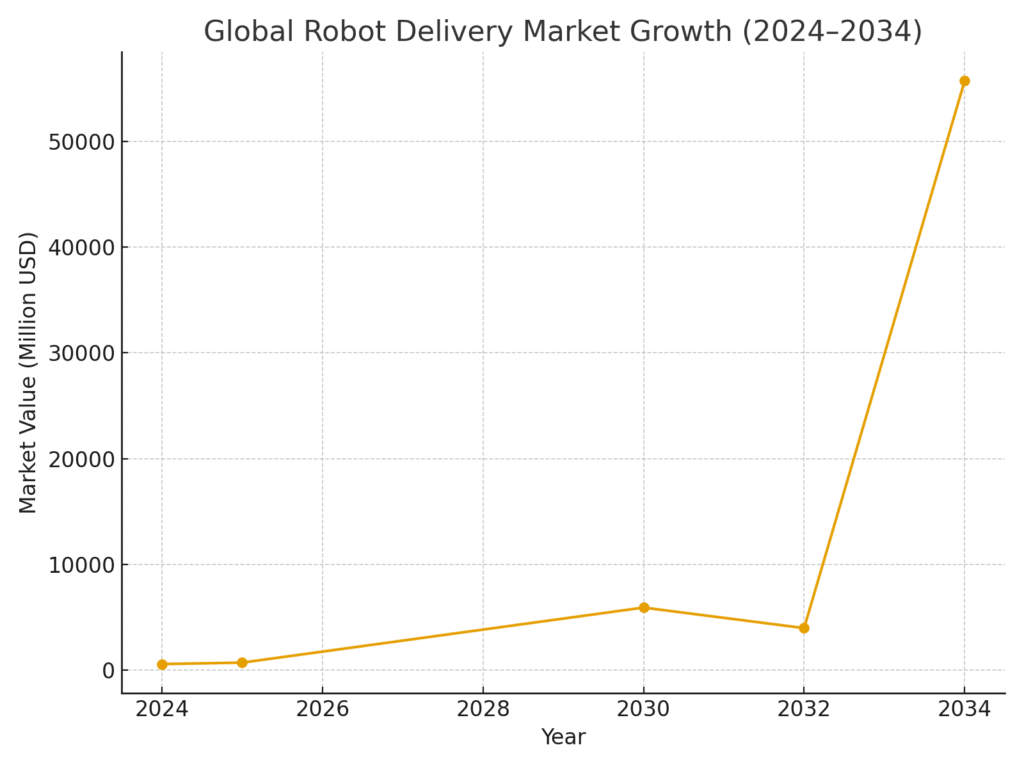
Robot Delivery Marketing Statistics #1: Global Market Value USD 592.8 Million In 2024
The delivery robot market was valued at USD 592.8 million in 2024. Analysts expect the market to expand rapidly due to demand for last-mile efficiency. Businesses are adopting robots to reduce delivery costs and meet consumer expectations for faster service. This growth reflects both technological readiness and consumer willingness to embrace automation. It’s a foundation that demonstrates why robot delivery is not just a trend but a structural shift in logistics.
Robot Delivery Marketing Statistics #2: Projected USD 3.99 Billion By 2032
Forecasts suggest the market will climb to nearly USD 4 billion by 2032. That’s an incredible leap from its current size, showing compounding growth. Marketers need to position their brands alongside this innovation to remain competitive. The acceleration also suggests potential for new players to enter and disrupt. Personally, I see this as a wake-up call for companies not to delay investment in automation strategies.
Robot Delivery Marketing Statistics #3: Estimated USD 728.3 Million In 2025
In 2025 alone, the autonomous delivery robots market is estimated at USD 728.3 million. This shows the immediate growth ahead, not just distant projections. Companies will need to adapt quickly to keep up with operational efficiencies robots bring. This growth will be felt in urban centers where demand is highest. For me, it emphasizes that 2025 is not a starting point but already part of the scaling stage.
Robot Delivery Marketing Statistics #4: Last-Mile Delivery Reaching USD 5.93 Billion By 2030
The autonomous last-mile delivery market, which includes robots, is expected to reach nearly USD 6 billion by 2030. This underscores how robots are crucial for solving delivery bottlenecks. Brands leveraging robots can offer both speed and reduced cost, winning consumer loyalty. The figure highlights how significant logistics innovation is to marketing success. I see this as a direct signal that delivery is now part of brand identity.
Robot Delivery Marketing Statistics #5: Potential USD 55.7 Billion By 2034
Some aggressive estimates show the market hitting USD 55.7 billion by 2034. That number is staggering and reflects optimism around mass adoption. For marketers, this means preparing for robots to become everyday fixtures. It’s also an opportunity to craft campaigns showing eco-friendliness and futuristic appeal. Personally, I find this number thrilling because it pushes the imagination of what’s possible.
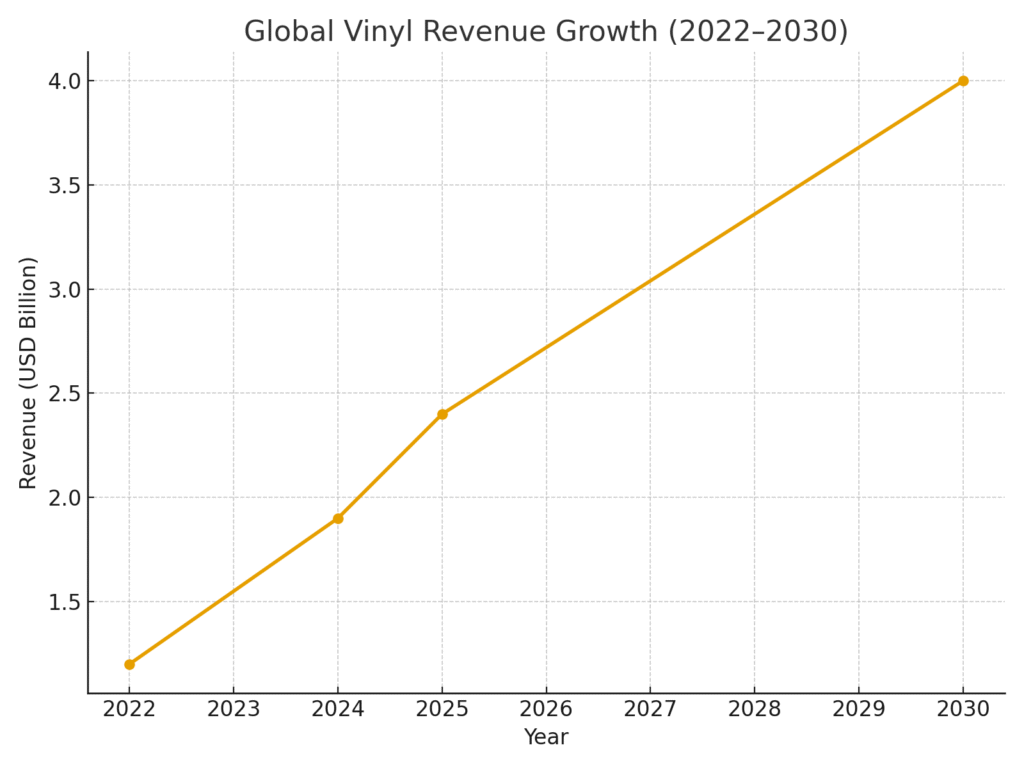
Robot Delivery Marketing Statistics #6: Market Exceeded USD 500 Million In 2022
Back in 2022, the market already exceeded half a billion dollars. That early traction set the stage for today’s momentum. Businesses investing then are now enjoying first-mover advantages. It’s proof that innovation rewards foresight. Looking back, I realize how quickly the industry has matured in only a few years.
Robot Delivery Marketing Statistics #7: Starship Surpassed 8 Million Deliveries
Starship Technologies reported over 8 million autonomous deliveries. This is a practical proof of consumer adoption. Each delivery builds trust and normalizes robots in communities. The scale also shows that robots can operate reliably in real-world conditions. Personally, I think milestones like this make the idea of robotic delivery less futuristic and more everyday.
Robot Delivery Marketing Statistics #8: 4.7 Million Units Forecasted By 2032
By 2032, there could be 4.7 million delivery robots operating globally. This number shows how mainstream robot delivery might become. With millions of units in service, they’ll be as common as food couriers or vans. For brands, it’s a marketing opportunity to showcase partnerships with robotics. I imagine neighborhoods where robots are simply part of the urban rhythm.
Robot Delivery Marketing Statistics #9: Starship Robots Traveled 10 Million Miles
Starship’s fleet has collectively traveled 10 million miles. That’s an astonishing measure of durability and scale. Each mile represents a learning point in machine navigation. Businesses can use this reliability to reassure customers of safety and efficiency. For me, it feels like robots are quietly achieving the equivalent of decades of human courier experience.
Robot Delivery Marketing Statistics #10: Study On 241,517 Consumer Decisions
Alibaba studied 241,517 package-level delivery choices. This shows the depth of consumer data being analyzed to improve services. Robots aren’t just about logistics; they’re tied to behavioral science. Companies can refine offerings by learning why customers choose robots over humans. I find this fascinating because it reveals psychology behind technology adoption.
Robot Delivery Marketing Statistics #11: 61.9% Share Expected For Fully Autonomous Segment
Fully autonomous robots are expected to account for 61.9% of the market by 2025. This demonstrates confidence in robots without human oversight. It also indicates rising technological maturity. For marketing, it’s a chance to highlight independence and precision. I personally see this as the ultimate test of trust between humans and machines.
Robot Delivery Marketing Statistics #12: 10.01–50 Kg Capacity Robots Leading With 51.8% Share
Robots carrying 10–50 kg loads are projected to hold 51.8% of the market. This is the sweet spot for groceries and e-commerce. It shows the technology aligns with everyday needs. Marketers can emphasize convenience for family households. Personally, I think this load range is where robots will feel most relevant in our lives.
Robot Delivery Marketing Statistics #13: Four-Wheeled Robots Expected To Lead With 44.11% Share
Four-wheeled robots are predicted to account for 44.11% of units in 2025. This design offers balance and adaptability. It shows that form factor is critical to adoption. Marketers may highlight safety and stability in campaigns. From my perspective, these small design choices make robots more approachable.
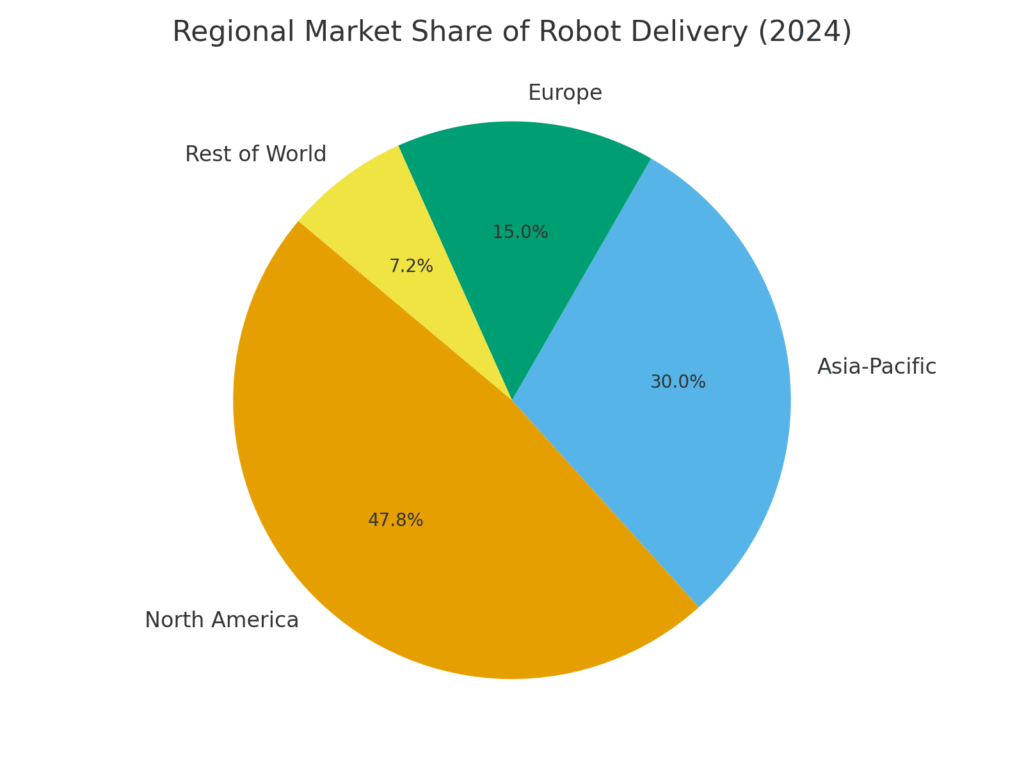
Robot Delivery Marketing Statistics #14: North America Holding 47.8% Market Share In 2024
North America represented 47.8% of market share in 2024. This dominance reflects early adoption and tech-friendly consumers. For brands, it means the U.S. and Canada remain the proving grounds. Campaigns here can set global standards. I view this as an indicator of where innovation stories will first take root.
Robot Delivery Marketing Statistics #15: Asia-Pacific CAGR Of 35.3% Forecasted
Asia-Pacific is forecasted to grow fastest, at 35.3% CAGR. This shows demand is surging across emerging markets. Marketers should craft region-specific strategies. Local adoption patterns may differ from Western trends. I find this exciting because it broadens the future landscape for delivery robots.
Robot Delivery Marketing Statistics #16: North America Accounted For 44% Revenue In Last-Mile Robots
In last-mile delivery, North America took 44% of revenue in 2024. This consolidates its leadership in both technology and market size. Brands working here are likely to influence global adoption. It suggests marketers should pay close attention to case studies from this region. For me, it’s reassuring that the data confirms what we see on the streets.
Robot Delivery Marketing Statistics #17: Food & Beverage Segment At 42% Market Share
Food and beverage represented 42% of robot delivery use in 2024. This category shows where robots have immediate impact. Consumers want speed and freshness, and robots deliver both. Marketers can emphasize “hot, fast, and convenient” messaging. Personally, I think food will remain the gateway for robot adoption.
Robot Delivery Marketing Statistics #18: 11.49% Higher Choice For Privacy-Sensitive Packages
Consumers were 11.49% more likely to choose robot delivery for privacy-sensitive items. This highlights trust in robots to deliver discreetly. Brands can leverage this insight to market privacy and security. It’s a unique advantage over human couriers. Personally, I believe this stat reveals one of the most emotional reasons people will adopt robots.
Robot Delivery Marketing Statistics #19: 0.97% Higher Choice With 1% Increase In Value
A 1% increase in product value increased robot delivery choice by 0.97%. Consumers trust robots with expensive goods. This indicates perception of safety in automation. Marketers should emphasize reliability and protection for valuable items. I find this intriguing because it shows robots are seen as guardians of quality.
Robot Delivery Marketing Statistics #20: 1.63% Preference For Human Delivery In Bad Weather
In adverse weather, consumers were 1.63% more likely to choose humans. This reveals a limitation of robots. For marketers, it’s a reminder to manage expectations. It also signals opportunities for hybrid models. Personally, I like that this stat keeps us grounded—robots are powerful, but not invincible.

Wrapping Up The Future Of Robot Delivery
Looking at these robot delivery marketing statistics, I can’t help but feel a mix of wonder and anticipation. The numbers are more than just data points; they’re a window into how our shopping, eating, and living habits are evolving. Partnering with a leading marketing agency in New York has helped me see that brands who embrace robotics now will be tomorrow’s household names. For me, the most exciting part is imagining how seamless and normalized this will become in our daily lives. As I close this piece, I’m left inspired not just by the technology but by the way it’s reshaping human experiences around convenience, privacy, and trust.
SOURCES
-
https://www.marketsandmarkets.com/Market-Reports/delivery-robot-market-263997316.html
-
https://www.fortunebusinessinsights.com/delivery-robots-market-106955
-
https://www.coherentmarketinsights.com/market-insight/autonomous-delivery-robots-market-5147
-
https://www.insightaceanalytic.com/report/global-autonomous-delivery-robots-market/1476
-
https://www.gminsights.com/industry-analysis/delivery-robot-market
-
https://www.researchandmarkets.com/reports/5139443/delivery-robots-market-global-industry-analysis