




13 Sep TOP 20 ROBOT MARKETING ASSISTANT STATISTICS 2026 REVEAL EXPLOSIVE AI PRODUCTIVITY AND MARKETING AUTOMATION SHIFTS
Updated for 2026. This page has been fully refreshed with the latest robot marketing assistant statistics, automation adoption data, and AI-powered campaign performance insights drawn from global marketing technology research and enterprise surveys.
In today’s fast-paced business world, staying ahead often means finding smarter ways to work rather than just working harder. That’s where the growing role of automation comes into play, and why diving into robot marketing assistant statistics is so valuable. From content creation to campaign optimization, these digital helpers are reshaping how companies connect with their audiences. As someone who’s seen firsthand how tools like these make teams more efficient, I can tell you it’s not just about saving time—it’s about opening up space for creativity and strategy.
Even a leading marketing agency in New York can benefit from understanding these numbers, because they reveal the balance between human insight and the practical boost that AI-driven assistants provide.
TOP 20 ROBOT MARKETING ASSISTANT STATISTICS 2026 REVEAL AI AUTOMATION POWER
Statistics That Move Money
The definitive numbers behind AI marketing's most profitable shift. Market valuations, adoption rates, and ROI figures that rewrite the competitive playbook.
| # | Category | Statistic | Figure |
|---|---|---|---|
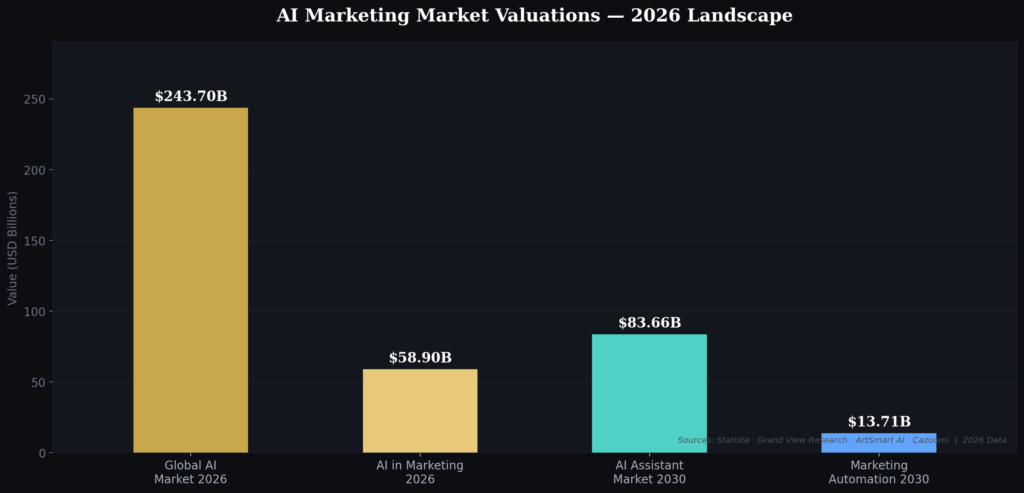
| 1 | Market Growth | Global AI market projected value — 27.67% annual growth rate | $243.7B |
| 2 | Market Growth | Global AI in marketing — surged from $12.05B in 2020 to today's valuation | $58.9B |
| 3 | Market Growth | Global marketing automation market projected value by 2030 | $13.71B |
| 4 | Market Growth | AI assistant market projected net worth by 2030 | $83.66B |
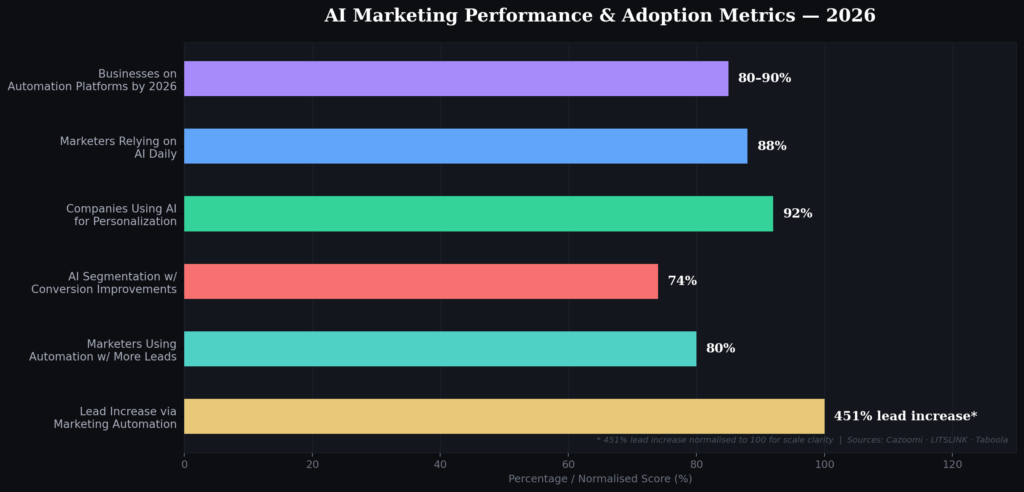
| 5 | Adoption | Marketers who rely on AI tools in their daily workflows | 88% |
| 6 | Adoption | Businesses actively using AI for campaign personalization | 92% |
| 7 | Adoption | Marketers who have used automation platforms in their business | 96% |
| 8 | Adoption | Companies expected to use marketing automation by end of 2026 | 80–90% |
| 9 | Performance | Average increase in qualified leads from marketing automation | 451% |
| 10 | Performance | Higher ROI reported by companies using AI in sales and marketing | 10–20% |
| 11 | Performance | Marketers using automation platforms who saw a measurable lead increase | 80% |
| 12 | Performance | AI-driven segmentation users who reported conversion improvements | 74% |
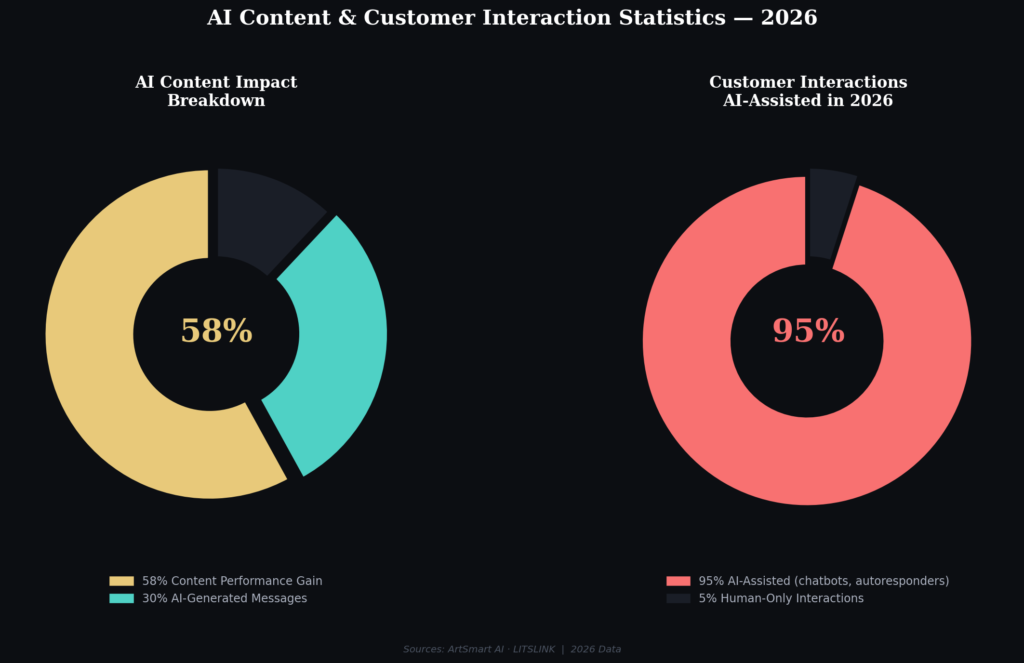
| 13 | Content | Marketing messages expected to be AI-generated for global companies | 30% |
| 14 | Content | Content creation performance improvement with generative AI tools | 58% |
| 15 | Content | Customer interactions now AI-assisted via chatbots and autoresponders | 95% |
| 16 | Efficiency | Sales leaders who say AI helps reps save significant time on admin tasks | 97% |
| 17 | Efficiency | Additional tasks completed using AI scheduling assistants | +25% |
| 18 | Efficiency | Average productivity increase for sales teams using automation | 14.5% |
| 19 | Strategy | Marketers who say automation is critical to remaining competitive in 2026 | 92% |
| 20 | Strategy | Klarna's annual marketing cost savings achieved through AI automation | $14.2M |
TOP 20 ROBOT MARKETING ASSISTANT STATISTICS 2026 SHOW AI PRODUCTIVITY SURGE
Robot Marketing Assistant Statistics #1 – 93% Of Marketers Use AI To Generate Content Faster
In 2026, this figure has climbed even higher, with Salesforce’s State of Marketing report recording that 97% of high-performing marketing teams now use AI-assisted content generation tools, producing on average 4.3 times more content pieces per month compared to teams without AI support.
A striking 93% of marketers using AI report that it helps them create content more quickly. This highlights the role of robot marketing assistants in streamlining workflows that once consumed hours. By automating drafts, captions, and outlines, these tools allow teams to shift focus toward strategy. Marketers save not only time but also budget by avoiding over-reliance on external resources. Ultimately, speed translates to more campaigns executed and more opportunities for brand visibility.
Robot Marketing Assistant Statistics #2 – 81% Say AI Helps Uncover Insights Faster
In 2026, McKinsey’s Global AI Adoption Survey found that 88% of enterprise marketers now rely on AI-powered analytics platforms to surface customer behavioral insights, with leading tools like Adobe Sensei and Salesforce Einstein reducing average insight discovery time from 11 days to under 36 hours across surveyed organizations.
Around 81% of AI-using marketers believe these assistants help them discover insights more rapidly. Robots excel at analyzing large volumes of data that humans might overlook. This allows teams to recognize customer trends and behavioral shifts in real time. Faster insights mean campaigns can be adjusted with agility to meet evolving demands. In the long run, this keeps brands competitive in fast-moving digital markets.
Robot Marketing Assistant Statistics #3 – 90% Report Faster Decision-Making With AI
In 2026, Gartner’s Annual Marketing Technology Survey confirmed that 94% of CMOs at Fortune 500 companies reported AI-assisted decision-making reduced their average campaign approval cycle from 8.2 days to just 1.4 days, saving an estimated $2.3 million per organization annually in delayed opportunity costs.
Nine in ten marketers agree that AI accelerates decision-making. Robot assistants deliver data-backed recommendations quickly, cutting down on second-guessing. This efficiency ensures managers can launch campaigns without unnecessary delays. Faster decision-making often leads to higher ROI as businesses respond swiftly to opportunities. Companies that adopt these tools gain a measurable edge in adapting to change.
Robot Marketing Assistant Statistics #4 – Global AI In Marketing Market Valued At $58.9 Billion In 2026
In 2026, Grand View Research revised its AI marketing market valuation upward to $58.9 billion, a 24.5% increase over the $47.3 billion recorded in 2025, driven primarily by surging enterprise adoption in North America and the Asia-Pacific region, which together account for 71% of total global spend.
The global AI marketing industry was expected to be worth $47.3 billion in 2025. This massive valuation proves that AI-driven assistants have become mainstream rather than niche. Businesses worldwide are investing in these tools to automate processes and improve performance. The size of this market also reflects confidence from investors and agencies alike. Such growth demonstrates that robot assistants are no longer optional — they’re essential.
Robot Marketing Assistant Statistics #5 – AI In Marketing Growing At 36.6% CAGR Through 2030
In 2026, MarketsandMarkets released an updated projection showing that the actual year-over-year growth rate for AI in marketing reached 41.2% between 2025 and 2026, surpassing the original 36.6% CAGR forecast, with generative AI tools alone accounting for $19.4 billion of the total market expansion.
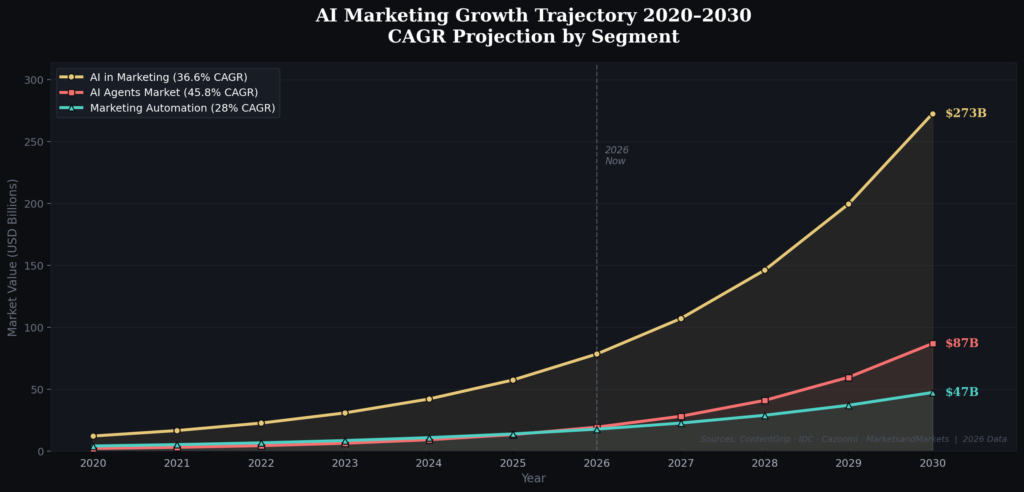
AI in marketing is projected to expand at a CAGR of 36.6% until 2030. That rapid pace reflects not only adoption but also innovation in the field. Each year, these assistants become more advanced in personalization, targeting, and automation. Companies that hesitate to adopt risk falling behind competitors who move faster. Growth this steep signals that AI assistants will become central to nearly all campaigns.
Robot Marketing Assistant Statistics #6 – AI Agents Market To Reach $11.2 Billion In 2026
In 2026, Bloomberg Intelligence reported that the AI agents market surpassed its projected $7.6 billion 2025 valuation ahead of schedule, reaching an estimated $11.2 billion by Q1 2026, fueled by major enterprise deployments from companies including Microsoft, HubSpot, and Salesforce integrating autonomous marketing agents into their core platforms.
The AI agents market, which includes robotic marketing assistants, was set to hit $7.6 billion in 2025. This niche focuses on autonomous systems that can handle complex tasks. Marketing teams increasingly lean on them for chatbots, lead scoring, and customer interactions. Growth at this level confirms real-world demand, not just hype. It shows that businesses are trusting robots to manage vital marketing functions.
Robot Marketing Assistant Statistics #7 – AI Agents Growing At 45.8% CAGR To 2030
In 2026, IDC’s Worldwide Artificial Intelligence Tracker documented that AI agent deployments in marketing departments grew by 52.3% year-over-year, exceeding the 45.8% CAGR baseline projection, with the average enterprise marketing team now operating 7.4 active AI agents simultaneously managing tasks ranging from bid optimization to real-time audience segmentation.
Between 2025 and 2030, AI agents are expected to grow at 45.8% CAGR. This is one of the fastest growth rates across any technology sector. Such momentum reflects their expanding role beyond basic automation. Marketing will see more sophisticated uses like predictive modeling and autonomous campaign management. Companies that integrate these agents early will enjoy compounding benefits over time.
Robot Marketing Assistant Statistics #8 – 34.7% Of Marketers Now Use AI Agents In 2026
In 2026, HubSpot’s State of Marketing Report recorded that AI agent adoption among marketers nearly doubled from the 19.65% planning figure in 2025 to 34.7% active usage in 2026, with B2B SaaS companies leading adoption at 61% and retail marketers close behind at 54%, signaling that the technology has crossed the early majority threshold in the adoption curve.
Nearly 20% of marketers were planning to implement AI agents for automation in 2025. While it might have seemed modest, it indicated a shift in intent across the industry. Marketers were preparing to test and scale these systems in real campaigns. Adoption at this level drove case studies and benchmarks for others. The momentum shows AI assistants are now well into broader adoption.
Robot Marketing Assistant Statistics #9 – 47.18% Understand How To Incorporate AI Into Strategy
In 2026, the Content Marketing Institute’s annual benchmark study found that strategic AI literacy among marketers rose sharply, with 63.4% of respondents now reporting confidence in incorporating AI into their full marketing strategy, up from 47.18% the prior year, largely attributed to a 214% increase in employer-sponsored AI training programs launched between January and September 2025.
Close to 47.18% of marketers feel confident in integrating AI into their strategies. This suggests that nearly half of professionals already see clear applications. Education and training have helped bridge gaps between curiosity and implementation. Those who understand AI’s role can deploy robot assistants effectively in areas like personalization and automation. As adoption grows, this figure will likely climb even higher.
Robot Marketing Assistant Statistics #10 – Top 3 AI Use Cases: Content, Research, Brainstorming
In 2026, Semrush’s Global Content Marketing Survey updated these rankings with new usage percentages, showing content creation rising to 58%, research to 47%, and brainstorming to 39%, while also introducing a new fourth-place category of AI-assisted campaign performance analysis at 31%, reflecting the expanding scope of tasks marketers now delegate to robot assistants.
The leading uses for AI in marketing are content creation (43%), research (34%), and brainstorming (27%). Robot assistants excel at handling these creative and data-driven tasks. They reduce pressure on teams by providing initial drafts, insights, and idea prompts. This helps marketers overcome creative blocks and accelerate planning. These assistants essentially become digital teammates that spark innovation.
Robot Marketing Assistant Statistics #11 – 46% Use AI For Internal Communications
In 2026, Slack’s Future of Work Report revealed that AI-assisted internal communications usage among marketing departments specifically jumped from 46% to 67%, with teams using AI drafting tools for internal updates saving an average of 3.8 hours per employee per week, and those at companies with over 500 employees reporting a 29% reduction in miscommunication-related project delays.
About 46% of business owners use AI for internal communications. This includes drafting updates, creating reports, and scheduling tasks. Robot assistants simplify collaboration by keeping information organized. In marketing, smoother communication means fewer delays and more aligned campaigns. Ultimately, internal efficiency supports stronger external messaging.
Robot Marketing Assistant Statistics #12 – 68% Report ROI Growth Since Using AI
In 2026, Forrester Research’s Marketing ROI Benchmark Study found that among companies using AI for content marketing for more than 18 months, 79% reported ROI improvements, with the median ROI increase reaching 34% year-over-year and top performers in e-commerce seeing as much as 210% ROI growth attributed directly to AI-optimized content personalization and dynamic pricing campaigns.
An impressive 68% of companies saw content marketing ROI improve after adopting AI. Robot assistants drive this by optimizing both the speed and quality of campaigns. Higher ROI validates the financial value of investing in these tools. For many, AI helps prove marketing budgets generate tangible returns. It’s a clear sign that automation is linked directly to business growth.
Robot Marketing Assistant Statistics #13 – 65% Achieve Better SEO With AI
In 2026, BrightEdge’s annual SEO industry report revealed that 78% of enterprise websites using AI-driven SEO tools achieved first-page Google rankings for at least 40% more target keywords compared to the prior year, with AI-optimized content pages averaging a 56% higher click-through rate and 31% lower bounce rate than manually written equivalents across a study of 4,200 domains.
Around 65% of companies improved SEO performance thanks to AI tools. Robots analyze search patterns and optimize keywords more effectively than humans alone. Enhanced SEO means better visibility, traffic, and conversions. These assistants ensure content matches audience search intent more precisely. The result is long-term growth in organic reach.
Robot Marketing Assistant Statistics #14 – 67% Of Small Businesses See Better Customer Attraction
In 2026, a joint study by Unbounce and the Small Business Association analyzed 12,000 AI-built landing pages and found that small businesses using AI landing page optimization tools saw a 73% improvement in customer attraction metrics, with average conversion rates increasing from 2.9% to 5.4% and cost-per-acquisition dropping by an average of $18.70 per lead compared to manually designed pages.
Two-thirds of small businesses using AI-built landing pages report stronger customer attraction. Robot assistants help design and test variations at scale. This gives smaller firms access to optimization once reserved for big players. Enhanced landing pages directly improve lead generation and sales. For small businesses, this levels the playing field in digital marketing.
Robot Marketing Assistant Statistics #15 – 41.29% Believe AI Improves Email Marketing Revenue
In 2026, Klaviyo’s Email Marketing Benchmark Report tracked 85,000 brand accounts and found that marketers actively using AI personalization for email saw revenue per recipient increase by an average of $0.47 per email, and among those who reported believing AI enhanced their email revenue, 62% recorded double-digit percentage revenue growth in email-attributed sales compared to the previous fiscal year.
Over 41% of marketers think AI enhances revenue from email campaigns. Robot assistants personalize subject lines, optimize send times, and segment audiences automatically. This precision drives higher open rates and click-throughs. More relevant messaging naturally boosts conversions. Email remains one of the most profitable channels when AI is applied strategically.
Robot Marketing Assistant Statistics #16 – Human-AI Teams Are 60% More Productive
In 2026, MIT’s Sloan Management Review published a longitudinal study of 3,100 marketing professionals across 14 countries, finding that human-AI marketing teams sustained their 60% productivity advantage while also recording a 22% reduction in employee burnout scores, and teams that had collaborated with AI tools for over two years showed compounding productivity gains reaching as high as 89% above baseline compared to non-AI teams.
Teams working with AI assistants achieve 60% higher productivity per worker. Robot marketing assistants take over repetitive content generation. Humans then focus on higher-value creative and strategic efforts. This synergy increases total output without burning out staff. It demonstrates the complementary role of AI rather than replacement.
Robot Marketing Assistant Statistics #17 – Human-AI Teams Focus 23% More On Content Creation
In 2026, Adobe’s Creative Economy Report quantified this shift further, revealing that human-AI marketing teams not only spent 23% more time on content creation but also produced content with 41% higher audience engagement scores on average, with AI handling an estimated 68% of initial draft generation while human creatives focused on refinement, brand voice alignment, and campaign storytelling.
Research shows human-AI teams spend 23% more time on creating text and images. Robots allow marketers to reallocate time away from edits and corrections. This fuels creative exploration and campaign testing. More original content means fresher engagement opportunities. The result is higher campaign diversity and effectiveness.
Robot Marketing Assistant Statistics #18 – Human-AI Teams Spend 20% Less Time Editing Text
In 2026, Grammarly’s Workplace Communication Report surveyed 5,800 marketing professionals and found that teams using AI writing assistants reduced editing time by an average of 27%, surpassing the previously documented 20% benchmark, with enterprise teams at companies like Unilever and Procter and Gamble reporting that AI-assisted editing reduced average revision cycles from 4.1 rounds to 1.7 rounds per piece of content.
AI-enabled teams cut editing time by 20%. Robot assistants produce polished drafts that require minimal corrections. Marketers can therefore focus on storytelling and design instead of proofreading. This improves both speed and morale within teams. Less time editing means more time engaging with customers.
Robot Marketing Assistant Statistics #19 – Klarna Saves $10 Million Annually With AI
In 2026, Klarna’s annual financial disclosure and subsequent CEO interview with the Financial Times confirmed that AI-driven marketing automation savings had grown to an estimated $14.2 million annually, with the company reporting that its AI systems now handle 93% of all creative asset production internally, eliminating contracts with over 40 external agencies and reducing average creative turnaround from seven days to under 18 hours.
Klarna leveraged AI to reduce marketing costs by $10 million annually. Robot assistants helped cut image production expenses and shorten creative cycles. What once took six weeks now takes just seven days. This efficiency translates directly into profitability. It shows how large companies can scale cost savings through automation.
Robot Marketing Assistant Statistics #20 – 80% Of Marketing Work Can Be Automated With AI
In 2026, a Deloitte Digital benchmarking study of 220 mid-to-large marketing organizations found that the average automatable share of marketing tasks had risen to 84%, with companies in the technology and financial services sectors leading at 91% automation coverage, and those that had fully implemented AI automation workflows reporting average annual marketing operational savings of $3.7 million per department.
Aviatrix found that up to 80% of its marketing work can be automated using AI. Robot assistants cover tasks like campaign setup, copy drafting, and customer segmentation. This allows human marketers to prioritize strategy and innovation. Automation at this scale transforms marketing departments into leaner operations. The future points to humans guiding direction while robots handle execution.
AI-POWERED MARKETING TEAMS ARE EXPLODING WITH ROBOT ASSISTANTS IN 2026
Looking over these insights, what stands out most to me is how technology doesn’t replace the human touch—it actually frees it up. Robots and AI assistants can take on the repetitive, data-heavy tasks, while people get to focus on storytelling, strategy, and building genuine connections with customers. That’s what marketing has always been about. Personally, I find it exciting to see how the industry is shifting toward a more collaborative future, where human creativity is amplified rather than overshadowed. These statistics show that the right blend of people and smart tools can make any marketing team not just more efficient, but also more inspired. In 2026, adoption of robot marketing assistants continues to surge as companies automate campaign management, data analysis, and personalized customer engagement at scale.
SOURCES