




25 Sep TOP 20 ROBOTICS MARKETING STATISTICS 2025
As I’ve been diving deeper into the world of robotics and its growing impact across industries, I couldn’t help but notice just how quickly the numbers are shifting. These robotics marketing statistics aren’t just abstract figures—they’re real indicators of how technology is reshaping businesses, customer experiences, and even the way we think about the future of work. From cobots on factory floors to service robots enhancing retail sales, the landscape is evolving faster than ever before. As someone passionate about staying ahead of these trends, I turned to insights from a leading marketing agency in New York to better understand how companies can position themselves in this high-growth sector. I’m excited to share these stats with you, not as a sterile list, but as tools we can all use to shape smarter marketing strategies around robotics.
Top 20 Robotics Marketing Statistics 2025 (Editor’s Choice)
| # | Robotics Marketing Statistic | Value / Insight |
|---|---|---|
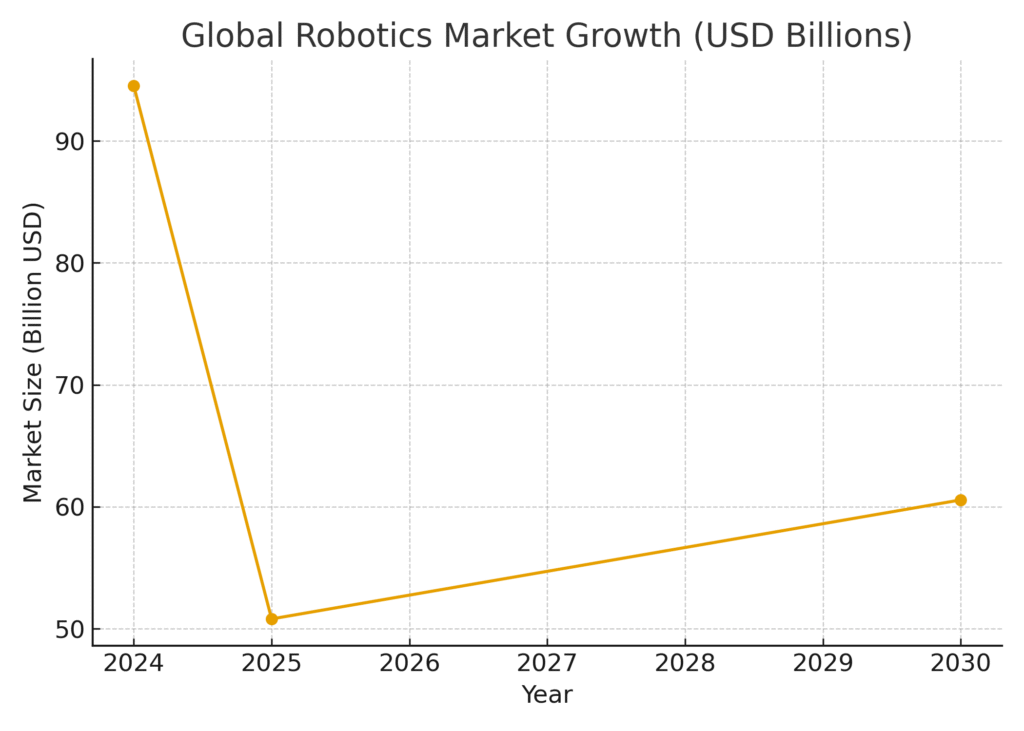
| 1 | Global robotics market size in 2025 | US$50.8 billion |
| 2 | Revenue share from mobile robots | 50–60% of market revenue |
| 3 | Projected CAGR (2024–2030) | ~13.8–14% |
| 4 | Cobot market CAGR | ~27.5%, reaching US$7B by 2030 |
| 5 | Industrial robots operational worldwide (2023) | 4,281,585 units |
| 6 | Robot installations by region (2023) | 70% Asia, 17% Europe, 10% Americas |
| 7 | Industrial robotics market size (2024) | US$33.96B, projected US$60.56B by 2030 |
| 8 | Top application in industrial robotics | Handling – 42% market share |
| 9 | Retail robotics market value (2024) | US$18.4 billion |
| 10 | Global robotics market size (2024) | US$94.54 billion, +14.7% YoY |
| 11 | Asia Pacific revenue share (2023) | 46% of global robotics revenue |
| 12 | U.S. robotics revenue (2024) | US$9.4 billion |
| 13 | Average cost: service vs. industrial robot | US$11,510 vs. US$21,350 |
| 14 | Medical robotics market size (2024) | US$11.19 billion |
| 15 | Forecast medical robotics market (2028) | US$20.99 billion |
| 16 | Retail experiment with service robot | Showed dramatic sales increase |
| 17 | Robot density in China | 470 robots per 10,000 workers |
| 18 | Robot density in South Korea | 1,012 robots per 10,000 workers |
| 19 | Funding raised by robotics companies (Q1 2025) | US$2.26 billion |
| 20 | Cobots share of industrial robot installs (2023) | 11%, ~US$3B annual sales |
Top 20 Robotics Marketing Statistics 2025
Robotics Marketing Statistics #1: Global Robotics Market Size In 2025 Reaches $50.8 Billion
The robotics market is on a trajectory to hit $50.8 billion by 2025, reflecting the rapid expansion of automation technologies worldwide. This growth is fueled by rising demand across industries such as manufacturing, healthcare, and logistics. Businesses are increasingly relying on robotics to reduce costs and improve efficiency, making the sector attractive to investors. For marketers, this surge highlights a lucrative opportunity to tailor campaigns toward companies adopting robotics solutions. The sheer scale of this figure proves robotics is no longer futuristic—it’s a present-day industry with immense marketing potential.
Robotics Marketing Statistics #2: Mobile Robots Account For 50–60% Of Revenue
Mobile robots are driving the robotics sector, contributing to more than half of total market revenue. They are widely adopted in warehouses, logistics centers, and even in hospitals, where mobility and adaptability are crucial. The popularity of these robots lies in their ability to perform repetitive tasks, reducing human labor in challenging environments. For marketers, highlighting the versatility of mobile robotics can resonate with businesses focused on efficiency and scalability. This revenue share shows that mobility is not just a feature—it’s the backbone of robotics growth.
Robotics Marketing Statistics #3: Projected CAGR Of 13.8–14% (2024–2030)
The robotics market is projected to grow at a CAGR of roughly 13.8–14% between 2024 and 2030. Such sustained double-digit growth indicates that robotics will remain one of the fastest-expanding technology industries globally. This projection is fueled by advancements in AI, automation, and cloud robotics that are improving robot efficiency. For marketers, it signals a stable and growing audience of robotics companies and adopters who will need targeted solutions. The CAGR also proves that robotics is not a temporary trend but a long-term revolution.
Robotics Marketing Statistics #4: Cobot Market CAGR Of 27.5%, Hitting $7 Billion By 2030
Collaborative robots (cobots) are projected to grow at a CAGR of 27.5%, reaching $7 billion by 2030. Unlike traditional industrial robots, cobots are designed to safely work alongside humans, opening new opportunities in smaller businesses and diverse industries. Their rapid adoption reflects a shift toward human-robot collaboration instead of replacement. For marketers, promoting the cost-efficiency and flexibility of cobots can attract small and mid-sized enterprises. This steep growth rate makes cobots one of the most promising robotics segments.
Robotics Marketing Statistics #5: 4,281,585 Industrial Robots Operational Worldwide In 2023
As of 2023, over 4.28 million industrial robots are working in factories worldwide. This number represents a historic high and demonstrates the increasing reliance on automation in global manufacturing. Robots are improving productivity, reducing error rates, and helping businesses scale faster than ever. For marketers, this figure emphasizes the need to target industries heavily investing in automation. The growing installed base of robots shows the market’s maturity and the ongoing appetite for robotics solutions.
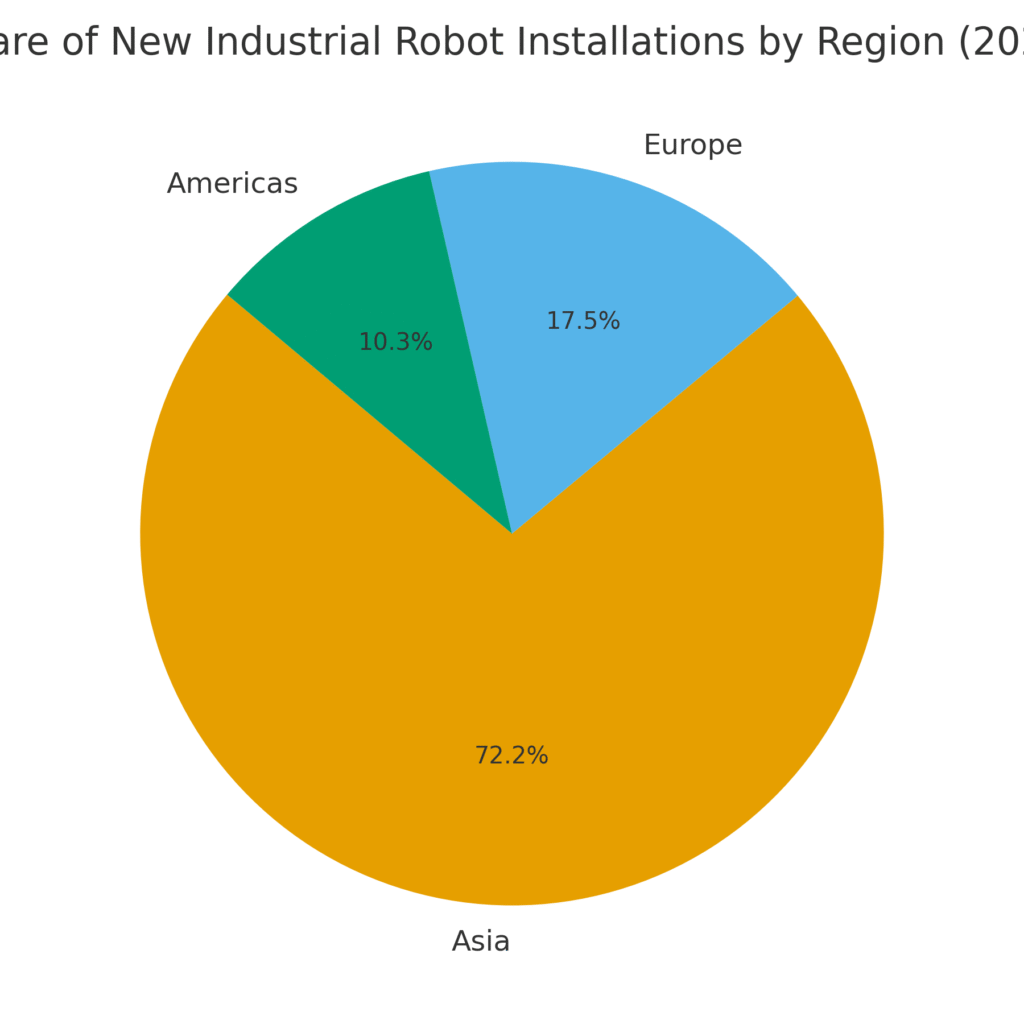
Robotics Marketing Statistics #6: 70% Of Robot Installations In Asia (2023)
In 2023, Asia accounted for 70% of new industrial robot installations, showing its dominance in robotics adoption. Countries like China, Japan, and South Korea lead the way, integrating automation at unprecedented levels. Europe followed with 17%, while the Americas represented only 10% of installations. For marketers, this stat highlights Asia as a critical focus region for robotics campaigns and outreach. It proves that the future of robotics is heavily influenced by Asian innovation and demand.
Robotics Marketing Statistics #7: Industrial Robotics Market Valued At $33.96 Billion In 2024
The industrial robotics market was valued at $33.96 billion in 2024 and is projected to reach $60.56 billion by 2030. This growth reflects the expansion of advanced robotics in areas like automotive, electronics, and metal industries. As more manufacturers embrace automation, the market continues to accelerate in scale and profitability. Marketers should note that industrial robotics remains a cornerstone of automation investments. This statistic demonstrates the staying power and profitability of industrial robotics.
Robotics Marketing Statistics #8: Handling Applications Represent 42% Of Revenue
Handling applications, such as pick-and-place and material movement, account for 42% of industrial robotics revenue. These tasks are essential for production efficiency, making robots indispensable in factories and warehouses. Handling robots reduce human strain, improve precision, and streamline operations in fast-paced industries. For marketers, showcasing case studies around handling robots can resonate with clients who value operational efficiency. This dominance underscores the practical, everyday utility of robotics in industry.
Robotics Marketing Statistics #9: Retail Robotics Market Valued At $18.4 Billion In 2024
Retail robotics reached a valuation of $18.4 billion in 2024, showing the growing role of automation in consumer-facing industries. From shelf-scanning robots to automated checkout solutions, retail is embracing robotics for customer service and efficiency. This trend represents a fusion of technology and consumer experience that marketers can leverage. Companies deploying retail robots can emphasize innovation and customer convenience in their branding. The figure proves that robotics is no longer just industrial—it’s also consumer-centric.
Robotics Marketing Statistics #10: Global Robotics Market Worth $94.54 Billion In 2024
In 2024, the global robotics market grew to $94.54 billion, marking a 14.7% increase compared to the previous year. This impressive leap illustrates how robotics continues to accelerate across industries. Businesses are investing in robotics to stay competitive in a rapidly evolving marketplace. For marketers, such growth presents a prime opportunity to connect with stakeholders eager for automation insights. This statistic highlights the urgency for businesses to embrace robotics as mainstream technology.
Robotics Marketing Statistics #11: Asia Pacific Generates 46% Of Global Revenue (2023)
Asia Pacific generated 46% of global robotics revenue in 2023, solidifying its role as the largest market. With strong investments in manufacturing and logistics, the region continues to lead global robotics innovation. China, in particular, has emerged as a frontrunner with aggressive adoption and government support. For marketers, targeting Asian markets opens access to nearly half of the industry’s revenue potential. This statistic underscores the importance of regional focus in global campaigns.
Robotics Marketing Statistics #12: U.S. Robotics Revenue Reaches $9.4 Billion In 2024
The U.S. robotics industry generated $9.4 billion in revenue in 2024, securing its place as a top national market. Investments are concentrated in manufacturing, healthcare, and defense robotics. American companies are also major innovators in AI-powered robotics, further fueling this growth. For marketers, U.S. businesses represent a premium audience for advanced automation solutions. This revenue level signals both maturity and continued growth potential in the American robotics market.
Robotics Marketing Statistics #13: Service Robots Average $11,510 Vs. $21,350 For Industrial Robots
The average cost of a service robot is $11,510, while industrial robots average $21,350. This pricing difference reflects the specialized capabilities and durability required in industrial applications. Service robots are increasingly affordable, allowing small businesses to integrate them into daily operations. For marketers, the affordability of service robots can be a strong selling point. This stat illustrates how cost accessibility is driving broader adoption.
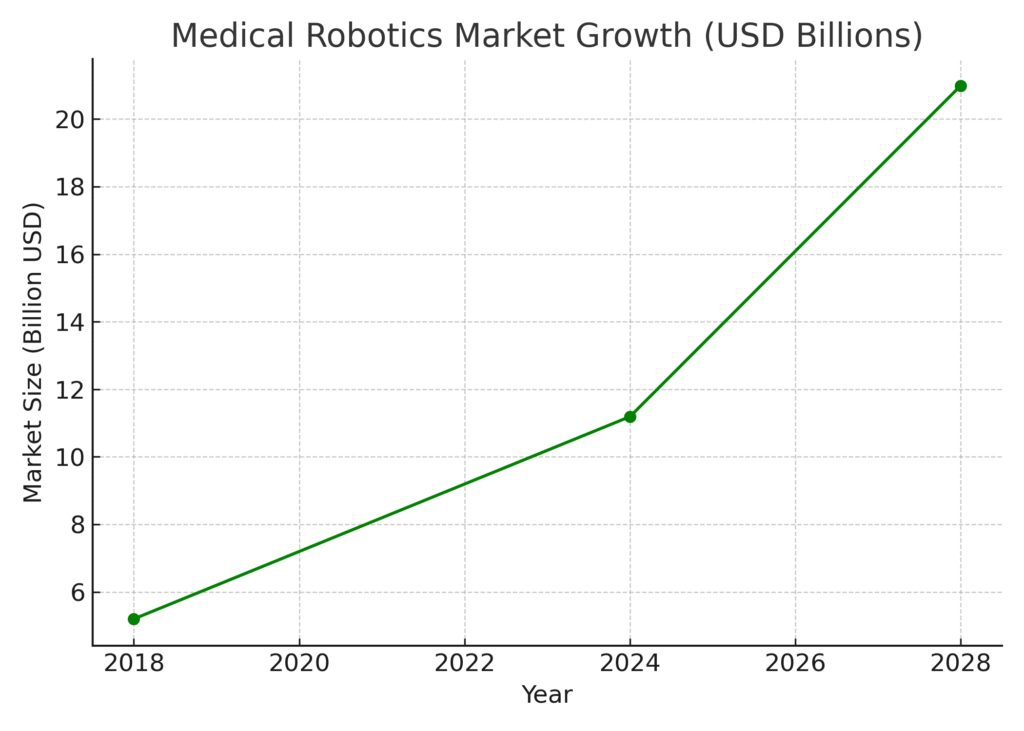
Robotics Marketing Statistics #14: Medical Robotics Market Valued At $11.19 Billion In 2024
Medical robotics reached a value of $11.19 billion in 2024, more than doubling its 2018 size. The segment includes surgical robots, rehabilitation robots, and assistive devices. Healthcare providers are turning to robotics for precision, safety, and efficiency in patient care. Marketers can use this growth to emphasize innovation in healthcare marketing strategies. This figure reflects a sector where technology directly improves lives.
Robotics Marketing Statistics #15: Medical Robotics Market Forecasted At $20.99 Billion By 2028
By 2028, the medical robotics market is projected to hit $20.99 billion, nearly doubling from 2024. This growth is driven by advancements in surgical systems, AI integration, and increasing demand for minimally invasive procedures. For healthcare marketers, this statistic points to a huge opportunity to position robotics as a patient-care enhancer. Investors are also closely watching this market for its high-growth potential. The forecast shows healthcare robotics is one of the most resilient technology segments.

Robotics Marketing Statistics #16: Service Robot Deployment Boosts Retail Sales
A study showed that service robots in retail environments significantly increased sales during deployment days. These robots engaged with customers, provided product recommendations, and enhanced shopping experiences. The results prove that robotics can have direct commercial benefits, not just operational ones. For marketers, this stat is a compelling case for promoting robotics as a customer engagement tool. It highlights the power of human-robot interaction in boosting revenue.
Robotics Marketing Statistics #17: China’s Robot Density Reaches 470 Per 10,000 Workers
China’s robot density reached 470 robots per 10,000 workers, surpassing Germany’s levels. This achievement highlights China’s aggressive adoption of automation technologies. The country’s manufacturing sector is rapidly transitioning into a global robotics powerhouse. For marketers, this proves that China is not just a consumer market but also a global leader in adoption. This density makes China a prime focus for B2B robotics campaigns.
Robotics Marketing Statistics #18: South Korea Leads With 1,012 Robots Per 10,000 Workers
South Korea remains the world leader in robot density, with 1,012 robots per 10,000 employees. This staggering figure reflects the nation’s commitment to automation and innovation. It positions South Korea as a testbed for next-generation robotics applications. For marketers, this market represents a unique opportunity to highlight success stories of robotics dominance. The statistic emphasizes how deeply embedded robotics is in South Korean industries.
Robotics Marketing Statistics #19: Robotics Companies Raised $2.26 Billion In Q1 2025
In the first quarter of 2025, robotics companies raised $2.26 billion in funding. Over 70% of this went to firms developing task-specific robots, rather than general humanoids. Investors are clearly prioritizing efficiency and practical use cases over hype. For marketers, this is a sign to focus campaigns on real-world, problem-solving robotics. This stat shows where money is flowing—and where marketing should follow.
Robotics Marketing Statistics #20: Cobots Represent 11% Of Industrial Installs In 2023
Cobots represented 11% of all industrial robot installations in 2023, generating nearly $3 billion in annual sales. Their growth rate exceeds traditional robots, reflecting their adaptability and safety. Businesses of all sizes are finding cobots useful for collaborative tasks. For marketers, this shows that cobots should be positioned as accessible solutions, not just high-end machinery. This stat proves cobots are steadily moving from niche to mainstream.
Why Robotics Marketing Insights Matter
Looking over these robotics marketing statistics, I feel more convinced than ever that this industry isn’t just about machines—it’s about opportunity. The trends tell a story of innovation, investment, and real customer engagement that marketers like us can’t afford to ignore. Personally, I see these figures as a reminder to stay curious and adaptable, whether that means rethinking campaigns for automation-driven sectors or finding ways to highlight human-robot collaboration in messaging. My biggest takeaway? Robotics isn’t just a technical revolution—it’s a marketing one too, and those who embrace it early will be miles ahead of the competition.
SOURCES
-
- https://www.abiresearch.com/blog/global-robotics-market-outlook
- https://thunderbit.com/blog/automation-statistics-industry-data-insights
- https://www.automate.org/robotics/market-trends/market-trends-in-robotics
- https://blog.bccresearch.com/robotics-market-insights-drones-pharmacy-global-trends
- https://firstpagesage.com/seo-blog/the-top-robotics-marketing-agencies/
- https://patentpc.com/blog/ai-powered-robots-market-growth-use-case-stats
- https://www.automate.org/robotics/market-trends/
- https://www.automate.org/robotics/market-trends/market-trends-in-robotics
- https://flobotics.io/blog/rpa-statistics/
- https://innowise.com/blog/rpa-market-trends/
- https://qviro.com/blog/manufacturing-trends-us/
- https://www.roboticmarketer.com/blog/
- https://patentpc.com/blog/ai-powered-robots-market-growth-use-case-stats
- https://blog.bccresearch.com/robotics-market-insights-drones-pharmacy-global-trends
- https://www.automate.org/robotics/market-trends/market-trends-in-robotics